NARESH GORANTLA, M.Pharm.., (Ph.D)
Asso Professor
Dept Of Pharmaceutics
Balaji College Of Pharmacy,anantapur.
DEFINITIONS:
 HAZARD: A substance that causes an injury in a given
environment or situation.
 INDUSTRIAL HAZARD: Any condition produced by
industries that may cause injury or death to personnel or
loss of product or property.
 SAFETY: Freedom from the occurrence of risk or injury
or loss.
 INDUSTRIAL SAFETY: Protection of workers from the
danger of industrial accidents.
 Toxic and corrosive chemicals, fire, explosions and
personnel falling-causes of accidents.
Types of Hazards:
 Electrical hazards
 Chemical hazards
 Gas hazards
 Dust explosion
 Fire and Explosion hazards.
 Human failure:
 Operating without clearance, failure to
respond warning
 Working at an unsafe speed
 Using equipment unsafely
 Making safety devices un-operative
 Unsafe loading, placing, mixing
 Distracting, teasing, abusing
 Machine failure:
 Inadequately guarded, height, strength
etc.
 Unsafely designed machines, tools etc.
 Defective, rough, sharp, slippery, decayed
machines
 Unsafely arranged, congestion, blocked
exits.
 Unsafely clothed, no goggles, glares or
masks, high heels etc.
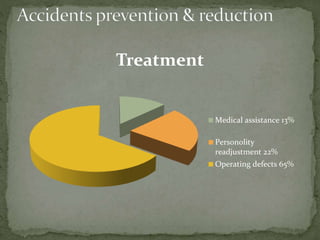
Treatment
Medical assistance 13%
Personolity
readjustment 22%
Operating defects 65%
 Types of accidents:
 Major-results in death or prolonged disability.
 Minor-scratch or a cut which doesn’t seriously
disable the worker.
Advantages of safety management:
1.Cost saving: Direct costs-compensation
medical expenses
Indirect costs-3 to 4 times higher includes
Loss due to downtime operations, slowed-up
production rate, spoiled materials, labour
time, charges for cleaning and damage of
equipment.
2.Increased productivity: employees
can devote more time in improving
the quality and quantity of output.
3.Moral:boosts morality of the worker
and his family.
4.Legal: laws covering occupational
health and safety and the penalties for
non compliance are severe.
 Head and Eyes: goggles, helmets,
masks and hats.
 Hands, arms, legs and feet: rubber or
canvas gloves, rubber boots, aprons,
shoes and other clothing.
 Prevention of breathing of
poisonous gases: respiration
protective devices.
 Safety programme deals with the prevention of
accidents and minimizing the resulting loss or
damage to persons and property.
 Principles of safety programme:
 To identify potential hazards, provide safety
equipment and facilities for taking prompt
action.
 To develop safety policies that continuously
monitor safety performance and ensure that
corrective action is taken when necessary.
 To make supervision fully accountable for safety
performance in the working areas.
 To train in safe methods of working and provide
education and guidance on prevention of hazards.
ELEMENTS OF SAFETY PROGRAMME:
Strategic choice
Safety policy
Organization for safety
Extent and remedies for accidents
Training in safety
Safety programme evaluation
Strategic choice: To make decisions
regarding safety of workers.
As a marketing tool.
Safety policy: must contain a
declaration of 4 fundamental points-
i. Safety of employees and the public is paramount
importance.
ii. Safety will take precedence over expediency.
iii. In the development and implementation of
safety procedures every effort will be made to
involve all managers, supervisors and employees.
iv. Safety legislation will be complied in letter and
the spirit of the law.
Organization for safety:
Constitution of an organization- Safety
committee.
composed of employees.
serves as advisory capacities
responsible for – reviewing safety procedures.
-making recommendations for
eliminating heath
hazards.
-investigating accidents
-fielding safety related
complaints from employees.
 Extent and remedies for accidents:
Based on the causes the supervisor should
apply the art of supervision to control worker’s
performance to prevent accident.
Human failure and machine failure.
 Training in safety:
 Systematic training of employees
 Safety measures should be kept in mind while
planning a layout and construction.
 Workers must be provided with safety tools.
 Safety posters with slogans at work places.
 National safety council.
 Safety programme evaluation:
 Qualitatively: changes in the behavior and attitudes
of the employees, changes in the injury producing
conditions.
 Quantitatively: incident ratio, severity ratio and
frequency ratio.
 Reasons like:
 Wrong raw materials
 Raw materials containing trace
impurities
 Changed operating conditions
 Unanticipated time delays
 Equipment failure
 Wrong materials of construction
 From irritation to death
 Severe burns by destroying living tissues-
dehydration, digestion, oxidation
 Eyes, nervous system, nose, mouth and
throat, pulmonary system, CVS, Breast,
digestive system, genitourinary system, skin
 Dermatitis reactions to synthetic drug-
Acridines and phenothiazine
compounds
 While grinding vegetable drugs dust
evolved causes irritation- capsicum,
phopdophyllum
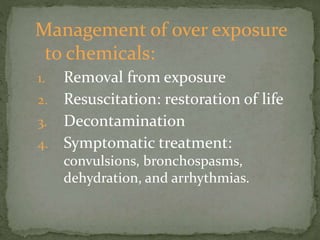
Management of over exposure
to chemicals:
1. Removal from exposure
2. Resuscitation: restoration of life
3. Decontamination
4. Symptomatic treatment:
convulsions, bronchospasms,
dehydration, and arrhythmias.
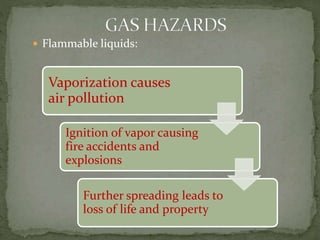
 Flammable liquids:
Vaporization causes
air pollution
Ignition of vapor causing
fire accidents and
explosions
Further spreading leads to
loss of life and property
Location, storage and handling:
The properties of liquids are
considered to design suitable methods for
storage and handling
1. Flash point
2. Apparent ignition temperature
3. Explosive range
4. Vapour density
 Stored in isolated places.
 Using tanks constructed above
ground and open place
 Methods of handling include
pumping, gravity flow and
compressed air.
 Compressed gases: filled in cylinders and
transported to the place of use and the precautions
are:
 Cylinders should not be dropped or striked.
 Safety devices should not be dropped.
 Valves should be of high quality.
 Protected against weather changes especially
excessive temperature.
 Cylinders should bear a standard label
indicating the kind of gas- inflammable,
corrosive, or inert.
 Full cylinders should be separated from empty
cylinders.
 The term Dust is used if the Max particle size of the
solids is 500 mm in the mixture.
 During grinding operations, stone or iron pieces
results in sparks finally leads to explosion of
combustible materials.
 Dust of starch, dextrin and some organic materials
are dangerous.
 Mixture of combustible dust burns or oxidizes in
presence of air.
 Upper and lower limits of air and dust are given for
the explosion to takes place.
 Avoiding the development of explosive
mixtures
 Replacing the atmospheric oxygen by inert
gas, working in a vacuum or using inert
dust- rock salt and sod sulphate
 Preventing the occurrence of effective
ignition source- welding, smoking, cutting,
mechanically generated sparks
Can be controlled at the source of
generation and the methods include
1. Filtration
2. Inertial separation
3. Electrostatic precipitation
What is the source?
 Spontaneous combustion
 Non-explosion proof electrical equipment
Fire occurs in industry most frequently than
explosion, toxic release, but the loss in
terms of life are less…
 Building construction
 Exit points
 Fire alarm equipment
 Fire Extinguishers
 Sprinkler systems
 Hydrants
 Safety and Fire protection organization
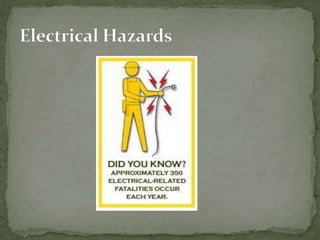
There are three direct and two indirect types of electrical
injuries:
 Direct:
Death due to electrical shock
Electrical shock
Burns
 Indirect:
Falls
Fire
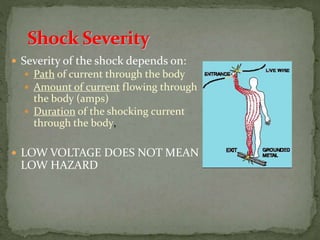
 Severity of the shock depends on:
 Path of current through the body
 Amount of current flowing through
the body (amps)
 Duration of the shocking current
through the body,
 LOW VOLTAGE DOES NOT MEAN
LOW HAZARD
Because failing to take the necessary precautions
can lead to:
 injury or death
 fire or property damage
Electrical hazards exist in almost every
workplace. Common causes of electrocution are:
 making contact with overhead wires
 undertaking maintenance on live equipment
 working with damaged electrical equipment,
such as extension leads, plugs and sockets
 using equipment affected by rain or water
ingress
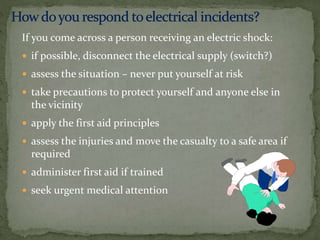
If you come across a person receiving an electric shock:
 if possible, disconnect the electrical supply (switch?)
 assess the situation – never put yourself at risk
 take precautions to protect yourself and anyone else in
the vicinity
 apply the first aid principles
 assess the injuries and move the casualty to a safe area if
required
 administer first aid if trained
 seek urgent medical attention
You could be the victim if you:
 don’t follow proper procedures around electricity
 use electrical equipment improperly
 use faulty electrical equipment
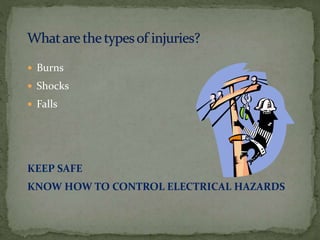
 Burns
 Shocks
 Falls
KEEP SAFE
KNOW HOW TO CONTROL ELECTRICAL HAZARDS
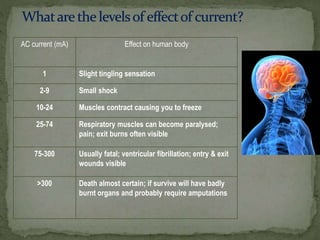
AC current (mA) Effect on human body
1 Slight tingling sensation
2-9 Small shock
10-24 Muscles contract causing you to freeze
25-74 Respiratory muscles can become paralysed;
pain; exit burns often visible
75-300 Usually fatal; ventricular fibrillation; entry & exit
wounds visible
>300 Death almost certain; if survive will have badly
burnt organs and probably require amputations
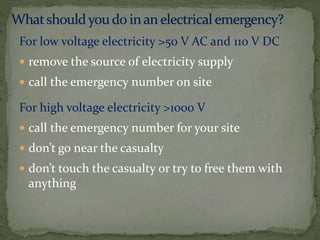
For low voltage electricity >50 V AC and 110 V DC
 remove the source of electricity supply
 call the emergency number on site
For high voltage electricity >1000 V
 call the emergency number for your site
 don’t go near the casualty
 don’t touch the casualty or try to free them with
anything
 Electricity is invisible – this in itself makes it dangerous
 It has great potential to seriously injure or kill
 The company has a duty of care to its employees and
contractors
 Everyone is exposed to electrical hazards, not just
electricians
 Report all electrical shocks and near misses
All employees can be exposed to electrical Hazards. They
should receive electrical hazard Training at the
commencement of their Employment and REGULAR
REFRESHER TRAINING.
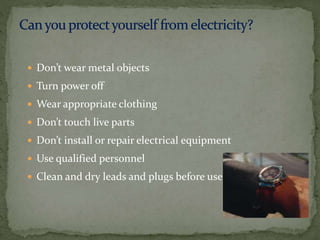
 Don’t wear metal objects
 Turn power off
 Wear appropriate clothing
 Don’t touch live parts
 Don’t install or repair electrical equipment
 Use qualified personnel
 Clean and dry leads and plugs before use
THANK YOU

Industrial hazards and safety

  • 1.
    NARESH GORANTLA, M.Pharm..,(Ph.D) Asso Professor Dept Of Pharmaceutics Balaji College Of Pharmacy,anantapur.
  • 2.
    DEFINITIONS:  HAZARD: Asubstance that causes an injury in a given environment or situation.  INDUSTRIAL HAZARD: Any condition produced by industries that may cause injury or death to personnel or loss of product or property.  SAFETY: Freedom from the occurrence of risk or injury or loss.  INDUSTRIAL SAFETY: Protection of workers from the danger of industrial accidents.  Toxic and corrosive chemicals, fire, explosions and personnel falling-causes of accidents.
  • 3.
    Types of Hazards: Electrical hazards  Chemical hazards  Gas hazards  Dust explosion  Fire and Explosion hazards.
  • 4.
     Human failure: Operating without clearance, failure to respond warning  Working at an unsafe speed  Using equipment unsafely  Making safety devices un-operative  Unsafe loading, placing, mixing  Distracting, teasing, abusing
  • 5.
     Machine failure: Inadequately guarded, height, strength etc.  Unsafely designed machines, tools etc.  Defective, rough, sharp, slippery, decayed machines  Unsafely arranged, congestion, blocked exits.  Unsafely clothed, no goggles, glares or masks, high heels etc.
  • 6.
  • 7.
     Types ofaccidents:  Major-results in death or prolonged disability.  Minor-scratch or a cut which doesn’t seriously disable the worker. Advantages of safety management: 1.Cost saving: Direct costs-compensation medical expenses Indirect costs-3 to 4 times higher includes Loss due to downtime operations, slowed-up production rate, spoiled materials, labour time, charges for cleaning and damage of equipment.
  • 8.
    2.Increased productivity: employees candevote more time in improving the quality and quantity of output. 3.Moral:boosts morality of the worker and his family. 4.Legal: laws covering occupational health and safety and the penalties for non compliance are severe.
  • 9.
     Head andEyes: goggles, helmets, masks and hats.  Hands, arms, legs and feet: rubber or canvas gloves, rubber boots, aprons, shoes and other clothing.  Prevention of breathing of poisonous gases: respiration protective devices.
  • 10.
     Safety programmedeals with the prevention of accidents and minimizing the resulting loss or damage to persons and property.  Principles of safety programme:  To identify potential hazards, provide safety equipment and facilities for taking prompt action.  To develop safety policies that continuously monitor safety performance and ensure that corrective action is taken when necessary.
  • 11.
     To makesupervision fully accountable for safety performance in the working areas.  To train in safe methods of working and provide education and guidance on prevention of hazards. ELEMENTS OF SAFETY PROGRAMME: Strategic choice Safety policy Organization for safety Extent and remedies for accidents Training in safety Safety programme evaluation
  • 12.
    Strategic choice: Tomake decisions regarding safety of workers. As a marketing tool. Safety policy: must contain a declaration of 4 fundamental points- i. Safety of employees and the public is paramount importance. ii. Safety will take precedence over expediency. iii. In the development and implementation of safety procedures every effort will be made to involve all managers, supervisors and employees. iv. Safety legislation will be complied in letter and the spirit of the law.
  • 13.
    Organization for safety: Constitutionof an organization- Safety committee. composed of employees. serves as advisory capacities responsible for – reviewing safety procedures. -making recommendations for eliminating heath hazards. -investigating accidents -fielding safety related complaints from employees.
  • 14.
     Extent andremedies for accidents: Based on the causes the supervisor should apply the art of supervision to control worker’s performance to prevent accident. Human failure and machine failure.  Training in safety:  Systematic training of employees  Safety measures should be kept in mind while planning a layout and construction.  Workers must be provided with safety tools.  Safety posters with slogans at work places.  National safety council.
  • 15.
     Safety programmeevaluation:  Qualitatively: changes in the behavior and attitudes of the employees, changes in the injury producing conditions.  Quantitatively: incident ratio, severity ratio and frequency ratio.
  • 16.
     Reasons like: Wrong raw materials  Raw materials containing trace impurities  Changed operating conditions  Unanticipated time delays  Equipment failure  Wrong materials of construction
  • 17.
     From irritationto death  Severe burns by destroying living tissues- dehydration, digestion, oxidation  Eyes, nervous system, nose, mouth and throat, pulmonary system, CVS, Breast, digestive system, genitourinary system, skin
  • 18.
     Dermatitis reactionsto synthetic drug- Acridines and phenothiazine compounds  While grinding vegetable drugs dust evolved causes irritation- capsicum, phopdophyllum
  • 19.
    Management of overexposure to chemicals: 1. Removal from exposure 2. Resuscitation: restoration of life 3. Decontamination 4. Symptomatic treatment: convulsions, bronchospasms, dehydration, and arrhythmias.
  • 20.
     Flammable liquids: Vaporizationcauses air pollution Ignition of vapor causing fire accidents and explosions Further spreading leads to loss of life and property
  • 21.
    Location, storage andhandling: The properties of liquids are considered to design suitable methods for storage and handling 1. Flash point 2. Apparent ignition temperature 3. Explosive range 4. Vapour density
  • 22.
     Stored inisolated places.  Using tanks constructed above ground and open place  Methods of handling include pumping, gravity flow and compressed air.
  • 23.
     Compressed gases:filled in cylinders and transported to the place of use and the precautions are:  Cylinders should not be dropped or striked.  Safety devices should not be dropped.  Valves should be of high quality.  Protected against weather changes especially excessive temperature.  Cylinders should bear a standard label indicating the kind of gas- inflammable, corrosive, or inert.  Full cylinders should be separated from empty cylinders.
  • 24.
     The termDust is used if the Max particle size of the solids is 500 mm in the mixture.  During grinding operations, stone or iron pieces results in sparks finally leads to explosion of combustible materials.  Dust of starch, dextrin and some organic materials are dangerous.  Mixture of combustible dust burns or oxidizes in presence of air.  Upper and lower limits of air and dust are given for the explosion to takes place.
  • 25.
     Avoiding thedevelopment of explosive mixtures  Replacing the atmospheric oxygen by inert gas, working in a vacuum or using inert dust- rock salt and sod sulphate  Preventing the occurrence of effective ignition source- welding, smoking, cutting, mechanically generated sparks
  • 26.
    Can be controlledat the source of generation and the methods include 1. Filtration 2. Inertial separation 3. Electrostatic precipitation
  • 27.
    What is thesource?  Spontaneous combustion  Non-explosion proof electrical equipment Fire occurs in industry most frequently than explosion, toxic release, but the loss in terms of life are less…
  • 28.
     Building construction Exit points  Fire alarm equipment  Fire Extinguishers  Sprinkler systems  Hydrants  Safety and Fire protection organization
  • 30.
    There are threedirect and two indirect types of electrical injuries:  Direct: Death due to electrical shock Electrical shock Burns  Indirect: Falls Fire
  • 31.
     Severity ofthe shock depends on:  Path of current through the body  Amount of current flowing through the body (amps)  Duration of the shocking current through the body,  LOW VOLTAGE DOES NOT MEAN LOW HAZARD
  • 32.
    Because failing totake the necessary precautions can lead to:  injury or death  fire or property damage
  • 33.
    Electrical hazards existin almost every workplace. Common causes of electrocution are:  making contact with overhead wires  undertaking maintenance on live equipment  working with damaged electrical equipment, such as extension leads, plugs and sockets  using equipment affected by rain or water ingress
  • 34.
    If you comeacross a person receiving an electric shock:  if possible, disconnect the electrical supply (switch?)  assess the situation – never put yourself at risk  take precautions to protect yourself and anyone else in the vicinity  apply the first aid principles  assess the injuries and move the casualty to a safe area if required  administer first aid if trained  seek urgent medical attention
  • 35.
    You could bethe victim if you:  don’t follow proper procedures around electricity  use electrical equipment improperly  use faulty electrical equipment
  • 36.
     Burns  Shocks Falls KEEP SAFE KNOW HOW TO CONTROL ELECTRICAL HAZARDS
  • 37.
    AC current (mA)Effect on human body 1 Slight tingling sensation 2-9 Small shock 10-24 Muscles contract causing you to freeze 25-74 Respiratory muscles can become paralysed; pain; exit burns often visible 75-300 Usually fatal; ventricular fibrillation; entry & exit wounds visible >300 Death almost certain; if survive will have badly burnt organs and probably require amputations
  • 38.
    For low voltageelectricity >50 V AC and 110 V DC  remove the source of electricity supply  call the emergency number on site For high voltage electricity >1000 V  call the emergency number for your site  don’t go near the casualty  don’t touch the casualty or try to free them with anything
  • 39.
     Electricity isinvisible – this in itself makes it dangerous  It has great potential to seriously injure or kill  The company has a duty of care to its employees and contractors  Everyone is exposed to electrical hazards, not just electricians  Report all electrical shocks and near misses All employees can be exposed to electrical Hazards. They should receive electrical hazard Training at the commencement of their Employment and REGULAR REFRESHER TRAINING.
  • 40.
     Don’t wearmetal objects  Turn power off  Wear appropriate clothing  Don’t touch live parts  Don’t install or repair electrical equipment  Use qualified personnel  Clean and dry leads and plugs before use
  • 41.