IDUSTRIAL HAZARDS DUE TO
FIRE ACCIDDENTS, MECHANICAL
AND ELECTRICAL EQUIPMENTS
PREPARED BY :
KOSARAJU SAI VIVEK,
I M.PHARMACY,
DEPARTMENT OF
PHARMACEUTICS,
Jss college of pharmacy
 Industrial hazards:
 It can be defined as any condition produced by or
in industries that may cause injury or death to
personal or loss of product or property.
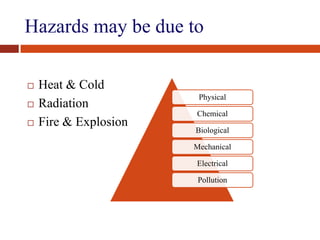
Hazards may be due to
 Heat & Cold
 Radiation
 Fire & Explosion
Physical
Chemical
Biological
Mechanical
Electrical
Pollution
FIRE ACCIDDENTS
 Fire is an exothermic chemical reaction between
oxygen and fuel.
 Combustion
 Slow combustion eg: cotton waste burning
 Rapid combustion eg: petroleum product
 Spontaneous combustion eg: paint, scrap
NFPA classification system
 The NFPA diamond is an easy way to determine the safety risks
associated with hazardous materials. According to the red section
of the diamond, The following numbering system is used to
indicate flammability
 0 - will not burn
 1 - must be preheated to burn
 2 -ignites when moderately heated
 3 -ignites at normal temperature
 4 -extremely flammable
CLASSIFICATION OF FIRES
1. Class A fires:- fires that occur in ordinary material
such as wood, paper rages, rubber and rubbish.
2. Class B fires:- with flammable material like
oil, paint, gasoline etc…….
3. Class C fires:- with gases and vapours .
4. Class D fires:- with combustible metals such as
magnesium, titanium, lithium, sodium etc….
5. Class E fires:- involved electricity in any form..
SOURCES OF FIRE HAZARDS
 Hot surfaces
 Combustible and flammable liquids
 Heat utilization equipment's (over heating)
 Chemical process equipment's
 Lightening
 Gas cylinders
 Ovens and furnaces
 Reactor
 Welding and cutting
 Spark from metal to metal contact
 Carelessness
CAUSES OF FIRE AND EXPLOSION
HAZARDS :
1. Improper storage of flammable oils, greases and fluids,
combustible wastes etc.
2. Smoking by employees.
3. Poor house keeping.
4. Defective heating equipment, electrical equipment and
wiring.
5. Explosive gas leakage.
6. Ignition of gases, vapours or combustible dusts.
7. Inadequate of electric motors.
8. Sparking in electric wires and equipment.
PROTECTION AND PREVENTION
Fire protection is better than fire combating. Following are the
safety measures against fire and explosion hazards
1) Prohibition of smoking in manufacturing area
2) Oxygen present in a flammable atmosphere may be reduced by
dilution with gases as nitrogen, carbon dioxide, steam or
combination of these inerts in exhaust gases from fuels, automobile
engines and jet engines.
3) Operating outside the range of flammability.
4) Eliminating the ignition sources:
i. Flames such as burner flames, matches& cigarette lighters &
heaters.
ii. Hot surface such as heated wires, rods or fragments
 Installation of combustible gas indicators.
 Adequate ventilation facility.
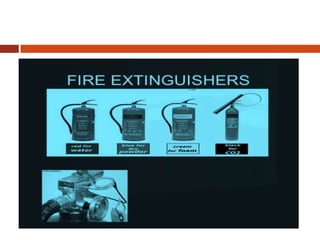
 Fire alarms & fire fighting equipment or fire
extinguishers to be installed in factory at suitable
location.
 Provide automatic sprinkles with adequate &
reliable water supply.
 Proper storage of combustible materials & removal
of waste materials.
MECHANICAL HAZARDS
 Mechanical hazards are those associated with
power driven machine weather automated or
manually operated machines driven by hydraulic or
electrical power
MECHANICAL INJURIES
 The types of injuries results are
cutting , tearing , shearing , crushing , breaking
, straining or puncturing .
PREVENTION OF MACHANICAL
HAZARDS
 IT can be reduced by the application of appropriate safeguards
 Safeguarding is to minimize the risk of accidents of machine-
operator contact
TYPES OF SAFEGUARDING
1. Point of operation guards
2. Feeding/ ejection method
Point of operation guards
Point of operation guards are three types
1. fixed guards
2. Interlocked guards
3. adjustable
• Fixed Guards
it provide a permanent barrier between workers
and point of operation
INTERLOCKED GUARDS
 They shut down the machine when the guard is
not securely in place
ADVANTAGES
 Allow safe access for removing jams or for
maintenance
ADJUSTABLE GUARDS
 They provide a barrier against a variety of
different hazards
FEEDING AND EJECTION SYSTEMS
 Automatic feed systems feed the stocks to the
machine from rolls. It eliminate the need of
operators to enter the danger zone
 Advantages of this is the operators do not reach in
to the danger zone to retrieve work pieces
LOCKOUT/ TAGOUT SYSTEMS
 It is a method that was especially designed to protect
against unexpected startup of a machine
 In the lockout system a padlock is placed through a
gate covering
 The lock usually has the label that gives the name
,department and telephone extension of a person.
The lock is removed only by the person
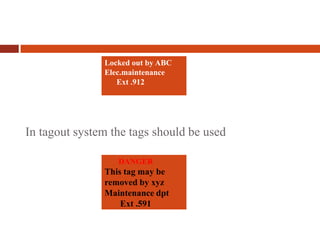
In tagout system the tags should be used
Locked out by ABC
Elec.maintenance
Ext .912
DANGER
This tag may be
removed by xyz
Maintenance dpt
Ext .591
GENERAL PRECAUTIONS
 All the operator should be trained in the safe
operation and maintenance of their machine.
 All machine operators should be trained in the
emergency procedures to take when accident occur.
 All employee should know how to activate
emergency shut down controls.
 Inspection, maintenance, adjustment, repair and
calibration of safe guards should be carried out
regularly.
 Supervisors should ensure the safe guards and
properly in place when machine are in use.
 Short-cuts that violate safety principle and practice
should be avoided.
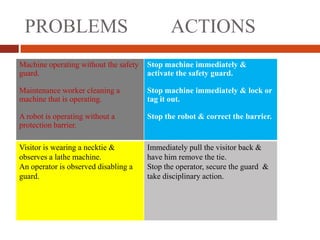
PROBLEMS ACTIONS
Machine operating without the safety
guard.
Maintenance worker cleaning a
machine that is operating.
A robot is operating without a
protection barrier.
Stop machine immediately &
activate the safety guard.
Stop machine immediately & lock or
tag it out.
Stop the robot & correct the barrier.
Visitor is wearing a necktie &
observes a lathe machine.
An operator is observed disabling a
guard.
Immediately pull the visitor back &
have him remove the tie.
Stop the operator, secure the guard &
take disciplinary action.
ELECTRICAL HAZARDS
 A shock is caused by electrical current passing
through human body. The quantity and path of this
current determines the level of damage.
 The electrical hazards occurs when a person makes
contact with a conductor carrying a current and
simultaneously contacts the ground.
SOURCES OF ELECTRICAL
HAZARDS
 The major causes of electrical shock are:
• Contact with a base wire carrying current.
• Working with electrical equipment that lacks the label
for safety inspection.
• Electrical equipment that has not been property
grounded.
• Working with electrical equipment on damp floors.
 Using metal ladders to work on electrical
equipment.
 Lighting strikes.
 Working on electrical equipment without ensuring
that the power has been shut off.
IMPROPER WIRING
 One common mistake is to jump the ground wire to
the neutral wire.
 If the neutral circuit becomes corroded or loose, the
voltage on the ground wire increases to a dangerous
level.
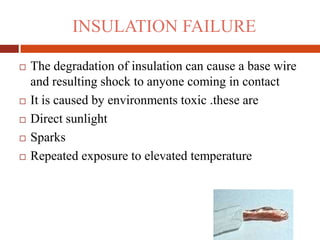
INSULATION FAILURE
 The degradation of insulation can cause a base wire
and resulting shock to anyone coming in contact
 It is caused by environments toxic .these are
 Direct sunlight
 Sparks
 Repeated exposure to elevated temperature
SAFETY PRECAUTIONS FOR ELECTRICAL
HAZARDS
 Ensure that power has been disconnected from the
system before working with it. Capacitors can store
current after power has been shut off.
 Allow only fully authorized and trained people to
work.
 Do not wear conductive materials such as metal
jewelry.
 Periodically inspect insulation.
 If working on a hot circuit, use the buddy system
and wear protective clothing.
 Do not use a fuse with a greater capacity than was
prescribed.
 Verify circuit voltage before performing work.
 Do not use water to put on electrical fire.
 Discharge capacitors before working on the
equipment.
 Use fuses and circuit breakers for protection
against excessive current.

Industrial hazards mechanical (1)

  • 1.
    IDUSTRIAL HAZARDS DUETO FIRE ACCIDDENTS, MECHANICAL AND ELECTRICAL EQUIPMENTS PREPARED BY : KOSARAJU SAI VIVEK, I M.PHARMACY, DEPARTMENT OF PHARMACEUTICS, Jss college of pharmacy
  • 2.
     Industrial hazards: It can be defined as any condition produced by or in industries that may cause injury or death to personal or loss of product or property.
  • 3.
    Hazards may bedue to  Heat & Cold  Radiation  Fire & Explosion Physical Chemical Biological Mechanical Electrical Pollution
  • 4.
    FIRE ACCIDDENTS  Fireis an exothermic chemical reaction between oxygen and fuel.  Combustion  Slow combustion eg: cotton waste burning  Rapid combustion eg: petroleum product  Spontaneous combustion eg: paint, scrap
  • 5.
    NFPA classification system The NFPA diamond is an easy way to determine the safety risks associated with hazardous materials. According to the red section of the diamond, The following numbering system is used to indicate flammability  0 - will not burn  1 - must be preheated to burn  2 -ignites when moderately heated  3 -ignites at normal temperature  4 -extremely flammable
  • 6.
    CLASSIFICATION OF FIRES 1.Class A fires:- fires that occur in ordinary material such as wood, paper rages, rubber and rubbish. 2. Class B fires:- with flammable material like oil, paint, gasoline etc……. 3. Class C fires:- with gases and vapours . 4. Class D fires:- with combustible metals such as magnesium, titanium, lithium, sodium etc…. 5. Class E fires:- involved electricity in any form..
  • 7.
    SOURCES OF FIREHAZARDS  Hot surfaces  Combustible and flammable liquids  Heat utilization equipment's (over heating)  Chemical process equipment's  Lightening  Gas cylinders  Ovens and furnaces  Reactor  Welding and cutting  Spark from metal to metal contact  Carelessness
  • 8.
    CAUSES OF FIREAND EXPLOSION HAZARDS : 1. Improper storage of flammable oils, greases and fluids, combustible wastes etc. 2. Smoking by employees. 3. Poor house keeping. 4. Defective heating equipment, electrical equipment and wiring. 5. Explosive gas leakage. 6. Ignition of gases, vapours or combustible dusts. 7. Inadequate of electric motors. 8. Sparking in electric wires and equipment.
  • 9.
    PROTECTION AND PREVENTION Fireprotection is better than fire combating. Following are the safety measures against fire and explosion hazards 1) Prohibition of smoking in manufacturing area 2) Oxygen present in a flammable atmosphere may be reduced by dilution with gases as nitrogen, carbon dioxide, steam or combination of these inerts in exhaust gases from fuels, automobile engines and jet engines. 3) Operating outside the range of flammability. 4) Eliminating the ignition sources: i. Flames such as burner flames, matches& cigarette lighters & heaters. ii. Hot surface such as heated wires, rods or fragments
  • 10.
     Installation ofcombustible gas indicators.  Adequate ventilation facility.  Fire alarms & fire fighting equipment or fire extinguishers to be installed in factory at suitable location.  Provide automatic sprinkles with adequate & reliable water supply.  Proper storage of combustible materials & removal of waste materials.
  • 12.
    MECHANICAL HAZARDS  Mechanicalhazards are those associated with power driven machine weather automated or manually operated machines driven by hydraulic or electrical power MECHANICAL INJURIES  The types of injuries results are cutting , tearing , shearing , crushing , breaking , straining or puncturing .
  • 13.
    PREVENTION OF MACHANICAL HAZARDS IT can be reduced by the application of appropriate safeguards  Safeguarding is to minimize the risk of accidents of machine- operator contact TYPES OF SAFEGUARDING 1. Point of operation guards 2. Feeding/ ejection method
  • 14.
    Point of operationguards Point of operation guards are three types 1. fixed guards 2. Interlocked guards 3. adjustable • Fixed Guards it provide a permanent barrier between workers and point of operation
  • 15.
    INTERLOCKED GUARDS  Theyshut down the machine when the guard is not securely in place ADVANTAGES  Allow safe access for removing jams or for maintenance ADJUSTABLE GUARDS  They provide a barrier against a variety of different hazards
  • 16.
    FEEDING AND EJECTIONSYSTEMS  Automatic feed systems feed the stocks to the machine from rolls. It eliminate the need of operators to enter the danger zone  Advantages of this is the operators do not reach in to the danger zone to retrieve work pieces
  • 17.
    LOCKOUT/ TAGOUT SYSTEMS It is a method that was especially designed to protect against unexpected startup of a machine  In the lockout system a padlock is placed through a gate covering  The lock usually has the label that gives the name ,department and telephone extension of a person. The lock is removed only by the person
  • 18.
    In tagout systemthe tags should be used Locked out by ABC Elec.maintenance Ext .912 DANGER This tag may be removed by xyz Maintenance dpt Ext .591
  • 19.
    GENERAL PRECAUTIONS  Allthe operator should be trained in the safe operation and maintenance of their machine.  All machine operators should be trained in the emergency procedures to take when accident occur.  All employee should know how to activate emergency shut down controls.  Inspection, maintenance, adjustment, repair and calibration of safe guards should be carried out regularly.
  • 20.
     Supervisors shouldensure the safe guards and properly in place when machine are in use.  Short-cuts that violate safety principle and practice should be avoided.
  • 21.
    PROBLEMS ACTIONS Machine operatingwithout the safety guard. Maintenance worker cleaning a machine that is operating. A robot is operating without a protection barrier. Stop machine immediately & activate the safety guard. Stop machine immediately & lock or tag it out. Stop the robot & correct the barrier. Visitor is wearing a necktie & observes a lathe machine. An operator is observed disabling a guard. Immediately pull the visitor back & have him remove the tie. Stop the operator, secure the guard & take disciplinary action.
  • 22.
    ELECTRICAL HAZARDS  Ashock is caused by electrical current passing through human body. The quantity and path of this current determines the level of damage.  The electrical hazards occurs when a person makes contact with a conductor carrying a current and simultaneously contacts the ground.
  • 23.
    SOURCES OF ELECTRICAL HAZARDS The major causes of electrical shock are: • Contact with a base wire carrying current. • Working with electrical equipment that lacks the label for safety inspection. • Electrical equipment that has not been property grounded. • Working with electrical equipment on damp floors.
  • 24.
     Using metalladders to work on electrical equipment.  Lighting strikes.  Working on electrical equipment without ensuring that the power has been shut off.
  • 25.
    IMPROPER WIRING  Onecommon mistake is to jump the ground wire to the neutral wire.  If the neutral circuit becomes corroded or loose, the voltage on the ground wire increases to a dangerous level.
  • 26.
    INSULATION FAILURE  Thedegradation of insulation can cause a base wire and resulting shock to anyone coming in contact  It is caused by environments toxic .these are  Direct sunlight  Sparks  Repeated exposure to elevated temperature
  • 27.
    SAFETY PRECAUTIONS FORELECTRICAL HAZARDS  Ensure that power has been disconnected from the system before working with it. Capacitors can store current after power has been shut off.  Allow only fully authorized and trained people to work.  Do not wear conductive materials such as metal jewelry.
  • 28.
     Periodically inspectinsulation.  If working on a hot circuit, use the buddy system and wear protective clothing.  Do not use a fuse with a greater capacity than was prescribed.  Verify circuit voltage before performing work.
  • 29.
     Do notuse water to put on electrical fire.  Discharge capacitors before working on the equipment.  Use fuses and circuit breakers for protection against excessive current.