Industrial Processes and Hazard Potential
Presented By
Mr. Dhananjay B. Shinde
M.Pharm (First Year)
Quality Assurance
Department, MQA14
Guided By
Mrs. Preeti S. Bobade
Assistant Professor
Quality Assurance
Department
R. C. PATEL INSTITUTE OF PHARMACEUTICAL EDUCATION AND RESEARCH, SHIRPUR
1
7/22/2023
CONTENTS
2
3
4
1 Introduction
2
Hazards Associated with Industrial Processes
Types of Hazards
References
7/22/2023
Introduction
Potential Hazard
• “Potential hazard is defined as physical, chemical, biological etc. characteristics
that has the potential for causing harm to people, property, or the environment”
Risk
• “Risk can be defined as combination of the probability of
occurrence of harm and severity of that harm”
3
7/22/2023
7/22/2023 4
Risk Assessment
A Risk Assessment is a process to identify potential hazard and analyze what could
happen if a hazard occurs
Risk Identification
Risk Analysis
Risk Evaluation
7/22/2023 5
• Pharmaceutical processes involve the production, manufacturing and handling of medications
and drugs
• These processes are designed to ensure the quality, safety and efficacy of pharmaceutical
products
Types of Hazard associated with Pharmaceutical processes:
1. Physical Hazard
2. Chemical Hazard
3. Biological Hazard
4. Electrical Hazards
5. Ergonomic Hazard
6. Thermal Hazards
Types of Hazards
7/22/2023 6
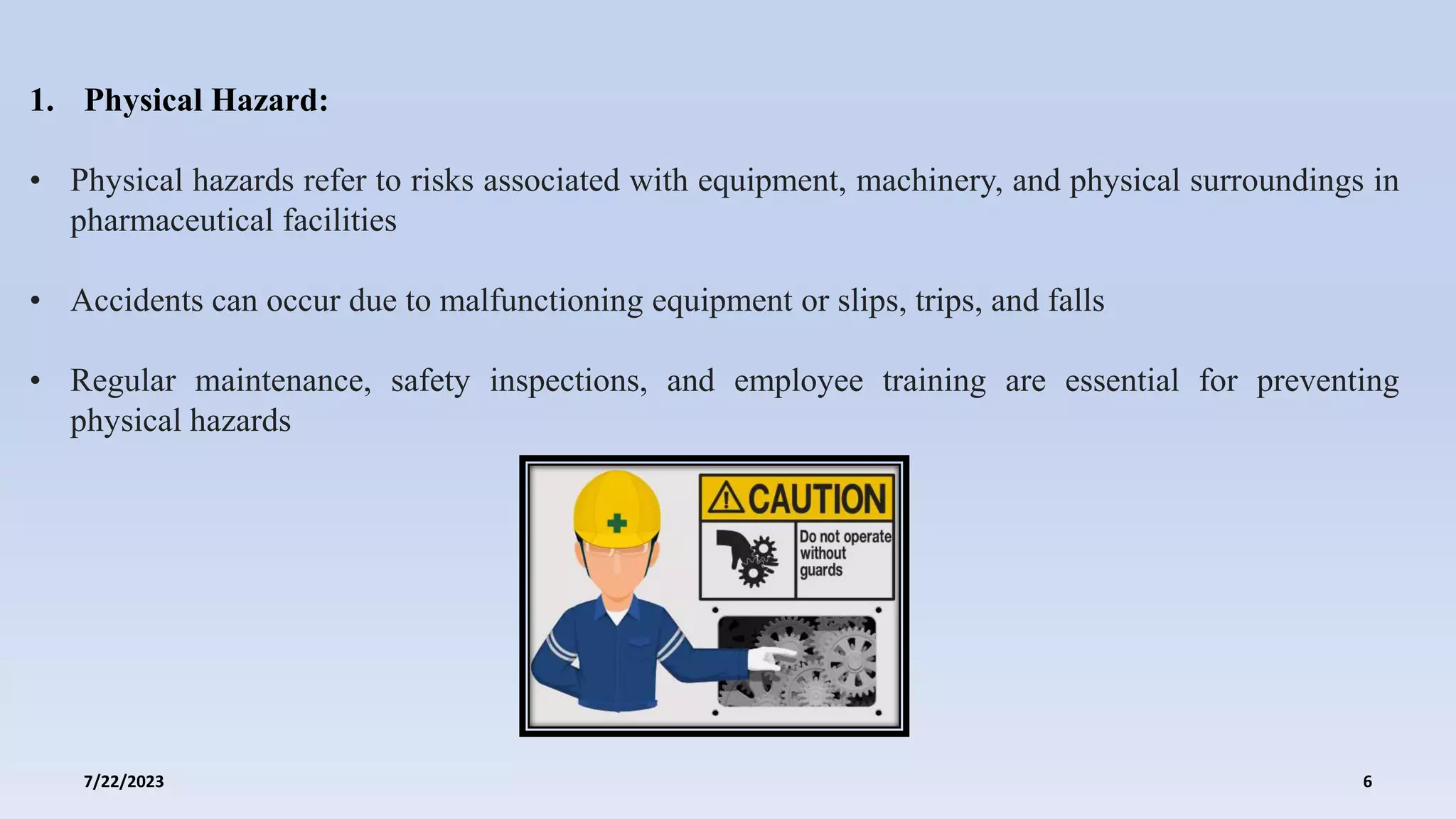
1. Physical Hazard:
• Physical hazards refer to risks associated with equipment, machinery, and physical surroundings in
pharmaceutical facilities
• Accidents can occur due to malfunctioning equipment or slips, trips, and falls
• Regular maintenance, safety inspections, and employee training are essential for preventing
physical hazards
7/22/2023 7
OSHA requirements overview—29 CFR 1910.212
(Title 29, Part 1910, Section 212, Code of Federal Regulations).
• Given guideline is for provision of safeguards for the point of operation
• These guideline suggest guards for mechanical or physical hazards related to operations
• Safeguarding are must be there The National Safety Council (NSC) defines safeguarding as Machine
safeguarding is to minimize the risk of accidents of machine-operator contact
• Safeguards can be broadly categorized as…
Safeguards
(A) point-of-
operation
guards
(B) point-of-
operation
devices
7/22/2023 8
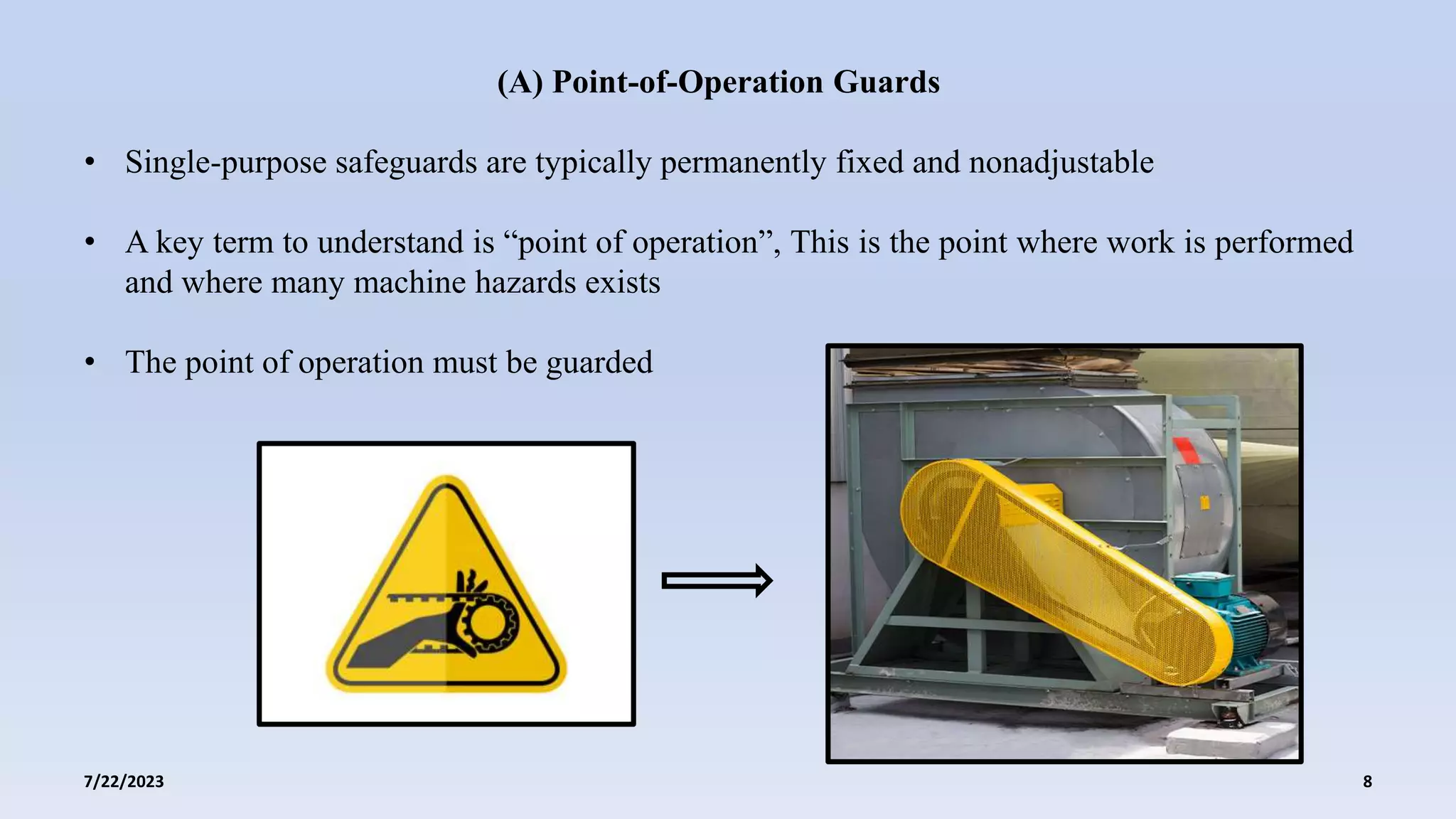
(A) Point-of-Operation Guards
• Single-purpose safeguards are typically permanently fixed and nonadjustable
• A key term to understand is “point of operation”, This is the point where work is performed
and where many machine hazards exists
• The point of operation must be guarded
7/22/2023 9
(B) Point-of-Operation Devices
• Electrical or non electrical devices are optical devices that shut down the machine whenever the light
field is broken
• They do not protect against mechanical failure
7/22/2023 10
Pullback Cords
7/22/2023 11
2. Chemical Hazard:
• Chemical hazards include exposure to toxic substances, reagents, and active
pharmaceutical ingredients (APIs) and solvents
• Improper handling or storage of chemicals can lead to accidental spills,
fires, or explosions
• Workers must follow strict safety protocols, including wearing personal
protective equipment (PPE) and practicing proper waste disposal
7/22/2023 12
Personal Protective Equipment
(PPE)
Mask
Spectacles Gloves
Disposal Bags Coverall Suit
Shoes Cover
7/22/2023 13
Chemical Spillage Control
Chemical Spillage Chemical Spillage
Control Kit
7/22/2023 14
Shower Safety with Eye Washing (SSWW)
SSWW
Eye Wash Bottle
7/22/2023 15
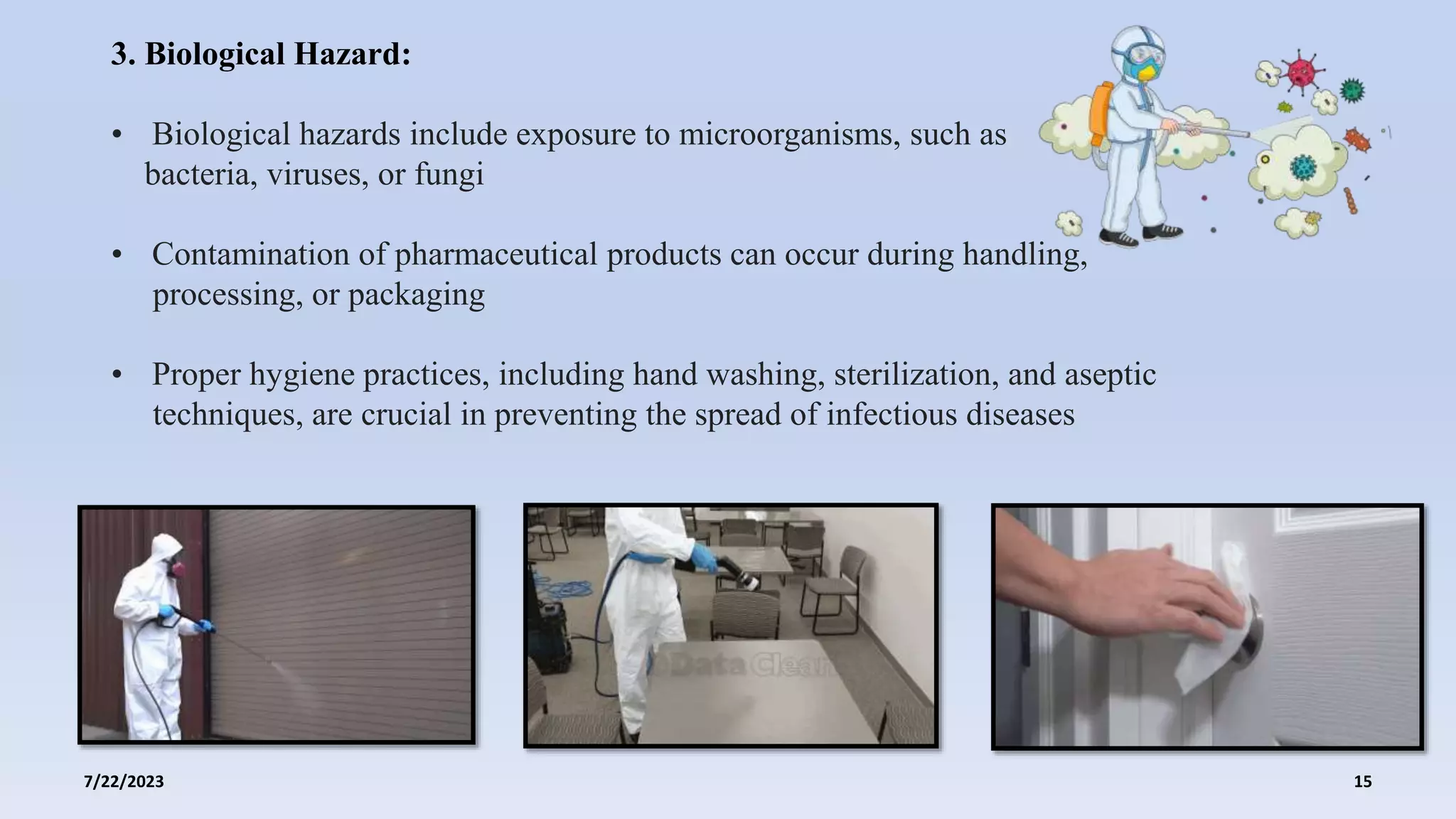
3. Biological Hazard:
• Biological hazards include exposure to microorganisms, such as
bacteria, viruses, or fungi
• Contamination of pharmaceutical products can occur during handling,
processing, or packaging
• Proper hygiene practices, including hand washing, sterilization, and aseptic
techniques, are crucial in preventing the spread of infectious diseases
7/22/2023 16
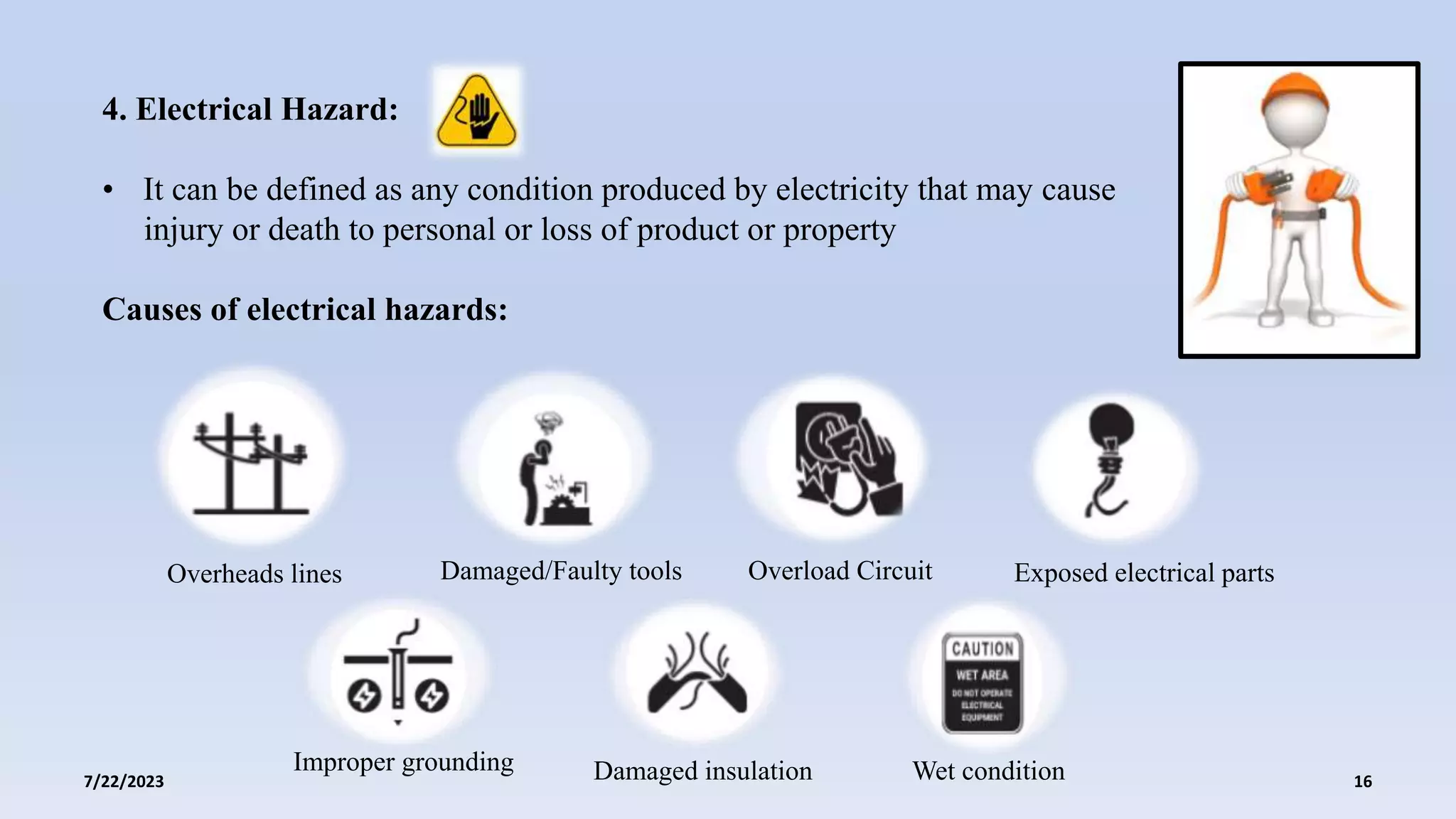
4. Electrical Hazard:
• It can be defined as any condition produced by electricity that may cause
injury or death to personal or loss of product or property
Causes of electrical hazards:
Overheads lines Damaged/Faulty tools Overload Circuit Exposed electrical parts
Improper grounding Damaged insulation Wet condition
7/22/2023 17
5. Ergonomic Hazard:
• Ergonomic hazards are related to the design of workstations, tools, and equipment,
which can lead to musculoskeletal disorders
• Repetitive tasks, awkward postures, or lifting heavy objects can cause
injuries and chronic pain
• Implementing ergonomic principles, such as proper workstation design and
regular breaks, can minimize these hazards
7/22/2023 18
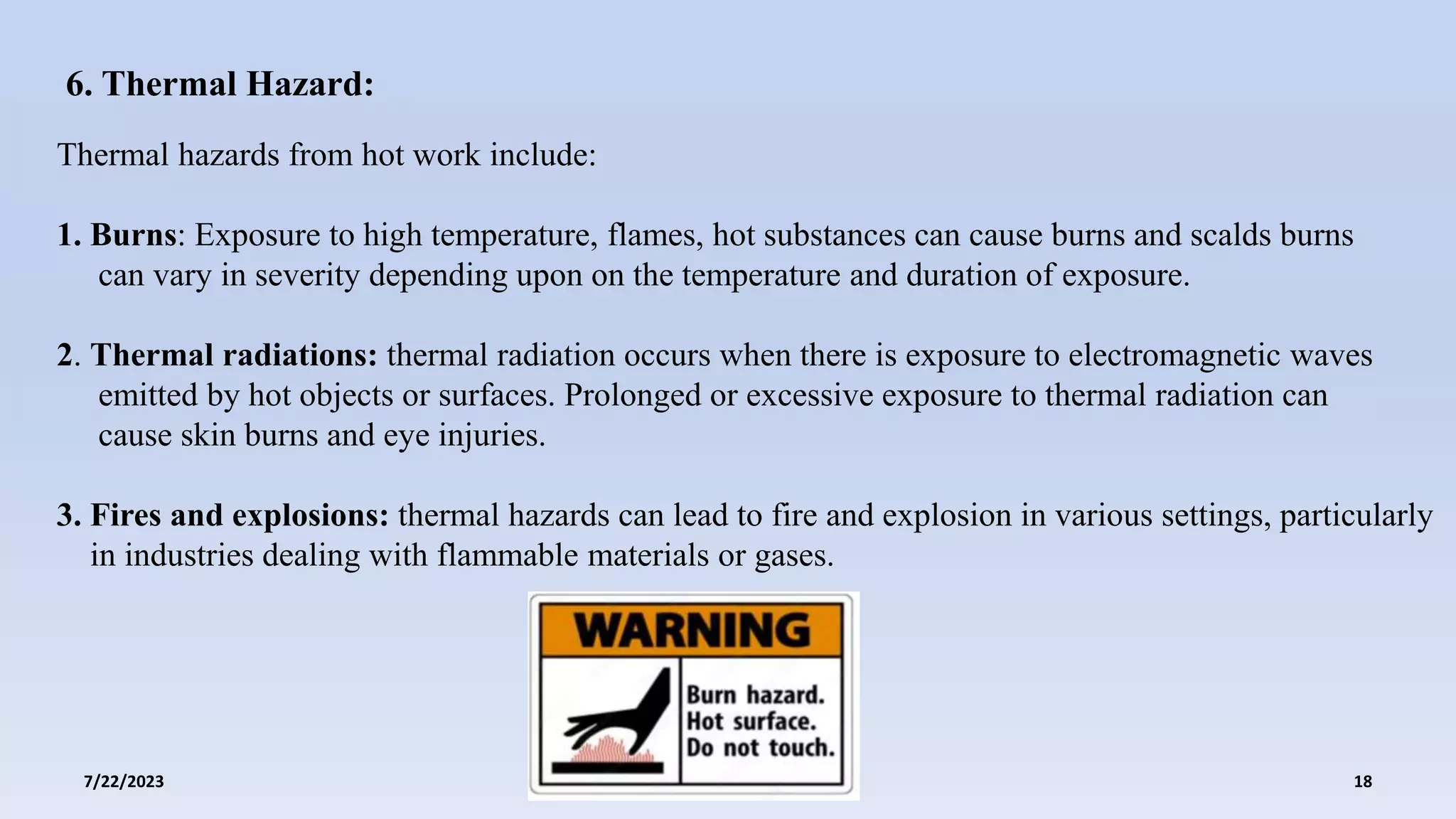
Thermal hazards from hot work include:
1. Burns: Exposure to high temperature, flames, hot substances can cause burns and scalds burns
can vary in severity depending upon on the temperature and duration of exposure.
2. Thermal radiations: thermal radiation occurs when there is exposure to electromagnetic waves
emitted by hot objects or surfaces. Prolonged or excessive exposure to thermal radiation can
cause skin burns and eye injuries.
3. Fires and explosions: thermal hazards can lead to fire and explosion in various settings, particularly
in industries dealing with flammable materials or gases.
6. Thermal Hazard:
7/22/2023 19
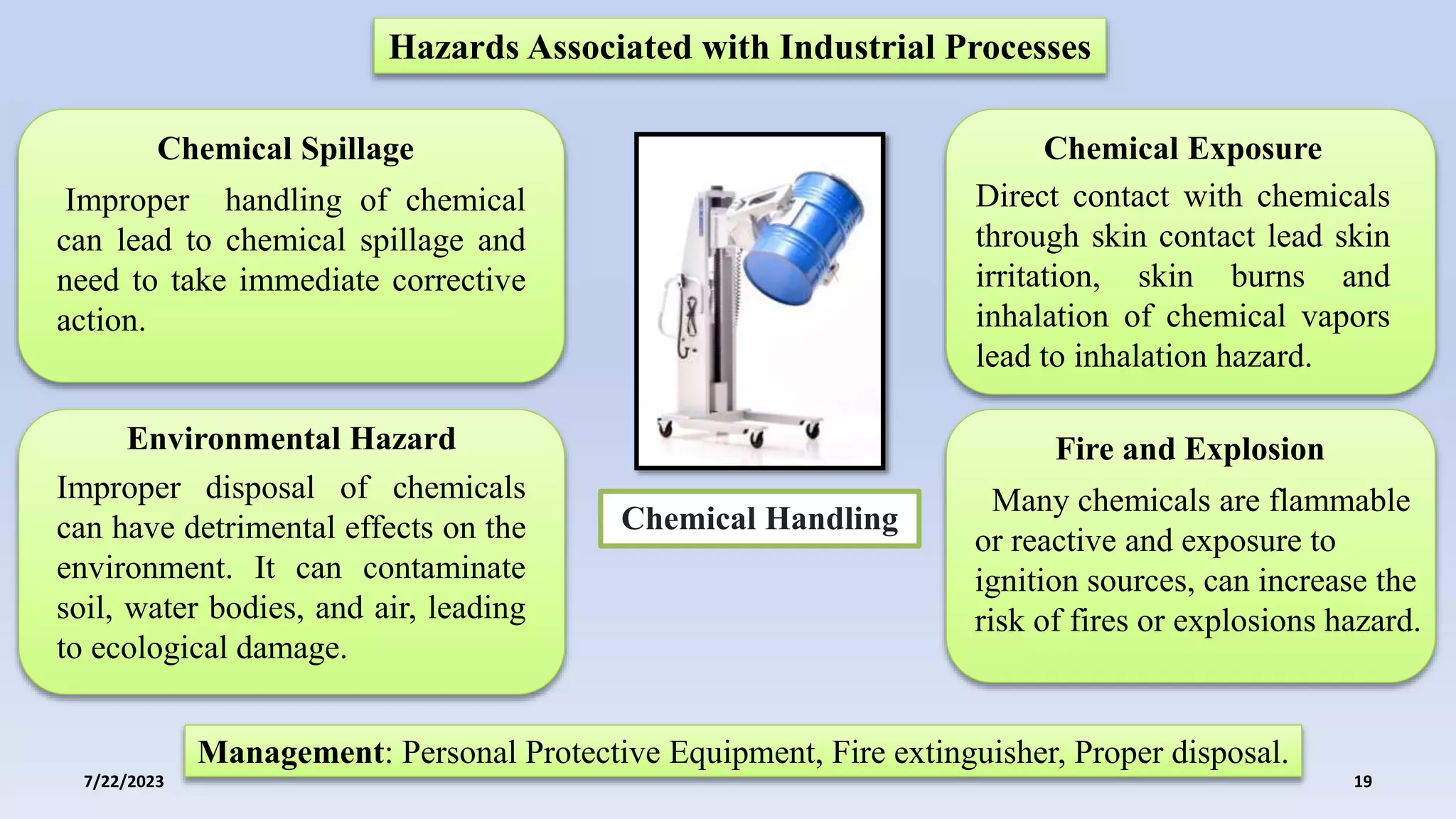
Chemical Handling
Direct contact with chemicals
through skin contact lead skin
irritation, skin burns and
inhalation of chemical vapors
lead to inhalation hazard.
Many chemicals are flammable
or reactive and exposure to
ignition sources, can increase the
risk of fires or explosions hazard.
Improper handling of chemical
can lead to chemical spillage and
need to take immediate corrective
action.
Improper disposal of chemicals
can have detrimental effects on the
environment. It can contaminate
soil, water bodies, and air, leading
to ecological damage.
Hazards Associated with Industrial Processes
Chemical Spillage
Environmental Hazard Fire and Explosion
Chemical Exposure
Management: Personal Protective Equipment, Fire extinguisher, Proper disposal.
7/22/2023 20
Mixing and Granulation
Mixing processes may involve the use of
mixers, reactors, or vessels. Hazards can
arise from equipment malfunctions, leaks,
or failures that can result in chemical spills,
releases, or other incidents.
During loading process into
mixers or granulator there is
chances of chemical spillage.
Improper cleaning of surrounding area or
improper line clearance can lead to potential
cross-contamination Issues.
Chemical Exposure
Direct contact with chemicals through
skin contact lead skin irritation, skin burns
and inhalation of chemical vapors lead to
inhalation hazard.
Chemical Spillage
Equipment Hazards
Cross-Contamination
Management: Personal Protective Equipment, Safety Inspection
and Cleaning & Maintenance.
7/22/2023 21
Tablet Compression
Operating tablet compression
machines can involve repetitive
motions, manual handling of
materials, and awkward postures.
Tablet compression machines can generate
significant levels of noise and vibration
during operation. Prolonged exposure can
lead to hearing loss.
Improper cleaning of surrounding area
or improper line clearance can lead to
potential cross-contamination issues
Tablet compression machines have
moving parts, such as rotating punches
and dies, which can pose risks of pinch
points or Mechanical hazard.
Cross-Contamination
Noise and Vibration
Ergonomic Hazards
Pinch Points and
Mechanical Hazards
Management: Safety Inspection, Automation and Cleaning & Maintenance.
7/22/2023 22
Filling, Sealing and Labeling
In some industries, during filling
process casuals are deployed to place
container in predefined order on
moving belt, due to such repetitive
motions it can lead ergonomic hazard.
In certain industries, filling process involves
combining different chemicals or Substance. If
incompatible materials filled it can result into
chemical reaction. Improper sealing can lead
chemical spillage.
Filling different product in close
proximity or using shared equipment
without proper cleaning can lead
cross contamination.
Incorrect machine settings can lead to
underfilled or overfilled containers.
Improper sealing can lead leakage.
Improper labeling can lead reprocess or
product recall.
Equipment Malfunction Ergonomic Hazards
Chemical Hazard Cross-Contamination
Management: Equipment Cleaning, Maintenance, Automation &
Personal Protective Equipment.
7/22/2023 23
Packaging and Transportation
Counterfeit pharmaceutical packaging
can pose significant risk to patients as
the contents may not contain the correct
active ingredients.
After use of product, if packaging
material not managed properly then
it may cause hazard to environment.
In case of secondary and tertiary
packaging casuals are involve and due to
their awkward postures or repetitive
motions chronic pain may occur.
If packaging equipment is not working
properly then it will results into improper
packaging and due to this the primary
product may loose its integrity during
transportation.
Counterfeiting
Environmental Hazard Ergonomic Hazard
Equipment Malfunction
Management: Equipment Maintenance, Identification mark on product,
Automation & Waste disposal management.
7/22/2023 24
Case Studies
Subject Organization Causality Root Cause Reference
Chemical
Hazard
Wockhardt
Biotech Park
During
chemical
loading, dust of
chemical enter
into the eye
Violation PPE protocol Wockhardt HSE report
Cross
Contamination
Aurolife
Pharma LLC,
Hyderabad.
Cross
Contamination
of finished
drug product
Improper cleaning and
maintenance
21 CFR 211.67(b)
USFDA Warning letter
Labeling error
on Robaxin
750mg tablet
Container
Endo
Pharmaceutical
Inc.
Patient who
follow
direction may
experience
drowsiness
Incorrect Direction “Two to
four tablet four times daily”
instead of “Two tablet three
times daily”
USFDA Officials
Counterfeiting Pfizer Counterfeit has
capacity to
poison or kill
human
----
Pfizer officials
7/22/2023 25
• Pharmaceutical processes involve various stages and potential hazards, including chemical,
biological, physical, and ergonomic factors.
• Mitigating these hazards requires adherence to safety protocols, regular risk assessment, and
compliance with regulatory standards.
• By prioritizing safety, the pharmaceutical industry can continue to develop and distribute
medications that benefit patients worldwide.
Conclusion
References
26
1. David Macdonald, Steve Mackay, Introduction to Hazard Studies, Practical Hazops, Trips and alarms
2004, Elsevier.
2. ICH Guideline Q9 (R1) on Quality Risk Management, European Medicines Agency.
3. Occupational Safety and Health Administration (OSHA), Laboratory Safety Guidance
4. Occupational Safety and Health Administration (OSHA), Hazard Communication Standard (29 CFR
1910.1200)
5. National Institute for Occupational Safety and Health (NIOSH), Ergonomic and Musculoskeletal
Disorder
6. Centers for disease control and prevention (CDC), Biosafety in Microbiological and Biomedical
Laboratories (BMBL)
7/22/2023
27
Thank you !
7/22/2023

Pharmaceutical Industrial Processes and Potential Hazards.pptx

  • 1.
    Industrial Processes andHazard Potential Presented By Mr. Dhananjay B. Shinde M.Pharm (First Year) Quality Assurance Department, MQA14 Guided By Mrs. Preeti S. Bobade Assistant Professor Quality Assurance Department R. C. PATEL INSTITUTE OF PHARMACEUTICAL EDUCATION AND RESEARCH, SHIRPUR 1 7/22/2023
  • 2.
    CONTENTS 2 3 4 1 Introduction 2 Hazards Associatedwith Industrial Processes Types of Hazards References 7/22/2023
  • 3.
    Introduction Potential Hazard • “Potentialhazard is defined as physical, chemical, biological etc. characteristics that has the potential for causing harm to people, property, or the environment” Risk • “Risk can be defined as combination of the probability of occurrence of harm and severity of that harm” 3 7/22/2023
  • 4.
    7/22/2023 4 Risk Assessment ARisk Assessment is a process to identify potential hazard and analyze what could happen if a hazard occurs Risk Identification Risk Analysis Risk Evaluation
  • 5.
    7/22/2023 5 • Pharmaceuticalprocesses involve the production, manufacturing and handling of medications and drugs • These processes are designed to ensure the quality, safety and efficacy of pharmaceutical products Types of Hazard associated with Pharmaceutical processes: 1. Physical Hazard 2. Chemical Hazard 3. Biological Hazard 4. Electrical Hazards 5. Ergonomic Hazard 6. Thermal Hazards Types of Hazards
  • 6.
    7/22/2023 6 1. PhysicalHazard: • Physical hazards refer to risks associated with equipment, machinery, and physical surroundings in pharmaceutical facilities • Accidents can occur due to malfunctioning equipment or slips, trips, and falls • Regular maintenance, safety inspections, and employee training are essential for preventing physical hazards
  • 7.
    7/22/2023 7 OSHA requirementsoverview—29 CFR 1910.212 (Title 29, Part 1910, Section 212, Code of Federal Regulations). • Given guideline is for provision of safeguards for the point of operation • These guideline suggest guards for mechanical or physical hazards related to operations • Safeguarding are must be there The National Safety Council (NSC) defines safeguarding as Machine safeguarding is to minimize the risk of accidents of machine-operator contact • Safeguards can be broadly categorized as… Safeguards (A) point-of- operation guards (B) point-of- operation devices
  • 8.
    7/22/2023 8 (A) Point-of-OperationGuards • Single-purpose safeguards are typically permanently fixed and nonadjustable • A key term to understand is “point of operation”, This is the point where work is performed and where many machine hazards exists • The point of operation must be guarded
  • 9.
    7/22/2023 9 (B) Point-of-OperationDevices • Electrical or non electrical devices are optical devices that shut down the machine whenever the light field is broken • They do not protect against mechanical failure
  • 10.
  • 11.
    7/22/2023 11 2. ChemicalHazard: • Chemical hazards include exposure to toxic substances, reagents, and active pharmaceutical ingredients (APIs) and solvents • Improper handling or storage of chemicals can lead to accidental spills, fires, or explosions • Workers must follow strict safety protocols, including wearing personal protective equipment (PPE) and practicing proper waste disposal
  • 12.
    7/22/2023 12 Personal ProtectiveEquipment (PPE) Mask Spectacles Gloves Disposal Bags Coverall Suit Shoes Cover
  • 13.
    7/22/2023 13 Chemical SpillageControl Chemical Spillage Chemical Spillage Control Kit
  • 14.
    7/22/2023 14 Shower Safetywith Eye Washing (SSWW) SSWW Eye Wash Bottle
  • 15.
    7/22/2023 15 3. BiologicalHazard: • Biological hazards include exposure to microorganisms, such as bacteria, viruses, or fungi • Contamination of pharmaceutical products can occur during handling, processing, or packaging • Proper hygiene practices, including hand washing, sterilization, and aseptic techniques, are crucial in preventing the spread of infectious diseases
  • 16.
    7/22/2023 16 4. ElectricalHazard: • It can be defined as any condition produced by electricity that may cause injury or death to personal or loss of product or property Causes of electrical hazards: Overheads lines Damaged/Faulty tools Overload Circuit Exposed electrical parts Improper grounding Damaged insulation Wet condition
  • 17.
    7/22/2023 17 5. ErgonomicHazard: • Ergonomic hazards are related to the design of workstations, tools, and equipment, which can lead to musculoskeletal disorders • Repetitive tasks, awkward postures, or lifting heavy objects can cause injuries and chronic pain • Implementing ergonomic principles, such as proper workstation design and regular breaks, can minimize these hazards
  • 18.
    7/22/2023 18 Thermal hazardsfrom hot work include: 1. Burns: Exposure to high temperature, flames, hot substances can cause burns and scalds burns can vary in severity depending upon on the temperature and duration of exposure. 2. Thermal radiations: thermal radiation occurs when there is exposure to electromagnetic waves emitted by hot objects or surfaces. Prolonged or excessive exposure to thermal radiation can cause skin burns and eye injuries. 3. Fires and explosions: thermal hazards can lead to fire and explosion in various settings, particularly in industries dealing with flammable materials or gases. 6. Thermal Hazard:
  • 19.
    7/22/2023 19 Chemical Handling Directcontact with chemicals through skin contact lead skin irritation, skin burns and inhalation of chemical vapors lead to inhalation hazard. Many chemicals are flammable or reactive and exposure to ignition sources, can increase the risk of fires or explosions hazard. Improper handling of chemical can lead to chemical spillage and need to take immediate corrective action. Improper disposal of chemicals can have detrimental effects on the environment. It can contaminate soil, water bodies, and air, leading to ecological damage. Hazards Associated with Industrial Processes Chemical Spillage Environmental Hazard Fire and Explosion Chemical Exposure Management: Personal Protective Equipment, Fire extinguisher, Proper disposal.
  • 20.
    7/22/2023 20 Mixing andGranulation Mixing processes may involve the use of mixers, reactors, or vessels. Hazards can arise from equipment malfunctions, leaks, or failures that can result in chemical spills, releases, or other incidents. During loading process into mixers or granulator there is chances of chemical spillage. Improper cleaning of surrounding area or improper line clearance can lead to potential cross-contamination Issues. Chemical Exposure Direct contact with chemicals through skin contact lead skin irritation, skin burns and inhalation of chemical vapors lead to inhalation hazard. Chemical Spillage Equipment Hazards Cross-Contamination Management: Personal Protective Equipment, Safety Inspection and Cleaning & Maintenance.
  • 21.
    7/22/2023 21 Tablet Compression Operatingtablet compression machines can involve repetitive motions, manual handling of materials, and awkward postures. Tablet compression machines can generate significant levels of noise and vibration during operation. Prolonged exposure can lead to hearing loss. Improper cleaning of surrounding area or improper line clearance can lead to potential cross-contamination issues Tablet compression machines have moving parts, such as rotating punches and dies, which can pose risks of pinch points or Mechanical hazard. Cross-Contamination Noise and Vibration Ergonomic Hazards Pinch Points and Mechanical Hazards Management: Safety Inspection, Automation and Cleaning & Maintenance.
  • 22.
    7/22/2023 22 Filling, Sealingand Labeling In some industries, during filling process casuals are deployed to place container in predefined order on moving belt, due to such repetitive motions it can lead ergonomic hazard. In certain industries, filling process involves combining different chemicals or Substance. If incompatible materials filled it can result into chemical reaction. Improper sealing can lead chemical spillage. Filling different product in close proximity or using shared equipment without proper cleaning can lead cross contamination. Incorrect machine settings can lead to underfilled or overfilled containers. Improper sealing can lead leakage. Improper labeling can lead reprocess or product recall. Equipment Malfunction Ergonomic Hazards Chemical Hazard Cross-Contamination Management: Equipment Cleaning, Maintenance, Automation & Personal Protective Equipment.
  • 23.
    7/22/2023 23 Packaging andTransportation Counterfeit pharmaceutical packaging can pose significant risk to patients as the contents may not contain the correct active ingredients. After use of product, if packaging material not managed properly then it may cause hazard to environment. In case of secondary and tertiary packaging casuals are involve and due to their awkward postures or repetitive motions chronic pain may occur. If packaging equipment is not working properly then it will results into improper packaging and due to this the primary product may loose its integrity during transportation. Counterfeiting Environmental Hazard Ergonomic Hazard Equipment Malfunction Management: Equipment Maintenance, Identification mark on product, Automation & Waste disposal management.
  • 24.
    7/22/2023 24 Case Studies SubjectOrganization Causality Root Cause Reference Chemical Hazard Wockhardt Biotech Park During chemical loading, dust of chemical enter into the eye Violation PPE protocol Wockhardt HSE report Cross Contamination Aurolife Pharma LLC, Hyderabad. Cross Contamination of finished drug product Improper cleaning and maintenance 21 CFR 211.67(b) USFDA Warning letter Labeling error on Robaxin 750mg tablet Container Endo Pharmaceutical Inc. Patient who follow direction may experience drowsiness Incorrect Direction “Two to four tablet four times daily” instead of “Two tablet three times daily” USFDA Officials Counterfeiting Pfizer Counterfeit has capacity to poison or kill human ---- Pfizer officials
  • 25.
    7/22/2023 25 • Pharmaceuticalprocesses involve various stages and potential hazards, including chemical, biological, physical, and ergonomic factors. • Mitigating these hazards requires adherence to safety protocols, regular risk assessment, and compliance with regulatory standards. • By prioritizing safety, the pharmaceutical industry can continue to develop and distribute medications that benefit patients worldwide. Conclusion
  • 26.
    References 26 1. David Macdonald,Steve Mackay, Introduction to Hazard Studies, Practical Hazops, Trips and alarms 2004, Elsevier. 2. ICH Guideline Q9 (R1) on Quality Risk Management, European Medicines Agency. 3. Occupational Safety and Health Administration (OSHA), Laboratory Safety Guidance 4. Occupational Safety and Health Administration (OSHA), Hazard Communication Standard (29 CFR 1910.1200) 5. National Institute for Occupational Safety and Health (NIOSH), Ergonomic and Musculoskeletal Disorder 6. Centers for disease control and prevention (CDC), Biosafety in Microbiological and Biomedical Laboratories (BMBL) 7/22/2023
  • 27.