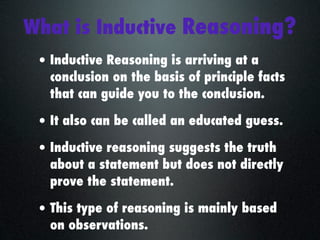
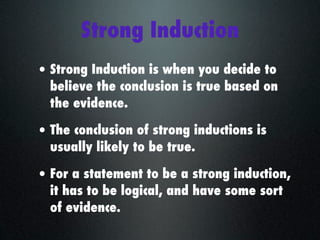
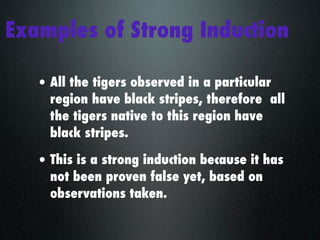
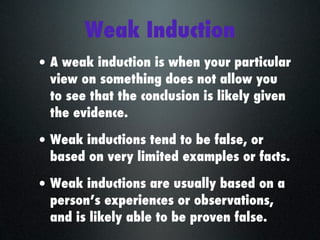
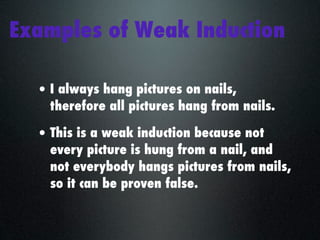
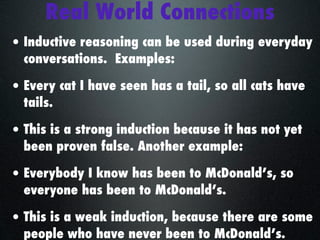
The document discusses inductive reasoning, which involves arriving at a conclusion based on observations and facts without direct proof. It defines strong and weak inductions, providing examples of each. Strong inductions are more likely to be true while weak inductions can be proven false. Inductive reasoning is used in everyday conversations, scientific theories, and mathematics by making educated guesses based on available evidence and observations.