Inductive and Deductive Reasoning
Objectives:
The student is able to (I can):
• Use inductive reasoning to identify patterns and make
conjectures
• Find counterexamples to disprove conjectures
• Understand the differences between inductive and
deductive reasoning
Find the next item in the sequence:
1. December, November, October, ...
2. 3, 6, 9, 12, ...
3. , , , ...
4. 1, 1, 2, 3, 5, 8, ...
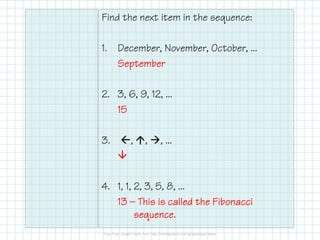
Find the next item in the sequence:
1. December, November, October, ...
SeptemberSeptemberSeptemberSeptember
2. 3, 6, 9, 12, ...
15151515
3. , , , ...
4. 1, 1, 2, 3, 5, 8, ...
13131313 ———— This is called the FibonacciThis is called the FibonacciThis is called the FibonacciThis is called the Fibonacci
sequence.sequence.sequence.sequence.
inductive
reasoning
conjecture
Reasoning that a rule or statement is true
because specific cases are true.
A statement believed true based on
inductive reasoning.
Complete the conjecture:
The product of an odd and an even number
is ______ .
inductive
reasoning
conjecture
Reasoning that a rule or statement is true
because specific cases are true.
A statement believed true based on
inductive reasoning.
Complete the conjecture:
The product of an odd and an even number
is ______ .
To do this, we consider some examples:
(2)(3) = 6 (4)(7) = 28 (2)(5) = 10
eveneveneveneven
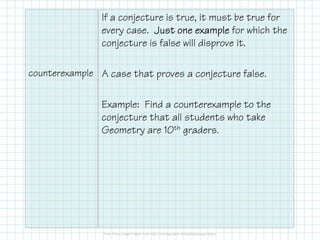
counterexample
If a conjecture is true, it must be true for
every case. Just one exampleJust one exampleJust one exampleJust one example for which the
conjecture is false will disprove it.
A case that proves a conjecture false.
To be a counterexample, the first part
must be truetruetruetrue, and the second part must be
falsefalsefalsefalse.
Example: Find a counterexample to the
conjecture that all students who take
Geometry are 10th graders.
counterexample
If a conjecture is true, it must be true for
every case. Just one exampleJust one exampleJust one exampleJust one example for which the
conjecture is false will disprove it.
A case that proves a conjecture false.
To be a counterexample, the first part
must be truetruetruetrue, and the second part must be
falsefalsefalsefalse.
Example: Find a counterexample to the
conjecture that all students who take
Geometry are 10th graders.
Most of the students in our class are
taking Geometry, but are not 10th graders.
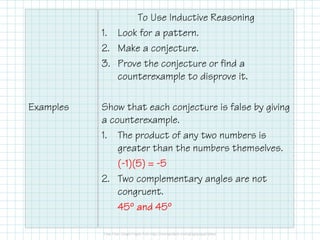
Examples
To Use Inductive Reasoning
1. Look for a pattern.
2. Make a conjecture.
3. Prove the conjecture or find a
counterexample to disprove it.
Show that each conjecture is false by giving
a counterexample.
1. The product of any two numbers is
greater than the numbers themselves.
2. Two complementary angles are not
congruent.
Examples
To Use Inductive Reasoning
1. Look for a pattern.
2. Make a conjecture.
3. Prove the conjecture or find a
counterexample to disprove it.
Show that each conjecture is false by giving
a counterexample.
1. The product of any two numbers is
greater than the numbers themselves.
((((----1)(5) =1)(5) =1)(5) =1)(5) = ----5555
2. Two complementary angles are not
congruent.
45º and 45º45º and 45º45º and 45º45º and 45º
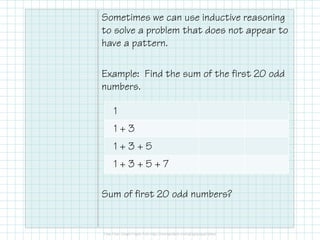
Sometimes we can use inductive reasoning
to solve a problem that does not appear to
have a pattern.
Example: Find the sum of the first 20 odd
numbers.
Sum of first 20 odd numbers?
1
1 + 3
1 + 3 + 5
1 + 3 + 5 + 7
1
4
9
16
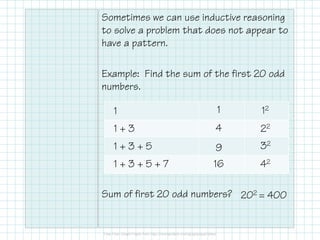
Sometimes we can use inductive reasoning
to solve a problem that does not appear to
have a pattern.
Example: Find the sum of the first 20 odd
numbers.
Sum of first 20 odd numbers?
1
1 + 3
1 + 3 + 5
1 + 3 + 5 + 7
1
4
9
16
12
22
32
42
202 = 400
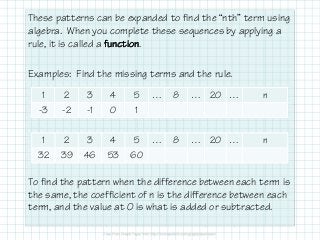
These patterns can be expanded to find the “nth” term using
algebra. When you complete these sequences by applying a
rule, it is called a functionfunctionfunctionfunction.
Examples: Find the missing terms and the rule.
To find the pattern when the difference between each term is
the same, the coefficient of n is the difference between each
term, and the value at 0 is what is added or subtracted.
1 2 3 4 5 … 8 … 20 … n
-3 -2 -1 0 1
1 2 3 4 5 … 8 … 20 … n
32 39 46 53 60
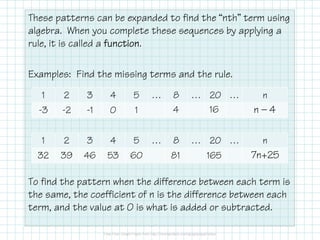
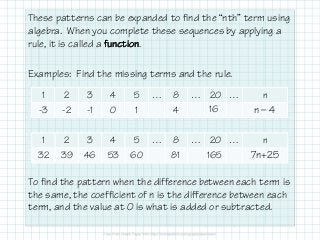
These patterns can be expanded to find the “nth” term using
algebra. When you complete these sequences by applying a
rule, it is called a functionfunctionfunctionfunction.
Examples: Find the missing terms and the rule.
To find the pattern when the difference between each term is
the same, the coefficient of n is the difference between each
term, and the value at 0 is what is added or subtracted.
1 2 3 4 5 … 8 … 20 … n
-3 -2 -1 0 1 4 16 n — 4
1 2 3 4 5 … 8 … 20 … n
32 39 46 53 60 81 165 7n+25
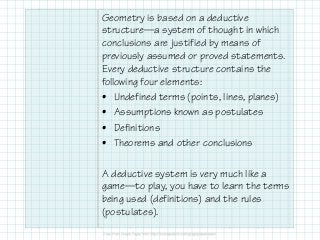
Geometry is based on a deductive
structure–a system of thought in which
conclusions are justified by means of
previously assumed or proved statements.
Every deductive structure contains the
following four elements:
• Undefined terms (points, lines, planes)
• Assumptions known as postulates
• Definitions
• Theorems and other conclusions
A deductive system is very much like a
game–to play, you have to learn the terms
being used (definitions) and the rules
(postulates).
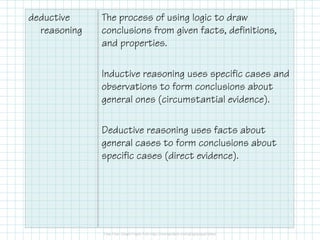
deductive
reasoning
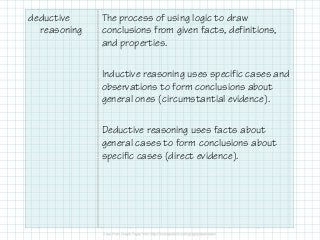
The process of using logic to draw
conclusions from given facts, definitions,
and properties.
Inductive reasoning uses specific cases and
observations to form conclusions about
general ones (circumstantial evidence).
Deductive reasoning uses facts about
general cases to form conclusions about
specific cases (direct evidence).
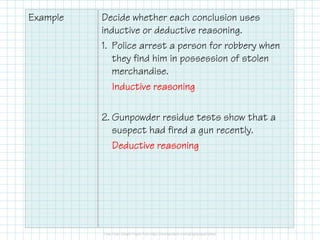
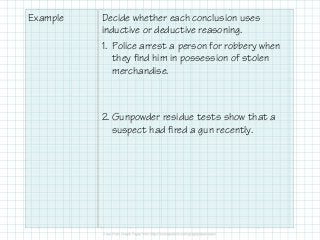
Example Decide whether each conclusion uses
inductive or deductive reasoning.
1. Police arrest a person for robbery when
they find him in possession of stolen
merchandise.
2. Gunpowder residue tests show that a
suspect had fired a gun recently.
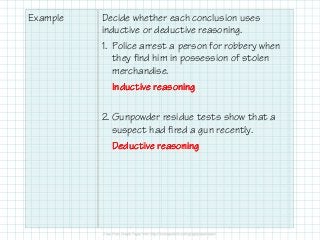
Example Decide whether each conclusion uses
inductive or deductive reasoning.
1. Police arrest a person for robbery when
they find him in possession of stolen
merchandise.
Inductive reasoningInductive reasoningInductive reasoningInductive reasoning
2. Gunpowder residue tests show that a
suspect had fired a gun recently.
Deductive reasoningDeductive reasoningDeductive reasoningDeductive reasoning

1.3.1 Inductive and Deductive Reasoning

  • 1.
    Inductive and DeductiveReasoning Objectives: The student is able to (I can): • Use inductive reasoning to identify patterns and make conjectures • Find counterexamples to disprove conjectures • Understand the differences between inductive and deductive reasoning
  • 2.
    Find the nextitem in the sequence: 1. December, November, October, ... 2. 3, 6, 9, 12, ... 3. , , , ... 4. 1, 1, 2, 3, 5, 8, ...
  • 3.
    Find the nextitem in the sequence: 1. December, November, October, ... SeptemberSeptemberSeptemberSeptember 2. 3, 6, 9, 12, ... 15151515 3. , , , ... 4. 1, 1, 2, 3, 5, 8, ... 13131313 ———— This is called the FibonacciThis is called the FibonacciThis is called the FibonacciThis is called the Fibonacci sequence.sequence.sequence.sequence.
  • 4.
    inductive reasoning conjecture Reasoning that arule or statement is true because specific cases are true. A statement believed true based on inductive reasoning. Complete the conjecture: The product of an odd and an even number is ______ .
  • 5.
    inductive reasoning conjecture Reasoning that arule or statement is true because specific cases are true. A statement believed true based on inductive reasoning. Complete the conjecture: The product of an odd and an even number is ______ . To do this, we consider some examples: (2)(3) = 6 (4)(7) = 28 (2)(5) = 10 eveneveneveneven
  • 6.
    counterexample If a conjectureis true, it must be true for every case. Just one exampleJust one exampleJust one exampleJust one example for which the conjecture is false will disprove it. A case that proves a conjecture false. To be a counterexample, the first part must be truetruetruetrue, and the second part must be falsefalsefalsefalse. Example: Find a counterexample to the conjecture that all students who take Geometry are 10th graders.
  • 7.
    counterexample If a conjectureis true, it must be true for every case. Just one exampleJust one exampleJust one exampleJust one example for which the conjecture is false will disprove it. A case that proves a conjecture false. To be a counterexample, the first part must be truetruetruetrue, and the second part must be falsefalsefalsefalse. Example: Find a counterexample to the conjecture that all students who take Geometry are 10th graders. Most of the students in our class are taking Geometry, but are not 10th graders.
  • 8.
    Examples To Use InductiveReasoning 1. Look for a pattern. 2. Make a conjecture. 3. Prove the conjecture or find a counterexample to disprove it. Show that each conjecture is false by giving a counterexample. 1. The product of any two numbers is greater than the numbers themselves. 2. Two complementary angles are not congruent.
  • 9.
    Examples To Use InductiveReasoning 1. Look for a pattern. 2. Make a conjecture. 3. Prove the conjecture or find a counterexample to disprove it. Show that each conjecture is false by giving a counterexample. 1. The product of any two numbers is greater than the numbers themselves. ((((----1)(5) =1)(5) =1)(5) =1)(5) = ----5555 2. Two complementary angles are not congruent. 45º and 45º45º and 45º45º and 45º45º and 45º
  • 10.
    Sometimes we canuse inductive reasoning to solve a problem that does not appear to have a pattern. Example: Find the sum of the first 20 odd numbers. Sum of first 20 odd numbers? 1 1 + 3 1 + 3 + 5 1 + 3 + 5 + 7 1 4 9 16
  • 11.
    Sometimes we canuse inductive reasoning to solve a problem that does not appear to have a pattern. Example: Find the sum of the first 20 odd numbers. Sum of first 20 odd numbers? 1 1 + 3 1 + 3 + 5 1 + 3 + 5 + 7 1 4 9 16 12 22 32 42 202 = 400
  • 12.
    These patterns canbe expanded to find the “nth” term using algebra. When you complete these sequences by applying a rule, it is called a functionfunctionfunctionfunction. Examples: Find the missing terms and the rule. To find the pattern when the difference between each term is the same, the coefficient of n is the difference between each term, and the value at 0 is what is added or subtracted. 1 2 3 4 5 … 8 … 20 … n -3 -2 -1 0 1 1 2 3 4 5 … 8 … 20 … n 32 39 46 53 60
  • 13.
    These patterns canbe expanded to find the “nth” term using algebra. When you complete these sequences by applying a rule, it is called a functionfunctionfunctionfunction. Examples: Find the missing terms and the rule. To find the pattern when the difference between each term is the same, the coefficient of n is the difference between each term, and the value at 0 is what is added or subtracted. 1 2 3 4 5 … 8 … 20 … n -3 -2 -1 0 1 4 16 n — 4 1 2 3 4 5 … 8 … 20 … n 32 39 46 53 60 81 165 7n+25
  • 14.
    Geometry is basedon a deductive structure–a system of thought in which conclusions are justified by means of previously assumed or proved statements. Every deductive structure contains the following four elements: • Undefined terms (points, lines, planes) • Assumptions known as postulates • Definitions • Theorems and other conclusions A deductive system is very much like a game–to play, you have to learn the terms being used (definitions) and the rules (postulates).
  • 15.
    deductive reasoning The process ofusing logic to draw conclusions from given facts, definitions, and properties. Inductive reasoning uses specific cases and observations to form conclusions about general ones (circumstantial evidence). Deductive reasoning uses facts about general cases to form conclusions about specific cases (direct evidence).
  • 16.
    Example Decide whethereach conclusion uses inductive or deductive reasoning. 1. Police arrest a person for robbery when they find him in possession of stolen merchandise. 2. Gunpowder residue tests show that a suspect had fired a gun recently.
  • 17.
    Example Decide whethereach conclusion uses inductive or deductive reasoning. 1. Police arrest a person for robbery when they find him in possession of stolen merchandise. Inductive reasoningInductive reasoningInductive reasoningInductive reasoning 2. Gunpowder residue tests show that a suspect had fired a gun recently. Deductive reasoningDeductive reasoningDeductive reasoningDeductive reasoning