DIVINA GRACIA D. DIZON
our beliefs about why,
what and how we teach,
whom we teach, and about
the nature of learning
a set of principles that
guides professional action
through the events and
issues teachers face daily
Plato
           Aristotle
Socrates
holds that ideas are the only truth
the only constant for Plato was mathematics,
unchangeable and eternal
Plato’s method of dialogue engaged in
systematic, logical examination of all points of
view…ultimately leading to agreement and a
synthesis of ideas…this approach known as the
dialectic.
AIMS OF EDUCATION   To discover and develop each individual’s abilities and full moral
                    excellence
                    to search for truth and further the character development of
                    learners

   CURRICULUM       based upon the spiritual nature of man
                    Subject-centered


TEACHING METHODS    Focus on handling ideas through lecture. Discussion and Socratic
                    dialogue
                    Character is developed through imitating examples and heroes


 ROLE OF TEACHER    To serve as a guide for immature learners, judge important
                    material, and model appropriate behavior.
                    expected to be an excellent and all around person


  INSTRUCTIONAL     holistic, seeks to develop critical thinkers, and deals with broad
     PROCESS        concepts rather than specific skills
 holds that reality exists independent of the human
  mind; matter in the universe is real and independent
  of man’s ideas.
 Aristotle was the leading proponent of realism,
  started the Lyceum, the first philosopher to develop
  a systematic theory of logic
 Generic Notions…only through studying the material
  world is it possible to clarify or develop ideas…matter
  is real independent of ideas
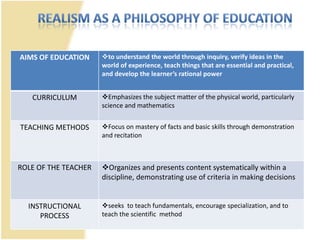
AIMS OF EDUCATION     to understand the world through inquiry, verify ideas in the
                      world of experience, teach things that are essential and practical,
                      and develop the learner’s rational power


   CURRICULUM         Emphasizes the subject matter of the physical world, particularly
                      science and mathematics


TEACHING METHODS      Focus on mastery of facts and basic skills through demonstration
                      and recitation


ROLE OF THE TEACHER   Organizes and presents content systematically within a
                      discipline, demonstrating use of criteria in making decisions


  INSTRUCTIONAL       seeks to teach fundamentals, encourage specialization, and to
     PROCESS          teach the scientific method
All material things are           Propositions are true only if they
explainable                         correspond with known facts
Ultimate reality is spiritual.    Physical matter is the ultimate
Nature possesses meaning and        reality. Nature and science are
purpose.                            real.
knowledge is independent          knowledge is derived through
of sense experience                 sense experince
start with the idea and ends      starts with a thing and end up
with thing                          with idea
universe as being made of         an attempt to portray life as it is
mind or reason                     Recognizes the importance of
high regard for individuality      individual education
and freedom in education
must provide for the        to provide man with the
development of the mind       essential knowledge he
of every pupil                needs to survive in
should develop the           nature
potentiality of man
emphasize the
intellectual, moral and
aesthetic judgment of the
pupil
IDEALISM                         REALISM
AIMS OF EDUCATION       True ideas                      truth of the natural and
                       Rational process                physical world
                       Self – realization              Scientific method
                        Character Development          Basic skills and facts
                       ( wisdom, moral conviction,       Character Development
                       good will and loyalty)           ( accountability and
                                                        preparedness )
METHODS OF EDUCATION    self-directed learning          direct teaching
                        depth over breath              Essential information


CURRICULUM              critical thinking              Practical and useful
                        reading and writing             3 R’s


ROLE OF THE TEACHER    Role models (intellectual and    subject matter expert
                       moral )
Idealism and realism (educ. 301)