Who IS Fibonacci?
Fibonacci was an Italian mathematician. He was
really named Leonardo de Pisa but his nickname
was Fibonacci.
About 800 years ago, in 1202, he wrote himself a
Maths problem all about rabbits that went like this:
"A certain man put a pair of rabbits in a place
surrounded by a wall. How many pairs of rabbits can
be produced from that pair in a year if it is supposed
that every month each pair breed a new pair from
which the second month on becomes productive?"
(Liber abbaci, pp. 283-284)
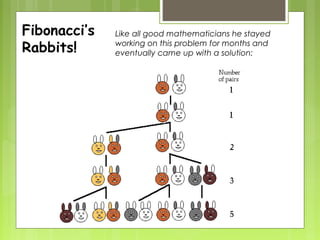
Fibonacci’s
Rabbits!

Like all good mathematicians he stayed
working on this problem for months and
eventually came up with a solution:
A load of…
 Fibonacci’s

rabbit theory turned out not
to be true BUT the sequence he created
IS incredibly useful…
 The sequence goes:
Can you work
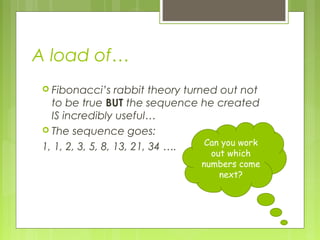
1, 1, 2, 3, 5, 8, 13, 21, 34 ….

out which
numbers come
next?
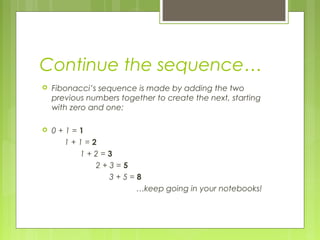
Continue the sequence…


Fibonacci’s sequence is made by adding the two
previous numbers together to create the next, starting
with zero and one:



0+1=1
1+1=2
1+2=3
2+3=5
3+5=8
…keep going in your notebooks!
 The

sequence Fibonacci created
may not have solved his rabbit
reproduction problem
 BUT other mathematicians looked
at his numbers and started seeing
them all over the place.
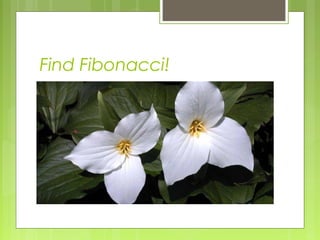
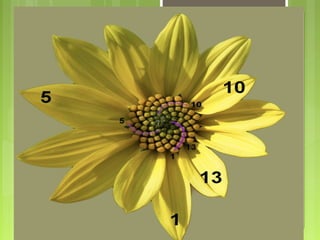
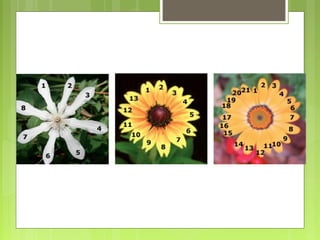
Find Fibonacci!
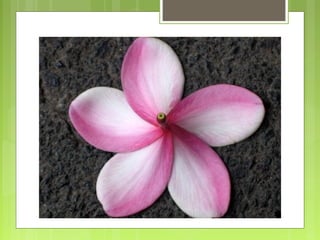
Other patterns in nature…
 Nature

may be full of Fibonacci but
not EVERY plant or flower has a
Fibonacci number.

 There

are plenty of other interesting
patterns to look out for.

 Can

you think of any patterns?
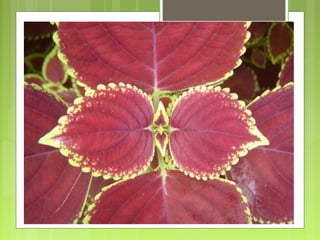
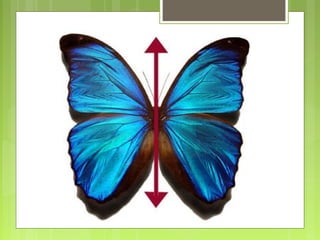
1. Symmetry…
SYMMETRY

– You can find symmetry
in leaves, flowers, insects and
animals.
Can

you think of any examples?
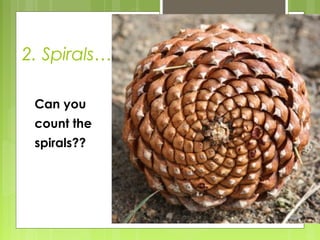
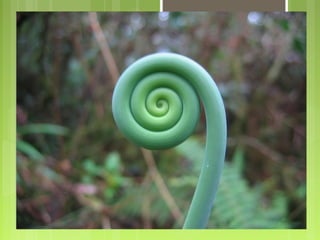
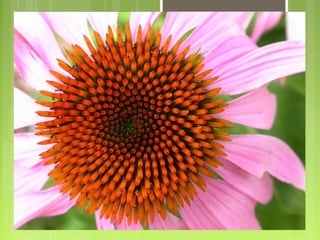
2. Spirals…
Can you
count the
spirals??
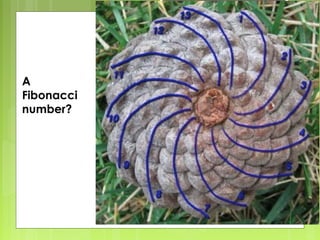
A
Fibonacci
number?
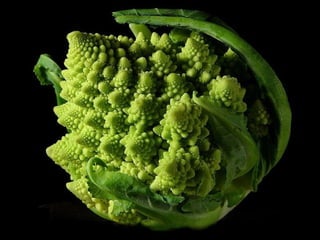
Check this out!
 Look

at what your teacher has brought in
and talk about any pattern you see.
3. Fractals…
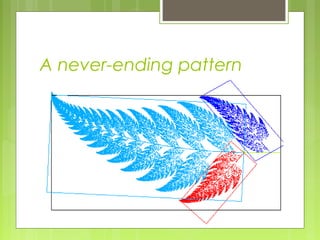
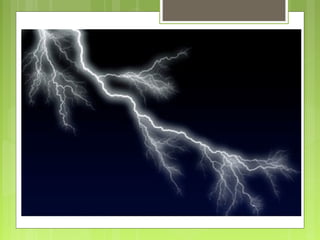
 Some

plants have fractal patterns. A
fractal is a never-ending pattern that
repeats itself at different scales.

A

fractal continually reproduces copies of
itself in various sizes and/or directions.

 Fractals

are extremely complex,
sometimes infinitely complex.
Watch this fractal zoooom!
 Watch

from 3:05 for one minute:
 http://www.youtube.com/watch?v=IIOQcJZlJE
 Watch

the same minute again and write
your own definition of a fractal.
A never-ending pattern
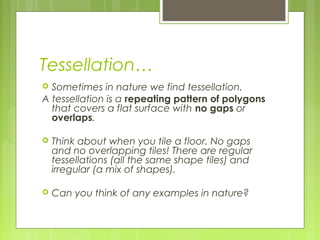
Tessellation…
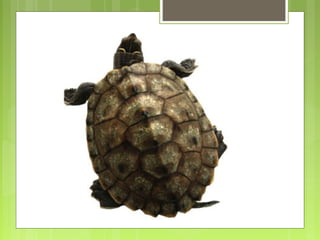
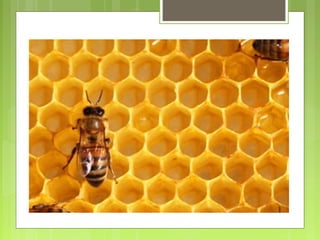
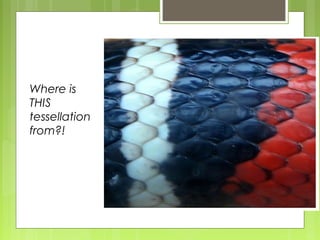
Sometimes in nature we find tessellation.
A tessellation is a repeating pattern of polygons
that covers a flat surface with no gaps or
overlaps.




Think about when you tile a floor. No gaps
and no overlapping tiles! There are regular
tessellations (all the same shape tiles) and
irregular (a mix of shapes).



Can you think of any examples in nature?
Where is
THIS
tessellation
from?!
Pattern hunters!
 With

all these patterns to search for, fifth
graders will be pattern hunters on Friday!

 With

your clipboards, pencils and lots of
curiosity, you will be searching for and
sketching patterns.
Good luck! 

Patterns in Nature

  • 2.
    Who IS Fibonacci? Fibonacciwas an Italian mathematician. He was really named Leonardo de Pisa but his nickname was Fibonacci. About 800 years ago, in 1202, he wrote himself a Maths problem all about rabbits that went like this: "A certain man put a pair of rabbits in a place surrounded by a wall. How many pairs of rabbits can be produced from that pair in a year if it is supposed that every month each pair breed a new pair from which the second month on becomes productive?" (Liber abbaci, pp. 283-284)
  • 3.
    Fibonacci’s Rabbits! Like all goodmathematicians he stayed working on this problem for months and eventually came up with a solution:
  • 4.
    A load of… Fibonacci’s rabbit theory turned out not to be true BUT the sequence he created IS incredibly useful…  The sequence goes: Can you work 1, 1, 2, 3, 5, 8, 13, 21, 34 …. out which numbers come next?
  • 5.
    Continue the sequence…  Fibonacci’ssequence is made by adding the two previous numbers together to create the next, starting with zero and one:  0+1=1 1+1=2 1+2=3 2+3=5 3+5=8 …keep going in your notebooks!
  • 6.
     The sequence Fibonaccicreated may not have solved his rabbit reproduction problem  BUT other mathematicians looked at his numbers and started seeing them all over the place.
  • 7.
  • 11.
    Other patterns innature…  Nature may be full of Fibonacci but not EVERY plant or flower has a Fibonacci number.  There are plenty of other interesting patterns to look out for.  Can you think of any patterns?
  • 12.
    1. Symmetry… SYMMETRY – Youcan find symmetry in leaves, flowers, insects and animals. Can you think of any examples?
  • 16.
  • 17.
  • 20.
    Check this out! Look at what your teacher has brought in and talk about any pattern you see.
  • 21.
    3. Fractals…  Some plantshave fractal patterns. A fractal is a never-ending pattern that repeats itself at different scales. A fractal continually reproduces copies of itself in various sizes and/or directions.  Fractals are extremely complex, sometimes infinitely complex.
  • 24.
    Watch this fractalzoooom!  Watch from 3:05 for one minute:  http://www.youtube.com/watch?v=IIOQcJZlJE  Watch the same minute again and write your own definition of a fractal.
  • 25.
  • 27.
    Tessellation… Sometimes in naturewe find tessellation. A tessellation is a repeating pattern of polygons that covers a flat surface with no gaps or overlaps.   Think about when you tile a floor. No gaps and no overlapping tiles! There are regular tessellations (all the same shape tiles) and irregular (a mix of shapes).  Can you think of any examples in nature?
  • 30.
  • 31.
    Pattern hunters!  With allthese patterns to search for, fifth graders will be pattern hunters on Friday!  With your clipboards, pencils and lots of curiosity, you will be searching for and sketching patterns. Good luck! 