Chapter Six Notes
Analyzing Inductive Arguments
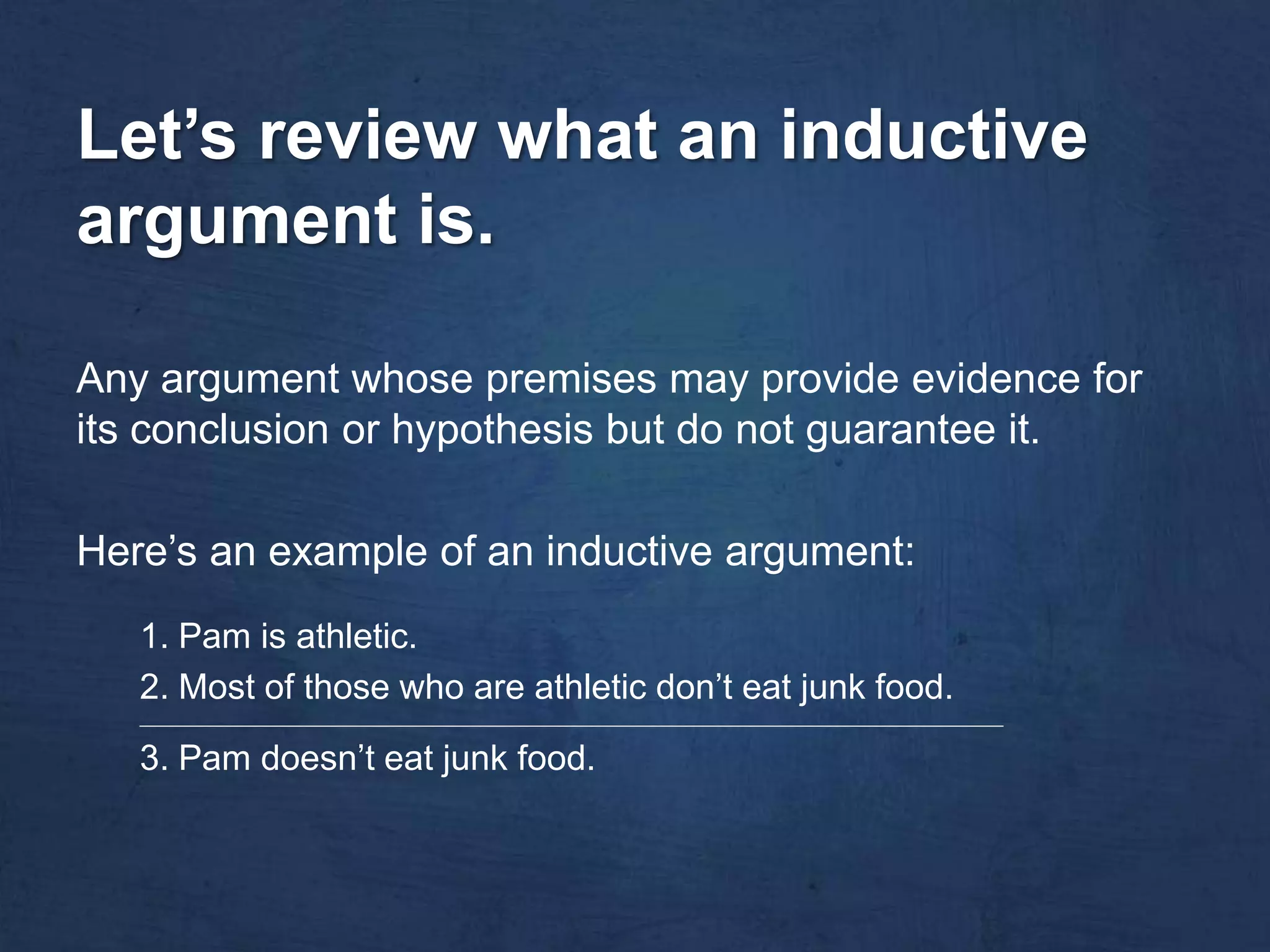
Let’s review what an inductive
argument is.

Any argument whose premises may provide evidence for
its conclusion or hypothesis but do not guarantee it.

Here’s an example of an inductive argument:
   1. Pam is athletic.
   2. Most of those who are athletic don’t eat junk food.
   _____________________________________________________________________________________________________________


   3. Pam doesn’t eat junk food.
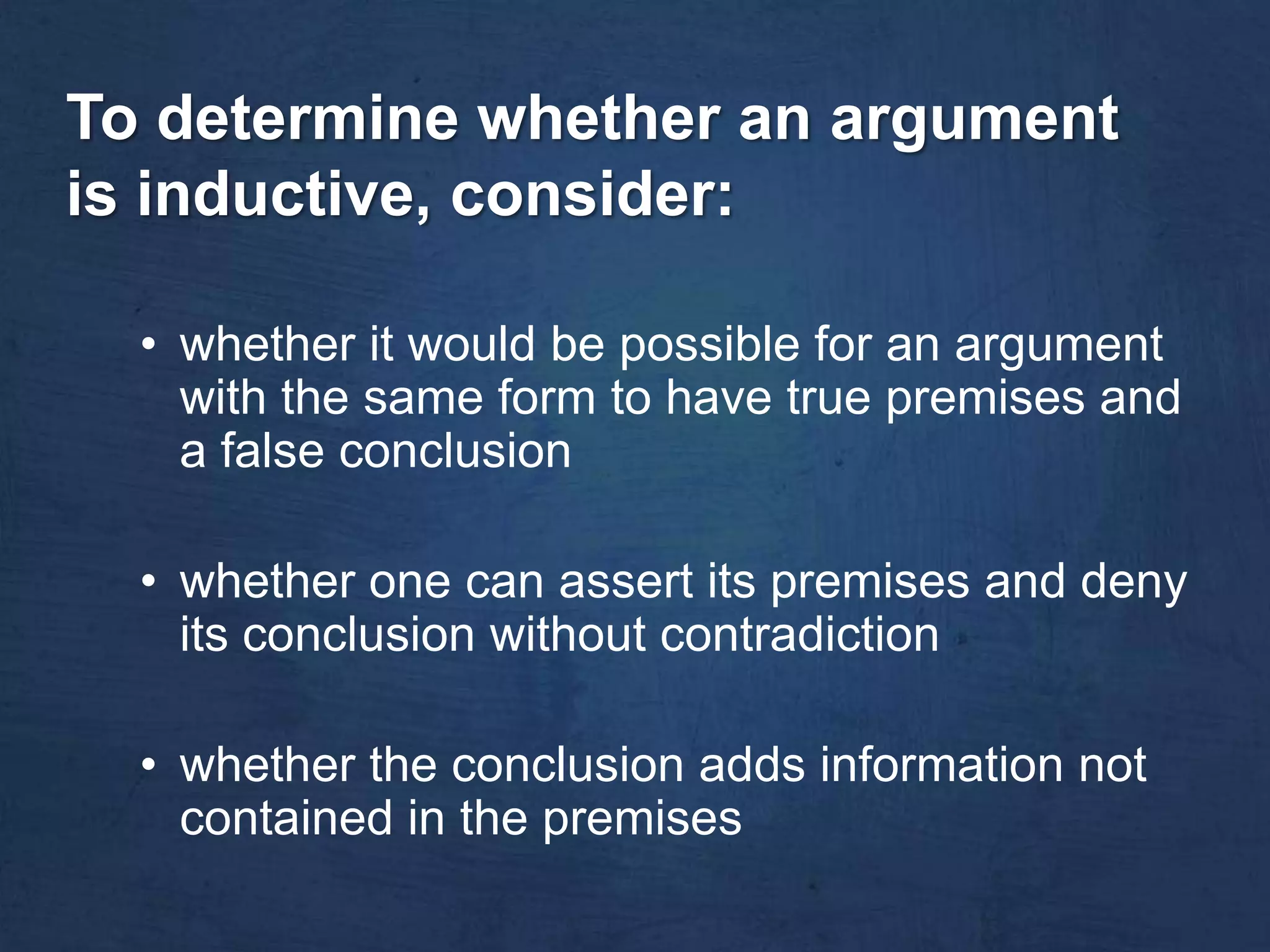
To determine whether an argument
is inductive, consider:

  • whether it would be possible for an argument
    with the same form to have true premises and
    a false conclusion

  • whether one can assert its premises and deny
    its conclusion without contradiction

  • whether the conclusion adds information not
    contained in the premises
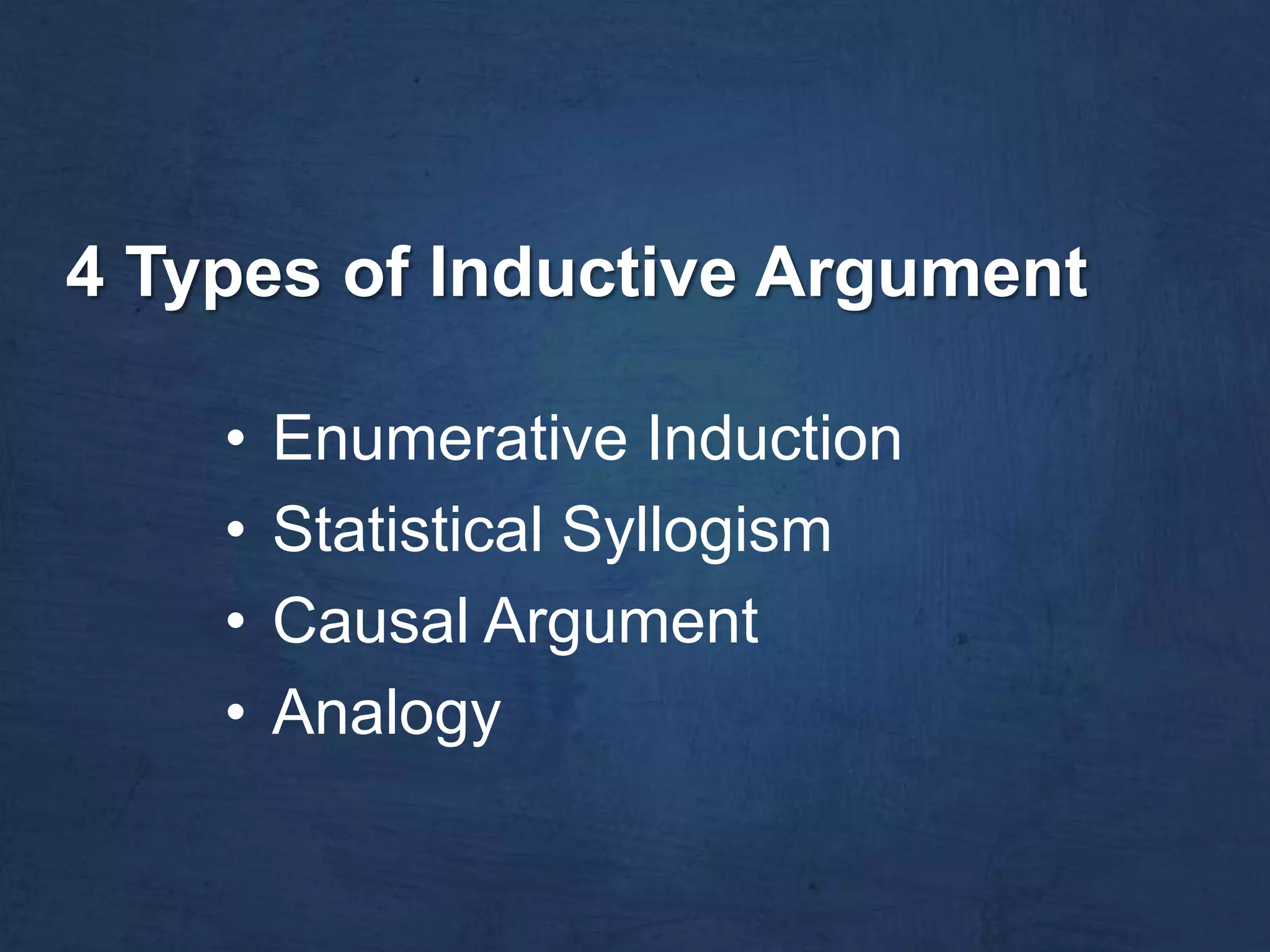
4 Types of Inductive Argument

    •   Enumerative Induction
    •   Statistical Syllogism
    •   Causal Argument
    •   Analogy
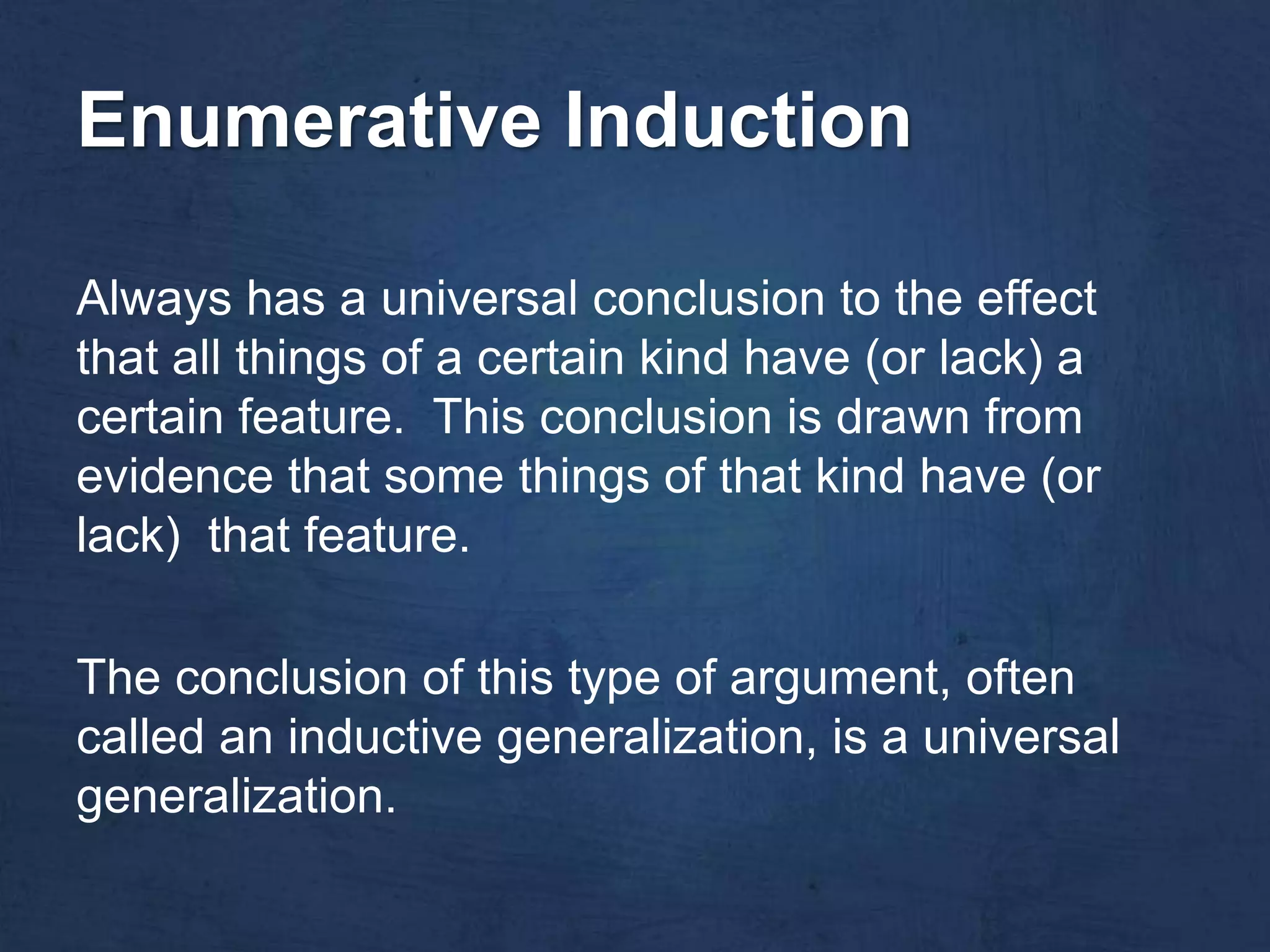
Enumerative Induction

Always has a universal conclusion to the effect
that all things of a certain kind have (or lack) a
certain feature. This conclusion is drawn from
evidence that some things of that kind have (or
lack) that feature.

The conclusion of this type of argument, often
called an inductive generalization, is a universal
generalization.
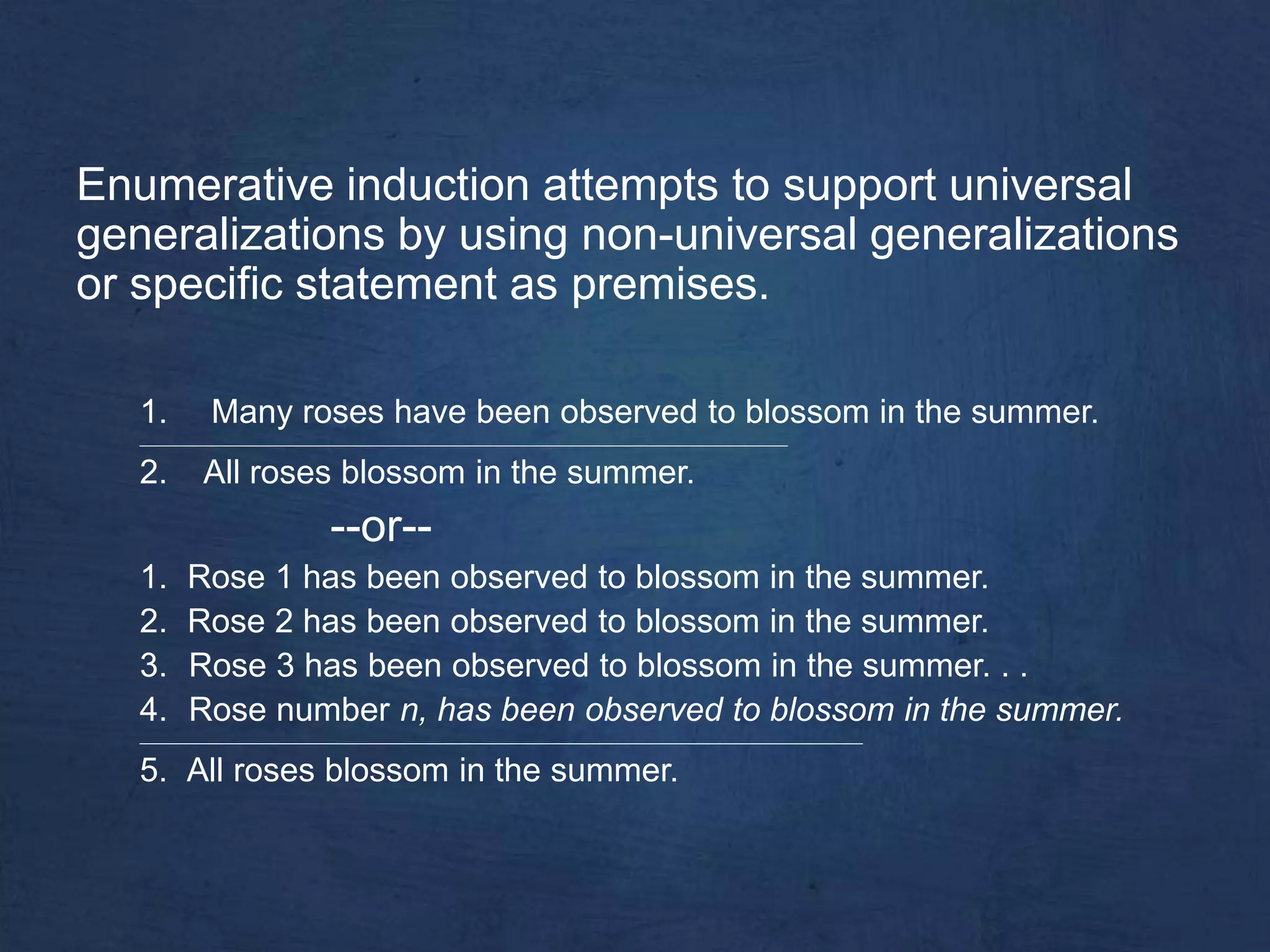
Enumerative induction attempts to support universal
generalizations by using non-universal generalizations
or specific statement as premises.

   1.        Many roses have been observed to blossom in the summer.
   _______________________________________________________________________________________________


   2.       All roses blossom in the summer.
                              --or--
   1.    Rose 1 has been observed to blossom in the summer.
   2.    Rose 2 has been observed to blossom in the summer.
   3.    Rose 3 has been observed to blossom in the summer. . .
   4.    Rose number n, has been observed to blossom in the summer.
   __________________________________________________________________________________________________________


   5. All roses blossom in the summer.
So what’s a universal generalization?

A statement asserting that all of the members of a certain
class have (or don’t have) a certain feature.

May be expressed by a great number of different patterns
of sentence.

      Some standard patterns:
        • “all . . . are”
        • “every . . . is”
        • “no . . . is”
Non-Universal Generalization
A statement asserting that some, perhaps many, of the
members of a class have (or don’t have) a certain
feature.

May be expressed by a great number of different
patterns of sentence. Some standard patterns:

      •   “most . . . are”
      •   “a few . . . are”
      •   “many . . . are”
      •   “n percent of . . . are” (where n is less than 100%)
      •   “some . . . are”
      •   “some . . . are not”
Statistical Syllogism

A statistical syllogism is an inductive argument
whereby a certain feature is ascribed to a case or
cases on the basis of their being subsumed within
a larger class of things, some of which, perhaps
many, have the ascribed feature.

  1. Most surgeons carry malpractice insurance.
  2. Dr. Hagopian is a surgeon.
  ________________________________________________________________________________________________________________


   3. Dr. Hagopian carries malpractice insurance.
Causal Argument
According to the textbook, a causal argument
makes the claim that two or more things or
events are causally related in either of these
ways:

  •   Effect E results from cause C.

  •   C causes E.

  •   E and C are the cause or the effect of another
      thing X.
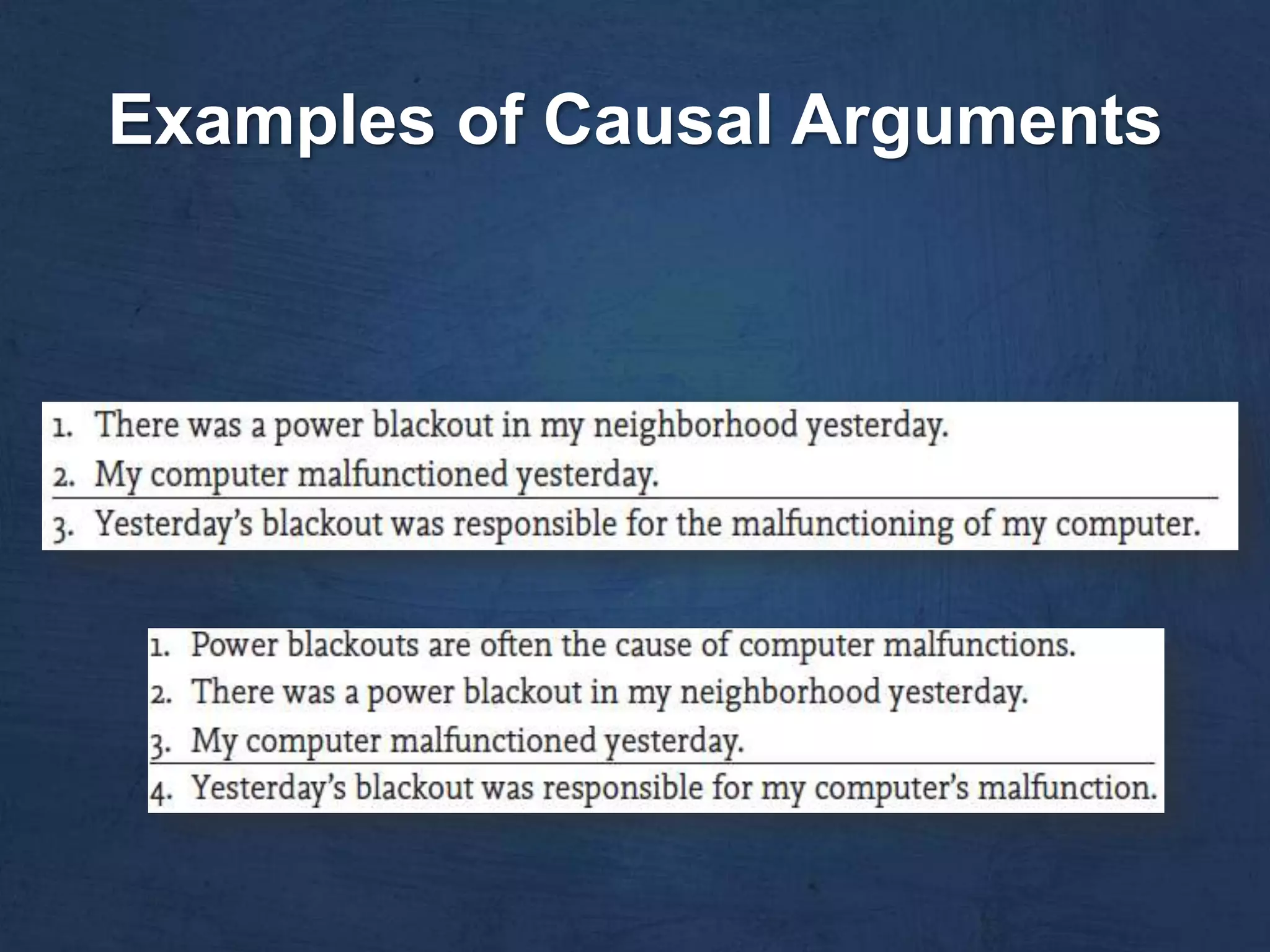
Examples of Causal Arguments

• HIV causes AIDS.

• Having the genome of a cat causes Fluffy
  the kitten to grow up to be a cat.
Three Meanings of Cause

• Sufficient Cause: C is a sufficient cause of E
  if, and only if, C always produces E.

• Necessary Cause: C is a necessary cause of
  E if, and only if, E cannot occur in the
  absence of C.

• Necessary and Sufficient Cause: C is a
  necessary and sufficient cause of E if, and
  only if, C always is the sole cause of E.
Analogy
Analogy is a type of inductive argument whereby a
certain conclusion about individuals, qualities, or
classes is drawn on the basis of some similarities with
other individuals, qualities, or classes.

Whether an analogy succeeds depends on:

   • the number of things and the number of features held to be
     analogous
   • the degree of similarity or dissimilarity among those things
   • the relevance of ascribed features to the hypothesis
   • the boldness of the hypothesis with respect to the evidence
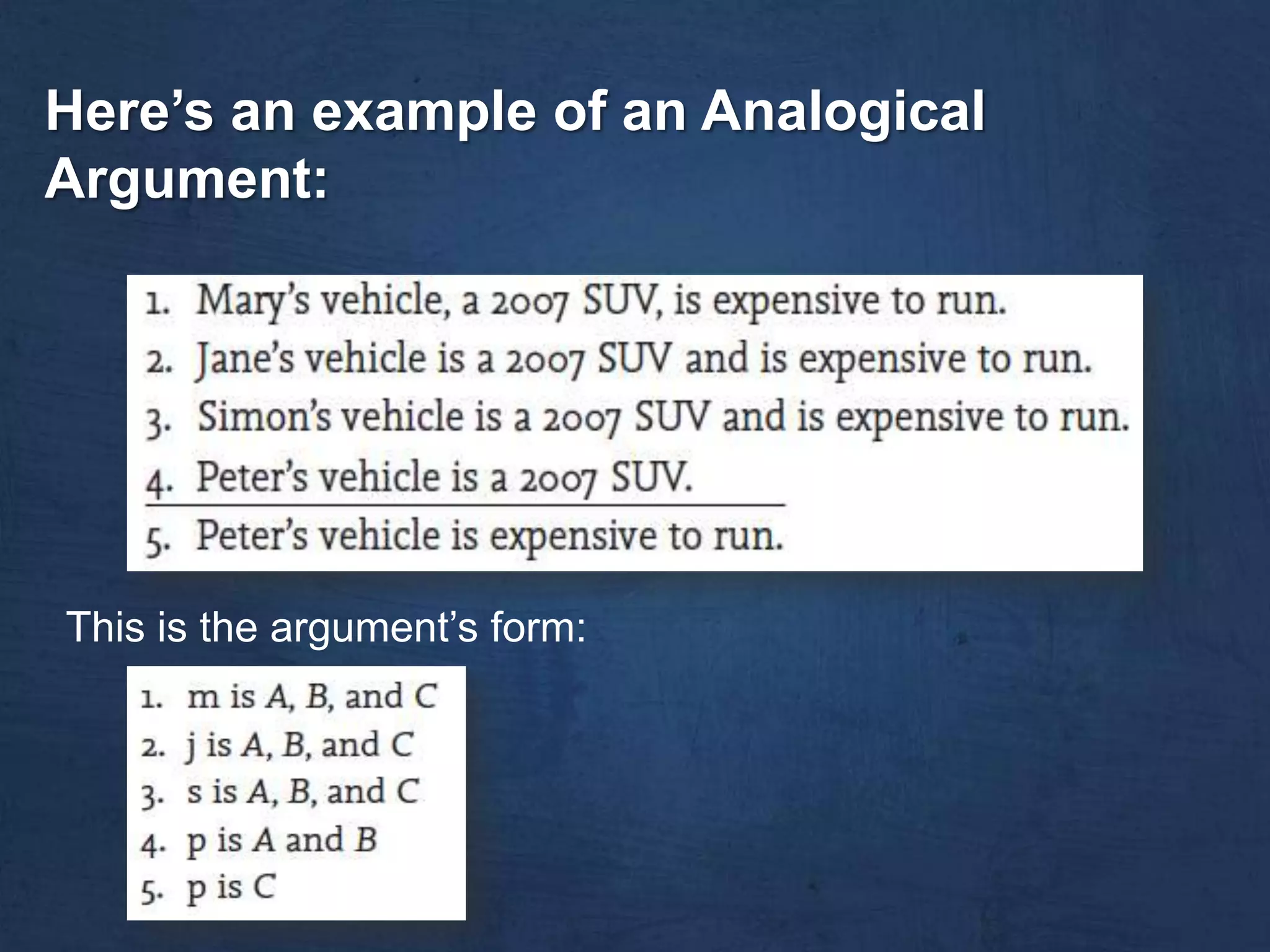
Here’s an example of an Analogical
Argument:


This is the argument’s form:
Criteria for Inductive Argument
Evaluation
Reliability
   Concerns argument form and is, in this respect, comparable
   to validity for deductive arguments.

   In a reliable argument, the relation of premises to conclusion
   is such that, if all the premises were true, it would be
   reasonable to accept the conclusion.


Strength
   Requires that the inductive argument be reliable and have
   true premises (compare deductive soundness). When an
   argument is inductively strong, it’s reasonable to accept its
   conclusion.
The “Cash Value” of Reliability
and Strength
Inductive Reliability’s Cash Value

  If an argument has a good share of reliability, then it would be
  reasonable to accept its conclusion, provided that its premises are
  true.


Inductive Strength’s Cash Value

  If an argument has a good share of inductive strength, then it’s
  reasonable to accept its conclusion, since it has a reliable form and
  its premises are true.

Chapter six

  • 1.
    Chapter Six Notes AnalyzingInductive Arguments
  • 2.
    Let’s review whatan inductive argument is. Any argument whose premises may provide evidence for its conclusion or hypothesis but do not guarantee it. Here’s an example of an inductive argument: 1. Pam is athletic. 2. Most of those who are athletic don’t eat junk food. _____________________________________________________________________________________________________________ 3. Pam doesn’t eat junk food.
  • 3.
    To determine whetheran argument is inductive, consider: • whether it would be possible for an argument with the same form to have true premises and a false conclusion • whether one can assert its premises and deny its conclusion without contradiction • whether the conclusion adds information not contained in the premises
  • 4.
    4 Types ofInductive Argument • Enumerative Induction • Statistical Syllogism • Causal Argument • Analogy
  • 5.
    Enumerative Induction Always hasa universal conclusion to the effect that all things of a certain kind have (or lack) a certain feature. This conclusion is drawn from evidence that some things of that kind have (or lack) that feature. The conclusion of this type of argument, often called an inductive generalization, is a universal generalization.
  • 6.
    Enumerative induction attemptsto support universal generalizations by using non-universal generalizations or specific statement as premises. 1. Many roses have been observed to blossom in the summer. _______________________________________________________________________________________________ 2. All roses blossom in the summer. --or-- 1. Rose 1 has been observed to blossom in the summer. 2. Rose 2 has been observed to blossom in the summer. 3. Rose 3 has been observed to blossom in the summer. . . 4. Rose number n, has been observed to blossom in the summer. __________________________________________________________________________________________________________ 5. All roses blossom in the summer.
  • 7.
    So what’s auniversal generalization? A statement asserting that all of the members of a certain class have (or don’t have) a certain feature. May be expressed by a great number of different patterns of sentence. Some standard patterns: • “all . . . are” • “every . . . is” • “no . . . is”
  • 8.
    Non-Universal Generalization A statementasserting that some, perhaps many, of the members of a class have (or don’t have) a certain feature. May be expressed by a great number of different patterns of sentence. Some standard patterns: • “most . . . are” • “a few . . . are” • “many . . . are” • “n percent of . . . are” (where n is less than 100%) • “some . . . are” • “some . . . are not”
  • 9.
    Statistical Syllogism A statisticalsyllogism is an inductive argument whereby a certain feature is ascribed to a case or cases on the basis of their being subsumed within a larger class of things, some of which, perhaps many, have the ascribed feature. 1. Most surgeons carry malpractice insurance. 2. Dr. Hagopian is a surgeon. ________________________________________________________________________________________________________________ 3. Dr. Hagopian carries malpractice insurance.
  • 10.
    Causal Argument According tothe textbook, a causal argument makes the claim that two or more things or events are causally related in either of these ways: • Effect E results from cause C. • C causes E. • E and C are the cause or the effect of another thing X.
  • 11.
  • 12.
    Examples of CausalArguments • HIV causes AIDS. • Having the genome of a cat causes Fluffy the kitten to grow up to be a cat.
  • 13.
    Three Meanings ofCause • Sufficient Cause: C is a sufficient cause of E if, and only if, C always produces E. • Necessary Cause: C is a necessary cause of E if, and only if, E cannot occur in the absence of C. • Necessary and Sufficient Cause: C is a necessary and sufficient cause of E if, and only if, C always is the sole cause of E.
  • 14.
    Analogy Analogy is atype of inductive argument whereby a certain conclusion about individuals, qualities, or classes is drawn on the basis of some similarities with other individuals, qualities, or classes. Whether an analogy succeeds depends on: • the number of things and the number of features held to be analogous • the degree of similarity or dissimilarity among those things • the relevance of ascribed features to the hypothesis • the boldness of the hypothesis with respect to the evidence
  • 15.
    Here’s an exampleof an Analogical Argument: This is the argument’s form:
  • 16.
    Criteria for InductiveArgument Evaluation Reliability Concerns argument form and is, in this respect, comparable to validity for deductive arguments. In a reliable argument, the relation of premises to conclusion is such that, if all the premises were true, it would be reasonable to accept the conclusion. Strength Requires that the inductive argument be reliable and have true premises (compare deductive soundness). When an argument is inductively strong, it’s reasonable to accept its conclusion.
  • 17.
    The “Cash Value”of Reliability and Strength Inductive Reliability’s Cash Value If an argument has a good share of reliability, then it would be reasonable to accept its conclusion, provided that its premises are true. Inductive Strength’s Cash Value If an argument has a good share of inductive strength, then it’s reasonable to accept its conclusion, since it has a reliable form and its premises are true.