INDUCTIVE
REASONING
Inductive reasoning
refers to the process of arriving
at a conclusion based on a set
of observations.
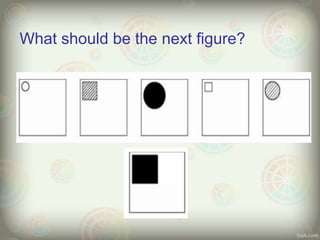
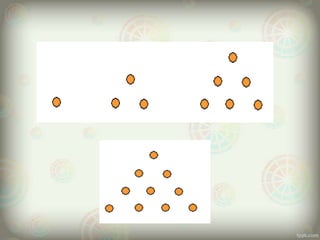
What should be the next figure?
Inductive reasoning refers to
reasoning that takes specific
information and makes a
broader generalization that is
considered probable, allowing
for the fact that the conclusion
may not be accurate.
In itself, it is not a valid
method
of
proof.
Just
because a person observes a
number of situations in which
a pattern exists doesn't mean
that that pattern is true for all
situations.
Inductive arguments are
arguments intended to be
judged
by
the
inductive
standard of, "Do the premises
make the conclusion probable?"
So the strengths of inductive
arguments range from
very weak to very strong.
Jill and Bob are friends. Jill likes to
dance, cook and write. Bob likes to
dance and cook. Therefore it can
be assumed that…

Bob also likes to write.
Robert is a teacher. All observed
teachers are nice. Therefore, it can
be assumed that…

Robert is nice.
John is a financial analyst.
Individuals with professions in
finance are observed to be very
serious.

John is a very serious
person.
Jenny is a dancer. Dancers are
observed to be thin and tall.

Jenny is thin and tall.
All observed police officers are
under 50 years old. John is a police
officer.

John is under 50 years old.

Inductive reasoning

  • 1.
  • 2.
    Inductive reasoning refers tothe process of arriving at a conclusion based on a set of observations.
  • 4.
    What should bethe next figure?
  • 7.
    Inductive reasoning refersto reasoning that takes specific information and makes a broader generalization that is considered probable, allowing for the fact that the conclusion may not be accurate.
  • 8.
    In itself, itis not a valid method of proof. Just because a person observes a number of situations in which a pattern exists doesn't mean that that pattern is true for all situations.
  • 9.
    Inductive arguments are argumentsintended to be judged by the inductive standard of, "Do the premises make the conclusion probable?" So the strengths of inductive arguments range from very weak to very strong.
  • 10.
    Jill and Bobare friends. Jill likes to dance, cook and write. Bob likes to dance and cook. Therefore it can be assumed that… Bob also likes to write.
  • 11.
    Robert is ateacher. All observed teachers are nice. Therefore, it can be assumed that… Robert is nice.
  • 12.
    John is afinancial analyst. Individuals with professions in finance are observed to be very serious. John is a very serious person.
  • 13.
    Jenny is adancer. Dancers are observed to be thin and tall. Jenny is thin and tall.
  • 14.
    All observed policeofficers are under 50 years old. John is a police officer. John is under 50 years old.