INTUITION, PROOF, AND
CERTAINTY
TOPICS
- What is intuition?
- Examples of intuition
- What is Proof?
- Examples of Proof
- What is certainty?
- Polya’s Problem Solving Strategy
2
WHAT IS INTUITION?
• INTUITION IS AN IMMEDIATE UNDERSTANDING OR KNOWING
SOMETHING WITHOUT REASONING
• INTUITION IS THAT FEELING IN YOUR GUT WHEN YOU
INSTINCTIVELY KNOW THAT SOMETHING YOU ARE DOING IS
RIGHT OR WRONG
• AN IMMEDIATE UNCONSCIOUS PERCEPTION
• DIRECT UNDERSTANDING OF TRUTHS - INDEPENDENCE OF
ANALYTICAL PROCESS A NON-LINEAR PROCESS OF KNOWING
THROUGH PHYSICAL AWARENESS, EMOTIONAL AWARENESS,
AND MAKING CONNECTION BETWEEN THEM
• AN IRRATIONAL UNCONSCIOUS TYPE OF KNOWING
WHAT IS INTUITION?
• There are a lot of definition of an intuition and one of these is that
it is an immediate understanding or knowing something without
reasoning.
• It does not require a big picture or full understanding of the
problem, as it uses a lot of small pieces of abstract information that
you have in your memory to create a reasoning leading to your
decision just from the limited information you have about the
problem in hand. Intuition comes from noticing, thinking and
questioning.
• As a student, you can build and improve your intuition by doing the
following: a. Be observant and see things visually towards with your
critical thinking.
• B. Make your own manipulation on the things that you have noticed
and observed.
• C. Do the right thinking and make a connections with it before
doing the solution.
EXAMPLES OF
INTUITION
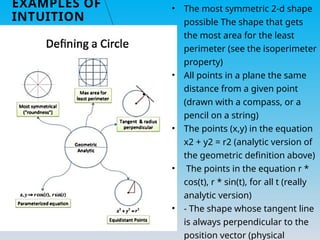
• The most symmetric 2-d shape
possible The shape that gets
the most area for the least
perimeter (see the isoperimeter
property)
• All points in a plane the same
distance from a given point
(drawn with a compass, or a
pencil on a string)
• The points (x,y) in the equation
x2 + y2 = r2 (analytic version of
the geometric definition above)
• The points in the equation r *
cos(t), r * sin(t), for all t (really
analytic version)
• - The shape whose tangent line
is always perpendicular to the
position vector (physical
1. Based on the given picture below, which among of the two
yellow lines is longer? Is it the upper one or the lower one?
6
The figure above is called Ponzo illusion (1911). There are two identical
yellow lines drawn horizontally in a railway track. If you will be observing
these two yellow lines, your mind tells you that upper yellow line looks
longer that the below yellow line. But in reality, the two lines has equal
length. For sure, you will be using a ruler to be able to determine which
of the two is longer than the other one. The exact reasoning could goes
like this. The upper yellow line looks longer because of the converging
sides of a railway. The farther the line, it seems look line longer that the
other yellow line below.
WHAT IS PROOF AND
CERTAINTY?
• By definition, a proof is an inferential argument for a
mathematical statement while proofs are an example
of mathematical logical certainty.
• A proof in mathematics is a convincing argument that
some mathematical statement is true. A proof should
contain enough mathematical detail to be convincing
to the person(s) to whom the proof is addressed
Proof Techniques used in Mathematics
 Direct Proof
 Proof by contradiction
 Proof by induction
 Proof by contrapositive
Examples of direct proof
► proof :the sum of any two consecutive numbers is odd
• 2+3 = odd
• 4+5 =odd
first, we define some definition:
definition 1: integer is even if n = 2k
definition 2: integer is odd if n = 2k +1
definition 3: two consecutive integers a and b are
consecutive if b = a+1
let a = integer
let b = consecutive integer = a+1
sum :
a + b
a + a+1
2a+1
based on our definition 2: integer is odd if n = 2k +1
therefore, we have a direct proof that the sum of two
consecutive integer is odd.
8
Example of Proof by Contradiction
• Proof
– Assume that a and b are consecutive integers
Assume that (a + b) is not odd, then no integer k such
that (a+b) = 2k+ 1
- Sum :
a + b
a + a +1
Statement 1: 2a+1
Statement 2: (a + b) = 2k+1
If k is not an integer, then why (a+b) = 2a+1, where a is an
integer??
These statements are contradicting!
Example of Proof by Induction
• Proof
- The sum of any two consecutive numbers is odd.
- 1+2 = 3 -> odd
- 5+6 = 11 -> odd
- 7+ 8 = 15 -> odd
Based on observations, (inductive reasoning) we have
proven that the sum of any two consecutive numbers is
odd
Example of Proof by Contrapositive
• Proof
- If the sum of (a + b) is NOT odd, then a and b are NOT
consecutive numbers
Make a statement that is consecutive and check the sum - We
know that (a + b) = K + (K+1) = 2k+1 K does not hold for any
integer K. K +1 is the successor of K. In order for
- • Therefore, we have proven that The sum of any two
consecutive numbers should be odd
Certainty
• the quality of being reliably true. Certainty is the
state of being definite or of having no doubts at all
about something
•examples:
probability is the branch of mathematics
concerning numerical descriptions of how likely an
event is to occur, or how likely it is that a
proposition is true.
The probability of an event is a number between 0
and 1, where, roughly speaking, 0 indicates
impossibility of the event and 1 indicates certainty
POLYA’S FOUR STEPS
IN PROBLEM SOLVING
• George Polya is one of the foremost recent mathematicians
to make a study of problem solving.
• He was born in Hungary and moved to the United States in
1940.
• He is also known as “The Father of Problem Solving”.
• He made fundamental contributions to combinatorics,
number theory, numerical analysis and probability theory.
• He is also noted for his work in heuristics and mathematics
education.
• Heuristic, a Greek word means that "find" or "discover" refers
to experience-based techniques for problem solving,
learning, and discovery that gives a solution which is not
15
THE GEORGE POLYA’S PROBLEM-
SOLVING METHOD ARE AS FOLLOWS:
Step 1. Understand the Problem.
Step 2. Devise a Plan
Step 3. Carry out the plan
 Step 4. Look back or Review the
Solution
16
THE GEORGE POLYA’S PROBLEM-
SOLVING METHOD ARE AS FOLLOWS:
Step 1. Understand the Problem.
Step 2. Devise a Plan
Step 3. Carry out the plan
 Step 4. Look back or Review the
Solution
THANK YOU
17

General math Intuition-Proof-and-Certainty.pptx

  • 1.
  • 2.
    TOPICS - What isintuition? - Examples of intuition - What is Proof? - Examples of Proof - What is certainty? - Polya’s Problem Solving Strategy 2
  • 3.
    WHAT IS INTUITION? •INTUITION IS AN IMMEDIATE UNDERSTANDING OR KNOWING SOMETHING WITHOUT REASONING • INTUITION IS THAT FEELING IN YOUR GUT WHEN YOU INSTINCTIVELY KNOW THAT SOMETHING YOU ARE DOING IS RIGHT OR WRONG • AN IMMEDIATE UNCONSCIOUS PERCEPTION • DIRECT UNDERSTANDING OF TRUTHS - INDEPENDENCE OF ANALYTICAL PROCESS A NON-LINEAR PROCESS OF KNOWING THROUGH PHYSICAL AWARENESS, EMOTIONAL AWARENESS, AND MAKING CONNECTION BETWEEN THEM • AN IRRATIONAL UNCONSCIOUS TYPE OF KNOWING
  • 4.
    WHAT IS INTUITION? •There are a lot of definition of an intuition and one of these is that it is an immediate understanding or knowing something without reasoning. • It does not require a big picture or full understanding of the problem, as it uses a lot of small pieces of abstract information that you have in your memory to create a reasoning leading to your decision just from the limited information you have about the problem in hand. Intuition comes from noticing, thinking and questioning. • As a student, you can build and improve your intuition by doing the following: a. Be observant and see things visually towards with your critical thinking. • B. Make your own manipulation on the things that you have noticed and observed. • C. Do the right thinking and make a connections with it before doing the solution.
  • 5.
    EXAMPLES OF INTUITION • Themost symmetric 2-d shape possible The shape that gets the most area for the least perimeter (see the isoperimeter property) • All points in a plane the same distance from a given point (drawn with a compass, or a pencil on a string) • The points (x,y) in the equation x2 + y2 = r2 (analytic version of the geometric definition above) • The points in the equation r * cos(t), r * sin(t), for all t (really analytic version) • - The shape whose tangent line is always perpendicular to the position vector (physical
  • 6.
    1. Based onthe given picture below, which among of the two yellow lines is longer? Is it the upper one or the lower one? 6 The figure above is called Ponzo illusion (1911). There are two identical yellow lines drawn horizontally in a railway track. If you will be observing these two yellow lines, your mind tells you that upper yellow line looks longer that the below yellow line. But in reality, the two lines has equal length. For sure, you will be using a ruler to be able to determine which of the two is longer than the other one. The exact reasoning could goes like this. The upper yellow line looks longer because of the converging sides of a railway. The farther the line, it seems look line longer that the other yellow line below.
  • 7.
    WHAT IS PROOFAND CERTAINTY? • By definition, a proof is an inferential argument for a mathematical statement while proofs are an example of mathematical logical certainty. • A proof in mathematics is a convincing argument that some mathematical statement is true. A proof should contain enough mathematical detail to be convincing to the person(s) to whom the proof is addressed Proof Techniques used in Mathematics  Direct Proof  Proof by contradiction  Proof by induction  Proof by contrapositive
  • 8.
    Examples of directproof ► proof :the sum of any two consecutive numbers is odd • 2+3 = odd • 4+5 =odd first, we define some definition: definition 1: integer is even if n = 2k definition 2: integer is odd if n = 2k +1 definition 3: two consecutive integers a and b are consecutive if b = a+1 let a = integer let b = consecutive integer = a+1 sum : a + b a + a+1 2a+1 based on our definition 2: integer is odd if n = 2k +1 therefore, we have a direct proof that the sum of two consecutive integer is odd. 8
  • 9.
    Example of Proofby Contradiction • Proof – Assume that a and b are consecutive integers Assume that (a + b) is not odd, then no integer k such that (a+b) = 2k+ 1 - Sum : a + b a + a +1 Statement 1: 2a+1 Statement 2: (a + b) = 2k+1 If k is not an integer, then why (a+b) = 2a+1, where a is an integer?? These statements are contradicting!
  • 10.
    Example of Proofby Induction • Proof - The sum of any two consecutive numbers is odd. - 1+2 = 3 -> odd - 5+6 = 11 -> odd - 7+ 8 = 15 -> odd Based on observations, (inductive reasoning) we have proven that the sum of any two consecutive numbers is odd
  • 11.
    Example of Proofby Contrapositive • Proof - If the sum of (a + b) is NOT odd, then a and b are NOT consecutive numbers Make a statement that is consecutive and check the sum - We know that (a + b) = K + (K+1) = 2k+1 K does not hold for any integer K. K +1 is the successor of K. In order for - • Therefore, we have proven that The sum of any two consecutive numbers should be odd
  • 12.
    Certainty • the qualityof being reliably true. Certainty is the state of being definite or of having no doubts at all about something •examples: probability is the branch of mathematics concerning numerical descriptions of how likely an event is to occur, or how likely it is that a proposition is true. The probability of an event is a number between 0 and 1, where, roughly speaking, 0 indicates impossibility of the event and 1 indicates certainty
  • 13.
    POLYA’S FOUR STEPS INPROBLEM SOLVING
  • 14.
    • George Polyais one of the foremost recent mathematicians to make a study of problem solving. • He was born in Hungary and moved to the United States in 1940. • He is also known as “The Father of Problem Solving”. • He made fundamental contributions to combinatorics, number theory, numerical analysis and probability theory. • He is also noted for his work in heuristics and mathematics education. • Heuristic, a Greek word means that "find" or "discover" refers to experience-based techniques for problem solving, learning, and discovery that gives a solution which is not
  • 15.
    15 THE GEORGE POLYA’SPROBLEM- SOLVING METHOD ARE AS FOLLOWS: Step 1. Understand the Problem. Step 2. Devise a Plan Step 3. Carry out the plan  Step 4. Look back or Review the Solution
  • 16.
    16 THE GEORGE POLYA’SPROBLEM- SOLVING METHOD ARE AS FOLLOWS: Step 1. Understand the Problem. Step 2. Devise a Plan Step 3. Carry out the plan  Step 4. Look back or Review the Solution
  • 17.

Editor's Notes

  • #13 One of the major problems of a student in mathematics is on how to solve worded problems correctly and accurately. Sometimes, they have difficulty understanding in grasping the main idea of a problem on how to deal with it and to solve it. It is very important that there is always a clear understanding on how to solve problems most especially in a Mathematics as a course. When you were in your senior high school, your teacher in mathematics especially in the course of Algebra taught you on how to solve problem using scientific method. Some of these problems are number problem, age problem, coin problem, work problem, mixture problem, etc. But not all problems in mathematics could be solve on what you have learned in your senior high school. Here, in this “Polya’s Four Steps in Solving Problem”, we will be learning on how to solve mathematical problem in a different way.
  • #15 Step 1. This part of Polya’s four-step strategy is often overlooked. You must have a clear understanding of the problem. To help you focus on understanding the problem, consider the following questions. These are some questions that you may be asked to yourself before you solve the problem. Are all words in a problem really understand and clear by the reader? Do the reader really know what is being asked in a problem on how to find the exact answer? Can a reader rephrase the problem by their own without deviating to its meaning? If necessary, do the reader can really visualize the real picture of the problem by drawing the diagram? Are the information in the problem complete or is there any missing information in a problem that could impossible to solve the problem? Step 2. Sometimes, it is necessary for us that to be able to solve a problem in mathematics, we need to devise a plan. Just like a Civil Engineer that before he construct a building, he needs to do a floor plan for a building that he wants to build. To be able to succeed to solve a problem, you could use different techniques or way in order to get a positive result. Here are some techniques that could be used. You could one of these or a combination to be able to solve the problem As much as possible, list down or identify all important information in the problem Sometimes, to be able to solve problem easily, you need to draw figures or diagram and tables or charts. Organized all information that are very essential to solve a problem. You could work backwards so that you could get the main idea of the problem. Look for a pattern and try to solve a similar but simpler problem. f. Create a working equation that determines the given (constant) and variable. g. You could use the experiment method and sometimes guessing is okay.
  • #16 Step 3. After we devised a plan, the next question is “How are we going to carry out the plan?” Now, to be able to carry out the plan, the following suggestions could help us in order to solve a problem. Carefully and accurately working on the problem. There must be a clear and essential information or data in the problem. If the first plan did not materialize, make another plan. Do not afraid to make mistakes if the first plan that you do would not materialize. There is a saying that “There is a second chance. Step 4. Just like on what you do in solving worded problems in Algebra, you should always check if your answer is correct or not. You need to review the solution that you have made. How will you check your solution? The following could be your guide. Make it sure that your solution is very accurate and it jibed all important details of the problem. Interpret the solution in the context of the problem. Try to ask yourself that the solutions you’ve made could also be used in other problems.