Lecture No.1
Introduction to Intelligence
Lecturer: Sajjad Ahmad Bhatti
Note:
• While studying artificially intelligence, you
need to know what intelligence is.
• This lecture covers Idea of intelligence, types,
and components of intelligence.
What is Intelligence?
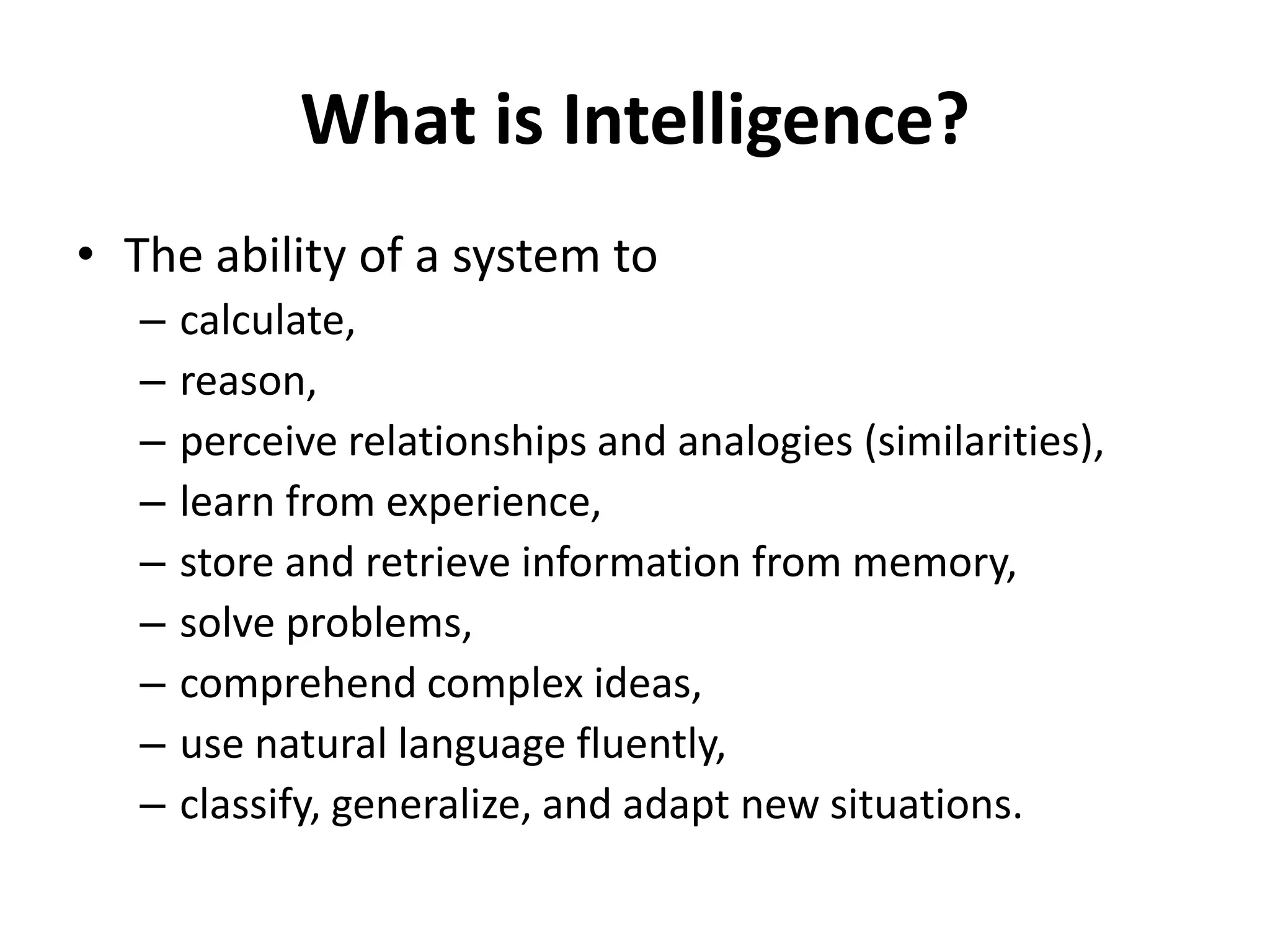
• The ability of a system to
– calculate,
– reason,
– perceive relationships and analogies (similarities),
– learn from experience,
– store and retrieve information from memory,
– solve problems,
– comprehend complex ideas,
– use natural language fluently,
– classify, generalize, and adapt new situations.
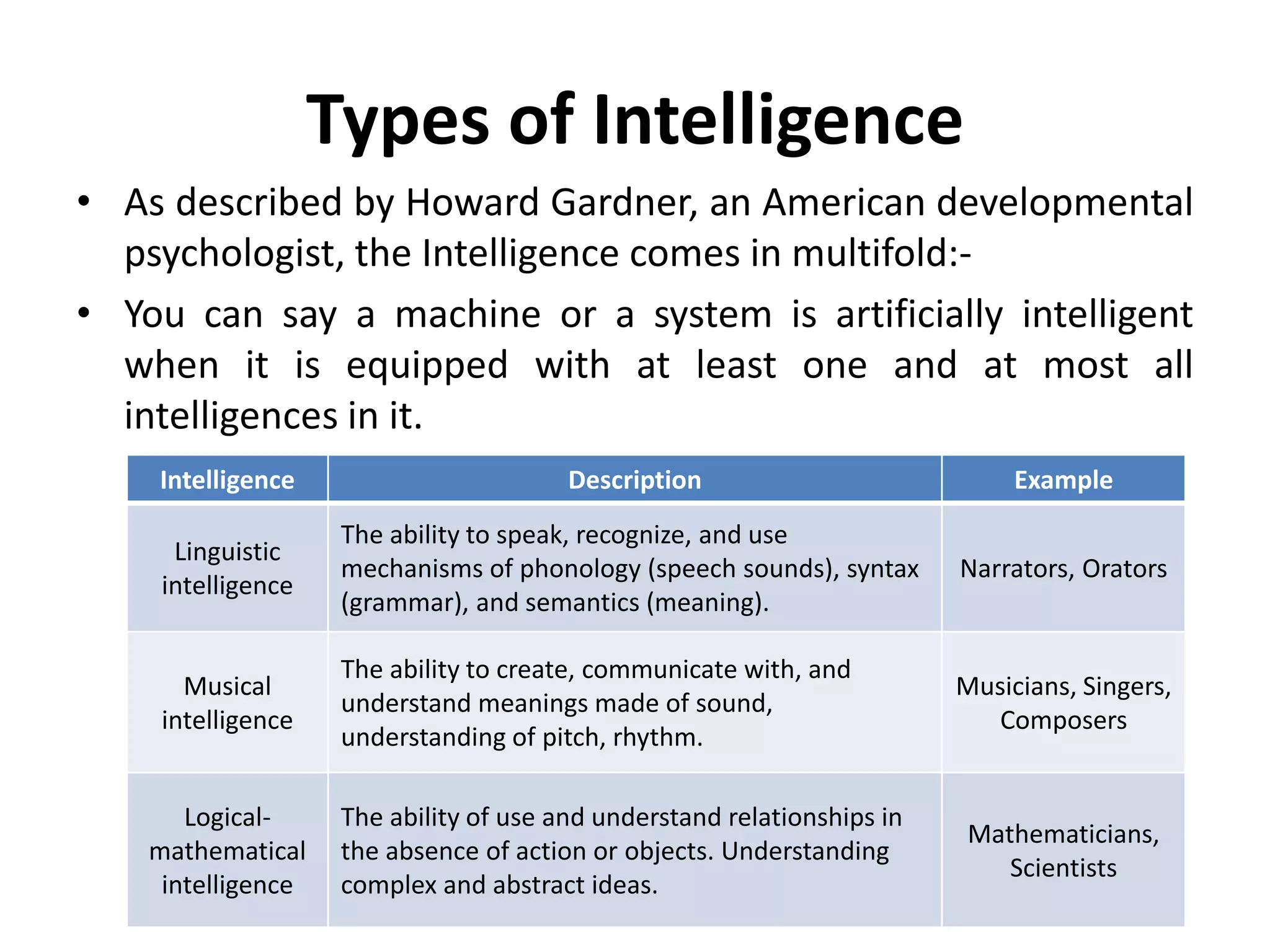
Types of Intelligence
• As described by Howard Gardner, an American developmental
psychologist, the Intelligence comes in multifold:-
• You can say a machine or a system is artificially intelligent
when it is equipped with at least one and at most all
intelligences in it.
Intelligence Description Example
Linguistic
intelligence
The ability to speak, recognize, and use
mechanisms of phonology (speech sounds), syntax
(grammar), and semantics (meaning).
Narrators, Orators
Musical
intelligence
The ability to create, communicate with, and
understand meanings made of sound,
understanding of pitch, rhythm.
Musicians, Singers,
Composers
Logical-
mathematical
intelligence
The ability of use and understand relationships in
the absence of action or objects. Understanding
complex and abstract ideas.
Mathematicians,
Scientists
Types of Intelligence
Intelligence Description Example
Spatial
intelligence
The ability to perceive visual or spatial information,
change it, and re-create visual images without
reference to the objects, construct 3D images, and
to move and rotate them.
Map readers,
Astronauts,
Physicists
Bodily-
Kinesthetic
intelligence
The ability to use complete or part of the body to
solve problems or fashion products, control over
fine and coarse motor skills, and manipulate the
objects.
Players, Dancers
Intra-
personal
intelligence
The ability to distinguish among one’s own feelings,
intentions, and motivations.
Gautam
Buddhha
Interpersonal
intelligence
The ability to recognize and make distinctions
among other people’s feelings, beliefs, and
intentions.
Mass
Communicators,
Interviewers
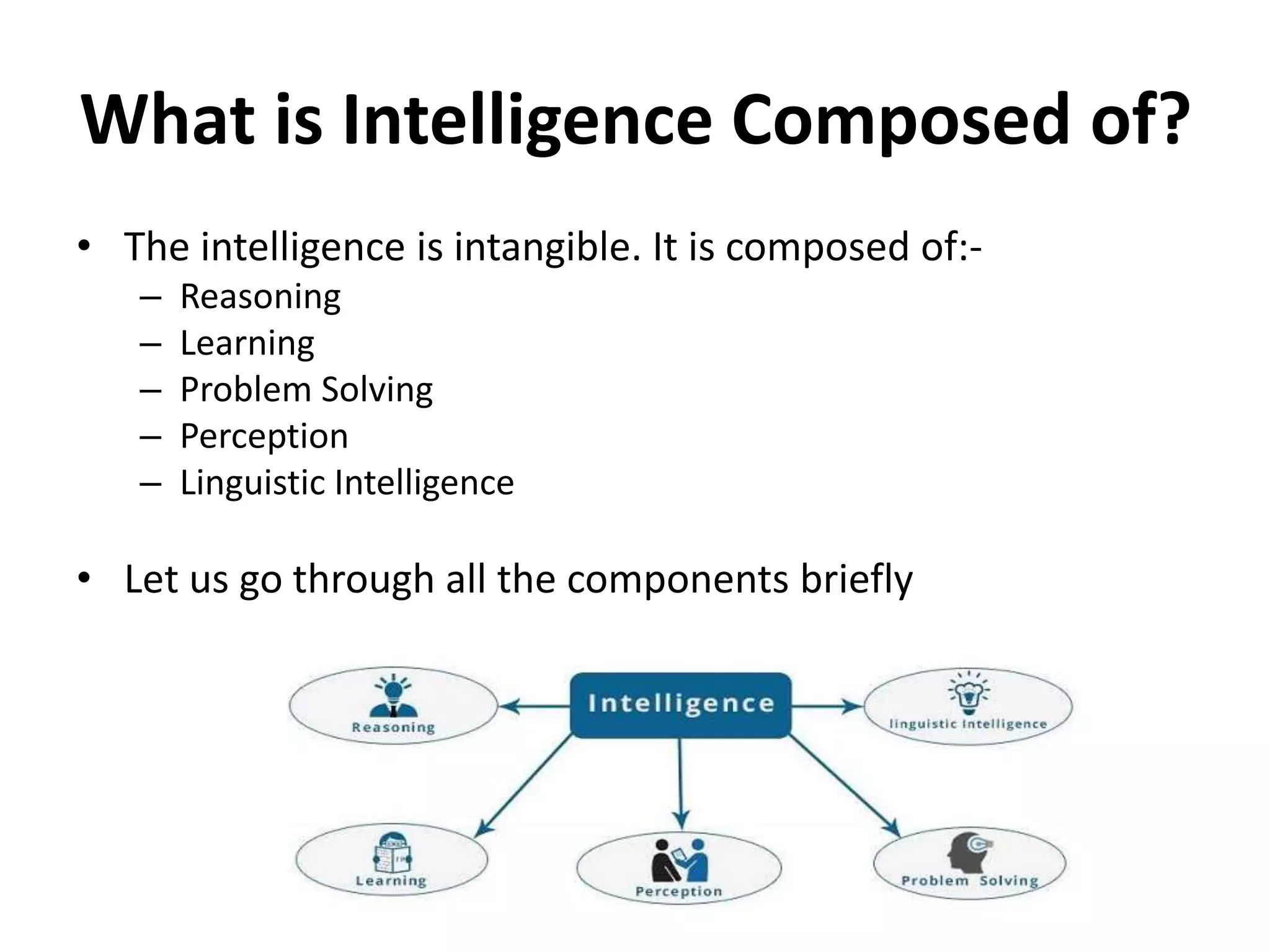
What is Intelligence Composed of?
• The intelligence is intangible. It is composed of:-
– Reasoning
– Learning
– Problem Solving
– Perception
– Linguistic Intelligence
• Let us go through all the components briefly
Reasoning
• It is the set of processes that enables us to
provide basis for judgment, making decisions,
and prediction.
• There are broadly two types:-
– Inductive Reasoning
– Deductive Reasoning
Inductive Reasoning
• Inductive reasoning is a logical process in which multiple premises,
all believed true or found true most of the time, are considered to
obtained a specific conclusion.
• The truth of the conclusion of an inductive argument is probable
rather certain.
• It conducts specific observations to makes broad general
statements.
• Even if all of the premises (evidences) are true in a statement,
inductive reasoning allows for the conclusion to be false.
• Inductive reasoning is often used in applications that involve
prediction, forecasting or behavior.
Examples of Inductive Reasoning
"Nita is a teacher. All teachers are studious. Therefore, Nita is studious.“
Every tornado I have ever seen in the United States rotated counter clockwise and I
have seen dozens of them.
We see a tornado in the distance, and we are in the United States.
I conclude that the tornado we see right now must be rotating counter clockwise.
Every time I've walked by that dog, it hasn't tried to bite me. So, the next time I walk
by that dog it won't try to bite me.
Aslam is a teacher. Aslam is Ph.D therefore all teachers are Ph.D.
The witness said John committed the murder. So, John committed the murder.
Other Example of Inductive Reasoning
• Example #1:
Look carefully at the following figures. Then,
use inductive reasoning to make a conjecture
about the next figure in the pattern
• If you have carefully observed the pattern,
may be you came up with the figure below:
Other Example of Inductive Reasoning
• Example #2:
• Look at the patterns below. Can you draw the next figure or next set of
dots using inductive reasoning?
• The trick is to see that one dot is always placed between and above two
dots. Also, the next figure always has one more dot at the very bottom
row
• Keeping this in mind, your next figure should look like this:
Other Example of Inductive Reasoning
• Example #3:
Take a look at this table that shows multiplication as repeated
addition:
Multiplication Repeated addition Sum
4 × -2 -2 + -2 + -2 + -2 - 8
3 × -7 -7 + -7 + -7 - 21
5 × -6 -6 + -6 + -6 + -6 + -6 - 30
What do you notice about the signs of the sums?
Since the sum is always negative, the pattern suggests that the
product of a positive integer and a negative integer is negative
Other Example of Inductive Reasoning
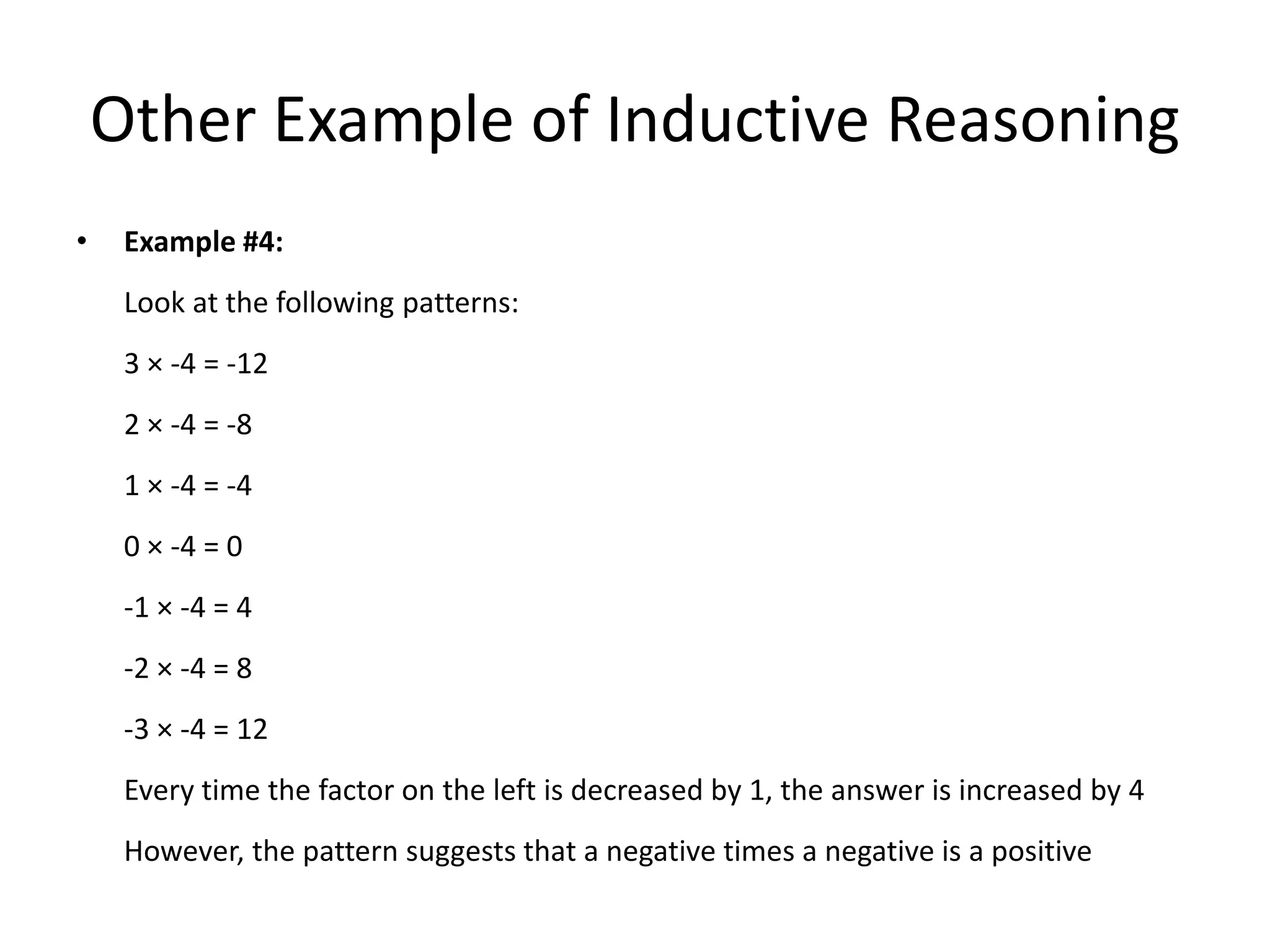
• Example #4:
Look at the following patterns:
3 × -4 = -12
2 × -4 = -8
1 × -4 = -4
0 × -4 = 0
-1 × -4 = 4
-2 × -4 = 8
-3 × -4 = 12
Every time the factor on the left is decreased by 1, the answer is increased by 4
However, the pattern suggests that a negative times a negative is a positive
Other Examples of Inductive Reasoning
• This cat is black. That cat is black A third cat is black. Therefore
all cats are black. 2
• This marble from the bag is black. That marble from the bag is
black. A third marble from the bag is black. Therefore all the
marbles in the bag black. 2
• Two-thirds of my latino neighbors are illegal immigrants.
Therefore, two-thirds of latino immigrants come illegally.
• Most universities and colleges in Utah ban alcohol from
campus. That most universities and colleges in the U.S. ban
alcohol from campus.
Other Examples of Inductive Reasoning
• Jennifer leaves for school at 7:00 a.m. Jennifer is always on time.
Jennifer assumes, then, that she will always be on time if she leaves
at 7:00 a.m.
• The cost of goods was $1.00. The cost of labor to manufacture the
time was $.50. The sales price of the item was $5.00; so, the item
always provides a good profit.
• Every windstorm in this area comes from the north. I can see a big
cloud of dust caused by a windstorm in the distance; so, a new
windstorm is coming from the north.
• Bob is showing a big diamond ring to his friend Larry. Bob has told
Larry that he is going to marry Joan. Bob has bought the diamond
ring to give to Joan.
Deductive Reasoning
• It starts with a general statement and
examines the possibilities to reach a specific,
logical conclusion.
• If something is true of a class of things in
general, it is also true for all members of that
class.
Example of Deductive Reasoning
"All women of age above 60 years are grandmothers. Shalini is 65 years.
Therefore, Shalini is a grandmother.“
A=B, B=C , A=C or A=B, A=D, B=D
All apples are fruits. A Granny Smith is an apple. Therefore, a Granny Smith is
a fruit.
All dogs have long ears. Puddles is a dog. Therefore, Puddles has long ears.
Since all humans are mortal, and I am a human, then I am mortal.
All numbers ending in 0 or 5 are divisible by 5. The number 35 ends with a 5,
so it is divisible by 5.
Deductive Reasoning Everyday Examples
• In mathematics, If A = B and B = C, then A = C.
• Since all humans are mortal, and I am a human, then I am mortal.
• All dolphins are mammals, all mammals have kidneys; therefore all
dolphins have kidneys.
• Since all squares are rectangles, and all rectangles have four sides,
so all squares have four sides.
• If Dennis misses work and at work there is a party, then Dennis will
miss the party.
• All numbers ending in 0 or 5 are divisible by 5. The number 35 ends
with a 5, so it is divisible by 5.
• To earn a master’s degree, a student must have 32 credits. Tim has
40 credits, so Tim will earn a master’s degree.
• All birds have feathers and robins are birds, so robins have feathers.
Deductive Reasoning Everyday Examples
• It is dangerous to drive on icy streets. The streets are icy now so it is
dangerous to drive now.
• All cats have a keen sense of smell. Fluffy is a cat, so Fluffy has a
keen sense of smell.
• Snakes are reptiles and reptiles are cold-blooded; therefore, snakes
are cold-blooded.
• Cacti are plants and all plants perform photosynthesis; therefore,
cacti perform photosynthesis.
• Red meat has iron in it and beef is red meat, so beef has iron in it.
• Acute angles are less than 90 degrees and this angle is 40 degrees
so this angle is acute.
• All noble gases are stable and helium is a noble gas, so helium is
stable.
• Magnolias are dicots and dicots have two embryonic leaves;
therefore magnolias have two embryonic leaves.
Learning
• It is the activity of gaining knowledge or skill
by studying, practicing, being taught, or
experiencing something. Learning enhances
the awareness of the subjects of the study.
• The ability of learning is possessed by
humans, some animals, and AI-enabled
systems.
Categorization of Learning
– Auditory Learning:-
• It is learning by listening and hearing.
• For example, students listening to recorded audio lectures.
– Episodic Learning:-
• To learn by remembering sequences of events that one has
witnessed or experienced.
– Motor Learning:-
• It is learning by precise movement of muscles.
• For example, picking objects, Writing, etc.
– Observational Learning:-
• To learn by watching and imitating others.
• For example, child tries to learn by mimicking her parent.
Categorization of Learning
– Perceptual Learning:-
• It is learning to recognize stimuli that one has seen
before.
• For example, identifying and classifying objects and
situations.
– Relational Learning:-
• It involves learning to differentiate among various
stimuli on the basis of relational properties, rather than
absolute properties.
• For Example, Adding ‘little less’ salt at the time of
cooking potatoes that came up salty last time, when
cooked with adding say a tablespoon of salt.
Categorization of Learning
– Spatial Learning:-
• It is learning through visual stimuli such as images,
colors, maps, etc. For
• Example, A person can create roadmap in mind before
actually following the road.
– Stimulus-Response Learning:-
• It is learning to perform a particular behavior when a
certain stimulus is present.
• For example, a dog raises its ear on hearing doorbell.
Problem Solving
• It is the process in which one perceives and tries
to arrive at a desired solution from a present
situation by taking some path, which is blocked
by known or unknown hurdles.
• Problem solving also includes decision making,
which is the process of selecting the best suitable
alternative out of multiple alternatives to reach
the desired goal are available.
Perception
• It is the process of acquiring, interpreting,
selecting, and organizing sensory information.
• Perception presumes sensing. In humans,
perception is aided by sensory organs.
• In the domain of AI, perception mechanism
puts the data acquired by the sensors
together in a meaningful manner.
Linguistic Intelligence
• It is one’s ability to use, comprehend, speak,
and write the verbal and written language.
• It is important in interpersonal
communication.
Difference between Human and
Machine Intelligence
• Humans perceive by patterns whereas the
machines perceive by set of rules and data.
• Humans store and recall information by patterns,
machines do it by searching algorithms.
– For example, the number 40404040 is easy to
remember, store, and recall as its pattern is simple.
• Humans can figure out the complete object even
if some part of it is missing or distorted; whereas
the machines cannot do it correctly.

Lecture No.1 Introduction to Intelligence.pptx

  • 1.
    Lecture No.1 Introduction toIntelligence Lecturer: Sajjad Ahmad Bhatti
  • 2.
    Note: • While studyingartificially intelligence, you need to know what intelligence is. • This lecture covers Idea of intelligence, types, and components of intelligence.
  • 3.
    What is Intelligence? •The ability of a system to – calculate, – reason, – perceive relationships and analogies (similarities), – learn from experience, – store and retrieve information from memory, – solve problems, – comprehend complex ideas, – use natural language fluently, – classify, generalize, and adapt new situations.
  • 4.
    Types of Intelligence •As described by Howard Gardner, an American developmental psychologist, the Intelligence comes in multifold:- • You can say a machine or a system is artificially intelligent when it is equipped with at least one and at most all intelligences in it. Intelligence Description Example Linguistic intelligence The ability to speak, recognize, and use mechanisms of phonology (speech sounds), syntax (grammar), and semantics (meaning). Narrators, Orators Musical intelligence The ability to create, communicate with, and understand meanings made of sound, understanding of pitch, rhythm. Musicians, Singers, Composers Logical- mathematical intelligence The ability of use and understand relationships in the absence of action or objects. Understanding complex and abstract ideas. Mathematicians, Scientists
  • 5.
    Types of Intelligence IntelligenceDescription Example Spatial intelligence The ability to perceive visual or spatial information, change it, and re-create visual images without reference to the objects, construct 3D images, and to move and rotate them. Map readers, Astronauts, Physicists Bodily- Kinesthetic intelligence The ability to use complete or part of the body to solve problems or fashion products, control over fine and coarse motor skills, and manipulate the objects. Players, Dancers Intra- personal intelligence The ability to distinguish among one’s own feelings, intentions, and motivations. Gautam Buddhha Interpersonal intelligence The ability to recognize and make distinctions among other people’s feelings, beliefs, and intentions. Mass Communicators, Interviewers
  • 6.
    What is IntelligenceComposed of? • The intelligence is intangible. It is composed of:- – Reasoning – Learning – Problem Solving – Perception – Linguistic Intelligence • Let us go through all the components briefly
  • 7.
    Reasoning • It isthe set of processes that enables us to provide basis for judgment, making decisions, and prediction. • There are broadly two types:- – Inductive Reasoning – Deductive Reasoning
  • 8.
    Inductive Reasoning • Inductivereasoning is a logical process in which multiple premises, all believed true or found true most of the time, are considered to obtained a specific conclusion. • The truth of the conclusion of an inductive argument is probable rather certain. • It conducts specific observations to makes broad general statements. • Even if all of the premises (evidences) are true in a statement, inductive reasoning allows for the conclusion to be false. • Inductive reasoning is often used in applications that involve prediction, forecasting or behavior.
  • 9.
    Examples of InductiveReasoning "Nita is a teacher. All teachers are studious. Therefore, Nita is studious.“ Every tornado I have ever seen in the United States rotated counter clockwise and I have seen dozens of them. We see a tornado in the distance, and we are in the United States. I conclude that the tornado we see right now must be rotating counter clockwise. Every time I've walked by that dog, it hasn't tried to bite me. So, the next time I walk by that dog it won't try to bite me. Aslam is a teacher. Aslam is Ph.D therefore all teachers are Ph.D. The witness said John committed the murder. So, John committed the murder.
  • 10.
    Other Example ofInductive Reasoning • Example #1: Look carefully at the following figures. Then, use inductive reasoning to make a conjecture about the next figure in the pattern • If you have carefully observed the pattern, may be you came up with the figure below:
  • 11.
    Other Example ofInductive Reasoning • Example #2: • Look at the patterns below. Can you draw the next figure or next set of dots using inductive reasoning? • The trick is to see that one dot is always placed between and above two dots. Also, the next figure always has one more dot at the very bottom row • Keeping this in mind, your next figure should look like this:
  • 12.
    Other Example ofInductive Reasoning • Example #3: Take a look at this table that shows multiplication as repeated addition: Multiplication Repeated addition Sum 4 × -2 -2 + -2 + -2 + -2 - 8 3 × -7 -7 + -7 + -7 - 21 5 × -6 -6 + -6 + -6 + -6 + -6 - 30 What do you notice about the signs of the sums? Since the sum is always negative, the pattern suggests that the product of a positive integer and a negative integer is negative
  • 13.
    Other Example ofInductive Reasoning • Example #4: Look at the following patterns: 3 × -4 = -12 2 × -4 = -8 1 × -4 = -4 0 × -4 = 0 -1 × -4 = 4 -2 × -4 = 8 -3 × -4 = 12 Every time the factor on the left is decreased by 1, the answer is increased by 4 However, the pattern suggests that a negative times a negative is a positive
  • 14.
    Other Examples ofInductive Reasoning • This cat is black. That cat is black A third cat is black. Therefore all cats are black. 2 • This marble from the bag is black. That marble from the bag is black. A third marble from the bag is black. Therefore all the marbles in the bag black. 2 • Two-thirds of my latino neighbors are illegal immigrants. Therefore, two-thirds of latino immigrants come illegally. • Most universities and colleges in Utah ban alcohol from campus. That most universities and colleges in the U.S. ban alcohol from campus.
  • 15.
    Other Examples ofInductive Reasoning • Jennifer leaves for school at 7:00 a.m. Jennifer is always on time. Jennifer assumes, then, that she will always be on time if she leaves at 7:00 a.m. • The cost of goods was $1.00. The cost of labor to manufacture the time was $.50. The sales price of the item was $5.00; so, the item always provides a good profit. • Every windstorm in this area comes from the north. I can see a big cloud of dust caused by a windstorm in the distance; so, a new windstorm is coming from the north. • Bob is showing a big diamond ring to his friend Larry. Bob has told Larry that he is going to marry Joan. Bob has bought the diamond ring to give to Joan.
  • 16.
    Deductive Reasoning • Itstarts with a general statement and examines the possibilities to reach a specific, logical conclusion. • If something is true of a class of things in general, it is also true for all members of that class.
  • 17.
    Example of DeductiveReasoning "All women of age above 60 years are grandmothers. Shalini is 65 years. Therefore, Shalini is a grandmother.“ A=B, B=C , A=C or A=B, A=D, B=D All apples are fruits. A Granny Smith is an apple. Therefore, a Granny Smith is a fruit. All dogs have long ears. Puddles is a dog. Therefore, Puddles has long ears. Since all humans are mortal, and I am a human, then I am mortal. All numbers ending in 0 or 5 are divisible by 5. The number 35 ends with a 5, so it is divisible by 5.
  • 18.
    Deductive Reasoning EverydayExamples • In mathematics, If A = B and B = C, then A = C. • Since all humans are mortal, and I am a human, then I am mortal. • All dolphins are mammals, all mammals have kidneys; therefore all dolphins have kidneys. • Since all squares are rectangles, and all rectangles have four sides, so all squares have four sides. • If Dennis misses work and at work there is a party, then Dennis will miss the party. • All numbers ending in 0 or 5 are divisible by 5. The number 35 ends with a 5, so it is divisible by 5. • To earn a master’s degree, a student must have 32 credits. Tim has 40 credits, so Tim will earn a master’s degree. • All birds have feathers and robins are birds, so robins have feathers.
  • 19.
    Deductive Reasoning EverydayExamples • It is dangerous to drive on icy streets. The streets are icy now so it is dangerous to drive now. • All cats have a keen sense of smell. Fluffy is a cat, so Fluffy has a keen sense of smell. • Snakes are reptiles and reptiles are cold-blooded; therefore, snakes are cold-blooded. • Cacti are plants and all plants perform photosynthesis; therefore, cacti perform photosynthesis. • Red meat has iron in it and beef is red meat, so beef has iron in it. • Acute angles are less than 90 degrees and this angle is 40 degrees so this angle is acute. • All noble gases are stable and helium is a noble gas, so helium is stable. • Magnolias are dicots and dicots have two embryonic leaves; therefore magnolias have two embryonic leaves.
  • 20.
    Learning • It isthe activity of gaining knowledge or skill by studying, practicing, being taught, or experiencing something. Learning enhances the awareness of the subjects of the study. • The ability of learning is possessed by humans, some animals, and AI-enabled systems.
  • 21.
    Categorization of Learning –Auditory Learning:- • It is learning by listening and hearing. • For example, students listening to recorded audio lectures. – Episodic Learning:- • To learn by remembering sequences of events that one has witnessed or experienced. – Motor Learning:- • It is learning by precise movement of muscles. • For example, picking objects, Writing, etc. – Observational Learning:- • To learn by watching and imitating others. • For example, child tries to learn by mimicking her parent.
  • 22.
    Categorization of Learning –Perceptual Learning:- • It is learning to recognize stimuli that one has seen before. • For example, identifying and classifying objects and situations. – Relational Learning:- • It involves learning to differentiate among various stimuli on the basis of relational properties, rather than absolute properties. • For Example, Adding ‘little less’ salt at the time of cooking potatoes that came up salty last time, when cooked with adding say a tablespoon of salt.
  • 23.
    Categorization of Learning –Spatial Learning:- • It is learning through visual stimuli such as images, colors, maps, etc. For • Example, A person can create roadmap in mind before actually following the road. – Stimulus-Response Learning:- • It is learning to perform a particular behavior when a certain stimulus is present. • For example, a dog raises its ear on hearing doorbell.
  • 24.
    Problem Solving • Itis the process in which one perceives and tries to arrive at a desired solution from a present situation by taking some path, which is blocked by known or unknown hurdles. • Problem solving also includes decision making, which is the process of selecting the best suitable alternative out of multiple alternatives to reach the desired goal are available.
  • 25.
    Perception • It isthe process of acquiring, interpreting, selecting, and organizing sensory information. • Perception presumes sensing. In humans, perception is aided by sensory organs. • In the domain of AI, perception mechanism puts the data acquired by the sensors together in a meaningful manner.
  • 26.
    Linguistic Intelligence • Itis one’s ability to use, comprehend, speak, and write the verbal and written language. • It is important in interpersonal communication.
  • 27.
    Difference between Humanand Machine Intelligence • Humans perceive by patterns whereas the machines perceive by set of rules and data. • Humans store and recall information by patterns, machines do it by searching algorithms. – For example, the number 40404040 is easy to remember, store, and recall as its pattern is simple. • Humans can figure out the complete object even if some part of it is missing or distorted; whereas the machines cannot do it correctly.