Formal Versus Informal Logic
Deductive Versus Inductive
Forms of Reasoning
Two basic categories
of human reasoning
• Deduction: reasoning from general premises, which are
known or presumed to be known, to more specific, certain
conclusions.
• Induction: reasoning from specific cases to more
general, but uncertain, conclusions.
• Both deductive and inductive arguments occur frequently
and naturally…both forms of reasoning can be equally
compelling and persuasive, and neither form is preferred
over the other (Hollihan & Baske, 1994).
Deduction Vs. Induction
Deduction:
• commonly associated
with “formal logic.”
• involves reasoning
from known premises,
or premises presumed
to be true, to a certain
conclusion.
• the conclusions
reached are certain,
inevitable,
inescapable.
Induction
• commonly known as
“informal logic,” or
“everyday argument”
• involves drawing
uncertain inferences,
based on probabalistic
reasoning.
• the conclusions
reached are probable,
reasonable, plausible,
believable.
Deductive Versus
Inductive Reasoning
Deduction
• It is the form or structure
of a deductive argument
that determines its validity
• the fundamental property
of a valid, deductive
argument is that if the
premises are true, then
the conclusion necessarily
follows.
• The conclusion is said to
be “entailed” in, or
contained in, the premises.
– example: use of DNA
testing to establish
paternity
Induction
• By contrast, the form or
structure of an inductive
argument has little to do with
its perceived believability or
credibility, apart from making
the argument seem more
clear or more well-organized.
• The receiver (or a 3rd party)
determines the worth of an
inductive argument
Inductive or deductive reasoning?
• A sample of fifty
motorists who were
stopped by the CHP at a
sobriety checkpoint on a
Saturday at midnight
revealed that one in four
drivers were either
uninsured, intoxicated,
or both. Thus, if you get
involved in an accident
on the freeway there is a
25% chance the other
motorist will be drunk or
uninsured.
• The Law of the Sea
treaty states that any
vessel beyond a 12 mile
limit is in international
waters. The treaty also
states that any vessel in
international waters
cannot be legally stopped
or boarded. Therefore,
when the U.S. Coast
Guard intercepts boats
coming from Cuba or
Haiti more than 12 miles
from the U.S. coast, it is
violating the Law of the
Sea.
Sample Deductive and Inductive Arguments
Example of
Deduction
• major premise: All
tortoises are
vegetarians
• minor premise:
Bessie is a tortoise
• conclusion:
Therefore, Bessie
is a vegetarian
Example of
Induction
• Boss to employee:
“Biff has a tattoo of an
anchor on his arm. He
probably served in the
Navy.”
Bessie
tortoisesvegetarian animals
sample “Venn diagram”
of a deductive argument
All tortoises
fall in the
circle of
animals that
are
vegetarians
Bessie falls into the circle
of animals that are
tortoises
Thus, Bessie
must be a
vegetarian
Other types of
deductive arguments
• Suppose every place in
the world that people
live is represented by
the blue space inside
the rectangle. Suppose
the long pink oval
represents all the
wooden houses in the
world. And, suppose
the green circle
represents Canada.
The most logical
conclusion one can
draw from the figure is:
A. all wooden houses
are found in Canada
B. Everyone lives in a
wooden house
C. Some Canadians live
in wooden houses
D. No one lives in
Canada
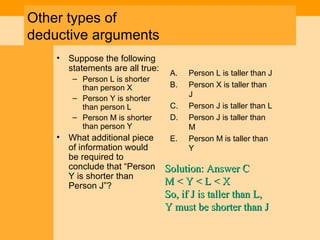
Other types of
deductive arguments
• Suppose the following
statements are all true:
– Person L is shorter
than person X
– Person Y is shorter
than person L
– Person M is shorter
than person Y
• What additional piece
of information would
be required to
conclude that “Person
Y is shorter than
Person J”?
A. Person L is taller than J
B. Person X is taller than
J
C. Person J is taller than L
D. Person J is taller than
M
E. Person M is taller than
Y
Solution: Answer CSolution: Answer C
M < Y < L < XM < Y < L < X
So, if J is taller than L,So, if J is taller than L,
Y must be shorter than JY must be shorter than J
Other types of
deductive arguments
A mother wants to order
one large pizza, with
exactly 5 toppings for her
three picky children. She
can choose from 7
toppings; cheese,
mushrooms, olives, ham,
sausage, onions, and
pineapple.
– Fifi says there has to be
pineapple
– Mona says there cannot
be any olives
– Rex says that if there is
going to be sausage,
then there has to be
ham too.
Which combination of
toppings should she
select if she is to satisfy
all three children’s
combined demands?
A. pineapple, onions,
cheese, mushrooms,
sausage
B. cheese, sausage, ham,
olives, pineapple
C. cheese, mushrooms,
ham, onions, pineapple
D. sausage, mushrooms,
onions, cheese, and
ham.
the five topping solution
chee
se
mushro
om
oliv
e
ham sausag
e
onio
n
pineapp
le
Fifi Yes
Mona No
Rex then
ham
if
sausa
ge
Note: the statement “if sausage, then ham” doesn’t
imply “If ham then sausage.” The obverse doesn’t
necessarily follow.
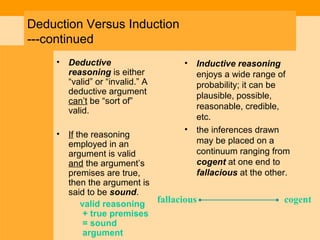
Deduction Versus Induction
---continued
• Deductive
reasoning is either
“valid” or “invalid.” A
deductive argument
can’t be “sort of”
valid.
• If the reasoning
employed in an
argument is valid
and the argument’s
premises are true,
then the argument is
said to be sound.
valid reasoning
+ true premises
= sound
argument
• Inductive reasoning
enjoys a wide range of
probability; it can be
plausible, possible,
reasonable, credible,
etc.
• the inferences drawn
may be placed on a
continuum ranging from
cogent at one end to
fallacious at the other.
fallacious cogent
Deduction Versus Induction
--still more
• Deductive reasoning is
commonly found in the
natural sciences or
“hard” sciences, less so
in everyday arguments
• Occasionally, everyday
arguments do involve
deductive reasoning:
Example: “Two or more
persons are required to
drive in the diamond
lane. You don’t have
two or more persons.
Therefore you may not
drive in the diamond
lane”
• Inductive reasoning is
found in the courtroom,
the boardroom, the
classroom, and
throughout the media
• Most, but not all everyday
arguments are based on
induction
– Examples: The
“reasonable person”
standard in civil law, and
the “beyond a
reasonable doubt”
standard in criminal law

Deduction vs. Induction

  • 1.
    Formal Versus InformalLogic Deductive Versus Inductive Forms of Reasoning
  • 2.
    Two basic categories ofhuman reasoning • Deduction: reasoning from general premises, which are known or presumed to be known, to more specific, certain conclusions. • Induction: reasoning from specific cases to more general, but uncertain, conclusions. • Both deductive and inductive arguments occur frequently and naturally…both forms of reasoning can be equally compelling and persuasive, and neither form is preferred over the other (Hollihan & Baske, 1994).
  • 3.
    Deduction Vs. Induction Deduction: •commonly associated with “formal logic.” • involves reasoning from known premises, or premises presumed to be true, to a certain conclusion. • the conclusions reached are certain, inevitable, inescapable. Induction • commonly known as “informal logic,” or “everyday argument” • involves drawing uncertain inferences, based on probabalistic reasoning. • the conclusions reached are probable, reasonable, plausible, believable.
  • 4.
    Deductive Versus Inductive Reasoning Deduction •It is the form or structure of a deductive argument that determines its validity • the fundamental property of a valid, deductive argument is that if the premises are true, then the conclusion necessarily follows. • The conclusion is said to be “entailed” in, or contained in, the premises. – example: use of DNA testing to establish paternity Induction • By contrast, the form or structure of an inductive argument has little to do with its perceived believability or credibility, apart from making the argument seem more clear or more well-organized. • The receiver (or a 3rd party) determines the worth of an inductive argument
  • 5.
    Inductive or deductivereasoning? • A sample of fifty motorists who were stopped by the CHP at a sobriety checkpoint on a Saturday at midnight revealed that one in four drivers were either uninsured, intoxicated, or both. Thus, if you get involved in an accident on the freeway there is a 25% chance the other motorist will be drunk or uninsured. • The Law of the Sea treaty states that any vessel beyond a 12 mile limit is in international waters. The treaty also states that any vessel in international waters cannot be legally stopped or boarded. Therefore, when the U.S. Coast Guard intercepts boats coming from Cuba or Haiti more than 12 miles from the U.S. coast, it is violating the Law of the Sea.
  • 6.
    Sample Deductive andInductive Arguments Example of Deduction • major premise: All tortoises are vegetarians • minor premise: Bessie is a tortoise • conclusion: Therefore, Bessie is a vegetarian Example of Induction • Boss to employee: “Biff has a tattoo of an anchor on his arm. He probably served in the Navy.”
  • 7.
    Bessie tortoisesvegetarian animals sample “Venndiagram” of a deductive argument All tortoises fall in the circle of animals that are vegetarians Bessie falls into the circle of animals that are tortoises Thus, Bessie must be a vegetarian
  • 8.
    Other types of deductivearguments • Suppose every place in the world that people live is represented by the blue space inside the rectangle. Suppose the long pink oval represents all the wooden houses in the world. And, suppose the green circle represents Canada. The most logical conclusion one can draw from the figure is: A. all wooden houses are found in Canada B. Everyone lives in a wooden house C. Some Canadians live in wooden houses D. No one lives in Canada
  • 9.
    Other types of deductivearguments • Suppose the following statements are all true: – Person L is shorter than person X – Person Y is shorter than person L – Person M is shorter than person Y • What additional piece of information would be required to conclude that “Person Y is shorter than Person J”? A. Person L is taller than J B. Person X is taller than J C. Person J is taller than L D. Person J is taller than M E. Person M is taller than Y Solution: Answer CSolution: Answer C M < Y < L < XM < Y < L < X So, if J is taller than L,So, if J is taller than L, Y must be shorter than JY must be shorter than J
  • 10.
    Other types of deductivearguments A mother wants to order one large pizza, with exactly 5 toppings for her three picky children. She can choose from 7 toppings; cheese, mushrooms, olives, ham, sausage, onions, and pineapple. – Fifi says there has to be pineapple – Mona says there cannot be any olives – Rex says that if there is going to be sausage, then there has to be ham too. Which combination of toppings should she select if she is to satisfy all three children’s combined demands? A. pineapple, onions, cheese, mushrooms, sausage B. cheese, sausage, ham, olives, pineapple C. cheese, mushrooms, ham, onions, pineapple D. sausage, mushrooms, onions, cheese, and ham.
  • 11.
    the five toppingsolution chee se mushro om oliv e ham sausag e onio n pineapp le Fifi Yes Mona No Rex then ham if sausa ge Note: the statement “if sausage, then ham” doesn’t imply “If ham then sausage.” The obverse doesn’t necessarily follow.
  • 12.
    Deduction Versus Induction ---continued •Deductive reasoning is either “valid” or “invalid.” A deductive argument can’t be “sort of” valid. • If the reasoning employed in an argument is valid and the argument’s premises are true, then the argument is said to be sound. valid reasoning + true premises = sound argument • Inductive reasoning enjoys a wide range of probability; it can be plausible, possible, reasonable, credible, etc. • the inferences drawn may be placed on a continuum ranging from cogent at one end to fallacious at the other. fallacious cogent
  • 13.
    Deduction Versus Induction --stillmore • Deductive reasoning is commonly found in the natural sciences or “hard” sciences, less so in everyday arguments • Occasionally, everyday arguments do involve deductive reasoning: Example: “Two or more persons are required to drive in the diamond lane. You don’t have two or more persons. Therefore you may not drive in the diamond lane” • Inductive reasoning is found in the courtroom, the boardroom, the classroom, and throughout the media • Most, but not all everyday arguments are based on induction – Examples: The “reasonable person” standard in civil law, and the “beyond a reasonable doubt” standard in criminal law