INDIRECT
OPHTHALMOSCOPY
DR. IDDI NDYABAWE
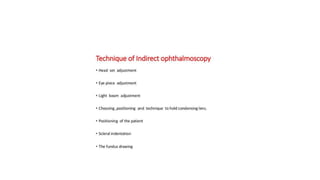
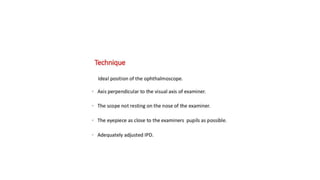
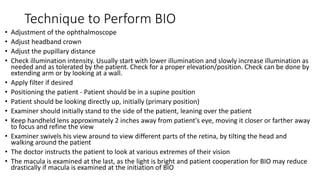
Technique to Perform BIO
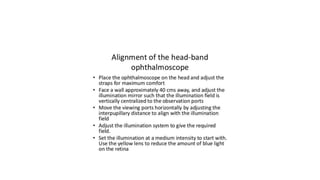
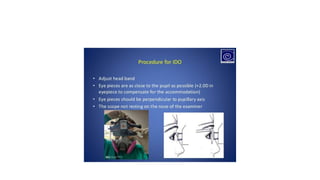
• Adjustment of the ophthalmoscope
• Adjust headband crown
• Adjust the pupillary distance
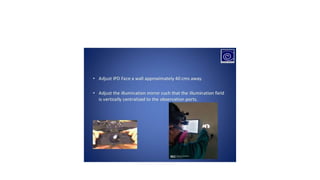
• Check illumination intensity. Usually start with lower illumination and slowly increase illumination as
needed and as tolerated by the patient. Check for a proper elevation/position. Check can be done by
extending arm or by looking at a wall.
• Apply filter if desired
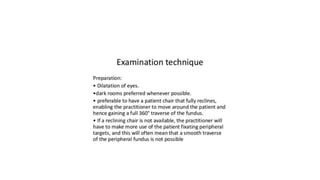
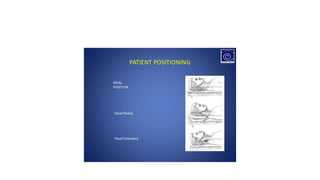
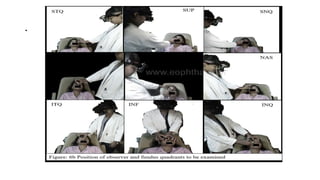
• Positioning the patient - Patient should be in a supine position
• Patient should be looking directly up, initially (primary position)
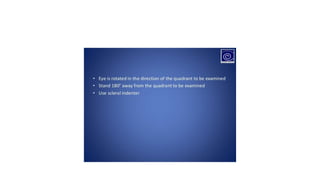
• Examiner should initially stand to the side of the patient, leaning over the patient
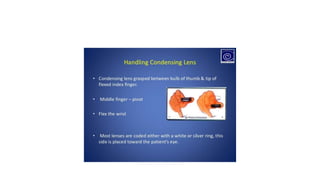
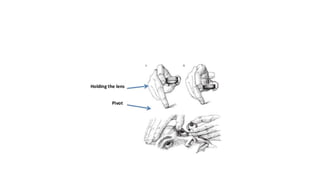
• Keep handheld lens approximately 2 inches away from patient's eye, moving it closer or farther away
to focus and refine the view
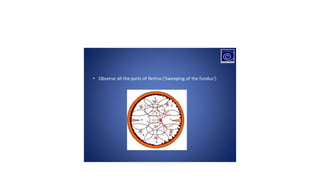
• Examiner swivels his view around to view different parts of the retina, by tilting the head and
walking around the patient
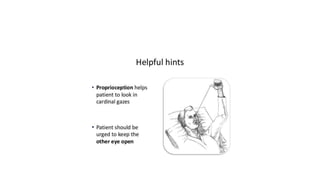
• The doctor instructs the patient to look at various extremes of their vision
• The macula is examined at the last, as the light is bright and patient cooperation for BIO may reduce
drastically if macula is examined at the initiation of BIO
.
• The retinal nerve fiber layer contains ganglion cell axons that run
toward the optic disc, with the temporal fibers following a arcuate
course around the fovea.
• The retinal nerve fiber layer is seen as bright striations and is most
easily visible where it is thickest, at the vertical poles of the optic disc
..

Indirect ophthalmoscopy

  • 1.
  • 16.
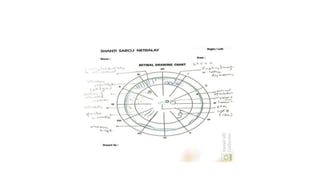
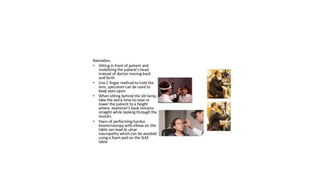
    Technique to PerformBIO • Adjustment of the ophthalmoscope • Adjust headband crown • Adjust the pupillary distance • Check illumination intensity. Usually start with lower illumination and slowly increase illumination as needed and as tolerated by the patient. Check for a proper elevation/position. Check can be done by extending arm or by looking at a wall. • Apply filter if desired • Positioning the patient - Patient should be in a supine position • Patient should be looking directly up, initially (primary position) • Examiner should initially stand to the side of the patient, leaning over the patient • Keep handheld lens approximately 2 inches away from patient's eye, moving it closer or farther away to focus and refine the view • Examiner swivels his view around to view different parts of the retina, by tilting the head and walking around the patient • The doctor instructs the patient to look at various extremes of their vision • The macula is examined at the last, as the light is bright and patient cooperation for BIO may reduce drastically if macula is examined at the initiation of BIO
  • 23.
  • 83.
    • The retinalnerve fiber layer contains ganglion cell axons that run toward the optic disc, with the temporal fibers following a arcuate course around the fovea. • The retinal nerve fiber layer is seen as bright striations and is most easily visible where it is thickest, at the vertical poles of the optic disc
  • 87.

Editor's Notes

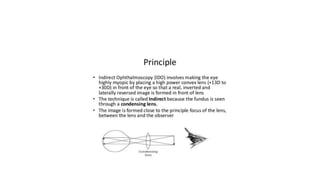
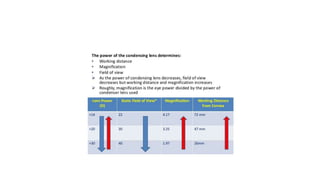
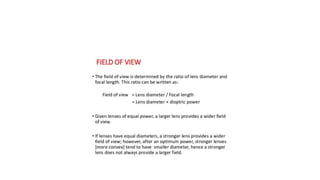
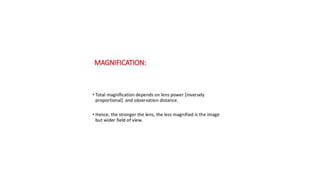
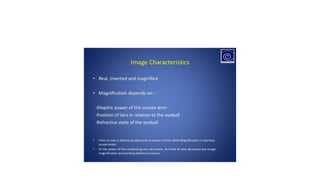
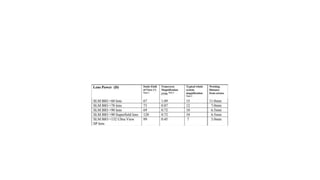
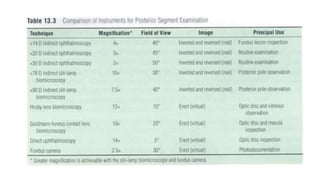
  • #4 About 2.5 times magnification and 35 degrees or 8DD field of view is obtained with a +20D lens. With a stronger lens, image will be smaller but brighter and field of view will be more.
  • #5 The magnification of a specific BIO lens is crudely determined by 60/the power of lens. Thus, a +20D lens would have a magnification of 60/20= 3X. 20D lens is the most commonly used lens for BIO in adults. For examination of retinopathy of prematurity patients, 28D lens is preferred.