1
786/92
Compiled by: Dr. Iddi Ndyabawe
Clinical approach to Depositions and Degenerations of the Conjuctiva, Cornea and Sclera.
Chapter 12 in Book 8, AAO
Original pages: 24
Degeneration means decomposition and deterioration of tissue elements and functions.
Causes of degenerations:
-aging
-disease
-chronic env’t insults to eye e.g UV light exposure
Degenerative changes of conjuctiva:
-Age-related (involutional) changes
-Pingecula
-Pterygium
-Conjuctival Concretions
-Conjuctival Inclusion cysts
-Conjuctivochalasis
--Conjuctival vascular tortuosity and hyperemia
Degenerative changes in cornea:
-Age-related (involutional) changes
-Epithelial and subepithelial changes:
Coats white ring
Spheroidal degeneration
Iron Deposition
Calcific band keratopathy
2
-Stromal degenerations:
White limbal girdle of Vogt
Corneal Arcus
Crocodile shagreen
Cornea farinata
Polymorphic amyloid degeneration
Senile furrow degeneration
Terrien marginal degeneration
Salzmann nodular degeneration
Corneal keloid
Lipid keratopathy
-Endothelial Degenerations:
Iridocorneal endothelial syndrome
Peripheral corneal guttae
Melanin pigmentation
Scleral degenerations
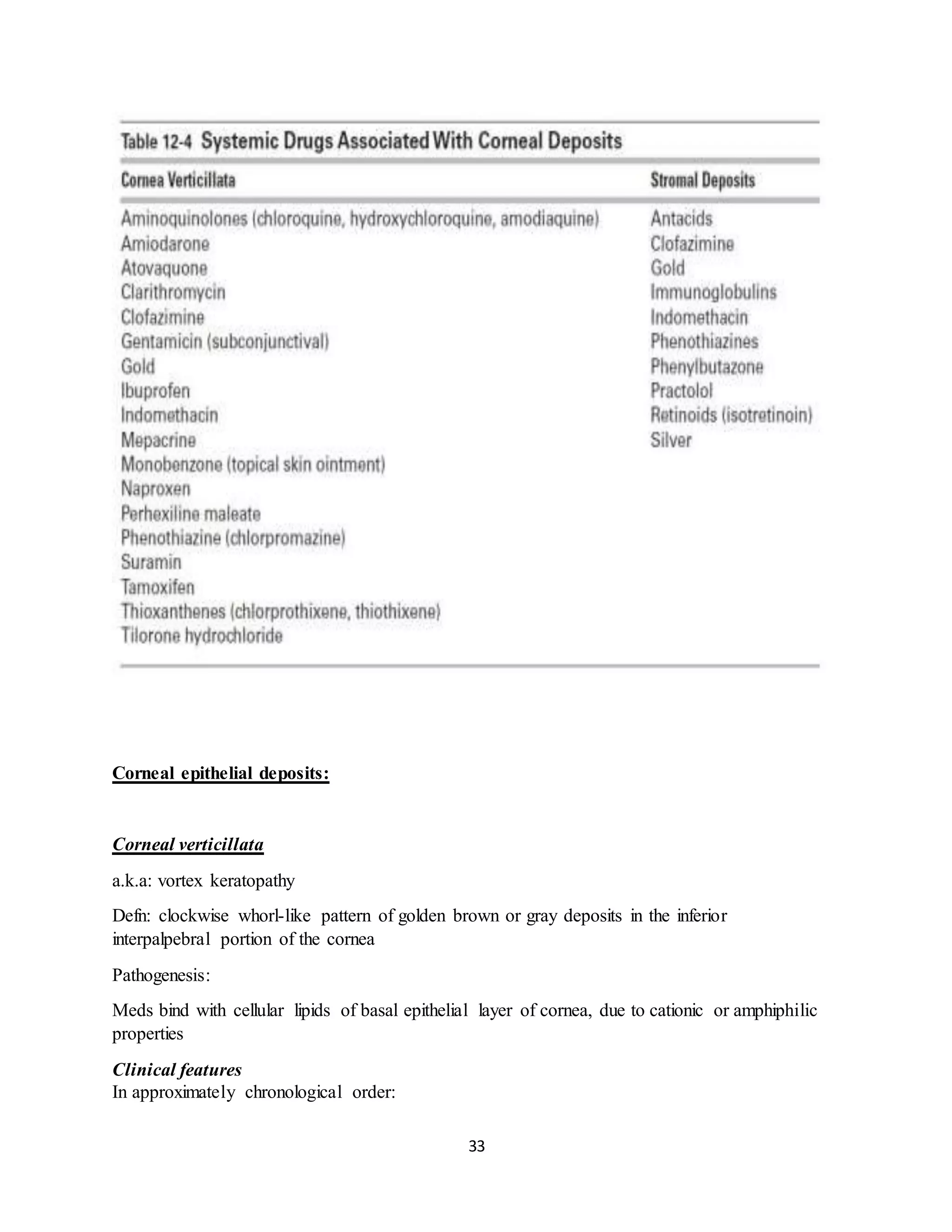
Drug induced deposition and pigmentation
Corneal epithelial deposits
Corneal verticillata
Epithelial cysts
Ciprofloxacin deposits
Adrenochrome deposits
Stromal and Descemet membrane pigmentation
3
Endothelial manifestations
Let’s start with Degenerative changes of the conjunctiva:
Recup of outline:
-Age-related (involutional) changes
-Pingecula
-Pterygium
-Conjuctival Concretions
-Conjuctival Inclusion cysts
-Conjuctivochalasis
--Conjuctival vascular tortuosity and hyperemia
Age-related (involutional) change:
-loss of transparency
-thinning
-conj laxity due to stroma becoming less elastic
-conj vessels changes:
become more prominent in older chaps
saccular telangiectasias
fusiform dilatory changes
tortuosities
4
PINGUECULA:
Defn: is an innocuous but extremely common asymptomatic elastotic degeneration of the
conjunctival stroma
Location: on the nasal side of the bulbar conjunctiva, adjacent to the limbus in the interpalpebral
zone.
Description: a yellow-white elevated mass, usually bilateral. This condition is termed
pinguecula, because of its resemblance to fat, which means pinguis Calcification occasional.
Etiology: not known exactly.
-Believed to be actinic damage similar to pterygium! But limbal barrier in pinguecula is intact!
-Effects of aging
-UV light
-Env’t trauma: dust, wind
Pathology.
-elastotic degeneration of collagen fibres of the substantia propria of conjunctiva;
Elastoid degeneration means that the material stains for elastin but is not broken down by
elastase.
-deposition of amorphous hyaline material in the substance of conjunctiva.
Clinical features.
c/o: asmptomatic, irritation…
o/e:
-bilateral, yellowish-white triangular patch near the limbus.
-apex of thectriangle is away from the cornea.
-affects the nasal side first and then the temporal side.
-when conjunctiva is congested, it stands out as an avascular prominence.
Complications of pinguecula
-recurrent inflammation of pinguecula,
5
-intraepithelial abscess formation
-conversion into pterygium (rarely!)
Treatment:
-Routinely no treatment required
Irritation may be treated with topical lubrication.
• Pingueculitis can be treated with lubrication if mild or with a short course of topical steroid.
• Excision for cosmetic reasons or for significant irritation; recurrence rates low
• Thermal laser ablation can be effective; gentian violet marking for adequate absorption in
lighter-skinned individuals
6
PTERYGIUM:
Defn: A pterygium is a wing-shaped growth of the conjunctiva and fibrovascular tissue on the
superficial cornea.
Description:
A pterygium is a benign, limbal, epithelial, wing-shaped, degenerative growth, mostly nasally,
that migrates onto the cornea from the conjunctiva and may cause visual distortion or loss of
vision if it progresses into the visual axis. It is treated by surgical removal when vision is
threatened or if it is a cosmetic problem. Recurrence of the pterygium can be an issue after
surgical removal.
Epidemiology
• More prevalent in outdoor workers exposed to highly reflective surfaces such as water and sand
• Encountered in latitudes less than 30°, due to ultraviolet {UV) light exposure
• Chemical exposure, excessive dust, wind, and ethnicity have been linked to pterygium
formation and growth.
• Genetic considerations and the presence of human papillomavirus may be linked in some cases
to pterygium formation.
Pediatric Considerations
Usually not seen in children and teenagers, due probably to cumulative exposure to UV light
Risk Factors
• Presence of pinguecula
• Exposure to UV light commonly in those living within 30° of the equator
• Wind
• Dust
Genetics
May be a factor but not yet delineated
7
General Prevention
Use of sun block, uv protective glasses, and hat when exposed to excessive and reflective sun
Pathophysiology
Actinic degeneration ofsensitive Iimbal stem cells probably in genetically predisposed
individuals.
Commonly Associated Conditions
• Pingueculum
• None beyond the corneal surface
Diagnosis
History
-most small lesions are asymptomatic
• Redness nasally usually, but occasionally temporally
• Distorted or reduced vision as pterygium grows toward the visual axis, and induced
astigmatism.
• Slight irritation as pterygium advances onto the cornea. Called dellen (localized dryness).
Occurs earlier in CL users due to edge lift
-cosmesis an issue. Intermittent inflammation like in pinguecula.
-Occasionally diplopia may occur due to limitation of ocular movements
Physical Exam
-A pterygium is made up of three parts: a ‘cap’ (an avascular halo-like zone at the advancing
edge), a head and a body
• Early, small whitish elevated nodule at 9o'clock limbus
• Later, wing-like growth of fibrovascular tissue extends onto the cornea from nasal limbus
mostly.
• May reach and cross visual axis in worst cases
• Hemorrhage from leaking capillaries at pterygium head indicates activity
8
• Iron line (Stocker's line) at pterygium head indicates inactivity.
-Fuchs islets are small discrete whitish flecks consisting of clusters of pterygial epithelial cells
often present at the advancing edge.
Types.
Progressive pterygium is thick, fleshy and vascular with a few infiltrates in the cornea, in front
of the head of the pterygium (called cap of pterygium).
Regressive pterygium is thin, atrophic, attenuated with very little vascularity. There is no cap.
Ultimately it becomes membranous but never disappears.
Complications
-cystic degeneration
-infection.
-neoplastic change to epithelioma, fibrosarcoma or malignant melanoma, may occur
Diagnostic Tests & Interpretation
Diagnostic Procedures/Other
Biopsy not indicated
Differential Diagnosis
• Pseudopterygium---conjunctival adherence to the cornea due to inflammation or trauma
• Dermoid of the limbus
• Squamous cell carcinoma (rare)
9
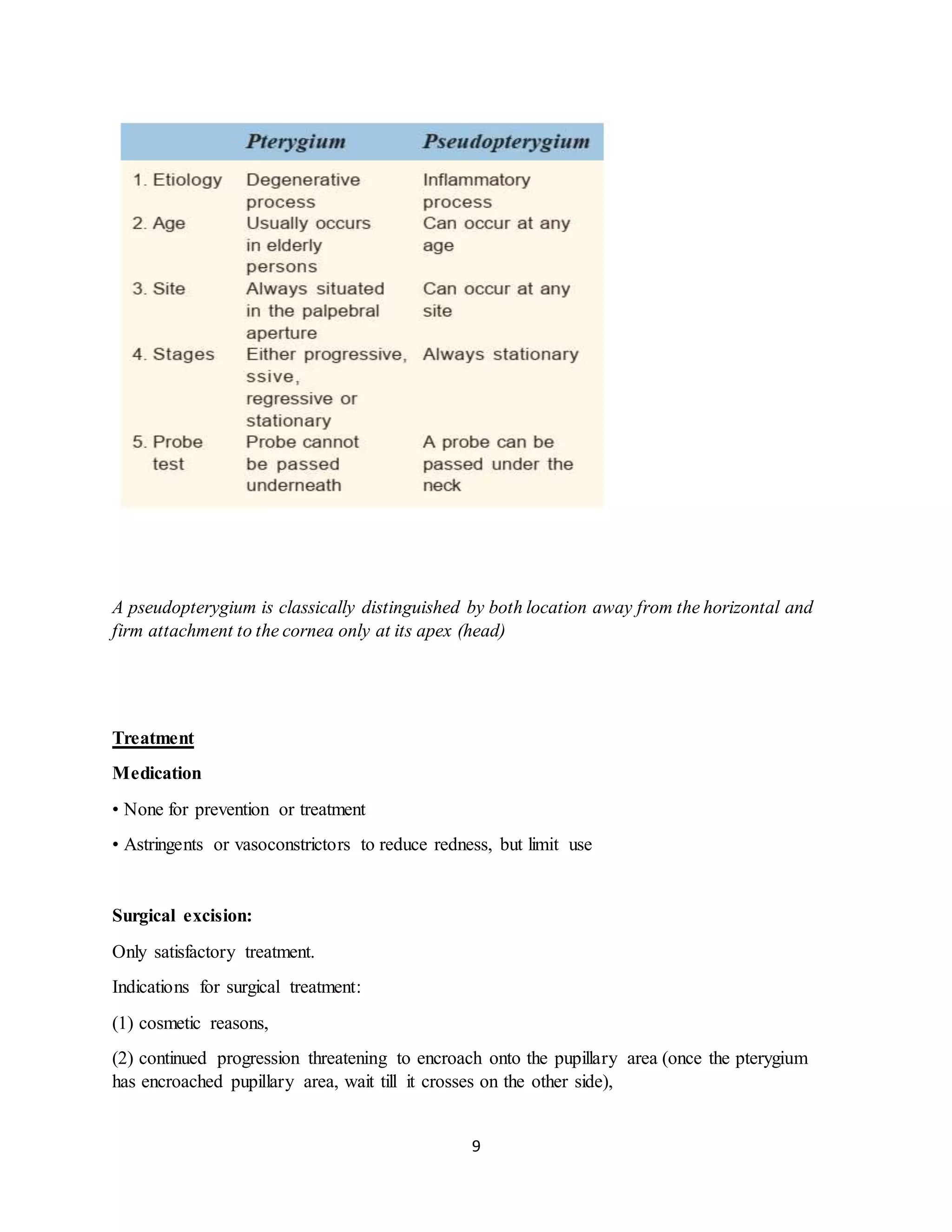
A pseudopterygium is classically distinguished by both location away from the horizontal and
firm attachment to the cornea only at its apex (head)
Treatment
Medication
• None for prevention or treatment
• Astringents or vasoconstrictors to reduce redness, but limit use
Surgical excision:
Only satisfactory treatment.
Indications for surgical treatment:
(1) cosmetic reasons,
(2) continued progression threatening to encroach onto the pupillary area (once the pterygium
has encroached pupillary area, wait till it crosses on the other side),
10
(3) diplopia due to interference in ocular movements.
Recurrence of the pterygium after surgical excision is the main problem (30-50%). However, it
can be reduced by any of the following measures:
1. Transplantation of pterygium in the lower fornix (McReynold's operation) is not performed
now.
2. Postoperative beta irradiations (not used now).
3. Postoperative use of antimitotic drugs such as mitomycin-C or thiotepa.
4. Surgical excision with bare sclera.
5. Surgical excision with free conjunctival graft taken from the same eye or other eye is presently
the preferred technique.
6. In recurrent recalcitrant pterygium, surgical excision should be coupled with lamellar
keratectomy and lamellar keratoplasty
Wound closure options during pterygium excision:
1. Bare sclera
2. Simple closure
3. Sliding flap
4. Rotational flap.
5. Autologous conjunctival transplantation.
6. Autologous conjunctival- limbal transplantation.
7. Amniotic membrane transplantation
Ongoing Care
Follow-Up Recommendation
• Topical steroids must be used postoperatively for at least 6 months in tapering dosage to
prevent recurrent pterygium.
11
Clinical Pearls
• Most pterygium can be observed at first. If there is progressive growth, they should be
surgically removed before coming dose to the visual axis.
CONJUCTIVAL CONCRETIONS:
Defn: Concretions are small, yellow-white dots found in the palpebral conjunctiva of older
patients who have had chronic conjunctivitis.
Etiology. Concretions are formed due to accumulation of inspissated mucus and dead epithelial
cell debris into the conjunctival depressions called loops of Henle. A.k.a epithelial inclusion
cysts filled with epithelial and keratin debris as well as mucin.
They are commonly seen in elderly people and patients with scarring stage of trachoma.
The name concretion is a misnomer, as they are not calcareous deposits.
Clinical features.
Concretions are seen on palpebral conjunctiva, more commonly on upper than the lower.
They may also be seen in lower fornix.
These are yellowish white, hard looking, raised areas, varying in size from pin point to pin head.
Being hard, they may produce foreign body sensations and lacrimation by rubbing the corneal
surface.
Occasionally they may even cause corneal abrasions.
Treatment.
It consists of their removal with the help of a hypodermic needle under topical anaesthesia.
12
CONJUCTIVAL INCLUSION CYSTS:
a.k.a epithelial inclusion cysts
Defn: Conjunctival retention cysts are thin-walled lesions on the bulbar conjunctiva containing
clear or occasionally turbid fluid.
Incidental finding. Asymptomatic.
Congenital or acquired.
Derived from an inclusion of conjunctival epithelium into the substantia propria.
Central fluid-filled cavity that is lined by nonkeratinised conjunctival epithelium.
Histology shows a fluid-filled internal cavity lined by a double epithelial layer
Stimuli for cyst formation:
-Chronic inflammation
-Trauma
-Surgery
Location: bulbar conj or fornix
Management:
-simple observation
-complete excision to avoid recurrence. Cysts reform after simple drainage because inner
epithelial cell wall remains.
Differential diagnosis
-secondary inclusion cysts following conjunctival surgery
lymphangiectasia.
The latter is characterized by strings of cystic or sausage-shaped clear-walled channels, which
may become filled with blood (haemorrhagic lymphangiectasia)
Dilated lymphatic channels may mimic an inclusion cyst of the bulbar conjunctiva.
13
CONJUCTIVOCHALASIS:
Defn: poor adherence of the bulbar conjuctiva
Description: appears as a fold of redundant conjunctiva interposed between the globe and lower
eyelid, protruding over the lid margin
Etiology: unknown.
-normal aging change.
-maybe exacerbated by inflammation and mechanical stress.
Histology:
Elastosis and chronic non-granulomatous inflammation plus collagenolysis.
Symptoms:
-watering of the eye due to obstruction of the inferior punctum and interference with the
marginal tear meniscus.
Treatment
-topical lubricants and treatment of any blepharitis.
-course of topical steroids or other anti-inflammatory agent may be helpful. Conjunctival
resection can be performed in severe cases.
14
15
Degenerative changes in the cornea
Defn: Corneal degenerations refers to the conditions in which the normal cells undergo some
degenerative changes under the influence of age or some pathological condition.
Age-related (involutional) changes
-Epithelial and subepithelial changes:
Coats white ring
Spheroidal degeneration
Iron Deposition
Calcific band keratopathy
-Stromal degenerations:
White limbal girdle of Vogt
Corneal Arcus
Crocodile shagreen
Cornea farinata
Polymorphic amyloid degeneration
Senile furrow degeneration
Terrien marginal degeneration
Salzmann nodular degeneration
Corneal keloid
Lipid keratopathy
-Endothelial Degenerations:
Iridocorneal endothelial syndrome
Peripheral corneal guttae
Melanin pigmentation
Scleral degenerations
16
Another classification:
[A] Depending upon location
I. Axial corneal degenerations
1. Fatty degeneration
2. Hyaline degeneration
3. Amyloidosis
4. Calcific degeneration (Band keratopathy)
5. Salzmann's nodular degeneration.
II. Peripheral degenerations
1. Arcus senilis
2. Vogt's white limbal girdle
3. Hassal-Henle bodies
4. Terrien's marginal degeneration
5. Mooren's ulcer
6. Pellucid marginal degeneration
7. Furrow degeneration (senile marginal degeneration).
[B] Depending upon etiology
I. Age related degenerations. Arcus senilis, Vogt's white limbal girdle, Hassal-Henle bodies,
Mosaic degeneration.
II. Pathological degenerations: Fatty degeneration, amyloidosis, calcific degeneration,
Salzmann's nodular degeneration, Furrow degeneration, spheroidal degeneration, Pellucid
marginal degeneration, Terrien's marginal degeneration, Mooren's ulcer.
17
Age-related (involutional) changes:
-cornea becomes flatter in the vertical meridian
-cornea becomes thinner
-cornea becomes less transparent
-RI of cornea increases
-Descemet membrane becomes thicker. 3mm at birth, and 10mm in adults
-Hassall-Henle bodies; occasional peripheral endothelial cells
-attrition corneal endothelial cells: average rate of decrease in epithelial cell density is 0.6% per
year
Epithelial and subepithelial degenerations:
Coat’s white ring:
-small circle of discrete gray-white dots in superficial stroma
-size: 1mm
-represent iron-containing fibrotic remnants of a metallic FB
Spheroidal degeneration:
Translucent, golden brown, spheroidlike deposits in the subeoithelium, Bowman’s layer or
superficial stroma
Primary: bilateral. No pre-existing ocular disease
Secondary: assoc with ocular injury or inflammation
Pathognomic: oil-droplet appearance.
Rx:
-no med therapy indicated.
-lubrication
Superficial keratectomy and PTK if central involvement
18
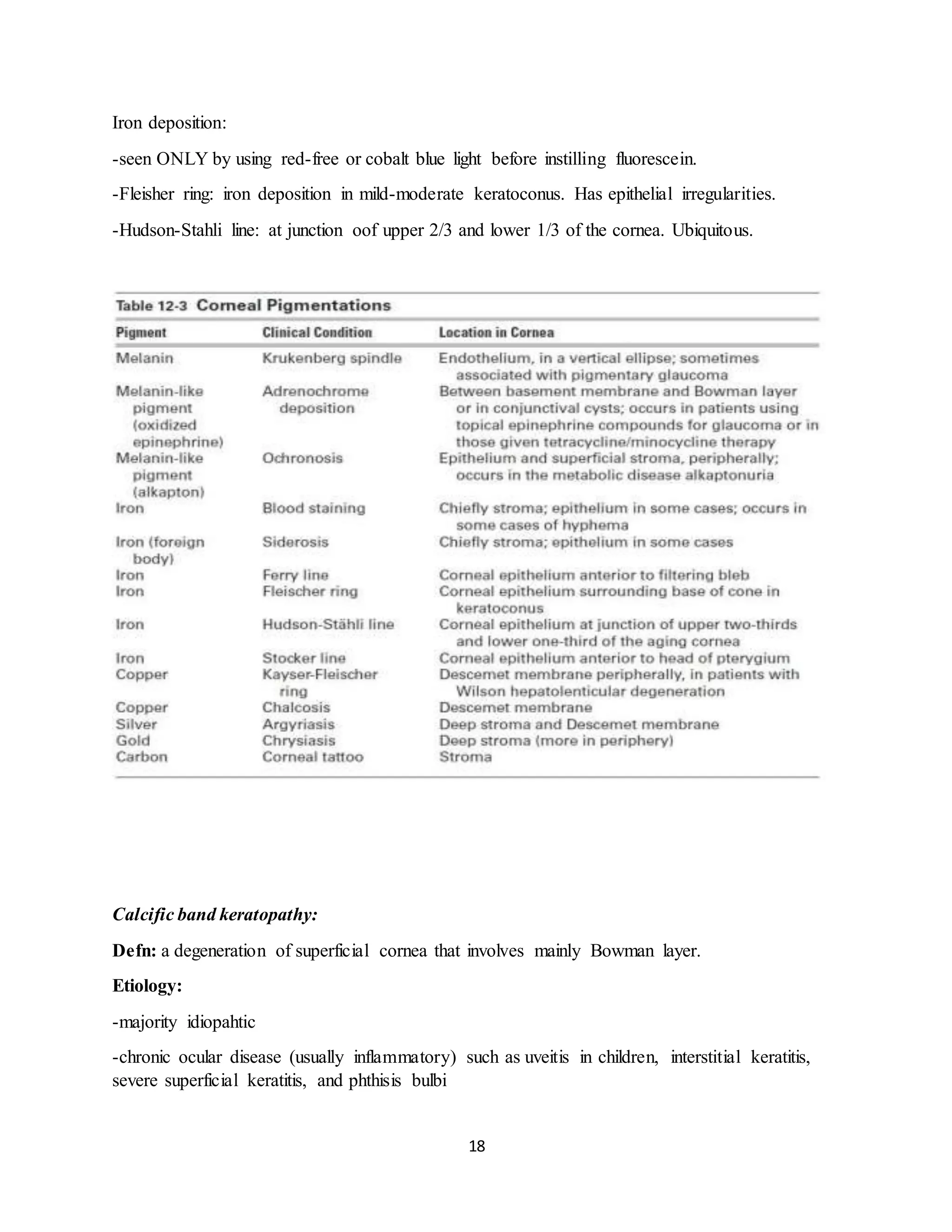
Iron deposition:
-seen ONLY by using red-free or cobalt blue light before instilling fluorescein.
-Fleisher ring: iron deposition in mild-moderate keratoconus. Has epithelial irregularities.
-Hudson-Stahli line: at junction oof upper 2/3 and lower 1/3 of the cornea. Ubiquitous.
Calcific band keratopathy:
Defn: a degeneration of superficial cornea that involves mainly Bowman layer.
Etiology:
-majority idiopahtic
-chronic ocular disease (usually inflammatory) such as uveitis in children, interstitial keratitis,
severe superficial keratitis, and phthisis bulbi
19
-hypercalcemia caused by hyperparathyroidism, vitamin D toxicity, milk-alkali syndrome,
sarcoidosis, or other systemic disorders
-hereditary transmission (primary hereditary band keratopathy, with or without other anomalies)
-elevated serum phosphorus level with normal serum calcium, which sometimes occurs in
patients with renal failure
-chronic exposure to mercurial vapors or to mercurial preservatives (phenylmercuric nitrate or
acetate) in ophthalmic medications (the mercury causes changes in corneal collagen that result in
the deposition of calcium)
-silicone oil instillation in an aphakic eye
Clinical features.
It typically presents as a bandshaped opacity in the interpalpebral zone with a clear interval
between the ends of the band and the limbus.
The condition begins at the periphery and gradually progresses towards the centre.
The opacity is beneath the epithelium which usually remains intact.
Surface of this opaque band is stippled due to holes in the calcium plaques in the area of nerve
canals of Bowman's membrane.
In later stages, transparent clefts due to cracks or tears in the calcium plaques may also be seen.
Treatment. It consists of :
1. Chelation, i.e., chemical removal of deposited calcium salts is an effective treatment. First of
all corneal epithelium is scraped under local anaesthesia.
Then 0.01 molar solution of EDTA (chelating agent) is applied to the denuded cornea with the
help of a cotton swab for about 10 minutes.
This removes most of the deposited calcium. Pad and bandage is then applied for 2-3 days to
allow the epithelium to regenerate.
2. Phototherapeutic keratectomy (PTK) with excimer laser is very effective in clearing the
cornea.
3. Keratoplasty may be performed when the band keratopathy is obscuring useful vision
20
Stromal Degenerations:
White limbal girdle of Vogt:
-Vogt limbal girdle is an innocuous condition that is present in up to 60% of individuals over 40
years of age, more commonly in women.
-It consists of whitish crescentic limbal bands composed of chalk-like flecks centred at 9 and/or
3 o’clock, more often nasally.
-There may be irregular central extension.
-Type I may be a variant of band keratopathy, featuring a ‘Swiss cheese’ hole pattern and a clear
area separating the lesion from the scleral margin.
-Type II is more prevalent, and is distinguished by the absence of holes and typically also of a
juxtalimbal clear zone; histologically the changes in both are similar to pinguecula and
pterygium.
Arcus senilis
Arcus senilis (gerontoxon, arcus lipoides) is the most common peripheral corneal opacity
-it frequently occurs without any predisposing systemic condition in elderly individuals, but may
be associated with dyslipidaemia in younger patients (arcus juvenilis).
• Signs
○ Stromal lipid deposition, initially in the superior and inferior perilimbal cornea, progressing
circumferentially to form a band about 1 mm wide
○ The band is usually wider in the vertical than horizontal meridian.
○ The central border is diffuse and the peripheral edge is sharp and separated from the
ARCUS SENILIS DETAILED SYNOPSIS:
DESCRIPTION
• Arcus senilis is ayellowish-white ring of extracellular lipid deposition in the peripheral cornea
separated from the limbus by a narrow (<1mm) dear zone. It is seen most frequently in the
elderly, but can present in children and rarely at birth. In younger patients, there is an association
with hyperlipidemia and cardiovascular disease risk factors. It does not interfere with vision and
requires no treatment.
• Synonyms: Corneal arcus, gerontoxon
- In children: Arcus juvenilis, anterior embryotoxon
21
EPIDEMIOLOGY
Prevalence
• Increases with age (1-3)
• Higher in black. population {1,3)
• Higher in men (3)
• Estimates of prevalence vary
• Approximately 65% of those 50 years or older (4)
RISK FACTORS
• Older age
• Hypercholesterolemia
GeneTICS”
• Early onset arcus (by age 45) is common in familial hyperlipoproteinemias.
- Familial hypercholesterolemia is an autosomal dominant inherited defect in lipoprotein
metabolism.
o Homozygotes often present with arcus earlier than heterozygotes
PATHOPHYSIOLOGY
Cholesterol. cholesterol esters. triglycerides. And phospholipids deposit within the cornea
causing no functional limitations
ETIOLOGY
• Product of aging and unlikely to represent disturbed metabolism in elderly patients
• In familial hyperlipoproteinemias, development of premature arcus relates to age of patient.
- In these cases, it is the duration of the dyslipidemic disease, not its severity, that is associated
with formation of arcus
COMMONLY ASSOCIATED CONDITIONS
• Most closely associated with aging
• Associated with hyperlipidemia and cardiovascular disease:
-Early onset arcus (childhood and early adulthood) is seen with familial hypercholesterolemia,
and with type Ill, IV. and V hyperlipoproteinemia.
o Corneal arcus before the age of 45 is included in the criteria for diagnosing familial
hypercholesterolemia
- Reported as a prognostic factor for cardiovascular disease mortality in hyperlipidemic men
aged 30-49 years (1)
-Also reported as a prognostic factor for coronary artery disease in men aged 30-49 years
independent of its association with hyperlipidemia
• When present in children it is called arcus juvenilis:
22
-Associated with certain congenital ocular anomalies, such as blue sclera, megalocornea,
and aniridia
-Also associated with familial hyperlipoproteinemias, as stated above
~ DIAGNOSIS
HISTORY
• Gradual formation of a bilateral white corneal ring.
Some patients complain of • changing eye color:
- For example, apatient with a dark brown iris may state that his or her peripheral iris is
becoming lighter.
• Arcus does not cause any visual disturbances.
PHYSICAL EXAM
• A yellowish-white ring is visible in the peripheral cornea with anarrow dear zone separating it
from the limbus.
-While examination is aided by the use of a slit lamp, arcus can be detected by examination with
the naked eye and the use of a light source.
• On slit lamp examination. the distribution of lipid deposit is better appreciated.
- Deposits are most concentrated in the area of Descemet's membrane (a deep corneal layer) and
Bowman's membrane (a superficial corneal layer).
-Appears as two wedge-shaped opacities:
o One wedge with the base on the superficial membrane and the apex pointing posteriorly into
the corneal stroma
o The other wedge with the base on the deep membrane and the apex pointing anteriorly into the
corneal stroma
• Peripheral margin of the arcus forms a sharply defined edge, whereas the central margin is less
distinct.
DIAGNOSTIC TESTS & INTERPRETATION
Lab
Patients younger than 50 years require serum lipid measurements
Imaging
In patients less than 50 years of age, consider echocardiogram/stress echocardiogram in the
context of other findings.
Diagnostic Procedures/Other
• Any patient younger than 50 years requires detailed work.-up for cardiovascular risk factors
23
-Assess for history of hypertension, diabetes, family history, symptoms of angina. exercise. and
smoking
- EKG, stress test
• Children must be investigated for dysfunction of lipoprotein metabolism.
Pathological Findings
• Grossly, a white ring of lipid deposit limited to the peripheral cornea with a 0.3-1 mm dear
zone separating it from the limbus:
- Ring begins as two arcs, one near the superior corneal margin and one near the inferior margin.
Arcs grow until they meet circumferentially completing a 360• ring.
…………………..
Crocodile shagreen:
Anterior crocodile shagreen, or mosaic degeneration is a central bilateral corneal opacity at the
level of Bowman layer characterized by mosaic, polygonal, gray opacities separated by clear
zones.
Histologically, the Bowman layer is thrown into ridges and may be calcified.
Posterior crocodile shagreen shows similar changes in the deep stroma near Descemet
membrane.
Cornea farinata:
The deep corneal stroma shows many subtle dot-shaped and comma-shaped opacities.
The condition does not affect vision and has no clinical significance, except that it is sometimes
mistaken for a progressive dystrophy.
Polymorphic amyloid degeneration
Polymorphic amyloid degeneration is a bilaterally symmetric, slowly progressive corneal
degeneration that appears late in life.
Senile furrow degeneration
Senile furrow degeneration is an appearance of peripheral thinning in the lucid interval of a
corneal arcus that is seen in older persons. Vision is rarely affected.
24
Terrien's marginal degeneration
Terrien's marginal degeneration is non-ulcerative thinning of the marginal cornea.
Clinical features are as follows :
1. Predominantly affects males usually after 40 years of age.
2. Mostly involves superior peripheral cornea.
3. Initial lesion is asymptomatic corneal opacification separated from limbus by a clear zone.
4. The lesion progresses very slowly over many years with thinning and superficial
vascularization.
Dense yellowish white deposits may be seen at the sharp leading edge. Patient experiences
irritation and defective vision (due to astigmatism).
Complications such as perforation (due to mild trauma) and pseudopterygia may develop.
Treatment is non-specific. In severe thinning, a patch of corneal graft may be required.
SALZMAN NODULAR DEGENERATION
DESCRIPTION
Salzmann's nodules are creamy white, occasionally with a yellow or blue-tinged, smooth,
elevated lesion(s) on the surface of the cornea.
EPIDEMIOLOGY
Incidence
• Uncommon but exact incidence is unknown
• Tends to occur in middle age
Prevalence
Much more prevalent in women than in men
RISK FACTORS
• Ocular surface inflammation. such as from meibomian gland dysfunction (MGD), dry eye
syndrome (DES), phlyctenular keratitis, vernal keratoamjunctivitis, trachoma, interstitial
keratitis, and trauma, such as long-term contact lens wear
• Most commonly idiopathic
25
GENERAL PREVENTION
Treat underlying conditions
ETIOLOGY
Thought to be related to low-grade chronic inflammation
COMMONLY ASSOCIATED CONDITIONS
• See risk factors above.
• Salzmann's has also been associated with epithelial basement membrane dystrophy and after
corneal surgery
DIAGNOSIS
HISTORY
• Generally asymptomatic
• May have symptoms of foreign body sensation, pain, redness, and tearing
• k; nodules reach toward the visual axis. the vision may be mildly to moderately affected.
PHYSICAL EXAM
• Slit lamp examination reveals single or multiple, elevated creamy, yellow- or blue-white
corneal nodules.
• Although typically located in the corneal periphery or midperiphery, the nodules may also be
paracentral or central.
DIAGNOSTIC TESTS & INTERPRETATION
Imaging
Initial approach
Not required if vision is unaffected
Follow-up & special considerations
Consider corneal topography to evaluate for irregular astigmatism if there are visual complaints.
Pathological Findings
• Collagen plaques with hyaline between epithelium and Bowman's layer
• Bowman's layer may be missing or damaged underlying the lesion.
DIFFERENTIAL DIAGNOSIS
• Climatic droplet keratopathy
• Corneal amyloidosis
• Corneal keloid
26
TREATMENT
MEDICATION
First Line
• If asymptomatic, no treatment is required.
• To decrease the risk of progression, underlying conditions can be treated.
• MGD and DES should be treated if present.
• Proper contact lens fit, wearing schedule, and care should be evaluated.
Second Line
Foreign body sensation or pain is treated with increased lubrication with artificial tears, gels and
ointments, cyclosporine 0.05% drops, and punctal plugs.
ADDITIONAL TREATMENT
General Measures
Salzmann's nodules may remain stable for years or may slowly progress.
Issues for Referral
When discomfort or visual symptoms are not responding to conservative medical therapy,
referral to a corneal specialist may be warranted.
…………………………..
Salzmann's nodular degeneration (summary)
Etiology. This condition occurs in eyes with recurrent attacks of phlyctenular keratitis, rosacea
keratitis and trachoma. The condition occurs more commonly in women and is usually unilateral.
Pathogenesis. In Salzmann's nodular degeneration, raised hyaline plaques are deposited between
epithelium and Bowman's membrane. There is associated destruction of Bowman's membrane
and the adjacent stroma.
Clinical features. Clinically, one to ten bluish white elevations (nodules), arranged in a circular
fashion, are seen within the cornea. Patient may experience discomfort due to loss of epithelium
from the surface of nodules. Visual loss occurs when nodules impinge on the central zone.
Treatment is essentially by keratoplasty
………………………………………………….
27
Corneal keloid
Corneal keloids are white, superficial, and sometimes protuberant glistening corneal masses that
can eventually involve the entire corneal surface.
Keloids can be congenital or primary, and they have been reported in association with many
congenital conditions, such as Lowe syndrome.
Ddx:
-hypertrophic scars
-Salzmann degeneration
-dermoids.
Rx: SK, PTK
Lipid keratopathy:
Primary lipid keratopathy is rare and occurs apparently spontaneously.
It is characterized by white or yellowish, often with a crystalline element, stromal deposits
consisting of cholesterol, fats and phospholipids and is not associated with vascularization
• Secondary lipid keratopathy is much more common and is associated with previous ocular
injury or disease that has resulted in corneal vascularization. The most common causes are
herpes simplex and herpes zoster keratitis
• Treatment is primarily aimed at medical control of the underlying inflammatory disease. Other
options include:
○ Photocoagulation or needle cautery (suture needle grasped with cautery forceps) of feeder
vessels.
○ Penetrating keratoplasty may be required in advanced but quiescent disease, though
vascularization, thinning and hypoaesthesia may prejudice the outcome.
28
ENDOTHELIAL DEGENERATIONS:
IRIDOCORNEAL ENDOTHELIAL DEGENERATION:
DESCRIPTION
An acquired and usually unilateral condition affecting young and middle-aged women. The
condition causes various degrees of iris abnormalities, corneal edema, and glaucoma in affected
individuals.
The etiology is unknown, but is thought to be due to a viral infection.
It affects all races. The hallmark of the condition is an abnormal corneal endothelium, which
advances onto the anterior chamber angle and iris.
Pediatric Considerations
It rarely affects children. A case of an 11-year-old girl with ICE syndrome and glaucoma was
reported.
Geriatric Considerations
Older patients may have limitation in vision in the affected eye due to corneal disease and/or
glaucomatous optic nerve damage.
Pregnancy Considerations
Glaucoma medications may need to be adjusted during pregnancy and nursing.
EPIDEMIOLOGY
ICE syndrome is a very rare condition with no known genetic risk factors.
GENERAL PREVENTION
There is no known preventive measure ICE syndrome.
ETIOLOGY
Thought to be due to a viral infection. In one study 5 out of 9 corneal specimens were positive
for herpes simplex virus (HSV} DNA in the corneal endothelium.
The specimens were negative for herpes zoster virus or Epstein-Barr virus DNA.
COMMONLY ASSOCIATED CONDITIONS
• There are 3variants that have slightly different presentations and courses. All 3variants are
associated with corneal disease and glaucoma.
• Essential or progressive iris atrophy is notable for corectopia (distorted pupil) or
29
pseudopolycoria (a "second" pupil). Marked iris atrophy is a hallmark of this variant. Severe
anterior segment abnormalities may include extensive peripheral anterior synechiae (PAS).
PAS formation is progressive, leading to angle closure and frequently elevated intraocular
pressure (lOP). Secondary angle-closure glaucoma is present in at least 50% of individuals.
• Iris nevus syndrome (Cogan Reese) is notable for the presence of a large nevus covering a large
part of the iris or multiple iris nodules. Specimens from eyes enucleated for presumed
malignancy demonstrated iris tissue in these nevi.
• Chandler's syndrome is notable for a corneal endothelium with a characteristic "hammered
silver• appearance. Chandler's syndrome variant has a lower incidence of glaucoma and a higher
incidence of corneal edema due to dysfunction of normal endothelial function.
~ DIAGNOSIS
HISTORY
Signs and symptoms:
• Almost always has a unilateral presentation
• Decreased vision due to corneal edema. which is frequently worse in the morning upon
awakening
• Pain is usually due to corneal edema, but may be from elevated lOP later on in the course of the
disease.
• Iris abnormalities noticed by patient or family and friends
• Decreased visual function due to glaucoma is present in advanced disease.
PHYSICAL EXAM
Slit lamp exam can demonstrate corneal edema and abnormal corneal endothelial appearance.
Areas of abnormal corneal endothelium may be seen in the fellow eye. Iris atrophy and pupillary
irregularity or decentration are hallmarks of progressive iris atrophy.
Gonioscopy can reveal complete angle closure, especially in essential iris atrophy.
DIAGNOSTIC TESTS AND INTERPRETATION
• Visual acuity may be reduced in the affected eye and may fluctuate with varying degrees of
corneal edema.
• Visual field may be abnormal if there is co-existing glaucomatous optic neuropathy.
Imaging
• Optic nerve Imaging can be helpful in establishing diagnosis of glaucoma or assisting in
detection of glaucoma progression. Imaging devices include optic nerve photography, opticaI
coherence tomography (OCT), confocal scanning laser ophthalmoscopy (Heidelberg Retina
30
Tomograph HRT, and scanning laser polarimetry (GDx).
• Corneal disease is mostly followed clinically, but specular microscopy can demonstrate
characteristic endothelial cell abnormality with variability in cell size and shape as well as loss of
the normal clear hexagonal margins.
• Pachymetry can be useful to quantify corneal thickening.
DIFFERENTlAL DIAGNOSIS
• Fuch's dystrophy may have a similar corneal appearance, but with no anterior chamber
abnormalities.
• PPMD--may appear similar, but Is familial and bilateral
• Axenfeld Riegers is congenital and bilateral and may have systemic findings, such as dental
abnormalities.
• Iris melanomas can appear similar to pure Cogan-Reese syndrome.
. TREATMENT
ADDITlONAL TREATMENT
General Measures
• Corneal edema can be treated with hypertonic saline drops or ointment (sodium chloride
solution or ointment 5%}.
• Elevated lOP and glaucoma can be treated with anti-glaucoma drops.
• Laser trabeculoplasty is not usually beneficial in this type of chronic angle-closure glaucoma.
• Laser peripheral iridotomy does not halt the progression of progressive angle closure that is a
hallmark of this condition.
SURGERY/OTHER PROCEDURES
• Cataract surgery can be complicated by poor pupillary dilation and the presence of an ICE
membrane over the anterior capsule.
• Corneal transplants are performed for chronically edematous and hazy corneas. Newer partial-
thickness corneal transplant procedures may reduce the Incidence of rejection. Descemet
Stripping Automated Endothelial Keratoplasty (DSAEK) involves Descemet's and endothelial
membrane transplant.
• Iris reconstruction surgery for improved cosmetic appearance or to ameliorate glare can be
undertaken alone or at the time of cataract surgery.
The iris tissue is often friable and difficult to suture. Artificial iris implantation can be useful.
• Glaucoma in ICE syndrome may be more severe and refractory to surgical management
Trabeculectomy may fail more frequently, and this is thought to be partially due to growth of
abnormal corneal endothelium over the internal scleral ostium.
Trabeculectomy in patients with Chandler's syndrome may be more successful than in the other
31
variants.
• Trabeculectomy may be more successful if performed with an anti-metabolite such as
mitomycin C
• Glaucoma drainage implants (tube shunts) may be more successful than trabeculectomy as they
may be less likely to be blocked with an endothelial membrane (4}.
ONGOING CARE
FOLLOW-UP RECOMMENDATIONS
Patient Monitoring
• Affected individuals should be followed up periodically for routine eye care. Mild cases
without glaucoma may be seen yearly.
• Monitoring for development of glaucoma includes evaluation of optic nerve appearance with
either direct or indirect ophthalmoscopy. Visual field testing and optic nerve imaging may also
be appropriate.
• Individuals with glaucoma or corneal disease may need more frequent monitoring
• Corneal decompensation and glaucoma may require sub-specialty referral.
PROGNOSIS
• Visual prognosis is mostly related to severity of glaucoma but may be affected by success in
restoration of corneal clarity.
• Complications from cataract surgery can also affect visual prognosis.
• Visual prognosis is generally more poor for individuals who reject multiple corneal transplants.
• Irregular refractive errors after corneal surgery may require use of specialty contact lenses.
……………………………
Peripheral corneal guttae:
-a.k.a Hassal Henle Bodies
-Small wartlike excrescences that appear in peripheral portion of Descemet membrane
-Normal aging change
-Pathogenesis: thickening of Descemet membrane
-Location: on posterior part of membrane and protrude in anterior chamber angle
-o/e: small dark dimples within the endothelial mosaic on specular microscopy
-Rarely seen before age 20
-Cornea guttae: when they appear in central cornea. Are pathologic.
32
Melanin pigmentation:
-Deposits of melanin on corneal endothelium seen in glaucoma patients associated with PDS.
-Krukenberg spindle: cluster of vertically oriented pigments
………………………………….
Scleral degenerations:
Scleral rigidity increases in older people: due to relative decrease in scleral hydration and the
amount of mucopolysaccharide
-subconj deposition of fat… giving sclera a yellow tinge
-calcium deposit; in granular or crystalline form…. Mistaken for pigmented tumor
-Histology: focal calcified plaque surrounded by relatively acellular collagen
……………………………
Drug-induced deposition and pigment:
Deposition of drug in cornea leads to:
-reduced vision
-produce photosensitivity
-ocular irritation
Rx: withdraw the drug
33
Corneal epithelial deposits:
Corneal verticillata
a.k.a: vortex keratopathy
Defn: clockwise whorl-like pattern of golden brown or gray deposits in the inferior
interpalpebral portion of the cornea
Pathogenesis:
Meds bind with cellular lipids of basal epithelial layer of cornea, due to cationic or amphiphilic
properties
Clinical features
In approximately chronological order:
34
• Fine golden-brown opacities form an irregular horizontal line in the lower corneal epithelium
of both eyes, similar to Hudson–Stähli iron line.
• Several irregular branching horizontal lines form a pattern resembling the whiskers of a cat.
• With an increasing number of branches a whorled pattern develops, centred on a point below
the pupil and swirling outwards, usually sparing the limbus.
• Associated pigmented clumps and iron deposition have been described.
Causes:
-Amiodarone: most common cause of corneal verticillata. Followed by;
-Chloroquine
-Hydroxychloroquine
-Indomethacin
-Phenothiazines
Vision rarely affected.
If vision reduced with amiodarone or tamoxifen, possibility of optic neuropathy should be
considered.
Retinal toxicity with chloroquine can also reduce vision
Ddx:
-Fabry disease: a disorder of sphingolipid metabolism
……………………………………
Epithelial Cysts:
Cytarabine can cause punctate keratopathy and refractile epithelial microcysts associated with:
-pain
-photophobia
-FB sensation
-reduced vision
35
Ciprofloxacin deposits:
-deposition of a chalky white precipitate composed of ciprofloxacin crystals within an epithelial
defect
-rare with other fluoroquinolones
-Rx: discontinue med
………………………………….
Adrenochrome deposits:
Black or very dark brown deposits in the conjunctiva and cornea due to long term use of:
-epinephrine compounds,
-tetracycline or minocycline
Ddx: conjunctival melanoma
……………………………….
Stromal and Descemet membrane pigmentation:
-Chlorpromazine may cause corneal pigmentation in 1/3 of patients after long term use. Enters
cornea thru aqueous hence brown opacities first seen in posterior stroma, Descemet membrane
and endothelium.
-Clofazimine can cause anterior stromal opacities or crystalline deposition
-Isotretinoin assoc with fine, diffuse gray deposits in central and peripheral cornea.
Argyriasis:
-a slate-gray or silver discolouration of the bulbar and palberal conjunctiva due to long term use
of silver compounds. E,g silver nitrate for treating Superior Limbic Keratoconjuctivitis.
36
Endothelial manifestations:
Rifabutin described as causing stellate, refractile endothelial deposits initially in periphery. May
extend to central cornea.

Depositions and Degenerations of Conjuctiva and Cornea.docx

  • 1.
    1 786/92 Compiled by: Dr.Iddi Ndyabawe Clinical approach to Depositions and Degenerations of the Conjuctiva, Cornea and Sclera. Chapter 12 in Book 8, AAO Original pages: 24 Degeneration means decomposition and deterioration of tissue elements and functions. Causes of degenerations: -aging -disease -chronic env’t insults to eye e.g UV light exposure Degenerative changes of conjuctiva: -Age-related (involutional) changes -Pingecula -Pterygium -Conjuctival Concretions -Conjuctival Inclusion cysts -Conjuctivochalasis --Conjuctival vascular tortuosity and hyperemia Degenerative changes in cornea: -Age-related (involutional) changes -Epithelial and subepithelial changes: Coats white ring Spheroidal degeneration Iron Deposition Calcific band keratopathy
  • 2.
    2 -Stromal degenerations: White limbalgirdle of Vogt Corneal Arcus Crocodile shagreen Cornea farinata Polymorphic amyloid degeneration Senile furrow degeneration Terrien marginal degeneration Salzmann nodular degeneration Corneal keloid Lipid keratopathy -Endothelial Degenerations: Iridocorneal endothelial syndrome Peripheral corneal guttae Melanin pigmentation Scleral degenerations Drug induced deposition and pigmentation Corneal epithelial deposits Corneal verticillata Epithelial cysts Ciprofloxacin deposits Adrenochrome deposits Stromal and Descemet membrane pigmentation
  • 3.
    3 Endothelial manifestations Let’s startwith Degenerative changes of the conjunctiva: Recup of outline: -Age-related (involutional) changes -Pingecula -Pterygium -Conjuctival Concretions -Conjuctival Inclusion cysts -Conjuctivochalasis --Conjuctival vascular tortuosity and hyperemia Age-related (involutional) change: -loss of transparency -thinning -conj laxity due to stroma becoming less elastic -conj vessels changes: become more prominent in older chaps saccular telangiectasias fusiform dilatory changes tortuosities
  • 4.
    4 PINGUECULA: Defn: is aninnocuous but extremely common asymptomatic elastotic degeneration of the conjunctival stroma Location: on the nasal side of the bulbar conjunctiva, adjacent to the limbus in the interpalpebral zone. Description: a yellow-white elevated mass, usually bilateral. This condition is termed pinguecula, because of its resemblance to fat, which means pinguis Calcification occasional. Etiology: not known exactly. -Believed to be actinic damage similar to pterygium! But limbal barrier in pinguecula is intact! -Effects of aging -UV light -Env’t trauma: dust, wind Pathology. -elastotic degeneration of collagen fibres of the substantia propria of conjunctiva; Elastoid degeneration means that the material stains for elastin but is not broken down by elastase. -deposition of amorphous hyaline material in the substance of conjunctiva. Clinical features. c/o: asmptomatic, irritation… o/e: -bilateral, yellowish-white triangular patch near the limbus. -apex of thectriangle is away from the cornea. -affects the nasal side first and then the temporal side. -when conjunctiva is congested, it stands out as an avascular prominence. Complications of pinguecula -recurrent inflammation of pinguecula,
  • 5.
    5 -intraepithelial abscess formation -conversioninto pterygium (rarely!) Treatment: -Routinely no treatment required Irritation may be treated with topical lubrication. • Pingueculitis can be treated with lubrication if mild or with a short course of topical steroid. • Excision for cosmetic reasons or for significant irritation; recurrence rates low • Thermal laser ablation can be effective; gentian violet marking for adequate absorption in lighter-skinned individuals
  • 6.
    6 PTERYGIUM: Defn: A pterygiumis a wing-shaped growth of the conjunctiva and fibrovascular tissue on the superficial cornea. Description: A pterygium is a benign, limbal, epithelial, wing-shaped, degenerative growth, mostly nasally, that migrates onto the cornea from the conjunctiva and may cause visual distortion or loss of vision if it progresses into the visual axis. It is treated by surgical removal when vision is threatened or if it is a cosmetic problem. Recurrence of the pterygium can be an issue after surgical removal. Epidemiology • More prevalent in outdoor workers exposed to highly reflective surfaces such as water and sand • Encountered in latitudes less than 30°, due to ultraviolet {UV) light exposure • Chemical exposure, excessive dust, wind, and ethnicity have been linked to pterygium formation and growth. • Genetic considerations and the presence of human papillomavirus may be linked in some cases to pterygium formation. Pediatric Considerations Usually not seen in children and teenagers, due probably to cumulative exposure to UV light Risk Factors • Presence of pinguecula • Exposure to UV light commonly in those living within 30° of the equator • Wind • Dust Genetics May be a factor but not yet delineated
  • 7.
    7 General Prevention Use ofsun block, uv protective glasses, and hat when exposed to excessive and reflective sun Pathophysiology Actinic degeneration ofsensitive Iimbal stem cells probably in genetically predisposed individuals. Commonly Associated Conditions • Pingueculum • None beyond the corneal surface Diagnosis History -most small lesions are asymptomatic • Redness nasally usually, but occasionally temporally • Distorted or reduced vision as pterygium grows toward the visual axis, and induced astigmatism. • Slight irritation as pterygium advances onto the cornea. Called dellen (localized dryness). Occurs earlier in CL users due to edge lift -cosmesis an issue. Intermittent inflammation like in pinguecula. -Occasionally diplopia may occur due to limitation of ocular movements Physical Exam -A pterygium is made up of three parts: a ‘cap’ (an avascular halo-like zone at the advancing edge), a head and a body • Early, small whitish elevated nodule at 9o'clock limbus • Later, wing-like growth of fibrovascular tissue extends onto the cornea from nasal limbus mostly. • May reach and cross visual axis in worst cases • Hemorrhage from leaking capillaries at pterygium head indicates activity
  • 8.
    8 • Iron line(Stocker's line) at pterygium head indicates inactivity. -Fuchs islets are small discrete whitish flecks consisting of clusters of pterygial epithelial cells often present at the advancing edge. Types. Progressive pterygium is thick, fleshy and vascular with a few infiltrates in the cornea, in front of the head of the pterygium (called cap of pterygium). Regressive pterygium is thin, atrophic, attenuated with very little vascularity. There is no cap. Ultimately it becomes membranous but never disappears. Complications -cystic degeneration -infection. -neoplastic change to epithelioma, fibrosarcoma or malignant melanoma, may occur Diagnostic Tests & Interpretation Diagnostic Procedures/Other Biopsy not indicated Differential Diagnosis • Pseudopterygium---conjunctival adherence to the cornea due to inflammation or trauma • Dermoid of the limbus • Squamous cell carcinoma (rare)
  • 9.
    9 A pseudopterygium isclassically distinguished by both location away from the horizontal and firm attachment to the cornea only at its apex (head) Treatment Medication • None for prevention or treatment • Astringents or vasoconstrictors to reduce redness, but limit use Surgical excision: Only satisfactory treatment. Indications for surgical treatment: (1) cosmetic reasons, (2) continued progression threatening to encroach onto the pupillary area (once the pterygium has encroached pupillary area, wait till it crosses on the other side),
  • 10.
    10 (3) diplopia dueto interference in ocular movements. Recurrence of the pterygium after surgical excision is the main problem (30-50%). However, it can be reduced by any of the following measures: 1. Transplantation of pterygium in the lower fornix (McReynold's operation) is not performed now. 2. Postoperative beta irradiations (not used now). 3. Postoperative use of antimitotic drugs such as mitomycin-C or thiotepa. 4. Surgical excision with bare sclera. 5. Surgical excision with free conjunctival graft taken from the same eye or other eye is presently the preferred technique. 6. In recurrent recalcitrant pterygium, surgical excision should be coupled with lamellar keratectomy and lamellar keratoplasty Wound closure options during pterygium excision: 1. Bare sclera 2. Simple closure 3. Sliding flap 4. Rotational flap. 5. Autologous conjunctival transplantation. 6. Autologous conjunctival- limbal transplantation. 7. Amniotic membrane transplantation Ongoing Care Follow-Up Recommendation • Topical steroids must be used postoperatively for at least 6 months in tapering dosage to prevent recurrent pterygium.
  • 11.
    11 Clinical Pearls • Mostpterygium can be observed at first. If there is progressive growth, they should be surgically removed before coming dose to the visual axis. CONJUCTIVAL CONCRETIONS: Defn: Concretions are small, yellow-white dots found in the palpebral conjunctiva of older patients who have had chronic conjunctivitis. Etiology. Concretions are formed due to accumulation of inspissated mucus and dead epithelial cell debris into the conjunctival depressions called loops of Henle. A.k.a epithelial inclusion cysts filled with epithelial and keratin debris as well as mucin. They are commonly seen in elderly people and patients with scarring stage of trachoma. The name concretion is a misnomer, as they are not calcareous deposits. Clinical features. Concretions are seen on palpebral conjunctiva, more commonly on upper than the lower. They may also be seen in lower fornix. These are yellowish white, hard looking, raised areas, varying in size from pin point to pin head. Being hard, they may produce foreign body sensations and lacrimation by rubbing the corneal surface. Occasionally they may even cause corneal abrasions. Treatment. It consists of their removal with the help of a hypodermic needle under topical anaesthesia.
  • 12.
    12 CONJUCTIVAL INCLUSION CYSTS: a.k.aepithelial inclusion cysts Defn: Conjunctival retention cysts are thin-walled lesions on the bulbar conjunctiva containing clear or occasionally turbid fluid. Incidental finding. Asymptomatic. Congenital or acquired. Derived from an inclusion of conjunctival epithelium into the substantia propria. Central fluid-filled cavity that is lined by nonkeratinised conjunctival epithelium. Histology shows a fluid-filled internal cavity lined by a double epithelial layer Stimuli for cyst formation: -Chronic inflammation -Trauma -Surgery Location: bulbar conj or fornix Management: -simple observation -complete excision to avoid recurrence. Cysts reform after simple drainage because inner epithelial cell wall remains. Differential diagnosis -secondary inclusion cysts following conjunctival surgery lymphangiectasia. The latter is characterized by strings of cystic or sausage-shaped clear-walled channels, which may become filled with blood (haemorrhagic lymphangiectasia) Dilated lymphatic channels may mimic an inclusion cyst of the bulbar conjunctiva.
  • 13.
    13 CONJUCTIVOCHALASIS: Defn: poor adherenceof the bulbar conjuctiva Description: appears as a fold of redundant conjunctiva interposed between the globe and lower eyelid, protruding over the lid margin Etiology: unknown. -normal aging change. -maybe exacerbated by inflammation and mechanical stress. Histology: Elastosis and chronic non-granulomatous inflammation plus collagenolysis. Symptoms: -watering of the eye due to obstruction of the inferior punctum and interference with the marginal tear meniscus. Treatment -topical lubricants and treatment of any blepharitis. -course of topical steroids or other anti-inflammatory agent may be helpful. Conjunctival resection can be performed in severe cases.
  • 14.
  • 15.
    15 Degenerative changes inthe cornea Defn: Corneal degenerations refers to the conditions in which the normal cells undergo some degenerative changes under the influence of age or some pathological condition. Age-related (involutional) changes -Epithelial and subepithelial changes: Coats white ring Spheroidal degeneration Iron Deposition Calcific band keratopathy -Stromal degenerations: White limbal girdle of Vogt Corneal Arcus Crocodile shagreen Cornea farinata Polymorphic amyloid degeneration Senile furrow degeneration Terrien marginal degeneration Salzmann nodular degeneration Corneal keloid Lipid keratopathy -Endothelial Degenerations: Iridocorneal endothelial syndrome Peripheral corneal guttae Melanin pigmentation Scleral degenerations
  • 16.
    16 Another classification: [A] Dependingupon location I. Axial corneal degenerations 1. Fatty degeneration 2. Hyaline degeneration 3. Amyloidosis 4. Calcific degeneration (Band keratopathy) 5. Salzmann's nodular degeneration. II. Peripheral degenerations 1. Arcus senilis 2. Vogt's white limbal girdle 3. Hassal-Henle bodies 4. Terrien's marginal degeneration 5. Mooren's ulcer 6. Pellucid marginal degeneration 7. Furrow degeneration (senile marginal degeneration). [B] Depending upon etiology I. Age related degenerations. Arcus senilis, Vogt's white limbal girdle, Hassal-Henle bodies, Mosaic degeneration. II. Pathological degenerations: Fatty degeneration, amyloidosis, calcific degeneration, Salzmann's nodular degeneration, Furrow degeneration, spheroidal degeneration, Pellucid marginal degeneration, Terrien's marginal degeneration, Mooren's ulcer.
  • 17.
    17 Age-related (involutional) changes: -corneabecomes flatter in the vertical meridian -cornea becomes thinner -cornea becomes less transparent -RI of cornea increases -Descemet membrane becomes thicker. 3mm at birth, and 10mm in adults -Hassall-Henle bodies; occasional peripheral endothelial cells -attrition corneal endothelial cells: average rate of decrease in epithelial cell density is 0.6% per year Epithelial and subepithelial degenerations: Coat’s white ring: -small circle of discrete gray-white dots in superficial stroma -size: 1mm -represent iron-containing fibrotic remnants of a metallic FB Spheroidal degeneration: Translucent, golden brown, spheroidlike deposits in the subeoithelium, Bowman’s layer or superficial stroma Primary: bilateral. No pre-existing ocular disease Secondary: assoc with ocular injury or inflammation Pathognomic: oil-droplet appearance. Rx: -no med therapy indicated. -lubrication Superficial keratectomy and PTK if central involvement
  • 18.
    18 Iron deposition: -seen ONLYby using red-free or cobalt blue light before instilling fluorescein. -Fleisher ring: iron deposition in mild-moderate keratoconus. Has epithelial irregularities. -Hudson-Stahli line: at junction oof upper 2/3 and lower 1/3 of the cornea. Ubiquitous. Calcific band keratopathy: Defn: a degeneration of superficial cornea that involves mainly Bowman layer. Etiology: -majority idiopahtic -chronic ocular disease (usually inflammatory) such as uveitis in children, interstitial keratitis, severe superficial keratitis, and phthisis bulbi
  • 19.
    19 -hypercalcemia caused byhyperparathyroidism, vitamin D toxicity, milk-alkali syndrome, sarcoidosis, or other systemic disorders -hereditary transmission (primary hereditary band keratopathy, with or without other anomalies) -elevated serum phosphorus level with normal serum calcium, which sometimes occurs in patients with renal failure -chronic exposure to mercurial vapors or to mercurial preservatives (phenylmercuric nitrate or acetate) in ophthalmic medications (the mercury causes changes in corneal collagen that result in the deposition of calcium) -silicone oil instillation in an aphakic eye Clinical features. It typically presents as a bandshaped opacity in the interpalpebral zone with a clear interval between the ends of the band and the limbus. The condition begins at the periphery and gradually progresses towards the centre. The opacity is beneath the epithelium which usually remains intact. Surface of this opaque band is stippled due to holes in the calcium plaques in the area of nerve canals of Bowman's membrane. In later stages, transparent clefts due to cracks or tears in the calcium plaques may also be seen. Treatment. It consists of : 1. Chelation, i.e., chemical removal of deposited calcium salts is an effective treatment. First of all corneal epithelium is scraped under local anaesthesia. Then 0.01 molar solution of EDTA (chelating agent) is applied to the denuded cornea with the help of a cotton swab for about 10 minutes. This removes most of the deposited calcium. Pad and bandage is then applied for 2-3 days to allow the epithelium to regenerate. 2. Phototherapeutic keratectomy (PTK) with excimer laser is very effective in clearing the cornea. 3. Keratoplasty may be performed when the band keratopathy is obscuring useful vision
  • 20.
    20 Stromal Degenerations: White limbalgirdle of Vogt: -Vogt limbal girdle is an innocuous condition that is present in up to 60% of individuals over 40 years of age, more commonly in women. -It consists of whitish crescentic limbal bands composed of chalk-like flecks centred at 9 and/or 3 o’clock, more often nasally. -There may be irregular central extension. -Type I may be a variant of band keratopathy, featuring a ‘Swiss cheese’ hole pattern and a clear area separating the lesion from the scleral margin. -Type II is more prevalent, and is distinguished by the absence of holes and typically also of a juxtalimbal clear zone; histologically the changes in both are similar to pinguecula and pterygium. Arcus senilis Arcus senilis (gerontoxon, arcus lipoides) is the most common peripheral corneal opacity -it frequently occurs without any predisposing systemic condition in elderly individuals, but may be associated with dyslipidaemia in younger patients (arcus juvenilis). • Signs ○ Stromal lipid deposition, initially in the superior and inferior perilimbal cornea, progressing circumferentially to form a band about 1 mm wide ○ The band is usually wider in the vertical than horizontal meridian. ○ The central border is diffuse and the peripheral edge is sharp and separated from the ARCUS SENILIS DETAILED SYNOPSIS: DESCRIPTION • Arcus senilis is ayellowish-white ring of extracellular lipid deposition in the peripheral cornea separated from the limbus by a narrow (<1mm) dear zone. It is seen most frequently in the elderly, but can present in children and rarely at birth. In younger patients, there is an association with hyperlipidemia and cardiovascular disease risk factors. It does not interfere with vision and requires no treatment. • Synonyms: Corneal arcus, gerontoxon - In children: Arcus juvenilis, anterior embryotoxon
  • 21.
    21 EPIDEMIOLOGY Prevalence • Increases withage (1-3) • Higher in black. population {1,3) • Higher in men (3) • Estimates of prevalence vary • Approximately 65% of those 50 years or older (4) RISK FACTORS • Older age • Hypercholesterolemia GeneTICS” • Early onset arcus (by age 45) is common in familial hyperlipoproteinemias. - Familial hypercholesterolemia is an autosomal dominant inherited defect in lipoprotein metabolism. o Homozygotes often present with arcus earlier than heterozygotes PATHOPHYSIOLOGY Cholesterol. cholesterol esters. triglycerides. And phospholipids deposit within the cornea causing no functional limitations ETIOLOGY • Product of aging and unlikely to represent disturbed metabolism in elderly patients • In familial hyperlipoproteinemias, development of premature arcus relates to age of patient. - In these cases, it is the duration of the dyslipidemic disease, not its severity, that is associated with formation of arcus COMMONLY ASSOCIATED CONDITIONS • Most closely associated with aging • Associated with hyperlipidemia and cardiovascular disease: -Early onset arcus (childhood and early adulthood) is seen with familial hypercholesterolemia, and with type Ill, IV. and V hyperlipoproteinemia. o Corneal arcus before the age of 45 is included in the criteria for diagnosing familial hypercholesterolemia - Reported as a prognostic factor for cardiovascular disease mortality in hyperlipidemic men aged 30-49 years (1) -Also reported as a prognostic factor for coronary artery disease in men aged 30-49 years independent of its association with hyperlipidemia • When present in children it is called arcus juvenilis:
  • 22.
    22 -Associated with certaincongenital ocular anomalies, such as blue sclera, megalocornea, and aniridia -Also associated with familial hyperlipoproteinemias, as stated above ~ DIAGNOSIS HISTORY • Gradual formation of a bilateral white corneal ring. Some patients complain of • changing eye color: - For example, apatient with a dark brown iris may state that his or her peripheral iris is becoming lighter. • Arcus does not cause any visual disturbances. PHYSICAL EXAM • A yellowish-white ring is visible in the peripheral cornea with anarrow dear zone separating it from the limbus. -While examination is aided by the use of a slit lamp, arcus can be detected by examination with the naked eye and the use of a light source. • On slit lamp examination. the distribution of lipid deposit is better appreciated. - Deposits are most concentrated in the area of Descemet's membrane (a deep corneal layer) and Bowman's membrane (a superficial corneal layer). -Appears as two wedge-shaped opacities: o One wedge with the base on the superficial membrane and the apex pointing posteriorly into the corneal stroma o The other wedge with the base on the deep membrane and the apex pointing anteriorly into the corneal stroma • Peripheral margin of the arcus forms a sharply defined edge, whereas the central margin is less distinct. DIAGNOSTIC TESTS & INTERPRETATION Lab Patients younger than 50 years require serum lipid measurements Imaging In patients less than 50 years of age, consider echocardiogram/stress echocardiogram in the context of other findings. Diagnostic Procedures/Other • Any patient younger than 50 years requires detailed work.-up for cardiovascular risk factors
  • 23.
    23 -Assess for historyof hypertension, diabetes, family history, symptoms of angina. exercise. and smoking - EKG, stress test • Children must be investigated for dysfunction of lipoprotein metabolism. Pathological Findings • Grossly, a white ring of lipid deposit limited to the peripheral cornea with a 0.3-1 mm dear zone separating it from the limbus: - Ring begins as two arcs, one near the superior corneal margin and one near the inferior margin. Arcs grow until they meet circumferentially completing a 360• ring. ………………….. Crocodile shagreen: Anterior crocodile shagreen, or mosaic degeneration is a central bilateral corneal opacity at the level of Bowman layer characterized by mosaic, polygonal, gray opacities separated by clear zones. Histologically, the Bowman layer is thrown into ridges and may be calcified. Posterior crocodile shagreen shows similar changes in the deep stroma near Descemet membrane. Cornea farinata: The deep corneal stroma shows many subtle dot-shaped and comma-shaped opacities. The condition does not affect vision and has no clinical significance, except that it is sometimes mistaken for a progressive dystrophy. Polymorphic amyloid degeneration Polymorphic amyloid degeneration is a bilaterally symmetric, slowly progressive corneal degeneration that appears late in life. Senile furrow degeneration Senile furrow degeneration is an appearance of peripheral thinning in the lucid interval of a corneal arcus that is seen in older persons. Vision is rarely affected.
  • 24.
    24 Terrien's marginal degeneration Terrien'smarginal degeneration is non-ulcerative thinning of the marginal cornea. Clinical features are as follows : 1. Predominantly affects males usually after 40 years of age. 2. Mostly involves superior peripheral cornea. 3. Initial lesion is asymptomatic corneal opacification separated from limbus by a clear zone. 4. The lesion progresses very slowly over many years with thinning and superficial vascularization. Dense yellowish white deposits may be seen at the sharp leading edge. Patient experiences irritation and defective vision (due to astigmatism). Complications such as perforation (due to mild trauma) and pseudopterygia may develop. Treatment is non-specific. In severe thinning, a patch of corneal graft may be required. SALZMAN NODULAR DEGENERATION DESCRIPTION Salzmann's nodules are creamy white, occasionally with a yellow or blue-tinged, smooth, elevated lesion(s) on the surface of the cornea. EPIDEMIOLOGY Incidence • Uncommon but exact incidence is unknown • Tends to occur in middle age Prevalence Much more prevalent in women than in men RISK FACTORS • Ocular surface inflammation. such as from meibomian gland dysfunction (MGD), dry eye syndrome (DES), phlyctenular keratitis, vernal keratoamjunctivitis, trachoma, interstitial keratitis, and trauma, such as long-term contact lens wear • Most commonly idiopathic
  • 25.
    25 GENERAL PREVENTION Treat underlyingconditions ETIOLOGY Thought to be related to low-grade chronic inflammation COMMONLY ASSOCIATED CONDITIONS • See risk factors above. • Salzmann's has also been associated with epithelial basement membrane dystrophy and after corneal surgery DIAGNOSIS HISTORY • Generally asymptomatic • May have symptoms of foreign body sensation, pain, redness, and tearing • k; nodules reach toward the visual axis. the vision may be mildly to moderately affected. PHYSICAL EXAM • Slit lamp examination reveals single or multiple, elevated creamy, yellow- or blue-white corneal nodules. • Although typically located in the corneal periphery or midperiphery, the nodules may also be paracentral or central. DIAGNOSTIC TESTS & INTERPRETATION Imaging Initial approach Not required if vision is unaffected Follow-up & special considerations Consider corneal topography to evaluate for irregular astigmatism if there are visual complaints. Pathological Findings • Collagen plaques with hyaline between epithelium and Bowman's layer • Bowman's layer may be missing or damaged underlying the lesion. DIFFERENTIAL DIAGNOSIS • Climatic droplet keratopathy • Corneal amyloidosis • Corneal keloid
  • 26.
    26 TREATMENT MEDICATION First Line • Ifasymptomatic, no treatment is required. • To decrease the risk of progression, underlying conditions can be treated. • MGD and DES should be treated if present. • Proper contact lens fit, wearing schedule, and care should be evaluated. Second Line Foreign body sensation or pain is treated with increased lubrication with artificial tears, gels and ointments, cyclosporine 0.05% drops, and punctal plugs. ADDITIONAL TREATMENT General Measures Salzmann's nodules may remain stable for years or may slowly progress. Issues for Referral When discomfort or visual symptoms are not responding to conservative medical therapy, referral to a corneal specialist may be warranted. ………………………….. Salzmann's nodular degeneration (summary) Etiology. This condition occurs in eyes with recurrent attacks of phlyctenular keratitis, rosacea keratitis and trachoma. The condition occurs more commonly in women and is usually unilateral. Pathogenesis. In Salzmann's nodular degeneration, raised hyaline plaques are deposited between epithelium and Bowman's membrane. There is associated destruction of Bowman's membrane and the adjacent stroma. Clinical features. Clinically, one to ten bluish white elevations (nodules), arranged in a circular fashion, are seen within the cornea. Patient may experience discomfort due to loss of epithelium from the surface of nodules. Visual loss occurs when nodules impinge on the central zone. Treatment is essentially by keratoplasty ………………………………………………….
  • 27.
    27 Corneal keloid Corneal keloidsare white, superficial, and sometimes protuberant glistening corneal masses that can eventually involve the entire corneal surface. Keloids can be congenital or primary, and they have been reported in association with many congenital conditions, such as Lowe syndrome. Ddx: -hypertrophic scars -Salzmann degeneration -dermoids. Rx: SK, PTK Lipid keratopathy: Primary lipid keratopathy is rare and occurs apparently spontaneously. It is characterized by white or yellowish, often with a crystalline element, stromal deposits consisting of cholesterol, fats and phospholipids and is not associated with vascularization • Secondary lipid keratopathy is much more common and is associated with previous ocular injury or disease that has resulted in corneal vascularization. The most common causes are herpes simplex and herpes zoster keratitis • Treatment is primarily aimed at medical control of the underlying inflammatory disease. Other options include: ○ Photocoagulation or needle cautery (suture needle grasped with cautery forceps) of feeder vessels. ○ Penetrating keratoplasty may be required in advanced but quiescent disease, though vascularization, thinning and hypoaesthesia may prejudice the outcome.
  • 28.
    28 ENDOTHELIAL DEGENERATIONS: IRIDOCORNEAL ENDOTHELIALDEGENERATION: DESCRIPTION An acquired and usually unilateral condition affecting young and middle-aged women. The condition causes various degrees of iris abnormalities, corneal edema, and glaucoma in affected individuals. The etiology is unknown, but is thought to be due to a viral infection. It affects all races. The hallmark of the condition is an abnormal corneal endothelium, which advances onto the anterior chamber angle and iris. Pediatric Considerations It rarely affects children. A case of an 11-year-old girl with ICE syndrome and glaucoma was reported. Geriatric Considerations Older patients may have limitation in vision in the affected eye due to corneal disease and/or glaucomatous optic nerve damage. Pregnancy Considerations Glaucoma medications may need to be adjusted during pregnancy and nursing. EPIDEMIOLOGY ICE syndrome is a very rare condition with no known genetic risk factors. GENERAL PREVENTION There is no known preventive measure ICE syndrome. ETIOLOGY Thought to be due to a viral infection. In one study 5 out of 9 corneal specimens were positive for herpes simplex virus (HSV} DNA in the corneal endothelium. The specimens were negative for herpes zoster virus or Epstein-Barr virus DNA. COMMONLY ASSOCIATED CONDITIONS • There are 3variants that have slightly different presentations and courses. All 3variants are associated with corneal disease and glaucoma. • Essential or progressive iris atrophy is notable for corectopia (distorted pupil) or
  • 29.
    29 pseudopolycoria (a "second"pupil). Marked iris atrophy is a hallmark of this variant. Severe anterior segment abnormalities may include extensive peripheral anterior synechiae (PAS). PAS formation is progressive, leading to angle closure and frequently elevated intraocular pressure (lOP). Secondary angle-closure glaucoma is present in at least 50% of individuals. • Iris nevus syndrome (Cogan Reese) is notable for the presence of a large nevus covering a large part of the iris or multiple iris nodules. Specimens from eyes enucleated for presumed malignancy demonstrated iris tissue in these nevi. • Chandler's syndrome is notable for a corneal endothelium with a characteristic "hammered silver• appearance. Chandler's syndrome variant has a lower incidence of glaucoma and a higher incidence of corneal edema due to dysfunction of normal endothelial function. ~ DIAGNOSIS HISTORY Signs and symptoms: • Almost always has a unilateral presentation • Decreased vision due to corneal edema. which is frequently worse in the morning upon awakening • Pain is usually due to corneal edema, but may be from elevated lOP later on in the course of the disease. • Iris abnormalities noticed by patient or family and friends • Decreased visual function due to glaucoma is present in advanced disease. PHYSICAL EXAM Slit lamp exam can demonstrate corneal edema and abnormal corneal endothelial appearance. Areas of abnormal corneal endothelium may be seen in the fellow eye. Iris atrophy and pupillary irregularity or decentration are hallmarks of progressive iris atrophy. Gonioscopy can reveal complete angle closure, especially in essential iris atrophy. DIAGNOSTIC TESTS AND INTERPRETATION • Visual acuity may be reduced in the affected eye and may fluctuate with varying degrees of corneal edema. • Visual field may be abnormal if there is co-existing glaucomatous optic neuropathy. Imaging • Optic nerve Imaging can be helpful in establishing diagnosis of glaucoma or assisting in detection of glaucoma progression. Imaging devices include optic nerve photography, opticaI coherence tomography (OCT), confocal scanning laser ophthalmoscopy (Heidelberg Retina
  • 30.
    30 Tomograph HRT, andscanning laser polarimetry (GDx). • Corneal disease is mostly followed clinically, but specular microscopy can demonstrate characteristic endothelial cell abnormality with variability in cell size and shape as well as loss of the normal clear hexagonal margins. • Pachymetry can be useful to quantify corneal thickening. DIFFERENTlAL DIAGNOSIS • Fuch's dystrophy may have a similar corneal appearance, but with no anterior chamber abnormalities. • PPMD--may appear similar, but Is familial and bilateral • Axenfeld Riegers is congenital and bilateral and may have systemic findings, such as dental abnormalities. • Iris melanomas can appear similar to pure Cogan-Reese syndrome. . TREATMENT ADDITlONAL TREATMENT General Measures • Corneal edema can be treated with hypertonic saline drops or ointment (sodium chloride solution or ointment 5%}. • Elevated lOP and glaucoma can be treated with anti-glaucoma drops. • Laser trabeculoplasty is not usually beneficial in this type of chronic angle-closure glaucoma. • Laser peripheral iridotomy does not halt the progression of progressive angle closure that is a hallmark of this condition. SURGERY/OTHER PROCEDURES • Cataract surgery can be complicated by poor pupillary dilation and the presence of an ICE membrane over the anterior capsule. • Corneal transplants are performed for chronically edematous and hazy corneas. Newer partial- thickness corneal transplant procedures may reduce the Incidence of rejection. Descemet Stripping Automated Endothelial Keratoplasty (DSAEK) involves Descemet's and endothelial membrane transplant. • Iris reconstruction surgery for improved cosmetic appearance or to ameliorate glare can be undertaken alone or at the time of cataract surgery. The iris tissue is often friable and difficult to suture. Artificial iris implantation can be useful. • Glaucoma in ICE syndrome may be more severe and refractory to surgical management Trabeculectomy may fail more frequently, and this is thought to be partially due to growth of abnormal corneal endothelium over the internal scleral ostium. Trabeculectomy in patients with Chandler's syndrome may be more successful than in the other
  • 31.
    31 variants. • Trabeculectomy maybe more successful if performed with an anti-metabolite such as mitomycin C • Glaucoma drainage implants (tube shunts) may be more successful than trabeculectomy as they may be less likely to be blocked with an endothelial membrane (4}. ONGOING CARE FOLLOW-UP RECOMMENDATIONS Patient Monitoring • Affected individuals should be followed up periodically for routine eye care. Mild cases without glaucoma may be seen yearly. • Monitoring for development of glaucoma includes evaluation of optic nerve appearance with either direct or indirect ophthalmoscopy. Visual field testing and optic nerve imaging may also be appropriate. • Individuals with glaucoma or corneal disease may need more frequent monitoring • Corneal decompensation and glaucoma may require sub-specialty referral. PROGNOSIS • Visual prognosis is mostly related to severity of glaucoma but may be affected by success in restoration of corneal clarity. • Complications from cataract surgery can also affect visual prognosis. • Visual prognosis is generally more poor for individuals who reject multiple corneal transplants. • Irregular refractive errors after corneal surgery may require use of specialty contact lenses. …………………………… Peripheral corneal guttae: -a.k.a Hassal Henle Bodies -Small wartlike excrescences that appear in peripheral portion of Descemet membrane -Normal aging change -Pathogenesis: thickening of Descemet membrane -Location: on posterior part of membrane and protrude in anterior chamber angle -o/e: small dark dimples within the endothelial mosaic on specular microscopy -Rarely seen before age 20 -Cornea guttae: when they appear in central cornea. Are pathologic.
  • 32.
    32 Melanin pigmentation: -Deposits ofmelanin on corneal endothelium seen in glaucoma patients associated with PDS. -Krukenberg spindle: cluster of vertically oriented pigments …………………………………. Scleral degenerations: Scleral rigidity increases in older people: due to relative decrease in scleral hydration and the amount of mucopolysaccharide -subconj deposition of fat… giving sclera a yellow tinge -calcium deposit; in granular or crystalline form…. Mistaken for pigmented tumor -Histology: focal calcified plaque surrounded by relatively acellular collagen …………………………… Drug-induced deposition and pigment: Deposition of drug in cornea leads to: -reduced vision -produce photosensitivity -ocular irritation Rx: withdraw the drug
  • 33.
    33 Corneal epithelial deposits: Cornealverticillata a.k.a: vortex keratopathy Defn: clockwise whorl-like pattern of golden brown or gray deposits in the inferior interpalpebral portion of the cornea Pathogenesis: Meds bind with cellular lipids of basal epithelial layer of cornea, due to cationic or amphiphilic properties Clinical features In approximately chronological order:
  • 34.
    34 • Fine golden-brownopacities form an irregular horizontal line in the lower corneal epithelium of both eyes, similar to Hudson–Stähli iron line. • Several irregular branching horizontal lines form a pattern resembling the whiskers of a cat. • With an increasing number of branches a whorled pattern develops, centred on a point below the pupil and swirling outwards, usually sparing the limbus. • Associated pigmented clumps and iron deposition have been described. Causes: -Amiodarone: most common cause of corneal verticillata. Followed by; -Chloroquine -Hydroxychloroquine -Indomethacin -Phenothiazines Vision rarely affected. If vision reduced with amiodarone or tamoxifen, possibility of optic neuropathy should be considered. Retinal toxicity with chloroquine can also reduce vision Ddx: -Fabry disease: a disorder of sphingolipid metabolism …………………………………… Epithelial Cysts: Cytarabine can cause punctate keratopathy and refractile epithelial microcysts associated with: -pain -photophobia -FB sensation -reduced vision
  • 35.
    35 Ciprofloxacin deposits: -deposition ofa chalky white precipitate composed of ciprofloxacin crystals within an epithelial defect -rare with other fluoroquinolones -Rx: discontinue med …………………………………. Adrenochrome deposits: Black or very dark brown deposits in the conjunctiva and cornea due to long term use of: -epinephrine compounds, -tetracycline or minocycline Ddx: conjunctival melanoma ………………………………. Stromal and Descemet membrane pigmentation: -Chlorpromazine may cause corneal pigmentation in 1/3 of patients after long term use. Enters cornea thru aqueous hence brown opacities first seen in posterior stroma, Descemet membrane and endothelium. -Clofazimine can cause anterior stromal opacities or crystalline deposition -Isotretinoin assoc with fine, diffuse gray deposits in central and peripheral cornea. Argyriasis: -a slate-gray or silver discolouration of the bulbar and palberal conjunctiva due to long term use of silver compounds. E,g silver nitrate for treating Superior Limbic Keratoconjuctivitis.
  • 36.
    36 Endothelial manifestations: Rifabutin describedas causing stellate, refractile endothelial deposits initially in periphery. May extend to central cornea.