BREEDS OF POULTRY
Classification of important breed of poultry in
Nepal
1. American Class : New Hampshire , Plymouth Rock , Rhode
Island Red , Delaware Chicken ,Wyandotte , Jersey giant ,
Rhode Island white , American Game
2. Mediterranean Class : Leghorn , Minorca , Ancona , Sicilian
Buttercup ,Catalanas
3. English Class : Australorp , Sussex , Cornish ,Orpington ,
Redcap
4. Asiatic Class : Brahma , Cochin , Langshan
A. Exotic pure breed of chicken
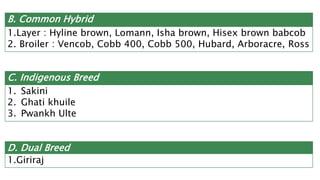
B. Common Hybrid
1.Layer : Hyline brown, Lomann, Isha brown, Hisex brown babcob
2. Broiler : Vencob, Cobb 400, Cobb 500, Hubard, Arboracre, Ross
C. Indigenous Breed
1. Sakini
2. Ghati khuile
3. Pwankh Ulte
D. Dual Breed
1.Giriraj
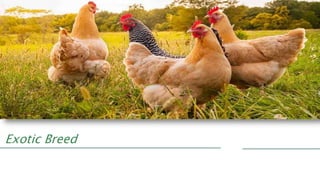
Exotic Breed
1. American Class
• Originated within United States or Canada
• Clean yellow shank and red ear lobe
• Lay brown shelled eggs
• Good for meat and egg production
• They are heavier breeds
• Friendly nature and can survive in hardy
conditions
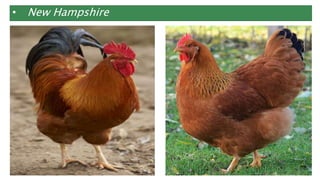
• New Hampshire
 Distinct Features
• Origin : New Hampshire of America
• Variant of Rhode Chicken.
• Plumage is of copper red with tail black colored tail
and no feathers in leg.
• Ear lobe is red with yellow colored skin.
• They usually don’t hatch their eggs.
• Eggs are of brown color.
• An adult weighs about 4 kg (Male) and 3 kg (Female).
• Lays 180-200 eggs per year.
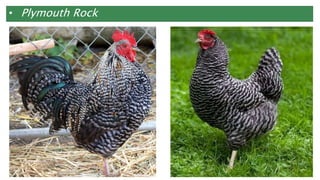
• Plymouth Rock
 Distinct Features
• Origin : America
• Variants : Barred ,White ,Blue ,Bluff ,Colombian
,Partridge ,Silver Penciled.
• Ear lobes are red with featherless legs.
• They have trend for hatching their eggs.
• Eggs are brown colored.
• An adult weighs 4kg (Male) and 3kg (Female).
• Lays 170-200 eggs per year.
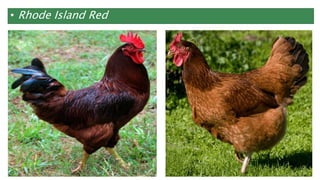
• Rhode Island Red
Distinct Features
• Origin : United States
• Feathers are red with wide and deep chest.
• Backside is wide, long, and flat.
• Hens are smaller in size than rooster.
• Single or rose comb in head.
• Ear lobe is red color.
• Lays brown colored eggs.
• An adult weighs 4kg (Male) and 3kg (Female).
• Lays 180-220 eggs per year.
2. Mediterranean Class
• Highly productive breed for meat and egg production.
• Body is smaller in size with feathers tightly attached to
body.
• Ear lobe is white with white or yellow skin color.
• Start laying eggs earlier than other breeds with white
shell.
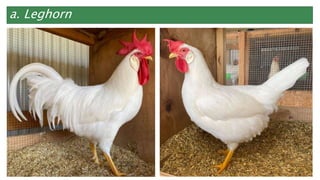
a. Leghorn
 Distinct Features
• Origin : Italy
• Variants : 13 (White, Black, Red Colored.
• Comb : Single or Rose
• Small and yellow featherless legs.
• Skin is yellow or white.
• Small body but lays big white eggs.
• They don’t hatch their eggs.
• Ear lobe is white.
• An adult weighs 3kg (Male) and 2kg (Female).
• Lays 200-250 eggs per year.
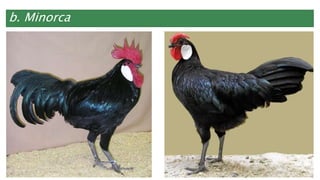
b. Minorca
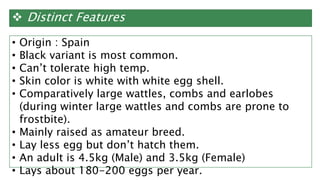
 Distinct Features
• Origin : Spain
• Black variant is most common.
• Can’t tolerate high temp.
• Skin color is white with white egg shell.
• Comparatively large wattles, combs and earlobes
(during winter large wattles and combs are prone to
frostbite).
• Mainly raised as amateur breed.
• Lay less egg but don’t hatch them.
• An adult is 4.5kg (Male) and 3.5kg (Female)
• Lays about 180-200 eggs per year.
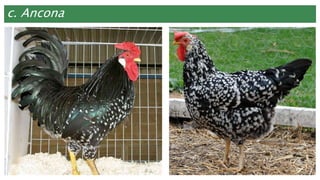
c. Ancona
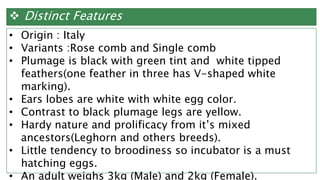
 Distinct Features
• Origin : Italy
• Variants :Rose comb and Single comb
• Plumage is black with green tint and white tipped
feathers(one feather in three has V-shaped white
marking).
• Ears lobes are white with white egg color.
• Contrast to black plumage legs are yellow.
• Hardy nature and prolificacy from it’s mixed
ancestors(Leghorn and others breeds).
• Little tendency to broodiness so incubator is a must
hatching eggs.
• An adult weighs 3kg (Male) and 2kg (Female).
3. English Class
• Highly productive for meat and egg production.
• Medium in size.
• Legs are covered with feathers.
• Skin is white in color.
• Ear lobe is red.
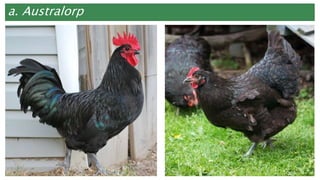
a. Australorp
 Distinct Features
• Origin : Australia
• Body : Straight, deep, strong and slopes gradually to
tail.
• Plumage is greenish black with no feathers on leg.
• Skin color is white.
• Single comb.
• Eggs are brown shelled.
• Mainly for egg production.
• An adult weighs 4kg (Male) and 3kg (Female).
• Lays about 200-250 eggs.
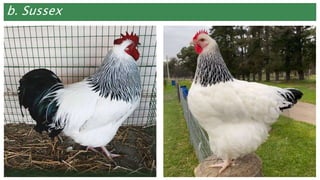
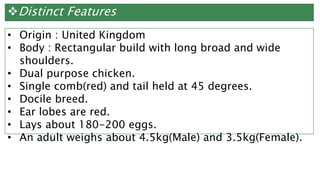
b. Sussex
Distinct Features
• Origin : United Kingdom
• Body : Rectangular build with long broad and wide
shoulders.
• Dual purpose chicken.
• Single comb(red) and tail held at 45 degrees.
• Docile breed.
• Ear lobes are red.
• Lays about 180-200 eggs.
• An adult weighs about 4.5kg(Male) and 3.5kg(Female).
4. Asiatic Class
• Highly productive breeds
• Big in size and produce huge amount of meat.
• Skin color is yellow or white .
• Feathers are tightly held at skin.
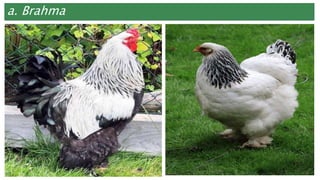
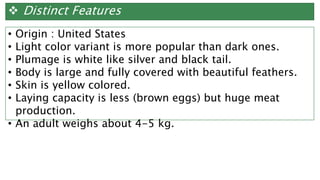
a. Brahma
 Distinct Features
• Origin : United States
• Light color variant is more popular than dark ones.
• Plumage is white like silver and black tail.
• Body is large and fully covered with beautiful feathers.
• Skin is yellow colored.
• Laying capacity is less (brown eggs) but huge meat
production.
• An adult weighs about 4-5 kg.
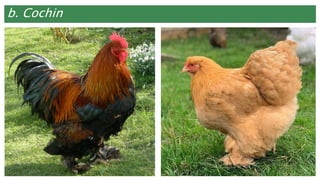
b. Cochin
 Distinct Features
• Origin : China
• Variant : Black, Blue, White, Buff, Grouse, Cuckoo,
Partridge.
• Large feather legged principally for exhibition.
• Low egg laying capacity with medium sized brown
eggs.
• Calm and docile nature.
• Single comb with red ear lobe.
• Hardy in winter but cant tolerate heat.
• An adult weighs about 5kg(Male) and 4kg (Female).
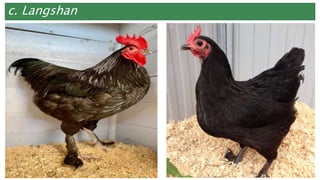
c. Langshan
 Distinct Features
• Origin : China
• Plumage is black with long tail.
• Suitable for both meat and egg production.
• Eggshell is brown.
• Skin is white in color.
• An adult weighs about 4.5kg (Male) and 4kg (Female).
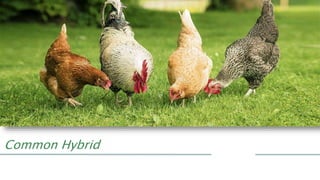
Common Hybrid
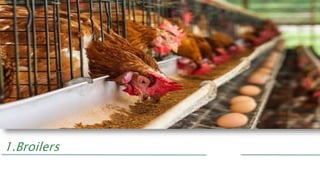
1.Broilers
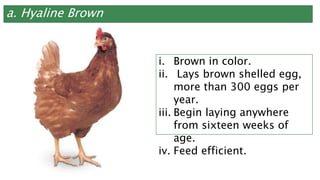
a. Hyaline Brown
i. Brown in color.
ii. Lays brown shelled egg,
more than 300 eggs per
year.
iii. Begin laying anywhere
from sixteen weeks of
age.
iv. Feed efficient.
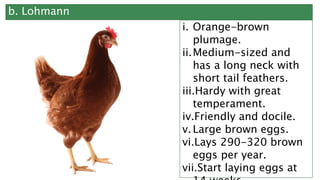
b. Lohmann
i. Orange-brown
plumage.
ii.Medium-sized and
has a long neck with
short tail feathers.
iii.Hardy with great
temperament.
iv.Friendly and docile.
v. Large brown eggs.
vi.Lays 290-320 brown
eggs per year.
vii.Start laying eggs at
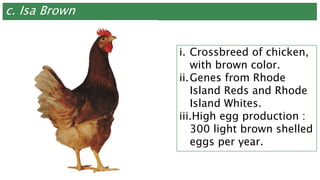
c. Isa Brown
i. Crossbreed of chicken,
with brown color.
ii.Genes from Rhode
Island Reds and Rhode
Island Whites.
iii.High egg production :
300 light brown shelled
eggs per year.
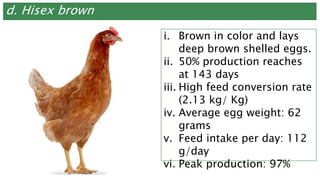
d. Hisex brown
i. Brown in color and lays
deep brown shelled eggs.
ii. 50% production reaches
at 143 days
iii. High feed conversion rate
(2.13 kg/ Kg)
iv. Average egg weight: 62
grams
v. Feed intake per day: 112
g/day
vi. Peak production: 97%
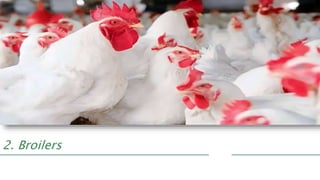
2. Broilers
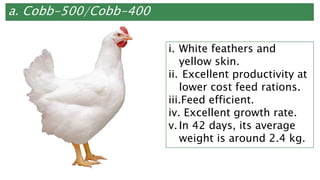
a. Cobb-500/Cobb-400
i. White feathers and
yellow skin.
ii. Excellent productivity at
lower cost feed rations.
iii.Feed efficient.
iv. Excellent growth rate.
v. In 42 days, its average
weight is around 2.4 kg.
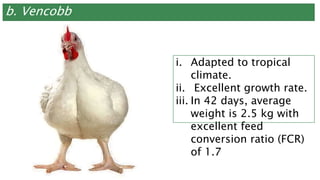
b. Vencobb
i. Adapted to tropical
climate.
ii. Excellent growth rate.
iii. In 42 days, average
weight is 2.5 kg with
excellent feed
conversion ratio (FCR)
of 1.7
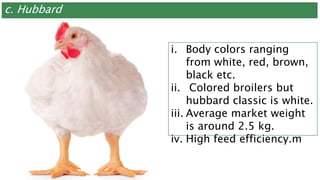
c. Hubbard
i. Body colors ranging
from white, red, brown,
black etc.
ii. Colored broilers but
hubbard classic is white.
iii. Average market weight
is around 2.5 kg.
iv. High feed efficiency.m
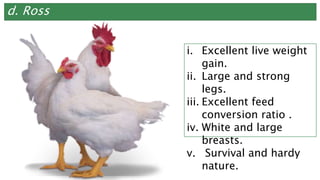
d. Ross
i. Excellent live weight
gain.
ii. Large and strong
legs.
iii. Excellent feed
conversion ratio .
iv. White and large
breasts.
v. Survival and hardy
nature.
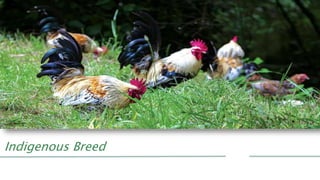
Indigenous Breed
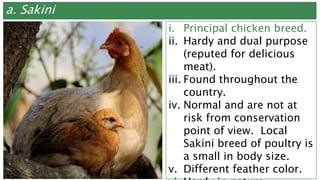
a. Sakini
i. Principal chicken breed.
ii. Hardy and dual purpose
(reputed for delicious
meat).
iii. Found throughout the
country.
iv. Normal and are not at
risk from conservation
point of view. Local
Sakini breed of poultry is
a small in body size.
v. Different feather color.
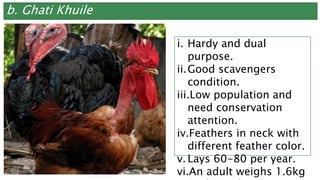
b. Ghati Khuile
i. Hardy and dual
purpose.
ii.Good scavengers
condition.
iii.Low population and
need conservation
attention.
iv.Feathers in neck with
different feather color.
v. Lays 60-80 per year.
vi.An adult weighs 1.6kg
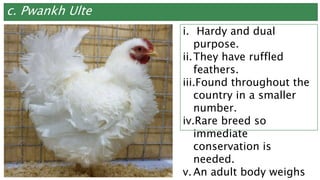
c. Pwankh Ulte
i. Hardy and dual
purpose.
ii.They have ruffled
feathers.
iii.Found throughout the
country in a smaller
number.
iv.Rare breed so
immediate
conservation is
needed.
v. An adult body weighs
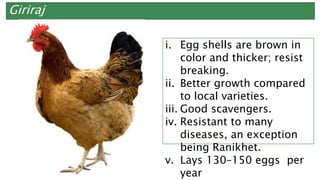
Giriraj
i. Egg shells are brown in
color and thicker; resist
breaking.
ii. Better growth compared
to local varieties.
iii. Good scavengers.
iv. Resistant to many
diseases, an exception
being Ranikhet.
v. Lays 130–150 eggs per
year