Poultry Production
Zoological Classification, Egg, Incubation, Chick Management, Housing
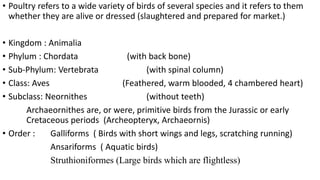
• Poultry refers to a wide variety of birds of several species and it refers to them
whether they are alive or dressed (slaughtered and prepared for market.)
• Kingdom : Animalia
• Phylum : Chordata (with back bone)
• Sub-Phylum: Vertebrata (with spinal column)
• Class: Aves (Feathered, warm blooded, 4 chambered heart)
• Subclass: Neornithes (without teeth)
Archaeornithes are, or were, primitive birds from the Jurassic or early
Cretaceous periods (Archeopteryx, Archaeornis)
• Order : Galliforms ( Birds with short wings and legs, scratching running)
Ansariforms ( Aquatic birds)
Struthioniformes (Large birds which are flightless)
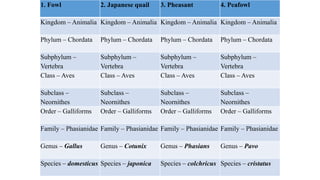
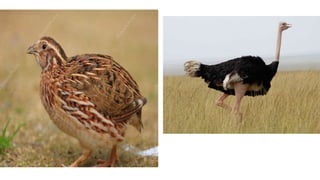
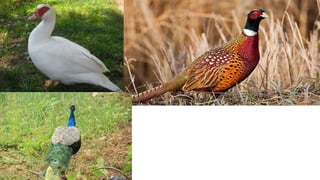
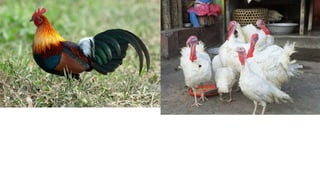
1. Fowl 2. Japanese quail 3. Pheasant 4. Peafowl
Kingdom – Animalia Kingdom – Animalia Kingdom – Animalia Kingdom – Animalia
Phylum – Chordata Phylum – Chordata Phylum – Chordata Phylum – Chordata
Subphylum –
Vertebra
Subphylum –
Vertebra
Subphylum –
Vertebra
Subphylum –
Vertebra
Class – Aves Class – Aves Class – Aves Class – Aves
Subclass –
Neornithes
Subclass –
Neornithes
Subclass –
Neornithes
Subclass –
Neornithes
Order – Galliforms Order – Galliforms Order – Galliforms Order – Galliforms
Family – Phasianidae Family – Phasianidae Family – Phasianidae Family – Phasianidae
Genus – Gallus Genus – Cotunix Genus – Phasians Genus – Pavo
Species – domesticus Species – japonica Species – colchricus Species – cristatus
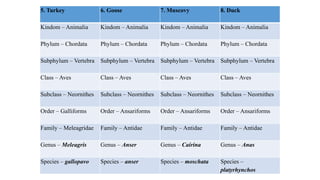
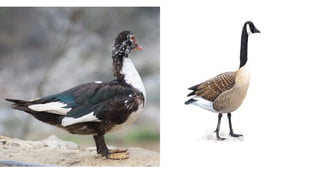
5. Turkey 6. Goose 7. Muscovy 8. Duck
Kindom – Animalia Kindom – Animalia Kindom – Animalia Kindom – Animalia
Phylum – Chordata Phylum – Chordata Phylum – Chordata Phylum – Chordata
Subphylum – Vertebra Subphylum – Vertebra Subphylum – Vertebra Subphylum – Vertebra
Class – Aves Class – Aves Class – Aves Class – Aves
Subclass – Neornithes Subclass – Neornithes Subclass – Neornithes Subclass – Neornithes
Order – Galliforms Order – Ansariforms Order – Ansariforms Order – Ansariforms
Family – Meleagridae Family – Antidae Family – Antidae Family – Antidae
Genus – Meleagris Genus – Anser Genus – Cairina Genus – Anas
Species – gallopavo Species – anser Species – moschata Species –
platyrhynchos
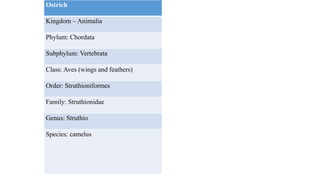
Ostrich
Kingdom – Animalia
Phylum: Chordata
Subphylum: Vertebrata
Class: Aves (wings and feathers)
Order: Struthioniformes
Family: Struthionidae
Genus: Struthio
Species: camelus
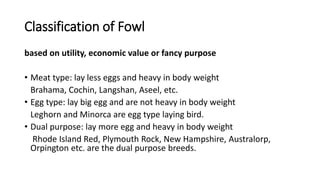
Classification of Fowl
based on utility, economic value or fancy purpose
• Meat type: lay less eggs and heavy in body weight
Brahama, Cochin, Langshan, Aseel, etc.
• Egg type: lay big egg and are not heavy in body weight
Leghorn and Minorca are egg type laying bird.
• Dual purpose: lay more egg and heavy in body weight
Rhode Island Red, Plymouth Rock, New Hampshire, Australorp,
Orpington etc. are the dual purpose breeds.
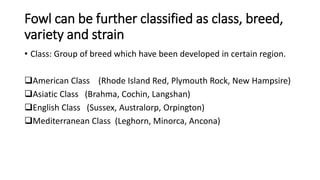
Fowl can be further classified as class, breed,
variety and strain
• Class: Group of breed which have been developed in certain region.
American Class (Rhode Island Red, Plymouth Rock, New Hampsire)
Asiatic Class (Brahma, Cochin, Langshan)
English Class (Sussex, Australorp, Orpington)
Mediterranean Class (Leghorn, Minorca, Ancona)
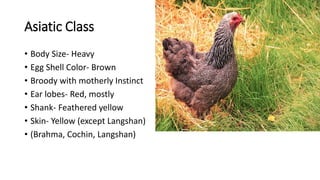
Asiatic Class
• Body Size- Heavy
• Egg Shell Color- Brown
• Broody with motherly Instinct
• Ear lobes- Red, mostly
• Shank- Feathered yellow
• Skin- Yellow (except Langshan)
• (Brahma, Cochin, Langshan)
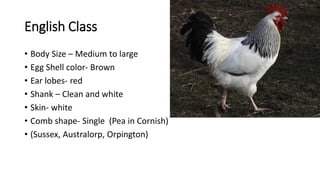
English Class
• Body Size – Medium to large
• Egg Shell color- Brown
• Ear lobes- red
• Shank – Clean and white
• Skin- white
• Comb shape- Single (Pea in Cornish)
• (Sussex, Australorp, Orpington)
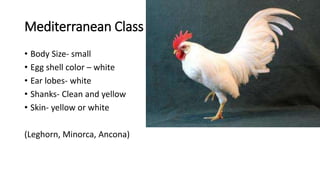
Mediterranean Class
• Body Size- small
• Egg shell color – white
• Ear lobes- white
• Shanks- Clean and yellow
• Skin- yellow or white
(Leghorn, Minorca, Ancona)
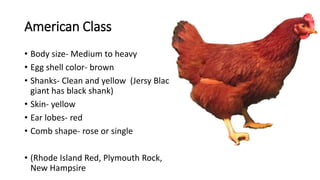
American Class
• Body size- Medium to heavy
• Egg shell color- brown
• Shanks- Clean and yellow (Jersy Black
giant has black shank)
• Skin- yellow
• Ear lobes- red
• Comb shape- rose or single
• (Rhode Island Red, Plymouth Rock,
New Hampsire
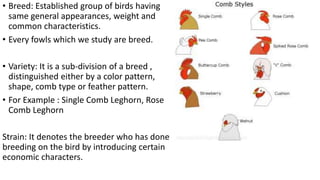
• Breed: Established group of birds having
same general appearances, weight and
common characteristics.
• Every fowls which we study are breed.
• Variety: It is a sub-division of a breed ,
distinguished either by a color pattern,
shape, comb type or feather pattern.
• For Example : Single Comb Leghorn, Rose
Comb Leghorn
Strain: It denotes the breeder who has done
breeding on the bird by introducing certain
economic characters.
Terms
• Cockerels: Mature male chickens less than one year old are
called cockerels.
• Pullets : A hen of domestic chicken less than one year old.
• Plumage : Feathers
Common feature of local breeds
• No standard size, color, shape and conformation
• Well adapted to local environment
• Excellent broodiness trait
• Poor layer (average 80 eggs per year)
• Hardy and resistant to many tropical diseases
• Good for table purpose for better flavor and test
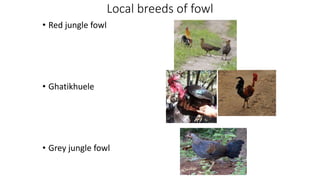
Local breeds of fowl
• Red jungle fowl
• Ghatikhuele
• Grey jungle fowl
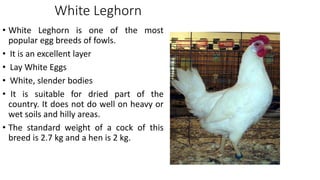
White Leghorn
• White Leghorn is one of the most
popular egg breeds of fowls.
• It is an excellent layer
• Lay White Eggs
• White, slender bodies
• It is suitable for dried part of the
country. It does not do well on heavy or
wet soils and hilly areas.
• The standard weight of a cock of this
breed is 2.7 kg and a hen is 2 kg.
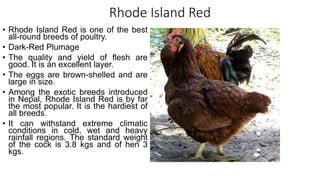
Rhode Island Red
• Rhode Island Red is one of the best
all-round breeds of poultry.
• Dark-Red Plumage
• The quality and yield of flesh are
good. It is an excellent layer.
• The eggs are brown-shelled and are
large in size.
• Among the exotic breeds introduced
in Nepal, Rhode Island Red is by far
the most popular. It is the hardiest of
all breeds.
• It can withstand extreme climatic
conditions in cold, wet and heavy
rainfall regions. The standard weight
of the cock is 3.8 kgs and of hen 3
kgs.
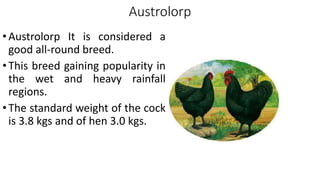
Austrolorp
•Austrolorp It is considered a
good all-round breed.
•This breed gaining popularity in
the wet and heavy rainfall
regions.
•The standard weight of the cock
is 3.8 kgs and of hen 3.0 kgs.
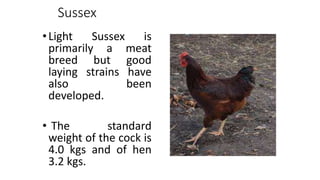
Sussex
•Light Sussex is
primarily a meat
breed but good
laying strains have
also been
developed.
• The standard
weight of the cock is
4.0 kgs and of hen
3.2 kgs.
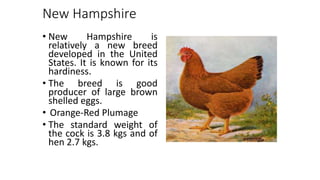
New Hampshire
• New Hampshire is
relatively a new breed
developed in the United
States. It is known for its
hardiness.
• The breed is good
producer of large brown
shelled eggs.
• Orange-Red Plumage
• The standard weight of
the cock is 3.8 kgs and of
hen 2.7 kgs.
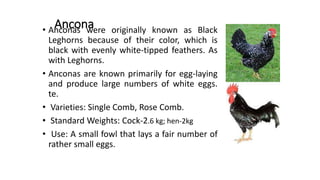
Ancona• Anconas were originally known as Black
Leghorns because of their color, which is
black with evenly white-tipped feathers. As
with Leghorns.
• Anconas are known primarily for egg-laying
and produce large numbers of white eggs.
te.
• Varieties: Single Comb, Rose Comb.
• Standard Weights: Cock-2.6 kg; hen-2kg
• Use: A small fowl that lays a fair number of
rather small eggs.
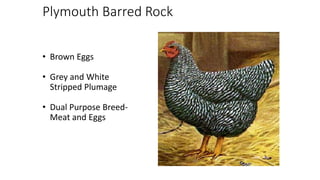
Plymouth Barred Rock
• Brown Eggs
• Grey and White
Stripped Plumage
• Dual Purpose Breed-
Meat and Eggs

Poultry production

  • 1.
    Poultry Production Zoological Classification,Egg, Incubation, Chick Management, Housing
  • 2.
    • Poultry refersto a wide variety of birds of several species and it refers to them whether they are alive or dressed (slaughtered and prepared for market.) • Kingdom : Animalia • Phylum : Chordata (with back bone) • Sub-Phylum: Vertebrata (with spinal column) • Class: Aves (Feathered, warm blooded, 4 chambered heart) • Subclass: Neornithes (without teeth) Archaeornithes are, or were, primitive birds from the Jurassic or early Cretaceous periods (Archeopteryx, Archaeornis) • Order : Galliforms ( Birds with short wings and legs, scratching running) Ansariforms ( Aquatic birds) Struthioniformes (Large birds which are flightless)
  • 3.
    1. Fowl 2.Japanese quail 3. Pheasant 4. Peafowl Kingdom – Animalia Kingdom – Animalia Kingdom – Animalia Kingdom – Animalia Phylum – Chordata Phylum – Chordata Phylum – Chordata Phylum – Chordata Subphylum – Vertebra Subphylum – Vertebra Subphylum – Vertebra Subphylum – Vertebra Class – Aves Class – Aves Class – Aves Class – Aves Subclass – Neornithes Subclass – Neornithes Subclass – Neornithes Subclass – Neornithes Order – Galliforms Order – Galliforms Order – Galliforms Order – Galliforms Family – Phasianidae Family – Phasianidae Family – Phasianidae Family – Phasianidae Genus – Gallus Genus – Cotunix Genus – Phasians Genus – Pavo Species – domesticus Species – japonica Species – colchricus Species – cristatus
  • 4.
    5. Turkey 6.Goose 7. Muscovy 8. Duck Kindom – Animalia Kindom – Animalia Kindom – Animalia Kindom – Animalia Phylum – Chordata Phylum – Chordata Phylum – Chordata Phylum – Chordata Subphylum – Vertebra Subphylum – Vertebra Subphylum – Vertebra Subphylum – Vertebra Class – Aves Class – Aves Class – Aves Class – Aves Subclass – Neornithes Subclass – Neornithes Subclass – Neornithes Subclass – Neornithes Order – Galliforms Order – Ansariforms Order – Ansariforms Order – Ansariforms Family – Meleagridae Family – Antidae Family – Antidae Family – Antidae Genus – Meleagris Genus – Anser Genus – Cairina Genus – Anas Species – gallopavo Species – anser Species – moschata Species – platyrhynchos
  • 5.
    Ostrich Kingdom – Animalia Phylum:Chordata Subphylum: Vertebrata Class: Aves (wings and feathers) Order: Struthioniformes Family: Struthionidae Genus: Struthio Species: camelus
  • 10.
    Classification of Fowl basedon utility, economic value or fancy purpose • Meat type: lay less eggs and heavy in body weight Brahama, Cochin, Langshan, Aseel, etc. • Egg type: lay big egg and are not heavy in body weight Leghorn and Minorca are egg type laying bird. • Dual purpose: lay more egg and heavy in body weight Rhode Island Red, Plymouth Rock, New Hampshire, Australorp, Orpington etc. are the dual purpose breeds.
  • 12.
    Fowl can befurther classified as class, breed, variety and strain • Class: Group of breed which have been developed in certain region. American Class (Rhode Island Red, Plymouth Rock, New Hampsire) Asiatic Class (Brahma, Cochin, Langshan) English Class (Sussex, Australorp, Orpington) Mediterranean Class (Leghorn, Minorca, Ancona)
  • 13.
    Asiatic Class • BodySize- Heavy • Egg Shell Color- Brown • Broody with motherly Instinct • Ear lobes- Red, mostly • Shank- Feathered yellow • Skin- Yellow (except Langshan) • (Brahma, Cochin, Langshan)
  • 14.
    English Class • BodySize – Medium to large • Egg Shell color- Brown • Ear lobes- red • Shank – Clean and white • Skin- white • Comb shape- Single (Pea in Cornish) • (Sussex, Australorp, Orpington)
  • 15.
    Mediterranean Class • BodySize- small • Egg shell color – white • Ear lobes- white • Shanks- Clean and yellow • Skin- yellow or white (Leghorn, Minorca, Ancona)
  • 16.
    American Class • Bodysize- Medium to heavy • Egg shell color- brown • Shanks- Clean and yellow (Jersy Black giant has black shank) • Skin- yellow • Ear lobes- red • Comb shape- rose or single • (Rhode Island Red, Plymouth Rock, New Hampsire
  • 17.
    • Breed: Establishedgroup of birds having same general appearances, weight and common characteristics. • Every fowls which we study are breed. • Variety: It is a sub-division of a breed , distinguished either by a color pattern, shape, comb type or feather pattern. • For Example : Single Comb Leghorn, Rose Comb Leghorn Strain: It denotes the breeder who has done breeding on the bird by introducing certain economic characters.
  • 18.
    Terms • Cockerels: Maturemale chickens less than one year old are called cockerels. • Pullets : A hen of domestic chicken less than one year old. • Plumage : Feathers
  • 19.
    Common feature oflocal breeds • No standard size, color, shape and conformation • Well adapted to local environment • Excellent broodiness trait • Poor layer (average 80 eggs per year) • Hardy and resistant to many tropical diseases • Good for table purpose for better flavor and test
  • 20.
    Local breeds offowl • Red jungle fowl • Ghatikhuele • Grey jungle fowl
  • 21.
    White Leghorn • WhiteLeghorn is one of the most popular egg breeds of fowls. • It is an excellent layer • Lay White Eggs • White, slender bodies • It is suitable for dried part of the country. It does not do well on heavy or wet soils and hilly areas. • The standard weight of a cock of this breed is 2.7 kg and a hen is 2 kg.
  • 22.
    Rhode Island Red •Rhode Island Red is one of the best all-round breeds of poultry. • Dark-Red Plumage • The quality and yield of flesh are good. It is an excellent layer. • The eggs are brown-shelled and are large in size. • Among the exotic breeds introduced in Nepal, Rhode Island Red is by far the most popular. It is the hardiest of all breeds. • It can withstand extreme climatic conditions in cold, wet and heavy rainfall regions. The standard weight of the cock is 3.8 kgs and of hen 3 kgs.
  • 23.
    Austrolorp •Austrolorp It isconsidered a good all-round breed. •This breed gaining popularity in the wet and heavy rainfall regions. •The standard weight of the cock is 3.8 kgs and of hen 3.0 kgs.
  • 24.
    Sussex •Light Sussex is primarilya meat breed but good laying strains have also been developed. • The standard weight of the cock is 4.0 kgs and of hen 3.2 kgs.
  • 25.
    New Hampshire • NewHampshire is relatively a new breed developed in the United States. It is known for its hardiness. • The breed is good producer of large brown shelled eggs. • Orange-Red Plumage • The standard weight of the cock is 3.8 kgs and of hen 2.7 kgs.
  • 26.
    Ancona• Anconas wereoriginally known as Black Leghorns because of their color, which is black with evenly white-tipped feathers. As with Leghorns. • Anconas are known primarily for egg-laying and produce large numbers of white eggs. te. • Varieties: Single Comb, Rose Comb. • Standard Weights: Cock-2.6 kg; hen-2kg • Use: A small fowl that lays a fair number of rather small eggs.
  • 27.
    Plymouth Barred Rock •Brown Eggs • Grey and White Stripped Plumage • Dual Purpose Breed- Meat and Eggs