
PoultryScience,PVNRTVU
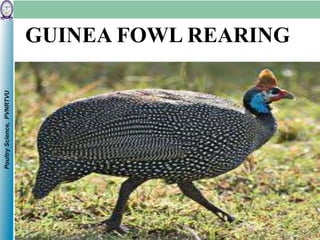
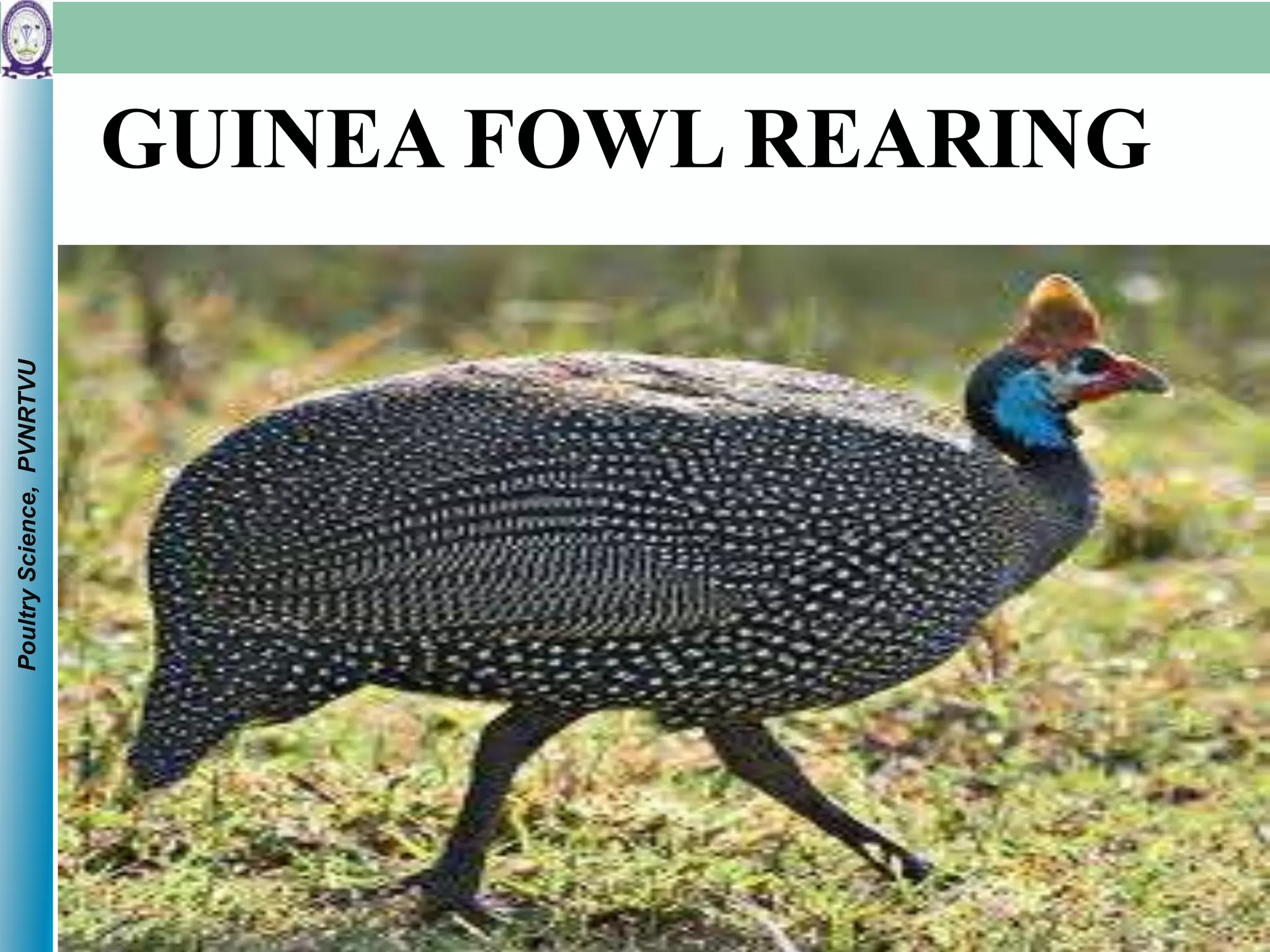
GUINEA FOWL REARING
Introduction
 Numida meleagris
 ORIGIN – AFRICA
 Reared for both meat and egg
 Gamy meat flavour
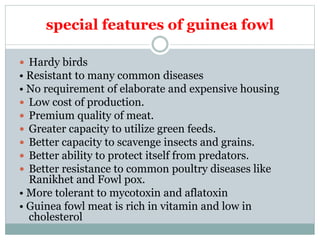
special features of guinea fowl
 Hardy birds
• Resistant to many common diseases
• No requirement of elaborate and expensive housing
 Low cost of production.
 Premium quality of meat.
 Greater capacity to utilize green feeds.
 Better capacity to scavenge insects and grains.
 Better ability to protect itself from predators.
 Better resistance to common poultry diseases like
Ranikhet and Fowl pox.
• More tolerant to mycotoxin and aflatoxin
• Guinea fowl meat is rich in vitamin and low in
cholesterol
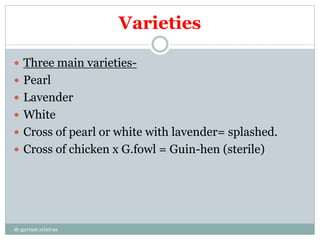
Varieties
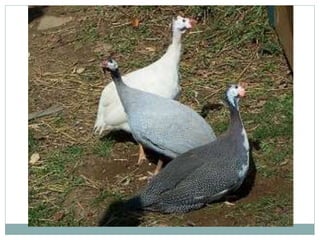
 Three main varieties-
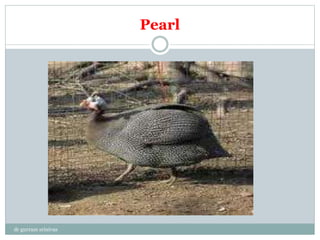
 Pearl
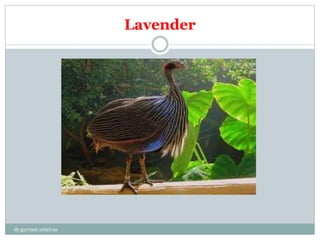
 Lavender
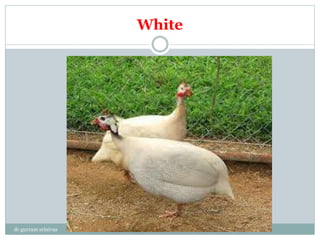
 White
 Cross of pearl or white with lavender= splashed.
 Cross of chicken x G.fowl = Guin-hen (sterile)
dr gurram srinivas
Pearl
dr gurram srinivas
Lavender
dr gurram srinivas
White
dr gurram srinivas
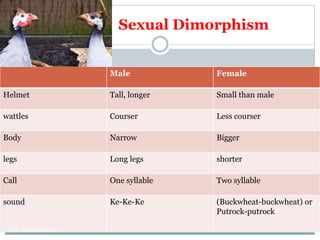
Sexual Dimorphism
Male Female
Helmet Tall, longer Small than male
wattles Courser Less courser
Body Narrow Bigger
legs Long legs shorter
Call One syllable Two syllable
sound Ke-Ke-Ke (Buckwheat-buckwheat) or
Putrock-putrock
dr gurram srinivas
Genetics of immune competence
 Guinea fowl has a high reputation for inbuilt disease
resistance potential
 Resistance to RNA tumors
 Resistance to tick infestations
 Low aflatoxin susceptibility
dr gurram srinivas
Productive performance
 Age at first egg-250 days
 Egg weight : 41-45 grams
 Egg production – 100-120eggs/yr.
 Egg production up to 2-3 yr well.
 Age of marketing for meat 12 weeks
 FCR – 3.3 (meat type).
 Dressing percentage 77%
 Less fat and cholesterol but more of B complex
dr gurram srinivas
Reproductive performance
 Age at sexual maturity : 21-22 wks
 Adult body weight : 1.5 kg
 Sex ratio - 1:4 (domestic)
1:6-8 (confined)
 (seasonal breeder),
 laying begins at 28 weeks.
 Starts laying march continue up to October
 Fertility -90%, Hatchability -80%
dr gurram srinivas
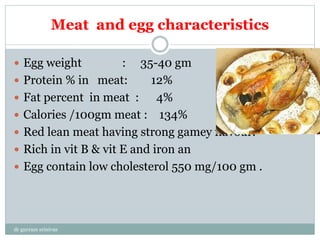
Meat and egg characteristics
 Egg weight : 35-40 gm
 Protein % in meat: 12%
 Fat percent in meat : 4%
 Calories /100gm meat : 134%
 Red lean meat having strong gamey flavour.
 Rich in vit B & vit E and iron an
 Egg contain low cholesterol 550 mg/100 gm .
dr gurram srinivas
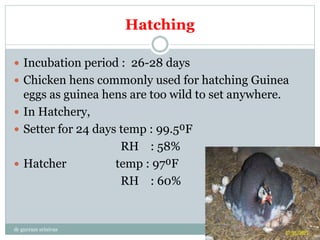
Hatching
 Incubation period : 26-28 days
 Chicken hens commonly used for hatching Guinea
eggs as guinea hens are too wild to set anywhere.
 In Hatchery,
 Setter for 24 days temp : 99.5⁰F
RH : 58%
 Hatcher temp : 97⁰F
RH : 60%
dr gurram srinivas
Management
 Brooding-
 Range system G.fowls are poor mother, broody hen that
hatched guinea fowl eggs will make good caretaker of keets.
 Intensive system- 100 keets placed in 4 feet diameter brooder
guard under hover or gas brooder (100⁰F)
 For 0-8 week floor space 0.5 sq ft/bird and later 1 sq ft/bird.
 Cage brooding can done up to 12 wks
 These bird can not been totally domesticated hence require
perches.
dr gurram srinivas
Feeding
 Under native conditions guinea fowls has a reputation of meeting
nutritional requirements successfully through scavenging and foraging
 Brooding-
CP : 20-24%
ME : 3000 kcal/kg
 Grower
ME: 3200 Kcal/kg
 Layer-
CP : 16-18 %
ME: 2900 kcal/kg
Ca: 3.35
Bird consume 115-120 gm /bird/day.
(oguntona,1983)
dr gurram srinivas
Aflatoxin in feeds and performance
 Guinea fowl has a natural tolerance to aflatoxin
 Damaged and moldy grains can be utilized with
harmful manifestations
 Diets has high as 1.00 ppm aflatoxin should no
adverse effect on wt gain ,avg feed consumption or
feed efficiency
 Autopsy showed absence of gross pathological
lesions
dr gurram srinivas
Grower and Layer G.Fowl management
 Require enough space with perches
 After 16 wks of age floor space : 2sqft/bird
 Grower and layer house well ventilated
 Linear or trough feeders and waterer with water
guard provided
 6-8 cm feeder space,3 cm waterer space
 1 nest provided for 4-5 birds
 12 hr light and 12 hr darkness give better results
dr gurram srinivas
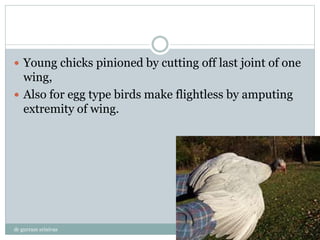
 Young chicks pinioned by cutting off last joint of one
wing,
 Also for egg type birds make flightless by amputing
extremity of wing.
dr gurram srinivas
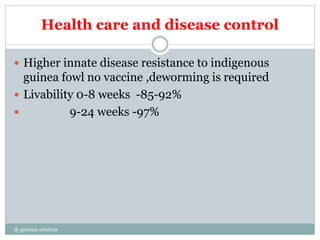
Health care and disease control
 Higher innate disease resistance to indigenous
guinea fowl no vaccine ,deworming is required
 Livability 0-8 weeks -85-92%
 9-24 weeks -97%
dr gurram srinivas
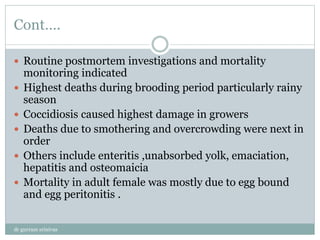
Cont….
 Routine postmortem investigations and mortality
monitoring indicated
 Highest deaths during brooding period particularly rainy
season
 Coccidiosis caused highest damage in growers
 Deaths due to smothering and overcrowding were next in
order
 Others include enteritis ,unabsorbed yolk, emaciation,
hepatitis and osteomaicia
 Mortality in adult female was mostly due to egg bound
and egg peritonitis .
dr gurram srinivas
Thank
you..
dr gurram srinivas

Guinea fowl farming

  • 1.
  • 3.
    Introduction  Numida meleagris ORIGIN – AFRICA  Reared for both meat and egg  Gamy meat flavour
  • 4.
    special features ofguinea fowl  Hardy birds • Resistant to many common diseases • No requirement of elaborate and expensive housing  Low cost of production.  Premium quality of meat.  Greater capacity to utilize green feeds.  Better capacity to scavenge insects and grains.  Better ability to protect itself from predators.  Better resistance to common poultry diseases like Ranikhet and Fowl pox. • More tolerant to mycotoxin and aflatoxin • Guinea fowl meat is rich in vitamin and low in cholesterol
  • 5.
    Varieties  Three mainvarieties-  Pearl  Lavender  White  Cross of pearl or white with lavender= splashed.  Cross of chicken x G.fowl = Guin-hen (sterile) dr gurram srinivas
  • 6.
  • 7.
  • 8.
  • 9.
    Sexual Dimorphism Male Female HelmetTall, longer Small than male wattles Courser Less courser Body Narrow Bigger legs Long legs shorter Call One syllable Two syllable sound Ke-Ke-Ke (Buckwheat-buckwheat) or Putrock-putrock dr gurram srinivas
  • 10.
    Genetics of immunecompetence  Guinea fowl has a high reputation for inbuilt disease resistance potential  Resistance to RNA tumors  Resistance to tick infestations  Low aflatoxin susceptibility dr gurram srinivas
  • 11.
    Productive performance  Ageat first egg-250 days  Egg weight : 41-45 grams  Egg production – 100-120eggs/yr.  Egg production up to 2-3 yr well.  Age of marketing for meat 12 weeks  FCR – 3.3 (meat type).  Dressing percentage 77%  Less fat and cholesterol but more of B complex dr gurram srinivas
  • 12.
    Reproductive performance  Ageat sexual maturity : 21-22 wks  Adult body weight : 1.5 kg  Sex ratio - 1:4 (domestic) 1:6-8 (confined)  (seasonal breeder),  laying begins at 28 weeks.  Starts laying march continue up to October  Fertility -90%, Hatchability -80% dr gurram srinivas
  • 13.
    Meat and eggcharacteristics  Egg weight : 35-40 gm  Protein % in meat: 12%  Fat percent in meat : 4%  Calories /100gm meat : 134%  Red lean meat having strong gamey flavour.  Rich in vit B & vit E and iron an  Egg contain low cholesterol 550 mg/100 gm . dr gurram srinivas
  • 14.
    Hatching  Incubation period: 26-28 days  Chicken hens commonly used for hatching Guinea eggs as guinea hens are too wild to set anywhere.  In Hatchery,  Setter for 24 days temp : 99.5⁰F RH : 58%  Hatcher temp : 97⁰F RH : 60% dr gurram srinivas
  • 15.
    Management  Brooding-  Rangesystem G.fowls are poor mother, broody hen that hatched guinea fowl eggs will make good caretaker of keets.  Intensive system- 100 keets placed in 4 feet diameter brooder guard under hover or gas brooder (100⁰F)  For 0-8 week floor space 0.5 sq ft/bird and later 1 sq ft/bird.  Cage brooding can done up to 12 wks  These bird can not been totally domesticated hence require perches. dr gurram srinivas
  • 16.
    Feeding  Under nativeconditions guinea fowls has a reputation of meeting nutritional requirements successfully through scavenging and foraging  Brooding- CP : 20-24% ME : 3000 kcal/kg  Grower ME: 3200 Kcal/kg  Layer- CP : 16-18 % ME: 2900 kcal/kg Ca: 3.35 Bird consume 115-120 gm /bird/day. (oguntona,1983) dr gurram srinivas
  • 17.
    Aflatoxin in feedsand performance  Guinea fowl has a natural tolerance to aflatoxin  Damaged and moldy grains can be utilized with harmful manifestations  Diets has high as 1.00 ppm aflatoxin should no adverse effect on wt gain ,avg feed consumption or feed efficiency  Autopsy showed absence of gross pathological lesions dr gurram srinivas
  • 18.
    Grower and LayerG.Fowl management  Require enough space with perches  After 16 wks of age floor space : 2sqft/bird  Grower and layer house well ventilated  Linear or trough feeders and waterer with water guard provided  6-8 cm feeder space,3 cm waterer space  1 nest provided for 4-5 birds  12 hr light and 12 hr darkness give better results dr gurram srinivas
  • 19.
     Young chickspinioned by cutting off last joint of one wing,  Also for egg type birds make flightless by amputing extremity of wing. dr gurram srinivas
  • 20.
    Health care anddisease control  Higher innate disease resistance to indigenous guinea fowl no vaccine ,deworming is required  Livability 0-8 weeks -85-92%  9-24 weeks -97% dr gurram srinivas
  • 21.
    Cont….  Routine postmorteminvestigations and mortality monitoring indicated  Highest deaths during brooding period particularly rainy season  Coccidiosis caused highest damage in growers  Deaths due to smothering and overcrowding were next in order  Others include enteritis ,unabsorbed yolk, emaciation, hepatitis and osteomaicia  Mortality in adult female was mostly due to egg bound and egg peritonitis . dr gurram srinivas
  • 22.