INDIAN ACCOUNTING
STANDARDS
ACCOUNTING STANDARD - 3
Tushar Swami (609)
Purnima Varun(535)
Aakshit Nangalia(591)
Shubham Verma (628)
Shweta Baisla (556)
Manisha Baisla (630)
What Are Accounting Standards?
 Accounting standards are authoritative standards for
financial reporting.
 The primary source of generally accepted accounting
principles (GAAP).
 They specify how transactions and other events are to
be recognized, measured, presented and disclosed in
financial statements.
 The objective of such standards is to provide financial
information to investors, lenders, creditors, contributors
and others that is useful in making decisions about
providing resources to the entity.
Indian Accounting Standards (Ind-AS)
 the Accounting Standard adopted by companies in India
 issued under the supervision of Accounting Standards Board (ASB).
 ASB - committee under ICAI (constituted in 1977) which consists of representatives
from government department, academicians, other professional bodies.
 named and numbered in the same way as the International Financial Reporting
Standards (IFRS).
 National Advisory Committee on Accounting Standards (NACAS) recommend these
standards to the Ministry of Corporate Affairs (MCA).
 As on date MCA has notified 41 Ind-AS.
 These shall be applied to the companies of financial year 2015-16 voluntarily, and
from 2016-17 on a mandatory basis.
Indian Accounting Standard -3
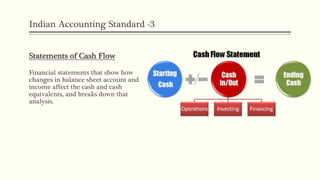
Statements of Cash Flow
Financial statements that show how
changes in balance sheet account and
income affect the cash and cash
equivalents, and breaks down that
analysis.
Definition
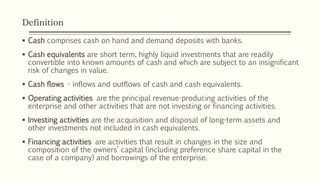
 Cash comprises cash on hand and demand deposits with banks.
 Cash equivalents are short term, highly liquid investments that are readily
convertible into known amounts of cash and which are subject to an insignificant
risk of changes in value.
 Cash flows - inflows and outflows of cash and cash equivalents.
 Operating activities are the principal revenue-producing activities of the
enterprise and other activities that are not investing or financing activities.
 Investing activities are the acquisition and disposal of long-term assets and
other investments not included in cash equivalents.
 Financing activities are activities that result in changes in the size and
composition of the owners’ capital (including preference share capital in the
case of a company) and borrowings of the enterprise.
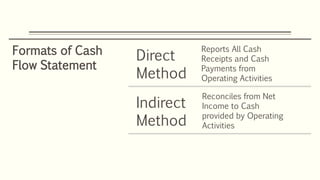
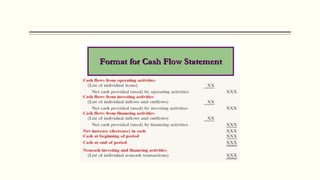
Formats of Cash
Flow Statement
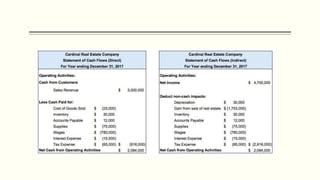
Direct
Method
Reports All Cash
Receipts and Cash
Payments from
Operating Activities
Indirect
Method
Reconciles from Net
Income to Cash
provided by Operating
Activities
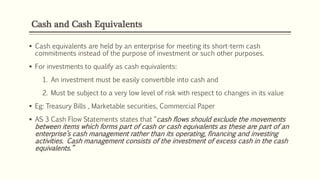
Cash and Cash Equivalents
 Cash equivalents are held by an enterprise for meeting its short-term cash
commitments instead of the purpose of investment or such other purposes.
 For investments to qualify as cash equivalents:
1. An investment must be easily convertible into cash and
2. Must be subject to a very low level of risk with respect to changes in its value
 Eg: Treasury Bills , Marketable securities, Commercial Paper
 AS 3 Cash Flow Statements states that “cash flows should exclude the movements
between items which forms part of cash or cash equivalents as these are part of an
enterprise’s cash management rather than its operating, financing and investing
activities. Cash management consists of the investment of excess cash in the cash
equivalents.”
Applicability of AS 3 Cash Flow Statements
 The applicability of Cash flow statement has been defined under the Companies Act,
2013. As per the definition in the act, a financial statement includes Cash flow
Statements
 Thus, cash flow statements are to be prepared by all companies but the act also
specifies a certain category of companies which are exempted from preparing the
same. Such companies are One Person Company (OPC), Small Company and
Dormant Company.
OPC means a company which has only one single person as its member.
A Small Company is a private company with a maximum paid up capital of Rs.
50 lakhs and a maximum turnover of Rs. 2 crores.
A Dormant Company is an inactive company which is formed for some future
projects or only to hold an asset and has no significant transactions.
Disclosure
 Enterprises must disclose, along with management commentary, the amount of
substantial cash and cash equivalents held by an enterprise which isn’t available for
use.
 Commitments that may arise from discounted bills of exchange and other similar
obligations that are undertaken by an enterprise are typically disclosed in financial
statements by means of notes, even in case the probability of loss is remote.
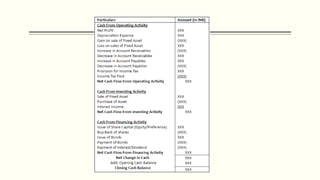
Operating Activities
 These are principal revenue producing activities of the enterprise.
Examples:
 Cash receipts from sale of goods / rendering services;
 Cash receipts from royalties, fees, commissions and other revenue;
 Cash payments to suppliers of goods and service;
 Cash payments to and on behalf of employees
Investing Activities
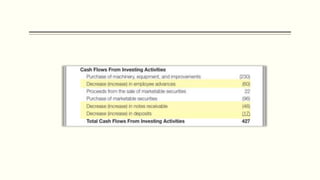
 The activities of acquisition and disposal of long term assets and other
investments not included in cash equivalent are investing activities.
 It includes making and collecting loans, acquiring and disposal of debt and
equity instruments, property and fixed assets etc.
Examples of cash flows arising from investing activities are as follows:
 Cash payments to acquire fixed assets
 Cash receipts from disposal of fixed assets
 Cash payments to acquire shares, warrants or debt instruments of other enterprises and
interest in joint ventures
 Cash receipt from disposal of above investments
Financing Activities
 Those activities that result in changes in size and composition of owners
capital and borrowing of the organization.
 It includes receipts from issuing shares, debentures, bonds, borrowing and
payment of borrowed amount, loan etc. Sale of share Buy back of shares ,
Redemption of preference shares , Issue / redemption of debentures , Long
term loan / payment thereof , Dividend / interest paid
Acquisitions and Disposal of Business Units including Subsidiaries
 The aggregate cash flows which arise from acquisition and from the disposal of
business units including subsidiaries must be shown as investing activities and
reported separately.
 Enterprises must present, in total, with respect to both the acquisitions and
disposals of other business units including subsidiaries within the period the
followings:
(a) Aggregate purchase or disposal value
(b) The amount of purchase or disposal value which is discharged by way of cash and
cash equivalents
Non Cash
 These should be excluded from the cash flow statement
 These transactions should be disclosed in the financial statements.
Examples
 Acquisition of an enterprise by means of issue of equity share
 Conversion of debt to equity
Treatment of Tax
 Cash flow for tax payments / refund should be classified as cash flow from
operating activities.
 If cash flow can be specifically identified as cash flow from investment /
financing activities, appropriate classification should be made.
Forex Transaction
 The effect of changes in foreign exchange rates should be reported as
separate part of the reconciliation of cash and cash equivalents.
 Unrealized gain and losses arising from changes in foreign exchanges rates
are not cash flows.
Dividend
Dividend Received
 For financial enterprises – in operating activities
 For other than financial enterprises – in investing activities
Dividend Paid
 Always classified as financing activities
Cash flow from dividend should be separately disclosed
Interest
Interest Received
 Received from investment – it is in investment activities
 Received from short term investment classified, as cash equivalents should be considered
as cash inflows from operating activities.
 Received on trade advances and operating receivables should be in operating activities
Interest Paid
 On loans/debts are in financing activities
 On working capital loan and any other loan taken to finance operating activities are in
operating activities
Cash flow from interest should be separately disclosed.
Indian AS 3

Indian AS 3

  • 1.
    INDIAN ACCOUNTING STANDARDS ACCOUNTING STANDARD- 3 Tushar Swami (609) Purnima Varun(535) Aakshit Nangalia(591) Shubham Verma (628) Shweta Baisla (556) Manisha Baisla (630)
  • 2.
    What Are AccountingStandards?  Accounting standards are authoritative standards for financial reporting.  The primary source of generally accepted accounting principles (GAAP).  They specify how transactions and other events are to be recognized, measured, presented and disclosed in financial statements.  The objective of such standards is to provide financial information to investors, lenders, creditors, contributors and others that is useful in making decisions about providing resources to the entity.
  • 3.
    Indian Accounting Standards(Ind-AS)  the Accounting Standard adopted by companies in India  issued under the supervision of Accounting Standards Board (ASB).  ASB - committee under ICAI (constituted in 1977) which consists of representatives from government department, academicians, other professional bodies.  named and numbered in the same way as the International Financial Reporting Standards (IFRS).  National Advisory Committee on Accounting Standards (NACAS) recommend these standards to the Ministry of Corporate Affairs (MCA).  As on date MCA has notified 41 Ind-AS.  These shall be applied to the companies of financial year 2015-16 voluntarily, and from 2016-17 on a mandatory basis.
  • 4.
    Indian Accounting Standard-3 Statements of Cash Flow Financial statements that show how changes in balance sheet account and income affect the cash and cash equivalents, and breaks down that analysis.
  • 5.
    Definition  Cash comprisescash on hand and demand deposits with banks.  Cash equivalents are short term, highly liquid investments that are readily convertible into known amounts of cash and which are subject to an insignificant risk of changes in value.  Cash flows - inflows and outflows of cash and cash equivalents.  Operating activities are the principal revenue-producing activities of the enterprise and other activities that are not investing or financing activities.  Investing activities are the acquisition and disposal of long-term assets and other investments not included in cash equivalents.  Financing activities are activities that result in changes in the size and composition of the owners’ capital (including preference share capital in the case of a company) and borrowings of the enterprise.
  • 6.
    Formats of Cash FlowStatement Direct Method Reports All Cash Receipts and Cash Payments from Operating Activities Indirect Method Reconciles from Net Income to Cash provided by Operating Activities
  • 8.
    Cash and CashEquivalents  Cash equivalents are held by an enterprise for meeting its short-term cash commitments instead of the purpose of investment or such other purposes.  For investments to qualify as cash equivalents: 1. An investment must be easily convertible into cash and 2. Must be subject to a very low level of risk with respect to changes in its value  Eg: Treasury Bills , Marketable securities, Commercial Paper  AS 3 Cash Flow Statements states that “cash flows should exclude the movements between items which forms part of cash or cash equivalents as these are part of an enterprise’s cash management rather than its operating, financing and investing activities. Cash management consists of the investment of excess cash in the cash equivalents.”
  • 9.
    Applicability of AS3 Cash Flow Statements  The applicability of Cash flow statement has been defined under the Companies Act, 2013. As per the definition in the act, a financial statement includes Cash flow Statements  Thus, cash flow statements are to be prepared by all companies but the act also specifies a certain category of companies which are exempted from preparing the same. Such companies are One Person Company (OPC), Small Company and Dormant Company. OPC means a company which has only one single person as its member. A Small Company is a private company with a maximum paid up capital of Rs. 50 lakhs and a maximum turnover of Rs. 2 crores. A Dormant Company is an inactive company which is formed for some future projects or only to hold an asset and has no significant transactions.
  • 10.
    Disclosure  Enterprises mustdisclose, along with management commentary, the amount of substantial cash and cash equivalents held by an enterprise which isn’t available for use.  Commitments that may arise from discounted bills of exchange and other similar obligations that are undertaken by an enterprise are typically disclosed in financial statements by means of notes, even in case the probability of loss is remote.
  • 11.
    Operating Activities  Theseare principal revenue producing activities of the enterprise. Examples:  Cash receipts from sale of goods / rendering services;  Cash receipts from royalties, fees, commissions and other revenue;  Cash payments to suppliers of goods and service;  Cash payments to and on behalf of employees
  • 13.
    Investing Activities  Theactivities of acquisition and disposal of long term assets and other investments not included in cash equivalent are investing activities.  It includes making and collecting loans, acquiring and disposal of debt and equity instruments, property and fixed assets etc. Examples of cash flows arising from investing activities are as follows:  Cash payments to acquire fixed assets  Cash receipts from disposal of fixed assets  Cash payments to acquire shares, warrants or debt instruments of other enterprises and interest in joint ventures  Cash receipt from disposal of above investments
  • 15.
    Financing Activities  Thoseactivities that result in changes in size and composition of owners capital and borrowing of the organization.  It includes receipts from issuing shares, debentures, bonds, borrowing and payment of borrowed amount, loan etc. Sale of share Buy back of shares , Redemption of preference shares , Issue / redemption of debentures , Long term loan / payment thereof , Dividend / interest paid
  • 18.
    Acquisitions and Disposalof Business Units including Subsidiaries  The aggregate cash flows which arise from acquisition and from the disposal of business units including subsidiaries must be shown as investing activities and reported separately.  Enterprises must present, in total, with respect to both the acquisitions and disposals of other business units including subsidiaries within the period the followings: (a) Aggregate purchase or disposal value (b) The amount of purchase or disposal value which is discharged by way of cash and cash equivalents
  • 19.
    Non Cash  Theseshould be excluded from the cash flow statement  These transactions should be disclosed in the financial statements. Examples  Acquisition of an enterprise by means of issue of equity share  Conversion of debt to equity
  • 20.
    Treatment of Tax Cash flow for tax payments / refund should be classified as cash flow from operating activities.  If cash flow can be specifically identified as cash flow from investment / financing activities, appropriate classification should be made.
  • 21.
    Forex Transaction  Theeffect of changes in foreign exchange rates should be reported as separate part of the reconciliation of cash and cash equivalents.  Unrealized gain and losses arising from changes in foreign exchanges rates are not cash flows.
  • 22.
    Dividend Dividend Received  Forfinancial enterprises – in operating activities  For other than financial enterprises – in investing activities Dividend Paid  Always classified as financing activities Cash flow from dividend should be separately disclosed
  • 23.
    Interest Interest Received  Receivedfrom investment – it is in investment activities  Received from short term investment classified, as cash equivalents should be considered as cash inflows from operating activities.  Received on trade advances and operating receivables should be in operating activities Interest Paid  On loans/debts are in financing activities  On working capital loan and any other loan taken to finance operating activities are in operating activities Cash flow from interest should be separately disclosed.

Editor's Notes

  • #2 NOTE: To change the image on this slide, select the picture and delete it. Then click the Pictures icon in the placeholder to insert your own image.