1
Cash Flow Statement
ACCOUNTING FOR MANAGERS
SESSION 21-26
2
Objective
At the end of this session you should be able to understand
◦ Statement of Cash Flows
◦ Purpose of the Statement of Cash Flow
◦ Content and the Format of Statement of Cash Flow
◦ Preparation of Cash Flow Statement
◦ Usefulness of the Statement of Cash Flow
3
Statement of Cash Flows in
Perspective
•Some profitable firms are unable to pay their suppliers promptly. Why?
•Why did Infosys hold cash of 305 billion (38 percent of assets) at
₹
December 31, 2016?
•Despite recurring losses, how does Tesla stay afloat and expand?
•How does the Vedanta group pay for its big-ticket acquisitions?
4
Purpose of the Statement of Cash Flow
•The main purpose of the statement of cash flows is to provide relevant
information about an enterprise’s cash receipts and cash payments.
•The information will help users of financial statements assess the
amounts, timing, and uncertainty of an enterprise’s prospective cash
flows.
5
Need for Cash Flow Statement
AS 3 – Objective of Cash Flow Statement:
Information about the cash flow of an enterprise is useful in providing
users of financial statements with a basis to assess the ability of the
enterprise to generate cash and cash equivalents and the needs of the
enterprise to utilise those cash flows.
6
What is Cash?
AS 3:
Cash equivalents are short term, highly liquid investments that are readily
convertible into known amount of cash and which are subject to an
insignificant risk of change in value
7
Illustration 1
Which of the following will be treated as cash and cash equivalents?
a. Balance in the current account with State Bank of India
b. Investments in the shares of a subsidiary company
c. Investments in 10 year government bonds maturing after two months
d. Investments in equity mutual funds
e. Fixed deposits with Canara Bank maturing after one year
8
Cash Flow Statement
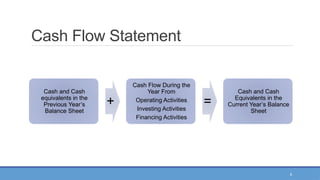
•The cash flow statement aims at explaining the reasons for increase or
decrease in the cash and cash equivalents between two balance sheet dates.
1. Cash flow from operating activities: Sources and uses of cash from the
main revenue generating activities of the business
2. Cash flow from investing activities: Sources and uses of cash for
acquiring or disposing off long-term assets and investments
3. Cash flow from financing activities: Sources and uses of cash relating to
means of financing (raising of funds and repayments)
9
Cash Flow Statement
Cash and Cash
equivalents in the
Previous Year’s
Balance Sheet
+
Cash Flow During the
Year From
Operating Activities
Investing Activities
Financing Activities
=
Cash and Cash
Equivalents in the
Current Year’s Balance
Sheet
10
Illustration 2
As on 31st
March 2021, the cash and cash equivalents of Muscles Power
Limited stood at 945 million as compared to 1,014 million in the
₹ ₹
previous year’s balance sheet. During the year, the company generated a
net cash flow of 844 million from its operating activities and used a net
₹
amount of 1,235 million towards investing activities.
₹
What are the net cash flows from financing activities?
11
Cash Flow from Operating Activities
AS 3: Operating Activities are the principal revenue-producing activities of
the enterprise and other activities that are not investing or financing
activities
There are two alternative methods for ascertaining cash flow from
operating activities as follows:
•Direct Method
•Indirect Method
12
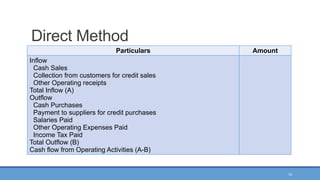
Direct Method
In this approach, gross receipts and payments on account of operating
activities are presented. The difference between receipts and payments is
taken as the net cash from operating activities
The direct method excludes non-cash expenses, non-operating expenses
(interest paid) and non-operating income (interest or dividends received,
profit on sale of assets or investments)
It considers only actual receipts and payments rather than income
accrued and expenses incurred
13
Direct Method
Particulars Amount
Inflow
Cash Sales
Collection from customers for credit sales
Other Operating receipts
Total Inflow (A)
Outflow
Cash Purchases
Payment to suppliers for credit purchases
Salaries Paid
Other Operating Expenses Paid
Income Tax Paid
Total Outflow (B)
Cash flow from Operating Activities (A-B)
14
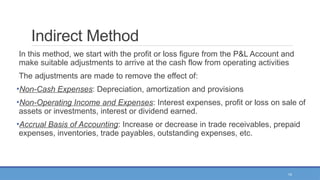
Indirect Method
In this method, we start with the profit or loss figure from the P&L Account and
make suitable adjustments to arrive at the cash flow from operating activities
The adjustments are made to remove the effect of:
•Non-Cash Expenses: Depreciation, amortization and provisions
•Non-Operating Income and Expenses: Interest expenses, profit or loss on sale of
assets or investments, interest or dividend earned.
•Accrual Basis of Accounting: Increase or decrease in trade receivables, prepaid
expenses, inventories, trade payables, outstanding expenses, etc.
15
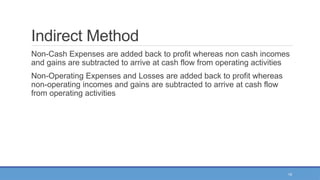
Indirect Method
Non-Cash Expenses are added back to profit whereas non cash incomes
and gains are subtracted to arrive at cash flow from operating activities
Non-Operating Expenses and Losses are added back to profit whereas
non-operating incomes and gains are subtracted to arrive at cash flow
from operating activities
16
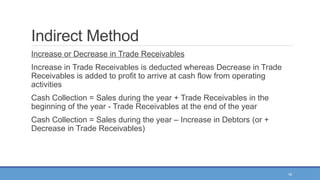
Indirect Method
Increase or Decrease in Trade Receivables
Increase in Trade Receivables is deducted whereas Decrease in Trade
Receivables is added to profit to arrive at cash flow from operating
activities
Cash Collection = Sales during the year + Trade Receivables in the
beginning of the year - Trade Receivables at the end of the year
Cash Collection = Sales during the year – Increase in Debtors (or +
Decrease in Trade Receivables)
17
Indirect Method
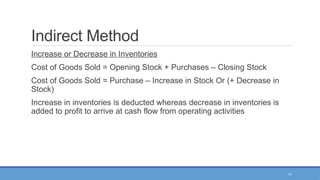
Increase or Decrease in Inventories
Cost of Goods Sold = Opening Stock + Purchases – Closing Stock
Cost of Goods Sold = Purchase – Increase in Stock Or (+ Decrease in
Stock)
Increase in inventories is deducted whereas decrease in inventories is
added to profit to arrive at cash flow from operating activities
18
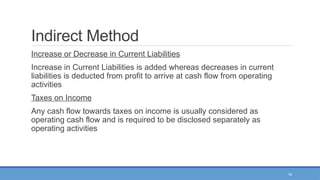
Indirect Method
Increase or Decrease in Current Liabilities
Increase in Current Liabilities is added whereas decreases in current
liabilities is deducted from profit to arrive at cash flow from operating
activities
Taxes on Income
Any cash flow towards taxes on income is usually considered as
operating cash flow and is required to be disclosed separately as
operating activities
19
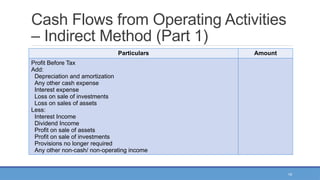
Cash Flows from Operating Activities
– Indirect Method (Part 1)
Particulars Amount
Profit Before Tax
Add:
Depreciation and amortization
Any other cash expense
Interest expense
Loss on sale of investments
Loss on sales of assets
Less:
Interest Income
Dividend Income
Profit on sale of assets
Profit on sale of investments
Provisions no longer required
Any other non-cash/ non-operating income
20
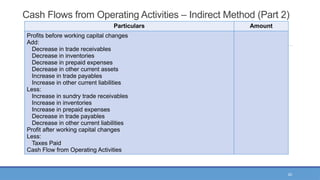
Cash Flows from Operating Activities – Indirect Method (Part 2)
Particulars Amount
Profits before working capital changes
Add:
Decrease in trade receivables
Decrease in inventories
Decrease in prepaid expenses
Decrease in other current assets
Increase in trade payables
Increase in other current liabilities
Less:
Increase in sundry trade receivables
Increase in inventories
Increase in prepaid expenses
Decrease in trade payables
Decrease in other current liabilities
Profit after working capital changes
Less:
Taxes Paid
Cash Flow from Operating Activities
21
Cash Flow from Investing Activities
AS 3: Investing activities are the acquisition and disposal of long term
assets and other investments not included in cash equivalents
Outflows: Payments for acquiring fixed assets – tangible and intangible,
payments for acquiring shares, debentures and other financial
instruments (excluding those classified as cash equivalents), loans and
advances given to third parties
Inflows: Receipts from disposal of fixed assets and sale of share, bonds,
debentures and other financial instruments and receipts on account of
repayment of loans and advances. Interest and dividend received are
also reported as cash inflows from investing activities
22
Cash Flow from Financing Activities
AS 3: Financing activities are the activities that result in the change in
size and composition of owners’ capital (including preference share
capital in case of a company) and borrowing of the enterprise
Inflows: Proceeds from issue of shares, bonds, debentures and other
similar instruments and long- and short-term borrowings.
Outflows: Repayment of loans, payment towards redemption of bonds,
debentures, preference shares and other similar instruments, interest on
loans and debentures, dividends paid, dividend distribution tax paid
23
Special Points
Extraordinary Items
Cash flows which are of extraordinary nature are required to be disclosed
separately in the CFS.
Non-cash Transactions
- Conversion of debentures or preference shares into equity
- Issue of bonus shares
- Splitting shares of higher face value to lower face value
- Acquisition of assets by issuing debentures
- Acquisition of another enterprise by issue of shares
24
Special Points
Foreign Currency Cash Flows
Cash flows in foreign currency are reported by converting the same in the
reporting currency by applying the appropriate exchange rate prevailing
on the date of the transaction.
Cash and cash equivalents held in foreign currency are also converted in
the reporting currency
25
Cash Flow Ratios
26
Conclusion
In this session we learnt about
◦ Statement of Cash Flows
◦ Purpose of the Statement of Cash Flow
◦ Content and the Format of Statement of Cash Flow
◦ Preparation of Cash Flow Statement
◦ Usefulness of the Statement of Cash Flow

Cash Flow Statement.pptx by financing,investing activity

  • 1.
    1 Cash Flow Statement ACCOUNTINGFOR MANAGERS SESSION 21-26
  • 2.
    2 Objective At the endof this session you should be able to understand ◦ Statement of Cash Flows ◦ Purpose of the Statement of Cash Flow ◦ Content and the Format of Statement of Cash Flow ◦ Preparation of Cash Flow Statement ◦ Usefulness of the Statement of Cash Flow
  • 3.
    3 Statement of CashFlows in Perspective •Some profitable firms are unable to pay their suppliers promptly. Why? •Why did Infosys hold cash of 305 billion (38 percent of assets) at ₹ December 31, 2016? •Despite recurring losses, how does Tesla stay afloat and expand? •How does the Vedanta group pay for its big-ticket acquisitions?
  • 4.
    4 Purpose of theStatement of Cash Flow •The main purpose of the statement of cash flows is to provide relevant information about an enterprise’s cash receipts and cash payments. •The information will help users of financial statements assess the amounts, timing, and uncertainty of an enterprise’s prospective cash flows.
  • 5.
    5 Need for CashFlow Statement AS 3 – Objective of Cash Flow Statement: Information about the cash flow of an enterprise is useful in providing users of financial statements with a basis to assess the ability of the enterprise to generate cash and cash equivalents and the needs of the enterprise to utilise those cash flows.
  • 6.
    6 What is Cash? AS3: Cash equivalents are short term, highly liquid investments that are readily convertible into known amount of cash and which are subject to an insignificant risk of change in value
  • 7.
    7 Illustration 1 Which ofthe following will be treated as cash and cash equivalents? a. Balance in the current account with State Bank of India b. Investments in the shares of a subsidiary company c. Investments in 10 year government bonds maturing after two months d. Investments in equity mutual funds e. Fixed deposits with Canara Bank maturing after one year
  • 8.
    8 Cash Flow Statement •Thecash flow statement aims at explaining the reasons for increase or decrease in the cash and cash equivalents between two balance sheet dates. 1. Cash flow from operating activities: Sources and uses of cash from the main revenue generating activities of the business 2. Cash flow from investing activities: Sources and uses of cash for acquiring or disposing off long-term assets and investments 3. Cash flow from financing activities: Sources and uses of cash relating to means of financing (raising of funds and repayments)
  • 9.
    9 Cash Flow Statement Cashand Cash equivalents in the Previous Year’s Balance Sheet + Cash Flow During the Year From Operating Activities Investing Activities Financing Activities = Cash and Cash Equivalents in the Current Year’s Balance Sheet
  • 10.
    10 Illustration 2 As on31st March 2021, the cash and cash equivalents of Muscles Power Limited stood at 945 million as compared to 1,014 million in the ₹ ₹ previous year’s balance sheet. During the year, the company generated a net cash flow of 844 million from its operating activities and used a net ₹ amount of 1,235 million towards investing activities. ₹ What are the net cash flows from financing activities?
  • 11.
    11 Cash Flow fromOperating Activities AS 3: Operating Activities are the principal revenue-producing activities of the enterprise and other activities that are not investing or financing activities There are two alternative methods for ascertaining cash flow from operating activities as follows: •Direct Method •Indirect Method
  • 12.
    12 Direct Method In thisapproach, gross receipts and payments on account of operating activities are presented. The difference between receipts and payments is taken as the net cash from operating activities The direct method excludes non-cash expenses, non-operating expenses (interest paid) and non-operating income (interest or dividends received, profit on sale of assets or investments) It considers only actual receipts and payments rather than income accrued and expenses incurred
  • 13.
    13 Direct Method Particulars Amount Inflow CashSales Collection from customers for credit sales Other Operating receipts Total Inflow (A) Outflow Cash Purchases Payment to suppliers for credit purchases Salaries Paid Other Operating Expenses Paid Income Tax Paid Total Outflow (B) Cash flow from Operating Activities (A-B)
  • 14.
    14 Indirect Method In thismethod, we start with the profit or loss figure from the P&L Account and make suitable adjustments to arrive at the cash flow from operating activities The adjustments are made to remove the effect of: •Non-Cash Expenses: Depreciation, amortization and provisions •Non-Operating Income and Expenses: Interest expenses, profit or loss on sale of assets or investments, interest or dividend earned. •Accrual Basis of Accounting: Increase or decrease in trade receivables, prepaid expenses, inventories, trade payables, outstanding expenses, etc.
  • 15.
    15 Indirect Method Non-Cash Expensesare added back to profit whereas non cash incomes and gains are subtracted to arrive at cash flow from operating activities Non-Operating Expenses and Losses are added back to profit whereas non-operating incomes and gains are subtracted to arrive at cash flow from operating activities
  • 16.
    16 Indirect Method Increase orDecrease in Trade Receivables Increase in Trade Receivables is deducted whereas Decrease in Trade Receivables is added to profit to arrive at cash flow from operating activities Cash Collection = Sales during the year + Trade Receivables in the beginning of the year - Trade Receivables at the end of the year Cash Collection = Sales during the year – Increase in Debtors (or + Decrease in Trade Receivables)
  • 17.
    17 Indirect Method Increase orDecrease in Inventories Cost of Goods Sold = Opening Stock + Purchases – Closing Stock Cost of Goods Sold = Purchase – Increase in Stock Or (+ Decrease in Stock) Increase in inventories is deducted whereas decrease in inventories is added to profit to arrive at cash flow from operating activities
  • 18.
    18 Indirect Method Increase orDecrease in Current Liabilities Increase in Current Liabilities is added whereas decreases in current liabilities is deducted from profit to arrive at cash flow from operating activities Taxes on Income Any cash flow towards taxes on income is usually considered as operating cash flow and is required to be disclosed separately as operating activities
  • 19.
    19 Cash Flows fromOperating Activities – Indirect Method (Part 1) Particulars Amount Profit Before Tax Add: Depreciation and amortization Any other cash expense Interest expense Loss on sale of investments Loss on sales of assets Less: Interest Income Dividend Income Profit on sale of assets Profit on sale of investments Provisions no longer required Any other non-cash/ non-operating income
  • 20.
    20 Cash Flows fromOperating Activities – Indirect Method (Part 2) Particulars Amount Profits before working capital changes Add: Decrease in trade receivables Decrease in inventories Decrease in prepaid expenses Decrease in other current assets Increase in trade payables Increase in other current liabilities Less: Increase in sundry trade receivables Increase in inventories Increase in prepaid expenses Decrease in trade payables Decrease in other current liabilities Profit after working capital changes Less: Taxes Paid Cash Flow from Operating Activities
  • 21.
    21 Cash Flow fromInvesting Activities AS 3: Investing activities are the acquisition and disposal of long term assets and other investments not included in cash equivalents Outflows: Payments for acquiring fixed assets – tangible and intangible, payments for acquiring shares, debentures and other financial instruments (excluding those classified as cash equivalents), loans and advances given to third parties Inflows: Receipts from disposal of fixed assets and sale of share, bonds, debentures and other financial instruments and receipts on account of repayment of loans and advances. Interest and dividend received are also reported as cash inflows from investing activities
  • 22.
    22 Cash Flow fromFinancing Activities AS 3: Financing activities are the activities that result in the change in size and composition of owners’ capital (including preference share capital in case of a company) and borrowing of the enterprise Inflows: Proceeds from issue of shares, bonds, debentures and other similar instruments and long- and short-term borrowings. Outflows: Repayment of loans, payment towards redemption of bonds, debentures, preference shares and other similar instruments, interest on loans and debentures, dividends paid, dividend distribution tax paid
  • 23.
    23 Special Points Extraordinary Items Cashflows which are of extraordinary nature are required to be disclosed separately in the CFS. Non-cash Transactions - Conversion of debentures or preference shares into equity - Issue of bonus shares - Splitting shares of higher face value to lower face value - Acquisition of assets by issuing debentures - Acquisition of another enterprise by issue of shares
  • 24.
    24 Special Points Foreign CurrencyCash Flows Cash flows in foreign currency are reported by converting the same in the reporting currency by applying the appropriate exchange rate prevailing on the date of the transaction. Cash and cash equivalents held in foreign currency are also converted in the reporting currency
  • 25.
  • 26.
    26 Conclusion In this sessionwe learnt about ◦ Statement of Cash Flows ◦ Purpose of the Statement of Cash Flow ◦ Content and the Format of Statement of Cash Flow ◦ Preparation of Cash Flow Statement ◦ Usefulness of the Statement of Cash Flow