UNIT – 5
AFA (BBA-104)
Cash Flow Analysis:
Various Cash and Non
cash Transactions, Flow of
Cash, Preparation of Cash
Flow Statement and its
Analysis.
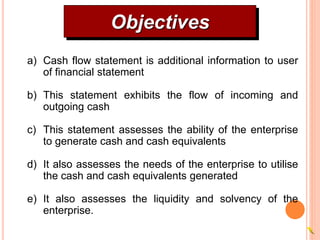
a) Cash flow statement is additional information to user
of financial statement
b) This statement exhibits the flow of incoming and
outgoing cash
c) This statement assesses the ability of the enterprise
to generate cash and cash equivalents
d) It also assesses the needs of the enterprise to utilise
the cash and cash equivalents generated
e) It also assesses the liquidity and solvency of the
enterprise.
Objectives
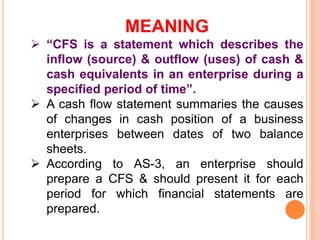
MEANING
 “CFS is a statement which describes the
inflow (source) & outflow (uses) of cash &
cash equivalents in an enterprise during a
specified period of time”.
 A cash flow statement summaries the causes
of changes in cash position of a business
enterprises between dates of two balance
sheets.
 According to AS-3, an enterprise should
prepare a CFS & should present it for each
period for which financial statements are
prepared.
4
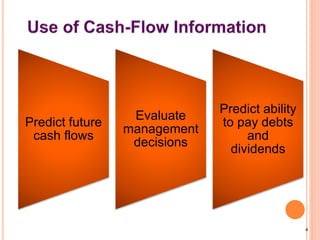
Predict future
cash flows
Evaluate
management
decisions
Predict ability
to pay debts
and
dividends
Cash comprises cash on hand and demand deposits
with banks.
Cash equivalents are short term, highly liquid
investments that are readily convertible into known
amounts of cash and which are subject to an
insignificant risk of changes in value.
Cash flows are inflows and outflows of cash and cash
equivalents.
Operating activities are the principal revenue-producing
activities of the enterprise and other activities that are
not investing or financing activities.
Investing activities are the acquisition and disposal of
long-term assets and other investments not included in
cash equivalents.
Financing activities are activities that result in changes
in the size and composition of the owners’ capital
(including preference share capital in the case of a
company) and borrowings of the enterprise.
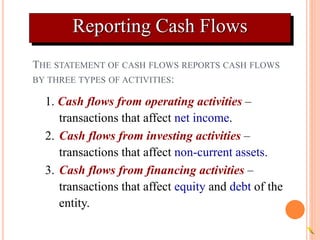
THE STATEMENT OF CASH FLOWS REPORTS CASH FLOWS
BY THREE TYPES OF ACTIVITIES:
1. Cash flows from operating activities –
transactions that affect net income.
2. Cash flows from investing activities –
transactions that affect non-current assets.
3. Cash flows from financing activities –
transactions that affect equity and debt of the
entity.
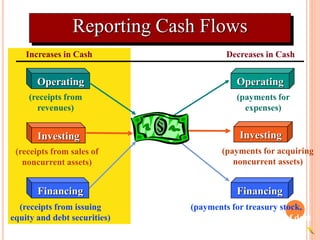
Reporting Cash Flows
(payments for
expenses)
Operating
Increases in Cash Decreases in Cash
(receipts from sales of
noncurrent assets)
Investing
(receipts from issuing
equity and debt securities)
Financing
(payments for acquiring
noncurrent assets)
Investing
Reporting Cash Flows
(receipts from
revenues)
Operating
(payments for treasury stock,
dividends, and redemption of debt
securities)
Financing
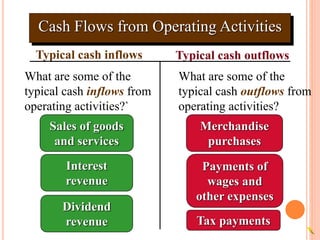
Typical cash inflows Typical cash outflows
What are some of the
typical cash inflows from
operating activities?`
Cash Flows from Operating Activities
Interest
revenue
Sales of goods
and services
Dividend
revenue
What are some of the
typical cash outflows from
operating activities?
Merchandise
purchases
Payments of
wages and
other expenses
Tax payments
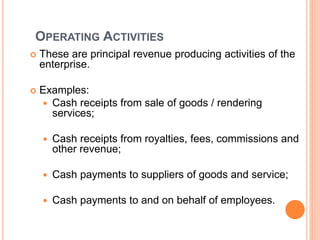
OPERATING ACTIVITIES
 These are principal revenue producing activities of the
enterprise.
 Examples:
 Cash receipts from sale of goods / rendering
services;
 Cash receipts from royalties, fees, commissions and
other revenue;
 Cash payments to suppliers of goods and service;
 Cash payments to and on behalf of employees.
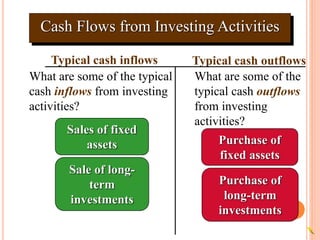
What are some of the typical
cash inflows from investing
activities?
Typical cash inflows Typical cash outflows
Sale of long-
term
investments
Sales of fixed
assets Purchase of
fixed assets
Purchase of
long-term
investments
What are some of the
typical cash outflows
from investing
activities?
Cash Flows from Investing Activities
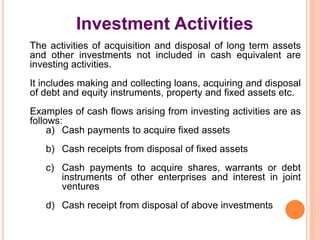
Investment Activities
The activities of acquisition and disposal of long term assets
and other investments not included in cash equivalent are
investing activities.
It includes making and collecting loans, acquiring and disposal
of debt and equity instruments, property and fixed assets etc.
Examples of cash flows arising from investing activities are as
follows:
a) Cash payments to acquire fixed assets
b) Cash receipts from disposal of fixed assets
c) Cash payments to acquire shares, warrants or debt
instruments of other enterprises and interest in joint
ventures
d) Cash receipt from disposal of above investments
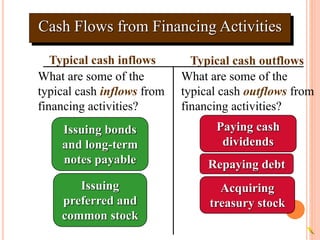
Cash Flows from Financing Activities
What are some of the
typical cash inflows from
financing activities?
Issuing
preferred and
common stock
Issuing bonds
and long-term
notes payable
Paying cash
dividends
Repaying debt
What are some of the
typical cash outflows from
financing activities?
Acquiring
treasury stock
Typical cash inflows Typical cash outflows
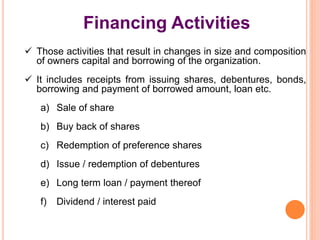
Financing Activities
 Those activities that result in changes in size and composition
of owners capital and borrowing of the organization.
 It includes receipts from issuing shares, debentures, bonds,
borrowing and payment of borrowed amount, loan etc.
a) Sale of share
b) Buy back of shares
c) Redemption of preference shares
d) Issue / redemption of debentures
e) Long term loan / payment thereof
f) Dividend / interest paid
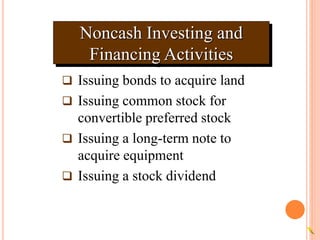
Noncash Investing and
Financing Activities
 Issuing bonds to acquire land
 Issuing common stock for
convertible preferred stock
 Issuing a long-term note to
acquire equipment
 Issuing a stock dividend
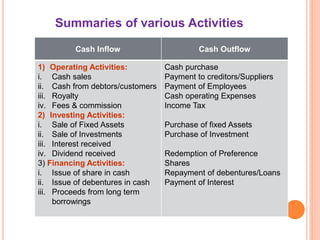
Summaries of various Activities
Cash Inflow Cash Outflow
1) Operating Activities:
i. Cash sales
ii. Cash from debtors/customers
iii. Royalty
iv. Fees & commission
2) Investing Activities:
i. Sale of Fixed Assets
ii. Sale of Investments
iii. Interest received
iv. Dividend received
3) Financing Activities:
i. Issue of share in cash
ii. Issue of debentures in cash
iii. Proceeds from long term
borrowings
Cash purchase
Payment to creditors/Suppliers
Payment of Employees
Cash operating Expenses
Income Tax
Purchase of fixed Assets
Purchase of Investment
Redemption of Preference
Shares
Repayment of debentures/Loans
Payment of Interest
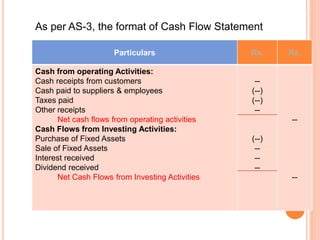
As per AS-3, the format of Cash Flow Statement
Particulars Rs. Rs.
Cash from operating Activities:
Cash receipts from customers
Cash paid to suppliers & employees
Taxes paid
Other receipts
Net cash flows from operating activities
Cash Flows from Investing Activities:
Purchase of Fixed Assets
Sale of Fixed Assets
Interest received
Dividend received
Net Cash Flows from Investing Activities
--
(--)
(--)
--
(--)
--
--
--
--
--
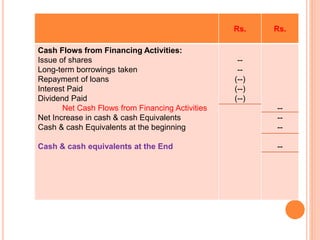
Rs. Rs.
Cash Flows from Financing Activities:
Issue of shares
Long-term borrowings taken
Repayment of loans
Interest Paid
Dividend Paid
Net Cash Flows from Financing Activities
Net Increase in cash & cash Equivalents
Cash & cash Equivalents at the beginning
Cash & cash equivalents at the End
--
--
(--)
(--)
(--)
--
--
--
--
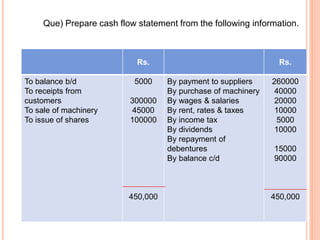
Que) Prepare cash flow statement from the following information.
Rs. Rs.
To balance b/d
To receipts from
customers
To sale of machinery
To issue of shares
5000
300000
45000
100000
450,000
By payment to suppliers
By purchase of machinery
By wages & salaries
By rent, rates & taxes
By income tax
By dividends
By repayment of
debentures
By balance c/d
260000
40000
20000
10000
5000
10000
15000
90000
450,000
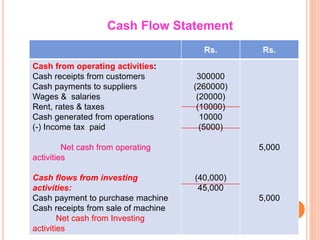
Rs. Rs.
Cash from operating activities:
Cash receipts from customers
Cash payments to suppliers
Wages & salaries
Rent, rates & taxes
Cash generated from operations
(-) Income tax paid
Net cash from operating
activities
Cash flows from investing
activities:
Cash payment to purchase machine
Cash receipts from sale of machine
Net cash from Investing
activities
300000
(260000)
(20000)
(10000)
10000
(5000)
(40,000)
45,000
5,000
5,000
Cash Flow Statement
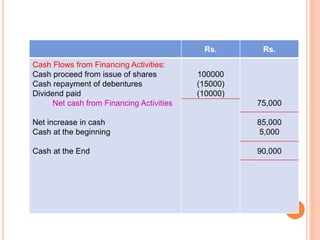
Rs. Rs.
Cash Flows from Financing Activities:
Cash proceed from issue of shares
Cash repayment of debentures
Dividend paid
Net cash from Financing Activities
Net increase in cash
Cash at the beginning
Cash at the End
100000
(15000)
(10000)
75,000
85,000
5,000
90,000
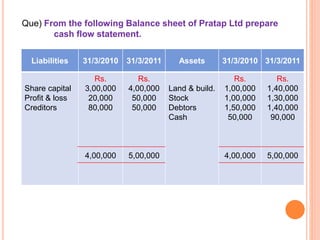
Que) From the following Balance sheet of Pratap Ltd prepare
cash flow statement.
Liabilities 31/3/2010 31/3/2011 Assets 31/3/2010 31/3/2011
Share capital
Profit & loss
Creditors
Rs.
3,00,000
20,000
80,000
4,00,000
Rs.
4,00,000
50,000
50,000
5,00,000
Land & build.
Stock
Debtors
Cash
Rs.
1,00,000
1,00,000
1,50,000
50,000
4,00,000
Rs.
1,40,000
1,30,000
1,40,000
90,000
5,00,000
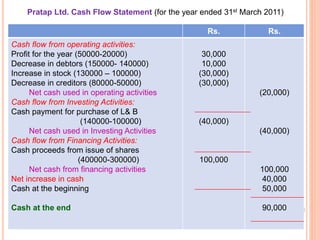
Pratap Ltd. Cash Flow Statement (for the year ended 31st March 2011)
Rs. Rs.
Cash flow from operating activities:
Profit for the year (50000-20000)
Decrease in debtors (150000- 140000)
Increase in stock (130000 – 100000)
Decrease in creditors (80000-50000)
Net cash used in operating activities
Cash flow from Investing Activities:
Cash payment for purchase of L& B
(140000-100000)
Net cash used in Investing Activities
Cash flow from Financing Activities:
Cash proceeds from issue of shares
(400000-300000)
Net cash from financing activities
Net increase in cash
Cash at the beginning
Cash at the end
30,000
10,000
(30,000)
(30,000)
(40,000)
100,000
(20,000)
(40,000)
100,000
40,000
50,000
90,000
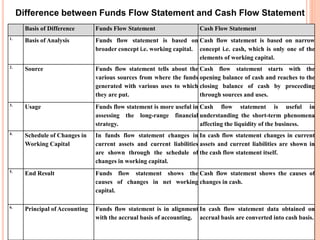
Basis of Difference Funds Flow Statement Cash Flow Statement
1.
Basis of Analysis Funds flow statement is based on
broader concept i.e. working capital.
Cash flow statement is based on narrow
concept i.e. cash, which is only one of the
elements of working capital.
2.
Source Funds flow statement tells about the
various sources from where the funds
generated with various uses to which
they are put.
Cash flow statement starts with the
opening balance of cash and reaches to the
closing balance of cash by proceeding
through sources and uses.
3.
Usage Funds flow statement is more useful in
assessing the long-range financial
strategy.
Cash flow statement is useful in
understanding the short-term phenomena
affecting the liquidity of the business.
4.
Schedule of Changes in
Working Capital
In funds flow statement changes in
current assets and current liabilities
are shown through the schedule of
changes in working capital.
In cash flow statement changes in current
assets and current liabilities are shown in
the cash flow statement itself.
5.
End Result Funds flow statement shows the
causes of changes in net working
capital.
Cash flow statement shows the causes of
changes in cash.
6.
Principal of Accounting Funds flow statement is in alignment
with the accrual basis of accounting.
In cash flow statement data obtained on
accrual basis are converted into cash basis.
Difference between Funds Flow Statement and Cash Flow Statement
UNIT - 5
THANKS A LOT

AFA Unit-5.ppt

  • 1.
    UNIT – 5 AFA(BBA-104) Cash Flow Analysis: Various Cash and Non cash Transactions, Flow of Cash, Preparation of Cash Flow Statement and its Analysis.
  • 2.
    a) Cash flowstatement is additional information to user of financial statement b) This statement exhibits the flow of incoming and outgoing cash c) This statement assesses the ability of the enterprise to generate cash and cash equivalents d) It also assesses the needs of the enterprise to utilise the cash and cash equivalents generated e) It also assesses the liquidity and solvency of the enterprise. Objectives
  • 3.
    MEANING  “CFS isa statement which describes the inflow (source) & outflow (uses) of cash & cash equivalents in an enterprise during a specified period of time”.  A cash flow statement summaries the causes of changes in cash position of a business enterprises between dates of two balance sheets.  According to AS-3, an enterprise should prepare a CFS & should present it for each period for which financial statements are prepared.
  • 4.
  • 5.
    Cash comprises cashon hand and demand deposits with banks. Cash equivalents are short term, highly liquid investments that are readily convertible into known amounts of cash and which are subject to an insignificant risk of changes in value. Cash flows are inflows and outflows of cash and cash equivalents. Operating activities are the principal revenue-producing activities of the enterprise and other activities that are not investing or financing activities. Investing activities are the acquisition and disposal of long-term assets and other investments not included in cash equivalents. Financing activities are activities that result in changes in the size and composition of the owners’ capital (including preference share capital in the case of a company) and borrowings of the enterprise.
  • 6.
    THE STATEMENT OFCASH FLOWS REPORTS CASH FLOWS BY THREE TYPES OF ACTIVITIES: 1. Cash flows from operating activities – transactions that affect net income. 2. Cash flows from investing activities – transactions that affect non-current assets. 3. Cash flows from financing activities – transactions that affect equity and debt of the entity. Reporting Cash Flows
  • 7.
    (payments for expenses) Operating Increases inCash Decreases in Cash (receipts from sales of noncurrent assets) Investing (receipts from issuing equity and debt securities) Financing (payments for acquiring noncurrent assets) Investing Reporting Cash Flows (receipts from revenues) Operating (payments for treasury stock, dividends, and redemption of debt securities) Financing
  • 9.
    Typical cash inflowsTypical cash outflows What are some of the typical cash inflows from operating activities?` Cash Flows from Operating Activities Interest revenue Sales of goods and services Dividend revenue What are some of the typical cash outflows from operating activities? Merchandise purchases Payments of wages and other expenses Tax payments
  • 10.
    OPERATING ACTIVITIES  Theseare principal revenue producing activities of the enterprise.  Examples:  Cash receipts from sale of goods / rendering services;  Cash receipts from royalties, fees, commissions and other revenue;  Cash payments to suppliers of goods and service;  Cash payments to and on behalf of employees.
  • 11.
    What are someof the typical cash inflows from investing activities? Typical cash inflows Typical cash outflows Sale of long- term investments Sales of fixed assets Purchase of fixed assets Purchase of long-term investments What are some of the typical cash outflows from investing activities? Cash Flows from Investing Activities
  • 12.
    Investment Activities The activitiesof acquisition and disposal of long term assets and other investments not included in cash equivalent are investing activities. It includes making and collecting loans, acquiring and disposal of debt and equity instruments, property and fixed assets etc. Examples of cash flows arising from investing activities are as follows: a) Cash payments to acquire fixed assets b) Cash receipts from disposal of fixed assets c) Cash payments to acquire shares, warrants or debt instruments of other enterprises and interest in joint ventures d) Cash receipt from disposal of above investments
  • 13.
    Cash Flows fromFinancing Activities What are some of the typical cash inflows from financing activities? Issuing preferred and common stock Issuing bonds and long-term notes payable Paying cash dividends Repaying debt What are some of the typical cash outflows from financing activities? Acquiring treasury stock Typical cash inflows Typical cash outflows
  • 14.
    Financing Activities  Thoseactivities that result in changes in size and composition of owners capital and borrowing of the organization.  It includes receipts from issuing shares, debentures, bonds, borrowing and payment of borrowed amount, loan etc. a) Sale of share b) Buy back of shares c) Redemption of preference shares d) Issue / redemption of debentures e) Long term loan / payment thereof f) Dividend / interest paid
  • 15.
    Noncash Investing and FinancingActivities  Issuing bonds to acquire land  Issuing common stock for convertible preferred stock  Issuing a long-term note to acquire equipment  Issuing a stock dividend
  • 16.
    Summaries of variousActivities Cash Inflow Cash Outflow 1) Operating Activities: i. Cash sales ii. Cash from debtors/customers iii. Royalty iv. Fees & commission 2) Investing Activities: i. Sale of Fixed Assets ii. Sale of Investments iii. Interest received iv. Dividend received 3) Financing Activities: i. Issue of share in cash ii. Issue of debentures in cash iii. Proceeds from long term borrowings Cash purchase Payment to creditors/Suppliers Payment of Employees Cash operating Expenses Income Tax Purchase of fixed Assets Purchase of Investment Redemption of Preference Shares Repayment of debentures/Loans Payment of Interest
  • 17.
    As per AS-3,the format of Cash Flow Statement Particulars Rs. Rs. Cash from operating Activities: Cash receipts from customers Cash paid to suppliers & employees Taxes paid Other receipts Net cash flows from operating activities Cash Flows from Investing Activities: Purchase of Fixed Assets Sale of Fixed Assets Interest received Dividend received Net Cash Flows from Investing Activities -- (--) (--) -- (--) -- -- -- -- --
  • 18.
    Rs. Rs. Cash Flowsfrom Financing Activities: Issue of shares Long-term borrowings taken Repayment of loans Interest Paid Dividend Paid Net Cash Flows from Financing Activities Net Increase in cash & cash Equivalents Cash & cash Equivalents at the beginning Cash & cash equivalents at the End -- -- (--) (--) (--) -- -- -- --
  • 19.
    Que) Prepare cashflow statement from the following information. Rs. Rs. To balance b/d To receipts from customers To sale of machinery To issue of shares 5000 300000 45000 100000 450,000 By payment to suppliers By purchase of machinery By wages & salaries By rent, rates & taxes By income tax By dividends By repayment of debentures By balance c/d 260000 40000 20000 10000 5000 10000 15000 90000 450,000
  • 20.
    Rs. Rs. Cash fromoperating activities: Cash receipts from customers Cash payments to suppliers Wages & salaries Rent, rates & taxes Cash generated from operations (-) Income tax paid Net cash from operating activities Cash flows from investing activities: Cash payment to purchase machine Cash receipts from sale of machine Net cash from Investing activities 300000 (260000) (20000) (10000) 10000 (5000) (40,000) 45,000 5,000 5,000 Cash Flow Statement
  • 21.
    Rs. Rs. Cash Flowsfrom Financing Activities: Cash proceed from issue of shares Cash repayment of debentures Dividend paid Net cash from Financing Activities Net increase in cash Cash at the beginning Cash at the End 100000 (15000) (10000) 75,000 85,000 5,000 90,000
  • 22.
    Que) From thefollowing Balance sheet of Pratap Ltd prepare cash flow statement. Liabilities 31/3/2010 31/3/2011 Assets 31/3/2010 31/3/2011 Share capital Profit & loss Creditors Rs. 3,00,000 20,000 80,000 4,00,000 Rs. 4,00,000 50,000 50,000 5,00,000 Land & build. Stock Debtors Cash Rs. 1,00,000 1,00,000 1,50,000 50,000 4,00,000 Rs. 1,40,000 1,30,000 1,40,000 90,000 5,00,000
  • 23.
    Pratap Ltd. CashFlow Statement (for the year ended 31st March 2011) Rs. Rs. Cash flow from operating activities: Profit for the year (50000-20000) Decrease in debtors (150000- 140000) Increase in stock (130000 – 100000) Decrease in creditors (80000-50000) Net cash used in operating activities Cash flow from Investing Activities: Cash payment for purchase of L& B (140000-100000) Net cash used in Investing Activities Cash flow from Financing Activities: Cash proceeds from issue of shares (400000-300000) Net cash from financing activities Net increase in cash Cash at the beginning Cash at the end 30,000 10,000 (30,000) (30,000) (40,000) 100,000 (20,000) (40,000) 100,000 40,000 50,000 90,000
  • 24.
    Basis of DifferenceFunds Flow Statement Cash Flow Statement 1. Basis of Analysis Funds flow statement is based on broader concept i.e. working capital. Cash flow statement is based on narrow concept i.e. cash, which is only one of the elements of working capital. 2. Source Funds flow statement tells about the various sources from where the funds generated with various uses to which they are put. Cash flow statement starts with the opening balance of cash and reaches to the closing balance of cash by proceeding through sources and uses. 3. Usage Funds flow statement is more useful in assessing the long-range financial strategy. Cash flow statement is useful in understanding the short-term phenomena affecting the liquidity of the business. 4. Schedule of Changes in Working Capital In funds flow statement changes in current assets and current liabilities are shown through the schedule of changes in working capital. In cash flow statement changes in current assets and current liabilities are shown in the cash flow statement itself. 5. End Result Funds flow statement shows the causes of changes in net working capital. Cash flow statement shows the causes of changes in cash. 6. Principal of Accounting Funds flow statement is in alignment with the accrual basis of accounting. In cash flow statement data obtained on accrual basis are converted into cash basis. Difference between Funds Flow Statement and Cash Flow Statement
  • 25.