“VALUE ADDED
STATEMENT”
ACCOUNTING THEORY AND PRACTICE
Submitted By:-
DHANANJAY SINGH
CONTENTS
• INTRODUCTION
• MEANING & CONCEPT
• DEFINITION & OBJECT
• CLASSIFICATION OF VALUE ADDED
• ADVANTAGE OF VALUE ADDED
• MEHODS OF CALCULATING THE AMOUNT OF
VALUE ADDED
• APPLICATION OF VALUE ADDED
INTRODUCTION
• Value-added statement (VAS) is a modified
version of the profit and loss account. Like profit
and loss account, the VAS reveals the operating
performance of a company at a given point in
time, using both accrual and matching
procedures.
• The VAS does not aim to provide a profit (or loss)
figure as in the case of profit and loss account but
a figure or return to a larger group of capital and
labor providers (i.e., owners, employees) or other
interested parties .
MEANING & CONCEPT
• The term ‘value-added’ means the difference
between the value of output produced by a
firm in a period, and the value of inputs
purchased in producing outputs.
• Value added is the wealth created by the
business during a particular period of time
and wealth so created or added is distributed
among the different stakeholders who created
it.
DEFINITION & OBJECT
Definition
“Value added is the wealth of reporting entity
created through the effective effort of capital,
management and employees.”
Object
This statement is additional statement difference
from profit & loss statement. This statement
explain wealth generated by businessman and
how he has distributed this fund.
CLASSIFICATION OF VALUE ADDED
• Value added may be classified as a
Gross value added & Net value added
1)Gross value added refers to sale plus income
from service less bought in material and services
purchased from outsider.
2)Net value added is calculated by deducting the
figure of depreciation from the figure of Gross
value added
ADVANTAGE OF VALUE ADDED
• Value Added Statement reflects a broader view
of the companies objectives and responsibilities,
so it improve the attitude of the employees
towards the employing company.
• Value Added Statement makes it easier for the
company to introduce the productivity linked
bonus scheme for employees based on Value
Added for this Value Added payroll ratio is used
as a basis.
CONTINUE..
• Value Added provides a very good measure of
the size and importance of a company.
• Value Added Statement link a companies
financial accounts to the National Income. A
companies Value Added Statement indicates
the companies contribution to National
Income. As Value Added Statement is based on
the System Of National Accounts given by UNO
to calculate GDP and India signatory to it.
METHODS OF CALCULATING THE
AMOUNT OF VALUE ADDED
• 1)ADDITIVE METHOD
• 2)SUBTRACTIVE METHOD
1)ADDITIVE METHOD
Under this method, the net added value
is computed by adding the distribution of added
value made to the stakeholders of
the output employed to turn out the product,
such as wages, salaries, taxes, interest, dividends,
and retained funds.
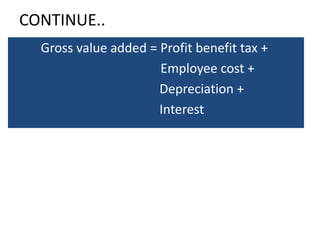
Gross value added = Profit benefit tax +
Employee cost +
Depreciation +
Interest
CONTINUE..
CONTINUE..
2)SUBTRACTIVE METHOD
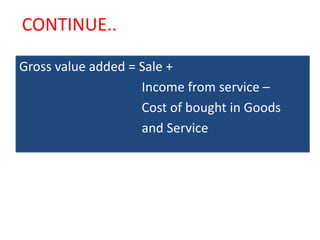
Under this method, value added is
determined as net turnover (revenue) which is
obtained by subtracting the cost of materials
from the sales proceeds.
CONTINUE..
Gross value added = Sale +
Income from service –
Cost of bought in Goods
and Service
APPLICATION OF VALUE ADDED
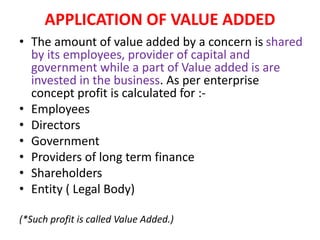
• The amount of value added by a concern is shared
by its employees, provider of capital and
government while a part of Value added is are
invested in the business. As per enterprise
concept profit is calculated for :-
• Employees
• Directors
• Government
• Providers of long term finance
• Shareholders
• Entity ( Legal Body)
(*Such profit is called Value Added.)
THANK YOU

Value added statement: Accounting Theory & Statement

  • 1.
    “VALUE ADDED STATEMENT” ACCOUNTING THEORYAND PRACTICE Submitted By:- DHANANJAY SINGH
  • 2.
    CONTENTS • INTRODUCTION • MEANING& CONCEPT • DEFINITION & OBJECT • CLASSIFICATION OF VALUE ADDED • ADVANTAGE OF VALUE ADDED • MEHODS OF CALCULATING THE AMOUNT OF VALUE ADDED • APPLICATION OF VALUE ADDED
  • 3.
    INTRODUCTION • Value-added statement(VAS) is a modified version of the profit and loss account. Like profit and loss account, the VAS reveals the operating performance of a company at a given point in time, using both accrual and matching procedures. • The VAS does not aim to provide a profit (or loss) figure as in the case of profit and loss account but a figure or return to a larger group of capital and labor providers (i.e., owners, employees) or other interested parties .
  • 4.
    MEANING & CONCEPT •The term ‘value-added’ means the difference between the value of output produced by a firm in a period, and the value of inputs purchased in producing outputs. • Value added is the wealth created by the business during a particular period of time and wealth so created or added is distributed among the different stakeholders who created it.
  • 5.
    DEFINITION & OBJECT Definition “Valueadded is the wealth of reporting entity created through the effective effort of capital, management and employees.” Object This statement is additional statement difference from profit & loss statement. This statement explain wealth generated by businessman and how he has distributed this fund.
  • 6.
    CLASSIFICATION OF VALUEADDED • Value added may be classified as a Gross value added & Net value added 1)Gross value added refers to sale plus income from service less bought in material and services purchased from outsider. 2)Net value added is calculated by deducting the figure of depreciation from the figure of Gross value added
  • 7.
    ADVANTAGE OF VALUEADDED • Value Added Statement reflects a broader view of the companies objectives and responsibilities, so it improve the attitude of the employees towards the employing company. • Value Added Statement makes it easier for the company to introduce the productivity linked bonus scheme for employees based on Value Added for this Value Added payroll ratio is used as a basis.
  • 8.
    CONTINUE.. • Value Addedprovides a very good measure of the size and importance of a company. • Value Added Statement link a companies financial accounts to the National Income. A companies Value Added Statement indicates the companies contribution to National Income. As Value Added Statement is based on the System Of National Accounts given by UNO to calculate GDP and India signatory to it.
  • 9.
    METHODS OF CALCULATINGTHE AMOUNT OF VALUE ADDED • 1)ADDITIVE METHOD • 2)SUBTRACTIVE METHOD 1)ADDITIVE METHOD Under this method, the net added value is computed by adding the distribution of added value made to the stakeholders of the output employed to turn out the product, such as wages, salaries, taxes, interest, dividends, and retained funds.
  • 10.
    Gross value added= Profit benefit tax + Employee cost + Depreciation + Interest CONTINUE..
  • 11.
    CONTINUE.. 2)SUBTRACTIVE METHOD Under thismethod, value added is determined as net turnover (revenue) which is obtained by subtracting the cost of materials from the sales proceeds.
  • 12.
    CONTINUE.. Gross value added= Sale + Income from service – Cost of bought in Goods and Service
  • 13.
    APPLICATION OF VALUEADDED • The amount of value added by a concern is shared by its employees, provider of capital and government while a part of Value added is are invested in the business. As per enterprise concept profit is calculated for :- • Employees • Directors • Government • Providers of long term finance • Shareholders • Entity ( Legal Body) (*Such profit is called Value Added.)
  • 14.