CAPITAL GAINS
INTRODUCTION
 CAPITAL GAINS
 SEC 45(1)-CHARGING SECTION
“Any profit or gains arising from the transfer of
capital assets is taxable under the head capital gains
in the previous year in which the transfer has taken
place.”
 Conditions for Gains to be charged under Capital
Gains
There should be a capital asset.
 The capital asset should be transferred by
the assessee.
 Such transfer should take place during the
previous year.
 The profits or gains should arise as a result
of this transfer.
 Such profit or gain should not be exempted
from tax under sections 54, 54B, 54D, 54EC,
54F and 54G & 54GA.
DEFINITION OF CAPITAL ASSETS
SEC 2(14)
 Capital asset is defined to include property of any
kind, whether or not connected with the business or
profession of the assessee.
EXCEPTIONS TO CAPITAL ASSETS
a) Any stock-in-trade, consumable stores or
raw material held for the purposes of
business or profession.
b)Personal Effects ,that is to say, Movable
property of the Assessee including wearing
apparel and furniture held for his personal
use or for the use of any member of his
family dependent on him. But excludes--
(a)Jewellery
(b) Archaelogical collections
 (c ) drawings
 (d) paintings
 (e)sculptures
 (f) any work of art.
 NOTE—Silver utensils constitute personal effects
and no capital gains will arise.
 Gold utensils are not personal effects and are
capital assets
CONTD…….
c) Agricultural land in India provided it is not
situated in urban area.i.e Rural agricultural
land
d) 6 ½ % Gold Bonds, 7% Gold Bonds or
National Defence Gold Bonds, issued by the
central government.
e) Special Bearer Bonds, and
f) Gold Deposit bonds issued under Gold
Deposit Scheme of 1999.
SHORT TERM AND LONG TERM
CAPITAL ASSETS
“Short term capital assets” means a capital asset held by
the assessee for not more than 36 months, immediately
prior to its date of transfer. However, the following
assets are treated as short term assets if they are held
for not more than 12 months, they are:
 Equity or preference shares in a company
 Securities like debentures, government securities listed
in a recognized stock exchange in India.
 Units of UTI and
 Units of mutual funds.
 An asset other than a short-term capital asset is
regarded as a “long term capital asset”.
METHOD OF DETERMINING
PERIOD OF HOLDING
 In case when the assessee acquires an asset as a gift or
by a will, the period for which the previous owner
holds the asset is also included.
•Any transaction involving the allowing of the
possession of any movable property to be taken or
retained in part of performance of contract of the
nature referred to in the sec53a of the transfer of
property act,1982
•Any transaction (whether by way of becoming a
member of, or acquiring shares in a co-operative society,
company association of person or by way of agreement
or any arrangement or in any other manner whatsoever)
which has the effect of transferring or enabling the
enjoyment of any immovable property
• Transfer Includes
• Sale
• Exchange
• Relinquishment
• Extinguishment
• Compulsory Acquisition
• Conversion of Capital Asset Into Stock in Trade[sec(45(2)]
•Distribution of Assets to Its Shareholder on Its Liquidation
[Sec46(1)]
•Distribution of Capital Assets in HUF to Its Member at the Time
of Total or Partial Partition [Sec 47(1)]
•Transfer of a Capital Asset Under a Will or an Irrevocable Trust or
a Gift [Sec 47(iii)]
• Transfer of a Capital Asset by a Company to Its Wholly Owned
Indian Subsidiary Company [Sec 47(iv)]
• Transfer of a Capital Asset by a Wholly Owned Subsidiary
Company to Its Indian Holding Company [Sec 47(v)]
SEC 48-Method of Computation of
Capital Gains
 Sales Consideration received or accruing as a result of
transfer
 Less-cost of acquisition of the asset
 Less-cost of improvement to the asset
 Less-Expenditure incurred wholly and exclusively in
connection with such transfer
SECOND PROVISO TO SEC 48-
INDEXATION
 Where the capital gains arises from the transfer of a
Long term capital Asset ,then for the purposes of
computing capital gains:
 (a) “Indexed cost of acquisition” shall be taken instead
of “Cost Of Acquisition”.
 (b) “Indexed cost of improvement” shall be taken
instead of “Cost Of improvement”.
 ICOI=COST OF IMPROVEMENT xCost inflation index
for the year in which asset is transferred/Cost inflation
index for the first year in which Improvement to the
asset took place
•Transfer in Case of Amalgamation Sec[47(vi)]
•Transfer in Case of Demerger Sec[47(vi B)]
•Transfer of Agricultural Land in India Effected Before March 1, 1970
[Sec 47(viii)]
• Transfer of a Capital Asset , Being Any Work of Art ,Scientific or Art
Collection, Book, Drawing, painting, photograph Etc [Sec47(ix)]
•Transfer by Way of Conversion of Bonds or Debenture of a Company
Into Shares or Debenture of That Company [ Sec 47(x)]
SHORT TERM CAPITAL GAIN
1)Find full value of consideration
2)Deduct the followings.
a) Expenditure incurred wholly and exclusively in
connection with such transfer.
b) Cost of acquisition.
c) Cost of improvement
3) From resulting sum deduct exemption provided
by u/s54 B, 54 D, 54 G, 54GA
4) The balancing amount is Short Term Capital
Gain.
LONG TERM CAPITAL GAIN
1) Find full value of consideration
2) Deduct the followings
a) Expenditure incurred wholly and exclusively in
connection with such transfer.
b) Indexed Cost of acquisition.
c) Indexed Cost of improvement.
3) From resulting sum deduct the exemption
provided by section 54, 54 B, 54 D,
54 EC, 54 F, 54 G, 54 GA
The balancing amount is Long Term Capital
Gain/Loss.
FULL VALUE OF CONSIDERATION
Full value means whole price without any deduction
and consideration in which transferor receives in
lieu of asset he parts with.
EXPENDITURE ON TRANSFER
Expenditure incurred wholly and exclusively in
connection with transfer of capital asset is
deductible from full value of consideration. This
means expenditure incurred which is necessary to
effect the transfer like brokerage commission, cost
of stamp, registration fees and all
COST OF ACQUISITION
Cost of acquisition of an asset is the value for which
it is acquired by the Assessee, expenses of capital
nature for acquiring the title are include in cost of
acquisition.
NOTIONAL COST OF ACQUISITION
Cost to previous owner is considered as cost of
acquisition to the assessee if that capital asset
become property in cases like.
a) Distribution of asset on partial or total partition
of Hindu Undivided Family.
b) Acquisition of property under gift and will.
c) Acquisition of property by a HUF where one of
its member has converted his self acquired
property into joint family property after Dec 31-
1969.
COST OF IMPROVEMENT
- It means all expenses of capital nature incurred in
making any addition/ alteration to capital asset by
assessee.
1) Expenditure after 31 mar 1981 will only be
considered.
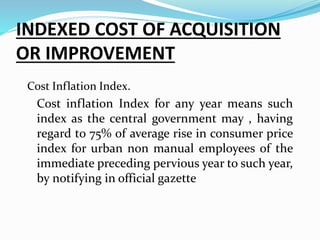
INDEXED COST OF ACQUISITION
OR IMPROVEMENT
Cost Inflation Index.
Cost inflation Index for any year means such
index as the central government may , having
regard to 75% of average rise in consumer price
index for urban non manual employees of the
immediate preceding pervious year to such year,
by notifying in official gazette
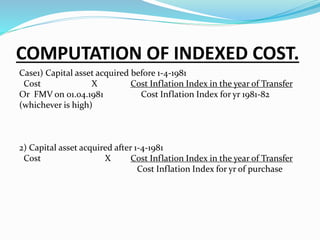
COMPUTATION OF INDEXED COST.
Case1) Capital asset acquired before 1-4-1981
Cost X Cost Inflation Index in the year of Transfer
Or FMV on 01.04.1981 Cost Inflation Index for yr 1981-82
(whichever is high)
2) Capital asset acquired after 1-4-1981
Cost X Cost Inflation Index in the year of Transfer
Cost Inflation Index for yr of purchase
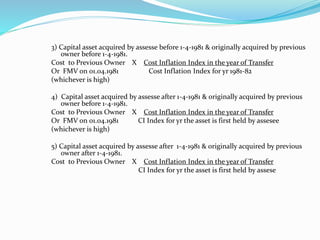
3) Capital asset acquired by assesse before 1-4-1981 & originally acquired by previous
owner before 1-4-1981.
Cost to Previous Owner X Cost Inflation Index in the year of Transfer
Or FMV on 01.04.1981 Cost Inflation Index for yr 1981-82
(whichever is high)
4) Capital asset acquired by assesse after 1-4-1981 & originally acquired by previous
owner before 1-4-1981.
Cost to Previous Owner X Cost Inflation Index in the year of Transfer
Or FMV on 01.04.1981 CI Index for yr the asset is first held by assesee
(whichever is high)
5) Capital asset acquired by assesse after 1-4-1981 & originally acquired by previous
owner after 1-4-1981.
Cost to Previous Owner X Cost Inflation Index in the year of Transfer
CI Index for yr the asset is first held by assese
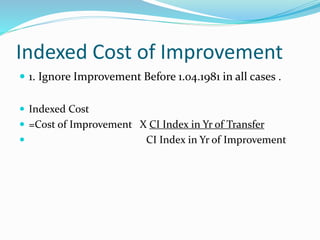
Indexed Cost of Improvement
 1. Ignore Improvement Before 1.04.1981 in all cases .
 Indexed Cost
 =Cost of Improvement X CI Index in Yr of Transfer
 CI Index in Yr of Improvement
Sec 45(1A)-CAPITAL GAINS ON
INSURANCE CLAIMS
 Where any person receives at anytime during the year
any money or other assets under an insurance from an
insurer on account of damage to ,or destruction of any
capital asset, as a result of-
 (i) Flood,typhoon,hurricane,cyclone,earthquake etc
 (ii)riot or civil disturbance
 (iii) accidental fire or explosion
 (iv)action taken by an enemy or action taken in
combating an enemy
 Then any Capital gains arising from the receipt of such
money or other assets shall be chargeable to tax
 Sec 45(1A) is not attracted if an asset is destroyed and
no insurance compensation is received. Such a
destruction of asset shall not be treated as transfer and
thus there will be no Capital Gains.The cost of the
asset destroyed shall be a capital loss which has no tax
treatment.
 The Capital gains shall not be taxable in the year in
which asset is destroyed but shall be taxable in the
year in which Insurance money is received or an asset
is received from the Insurance company.(Exception to
charging section 45(1).
Section 45(3)
Taxable in the hands of the partner
Consideration: Amount recorded in the books of
accounts
Section 45(4)
Chargeable in the hands of the firm
Consideration : fair market value as on the
date of transfer
Slump sale means transfer of one or more undertakings as
a result of sale for lump sum consideration without values
being assigned to individual assets and liabilities in such
sales –Section 2(42C).
SLUMP SALE
 Cost of acquisition : Net worth
 No indexation
 Short term/long term
 Value of assets : Depreciable/non-depreciable
 Value in the hands of purchaser.
SEC 50C-SPECIAL PROVISIONS FOR FULL
VALUE OF CONSIDERATION IN CERTAIN
CASES
 Where the consideration received or accruing on
transfer of a capital asset ,being land or building or
both,
 Is less than
 The value assessed or assessable by the Stamp
Valuation Authority for the purpose of payment of
stamp duty,
 The value so assessed or assessable shall be deemed to
be the Sales Consideration.
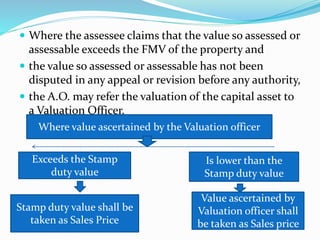
 Where the assessee claims that the value so assessed or
assessable exceeds the FMV of the property and
 the value so assessed or assessable has not been
disputed in any appeal or revision before any authority,
 the A.O. may refer the valuation of the capital asset to
a Valuation Officer.
Where value ascertained by the Valuation officer
Exceeds the Stamp
duty value
Is lower than the
Stamp duty value
Stamp duty value shall be
taken as Sales Price
Value ascertained by
Valuation officer shall
be taken as Sales price
SEC 50D-FAIR MARKET VALUE DEEMED TO BE
FULL VALUE OF CONSIDERATION IN CERTAIN
CASES
 Where the consideration received or accruing as a
result of transfer of a capital asset by an assessee is not
ascertainable or cannot be determined ,then, for the
purposes of computing income chargeable to tax as
capital gains ,the fair market value of the said asset
on the date of transfer shall be deemed to be the full
value of the consideration received or accruing as
a result of such transfer.
CAPITAL GAINS ON CONVERSION OF DEBENTURES
INTO SHARES [SEC 49(2A)]:
 1) Any transfer by way of conversion of debentures,
debenture – stock, or deposit certificates in any form, of a
Co. into shares or debentures of that co. is not regarded as a
transfer giving rise to Capital gains.
 2) Cost of Acquisition will be the cost of debentures,
debentures – stock or deposit certificates which has been
appropriated towards to shares or debentures in case there
is sale of above transferred assets giving rise to capital
gains.
CAPITAL GAINS ON CONVERSION OF DEBENTURES
INTO SHARES
[SEC 49(2A)]:
In case of conversion of debentures into Shares:
1) Cost of Debentures will be the Cost of acquisition
of shares.
2) To find out whether or not shares are LTCA or
STCA, the period of holding shall be determined
from date of allotment of shares.
3) The indexation will start from the date of
conversion of debentures into shares.
4) Not applicable for preference shares converted into
equity shares.
CAPITAL GAINS ON TRANSFER OF SECURITY BY
DEPOSITORY
[ SEC 45(2A) ]
1) Any beneficial will be chargeable to Income tax, if in
PY he has had
any profits or gains by virtue of transferring of any
securities through
depository or participant of such beneficial interest.
2) It shall not be income of the depository.
3) Cost of Acquisitions and the period of holding of any
securities shall be determined on the basis of the First
– In – First – Out (FIFO)
Sec 45(2A)(contd.)
4)FIFO shall be applied only in respect of
dematerialized holdings, as physical form of
shares are still in possession of the investor when
there is sale of dematerialized shares.
5) FIFO shall be applied accountwise incase if there
are multiple depository accounts, as sale in
particular account shall not be construed as sale in
other accounts.
6) Date of entry is used for the basis of FIFO.
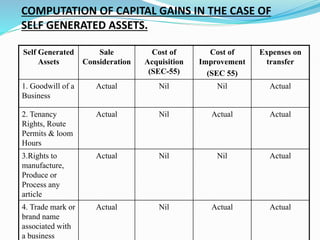
COMPUTATION OF CAPITAL GAINS IN THE CASE OF
SELF GENERATED ASSETS.
Self Generated
Assets
Sale
Consideration
Cost of
Acquisition
(SEC-55)
Cost of
Improvement
(SEC 55)
Expenses on
transfer
1. Goodwill of a
Business
Actual Nil Nil Actual
2. Tenancy
Rights, Route
Permits & loom
Hours
Actual Nil Actual Actual
3.Rights to
manufacture,
Produce or
Process any
article
Actual Nil Nil Actual
4. Trade mark or
brand name
associated with
a business
Actual Nil Actual Actual
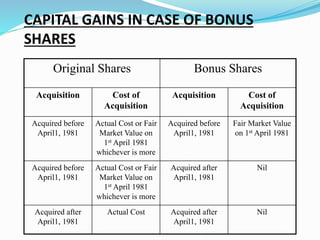
CAPITAL GAINS IN CASE OF BONUS
SHARES
Original Shares Bonus Shares
Acquisition Cost of
Acquisition
Acquisition Cost of
Acquisition
Acquired before
April1, 1981
Actual Cost or Fair
Market Value on
1st April 1981
whichever is more
Acquired before
April1, 1981
Fair Market Value
on 1st April 1981
Acquired before
April1, 1981
Actual Cost or Fair
Market Value on
1st April 1981
whichever is more
Acquired after
April1, 1981
Nil
Acquired after
April1, 1981
Actual Cost Acquired after
April1, 1981
Nil
CAPITAL GAIN ON TRANSFER OF RIGHTS
SHARES
 For Original Shareholder ( Renouncer )
 Cost of Acquisition :
 Cost of acquiring original shares.
 Cost of aquiring Rights shares.
 Premium Received on renouncement – Short
Term Capital Gain.
 For the Renouncee
 Cost of Acquisition :
 Amount paid to Company
 Premium paid to the renouncer.
CAPITAL GAINS IN CASE OF COMPULSORY
ACQUISITION OF AN ASSET [SEC 45(5)]
 Applicability :
 Transfer of capital asset by way of compulsory acquisition
under any law.
 Capital asset is transferred (not by way of compulsory
acquisition), & consideration is approved or determined by
central Gov. or RBI.
 Chargeability :
 Initial Compensation is full value of consideration.
 Charged in the year in which first Initial Compensation is
received
 Enhanced Compensation-Taxable in the year in which it is
received by the assessee.
 *Nature of capital gains shall be the same as the nature of capital
gain with reference to original compensation.
 *COA= nil
SEC 45(2)-CONVERSION OF CAPITAL
ASSETS INTO STOCK IN TRADE
 Transfer includes conversion of a capital assets into stock
in trade of the business carried on by the assessee.
 Capital gains shall be charged to tax in the year in which
the stock in trade is sold or transferred by the assessee.
 The Fair Market value as on the date on conversion shall be
deemed to be the sales consideration .
 PGBP=Sale price of Stock –FMV as on the date of
conversion
 Capital gain=FMV of the asset on the date of conversion-
Cost of acquisition
Example
 A building has been acquired by the assessee on 1.06.1980
for Rs.1,00,000.The assessee converts the building into
stock in trade of his property dealing business on 1.01.1992
when the fair market value of the building is
RS.9,00,000.The stock in trade is sold by the assessee on
1.01.2011 for Rs.13,00,000.(FMV as on 1.04.1981 was
Rs.1,80,000).
 Assessment year 2011-2012
 PGBP income (Rs.13 lac -9lac) = 4 lac
 Capital Gains
 Period of holding-1.06.1980 to 31.12.91 Long term
 Sale price as per Sec 45(2)-Rs.9,00,000
 COA =Rs.1,80,000
 Indexed COA =1,80,000*199/100=3,58,200
 LTCG=Rs.5,41,800
OTHER SPECIAL PROVISIONS
 Capital Gains in case of Depreciable Assets ( Sec 50 )
 Buy Back of Shares
 Transfer of Land & Bldg ( Sec 50 [c])
EXEMPTION U/S 54
 Conditions :
 Gains are from Transfer of Residential House Property
 Applicable only to Individual / HUF
 Asset Sold is a Long Term Capital Asset
 Assessee should invest in another Residential House
Property within the specified time limit.
 New asset should not be sold within 3 years of acquisition,
otherwise will be treated as a short term capital gain.
 Exemption = Amount Invested OR Capital Gains
 whichever is Less.
EXEMPTION U/S 54B
 Available if agricultural land transferred. The said land
should be used by the individual or his parents for
agricultural purposes during at least 2 years immediately
prior to transfer.
 Available only to an individual.
 Asset Sold should be Short term / Long term Capital Asset.
 Investment in agricultural land (rural or urban) within 2
years.
 New Asset should not be sold within 3 years of acquisition,
otherwise will be treated as a short term capital gain.
 Exemption = Amount Invested OR Capital Gains
 whichever is Less.
EXEMPTION U/S 54D
 Available if land or building forming part of an industrial
undertaking is compulsorily acquired by the govt and
which is used during 2 years for industrial purposes prior to
acquisition.
 Available to any person.
 Asset Sold should be Short term / Long term Capital Asset.
 Investment in land or building for industrial purposes
within 3 years.
 New Asset should not be sold within 3 years of acquisition,
otherwise will be treated as a short term capital gain.
 Exemption = Amount Invested OR Capital Gains
 whichever is Less.
EXEMPTION U/S 54EC
 Available if any long term capital asset is transferred after
31.3.2000.
 Available to any person.
 The asset should be a Long term capital asset.
 Investment within 6 months in bonds of NHAI or RECL
which are redeemable after 3 years.
 New Asset should not be sold within 3 years of
acquisition, otherwise will be treated as a short
term capital gain.
 Exemption = Amount Invested OR Capital Gains
 whichever is Less.
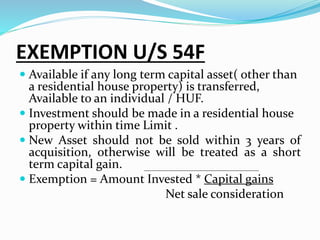
EXEMPTION U/S 54F
 Available if any long term capital asset( other than
a residential house property) is transferred,
Available to an individual / HUF.
 Investment should be made in a residential house
property within time Limit .
 New Asset should not be sold within 3 years of
acquisition, otherwise will be treated as a short
term capital gain.
 Exemption = Amount Invested * Capital gains
Net sale consideration
EXEMPTION U/S 54G
 Available if any land, building, plant or machinery
is transferred in order to shift an industrial
undertaking from urban to rural area.
 Available to any person.
 Asset may be short term / long term.
 Investment should be made in land, building or
plant and machinery to shift the undertaking in a
rural area.
 New Asset should not be sold within 3 years of
acquisition,
 Exemption = Amount Invested OR Capital Gains
 whichever is Less
EXEMPTION U/S 54GA
 Available if any land, building, plant or machinery
is transferred in order to shift an industrial
undertaking from any area to SEZ.
 Available to any person.
 Asset may be short term / long term.
 Investment should be made in land, building or
plant and machinery to shift the undertaking to
SEZ area.
 New Asset should not be sold within 3 years of
acquisition,
 Exemption = Amount Invested OR Capital Gains
 whichever is Less
SEC 10(38)-Exemption in respect of Long
Term Capital Gains in case of
Specified Securities
 The following income shall be exempt from income tax
 Any income arising from the transfer of a Long term
Capital Asset being an Equity share in a company or
a unit of equity oriented fund where-Such transaction
is chargeable to Securities Transaction Tax (STT)
and the transaction of sale of equity share or unit is
entered into on or after 1.10.2004.
SEC 111A-TAX ON SHORT TERM
CAPITAL GAINS IN CERTAIN CASES
 SEC 111A shall be applicable to all assesees including
non-residents ,if all the following conditions are
satisfied-
 The gains arise from transfer of a short term capital
asset,
 Being an equity share in a company or a unit of an
Equity oriented fund
 The transaction of sale is chargeable to Securities
Transaction Tax (STT).
 Tax payable on such STCG shall be @15%.
PROVISO OF SEC 112
 Section 112 provides an alternative option for charging
long term capital gains to tax, if the following conditions
are satisfied :
 The taxpayer is an individual, HUF, company or any
other person(may be resident or non resident)
 The asset is a long term capital asset
 The long term capital asset is :
- a security listed in any recognised stock exchange in
India or,
- a unit of UTI or a mutual fund(whether listed or not)
Sec 112 (contd.)
 If the conditions are satisfied, then the other option is to
charge the capital gains at the rate of 10% without taking
the benefit of indexation in the cost of acquisition.
 The tax payable by the assessee will be lower of 20%(+
surcharge)on the capital gain calculated giving benefit of
indexation or @10% without the benefit of indexation,
whichever is lower.
 In the case of listed bonus shares, listed debentures and
listed bonds, Option u/s 112 will be better.
Capital gains ppt

Capital gains ppt

  • 1.
  • 2.
    INTRODUCTION  CAPITAL GAINS SEC 45(1)-CHARGING SECTION “Any profit or gains arising from the transfer of capital assets is taxable under the head capital gains in the previous year in which the transfer has taken place.”
  • 3.
     Conditions forGains to be charged under Capital Gains There should be a capital asset.  The capital asset should be transferred by the assessee.  Such transfer should take place during the previous year.  The profits or gains should arise as a result of this transfer.  Such profit or gain should not be exempted from tax under sections 54, 54B, 54D, 54EC, 54F and 54G & 54GA.
  • 4.
    DEFINITION OF CAPITALASSETS SEC 2(14)  Capital asset is defined to include property of any kind, whether or not connected with the business or profession of the assessee.
  • 5.
    EXCEPTIONS TO CAPITALASSETS a) Any stock-in-trade, consumable stores or raw material held for the purposes of business or profession. b)Personal Effects ,that is to say, Movable property of the Assessee including wearing apparel and furniture held for his personal use or for the use of any member of his family dependent on him. But excludes-- (a)Jewellery (b) Archaelogical collections
  • 6.
     (c )drawings  (d) paintings  (e)sculptures  (f) any work of art.  NOTE—Silver utensils constitute personal effects and no capital gains will arise.  Gold utensils are not personal effects and are capital assets
  • 7.
    CONTD……. c) Agricultural landin India provided it is not situated in urban area.i.e Rural agricultural land d) 6 ½ % Gold Bonds, 7% Gold Bonds or National Defence Gold Bonds, issued by the central government. e) Special Bearer Bonds, and f) Gold Deposit bonds issued under Gold Deposit Scheme of 1999.
  • 8.
    SHORT TERM ANDLONG TERM CAPITAL ASSETS “Short term capital assets” means a capital asset held by the assessee for not more than 36 months, immediately prior to its date of transfer. However, the following assets are treated as short term assets if they are held for not more than 12 months, they are:  Equity or preference shares in a company  Securities like debentures, government securities listed in a recognized stock exchange in India.  Units of UTI and  Units of mutual funds.  An asset other than a short-term capital asset is regarded as a “long term capital asset”.
  • 9.
    METHOD OF DETERMINING PERIODOF HOLDING  In case when the assessee acquires an asset as a gift or by a will, the period for which the previous owner holds the asset is also included.
  • 10.
    •Any transaction involvingthe allowing of the possession of any movable property to be taken or retained in part of performance of contract of the nature referred to in the sec53a of the transfer of property act,1982 •Any transaction (whether by way of becoming a member of, or acquiring shares in a co-operative society, company association of person or by way of agreement or any arrangement or in any other manner whatsoever) which has the effect of transferring or enabling the enjoyment of any immovable property
  • 11.
    • Transfer Includes •Sale • Exchange • Relinquishment • Extinguishment • Compulsory Acquisition • Conversion of Capital Asset Into Stock in Trade[sec(45(2)]
  • 12.
    •Distribution of Assetsto Its Shareholder on Its Liquidation [Sec46(1)] •Distribution of Capital Assets in HUF to Its Member at the Time of Total or Partial Partition [Sec 47(1)] •Transfer of a Capital Asset Under a Will or an Irrevocable Trust or a Gift [Sec 47(iii)] • Transfer of a Capital Asset by a Company to Its Wholly Owned Indian Subsidiary Company [Sec 47(iv)] • Transfer of a Capital Asset by a Wholly Owned Subsidiary Company to Its Indian Holding Company [Sec 47(v)]
  • 13.
    SEC 48-Method ofComputation of Capital Gains  Sales Consideration received or accruing as a result of transfer  Less-cost of acquisition of the asset  Less-cost of improvement to the asset  Less-Expenditure incurred wholly and exclusively in connection with such transfer
  • 14.
    SECOND PROVISO TOSEC 48- INDEXATION  Where the capital gains arises from the transfer of a Long term capital Asset ,then for the purposes of computing capital gains:  (a) “Indexed cost of acquisition” shall be taken instead of “Cost Of Acquisition”.  (b) “Indexed cost of improvement” shall be taken instead of “Cost Of improvement”.  ICOI=COST OF IMPROVEMENT xCost inflation index for the year in which asset is transferred/Cost inflation index for the first year in which Improvement to the asset took place
  • 15.
    •Transfer in Caseof Amalgamation Sec[47(vi)] •Transfer in Case of Demerger Sec[47(vi B)] •Transfer of Agricultural Land in India Effected Before March 1, 1970 [Sec 47(viii)] • Transfer of a Capital Asset , Being Any Work of Art ,Scientific or Art Collection, Book, Drawing, painting, photograph Etc [Sec47(ix)] •Transfer by Way of Conversion of Bonds or Debenture of a Company Into Shares or Debenture of That Company [ Sec 47(x)]
  • 16.
    SHORT TERM CAPITALGAIN 1)Find full value of consideration 2)Deduct the followings. a) Expenditure incurred wholly and exclusively in connection with such transfer. b) Cost of acquisition. c) Cost of improvement 3) From resulting sum deduct exemption provided by u/s54 B, 54 D, 54 G, 54GA 4) The balancing amount is Short Term Capital Gain.
  • 17.
    LONG TERM CAPITALGAIN 1) Find full value of consideration 2) Deduct the followings a) Expenditure incurred wholly and exclusively in connection with such transfer. b) Indexed Cost of acquisition. c) Indexed Cost of improvement. 3) From resulting sum deduct the exemption provided by section 54, 54 B, 54 D, 54 EC, 54 F, 54 G, 54 GA The balancing amount is Long Term Capital Gain/Loss.
  • 18.
    FULL VALUE OFCONSIDERATION Full value means whole price without any deduction and consideration in which transferor receives in lieu of asset he parts with.
  • 19.
    EXPENDITURE ON TRANSFER Expenditureincurred wholly and exclusively in connection with transfer of capital asset is deductible from full value of consideration. This means expenditure incurred which is necessary to effect the transfer like brokerage commission, cost of stamp, registration fees and all
  • 20.
    COST OF ACQUISITION Costof acquisition of an asset is the value for which it is acquired by the Assessee, expenses of capital nature for acquiring the title are include in cost of acquisition.
  • 21.
    NOTIONAL COST OFACQUISITION Cost to previous owner is considered as cost of acquisition to the assessee if that capital asset become property in cases like. a) Distribution of asset on partial or total partition of Hindu Undivided Family. b) Acquisition of property under gift and will. c) Acquisition of property by a HUF where one of its member has converted his self acquired property into joint family property after Dec 31- 1969.
  • 22.
    COST OF IMPROVEMENT -It means all expenses of capital nature incurred in making any addition/ alteration to capital asset by assessee. 1) Expenditure after 31 mar 1981 will only be considered.
  • 23.
    INDEXED COST OFACQUISITION OR IMPROVEMENT Cost Inflation Index. Cost inflation Index for any year means such index as the central government may , having regard to 75% of average rise in consumer price index for urban non manual employees of the immediate preceding pervious year to such year, by notifying in official gazette
  • 24.
    COMPUTATION OF INDEXEDCOST. Case1) Capital asset acquired before 1-4-1981 Cost X Cost Inflation Index in the year of Transfer Or FMV on 01.04.1981 Cost Inflation Index for yr 1981-82 (whichever is high) 2) Capital asset acquired after 1-4-1981 Cost X Cost Inflation Index in the year of Transfer Cost Inflation Index for yr of purchase
  • 25.
    3) Capital assetacquired by assesse before 1-4-1981 & originally acquired by previous owner before 1-4-1981. Cost to Previous Owner X Cost Inflation Index in the year of Transfer Or FMV on 01.04.1981 Cost Inflation Index for yr 1981-82 (whichever is high) 4) Capital asset acquired by assesse after 1-4-1981 & originally acquired by previous owner before 1-4-1981. Cost to Previous Owner X Cost Inflation Index in the year of Transfer Or FMV on 01.04.1981 CI Index for yr the asset is first held by assesee (whichever is high) 5) Capital asset acquired by assesse after 1-4-1981 & originally acquired by previous owner after 1-4-1981. Cost to Previous Owner X Cost Inflation Index in the year of Transfer CI Index for yr the asset is first held by assese
  • 26.
    Indexed Cost ofImprovement  1. Ignore Improvement Before 1.04.1981 in all cases .  Indexed Cost  =Cost of Improvement X CI Index in Yr of Transfer  CI Index in Yr of Improvement
  • 27.
    Sec 45(1A)-CAPITAL GAINSON INSURANCE CLAIMS  Where any person receives at anytime during the year any money or other assets under an insurance from an insurer on account of damage to ,or destruction of any capital asset, as a result of-  (i) Flood,typhoon,hurricane,cyclone,earthquake etc  (ii)riot or civil disturbance  (iii) accidental fire or explosion  (iv)action taken by an enemy or action taken in combating an enemy  Then any Capital gains arising from the receipt of such money or other assets shall be chargeable to tax
  • 28.
     Sec 45(1A)is not attracted if an asset is destroyed and no insurance compensation is received. Such a destruction of asset shall not be treated as transfer and thus there will be no Capital Gains.The cost of the asset destroyed shall be a capital loss which has no tax treatment.  The Capital gains shall not be taxable in the year in which asset is destroyed but shall be taxable in the year in which Insurance money is received or an asset is received from the Insurance company.(Exception to charging section 45(1).
  • 29.
    Section 45(3) Taxable inthe hands of the partner Consideration: Amount recorded in the books of accounts
  • 30.
    Section 45(4) Chargeable inthe hands of the firm Consideration : fair market value as on the date of transfer
  • 31.
    Slump sale meanstransfer of one or more undertakings as a result of sale for lump sum consideration without values being assigned to individual assets and liabilities in such sales –Section 2(42C).
  • 32.
    SLUMP SALE  Costof acquisition : Net worth  No indexation  Short term/long term  Value of assets : Depreciable/non-depreciable  Value in the hands of purchaser.
  • 33.
    SEC 50C-SPECIAL PROVISIONSFOR FULL VALUE OF CONSIDERATION IN CERTAIN CASES  Where the consideration received or accruing on transfer of a capital asset ,being land or building or both,  Is less than  The value assessed or assessable by the Stamp Valuation Authority for the purpose of payment of stamp duty,  The value so assessed or assessable shall be deemed to be the Sales Consideration.
  • 34.
     Where theassessee claims that the value so assessed or assessable exceeds the FMV of the property and  the value so assessed or assessable has not been disputed in any appeal or revision before any authority,  the A.O. may refer the valuation of the capital asset to a Valuation Officer. Where value ascertained by the Valuation officer Exceeds the Stamp duty value Is lower than the Stamp duty value Stamp duty value shall be taken as Sales Price Value ascertained by Valuation officer shall be taken as Sales price
  • 35.
    SEC 50D-FAIR MARKETVALUE DEEMED TO BE FULL VALUE OF CONSIDERATION IN CERTAIN CASES  Where the consideration received or accruing as a result of transfer of a capital asset by an assessee is not ascertainable or cannot be determined ,then, for the purposes of computing income chargeable to tax as capital gains ,the fair market value of the said asset on the date of transfer shall be deemed to be the full value of the consideration received or accruing as a result of such transfer.
  • 36.
    CAPITAL GAINS ONCONVERSION OF DEBENTURES INTO SHARES [SEC 49(2A)]:  1) Any transfer by way of conversion of debentures, debenture – stock, or deposit certificates in any form, of a Co. into shares or debentures of that co. is not regarded as a transfer giving rise to Capital gains.  2) Cost of Acquisition will be the cost of debentures, debentures – stock or deposit certificates which has been appropriated towards to shares or debentures in case there is sale of above transferred assets giving rise to capital gains.
  • 37.
    CAPITAL GAINS ONCONVERSION OF DEBENTURES INTO SHARES [SEC 49(2A)]: In case of conversion of debentures into Shares: 1) Cost of Debentures will be the Cost of acquisition of shares. 2) To find out whether or not shares are LTCA or STCA, the period of holding shall be determined from date of allotment of shares. 3) The indexation will start from the date of conversion of debentures into shares. 4) Not applicable for preference shares converted into equity shares.
  • 38.
    CAPITAL GAINS ONTRANSFER OF SECURITY BY DEPOSITORY [ SEC 45(2A) ] 1) Any beneficial will be chargeable to Income tax, if in PY he has had any profits or gains by virtue of transferring of any securities through depository or participant of such beneficial interest. 2) It shall not be income of the depository. 3) Cost of Acquisitions and the period of holding of any securities shall be determined on the basis of the First – In – First – Out (FIFO)
  • 39.
    Sec 45(2A)(contd.) 4)FIFO shallbe applied only in respect of dematerialized holdings, as physical form of shares are still in possession of the investor when there is sale of dematerialized shares. 5) FIFO shall be applied accountwise incase if there are multiple depository accounts, as sale in particular account shall not be construed as sale in other accounts. 6) Date of entry is used for the basis of FIFO.
  • 40.
    COMPUTATION OF CAPITALGAINS IN THE CASE OF SELF GENERATED ASSETS. Self Generated Assets Sale Consideration Cost of Acquisition (SEC-55) Cost of Improvement (SEC 55) Expenses on transfer 1. Goodwill of a Business Actual Nil Nil Actual 2. Tenancy Rights, Route Permits & loom Hours Actual Nil Actual Actual 3.Rights to manufacture, Produce or Process any article Actual Nil Nil Actual 4. Trade mark or brand name associated with a business Actual Nil Actual Actual
  • 41.
    CAPITAL GAINS INCASE OF BONUS SHARES Original Shares Bonus Shares Acquisition Cost of Acquisition Acquisition Cost of Acquisition Acquired before April1, 1981 Actual Cost or Fair Market Value on 1st April 1981 whichever is more Acquired before April1, 1981 Fair Market Value on 1st April 1981 Acquired before April1, 1981 Actual Cost or Fair Market Value on 1st April 1981 whichever is more Acquired after April1, 1981 Nil Acquired after April1, 1981 Actual Cost Acquired after April1, 1981 Nil
  • 42.
    CAPITAL GAIN ONTRANSFER OF RIGHTS SHARES  For Original Shareholder ( Renouncer )  Cost of Acquisition :  Cost of acquiring original shares.  Cost of aquiring Rights shares.  Premium Received on renouncement – Short Term Capital Gain.  For the Renouncee  Cost of Acquisition :  Amount paid to Company  Premium paid to the renouncer.
  • 43.
    CAPITAL GAINS INCASE OF COMPULSORY ACQUISITION OF AN ASSET [SEC 45(5)]  Applicability :  Transfer of capital asset by way of compulsory acquisition under any law.  Capital asset is transferred (not by way of compulsory acquisition), & consideration is approved or determined by central Gov. or RBI.  Chargeability :  Initial Compensation is full value of consideration.  Charged in the year in which first Initial Compensation is received  Enhanced Compensation-Taxable in the year in which it is received by the assessee.  *Nature of capital gains shall be the same as the nature of capital gain with reference to original compensation.  *COA= nil
  • 44.
    SEC 45(2)-CONVERSION OFCAPITAL ASSETS INTO STOCK IN TRADE  Transfer includes conversion of a capital assets into stock in trade of the business carried on by the assessee.  Capital gains shall be charged to tax in the year in which the stock in trade is sold or transferred by the assessee.  The Fair Market value as on the date on conversion shall be deemed to be the sales consideration .  PGBP=Sale price of Stock –FMV as on the date of conversion  Capital gain=FMV of the asset on the date of conversion- Cost of acquisition
  • 45.
    Example  A buildinghas been acquired by the assessee on 1.06.1980 for Rs.1,00,000.The assessee converts the building into stock in trade of his property dealing business on 1.01.1992 when the fair market value of the building is RS.9,00,000.The stock in trade is sold by the assessee on 1.01.2011 for Rs.13,00,000.(FMV as on 1.04.1981 was Rs.1,80,000).  Assessment year 2011-2012  PGBP income (Rs.13 lac -9lac) = 4 lac  Capital Gains  Period of holding-1.06.1980 to 31.12.91 Long term  Sale price as per Sec 45(2)-Rs.9,00,000  COA =Rs.1,80,000  Indexed COA =1,80,000*199/100=3,58,200  LTCG=Rs.5,41,800
  • 46.
    OTHER SPECIAL PROVISIONS Capital Gains in case of Depreciable Assets ( Sec 50 )  Buy Back of Shares  Transfer of Land & Bldg ( Sec 50 [c])
  • 47.
    EXEMPTION U/S 54 Conditions :  Gains are from Transfer of Residential House Property  Applicable only to Individual / HUF  Asset Sold is a Long Term Capital Asset  Assessee should invest in another Residential House Property within the specified time limit.  New asset should not be sold within 3 years of acquisition, otherwise will be treated as a short term capital gain.  Exemption = Amount Invested OR Capital Gains  whichever is Less.
  • 48.
    EXEMPTION U/S 54B Available if agricultural land transferred. The said land should be used by the individual or his parents for agricultural purposes during at least 2 years immediately prior to transfer.  Available only to an individual.  Asset Sold should be Short term / Long term Capital Asset.  Investment in agricultural land (rural or urban) within 2 years.  New Asset should not be sold within 3 years of acquisition, otherwise will be treated as a short term capital gain.  Exemption = Amount Invested OR Capital Gains  whichever is Less.
  • 49.
    EXEMPTION U/S 54D Available if land or building forming part of an industrial undertaking is compulsorily acquired by the govt and which is used during 2 years for industrial purposes prior to acquisition.  Available to any person.  Asset Sold should be Short term / Long term Capital Asset.  Investment in land or building for industrial purposes within 3 years.  New Asset should not be sold within 3 years of acquisition, otherwise will be treated as a short term capital gain.  Exemption = Amount Invested OR Capital Gains  whichever is Less.
  • 50.
    EXEMPTION U/S 54EC Available if any long term capital asset is transferred after 31.3.2000.  Available to any person.  The asset should be a Long term capital asset.  Investment within 6 months in bonds of NHAI or RECL which are redeemable after 3 years.  New Asset should not be sold within 3 years of acquisition, otherwise will be treated as a short term capital gain.  Exemption = Amount Invested OR Capital Gains  whichever is Less.
  • 51.
    EXEMPTION U/S 54F Available if any long term capital asset( other than a residential house property) is transferred, Available to an individual / HUF.  Investment should be made in a residential house property within time Limit .  New Asset should not be sold within 3 years of acquisition, otherwise will be treated as a short term capital gain.  Exemption = Amount Invested * Capital gains Net sale consideration
  • 52.
    EXEMPTION U/S 54G Available if any land, building, plant or machinery is transferred in order to shift an industrial undertaking from urban to rural area.  Available to any person.  Asset may be short term / long term.  Investment should be made in land, building or plant and machinery to shift the undertaking in a rural area.  New Asset should not be sold within 3 years of acquisition,  Exemption = Amount Invested OR Capital Gains  whichever is Less
  • 53.
    EXEMPTION U/S 54GA Available if any land, building, plant or machinery is transferred in order to shift an industrial undertaking from any area to SEZ.  Available to any person.  Asset may be short term / long term.  Investment should be made in land, building or plant and machinery to shift the undertaking to SEZ area.  New Asset should not be sold within 3 years of acquisition,  Exemption = Amount Invested OR Capital Gains  whichever is Less
  • 54.
    SEC 10(38)-Exemption inrespect of Long Term Capital Gains in case of Specified Securities  The following income shall be exempt from income tax  Any income arising from the transfer of a Long term Capital Asset being an Equity share in a company or a unit of equity oriented fund where-Such transaction is chargeable to Securities Transaction Tax (STT) and the transaction of sale of equity share or unit is entered into on or after 1.10.2004.
  • 55.
    SEC 111A-TAX ONSHORT TERM CAPITAL GAINS IN CERTAIN CASES  SEC 111A shall be applicable to all assesees including non-residents ,if all the following conditions are satisfied-  The gains arise from transfer of a short term capital asset,  Being an equity share in a company or a unit of an Equity oriented fund  The transaction of sale is chargeable to Securities Transaction Tax (STT).  Tax payable on such STCG shall be @15%.
  • 56.
    PROVISO OF SEC112  Section 112 provides an alternative option for charging long term capital gains to tax, if the following conditions are satisfied :  The taxpayer is an individual, HUF, company or any other person(may be resident or non resident)  The asset is a long term capital asset  The long term capital asset is : - a security listed in any recognised stock exchange in India or, - a unit of UTI or a mutual fund(whether listed or not)
  • 57.
    Sec 112 (contd.) If the conditions are satisfied, then the other option is to charge the capital gains at the rate of 10% without taking the benefit of indexation in the cost of acquisition.  The tax payable by the assessee will be lower of 20%(+ surcharge)on the capital gain calculated giving benefit of indexation or @10% without the benefit of indexation, whichever is lower.  In the case of listed bonus shares, listed debentures and listed bonds, Option u/s 112 will be better.