Accounting Standard – 28
Impairment Of Assets

PREPARED BY: CA. JIMMIT D MEHTA
MODERATOR: SHINING STARS: A GROUP OF PROFESSIONALS
OVERVIEW







Objective
Applicability
Indications Of Impairment
Impairment – Bird’s Eye View
Scope
Definitions
OBJECTIVE

“To prescribe the procedures that an
enterprise applies to ensure that its assets are
carried at no more than their recoverable
amount.”
APPLICABILITY
Accounting Periods
On or After 01-04-2004

- Companies which are
listed or in the
process of listing
- Enterprises having
turnover exceeding 50
crores

On or After 01-04-2005

All other enterprises Corporate or NonCorporate
INDICATORS OF IMPAIRMENT
External Sources:
o significant decline in market value
o significant changes with adverse effect due to
technological, market, economic, legal
environment
o changes in interest rates or rates of return
o net assets are more than its market capilisation
These indicators to be considered as a minimum
INDICATORS OF IMPAIRMENT
Internal Sources:
o evidence of obsolescence or of physical damage
o discontinuance, disposal, restructuring plans
o assets performance declining or expected to
decline

These indicators to be considered as a minimum
IMPAIRMENT – BIRD’S EYE VIEW
Identifying an asset that may be impaired
Question: Whether at each balance sheet date,
recoverable amount of each asset to be estimated?
Answer: NO
Question: To See whether there is any indication
that an asset may be impaired?
Answer: IF YES, recoverable amount to be
estimated
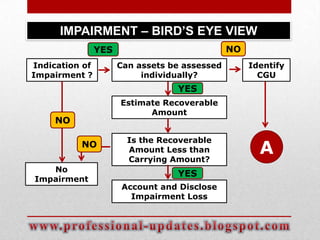
IMPAIRMENT – BIRD’S EYE VIEW
NO

YES
Indication of
Impairment ?

Can assets be assessed
individually?

Identify
CGU

YES
Estimate Recoverable
Amount

NO
NO
No
Impairment

Is the Recoverable
Amount Less than
Carrying Amount?

YES
Account and Disclose
Impairment Loss

A
IMPAIRMENT – BIRD’S EYE VIEW

A

Identify
CGU

Estimate Recoverable
Amount of CGU
Is the Recoverable Amount
Less than Carrying Amount?

YES

NO
No
Impairment

Allocate Impairment Loss to
Goodwill and Assets in CGU
Account and Disclose
Impairment Loss
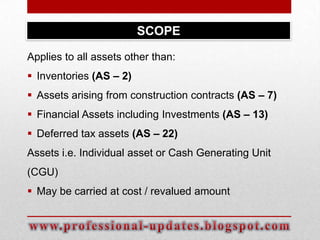
SCOPE
Applies to all assets other than:
 Inventories (AS – 2)
 Assets arising from construction contracts (AS – 7)
 Financial Assets including Investments (AS – 13)
 Deferred tax assets (AS – 22)
Assets i.e. Individual asset or Cash Generating Unit
(CGU)

 May be carried at cost / revalued amount
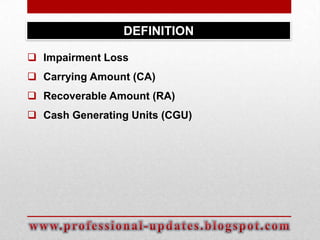
DEFINITION
 Impairment Loss
 Carrying Amount (CA)
 Recoverable Amount (RA)
 Cash Generating Units (CGU)
IMPAIRMENT LOSS
It is an amount by which Carrying Amount of an
assets exceeds its Recoverable Amount.
CARRYING AMOUNT
Carrying amount is the cost of the asset recognized
in the Balance Sheet after deducting:
 Accumulated depreciation / amortization
 Accumulated impairment loss
RECOVERABLE AMOUNT
It is the higher of an asset’s net selling price and
its value in use.
NET SELLING PRICE
 Sale price less costs of disposal in an arm’s
length transaction.
 Asset traded in an active market the current bid
price less costs of disposal.
VALUE IN USE
 Present Value of Estimated Future Cash Flows
 Cash Flow Projections
 Discount Rate
VALUE IN USE






Is the present value of estimated future cash flows expected
from the use of an asset & from its disposal at the end of its
useful life.
Cash Flow Projections
o Short term – maximum 5 years, unless longer can be
justified.
o Based on financial budgets approved by management.
o Do not include financial and taxation cash flows
Long Term Projections
o Based on short term projections
o Steady or declining growth
o Growth rates exceeding long term average rates of the
product, industry or economy discouraged
o Estimation for the assets in its current condition
VALUE IN USE
Discount rate should
 be pre-tax, since cash flows are also pre-tax
 be independent of the entity’s capital structure
 reflect the time value of money and the risks related to
the assets
 reflect weighted average cost of capital

When asset specific rates are not available, following may
be considered as a starting point
 Techniques such as CAPM
 Cost of borrowing
 Adjust the same to reflect the risks of the assets
CASH GENERATING UNIT (CGU)
 At the first instance, to determine impairment loss, the
recoverable amount to be estimated for the individual
asset
 If it is not possible to estimate the recoverable amount of
the individual asset, to determine the recoverable amount
of the cash generating unit to which the asset belongs.
 A cash generating unit is the smallest identifiable group
of assets that generates cash inflows from continuing use
that are largely independent of the cash inflows from
other assets or group of assets.
 Allocation of goodwill and corporate assets to cash
generating unit
CASH GENERATING UNIT (CGU)
 Impairment loss for a cash generating unit to be allocated
for individual assets in the following order
- first to goodwill allocated to the cash generating
unit, if any, and
- then, to the other assets of the unit on pro-rate basis
based on the carrying amount of each asset in the
unit
REVERSAL OF IMPAIRMENT LOSS
 If there are indications, that an impairment loss no longer
exists, the enterprise should estimate the recoverable
amount of the asset.
 In case recoverable amount is higher than asset’s carrying
amount, the impairment loss earlier recognized may be
reversed.
 The increased carrying amount of an asset due to a
reversal of an impairment loss should not exceed the
carrying amount that would have been determined (net of
depreciation) had no impairment loss been recognized for
the asset in prior accounting periods.
JOIN OUR GROUP ON WHATSAPP:

SEND MESSAGE TO +96894185332
WITH YOUR NAME, MOBILE NUMBER
AND EMAIL ID
JOIN OUR GROUP ON FACEBOOK:
www.facebook.com/professionalupdates
VISIT OUR WEBSITE FOR MORE DETAILS

Accounting Standard - 28 Impairment Of Assets

  • 1.
    Accounting Standard –28 Impairment Of Assets PREPARED BY: CA. JIMMIT D MEHTA MODERATOR: SHINING STARS: A GROUP OF PROFESSIONALS
  • 2.
  • 3.
    OBJECTIVE “To prescribe theprocedures that an enterprise applies to ensure that its assets are carried at no more than their recoverable amount.”
  • 4.
    APPLICABILITY Accounting Periods On orAfter 01-04-2004 - Companies which are listed or in the process of listing - Enterprises having turnover exceeding 50 crores On or After 01-04-2005 All other enterprises Corporate or NonCorporate
  • 5.
    INDICATORS OF IMPAIRMENT ExternalSources: o significant decline in market value o significant changes with adverse effect due to technological, market, economic, legal environment o changes in interest rates or rates of return o net assets are more than its market capilisation These indicators to be considered as a minimum
  • 6.
    INDICATORS OF IMPAIRMENT InternalSources: o evidence of obsolescence or of physical damage o discontinuance, disposal, restructuring plans o assets performance declining or expected to decline These indicators to be considered as a minimum
  • 7.
    IMPAIRMENT – BIRD’SEYE VIEW Identifying an asset that may be impaired Question: Whether at each balance sheet date, recoverable amount of each asset to be estimated? Answer: NO Question: To See whether there is any indication that an asset may be impaired? Answer: IF YES, recoverable amount to be estimated
  • 8.
    IMPAIRMENT – BIRD’SEYE VIEW NO YES Indication of Impairment ? Can assets be assessed individually? Identify CGU YES Estimate Recoverable Amount NO NO No Impairment Is the Recoverable Amount Less than Carrying Amount? YES Account and Disclose Impairment Loss A
  • 9.
    IMPAIRMENT – BIRD’SEYE VIEW A Identify CGU Estimate Recoverable Amount of CGU Is the Recoverable Amount Less than Carrying Amount? YES NO No Impairment Allocate Impairment Loss to Goodwill and Assets in CGU Account and Disclose Impairment Loss
  • 10.
    SCOPE Applies to allassets other than:  Inventories (AS – 2)  Assets arising from construction contracts (AS – 7)  Financial Assets including Investments (AS – 13)  Deferred tax assets (AS – 22) Assets i.e. Individual asset or Cash Generating Unit (CGU)  May be carried at cost / revalued amount
  • 11.
    DEFINITION  Impairment Loss Carrying Amount (CA)  Recoverable Amount (RA)  Cash Generating Units (CGU)
  • 12.
    IMPAIRMENT LOSS It isan amount by which Carrying Amount of an assets exceeds its Recoverable Amount. CARRYING AMOUNT Carrying amount is the cost of the asset recognized in the Balance Sheet after deducting:  Accumulated depreciation / amortization  Accumulated impairment loss
  • 13.
    RECOVERABLE AMOUNT It isthe higher of an asset’s net selling price and its value in use. NET SELLING PRICE  Sale price less costs of disposal in an arm’s length transaction.  Asset traded in an active market the current bid price less costs of disposal.
  • 14.
    VALUE IN USE Present Value of Estimated Future Cash Flows  Cash Flow Projections  Discount Rate
  • 15.
    VALUE IN USE    Isthe present value of estimated future cash flows expected from the use of an asset & from its disposal at the end of its useful life. Cash Flow Projections o Short term – maximum 5 years, unless longer can be justified. o Based on financial budgets approved by management. o Do not include financial and taxation cash flows Long Term Projections o Based on short term projections o Steady or declining growth o Growth rates exceeding long term average rates of the product, industry or economy discouraged o Estimation for the assets in its current condition
  • 16.
    VALUE IN USE Discountrate should  be pre-tax, since cash flows are also pre-tax  be independent of the entity’s capital structure  reflect the time value of money and the risks related to the assets  reflect weighted average cost of capital When asset specific rates are not available, following may be considered as a starting point  Techniques such as CAPM  Cost of borrowing  Adjust the same to reflect the risks of the assets
  • 17.
    CASH GENERATING UNIT(CGU)  At the first instance, to determine impairment loss, the recoverable amount to be estimated for the individual asset  If it is not possible to estimate the recoverable amount of the individual asset, to determine the recoverable amount of the cash generating unit to which the asset belongs.  A cash generating unit is the smallest identifiable group of assets that generates cash inflows from continuing use that are largely independent of the cash inflows from other assets or group of assets.  Allocation of goodwill and corporate assets to cash generating unit
  • 18.
    CASH GENERATING UNIT(CGU)  Impairment loss for a cash generating unit to be allocated for individual assets in the following order - first to goodwill allocated to the cash generating unit, if any, and - then, to the other assets of the unit on pro-rate basis based on the carrying amount of each asset in the unit
  • 19.
    REVERSAL OF IMPAIRMENTLOSS  If there are indications, that an impairment loss no longer exists, the enterprise should estimate the recoverable amount of the asset.  In case recoverable amount is higher than asset’s carrying amount, the impairment loss earlier recognized may be reversed.  The increased carrying amount of an asset due to a reversal of an impairment loss should not exceed the carrying amount that would have been determined (net of depreciation) had no impairment loss been recognized for the asset in prior accounting periods.
  • 20.
    JOIN OUR GROUPON WHATSAPP: SEND MESSAGE TO +96894185332 WITH YOUR NAME, MOBILE NUMBER AND EMAIL ID JOIN OUR GROUP ON FACEBOOK: www.facebook.com/professionalupdates VISIT OUR WEBSITE FOR MORE DETAILS