Accounting Standards – 2      Valuation Of Inventories
Objective of Accounting StandardsThe basic objective of accounting standards is to remove variations in the treatment of several accounting aspects and to bring about standardization in presentationThe ACCOUNTING STANDARDS BOARD (ASB) which functions under ICAI issues accounting standards
OBJECTIVE  valuation of inventoriesFormulate the method of computation of cost of inventories/stock. Determining the value of closing stock at which it is to be shown in balance sheet till it is not sold and recognized as revenue.
ApplicationsThis Standard should be applied in accounting for inventories other than:work in progress arising under construction contracts, including directly related service contracts (see Accounting Standard (AS) 7, Construction Contracts);work in progress arising in the ordinary course of business of service providers;shares, debentures and other financial instruments held as sk in trade; and(d)producers' inventories of livestock, agricultural and forest products, and mineral oils, ores and gases to the extent that they are measured at net realisable value in accordance with well established practices in those industries.
DEFINITION   	Inventories are assets:Held for the sale in the ordinary course of business (Finished Goods).In the process of production of such sale (Raw material and working progress).In the form of materials and supplies to be consumed in the production process or in the rendering of services (Stores, Spares, Raw material).Inventories do not include machinery.
Measure Of Inventories	Inventories should be valued at the lower of cost and net resale value	MAJOR POINTS FOR VALUATION OF INVENTORIESDetermination of  cost of InventoriesDetermination of net realizable value of inventoriesComparison between the cost and net realizable value
Determination of Cost of InventoriesCost of Inventories Includes:Cost of Purchase Cost of Conversion Other  Costs (incurred in bringing the inventories to their present location and condition)
Cost Of Purchase  Cost of Purchase Price includes :Duty and Purchase Price
 Taxes
Freight Inward
Other Expenditure directly attributable to the acquisition.	Less :Duties and taxes recoverable by enterprises from taxing authorities
Trade discount
Duty Drawback
Rebate Cost Of ConversionIt Consists of the cost directly related to the   units(Direct Labor, Direct Material, Direct Expenses)Add:Systematic allocation of fixed and variable production overheads that are incurred in converting material into finished goods.Other  Costs 	Cost incurred in bringing the inventories to their present location and conditionExcise duty contributes directly to bringing the inventories to its present location and conditionExcise duties is direct costs, which should be included in the valuation of inventories
Determination of net realizable value of Inventories.Net realizable value means estimated selling price in ordinary course of business less estimated costs of completion and estimated costs necessary to make the sale If the finished product is sold at cost or above cost, then the estimated realizable value of raw material and supplies is considered more than its costIf the finished product is sold below cost, then the estimated realizable value of raw material or supplies is equal to replacement price of raw material or supplies
Comparison between the cost and net realizable valueThe comparison between the cost and net realizable value should be made by grouping the items.
Methods of computing InventoriesFirst-in, First-out (FIFO)Last-in, First-out (LIFO)Weighted-average cost (WAC)
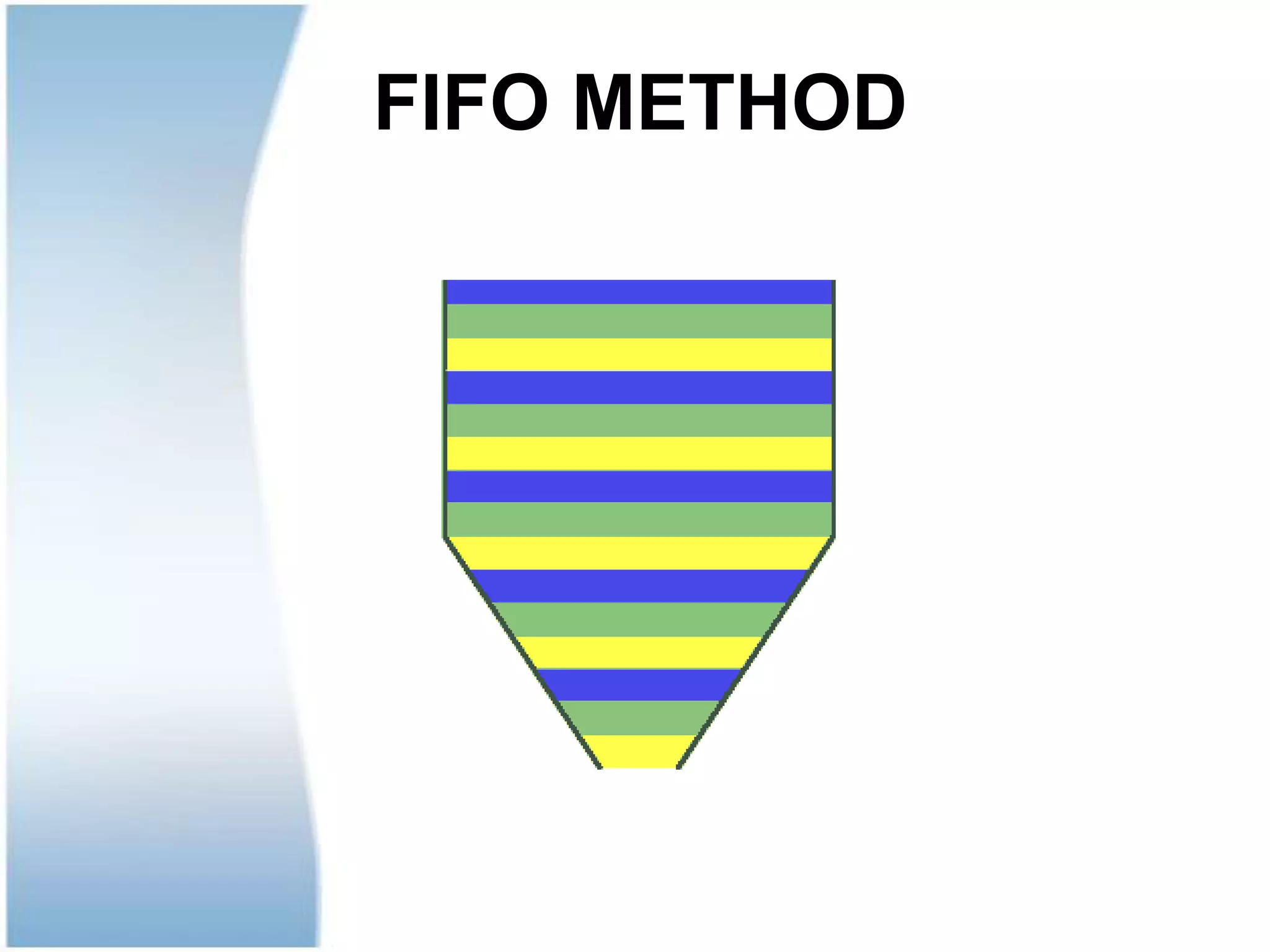
First-in, First-out (FIFO)This method assumes that the first unit acquired are the first unit sold The costs of ending inventories is that of the most recent purchasesA major criticism of FIFO: Improper matching of cost with revenues since the cost of goods sold is computed on the bases of old price that are possibly unrealistic
FIFO METHOD
Last-in, First-out(LIFO)This method assumes that the last unit acquired are the first unit soldThe cost of the units in the ending inventory is that of the earliest purchases The chief advantage of LIFO is that balance sheet value of inventories may be outdated and unrealistic
   LIFO METHOD
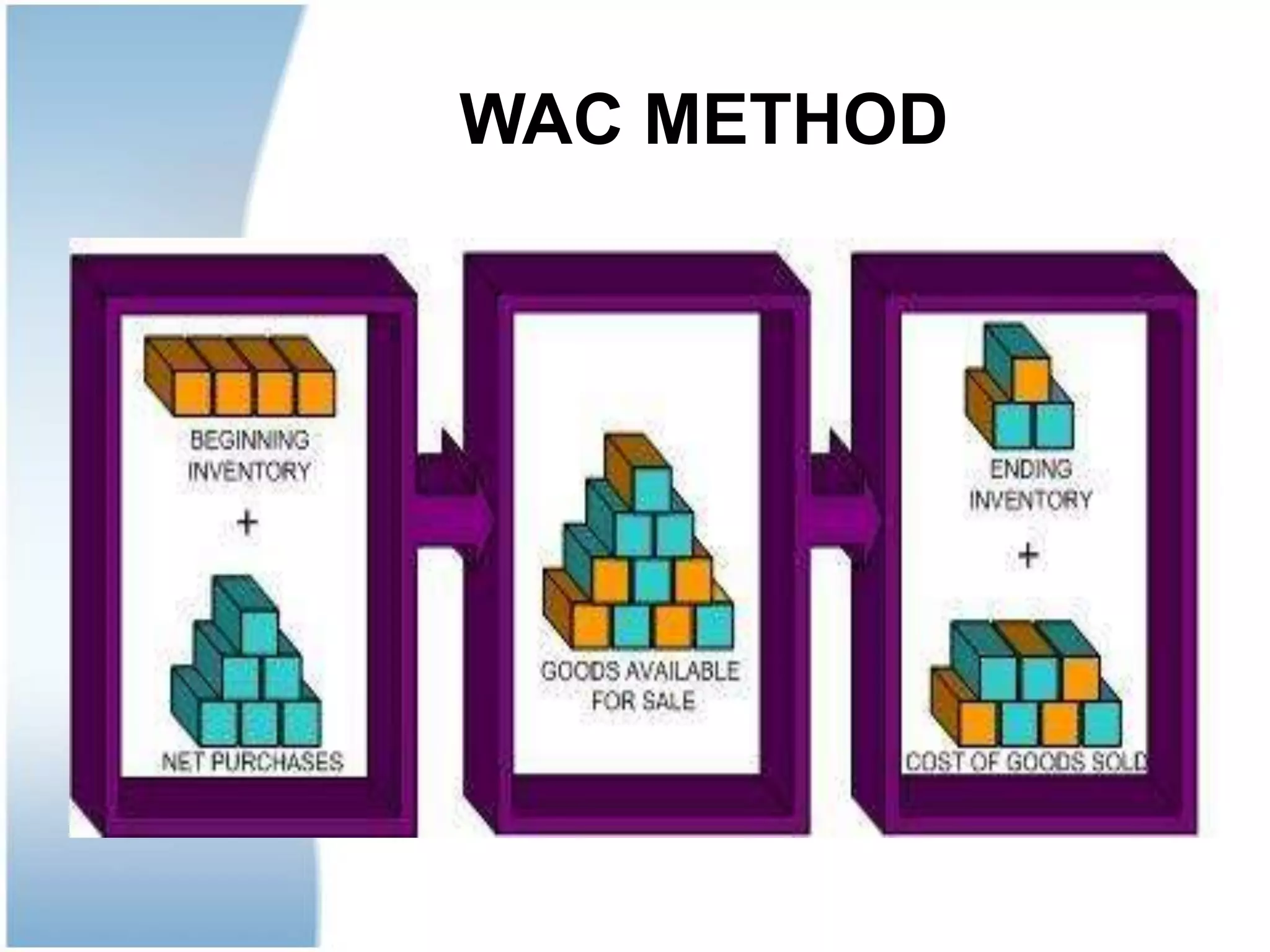
Weighted average Cost (WAC)This method assumes that the goods available for the sale are homogeneousThe average cost is computed by dividing the cost of goods available for sale by the number of the units available by saleThe major criticism of WAC is that it assigns no more importance to current prices than to past prices paid several months ago

As 2

  • 1.
    Accounting Standards –2 Valuation Of Inventories
  • 2.
    Objective of AccountingStandardsThe basic objective of accounting standards is to remove variations in the treatment of several accounting aspects and to bring about standardization in presentationThe ACCOUNTING STANDARDS BOARD (ASB) which functions under ICAI issues accounting standards
  • 3.
    OBJECTIVE valuationof inventoriesFormulate the method of computation of cost of inventories/stock. Determining the value of closing stock at which it is to be shown in balance sheet till it is not sold and recognized as revenue.
  • 4.
    ApplicationsThis Standard shouldbe applied in accounting for inventories other than:work in progress arising under construction contracts, including directly related service contracts (see Accounting Standard (AS) 7, Construction Contracts);work in progress arising in the ordinary course of business of service providers;shares, debentures and other financial instruments held as sk in trade; and(d)producers' inventories of livestock, agricultural and forest products, and mineral oils, ores and gases to the extent that they are measured at net realisable value in accordance with well established practices in those industries.
  • 5.
    DEFINITION Inventories are assets:Held for the sale in the ordinary course of business (Finished Goods).In the process of production of such sale (Raw material and working progress).In the form of materials and supplies to be consumed in the production process or in the rendering of services (Stores, Spares, Raw material).Inventories do not include machinery.
  • 6.
    Measure Of Inventories Inventoriesshould be valued at the lower of cost and net resale value MAJOR POINTS FOR VALUATION OF INVENTORIESDetermination of cost of InventoriesDetermination of net realizable value of inventoriesComparison between the cost and net realizable value
  • 7.
    Determination of Costof InventoriesCost of Inventories Includes:Cost of Purchase Cost of Conversion Other Costs (incurred in bringing the inventories to their present location and condition)
  • 8.
    Cost Of Purchase Cost of Purchase Price includes :Duty and Purchase Price
  • 9.
  • 10.
  • 11.
    Other Expenditure directlyattributable to the acquisition. Less :Duties and taxes recoverable by enterprises from taxing authorities
  • 12.
  • 13.
  • 14.
    Rebate Cost OfConversionIt Consists of the cost directly related to the units(Direct Labor, Direct Material, Direct Expenses)Add:Systematic allocation of fixed and variable production overheads that are incurred in converting material into finished goods.Other Costs Cost incurred in bringing the inventories to their present location and conditionExcise duty contributes directly to bringing the inventories to its present location and conditionExcise duties is direct costs, which should be included in the valuation of inventories
  • 15.
    Determination of netrealizable value of Inventories.Net realizable value means estimated selling price in ordinary course of business less estimated costs of completion and estimated costs necessary to make the sale If the finished product is sold at cost or above cost, then the estimated realizable value of raw material and supplies is considered more than its costIf the finished product is sold below cost, then the estimated realizable value of raw material or supplies is equal to replacement price of raw material or supplies
  • 16.
    Comparison between thecost and net realizable valueThe comparison between the cost and net realizable value should be made by grouping the items.
  • 17.
    Methods of computingInventoriesFirst-in, First-out (FIFO)Last-in, First-out (LIFO)Weighted-average cost (WAC)
  • 18.
    First-in, First-out (FIFO)Thismethod assumes that the first unit acquired are the first unit sold The costs of ending inventories is that of the most recent purchasesA major criticism of FIFO: Improper matching of cost with revenues since the cost of goods sold is computed on the bases of old price that are possibly unrealistic
  • 19.
  • 20.
    Last-in, First-out(LIFO)This methodassumes that the last unit acquired are the first unit soldThe cost of the units in the ending inventory is that of the earliest purchases The chief advantage of LIFO is that balance sheet value of inventories may be outdated and unrealistic
  • 21.
    LIFO METHOD
  • 22.
    Weighted average Cost(WAC)This method assumes that the goods available for the sale are homogeneousThe average cost is computed by dividing the cost of goods available for sale by the number of the units available by saleThe major criticism of WAC is that it assigns no more importance to current prices than to past prices paid several months ago
  • 23.
  • 24.
    Disclosure in financialstatementsAccounting policy adopted in measuring inventoriesCost formula usedClassification of inventories like Finished Goods, WIP, Raw Materials, Spare Parts.
  • 25.
    Presented By…GROUP NO:2Wesley VargheseAkhil JohnVinayak ShenoyMukul PooniaAbhishek VyasSandeep Kumar .N.RSukeshPoojariSuprit Nayak
  • 26.