Block 1
Increasing/Decreasing
Functions
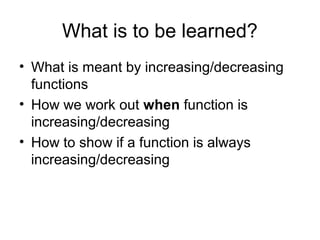
What is to be learned?
• What is meant by increasing/decreasing
functions
• How we work out when function is
increasing/decreasing
• How to show if a function is always
increasing/decreasing
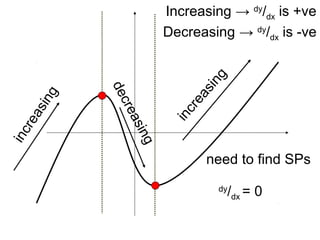
increasing
increasing
decreasing
need to find SPs
dy
/dx = 0
Increasing → dy
/dx is +ve
Decreasing → dy
/dx is -ve
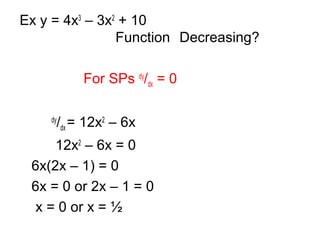
Ex y = 4x3
– 3x2
+ 10
Function Decreasing?
For SPs dy
/dx = 0
dy
/dx = 12x2
– 6x
12x2
– 6x = 0
6x(2x – 1) = 0
6x = 0 or 2x – 1 = 0
x = 0 or x = ½
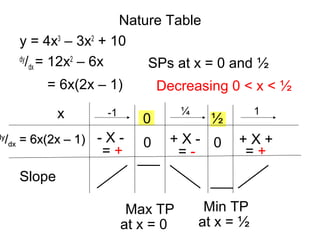
Nature Table
y = 4x3
– 3x2
+ 10
dy
/dx = 12x2
– 6x
= 6x(2x – 1)
SPs at x = 0 and ½
x 0
dydy
//dxdx = 6x(2x – 1)= 6x(2x – 1) 0
-1 ¼
= + = -
Slope
Max TP
at x = 0
½
1
= +
0
Min TP
at x = ½
- X - + X - + X +
Decreasing 0 < x < ½
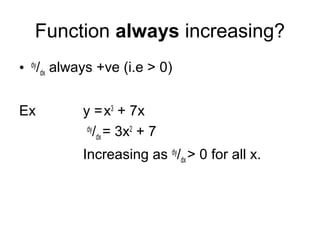
Function always increasing?
• dy
/dx always +ve (i.e > 0)
Ex y =x3
+ 7x
dy
/dx = 3x2
+ 7
Increasing as dy
/dx > 0 for all x.
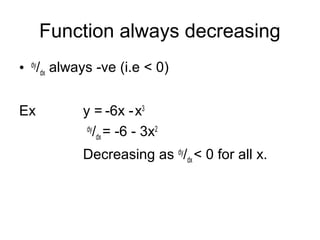
Function always decreasing
• dy
/dx always -ve (i.e < 0)
Ex y = -6x -x3
dy
/dx = -6 - 3x2
Decreasing as dy
/dx < 0 for all x.
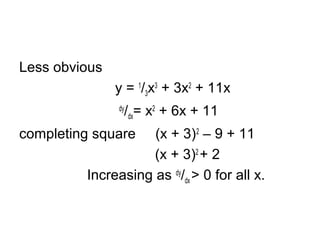
Less obvious
y = 1
/3x3
+ 3x2
+ 11x
dy
/dx= x2
+ 6x + 11
completing square (x + 3)2
– 9 + 11
(x + 3)2
+ 2
Increasing as dy
/dx > 0 for all x.
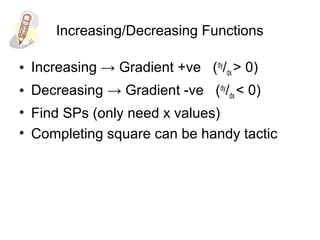
Increasing/Decreasing Functions
• Increasing → Gradient +ve (dy
/dx > 0)
• Decreasing → Gradient -ve (dy
/dx < 0)
• Find SPs (only need x values)
• Completing square can be handy tactic
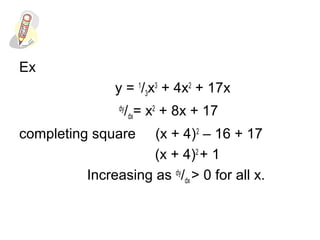
Ex
y = 1
/3x3
+ 4x2
+ 17x
dy
/dx= x2
+ 8x + 17
completing square (x + 4)2
– 16 + 17
(x + 4)2
+ 1
Increasing as dy
/dx > 0 for all x.

Increasing decreasing functions

  • 1.
  • 2.
    What is tobe learned? • What is meant by increasing/decreasing functions • How we work out when function is increasing/decreasing • How to show if a function is always increasing/decreasing
  • 3.
    increasing increasing decreasing need to findSPs dy /dx = 0 Increasing → dy /dx is +ve Decreasing → dy /dx is -ve
  • 4.
    Ex y =4x3 – 3x2 + 10 Function Decreasing? For SPs dy /dx = 0 dy /dx = 12x2 – 6x 12x2 – 6x = 0 6x(2x – 1) = 0 6x = 0 or 2x – 1 = 0 x = 0 or x = ½
  • 5.
    Nature Table y =4x3 – 3x2 + 10 dy /dx = 12x2 – 6x = 6x(2x – 1) SPs at x = 0 and ½ x 0 dydy //dxdx = 6x(2x – 1)= 6x(2x – 1) 0 -1 ¼ = + = - Slope Max TP at x = 0 ½ 1 = + 0 Min TP at x = ½ - X - + X - + X + Decreasing 0 < x < ½
  • 6.
    Function always increasing? •dy /dx always +ve (i.e > 0) Ex y =x3 + 7x dy /dx = 3x2 + 7 Increasing as dy /dx > 0 for all x.
  • 7.
    Function always decreasing •dy /dx always -ve (i.e < 0) Ex y = -6x -x3 dy /dx = -6 - 3x2 Decreasing as dy /dx < 0 for all x.
  • 8.
    Less obvious y =1 /3x3 + 3x2 + 11x dy /dx= x2 + 6x + 11 completing square (x + 3)2 – 9 + 11 (x + 3)2 + 2 Increasing as dy /dx > 0 for all x.
  • 9.
    Increasing/Decreasing Functions • Increasing→ Gradient +ve (dy /dx > 0) • Decreasing → Gradient -ve (dy /dx < 0) • Find SPs (only need x values) • Completing square can be handy tactic
  • 10.
    Ex y = 1 /3x3 +4x2 + 17x dy /dx= x2 + 8x + 17 completing square (x + 4)2 – 16 + 17 (x + 4)2 + 1 Increasing as dy /dx > 0 for all x.