By
Always Late
“Remember that time is money”
Ben Franklin, 1748
By the End of the Session
You will be able to
• Clarify your goals and achieve them
• Handle people and projects that waste your time
• Be involved in better delegation
• Work more efficiently with your Boss/Advisor
• Learn specific skills and tools to save your time
• Overcome stress and Procrastination
5
Time Management
• Time management is the act of taking conscious control over the amount
of time spent on specific activities.
• You exercise time management to increase productivity, effectiveness and
efficiency.
• You practice skills and use tools and techniques to aid you when
accomplishing tasks, projects or are working toward goals and deadlines.
Why Do We Need TM?
• To save time.
• To reduce stress.
• To increase our work output.
• To have more control over our job responsibilities.
• Bad time management = stress
How To Use Time Effectively
• Effective planning.
• Setting goals and objectives.
• Setting deadlines.
• Delegation of responsibilities.
• Prioritizing activities as per their importance.
• Spending the right time on the right activity.
Poor time management
1. Constant rushing (e.g. between meetings or tasks)
2. Frequent delays (e.g. in attending meetings, meeting deadlines)
3. Low productivity, energy and motivation (e.g. ‘I can’t seem to get worked
up about anything’)
4. Frustration (e.g. ‘Oh, things just don’t move ahead)
5. Impatience (e.g. ‘where the hell is that information I’ve asked him for?’)
6. Chronic vacillation between alternatives (e.g. ‘whichever option I choose it
is going to put me at a big disadvantage. I don’t know which way to jump’)
7. Difficulty setting and achieving goals (e.g. ‘I’m not sure what is expected of
me’)
There is a time for everything
• A time to be born and a time to die, a time to plant and a time to uproot
• A time to love and a time to hate, a time for war and a time for peace
• A time to weep and a time to laugh, a time to mourn and a time to dance
• A time to tear and a time to mend, a time to be silent and a time to speak
• A time to kill and a time to heal, a time to tear down and a time to build
• A time to search and a time to give up, a time to keep and a time to throw
away
12
The Problem is Severe
By some estimates, people waste about 2 hours per day. Signs of time wasting:
• Messy desk and cluttered (or no) files
• Can’t find things
• Miss appointments, need to reschedule them late and/or unprepared for meetings
• Volunteer to do things other people should do
• Tired/unable to concentrate
Hear me Now, Believe me Later
“Being successful doesn’t make you manage
your time well.
Managing your time well makes you successful.”
13
Goals, Priorities, and Planning
• Why am I doing this?
• What is the goal?
• Why will I succeed?
• What happens if I chose not to do it?
14
15
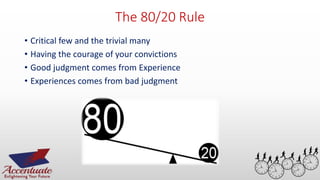
The 80/20 Rule
• Critical few and the trivial many
• Having the courage of your convictions
• Good judgment comes from Experience
• Experiences comes from bad judgment
16
Inspiration
“If you can dream it, you can do it”
Walt Disney
• Disneyland was built in 366 days, from ground-breaking to first day open to
the public.
17
TO DO Lists
• Break things down into small steps
• Like a child cleaning his/her room
• Do the ugliest thing first
Four Quadrants of To-Do List
19
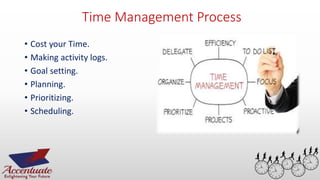
Time Management Process
• Cost your Time.
• Making activity logs.
• Goal setting.
• Planning.
• Prioritizing.
• Scheduling.
1. Costing your Time
• Understand the true value by calculating your cost per year
• Cost per year=(salary + taxes +office space + office equipment + profit you
generate)
2. Making Activity Logs
• Make a realistic estimate of time spend during day on job orders.
• Pinpoint the critical areas.
• Finding the high yielding time of our day.
3. Goal Setting
• Setting lifetime goals help to chart your life course and your career
path.
• Breakup your lifetime goal in smaller goals.
• Make a daily To-Do list.
• Revise and update your list on daily bases and judge your
performance.
4. Planning
• Draw an action plan –A list of things that need to be done to achieve
your goals
4. Planning (Contd…)
• Failing to plan is planning to fail
• Plan Each Day, Each Week, Each Semester
• You can always change your plan, but only once you have one!
26
5. Prioritizing
• Make a To-Do List.
• Consider the value of the task before to do it-
Is it worth spending your time and company resources.
• Prioritize your task- The most important jobs should be completed first
followed by other jobs.
6. Scheduling
• Make a realistic estimate of how much you can do.
• Plan to make the best use of the available time.
• Reserve some contingency time to deal with ‘unexpected jobs’.
• Minimize stress by avoiding commitment by yourself and others.
Time Management Matrix
How To Manage Time
1. Prepare yourself first, by taking 30 minutes of your time to fix yourself
something to eat and relax.
Assign realistic priorities to each task.
How To Manage Time
2. Balance your effort.
Work on small portions every day of work that will be due by
the end of the week, starting with the most important tasks first.
How To Manage Time
3. Focus on your most productive time of day.
Some people work better in the morning, and some are more
focused in the evening.
How To Manage Time
4. Manage time in increments.
Play a game with yourself by competing against the clock. Work
in fifteen minute, half hour or hour intervals followed by a 10 minutes
How To Manage Time
5. Take a break. Clear your mind
and refresh yourself to refocus. Decide beforehand on a 5, 10 or 15
minute break and stick to that decision
How To Manage Time
6. Keep track of your progress. Cross things off the list as they are
completed.
How To Manage Time
7. Reassess the list.
Rewrite and prioritize your list on a regular basis.
How To Manage Time
8. Leave time for fun.
While there are times when we just need to power through a
large project, it's important to give yourself time to let loose
How To Manage Time
9. Sleep for 7-9 hours every night. Getting the proper amount of sleep
will help keep you alert and energetic, able to think clearly, and function
at a high level
Achieve your goals
• Be your own judge and your own motivator
• Make Time Management Your Tool For Success.
41
42
43
Fred Brooks’ Time Clocks
44
45
Using Time Journal Data
• What am I doing that doesn’t really need to be done?
• What am I doing that could be done by someone else?
• What am I doing that could be done more efficiently?
• What do I do that wastes others’ time?
46
47
Procrastination
“Procrastination is the
thief of time”
Edward Young
Night Thoughts, 1742
48
Avoiding Procrastination
• Doing things at the last minute is much more expensive than just
before the last minute
• Deadlines are really important: establish them yourself!
49
Balancing Act
“Work expands so as to fill the time available for
its completion”
Parkinson’s Law
Cyril Parkinson, 1957
50
Comfort Zones
• Identify why you aren’t enthusiastic
• Fear of embarrassment
• Fear of failure?
• Get a spine!
Quit Making Excuses…
51
Delegation
• No one is an island
• You can accomplish a lot more with help
• Most delegation in your life is from faculty to graduate student
52
53
Delegation is not dumping
• Grant authority with responsibility.
• Concrete goal, deadline, and consequences.
• Treat your people well
• Grad students and secretaries are a faculty member’s lifeline; they
should be treated well!
54
Challenge People
• People rise to the challenge: You should delegate “until they complain”
• Communication Must Be Clear: “Get it in writing” – Judge Wapner
• Give objectives, not procedures
• Tell the relative importance of this task
55
Sociology
• Beware upward delegation!
• Reinforce behavior you want repeated
• Ignorance is your friend – I do not know how to run the photocopier
or the fax machine
56
Meetings
• Average executive: > 40% of time
• Lock the door, unplug the phone
• Maximum of 1 hour
• Prepare: there must be an agenda
• 1 minute minutes: an efficient way to keep track of decisions made in a
meeting: who is responsible for what by when?
57
Technology
• “Computers are faster but they take longer”
--Janitor, UCF
• Secretaries are better than answering machines; where are the costs
& benefits of a technology?
Technology
• Laptop computer (and docking station)
• You can scavenge time & work anywhere
• At CMU, you still have internet access
• one machine in your life is the right number
• WWW; only do things once (post them)
• Google (now with image search!)
• ACM Digital Library (I haven’t been in the library in over five years)
58
Care and Feeding of Advisors
Time Management Advice
• Get a day timer or PDA
• Write things down
• When’s our next meeting?
• What’s my goal to have done by then?
• Who to turn to for help?
• Remember: advisors want results !
59
60
The Seven Habits
1. Be proactive
2. Begin with the end in mind
3. Put first things first.
4. Think win/win.
5. Seek first to be understanding, then to be understood.
6. Synergize.
7. Sharpen the saw.
Self Analysis of Time Management
1. Initially focus on activities by giving them the time and attention that their
importance and urgency requires. Like crisis, Meeting preparation, Deadline
driven projects, etc.
2. Secondary make a decision about activities if they are important but not urgent.
You may be able to spend less time on them or postpone them temporarily. But
you don’t want to forget about them. Like preparation, planning, relationship
building, true recreation, empowerment etc…
3. Third, you may decide to eliminate them because, even though they are coming
up very soon, they aren't really that important. Like some meetings,
interruptions, some phone calls etc.
4. Finally if you really are short on time, you will probably want to eliminate
activities. Like excessive TV, chatting, video games etc…
“Time is the ultimate democracy.
Rich and poor,
young and old,
male and female:
all have 24 hours in a day
7 days in a week.”
Hence let us now accentuate on effective
time management
• Realize that time management is a myth
• Find out where you are wasting time
• Create time management goals
• Implement a time management plan
• Use time management tools
• Prioritize ruthlessly
• Learn to delegate and/or outsource
• Establish routines and stick to them as much as possible
• Get in the habit of setting time limits for tasks
• Be sure your systems are organized
• Don't waste time waiting
3 D’s of Time Management
• Delete
• Defer
• Deal
Situation become odd…if you don’t manage
time…!!!
Manage your time & keep smiling…

Time management

  • 1.
  • 2.
  • 3.
    “Remember that timeis money” Ben Franklin, 1748
  • 5.
    By the Endof the Session You will be able to • Clarify your goals and achieve them • Handle people and projects that waste your time • Be involved in better delegation • Work more efficiently with your Boss/Advisor • Learn specific skills and tools to save your time • Overcome stress and Procrastination 5
  • 6.
    Time Management • Timemanagement is the act of taking conscious control over the amount of time spent on specific activities. • You exercise time management to increase productivity, effectiveness and efficiency. • You practice skills and use tools and techniques to aid you when accomplishing tasks, projects or are working toward goals and deadlines.
  • 7.
    Why Do WeNeed TM? • To save time. • To reduce stress. • To increase our work output. • To have more control over our job responsibilities. • Bad time management = stress
  • 8.
    How To UseTime Effectively • Effective planning. • Setting goals and objectives. • Setting deadlines. • Delegation of responsibilities. • Prioritizing activities as per their importance. • Spending the right time on the right activity.
  • 9.
    Poor time management 1.Constant rushing (e.g. between meetings or tasks) 2. Frequent delays (e.g. in attending meetings, meeting deadlines) 3. Low productivity, energy and motivation (e.g. ‘I can’t seem to get worked up about anything’) 4. Frustration (e.g. ‘Oh, things just don’t move ahead) 5. Impatience (e.g. ‘where the hell is that information I’ve asked him for?’) 6. Chronic vacillation between alternatives (e.g. ‘whichever option I choose it is going to put me at a big disadvantage. I don’t know which way to jump’) 7. Difficulty setting and achieving goals (e.g. ‘I’m not sure what is expected of me’)
  • 10.
    There is atime for everything • A time to be born and a time to die, a time to plant and a time to uproot • A time to love and a time to hate, a time for war and a time for peace • A time to weep and a time to laugh, a time to mourn and a time to dance • A time to tear and a time to mend, a time to be silent and a time to speak • A time to kill and a time to heal, a time to tear down and a time to build • A time to search and a time to give up, a time to keep and a time to throw away
  • 12.
    12 The Problem isSevere By some estimates, people waste about 2 hours per day. Signs of time wasting: • Messy desk and cluttered (or no) files • Can’t find things • Miss appointments, need to reschedule them late and/or unprepared for meetings • Volunteer to do things other people should do • Tired/unable to concentrate
  • 13.
    Hear me Now,Believe me Later “Being successful doesn’t make you manage your time well. Managing your time well makes you successful.” 13
  • 14.
    Goals, Priorities, andPlanning • Why am I doing this? • What is the goal? • Why will I succeed? • What happens if I chose not to do it? 14
  • 15.
    15 The 80/20 Rule •Critical few and the trivial many • Having the courage of your convictions • Good judgment comes from Experience • Experiences comes from bad judgment
  • 16.
    16 Inspiration “If you candream it, you can do it” Walt Disney • Disneyland was built in 366 days, from ground-breaking to first day open to the public.
  • 17.
    17 TO DO Lists •Break things down into small steps • Like a child cleaning his/her room • Do the ugliest thing first
  • 18.
  • 19.
  • 21.
    Time Management Process •Cost your Time. • Making activity logs. • Goal setting. • Planning. • Prioritizing. • Scheduling.
  • 22.
    1. Costing yourTime • Understand the true value by calculating your cost per year • Cost per year=(salary + taxes +office space + office equipment + profit you generate)
  • 23.
    2. Making ActivityLogs • Make a realistic estimate of time spend during day on job orders. • Pinpoint the critical areas. • Finding the high yielding time of our day.
  • 24.
    3. Goal Setting •Setting lifetime goals help to chart your life course and your career path. • Breakup your lifetime goal in smaller goals. • Make a daily To-Do list. • Revise and update your list on daily bases and judge your performance.
  • 25.
    4. Planning • Drawan action plan –A list of things that need to be done to achieve your goals
  • 26.
    4. Planning (Contd…) •Failing to plan is planning to fail • Plan Each Day, Each Week, Each Semester • You can always change your plan, but only once you have one! 26
  • 27.
    5. Prioritizing • Makea To-Do List. • Consider the value of the task before to do it- Is it worth spending your time and company resources. • Prioritize your task- The most important jobs should be completed first followed by other jobs.
  • 28.
    6. Scheduling • Makea realistic estimate of how much you can do. • Plan to make the best use of the available time. • Reserve some contingency time to deal with ‘unexpected jobs’. • Minimize stress by avoiding commitment by yourself and others.
  • 29.
  • 30.
    How To ManageTime 1. Prepare yourself first, by taking 30 minutes of your time to fix yourself something to eat and relax. Assign realistic priorities to each task.
  • 31.
    How To ManageTime 2. Balance your effort. Work on small portions every day of work that will be due by the end of the week, starting with the most important tasks first.
  • 32.
    How To ManageTime 3. Focus on your most productive time of day. Some people work better in the morning, and some are more focused in the evening.
  • 33.
    How To ManageTime 4. Manage time in increments. Play a game with yourself by competing against the clock. Work in fifteen minute, half hour or hour intervals followed by a 10 minutes
  • 34.
    How To ManageTime 5. Take a break. Clear your mind and refresh yourself to refocus. Decide beforehand on a 5, 10 or 15 minute break and stick to that decision
  • 35.
    How To ManageTime 6. Keep track of your progress. Cross things off the list as they are completed.
  • 36.
    How To ManageTime 7. Reassess the list. Rewrite and prioritize your list on a regular basis.
  • 37.
    How To ManageTime 8. Leave time for fun. While there are times when we just need to power through a large project, it's important to give yourself time to let loose
  • 38.
    How To ManageTime 9. Sleep for 7-9 hours every night. Getting the proper amount of sleep will help keep you alert and energetic, able to think clearly, and function at a high level
  • 39.
    Achieve your goals •Be your own judge and your own motivator • Make Time Management Your Tool For Success.
  • 41.
  • 42.
  • 43.
  • 44.
  • 45.
  • 46.
    Using Time JournalData • What am I doing that doesn’t really need to be done? • What am I doing that could be done by someone else? • What am I doing that could be done more efficiently? • What do I do that wastes others’ time? 46
  • 47.
    47 Procrastination “Procrastination is the thiefof time” Edward Young Night Thoughts, 1742
  • 48.
    48 Avoiding Procrastination • Doingthings at the last minute is much more expensive than just before the last minute • Deadlines are really important: establish them yourself!
  • 49.
    49 Balancing Act “Work expandsso as to fill the time available for its completion” Parkinson’s Law Cyril Parkinson, 1957
  • 50.
    50 Comfort Zones • Identifywhy you aren’t enthusiastic • Fear of embarrassment • Fear of failure? • Get a spine!
  • 51.
  • 52.
    Delegation • No oneis an island • You can accomplish a lot more with help • Most delegation in your life is from faculty to graduate student 52
  • 53.
    53 Delegation is notdumping • Grant authority with responsibility. • Concrete goal, deadline, and consequences. • Treat your people well • Grad students and secretaries are a faculty member’s lifeline; they should be treated well!
  • 54.
    54 Challenge People • Peoplerise to the challenge: You should delegate “until they complain” • Communication Must Be Clear: “Get it in writing” – Judge Wapner • Give objectives, not procedures • Tell the relative importance of this task
  • 55.
    55 Sociology • Beware upwarddelegation! • Reinforce behavior you want repeated • Ignorance is your friend – I do not know how to run the photocopier or the fax machine
  • 56.
    56 Meetings • Average executive:> 40% of time • Lock the door, unplug the phone • Maximum of 1 hour • Prepare: there must be an agenda • 1 minute minutes: an efficient way to keep track of decisions made in a meeting: who is responsible for what by when?
  • 57.
    57 Technology • “Computers arefaster but they take longer” --Janitor, UCF • Secretaries are better than answering machines; where are the costs & benefits of a technology?
  • 58.
    Technology • Laptop computer(and docking station) • You can scavenge time & work anywhere • At CMU, you still have internet access • one machine in your life is the right number • WWW; only do things once (post them) • Google (now with image search!) • ACM Digital Library (I haven’t been in the library in over five years) 58
  • 59.
    Care and Feedingof Advisors Time Management Advice • Get a day timer or PDA • Write things down • When’s our next meeting? • What’s my goal to have done by then? • Who to turn to for help? • Remember: advisors want results ! 59
  • 60.
    60 The Seven Habits 1.Be proactive 2. Begin with the end in mind 3. Put first things first. 4. Think win/win. 5. Seek first to be understanding, then to be understood. 6. Synergize. 7. Sharpen the saw.
  • 62.
    Self Analysis ofTime Management 1. Initially focus on activities by giving them the time and attention that their importance and urgency requires. Like crisis, Meeting preparation, Deadline driven projects, etc. 2. Secondary make a decision about activities if they are important but not urgent. You may be able to spend less time on them or postpone them temporarily. But you don’t want to forget about them. Like preparation, planning, relationship building, true recreation, empowerment etc… 3. Third, you may decide to eliminate them because, even though they are coming up very soon, they aren't really that important. Like some meetings, interruptions, some phone calls etc. 4. Finally if you really are short on time, you will probably want to eliminate activities. Like excessive TV, chatting, video games etc…
  • 63.
    “Time is theultimate democracy. Rich and poor, young and old, male and female: all have 24 hours in a day 7 days in a week.”
  • 64.
    Hence let usnow accentuate on effective time management • Realize that time management is a myth • Find out where you are wasting time • Create time management goals • Implement a time management plan • Use time management tools • Prioritize ruthlessly • Learn to delegate and/or outsource • Establish routines and stick to them as much as possible • Get in the habit of setting time limits for tasks • Be sure your systems are organized • Don't waste time waiting
  • 65.
    3 D’s ofTime Management • Delete • Defer • Deal
  • 67.
    Situation become odd…ifyou don’t manage time…!!!
  • 69.
    Manage your time& keep smiling…