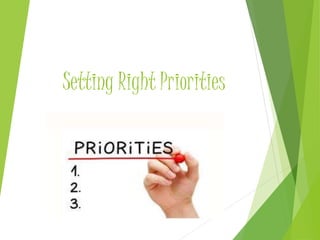
Setting Right Priorities
The Purpose of Setting Priorities
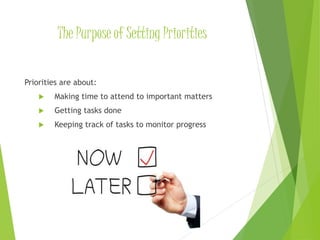
Priorities are about:
 Making time to attend to important matters
 Getting tasks done
 Keeping track of tasks to monitor progress
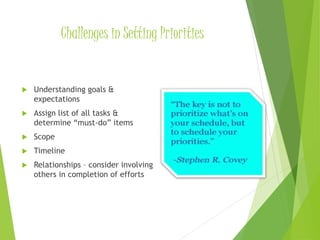
Challenges in Setting Priorities
 Understanding goals &
expectations
 Assign list of all tasks &
determine “must-do” items
 Scope
 Timeline
 Relationships – consider involving
others in completion of efforts
Defining Goals
“Begin with the end in mind” – Stephen Covey
 Determine the desired end result
 Set short-term objectives for achieving goals
 Adjust objectives as conditions change
Prioritizing
 Rank tasks in order of importance
 Build in-time for the unexpected
 Leave time for thinking and planning
 Remain flexible
 Realize you won’t finish everything
Prime Time
 When do you have the
most energy?
 When are there fewest
interruptions?
 When can you
schedule private time?
Procrastination
 Break a large job down
into smaller parts
 Do the easy parts first
 Time yourself
 Punish yourself
 Reward yourself
Tips for Productive Meetings
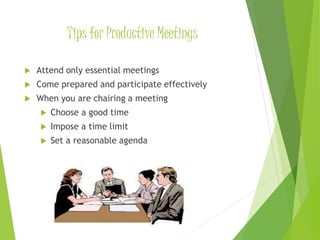
 Attend only essential meetings
 Come prepared and participate effectively
 When you are chairing a meeting
 Choose a good time
 Impose a time limit
 Set a reasonable agenda
The Art of Priority Management
 Get to meetings early so you
can compose yourself before
others arrive.
 Practice doing just one thing
at a time, giving it your full
attention.
 Pause after you finish one task
before beginning another.
 Say “No” and mean it:
 When the timings just not
right
 When you have other
priorities
 When someone suggests
something you’d like to
consider
In Closing
 Time is one of your most
valuable assets
 Planning and organization
are the key to priority
management
 Eliminating time thieves
allows you to accomplish
essential tasks
 Control your schedule
instead of being controlled
by it
Being Productive With Prioritization

Being Productive With Prioritization

  • 1.
  • 2.
    The Purpose ofSetting Priorities Priorities are about:  Making time to attend to important matters  Getting tasks done  Keeping track of tasks to monitor progress
  • 3.
    Challenges in SettingPriorities  Understanding goals & expectations  Assign list of all tasks & determine “must-do” items  Scope  Timeline  Relationships – consider involving others in completion of efforts
  • 4.
    Defining Goals “Begin withthe end in mind” – Stephen Covey  Determine the desired end result  Set short-term objectives for achieving goals  Adjust objectives as conditions change
  • 5.
    Prioritizing  Rank tasksin order of importance  Build in-time for the unexpected  Leave time for thinking and planning  Remain flexible  Realize you won’t finish everything
  • 6.
    Prime Time  Whendo you have the most energy?  When are there fewest interruptions?  When can you schedule private time?
  • 7.
    Procrastination  Break alarge job down into smaller parts  Do the easy parts first  Time yourself  Punish yourself  Reward yourself
  • 8.
    Tips for ProductiveMeetings  Attend only essential meetings  Come prepared and participate effectively  When you are chairing a meeting  Choose a good time  Impose a time limit  Set a reasonable agenda
  • 9.
    The Art ofPriority Management  Get to meetings early so you can compose yourself before others arrive.  Practice doing just one thing at a time, giving it your full attention.  Pause after you finish one task before beginning another.  Say “No” and mean it:  When the timings just not right  When you have other priorities  When someone suggests something you’d like to consider
  • 10.
    In Closing  Timeis one of your most valuable assets  Planning and organization are the key to priority management  Eliminating time thieves allows you to accomplish essential tasks  Control your schedule instead of being controlled by it