Presented by Dr. B. Victor Water Pollution
About the presenter Dr.B.Victor is a highly experienced postgraduate biology teacher, recently retired from the reputed educational institution St. Xavier’ s College, Palayamkottai, India-627001. He was  the dean of sciences and assistant controller of examinations. He has more than 32 years of teaching and research experience He has  taught a diversity of courses ranging from pre-  university to post graduate classes. Send your comments to : bonfiliusvictor@gmail.com
Water is essential to life on earth.
Importance of water Organisms are composed of much water––70%-95% Supportive external environment for aquatic organisms Cellular medium within which biochemical reactions can occur Transport medium for food, oxygen, and other things needed by cells Means of support- Turgid plant cells /Hydrostatic animal support systems
Three forms of Water. Solids:  When water becomes very cold and freezes it will change from a liquid to a solid.  It has a definite form and shape. Liquids:   When water takes the shape  of its container it is in a liquid form. Gases:  When water is seen in a vapor form and has no definite size or shape it is in a gas form.
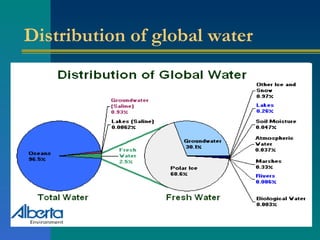
Distribution of global water
The earth's water supply 97.2% of the Earth's water supply is salt water. Only 2.8% is fresh water!
Salt and freshwater relationship
World Water Supply 97.200% salt water in the oceans 02.014% ice caps and glaciers 00.600% groundwater 00.009% surface water 00.005% soil moisture 00.001% atmospheric moisture
Earth as water planet Earth is often referred to as  `the water planet'.  Earth is unique amongst planets of our solar system because of its abundant water -  in oceans, in the atmosphere, in glaciers and as fresh water on land.   Without water, life could not exist.
The  earth's  freshwater supply Only about  3%  of Earth's water is fresh. Two percent  of the Earth's water (about 66% of all fresh water) is in solid form, found in ice caps and glaciers. One percent   of all the Earth's water in a form useable to humans and land animals.  This fresh water is found in lakes, rivers, streams, ponds, and in the ground. (A small amount of water is found as vapor in the atmosphere.) 
Distribution of water Ocean Water :  The vast majority of water on the planet is the salt water in the oceans and seas. Fresh Surface Water :  This is the fresh water in rivers, streams, lakes, ponds and similar bodies of water.  Groundwater :  The majority of the planet's liquid freshwater is stored in underground aquifers. Water that enters an aquifer remains there for an average of 1,400 years!
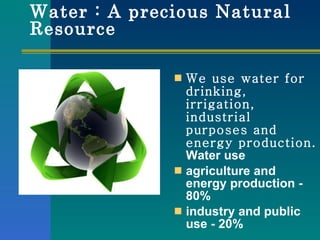
Water : A precious Natural Resource We use water for drinking, irrigation, industrial purposes and energy production.  Water use agriculture and energy production - 80% industry and public use - 20%
Water is used in many ways as a nourisher of plant and animal life,  a bearer of food,  a prime element of industrial processes, and a medium for transportation
Significance of water Water is an integral part of life on this planet.  It is an odorless, tasteless, substance that covers more than three-fourths of the Earth's surface. Most of the water on Earth, 97% to be exact, is salt water found in the oceans.  We can not drink salt water or use it for crops because of the salt content. We can remove salt from ocean water, but the process is very expensive.
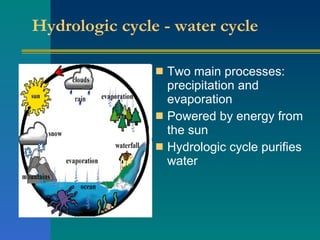
Hydrologic cycle - water cycle   Two main processes: precipitation and evaporation Powered by energy from the sun  Hydrologic cycle purifies water
Global hydrologic cycle
Water Cycle  Saltwater evaporates from sun's energy producing fresh water in clouds; leaves salts in ocean.  Water vapor cools and condenses to precipitation over oceans and land.  Runoff forms fresh water lakes, streams, ponds, groundwater, and is held in plants and transpired.
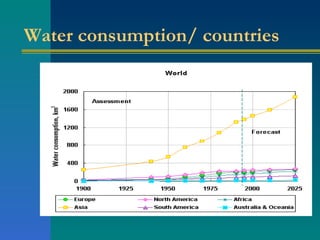
Water consumption/ countries
Human activity disrupts local water cycles Irrigation Clear cutting of forests Watershed disturbance Loss of minerals through runoff Desertification
Water consumption/use
Daily use of water
Pollution of water
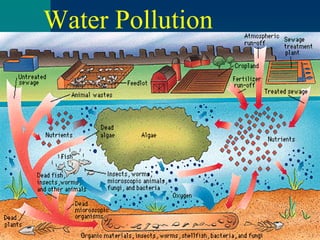
Water Pollution
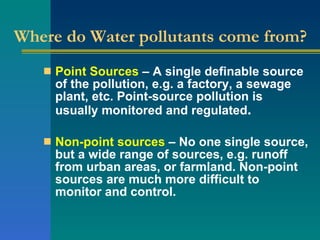
Where do Water pollutants come from? Point Sources  – A single definable source of the pollution, e.g. a factory, a sewage plant, etc. Point-source pollution is usually monitored and regulated .  Non-point sources  – No one single source, but a wide range of sources, e.g. runoff from urban areas, or farmland. Non-point sources are much more difficult to monitor and control.
Pollution  of  Water  1. Industrial pollution 2. Surface pollution 3. Groundwater contamination 4. Sewage pollution 5.Oil pollution 6.Thermal pollution
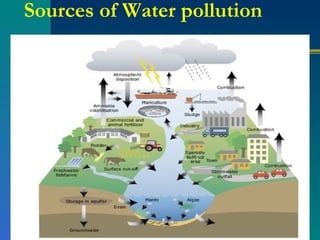
Sources of Water pollution
Water pollutants Industrial Effluents This waste water may contain acids, alkalis, salts, poisons, oils and in some cases harmful bacteria.  Mining and Agricultural Wastes Mines, especially gold and coal mines, are responsible for large quantities of acid water.  Agricultural pesticides, fertilizers and herbicides  may wash into rivers and stagnant water bodies.  Sewage Disposal and Domestic Wastes Sewage as well as domestic and farm wastes were often allowed to pollute rivers and dams.
Water pollution
Non-persistent (degradable )  Water pollutants  Domestic  sewage  Fertilizers  Some  industrial wastes
Non-persistent (degradable) water pollutants These compounds can be broken down by chemical reactions or by natural bacteria into simple, non-polluting substances such as carbon dioxide and nitrogen.  if the pollution load is high, this process can lead to low oxygen levels and eutrophication.  This damage is reversible.
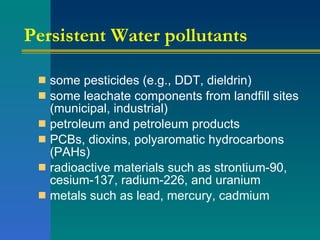
Persistent Water pollutants some pesticides (e.g., DDT, dieldrin)  some leachate components from landfill sites (municipal, industrial)  petroleum and petroleum products  PCBs, dioxins, polyaromatic hydrocarbons (PAHs)  radioactive materials such as strontium-90, cesium-137, radium-226, and uranium  metals such as lead, mercury, cadmium
Persistent Water pollutants This is the most rapidly growing type of pollution  This includes substances that degrade very slowly or cannot be broken down at all;  They  may remain in the aquatic environment for years or longer periods of time.  The damage they cause is either irreversible or repairable only over decades or centuries
Other  w ater quality pollutants warm water from cooling towers (thermal pollution)  floating debris  garbage  foam  These physical pollutants interfere mainly with the usability and/or aesthetic appeal of the water. In certain cases, thermal pollution can kill fish.
1 . Classes  of  Water pollutants   Pathogens     Bacteria, Viruses, Protozoa, Parasitic Worms, Colliform Bacteria Used As Indicators Of Water Quality  Oxygen Demanding Wastes     Organics That Are Decomposed By Bacteria And That Use A Lot Of O2, Dissolved Oxygen (DO) Decreases, And BOD Increases  Water Soluble   Inorganic Chemicals     Acids, Salts, Toxic Metal Compounds Like Mercury, And Lead. Inorganic Plant Nutrients     Water Soluble Phosphates, Nitrates => Algal Blooms, Decreased Dissolved O2, Increased BOD, Methemoglobinemia (="blue baby syndrome")
2. Classes  of  Water pollutants Organic Chemicals     Oil, Gas, Plastics, Pesticides, Cleaning Solvents, Detergents, Etc.   Sediment & Suspended Mater     Insoluble Soil Particulates & Other Solids.  Clouds The Water, Decreasing Photosynthesis, Carries Pesticides And Disrupts Aquatic Food Webs.   Radioactive Isotopes     Are Biologically Amplified To Higher Concentrations In The Food Chain.  Ionizing Radiation & Birth Defects, Cancer.   Warmed Water     From Power Plants, Decreases DO And Increases Susceptibility To Diseases And Parasites And Toxic Wastes.   Alien Species     Zebra Mussels, Asiatic Catfish, Sea Lamprey, etc.  Out compete Native Species And Ultimately Decrease Biodiversity
Industrial Water pollution   Industries discharge a variety of pollutants in their wastewater including heavy metals , resin pellets, organic toxins, oils, nutrients, and solids.
Over 1 billion people lack access to safe water supplies, while 2.6 billion people lack adequate sanitation. This has led to widespread microbial contamination of drinking water. Water-associated infectious diseases claim up to 3.2 million lives each year, approximately 6% of all deaths globally. Microbial  contamination   of water
Eutrophication  Increases in  nutrient loading may lead to eutrophication .  Organic wastes such as  sewage impose high  oxygen demands on the receiving water leading to oxygen depletion.
Drought D rought  causes more damage and suffering than any other natural disaster. 80 countries experience droughts lasting more than 1 year. According  to the UN, almost 500 million people, in 31 countries (~40% of the world’s population) experience chronic water shortages today.
Flooding: o versupply of  water Water Logged Soil Nutrient Leakage Topsoil Erosion
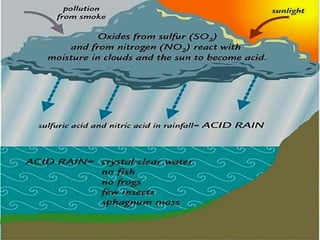
Acid rain Acid rain is formed when moisture in the clouds mixes with sulfur or nitrogen in the air.  Acid rain includes rain, sleet or snow with a pH level that falls below 5.6 (normal rainwater).  The sulfur and nitrogen get into the air by the burning of fossil fuels such as coal and gasoline. The average pH of rainfall is 4.3.
 
River pollution Asian rivers are the most polluted in the world.  Three times as many bacteria from human waste as the global average 20 times more lead than rivers in industrialized countries.
Mass fish kills
Plastic waste in water Each year, plastic waste in water and coastal areas kills up to: 100,000 marine mammals,  1 million sea birds, and  countless fish.
Water borne diseases Diseases caused by the ingestion of water contaminated with pathogenic bacteria, viruses, or parasites include: cholera  typhoid  schistosomiasis  dysentery and other diarrheal diseases
  Disease burden from water pollution   Water-associated infectious diseases claim up to 3.2 million lives each year, approximately 6% of all deaths globally. The burden of disease from inadequate water, sanitation, and hygiene totals 1.8 million deaths and the loss of greater than 75 million healthy life years.
Water and  sanitation It is well established that investments in safe drinking water and improved sanitation show a close correspondence with improvement in human health and economic productivity. Each person needs 20 to 50 liters of water free of harmful chemical and microbial contaminants each day for drinking and hygiene. There remain substantial challenges to providing this basic service to large segments of the human population.
Oil Pollution of water  Both Point and Nonpoint Sources Largest source of oil pollution is pipeline leaks and runoff 61% ocean oil pollution river & urban runoff 30% intentional discharges from tankers 5% accidental spills from tankers
Remedial measures Locate the point sources of pollution.  Work against acid rain. Educate your community.  Ensure sustainable sewage treatment.  Watch out for toxins.  Be careful what you throw away.  Use water efficiently.  Prevent pollution .  Think globally, act locally.
Thank you

Water Pollution

  • 1.
    Presented by Dr.B. Victor Water Pollution
  • 2.
    About the presenterDr.B.Victor is a highly experienced postgraduate biology teacher, recently retired from the reputed educational institution St. Xavier’ s College, Palayamkottai, India-627001. He was the dean of sciences and assistant controller of examinations. He has more than 32 years of teaching and research experience He has taught a diversity of courses ranging from pre- university to post graduate classes. Send your comments to : bonfiliusvictor@gmail.com
  • 3.
    Water is essentialto life on earth.
  • 4.
    Importance of waterOrganisms are composed of much water––70%-95% Supportive external environment for aquatic organisms Cellular medium within which biochemical reactions can occur Transport medium for food, oxygen, and other things needed by cells Means of support- Turgid plant cells /Hydrostatic animal support systems
  • 5.
    Three forms ofWater. Solids: When water becomes very cold and freezes it will change from a liquid to a solid. It has a definite form and shape. Liquids: When water takes the shape of its container it is in a liquid form. Gases: When water is seen in a vapor form and has no definite size or shape it is in a gas form.
  • 6.
  • 7.
    The earth's watersupply 97.2% of the Earth's water supply is salt water. Only 2.8% is fresh water!
  • 8.
    Salt and freshwaterrelationship
  • 9.
    World Water Supply97.200% salt water in the oceans 02.014% ice caps and glaciers 00.600% groundwater 00.009% surface water 00.005% soil moisture 00.001% atmospheric moisture
  • 10.
    Earth as waterplanet Earth is often referred to as `the water planet'. Earth is unique amongst planets of our solar system because of its abundant water - in oceans, in the atmosphere, in glaciers and as fresh water on land. Without water, life could not exist.
  • 11.
    The earth's freshwater supply Only about 3% of Earth's water is fresh. Two percent of the Earth's water (about 66% of all fresh water) is in solid form, found in ice caps and glaciers. One percent of all the Earth's water in a form useable to humans and land animals. This fresh water is found in lakes, rivers, streams, ponds, and in the ground. (A small amount of water is found as vapor in the atmosphere.) 
  • 12.
    Distribution of waterOcean Water : The vast majority of water on the planet is the salt water in the oceans and seas. Fresh Surface Water : This is the fresh water in rivers, streams, lakes, ponds and similar bodies of water. Groundwater : The majority of the planet's liquid freshwater is stored in underground aquifers. Water that enters an aquifer remains there for an average of 1,400 years!
  • 13.
    Water : Aprecious Natural Resource We use water for drinking, irrigation, industrial purposes and energy production. Water use agriculture and energy production - 80% industry and public use - 20%
  • 14.
    Water is usedin many ways as a nourisher of plant and animal life, a bearer of food, a prime element of industrial processes, and a medium for transportation
  • 15.
    Significance of waterWater is an integral part of life on this planet. It is an odorless, tasteless, substance that covers more than three-fourths of the Earth's surface. Most of the water on Earth, 97% to be exact, is salt water found in the oceans. We can not drink salt water or use it for crops because of the salt content. We can remove salt from ocean water, but the process is very expensive.
  • 16.
    Hydrologic cycle -water cycle   Two main processes: precipitation and evaporation Powered by energy from the sun  Hydrologic cycle purifies water
  • 17.
  • 18.
    Water Cycle Saltwater evaporates from sun's energy producing fresh water in clouds; leaves salts in ocean. Water vapor cools and condenses to precipitation over oceans and land. Runoff forms fresh water lakes, streams, ponds, groundwater, and is held in plants and transpired.
  • 19.
  • 20.
    Human activity disruptslocal water cycles Irrigation Clear cutting of forests Watershed disturbance Loss of minerals through runoff Desertification
  • 21.
  • 22.
  • 23.
  • 24.
  • 25.
    Where do Waterpollutants come from? Point Sources – A single definable source of the pollution, e.g. a factory, a sewage plant, etc. Point-source pollution is usually monitored and regulated . Non-point sources – No one single source, but a wide range of sources, e.g. runoff from urban areas, or farmland. Non-point sources are much more difficult to monitor and control.
  • 26.
    Pollution of Water 1. Industrial pollution 2. Surface pollution 3. Groundwater contamination 4. Sewage pollution 5.Oil pollution 6.Thermal pollution
  • 27.
  • 28.
    Water pollutants IndustrialEffluents This waste water may contain acids, alkalis, salts, poisons, oils and in some cases harmful bacteria. Mining and Agricultural Wastes Mines, especially gold and coal mines, are responsible for large quantities of acid water. Agricultural pesticides, fertilizers and herbicides may wash into rivers and stagnant water bodies. Sewage Disposal and Domestic Wastes Sewage as well as domestic and farm wastes were often allowed to pollute rivers and dams.
  • 29.
  • 30.
    Non-persistent (degradable ) Water pollutants Domestic sewage Fertilizers Some industrial wastes
  • 31.
    Non-persistent (degradable) waterpollutants These compounds can be broken down by chemical reactions or by natural bacteria into simple, non-polluting substances such as carbon dioxide and nitrogen. if the pollution load is high, this process can lead to low oxygen levels and eutrophication. This damage is reversible.
  • 32.
    Persistent Water pollutantssome pesticides (e.g., DDT, dieldrin) some leachate components from landfill sites (municipal, industrial) petroleum and petroleum products PCBs, dioxins, polyaromatic hydrocarbons (PAHs) radioactive materials such as strontium-90, cesium-137, radium-226, and uranium metals such as lead, mercury, cadmium
  • 33.
    Persistent Water pollutantsThis is the most rapidly growing type of pollution This includes substances that degrade very slowly or cannot be broken down at all; They may remain in the aquatic environment for years or longer periods of time. The damage they cause is either irreversible or repairable only over decades or centuries
  • 34.
    Other water quality pollutants warm water from cooling towers (thermal pollution) floating debris garbage foam These physical pollutants interfere mainly with the usability and/or aesthetic appeal of the water. In certain cases, thermal pollution can kill fish.
  • 35.
    1 . Classes of Water pollutants   Pathogens  Bacteria, Viruses, Protozoa, Parasitic Worms, Colliform Bacteria Used As Indicators Of Water Quality Oxygen Demanding Wastes  Organics That Are Decomposed By Bacteria And That Use A Lot Of O2, Dissolved Oxygen (DO) Decreases, And BOD Increases Water Soluble Inorganic Chemicals  Acids, Salts, Toxic Metal Compounds Like Mercury, And Lead. Inorganic Plant Nutrients  Water Soluble Phosphates, Nitrates => Algal Blooms, Decreased Dissolved O2, Increased BOD, Methemoglobinemia (="blue baby syndrome")
  • 36.
    2. Classes of Water pollutants Organic Chemicals  Oil, Gas, Plastics, Pesticides, Cleaning Solvents, Detergents, Etc.   Sediment & Suspended Mater  Insoluble Soil Particulates & Other Solids. Clouds The Water, Decreasing Photosynthesis, Carries Pesticides And Disrupts Aquatic Food Webs.   Radioactive Isotopes  Are Biologically Amplified To Higher Concentrations In The Food Chain. Ionizing Radiation & Birth Defects, Cancer.   Warmed Water  From Power Plants, Decreases DO And Increases Susceptibility To Diseases And Parasites And Toxic Wastes.   Alien Species  Zebra Mussels, Asiatic Catfish, Sea Lamprey, etc. Out compete Native Species And Ultimately Decrease Biodiversity
  • 37.
    Industrial Water pollution Industries discharge a variety of pollutants in their wastewater including heavy metals , resin pellets, organic toxins, oils, nutrients, and solids.
  • 38.
    Over 1 billionpeople lack access to safe water supplies, while 2.6 billion people lack adequate sanitation. This has led to widespread microbial contamination of drinking water. Water-associated infectious diseases claim up to 3.2 million lives each year, approximately 6% of all deaths globally. Microbial contamination of water
  • 39.
    Eutrophication Increasesin nutrient loading may lead to eutrophication . Organic wastes such as sewage impose high oxygen demands on the receiving water leading to oxygen depletion.
  • 40.
    Drought D rought causes more damage and suffering than any other natural disaster. 80 countries experience droughts lasting more than 1 year. According to the UN, almost 500 million people, in 31 countries (~40% of the world’s population) experience chronic water shortages today.
  • 41.
    Flooding: o versupplyof water Water Logged Soil Nutrient Leakage Topsoil Erosion
  • 42.
    Acid rain Acidrain is formed when moisture in the clouds mixes with sulfur or nitrogen in the air. Acid rain includes rain, sleet or snow with a pH level that falls below 5.6 (normal rainwater). The sulfur and nitrogen get into the air by the burning of fossil fuels such as coal and gasoline. The average pH of rainfall is 4.3.
  • 43.
  • 44.
    River pollution Asianrivers are the most polluted in the world. Three times as many bacteria from human waste as the global average 20 times more lead than rivers in industrialized countries.
  • 45.
  • 46.
    Plastic waste inwater Each year, plastic waste in water and coastal areas kills up to: 100,000 marine mammals, 1 million sea birds, and countless fish.
  • 47.
    Water borne diseasesDiseases caused by the ingestion of water contaminated with pathogenic bacteria, viruses, or parasites include: cholera typhoid schistosomiasis dysentery and other diarrheal diseases
  • 48.
    Diseaseburden from water pollution Water-associated infectious diseases claim up to 3.2 million lives each year, approximately 6% of all deaths globally. The burden of disease from inadequate water, sanitation, and hygiene totals 1.8 million deaths and the loss of greater than 75 million healthy life years.
  • 49.
    Water and sanitation It is well established that investments in safe drinking water and improved sanitation show a close correspondence with improvement in human health and economic productivity. Each person needs 20 to 50 liters of water free of harmful chemical and microbial contaminants each day for drinking and hygiene. There remain substantial challenges to providing this basic service to large segments of the human population.
  • 50.
    Oil Pollution ofwater Both Point and Nonpoint Sources Largest source of oil pollution is pipeline leaks and runoff 61% ocean oil pollution river & urban runoff 30% intentional discharges from tankers 5% accidental spills from tankers
  • 51.
    Remedial measures Locatethe point sources of pollution. Work against acid rain. Educate your community. Ensure sustainable sewage treatment. Watch out for toxins. Be careful what you throw away. Use water efficiently. Prevent pollution . Think globally, act locally.
  • 52.