(Make Every Minute Count)
Benefits out of the programme
Get more done in less time.
Meet deadlines and commitments.
Have time left over for the things
you really want to do.
Increase customer satisfaction
Enhance your on–the-job
performance.
Have more time for family,
personal and other important
activities.
Benefits out of the programme
Feel better and have more energy.
Eliminate Time Wasters.
Improve your efficiency.
Find the information you need
easier and faster.
Reduce pressure and stress.
Get through your work backlog.
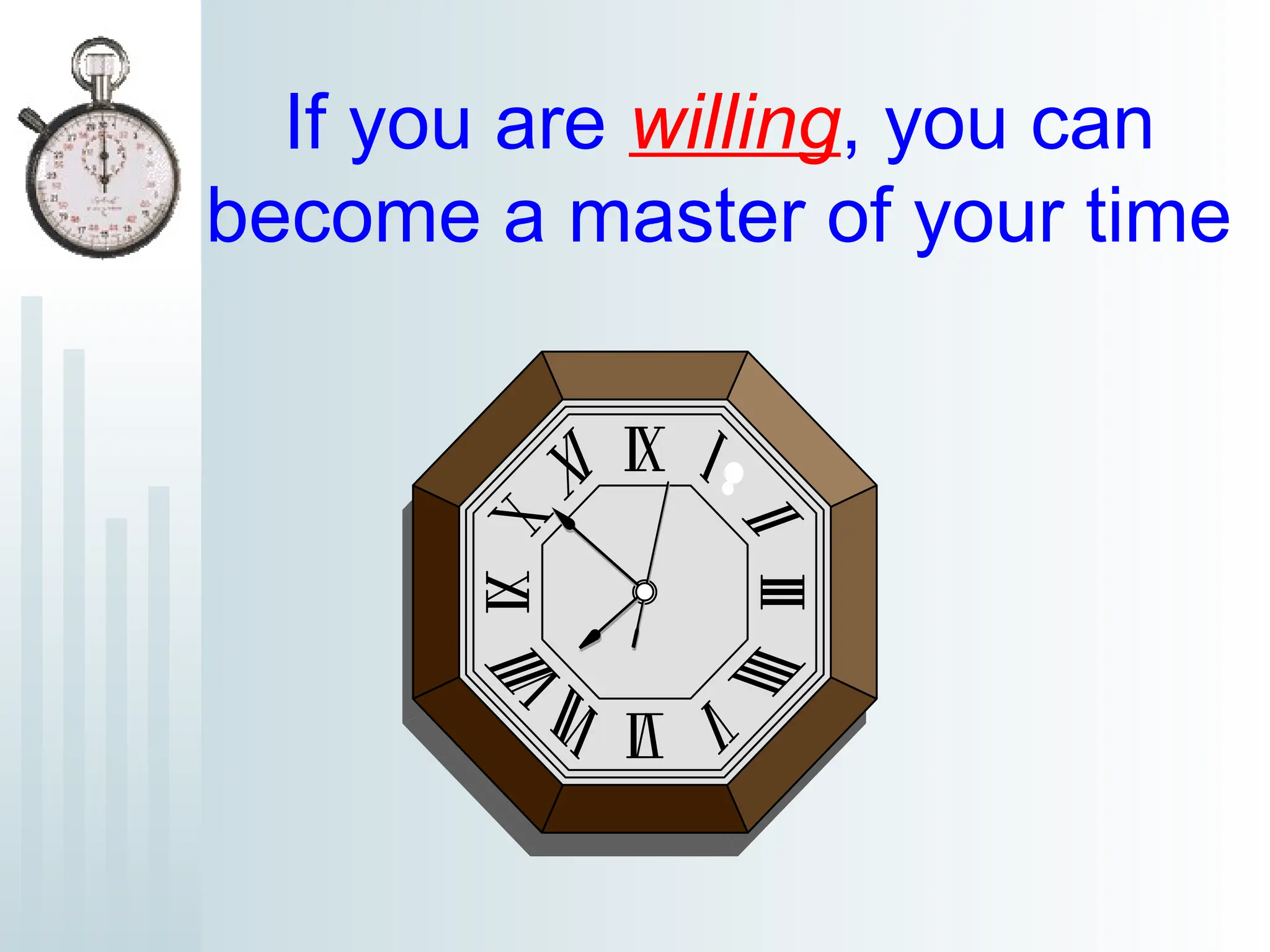
If you are willing, you can
become a master of your time
Time can't be managed, time is
uncontrollable.
We can only manage ourselves
and our use of time.
"People don't plan to fail but a
lot of people do fail to plan."
“We all have time to either
spend or waste and it is our
decision what to do with it.
But once passed, it is gone
forever.”
-- Bruce Lee
The bad news is time flies
The good news is you’re the
PILOT.
What is it anyway?
• Work:
Time management refers to
the development of
processes and tools that
increase efficiency and
productivity.
What is it anyway?
• Life:
Managing our time to
waste less time on doing
the things we have to do
so we have more time to
do the things we want to
do.
Time management is
nothing but
SELF MANAGEMENT
It requires self discipline
and control
Manage yourself, not
time!
Time management is actually self-
management.
What do we need to manage ourselves?
The ability to:
Plan
Delegate
Organize
Direct
Control
Time Management is a common-sense
skill that help us use our time in the most
Why don't people manage their time?
Despite the benefits of time
management, why do so many
people do not use it?
This is because:
• they don't know about it,
• they are too lazy to plan,
• they enjoy the adrenaline buzz
of meeting tight deadlines,
• they enjoy crisis management.
How busy are you?
• There are occasions when you are busy all day
long, but nothing important gets done. You
might spend the day in a frenzy of activity, but
achieve very little.
• Why does this happen? Because we are not
concentrating on the right things.
To succeed, we must concentrate on:
1. The results to be achieved, not on being
busy.
2. Setting priorities, which is vital.
Time management aims to ensure that we
concentrate our effort on the high payoff tasks.
Do not live life by accident,
be encouraged to live your
life on purpose
How can I find
purpose in my life?
Are You Sure
• Your days are never wasted.
• You are very organized.
• You clearly know where you are
going and what you are going to do
If Yes
You are in
the minority
The four D’s, the four rules for
mastering time management are
• Desire
– To become efficient at Time Management
• Decision
– Decide to become Organized
• Determination
– Keep trying to master the techniques
• Discipline
– Be willing to pay the price
Some of the strategies to use in
managing time are
Always define your objectives as clearly
as possible
• Without a goal or objective people tend
to just drift personally and
professionally.
• You might not be doing what you want
because your goals have not been set.
• Develop the ability to work out what you
want to achieve by writing goals which
you can review often.
What are the elements of
effective time management?
• Evaluate how you are using
your time
• Determine your priorities
• Create a weekly schedule
• Maintain a to-do list
• Eliminate barriers to effective
time management
Evaluating your use of time
The first step of effective time
management is identifying how you
are using your time.
• Make a list of the activities that you spend
time on.
• Identify how much time the activities
consume.
• Take note of activities you are keeping up
with versus activities you are falling
behind on.
Tips on evaluating your time
• Be systematic. Start in the morning
and go through the day when
thinking of your activities.
• Don’t overlook activities like
commuting, taking care of yourself,
and relaxing. These activities may
not be work or school related, but
they consume time too.
• Be realistic. People often fail to
allow enough time for activities.
Priorities
Many people work hard without
achieving the things that they want.
This comes from focusing on tasks
that do not lead to goals.
People who manage their time well
have identified tasks that lead to
their goals. They focus their energy
on these tasks.
Tips on Prioritizing
• Know your goals.
• Identify activities that help you achieve
your goals.
• Decide whether activities need to be
done in a particular order.
• Give the highest priority to tasks that are
most necessary in achieving your goals
and need to be done first.
Mark the priority level for each item on the
list of activities that you created.
A = High Priority
B = Medium Priority
C = Low Priority
Remember that priorities can change. You
need to re-visit your priority ratings often.
A Weekly Schedule
Now that you have identified your
activities and prioritized them, it is
time to create a schedule.
It is helpful to keep one’s schedule in
an appointment book or electronic
organizer, but for purposes of
planning you can use a scheduling
grid like the one on the next slide.
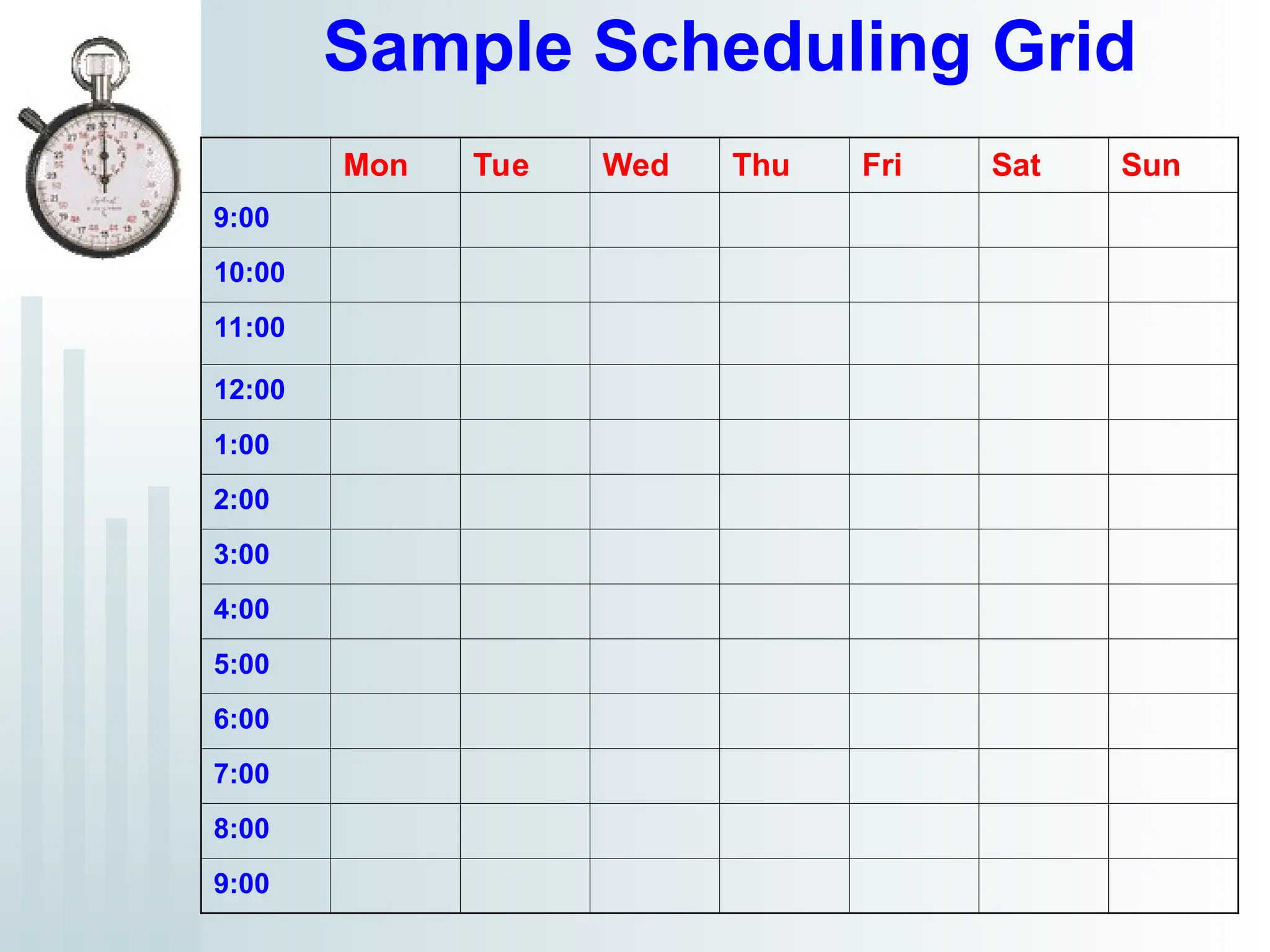
Sample Scheduling Grid
Mon Tue Wed Thu Fri Sat Sun
9:00
10:00
11:00
12:00
1:00
2:00
3:00
4:00
5:00
6:00
7:00
8:00
9:00
Scheduling Grid Instructions
• Block out times on the schedule for
each of your major activities.
• Start with recurring activities that
occur at a fixed time (examples:
classes or work).
• Then block out time for activities that
you want to do on a regular basis
(examples: exercising or studying).
• Allot ample time for each activity,
especially high priority activities.
• Take into account when you are most
effective. Morning people might
schedule more activities early in the
day. Night owls might schedule
things later.
To-Do Lists
The weekly schedule is used to
assign blocks of time to different
types of activities, but you also
need to keep track of the specific
tasks that must be accomplished
within each activity. Keeping a to-
do list is a good way to accomplish
this.
• Make a written list of specific tasks or
assignments that you need to do.
• Plan ahead, taking into account the
entire semester.
• Allot time for these tasks in your
schedule. Keep in mind their due dates.
• Assign priority ratings (A, B, or C) and
revise as needed.
• Refer to the list often
• Check off items when completed.
Barriers to Effective
Time Management
• Distractions
• Disorganization
• Perfectionism
• Procrastination
• Rigidity
There are many barriers to effective
time management, but they can be
overcome. Here is a list of the most
common barriers:
Distractions
Distractions come in many forms, but we must
learn to avoid distractions if we are to get work
done. Here are a few ideas:
• Tell people when you are busy and
cannot be disturbed.
• Work in areas where you are less likely
to be disturbed.
• Do your work at times when you are
most alert. It is easier to get distracted
when you are tired.
Disorganization
• Keep things that you need in a
specific place.
• Eliminate clutter.
• Before starting on a task, make sure
that you have all of the materials or
information that you need.
• Follow your schedule.
People often waste much time because of
disorganization. Here are some tips for staying
organized:
Perfectionism
• Examine whether your efforts to get
the job done perfectly are really
improving things or preventing you
from getting the job done.
• Think about the cost-benefit ratio of
the extra effort.
• Remember that nothing is perfect.
It is a virtue to want to do a good job, but some
people become so anxious about getting a job
done perfectly that they never complete it.
Procrastination
It is easy to put off tasks if they are
not due right away. The trouble is,
tasks pile up and you can run into
a time crunch later.
Remember to work ahead
whenever possible. If you can do
it today, do it!
Rigidity
It is important to develop a habit of
following your schedule, but some people
become too rigid. Unexpected things
come up and activities sometimes take
more time than planned.
It is important to have some flexibility in
your schedule. Allow extra time and
avoid becoming too frustrated if things
don’t work out as planned… just re-
evaluate the plan and make adjustments.
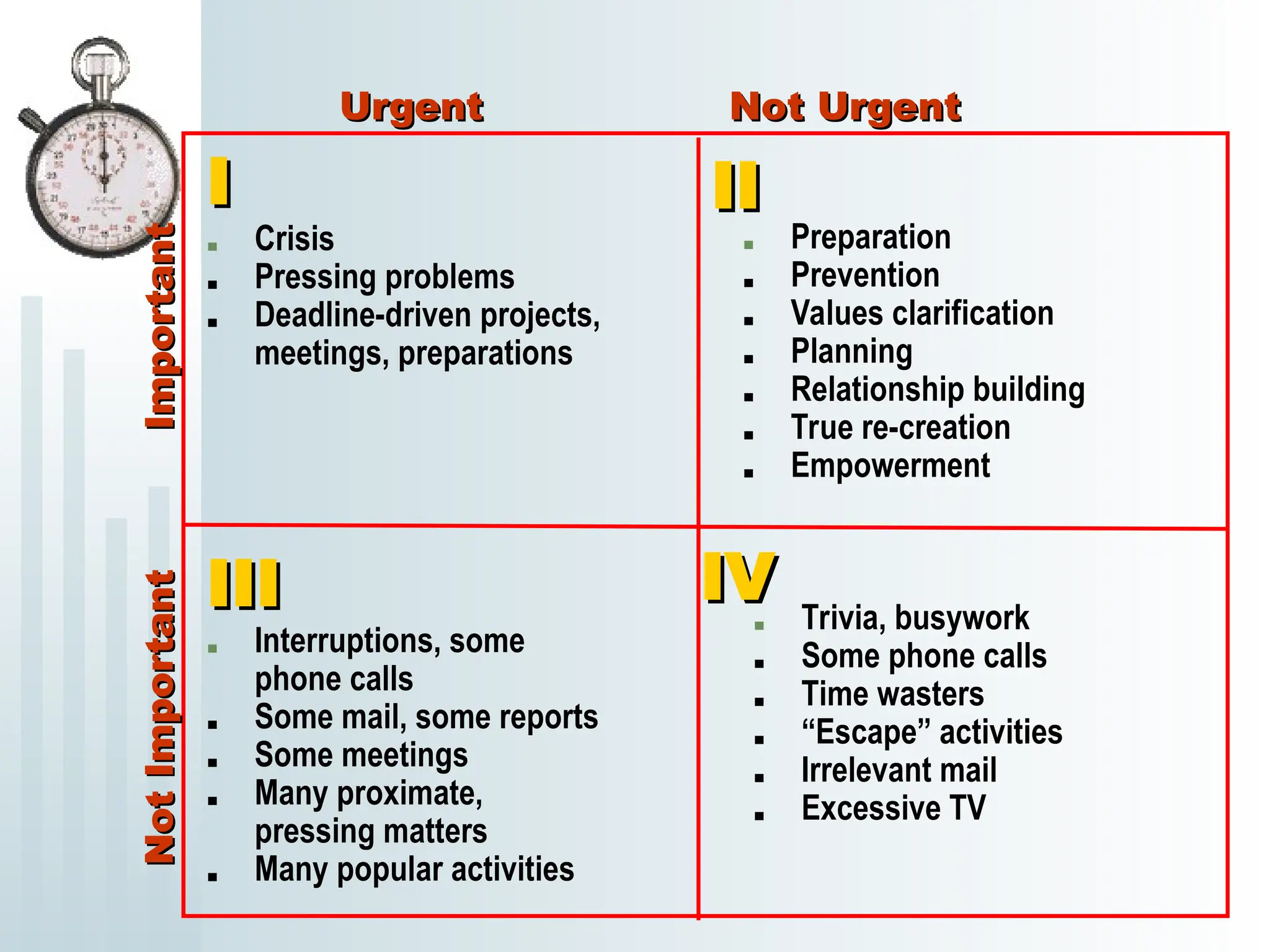
. Crisis
. Pressing problems
. Deadline-driven projects,
meetings, preparations
. Preparation
. Prevention
. Values clarification
. Planning
. Relationship building
. True re-creation
. Empowerment
. Interruptions, some
phone calls
. Some mail, some reports
. Some meetings
. Many proximate,
pressing matters
. Many popular activities
. Trivia, busywork
. Some phone calls
. Time wasters
. “Escape” activities
. Irrelevant mail
. Excessive TV
I
I II
II
III
III IV
IV
Urgent
Urgent Not Urgent
Not Urgent
Important
Important
Not
Important
Not
Important
Quadrant I
• Represents things that are both “urgent”
and “important” – we need to spend time
here.
• This is where we manage, we produce,
where we bring our experience and
judgment to bear in responding to many
needs and challenges.
• Many important activities become urgent
through procrastination, or because we
don’t do enough prevention and planning.
Results of Living in Quadrant I
(Urgent/Important)
• Stress
• Burnout
• Crisis Management
• Always putting out fires
Quadrant II
• Includes activities that are “important,
but not urgent”- Quadrant of Quality
• Here’s where we do our long-range
planning, anticipate and prevent
problems, empower others, broaden
our minds and increase our skills
• Ignoring this Quadrant feeds and
enlarges Quadrant I, creating stress,
burnout, and deeper crises for the
person consumed by it
• Investing in this Quadrant shrinks
Quadrant I
Quadrant II does
not act on us, we
must act on it
Quadrant III
• Includes things that are “urgent,
but not important” - Quadrant of
Deception.
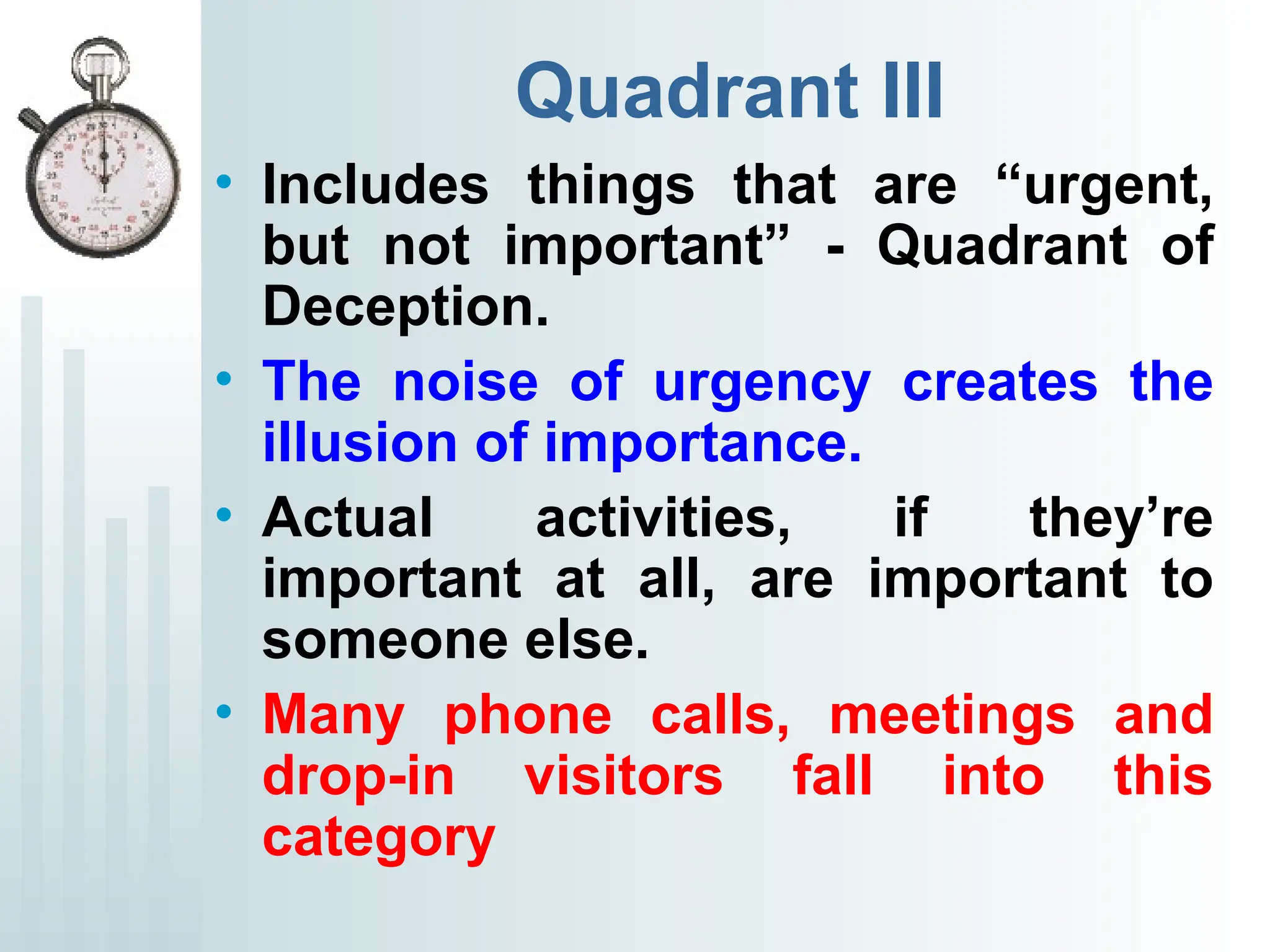
• The noise of urgency creates the
illusion of importance.
• Actual activities, if they’re
important at all, are important to
someone else.
• Many phone calls, meetings and
drop-in visitors fall into this
category
Results of living in Quadrant III
(Urgent/Not Important)
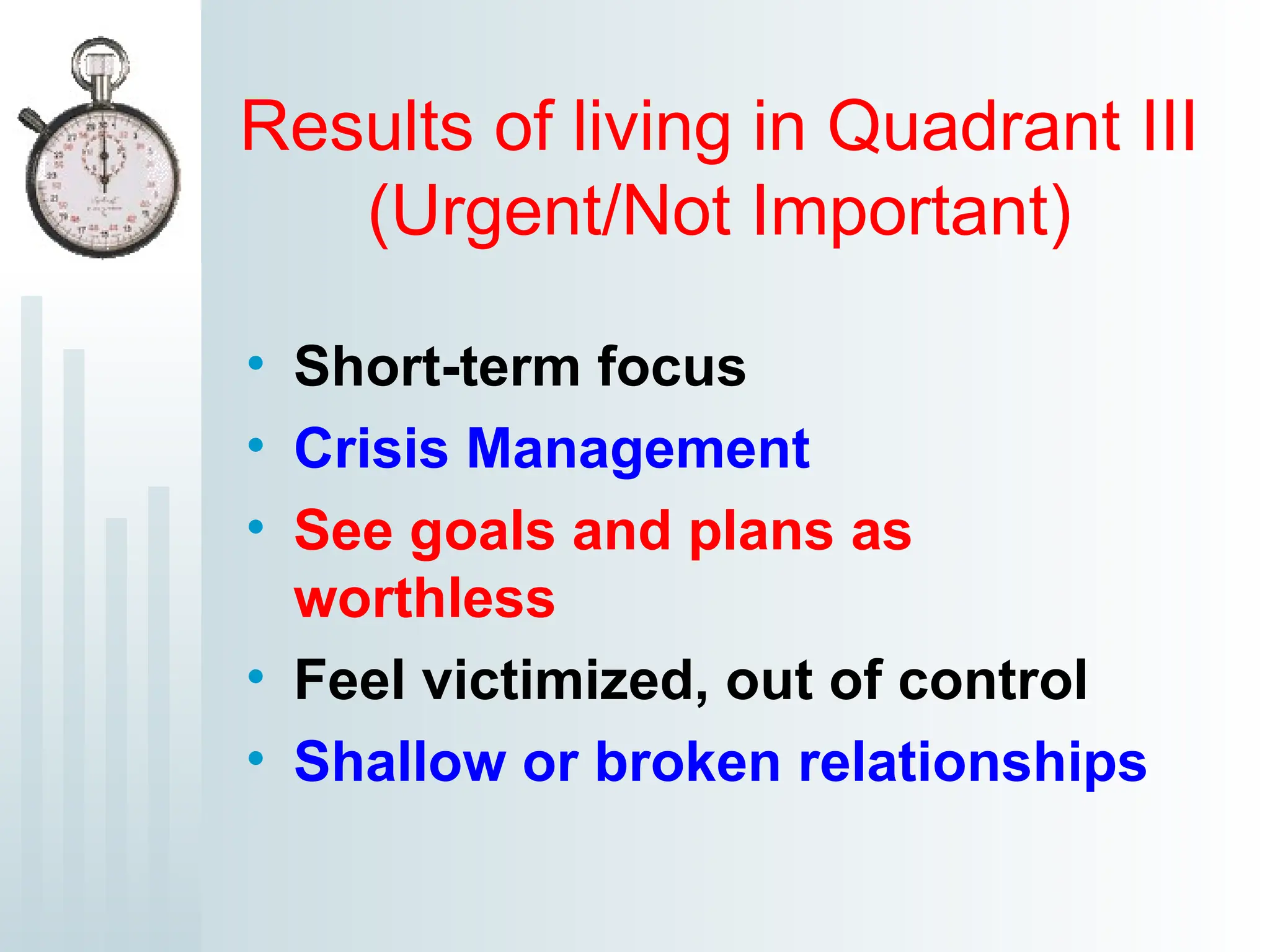
• Short-term focus
• Crisis Management
• See goals and plans as
worthless
• Feel victimized, out of control
• Shallow or broken relationships
Quadrant IV
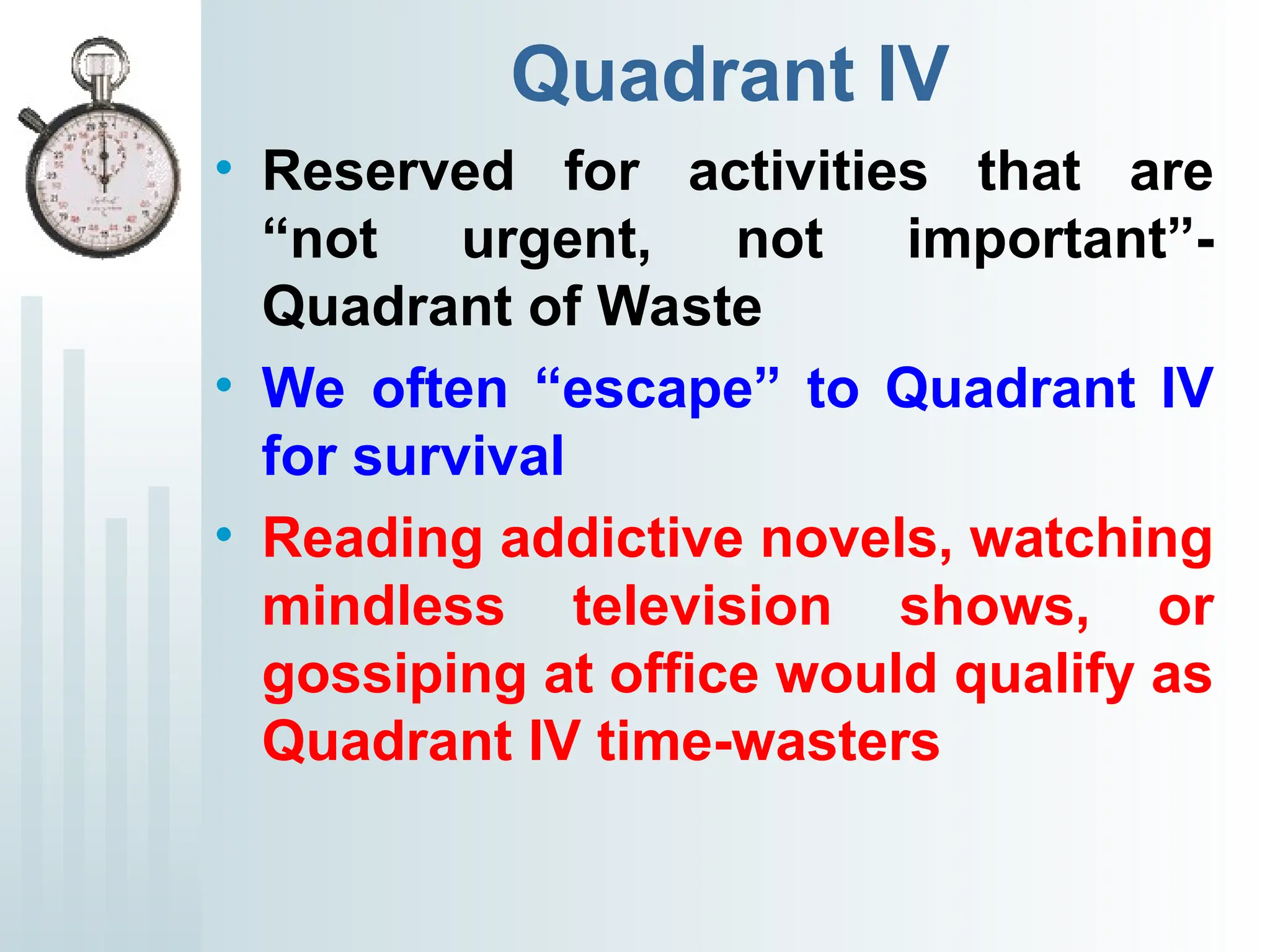
• Reserved for activities that are
“not urgent, not important”-
Quadrant of Waste
• We often “escape” to Quadrant IV
for survival
• Reading addictive novels, watching
mindless television shows, or
gossiping at office would qualify as
Quadrant IV time-wasters
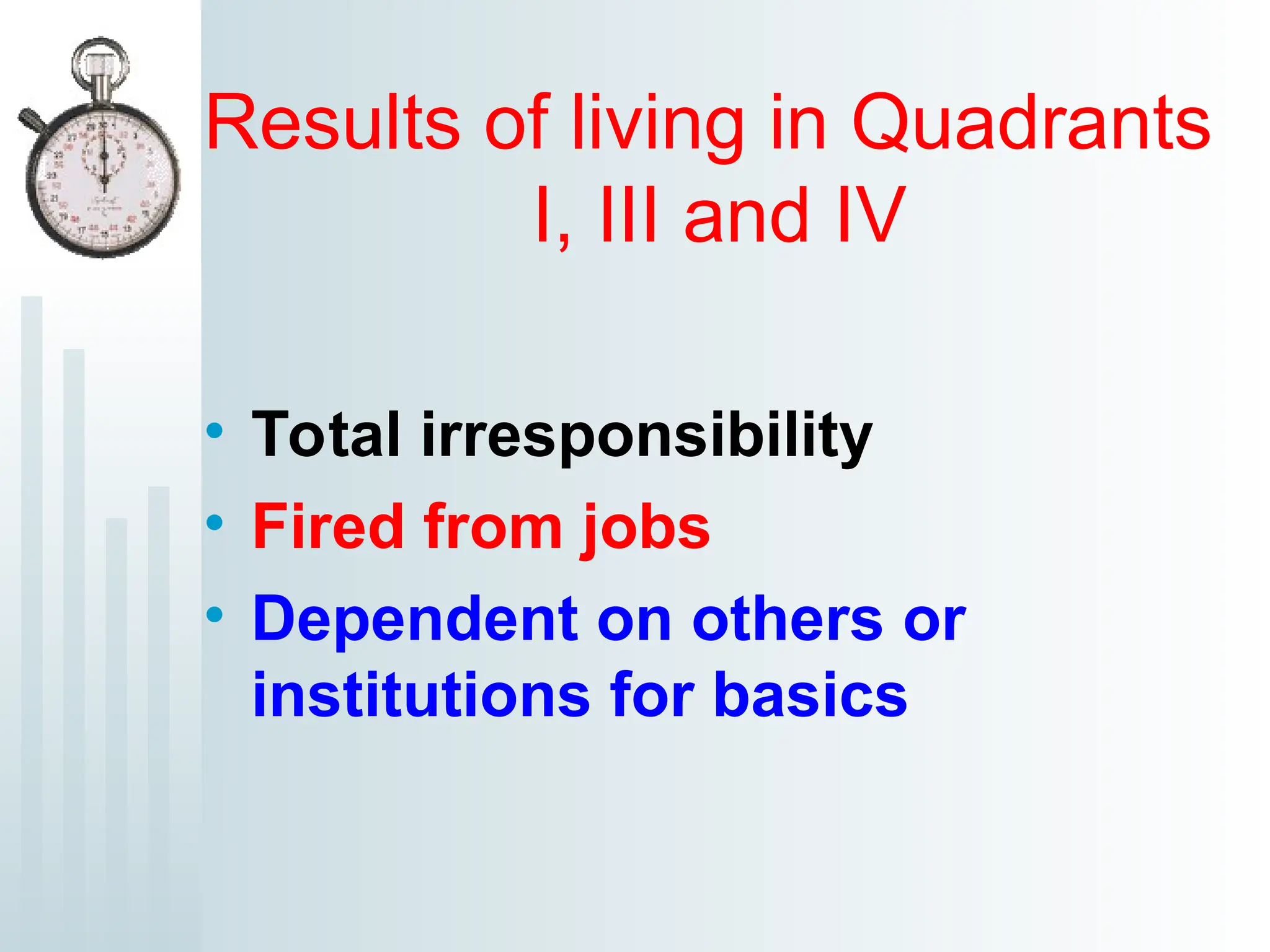
Results of living in Quadrants
I, III and IV
• Total irresponsibility
• Fired from jobs
• Dependent on others or
institutions for basics
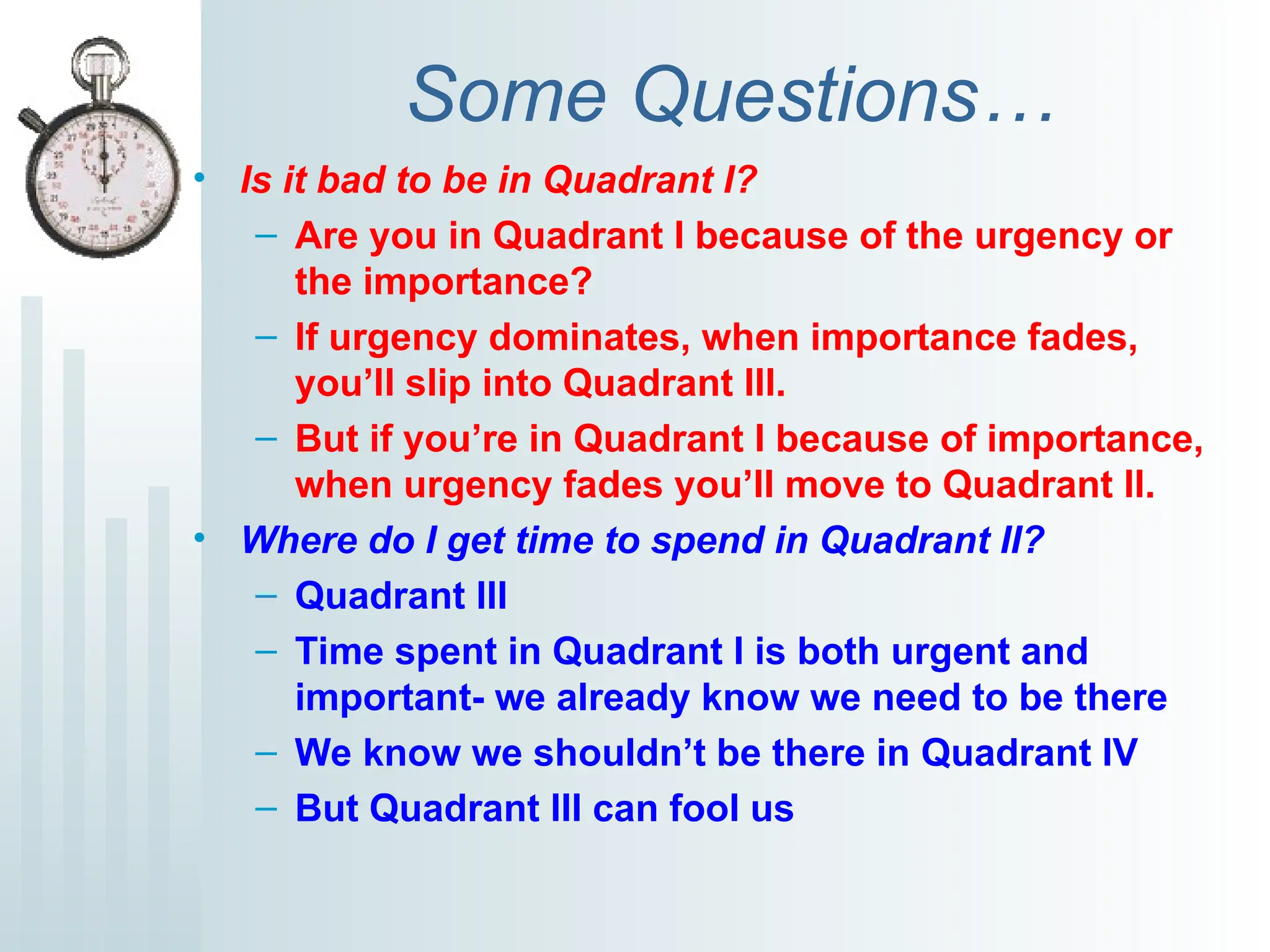
Some Questions…
• Is it bad to be in Quadrant I?
– Are you in Quadrant I because of the urgency or
the importance?
– If urgency dominates, when importance fades,
you’ll slip into Quadrant III.
– But if you’re in Quadrant I because of importance,
when urgency fades you’ll move to Quadrant II.
• Where do I get time to spend in Quadrant II?
– Quadrant III
– Time spent in Quadrant I is both urgent and
important- we already know we need to be there
– We know we shouldn’t be there in Quadrant IV
– But Quadrant III can fool us
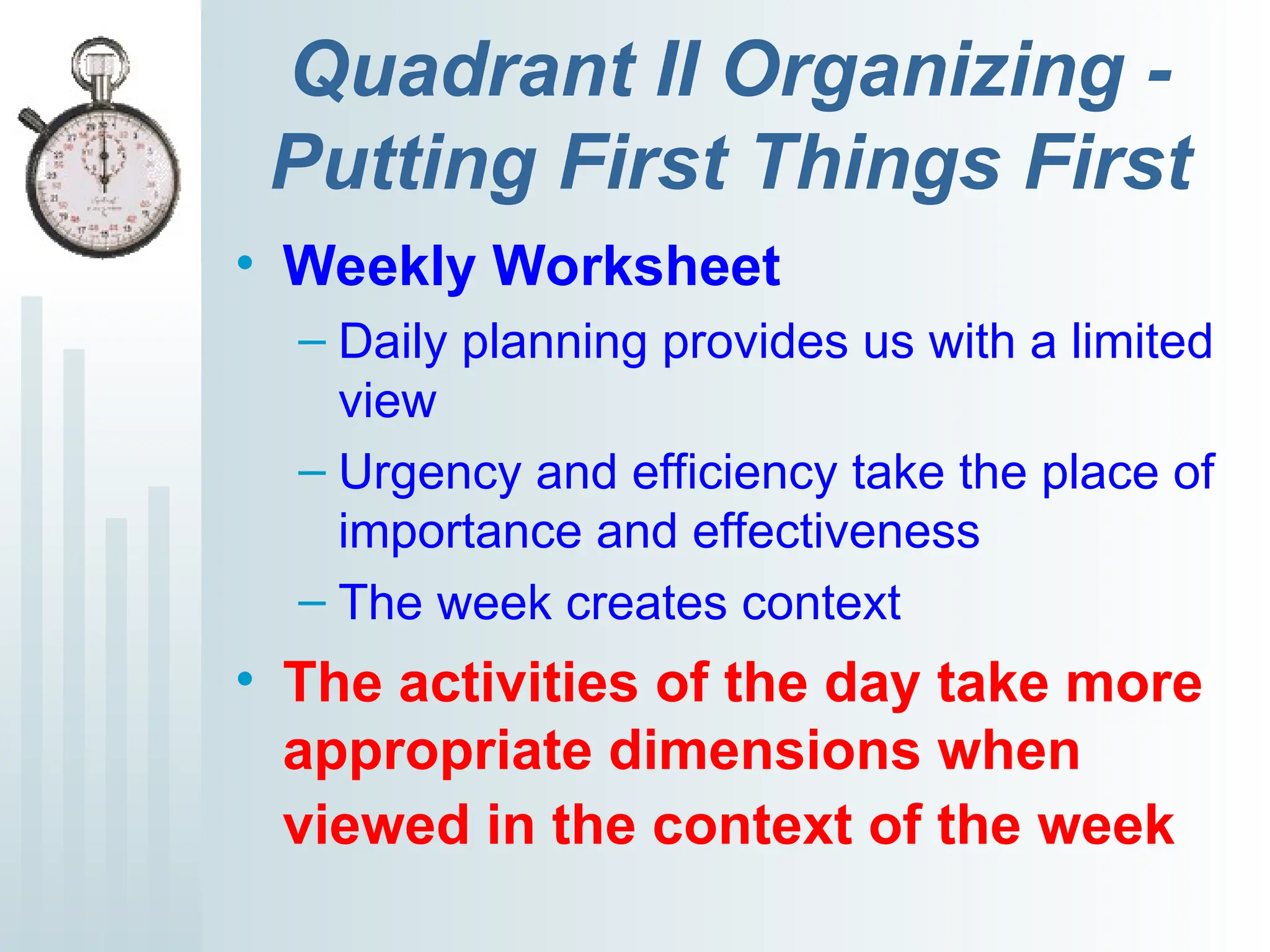
Quadrant II Organizing -
Putting First Things First
• Weekly Worksheet
– Daily planning provides us with a limited
view
– Urgency and efficiency take the place of
importance and effectiveness
– The week creates context
• The activities of the day take more
appropriate dimensions when
viewed in the context of the week
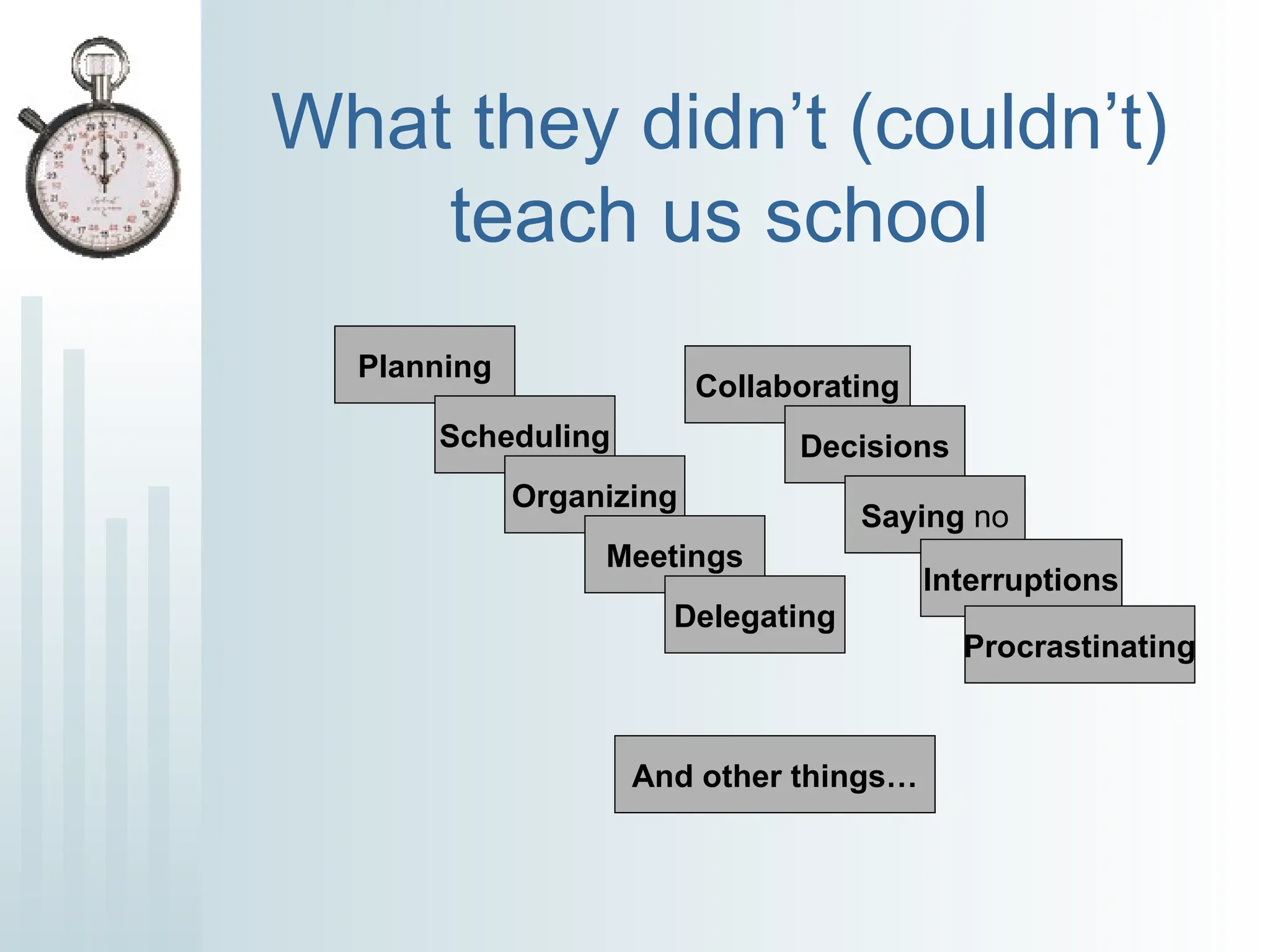
What they didn’t (couldn’t)
teach us school
Planning
Scheduling
Organizing
Meetings
Delegating
Collaborating
Decisions
Saying no
Interruptions
Procrastinating
And other things…
Planning and Prioritizing
• Take time to think and to consult
• Align your work with what matters
most to your institution:
Mission statement and goals
Supporting important work that
others are doing
• Determine priority before urgency
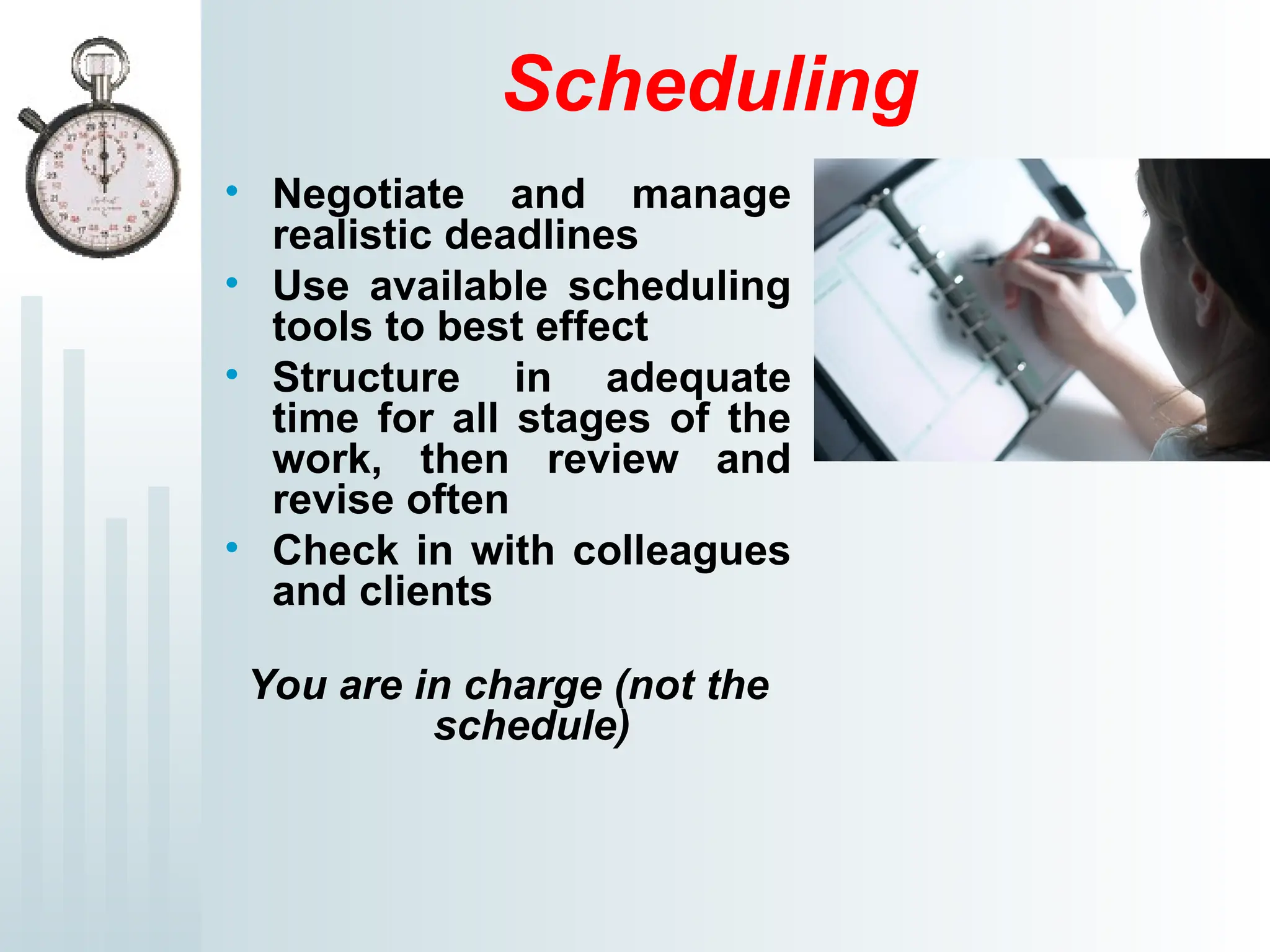
Scheduling
• Negotiate and manage
realistic deadlines
• Use available scheduling
tools to best effect
• Structure in adequate
time for all stages of the
work, then review and
revise often
• Check in with colleagues
and clients
You are in charge (not the
schedule)
Organize yourself
• Keep an updated “to do” list, in
priority order
• Deal with paperwork/email once
… or treat it as a scheduled event
• Staged filing
• Practice the “deep filing" method
Organize yourself
• Use technology wisely
• Manage professional reading
• Organize your workspace (match
your own mental models)
• Use project management
techniques
• Time shift
Managing Meetings
• Question the need and frequency of
meetings
• Shared agenda building
• (only) the right participants
• Facilitate well
• Keep minutes brief (a record of the
agenda + decisions + designated
followup)
• Maximize email collaboration,
document sharing, and work between
meetings
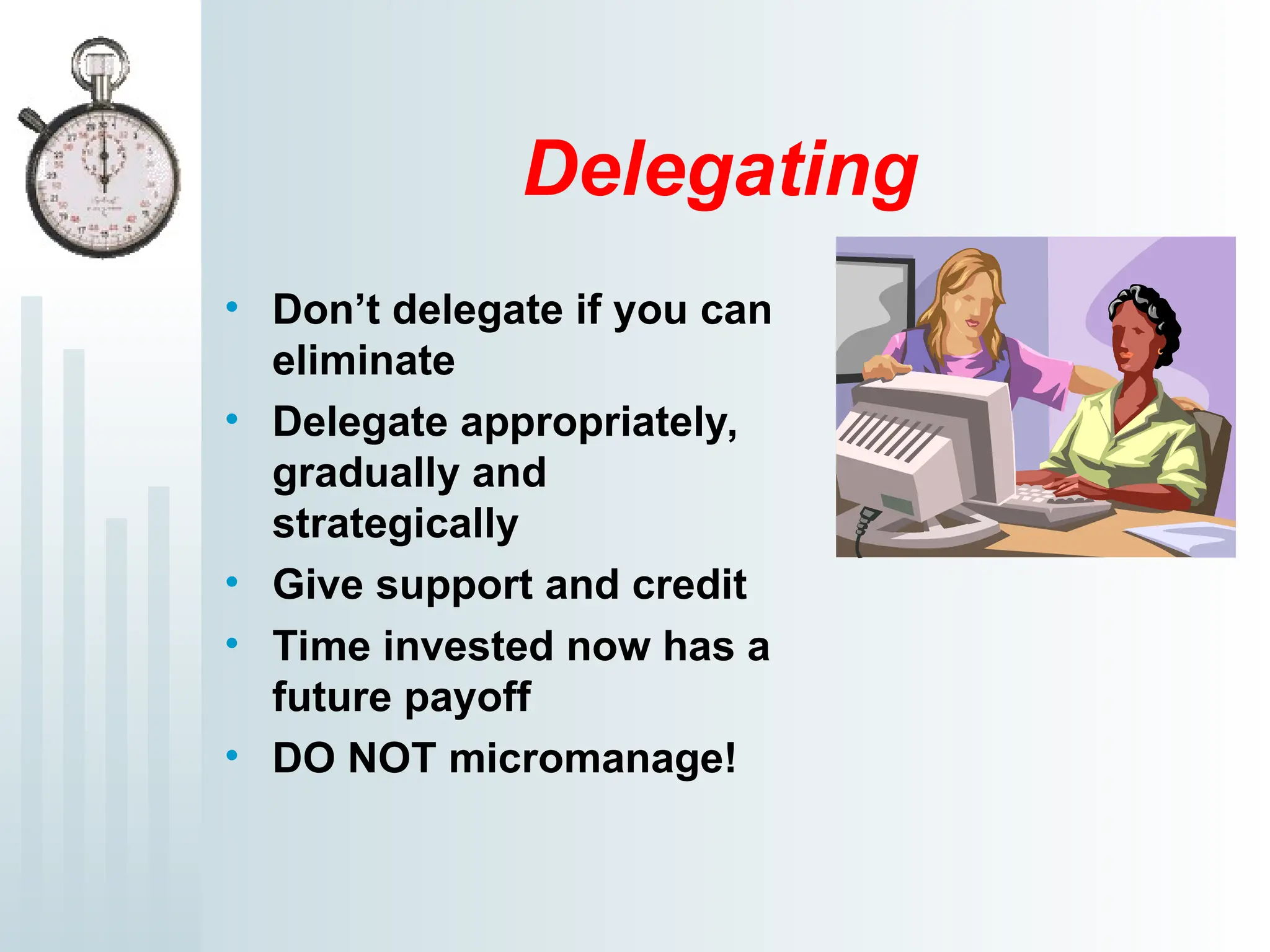
Delegating
• Don’t delegate if you can
eliminate
• Delegate appropriately,
gradually and
strategically
• Give support and credit
• Time invested now has a
future payoff
• DO NOT micromanage!
Collaboration
• Assigning/sharing workload
• Maximizing the strengths and
productivity of a team
• Making good use of the ideas of
others
• Asking for help when you need it
• Borrowing models and templates
from other sources
Decision making
• Make informed decisions
• DO make decisions
• Communicate effectively and
clearly
• Use common sense
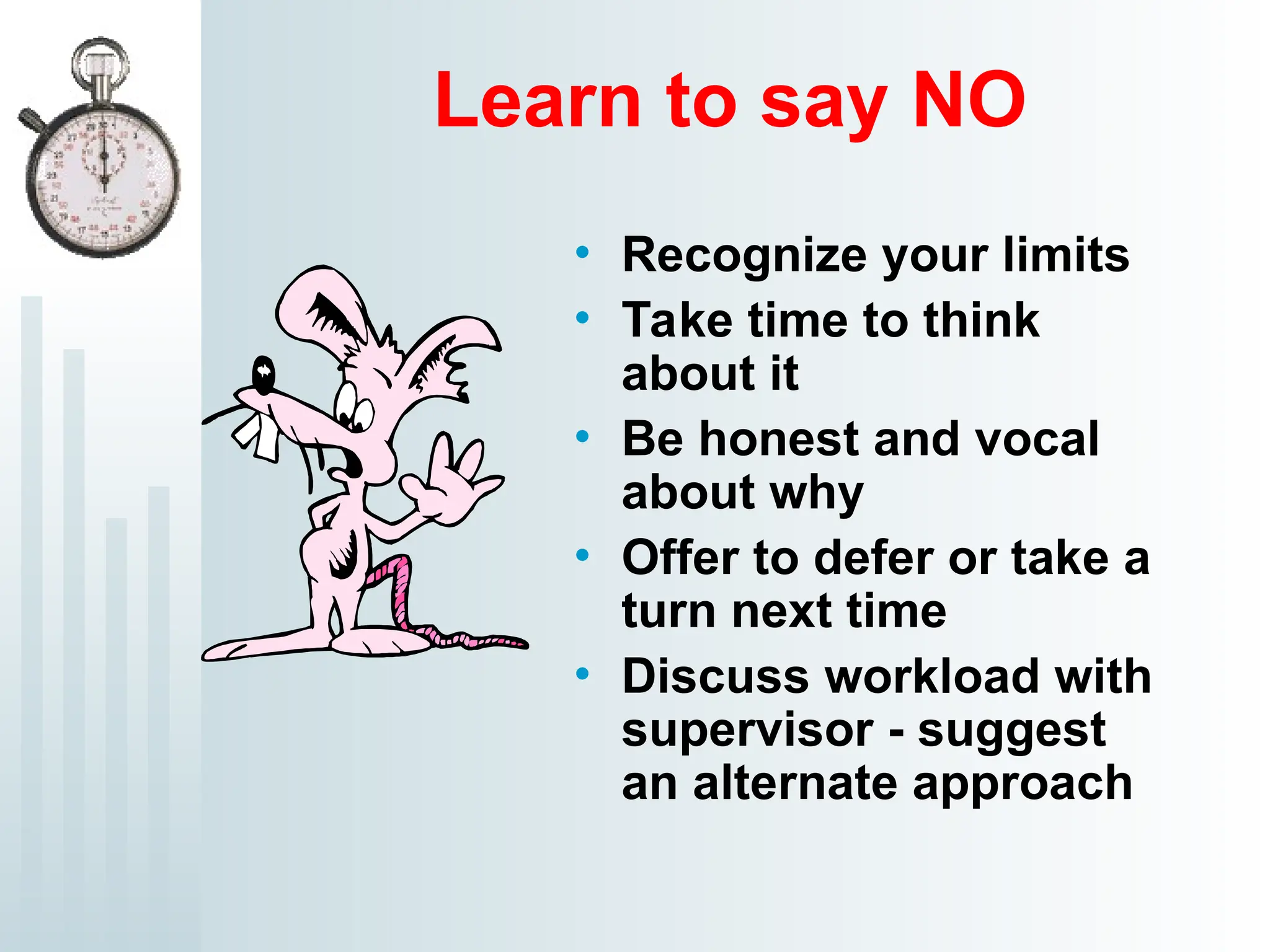
Learn to say NO
• Recognize your limits
• Take time to think
about it
• Be honest and vocal
about why
• Offer to defer or take a
turn next time
• Discuss workload with
supervisor - suggest
an alternate approach
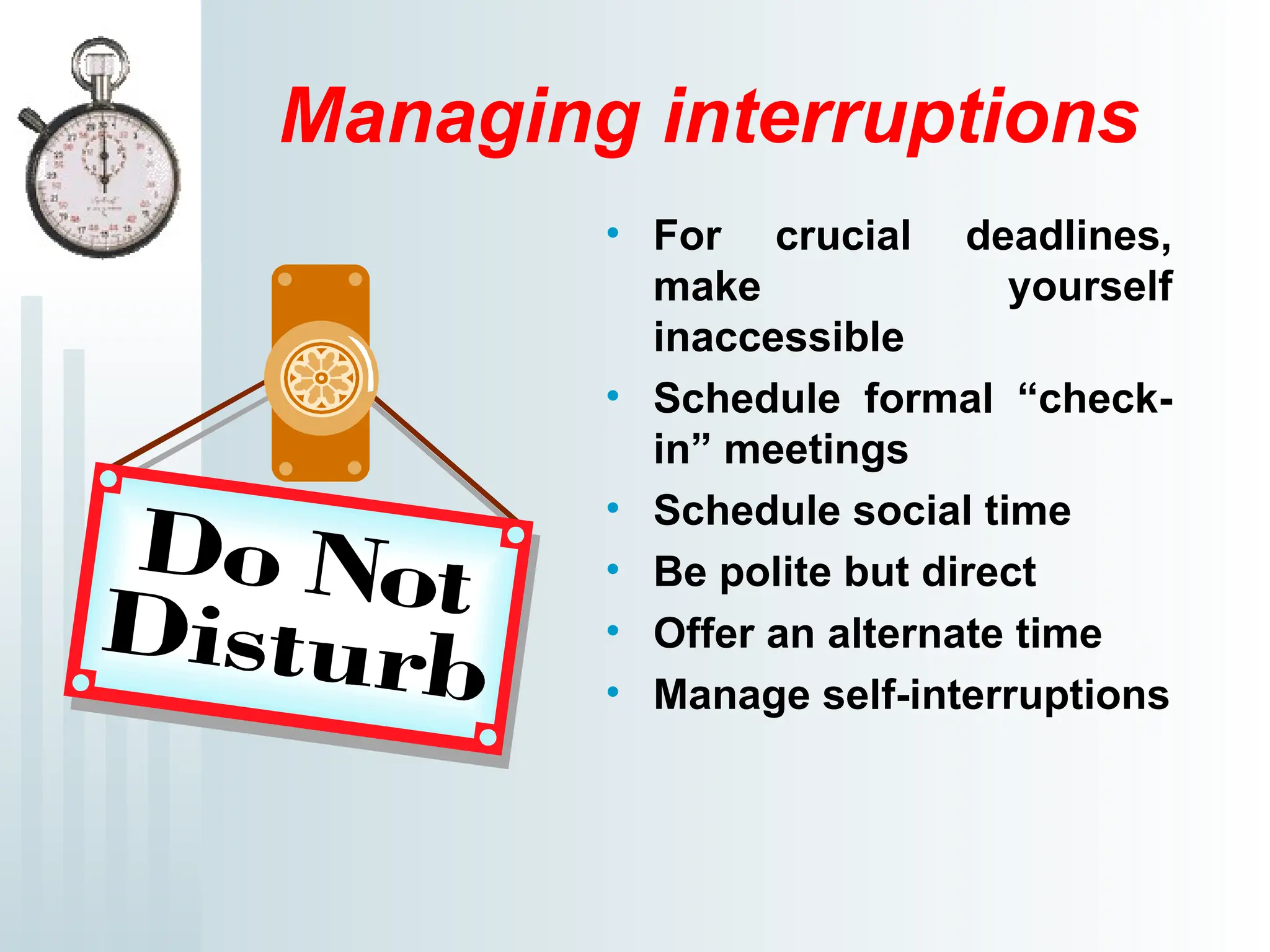
Managing interruptions
• For crucial deadlines,
make yourself
inaccessible
• Schedule formal “check-
in” meetings
• Schedule social time
• Be polite but direct
• Offer an alternate time
• Manage self-interruptions
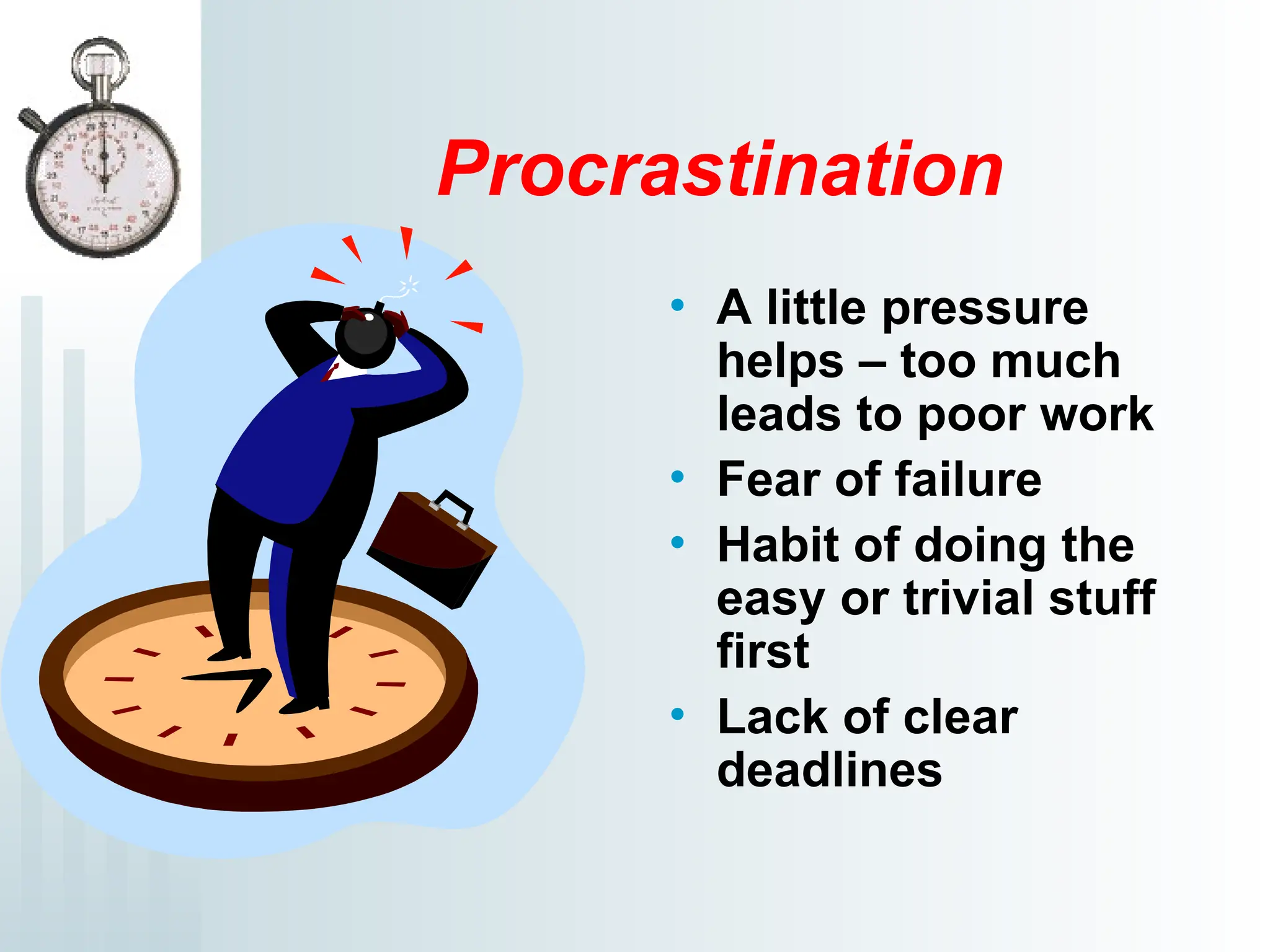
Procrastination
• A little pressure
helps – too much
leads to poor work
• Fear of failure
• Habit of doing the
easy or trivial stuff
first
• Lack of clear
deadlines
Avoiding procrastination
• Divide project into small,
schedulable stages
• Do collaborative work
• Don’t be a perfectionist
• Take a break at the end
TIME LOG SHEET
On The Job
• Telephoning
• Dictating
• Reading
• Writing
• Traveling
• Meeting
• Entertaining
• Researching
• Dealing with People
….Cont
TIME LOG SHEET (Cont….)
Personal Work
• Sleeping
• Eating
• Dressing
• Commuting
Family
• Spouse
• Children
• Parents
• Relatives
• Friends
….Cont
TIME LOG SHEET (Cont….)
Leisure
• Sports
• Music
• Others
Personal Growth
• Reading
• Meditation
• Learning
SOME TYPICAL TIME WASTERS
• The “Bosses”
• Files, Papers,
Mail
• Telephone
Interruptions
• Government
Regulations
• Unproductive
Meetings
• Procrastination - “I
will do it later”
• Poor Communication
& Listening
• People Unavailable
When They Are
Wanted
• Poor Information
….Cont
SOME TYPICAL TIME WASTERS
• People Not
Keeping To
Appointments
• Unwanted Visitors
• Social chit-chat
• Endless Drafting
& Re-drafting of
Letters or Memos
• Misplacing
Documents
• Poor Planning & Job
Organization
• Waiting For Decisions
• Traveling
• Unclear Job
Responsibilities
• Personal
Disorganization or
Stacked Desk
SOME TYPICAL TIME WASTERS
• Advising or Solving
Other People’s
Problems
• Ceremonies,
Rituals,Conferences
• Poor Delegation
• Jumping from One
Task to Another,
without Completing
the First
• Under or Over Staffed
• Lack Of Competent
Personnel
• Power Politics
• Management By
Crises
• Fire Fighting
• Inability to say ‘NO’
SOLUTIONS TO SOME OF THE
COMMON TIME WASTERS
Work not getting done in time or piling up
• Set Priorities
• Set Deadlines
• Make realistic time estimates
Trying to handle too much at a time
• Set priorities & tackle tasks accordingly
• Do one thing at a time
• Learn to say ‘No’
• Delegate more
….Cont
SOLUTIONS TO SOME OF THE
COMMON TIME WASTERS
Getting involved in too much detail
• Delegate more
• Do not be a perfectionist all the time
Postponing unpleasant or new tasks/
procrastination
• Set a time-table and stick to it
• Get unpleasant tasks over, quickly - you
will feel better
….Cont
SOLUTIONS TO SOME OF THE
COMMON TIME
Insufficient time to think
• Reserve blocks of time for thinking
• Allow no interruptions
Crisis management/overshooting deadlines
• Plan better
• Allow more time
Doing things hastily
• Take time to get it right the first time
• Distinguish between urgent and important
SOLUTIONS TO SOME OF THE
COMMON TIME WASTERS
Constant visitors/interruptions
• Make appointments and see that people stick to
it
• Block ‘reserved’ time slots when no one can
interrupt you
• Use secretary to intercept unwanted visitors or
delegate them to subordinates
• Say ‘No’ if necessary
• Modify ‘open-door’ policy
• Keep the discussion brief and to the point
• Do not do other peoples’ thinking for them
SOLUTIONS TO SOME OF THE
COMMON TIME WASTERS
Telephone calls/interruptions
• Use secretary to screen and divert calls if
necessary
• State you will call back when convenient
• Keep time-slots for making out going calls
• Be brief
• Stay uninvolved with all but essentials
….Cont
SOLUTIONS TO SOME OF THE
COMMON TIME WASTERS
Time spent in conversation/meetings
• Decide in advance what you want to
achieve when you meet someone
• Keep pleasantries to a minimum
• Stick to the point
• Make observations without meetings
• Discourage unnecessary meetings
• Use agendas, stick to the subject
• End meetings quickly, but not brusquely
….Cont
SOLUTIONS TO SOME OF THE
COMMON TIME WASTERS
Paper work/reading
• Get secretary to sort into : Urgent/Ordinary
• Ask for written memos or reports only
when they are really required
• Delegate routine to subordinates
• Ask for summaries rather than reports
• Read selectively
….Cont
SOLUTIONS TO SOME OF THE
COMMON TIME WASTERS
Letters/memos to answer/dictate
• Use telephone more often
• Keep a slot for dictating letters
• Use handwritten notes/’Post it’ slips
• Delegate routine letters/replies
• Ask secretary to answer routine mail
….Cont
SOLUTIONS TO SOME OF THE
COMMON TIME WASTERS
Cluttered Desk
• Set aside half an hour everyday to clear-
up urgent paper work
• Handle each piece of paper only once
• Aim to clear 90% of paper on your desk
everyday
….Cont
SOLUTIONS TO SOME OF THE
COMMON TIME WASTERS
Lost papers
• Implement good filing and retrieval
system
• Have list of files kept and available for
ready reference
• Arrange papers relating to current
assignments in separate folders and
keep them in easy reach
• Get papers filed everyday
• Keep the desk clean
SOLUTIONS TO SOME OF THE
COMMON TIME WASTERS
Meetings
• Get yourself taken off committees if your
presence is not important or delegate to
subordinates
• Avoid calling unnecessary meetings
• Set time limit, do not allow repetitions,
stick to agenda
….Cont
SOLUTIONS TO SOME OF THE COMMON
TIME WASTERS
Traveling
• Use phone or mail
• Delegate more
• Ask yourself, “Is it really required?”
• Get the other party to come to you
• Plan quickest way
• Use a good travel agent
• Use journey time productively to catch-up on
reading, writing letters or analyzing reports
SOLUTIONS TO SOME OF THE
COMMON TIME WASTERS
Routine/Trivia
• Concentrate on A Priority first
• Delegate routine to subordinates
• Keep aside half an hour for routine work
Lack of planning
• Review work and diary everyday
• Focus on important results and not
merely on activity
SOLUTIONS TO SOME OF THE
COMMON TIME WASTERS
Not clear about goals and
priorities
• Write down KRAs and priorities
• Discuss priorities with
subordinates/
superiors/peers
BENEFITS OF DELEGATION
• We can free ourselves for tasks which require
more of our attention.
• We achieve maximum use of our skills by
having enough time to spend on important
issues.
• Subordinates obtain experience and training
through getting additional responsibilities.
….Cont
BENEFITS OF DELEGATION
• A culture of confidence and responsibility gets
developed in the organization whereby
subordinates feel more confident of
themselves.
• It increases the problem-solving capability of
the organization.
• It does not put undue responsibility on one
person and the capabilities of the entire
organization increases.
BENEFITS OF DELEGATION
• It helps to test the capabilities and
capacity of the subordinates.
• New ideas get generated.
• It improves our own skills of
interacting with others and our
effectiveness in the leadership role.
FOUR STEPS OF DELEGATION
• Assigning responsibility with clear
communication.
• Granting authority.
• Creating accountability for results.
• Creating feedback systems.
WHY MANAGER DO NOT
DELEGATE?
• Insecurity about job
• Subordinates could make mistakes
• Lack of proper communication
• Weak Feedback & Control System
• Feeling of being Indispensable
• Unclear about Own Authority
SOME TASKS WHICH CAN EASILY BE DELEGATED
• Reports
• Fact gathering
• Planning a project
• Supervising a project
• Delegating at some routine meetings
• Liaison with other departments
• Routine telephone calls and letters
• Screening and preliminary
interviews/meetings
• Departmental routine work
CRITICAL STEPS OF DELEGATION
• Make a list of tasks that needs to be done
• Identify tasks to be delegated
• Choose the correct person who can do the task
efficiently
• Explain the purpose clearly, specifically using
clear communication
• Specify the result expected and deadline for
completion
• Provide basic inputs and ensure inflow of
relevant information
….Cont
CRITICAL STEPS OF DELEGATION
• Make sure that the subordinate
understands what you expect of him/her
• Have a written memo which specifies what
you have spoken about
• Assign resources and authority to the
subordinate.
• Come to an agreement about time schedule
• Make a notation in your Diary about tasks
you have delegated and to whom
• Weekly check-up
THE BENEFITS OF A DIARY
• It gives us better control of our own
life
• It helps us to set priorities and stick
to them
• It helps us to achieve our goals in life
• It helps us to use our time in a
productive way
• It encourages thought and creativity
• It helps reduce tension and stress
WHAT SHOULD A DIARY CONTAIN?
• Life time goals, both personal and professional
• Priority areas or KRAs
• The various objectives and activities under
each KRA
• Back-up support information on KRAs i.e.
statistics, resource people, etc
• A detailed calendar section which helps to
connect goals with what we are actually doing
and plan to do
• Section on ideas, addresses, telephone
numbers, graphs, budgets, plans, checklists,
financial details, personal data etc
TIME MANAGEMENT PRINCIPLES
1.Identify "Best Time" for Working:
Everyone has high and low periods of attention and concentration.
Are you a "morning person" or a "night person"? Use your power
times to do hard jobs; use the down times for routines.
2.Study Difficult Jobs First:
When you are fresh, you can process information more quickly and
save time as a result.
3.Use Distributed Work and Practice:
Work in shorter time blocks with short breaks between. This keeps
you from getting fatigued and "wasting time." This type of work is
efficient because while you are taking a break, the brain is still
processing the information.
4.Make Sure the Surroundings are Conducive to Work:
This will allow you to reduce distractions which can "waste time."
For E.g. If there are times in the residence halls or your apartment
when you know there will be noise and commotion, use that time
for mindless tasks.
5.Make Room for Entertainment and Relaxation
5.Make Room for Entertainment and Relaxation:
:
Office is more than Job. You need to have a Career, yet,
you need to have a balance in your life.
6.Make Sure you Have Time to Sleep and Eat
Properly:
Properly: Sleep is often used by so called professionals as
Sleep is often used by so called professionals as
their time management "bank." When they need a few
extra hours, they withdraw a few hours of sleep. Doing this
makes the time they spend is less effective because they
will need a couple hours of clock time to get an hour of
productive time. This is not a good way to manage yourself
in relation to time.
7.Try to Combine Activities
7.Try to Combine Activities:
: Use the "Twofer" concept.
Use the "Twofer" concept.
If you are spending time at the client place, bring your
planning notes for completion. If you are waiting in line for
tickets, bring your flashcards to memorize new concepts in
place.
place.
TIME MANAGEMENT PRINCIPLES
Finding Out How Much Your Time is Worth
• Calculate how much you cost your
organization each year. Include your salary,
payroll taxes, the cost of office space you
occupy, equipment and facilities you use,
expenses, administrative support, etc.
• To this figure add a 'guesstimate' of the
amount of profit you should generate by your
activity.
• If you work normal hours, you will have
approximately 200 productive days each year.
If you work 7½ hours each day, this equates
to 1,500 hours in a year.
• From these figures, calculate an hourly rate.
This should give a reasonable estimate of
how much your time is worth.
A W-A-T-C-H to watch!
• W Watch your Words
• A Watch your Actions
• T Watch your Thoughts
• C Watch your Character
• H Watch your Habits
Thank You

Jindal-Time Mgmt.PPT best presentation for students

  • 1.
  • 2.
    Benefits out ofthe programme Get more done in less time. Meet deadlines and commitments. Have time left over for the things you really want to do. Increase customer satisfaction Enhance your on–the-job performance. Have more time for family, personal and other important activities.
  • 3.
    Benefits out ofthe programme Feel better and have more energy. Eliminate Time Wasters. Improve your efficiency. Find the information you need easier and faster. Reduce pressure and stress. Get through your work backlog.
  • 4.
    If you arewilling, you can become a master of your time
  • 5.
    Time can't bemanaged, time is uncontrollable. We can only manage ourselves and our use of time.
  • 6.
    "People don't planto fail but a lot of people do fail to plan."
  • 7.
    “We all havetime to either spend or waste and it is our decision what to do with it. But once passed, it is gone forever.” -- Bruce Lee
  • 8.
    The bad newsis time flies The good news is you’re the PILOT.
  • 9.
    What is itanyway? • Work: Time management refers to the development of processes and tools that increase efficiency and productivity.
  • 10.
    What is itanyway? • Life: Managing our time to waste less time on doing the things we have to do so we have more time to do the things we want to do.
  • 11.
    Time management is nothingbut SELF MANAGEMENT It requires self discipline and control
  • 12.
    Manage yourself, not time! Timemanagement is actually self- management. What do we need to manage ourselves? The ability to: Plan Delegate Organize Direct Control Time Management is a common-sense skill that help us use our time in the most
  • 13.
    Why don't peoplemanage their time? Despite the benefits of time management, why do so many people do not use it? This is because: • they don't know about it, • they are too lazy to plan, • they enjoy the adrenaline buzz of meeting tight deadlines, • they enjoy crisis management.
  • 14.
    How busy areyou? • There are occasions when you are busy all day long, but nothing important gets done. You might spend the day in a frenzy of activity, but achieve very little. • Why does this happen? Because we are not concentrating on the right things. To succeed, we must concentrate on: 1. The results to be achieved, not on being busy. 2. Setting priorities, which is vital. Time management aims to ensure that we concentrate our effort on the high payoff tasks.
  • 15.
    Do not livelife by accident, be encouraged to live your life on purpose How can I find purpose in my life?
  • 16.
    Are You Sure •Your days are never wasted. • You are very organized. • You clearly know where you are going and what you are going to do
  • 17.
    If Yes You arein the minority
  • 18.
    The four D’s,the four rules for mastering time management are • Desire – To become efficient at Time Management • Decision – Decide to become Organized • Determination – Keep trying to master the techniques • Discipline – Be willing to pay the price
  • 19.
    Some of thestrategies to use in managing time are Always define your objectives as clearly as possible • Without a goal or objective people tend to just drift personally and professionally. • You might not be doing what you want because your goals have not been set. • Develop the ability to work out what you want to achieve by writing goals which you can review often.
  • 20.
    What are theelements of effective time management? • Evaluate how you are using your time • Determine your priorities • Create a weekly schedule • Maintain a to-do list • Eliminate barriers to effective time management
  • 21.
    Evaluating your useof time The first step of effective time management is identifying how you are using your time. • Make a list of the activities that you spend time on. • Identify how much time the activities consume. • Take note of activities you are keeping up with versus activities you are falling behind on.
  • 22.
    Tips on evaluatingyour time • Be systematic. Start in the morning and go through the day when thinking of your activities. • Don’t overlook activities like commuting, taking care of yourself, and relaxing. These activities may not be work or school related, but they consume time too. • Be realistic. People often fail to allow enough time for activities.
  • 23.
    Priorities Many people workhard without achieving the things that they want. This comes from focusing on tasks that do not lead to goals. People who manage their time well have identified tasks that lead to their goals. They focus their energy on these tasks.
  • 24.
    Tips on Prioritizing •Know your goals. • Identify activities that help you achieve your goals. • Decide whether activities need to be done in a particular order. • Give the highest priority to tasks that are most necessary in achieving your goals and need to be done first.
  • 25.
    Mark the prioritylevel for each item on the list of activities that you created. A = High Priority B = Medium Priority C = Low Priority Remember that priorities can change. You need to re-visit your priority ratings often.
  • 26.
    A Weekly Schedule Nowthat you have identified your activities and prioritized them, it is time to create a schedule. It is helpful to keep one’s schedule in an appointment book or electronic organizer, but for purposes of planning you can use a scheduling grid like the one on the next slide.
  • 27.
    Sample Scheduling Grid MonTue Wed Thu Fri Sat Sun 9:00 10:00 11:00 12:00 1:00 2:00 3:00 4:00 5:00 6:00 7:00 8:00 9:00
  • 28.
    Scheduling Grid Instructions •Block out times on the schedule for each of your major activities. • Start with recurring activities that occur at a fixed time (examples: classes or work). • Then block out time for activities that you want to do on a regular basis (examples: exercising or studying).
  • 29.
    • Allot ampletime for each activity, especially high priority activities. • Take into account when you are most effective. Morning people might schedule more activities early in the day. Night owls might schedule things later.
  • 30.
    To-Do Lists The weeklyschedule is used to assign blocks of time to different types of activities, but you also need to keep track of the specific tasks that must be accomplished within each activity. Keeping a to- do list is a good way to accomplish this.
  • 31.
    • Make awritten list of specific tasks or assignments that you need to do. • Plan ahead, taking into account the entire semester. • Allot time for these tasks in your schedule. Keep in mind their due dates. • Assign priority ratings (A, B, or C) and revise as needed. • Refer to the list often • Check off items when completed.
  • 32.
    Barriers to Effective TimeManagement • Distractions • Disorganization • Perfectionism • Procrastination • Rigidity There are many barriers to effective time management, but they can be overcome. Here is a list of the most common barriers:
  • 33.
    Distractions Distractions come inmany forms, but we must learn to avoid distractions if we are to get work done. Here are a few ideas: • Tell people when you are busy and cannot be disturbed. • Work in areas where you are less likely to be disturbed. • Do your work at times when you are most alert. It is easier to get distracted when you are tired.
  • 34.
    Disorganization • Keep thingsthat you need in a specific place. • Eliminate clutter. • Before starting on a task, make sure that you have all of the materials or information that you need. • Follow your schedule. People often waste much time because of disorganization. Here are some tips for staying organized:
  • 35.
    Perfectionism • Examine whetheryour efforts to get the job done perfectly are really improving things or preventing you from getting the job done. • Think about the cost-benefit ratio of the extra effort. • Remember that nothing is perfect. It is a virtue to want to do a good job, but some people become so anxious about getting a job done perfectly that they never complete it.
  • 36.
    Procrastination It is easyto put off tasks if they are not due right away. The trouble is, tasks pile up and you can run into a time crunch later. Remember to work ahead whenever possible. If you can do it today, do it!
  • 37.
    Rigidity It is importantto develop a habit of following your schedule, but some people become too rigid. Unexpected things come up and activities sometimes take more time than planned. It is important to have some flexibility in your schedule. Allow extra time and avoid becoming too frustrated if things don’t work out as planned… just re- evaluate the plan and make adjustments.
  • 38.
    . Crisis . Pressingproblems . Deadline-driven projects, meetings, preparations . Preparation . Prevention . Values clarification . Planning . Relationship building . True re-creation . Empowerment . Interruptions, some phone calls . Some mail, some reports . Some meetings . Many proximate, pressing matters . Many popular activities . Trivia, busywork . Some phone calls . Time wasters . “Escape” activities . Irrelevant mail . Excessive TV I I II II III III IV IV Urgent Urgent Not Urgent Not Urgent Important Important Not Important Not Important
  • 39.
    Quadrant I • Representsthings that are both “urgent” and “important” – we need to spend time here. • This is where we manage, we produce, where we bring our experience and judgment to bear in responding to many needs and challenges. • Many important activities become urgent through procrastination, or because we don’t do enough prevention and planning.
  • 40.
    Results of Livingin Quadrant I (Urgent/Important) • Stress • Burnout • Crisis Management • Always putting out fires
  • 41.
    Quadrant II • Includesactivities that are “important, but not urgent”- Quadrant of Quality • Here’s where we do our long-range planning, anticipate and prevent problems, empower others, broaden our minds and increase our skills • Ignoring this Quadrant feeds and enlarges Quadrant I, creating stress, burnout, and deeper crises for the person consumed by it • Investing in this Quadrant shrinks Quadrant I
  • 42.
    Quadrant II does notact on us, we must act on it
  • 43.
    Quadrant III • Includesthings that are “urgent, but not important” - Quadrant of Deception. • The noise of urgency creates the illusion of importance. • Actual activities, if they’re important at all, are important to someone else. • Many phone calls, meetings and drop-in visitors fall into this category
  • 44.
    Results of livingin Quadrant III (Urgent/Not Important) • Short-term focus • Crisis Management • See goals and plans as worthless • Feel victimized, out of control • Shallow or broken relationships
  • 45.
    Quadrant IV • Reservedfor activities that are “not urgent, not important”- Quadrant of Waste • We often “escape” to Quadrant IV for survival • Reading addictive novels, watching mindless television shows, or gossiping at office would qualify as Quadrant IV time-wasters
  • 46.
    Results of livingin Quadrants I, III and IV • Total irresponsibility • Fired from jobs • Dependent on others or institutions for basics
  • 47.
    Some Questions… • Isit bad to be in Quadrant I? – Are you in Quadrant I because of the urgency or the importance? – If urgency dominates, when importance fades, you’ll slip into Quadrant III. – But if you’re in Quadrant I because of importance, when urgency fades you’ll move to Quadrant II. • Where do I get time to spend in Quadrant II? – Quadrant III – Time spent in Quadrant I is both urgent and important- we already know we need to be there – We know we shouldn’t be there in Quadrant IV – But Quadrant III can fool us
  • 48.
    Quadrant II Organizing- Putting First Things First • Weekly Worksheet – Daily planning provides us with a limited view – Urgency and efficiency take the place of importance and effectiveness – The week creates context • The activities of the day take more appropriate dimensions when viewed in the context of the week
  • 49.
    What they didn’t(couldn’t) teach us school Planning Scheduling Organizing Meetings Delegating Collaborating Decisions Saying no Interruptions Procrastinating And other things…
  • 50.
    Planning and Prioritizing •Take time to think and to consult • Align your work with what matters most to your institution: Mission statement and goals Supporting important work that others are doing • Determine priority before urgency
  • 51.
    Scheduling • Negotiate andmanage realistic deadlines • Use available scheduling tools to best effect • Structure in adequate time for all stages of the work, then review and revise often • Check in with colleagues and clients You are in charge (not the schedule)
  • 52.
    Organize yourself • Keepan updated “to do” list, in priority order • Deal with paperwork/email once … or treat it as a scheduled event • Staged filing • Practice the “deep filing" method
  • 53.
    Organize yourself • Usetechnology wisely • Manage professional reading • Organize your workspace (match your own mental models) • Use project management techniques • Time shift
  • 54.
    Managing Meetings • Questionthe need and frequency of meetings • Shared agenda building • (only) the right participants • Facilitate well • Keep minutes brief (a record of the agenda + decisions + designated followup) • Maximize email collaboration, document sharing, and work between meetings
  • 55.
    Delegating • Don’t delegateif you can eliminate • Delegate appropriately, gradually and strategically • Give support and credit • Time invested now has a future payoff • DO NOT micromanage!
  • 56.
    Collaboration • Assigning/sharing workload •Maximizing the strengths and productivity of a team • Making good use of the ideas of others • Asking for help when you need it • Borrowing models and templates from other sources
  • 57.
    Decision making • Makeinformed decisions • DO make decisions • Communicate effectively and clearly • Use common sense
  • 58.
    Learn to sayNO • Recognize your limits • Take time to think about it • Be honest and vocal about why • Offer to defer or take a turn next time • Discuss workload with supervisor - suggest an alternate approach
  • 59.
    Managing interruptions • Forcrucial deadlines, make yourself inaccessible • Schedule formal “check- in” meetings • Schedule social time • Be polite but direct • Offer an alternate time • Manage self-interruptions
  • 60.
    Procrastination • A littlepressure helps – too much leads to poor work • Fear of failure • Habit of doing the easy or trivial stuff first • Lack of clear deadlines
  • 61.
    Avoiding procrastination • Divideproject into small, schedulable stages • Do collaborative work • Don’t be a perfectionist • Take a break at the end
  • 62.
    TIME LOG SHEET OnThe Job • Telephoning • Dictating • Reading • Writing • Traveling • Meeting • Entertaining • Researching • Dealing with People ….Cont
  • 63.
    TIME LOG SHEET(Cont….) Personal Work • Sleeping • Eating • Dressing • Commuting Family • Spouse • Children • Parents • Relatives • Friends ….Cont
  • 64.
    TIME LOG SHEET(Cont….) Leisure • Sports • Music • Others Personal Growth • Reading • Meditation • Learning
  • 65.
    SOME TYPICAL TIMEWASTERS • The “Bosses” • Files, Papers, Mail • Telephone Interruptions • Government Regulations • Unproductive Meetings • Procrastination - “I will do it later” • Poor Communication & Listening • People Unavailable When They Are Wanted • Poor Information ….Cont
  • 66.
    SOME TYPICAL TIMEWASTERS • People Not Keeping To Appointments • Unwanted Visitors • Social chit-chat • Endless Drafting & Re-drafting of Letters or Memos • Misplacing Documents • Poor Planning & Job Organization • Waiting For Decisions • Traveling • Unclear Job Responsibilities • Personal Disorganization or Stacked Desk
  • 67.
    SOME TYPICAL TIMEWASTERS • Advising or Solving Other People’s Problems • Ceremonies, Rituals,Conferences • Poor Delegation • Jumping from One Task to Another, without Completing the First • Under or Over Staffed • Lack Of Competent Personnel • Power Politics • Management By Crises • Fire Fighting • Inability to say ‘NO’
  • 68.
    SOLUTIONS TO SOMEOF THE COMMON TIME WASTERS Work not getting done in time or piling up • Set Priorities • Set Deadlines • Make realistic time estimates Trying to handle too much at a time • Set priorities & tackle tasks accordingly • Do one thing at a time • Learn to say ‘No’ • Delegate more ….Cont
  • 69.
    SOLUTIONS TO SOMEOF THE COMMON TIME WASTERS Getting involved in too much detail • Delegate more • Do not be a perfectionist all the time Postponing unpleasant or new tasks/ procrastination • Set a time-table and stick to it • Get unpleasant tasks over, quickly - you will feel better ….Cont
  • 70.
    SOLUTIONS TO SOMEOF THE COMMON TIME Insufficient time to think • Reserve blocks of time for thinking • Allow no interruptions Crisis management/overshooting deadlines • Plan better • Allow more time Doing things hastily • Take time to get it right the first time • Distinguish between urgent and important
  • 71.
    SOLUTIONS TO SOMEOF THE COMMON TIME WASTERS Constant visitors/interruptions • Make appointments and see that people stick to it • Block ‘reserved’ time slots when no one can interrupt you • Use secretary to intercept unwanted visitors or delegate them to subordinates • Say ‘No’ if necessary • Modify ‘open-door’ policy • Keep the discussion brief and to the point • Do not do other peoples’ thinking for them
  • 72.
    SOLUTIONS TO SOMEOF THE COMMON TIME WASTERS Telephone calls/interruptions • Use secretary to screen and divert calls if necessary • State you will call back when convenient • Keep time-slots for making out going calls • Be brief • Stay uninvolved with all but essentials ….Cont
  • 73.
    SOLUTIONS TO SOMEOF THE COMMON TIME WASTERS Time spent in conversation/meetings • Decide in advance what you want to achieve when you meet someone • Keep pleasantries to a minimum • Stick to the point • Make observations without meetings • Discourage unnecessary meetings • Use agendas, stick to the subject • End meetings quickly, but not brusquely ….Cont
  • 74.
    SOLUTIONS TO SOMEOF THE COMMON TIME WASTERS Paper work/reading • Get secretary to sort into : Urgent/Ordinary • Ask for written memos or reports only when they are really required • Delegate routine to subordinates • Ask for summaries rather than reports • Read selectively ….Cont
  • 75.
    SOLUTIONS TO SOMEOF THE COMMON TIME WASTERS Letters/memos to answer/dictate • Use telephone more often • Keep a slot for dictating letters • Use handwritten notes/’Post it’ slips • Delegate routine letters/replies • Ask secretary to answer routine mail ….Cont
  • 76.
    SOLUTIONS TO SOMEOF THE COMMON TIME WASTERS Cluttered Desk • Set aside half an hour everyday to clear- up urgent paper work • Handle each piece of paper only once • Aim to clear 90% of paper on your desk everyday ….Cont
  • 77.
    SOLUTIONS TO SOMEOF THE COMMON TIME WASTERS Lost papers • Implement good filing and retrieval system • Have list of files kept and available for ready reference • Arrange papers relating to current assignments in separate folders and keep them in easy reach • Get papers filed everyday • Keep the desk clean
  • 78.
    SOLUTIONS TO SOMEOF THE COMMON TIME WASTERS Meetings • Get yourself taken off committees if your presence is not important or delegate to subordinates • Avoid calling unnecessary meetings • Set time limit, do not allow repetitions, stick to agenda ….Cont
  • 79.
    SOLUTIONS TO SOMEOF THE COMMON TIME WASTERS Traveling • Use phone or mail • Delegate more • Ask yourself, “Is it really required?” • Get the other party to come to you • Plan quickest way • Use a good travel agent • Use journey time productively to catch-up on reading, writing letters or analyzing reports
  • 80.
    SOLUTIONS TO SOMEOF THE COMMON TIME WASTERS Routine/Trivia • Concentrate on A Priority first • Delegate routine to subordinates • Keep aside half an hour for routine work Lack of planning • Review work and diary everyday • Focus on important results and not merely on activity
  • 81.
    SOLUTIONS TO SOMEOF THE COMMON TIME WASTERS Not clear about goals and priorities • Write down KRAs and priorities • Discuss priorities with subordinates/ superiors/peers
  • 82.
    BENEFITS OF DELEGATION •We can free ourselves for tasks which require more of our attention. • We achieve maximum use of our skills by having enough time to spend on important issues. • Subordinates obtain experience and training through getting additional responsibilities. ….Cont
  • 83.
    BENEFITS OF DELEGATION •A culture of confidence and responsibility gets developed in the organization whereby subordinates feel more confident of themselves. • It increases the problem-solving capability of the organization. • It does not put undue responsibility on one person and the capabilities of the entire organization increases.
  • 84.
    BENEFITS OF DELEGATION •It helps to test the capabilities and capacity of the subordinates. • New ideas get generated. • It improves our own skills of interacting with others and our effectiveness in the leadership role.
  • 85.
    FOUR STEPS OFDELEGATION • Assigning responsibility with clear communication. • Granting authority. • Creating accountability for results. • Creating feedback systems.
  • 86.
    WHY MANAGER DONOT DELEGATE? • Insecurity about job • Subordinates could make mistakes • Lack of proper communication • Weak Feedback & Control System • Feeling of being Indispensable • Unclear about Own Authority
  • 87.
    SOME TASKS WHICHCAN EASILY BE DELEGATED • Reports • Fact gathering • Planning a project • Supervising a project • Delegating at some routine meetings • Liaison with other departments • Routine telephone calls and letters • Screening and preliminary interviews/meetings • Departmental routine work
  • 88.
    CRITICAL STEPS OFDELEGATION • Make a list of tasks that needs to be done • Identify tasks to be delegated • Choose the correct person who can do the task efficiently • Explain the purpose clearly, specifically using clear communication • Specify the result expected and deadline for completion • Provide basic inputs and ensure inflow of relevant information ….Cont
  • 89.
    CRITICAL STEPS OFDELEGATION • Make sure that the subordinate understands what you expect of him/her • Have a written memo which specifies what you have spoken about • Assign resources and authority to the subordinate. • Come to an agreement about time schedule • Make a notation in your Diary about tasks you have delegated and to whom • Weekly check-up
  • 90.
    THE BENEFITS OFA DIARY • It gives us better control of our own life • It helps us to set priorities and stick to them • It helps us to achieve our goals in life • It helps us to use our time in a productive way • It encourages thought and creativity • It helps reduce tension and stress
  • 91.
    WHAT SHOULD ADIARY CONTAIN? • Life time goals, both personal and professional • Priority areas or KRAs • The various objectives and activities under each KRA • Back-up support information on KRAs i.e. statistics, resource people, etc • A detailed calendar section which helps to connect goals with what we are actually doing and plan to do • Section on ideas, addresses, telephone numbers, graphs, budgets, plans, checklists, financial details, personal data etc
  • 92.
    TIME MANAGEMENT PRINCIPLES 1.Identify"Best Time" for Working: Everyone has high and low periods of attention and concentration. Are you a "morning person" or a "night person"? Use your power times to do hard jobs; use the down times for routines. 2.Study Difficult Jobs First: When you are fresh, you can process information more quickly and save time as a result. 3.Use Distributed Work and Practice: Work in shorter time blocks with short breaks between. This keeps you from getting fatigued and "wasting time." This type of work is efficient because while you are taking a break, the brain is still processing the information. 4.Make Sure the Surroundings are Conducive to Work: This will allow you to reduce distractions which can "waste time." For E.g. If there are times in the residence halls or your apartment when you know there will be noise and commotion, use that time for mindless tasks.
  • 93.
    5.Make Room forEntertainment and Relaxation 5.Make Room for Entertainment and Relaxation: : Office is more than Job. You need to have a Career, yet, Office is more than Job. You need to have a Career, yet, you need to have a balance in your life. you need to have a balance in your life. 6.Make Sure you Have Time to Sleep and Eat 6.Make Sure you Have Time to Sleep and Eat Properly: Properly: Sleep is often used by so called professionals as Sleep is often used by so called professionals as their time management "bank." When they need a few their time management "bank." When they need a few extra hours, they withdraw a few hours of sleep. Doing this extra hours, they withdraw a few hours of sleep. Doing this makes the time they spend is less effective because they makes the time they spend is less effective because they will need a couple hours of clock time to get an hour of will need a couple hours of clock time to get an hour of productive time. This is not a good way to manage yourself productive time. This is not a good way to manage yourself in relation to time. in relation to time. 7.Try to Combine Activities 7.Try to Combine Activities: : Use the "Twofer" concept. Use the "Twofer" concept. If you are spending time at the client place, bring your If you are spending time at the client place, bring your planning notes for completion. If you are waiting in line for planning notes for completion. If you are waiting in line for tickets, bring your flashcards to memorize new concepts in tickets, bring your flashcards to memorize new concepts in place. place. TIME MANAGEMENT PRINCIPLES TIME MANAGEMENT PRINCIPLES
  • 94.
    Finding Out HowMuch Your Time is Worth • Calculate how much you cost your organization each year. Include your salary, payroll taxes, the cost of office space you occupy, equipment and facilities you use, expenses, administrative support, etc. • To this figure add a 'guesstimate' of the amount of profit you should generate by your activity. • If you work normal hours, you will have approximately 200 productive days each year. If you work 7½ hours each day, this equates to 1,500 hours in a year. • From these figures, calculate an hourly rate. This should give a reasonable estimate of how much your time is worth.
  • 95.
    A W-A-T-C-H towatch! • W Watch your Words • A Watch your Actions • T Watch your Thoughts • C Watch your Character • H Watch your Habits
  • 96.