Reddivari Manjula
Assistant Professor
JNTUA College of Engineering
Anantapur
You are not supposed to be the same person
you were a year, Month, a day, or even 5
seconds ago.
You are designed to grow.
--Mel Robbins
2
Time Management
Target Audience: B.Tech Students
This OER is developedon Time Managementfollowed by self assessment –
Knowledge and assimilationquiz.
After following this OER students are able to manage their time
effectively
3
What is time Management?
4
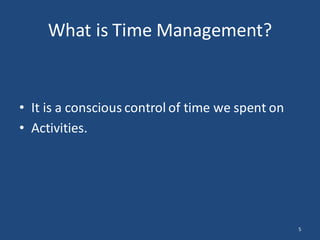
What is Time Management?
• It is a conscious control of time we spent on
• Activities.
5
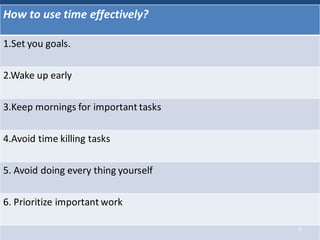
How to use time effectively?
1.Set you goals.
2.Wake up early
3.Keep mornings for important tasks
4.Avoid time killing tasks
5. Avoid doing every thing yourself
6. Prioritize important work
6
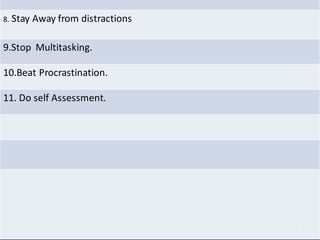
8. Stay Away from distractions
9.Stop Multitasking.
10.Beat Procrastination.
11. Do self Assessment.
7
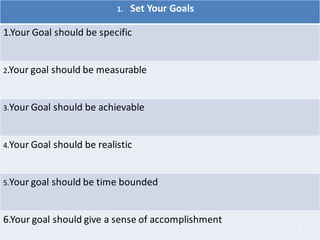
1. Set Your Goals
1.Your Goal should be specific
2.Your goal should be measurable
3.Your Goal should be achievable
4.Your Goal should be realistic
5.Your goal should be time bounded
6.Your goal should give a sense of accomplishment
8
2. Wake up Early in the morning
Winning starts at your beginning. Your firsthours are where the great heroes are
made.-----Robin Sharma.
1. Set your alarm for the time you want to wake up.
2. Set your alarm just 15 minutes earlier every day.
3. Gradually count down your wake up time
4.Eventually get used to the rhythm of early rising 9
Take this book into action and make your
day longer.
10
3.Keep Mornings for most important tasks
Research says morning hours are more productive hours.
Have a specific reason to get up early in the morning.
Devote sometime to spiritual practice.
Have a consistencemorning routine.
Invest your time for top priority activities
Carve your morning time to read or writing a bit every day makes you
more creative
11
4. Avoid Time killing tasks
1.Focus on genuinely important things.
2.Identify activities that acts as a detriment to your career, such as
Gossip----quarreling with others---Watching T.V . Playing video games,
Petty tasks, eating junk food, Procrastination, wrong decisions,
Complaining others, Hanging with negative people, bad habits,
divert your thought process and task at hand.
Determine what is significant and what is not significant.
Draw distinction between being busy and being productive
12
5.Avoid doing every thing yourself
Delegation is not running away from duties.
Delegation is an art of time management.
Define the task that must be done by you and that must be done by
others.
Delegate a task to the right person.
Delegate a task when you are not good at something
Delegation, saves time , money and gives the ability to focus on higher
level task. 13
6. Prioritize important work
The most urgent decisions are rarely the most important ones
----Dwight Eisenshower
Urgent and Important:-Tasksthat need immediate attention.
Important ,but not urgent-Tasksthat can be scheduled later
Urgent ,but not important—Tasks thatcan be delegated to some one.
Neither urgent not important---Tasksthat can be avoided.
Make a distinction between urgent and important tasks. Urgent tasks
are time sensitive, need immediate attention. Important tasks
contribute to professional growth in the long run.
Make a clear distinction between urgent and important tasks.
14
7. Be organized
It is said that 30 percent of our time is wasted on searching
misplaced things.
Keep things organized and easily accessible.
Keep things in their designated place.
Organize your documentsinto different categories.
Mark important dates, events and set up reminders to meet your
deadlines.
Make a weekly appointment with yourself to clear the paper clutter.
15
8. Stay Away from all the distractions
“Productivity is never an accident. It is always a result of a commitment to excellence,
intelligent planning and focused effort”.
------Paul J.Meyer
Stay away from all the distractions when your are committedto
excellence.
List out the things that distract you.
Block out all distractive elements.
Avoid multi tasking
Block out social networking sites,Whats app alerts
Surround yourself with work minded people.
16
9.Stop Multitasking
Multitasking can be defined as taking up two or more tasks
simultaneously.
According to research multitasking is detriment to over all productivity.
Prepare a to do list .Set up a time limit to every task.
Keep your time sensitive tasks at the top.
Focus on single task. Start achieving one after the other.
Studies have shown that our brain is not able to focus on two tasks at a
time. 17
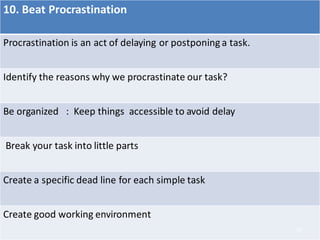
10. Beat Procrastination
Procrastination is an act of delaying or postponing a task.
Identify the reasons why we procrastinate our task?
Be organized : Keep things accessible to avoid delay
Break your task into little parts
Create a specific dead line for each simple task
Create good working environment
18
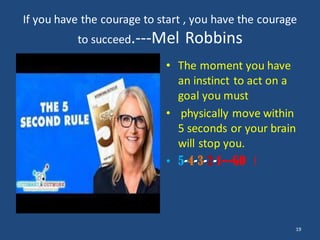
If you have the courage to start , you have the courage
to succeed.---Mel Robbins
• The moment you have
an instinct to act on a
goal you must
• physically move within
5 seconds or your brain
will stop you.
• 5-4-3-2-1---GO !
19
20
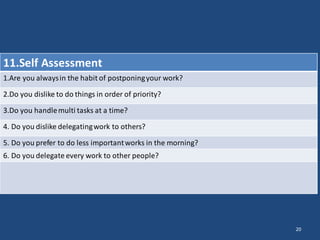
11.Self Assessment
1.Are you alwaysin the habit of postponingyour work?
2.Do you dislike to do things in order of priority?
3.Do you handlemulti tasks at a time?
4. Do you dislike delegatingwork to others?
5. Do you prefer to do less importantworks in the morning?
6. Do you delegate every work to other people?
21
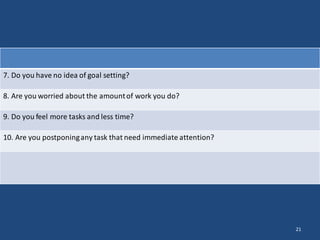
7. Do you have no idea of goal setting?
8. Are you worried about the amountof work you do?
9. Do you feel more tasks and less time?
10. Are you postponingany task that need immediate attention?
Self Assessment
22
Note: Answer yes/ No to the above questions. Give one point for yes and give
one point for no.
If your answer is No for more than 7 questions, you have excellent time
management techniques.
if your answer is Yes for more than 7 questions , you need to improve time
management skills.
23
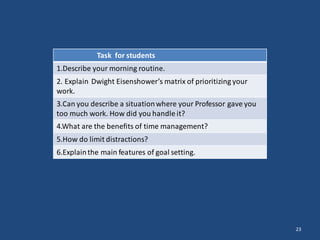
Task for students
1.Describe your morning routine.
2. Explain Dwight Eisenshower’s matrix of prioritizing your
work.
3.Can you describe a situationwhere your Professor gave you
too much work. How did you handle it?
4.What are the benefits of time management?
5.How do limit distractions?
6.Explainthe main features of goal setting.
24
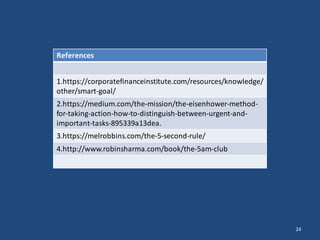
References
1.https://corporatefinanceinstitute.com/resources/knowledge/
other/smart-goal/
2.https://medium.com/the-mission/the-eisenhower-method-
for-taking-action-how-to-distinguish-between-urgent-and-
important-tasks-895339a13dea.
3.https://melrobbins.com/the-5-second-rule/
4.http://www.robinsharma.com/book/the-5am-club
25
Manjula

TIME MANAGEMENT

  • 1.
    Reddivari Manjula Assistant Professor JNTUACollege of Engineering Anantapur
  • 2.
    You are notsupposed to be the same person you were a year, Month, a day, or even 5 seconds ago. You are designed to grow. --Mel Robbins 2
  • 3.
    Time Management Target Audience:B.Tech Students This OER is developedon Time Managementfollowed by self assessment – Knowledge and assimilationquiz. After following this OER students are able to manage their time effectively 3
  • 4.
    What is timeManagement? 4
  • 5.
    What is TimeManagement? • It is a conscious control of time we spent on • Activities. 5
  • 6.
    How to usetime effectively? 1.Set you goals. 2.Wake up early 3.Keep mornings for important tasks 4.Avoid time killing tasks 5. Avoid doing every thing yourself 6. Prioritize important work 6
  • 7.
    8. Stay Awayfrom distractions 9.Stop Multitasking. 10.Beat Procrastination. 11. Do self Assessment. 7
  • 8.
    1. Set YourGoals 1.Your Goal should be specific 2.Your goal should be measurable 3.Your Goal should be achievable 4.Your Goal should be realistic 5.Your goal should be time bounded 6.Your goal should give a sense of accomplishment 8
  • 9.
    2. Wake upEarly in the morning Winning starts at your beginning. Your firsthours are where the great heroes are made.-----Robin Sharma. 1. Set your alarm for the time you want to wake up. 2. Set your alarm just 15 minutes earlier every day. 3. Gradually count down your wake up time 4.Eventually get used to the rhythm of early rising 9
  • 10.
    Take this bookinto action and make your day longer. 10
  • 11.
    3.Keep Mornings formost important tasks Research says morning hours are more productive hours. Have a specific reason to get up early in the morning. Devote sometime to spiritual practice. Have a consistencemorning routine. Invest your time for top priority activities Carve your morning time to read or writing a bit every day makes you more creative 11
  • 12.
    4. Avoid Timekilling tasks 1.Focus on genuinely important things. 2.Identify activities that acts as a detriment to your career, such as Gossip----quarreling with others---Watching T.V . Playing video games, Petty tasks, eating junk food, Procrastination, wrong decisions, Complaining others, Hanging with negative people, bad habits, divert your thought process and task at hand. Determine what is significant and what is not significant. Draw distinction between being busy and being productive 12
  • 13.
    5.Avoid doing everything yourself Delegation is not running away from duties. Delegation is an art of time management. Define the task that must be done by you and that must be done by others. Delegate a task to the right person. Delegate a task when you are not good at something Delegation, saves time , money and gives the ability to focus on higher level task. 13
  • 14.
    6. Prioritize importantwork The most urgent decisions are rarely the most important ones ----Dwight Eisenshower Urgent and Important:-Tasksthat need immediate attention. Important ,but not urgent-Tasksthat can be scheduled later Urgent ,but not important—Tasks thatcan be delegated to some one. Neither urgent not important---Tasksthat can be avoided. Make a distinction between urgent and important tasks. Urgent tasks are time sensitive, need immediate attention. Important tasks contribute to professional growth in the long run. Make a clear distinction between urgent and important tasks. 14
  • 15.
    7. Be organized Itis said that 30 percent of our time is wasted on searching misplaced things. Keep things organized and easily accessible. Keep things in their designated place. Organize your documentsinto different categories. Mark important dates, events and set up reminders to meet your deadlines. Make a weekly appointment with yourself to clear the paper clutter. 15
  • 16.
    8. Stay Awayfrom all the distractions “Productivity is never an accident. It is always a result of a commitment to excellence, intelligent planning and focused effort”. ------Paul J.Meyer Stay away from all the distractions when your are committedto excellence. List out the things that distract you. Block out all distractive elements. Avoid multi tasking Block out social networking sites,Whats app alerts Surround yourself with work minded people. 16
  • 17.
    9.Stop Multitasking Multitasking canbe defined as taking up two or more tasks simultaneously. According to research multitasking is detriment to over all productivity. Prepare a to do list .Set up a time limit to every task. Keep your time sensitive tasks at the top. Focus on single task. Start achieving one after the other. Studies have shown that our brain is not able to focus on two tasks at a time. 17
  • 18.
    10. Beat Procrastination Procrastinationis an act of delaying or postponing a task. Identify the reasons why we procrastinate our task? Be organized : Keep things accessible to avoid delay Break your task into little parts Create a specific dead line for each simple task Create good working environment 18
  • 19.
    If you havethe courage to start , you have the courage to succeed.---Mel Robbins • The moment you have an instinct to act on a goal you must • physically move within 5 seconds or your brain will stop you. • 5-4-3-2-1---GO ! 19
  • 20.
    20 11.Self Assessment 1.Are youalwaysin the habit of postponingyour work? 2.Do you dislike to do things in order of priority? 3.Do you handlemulti tasks at a time? 4. Do you dislike delegatingwork to others? 5. Do you prefer to do less importantworks in the morning? 6. Do you delegate every work to other people?
  • 21.
    21 7. Do youhave no idea of goal setting? 8. Are you worried about the amountof work you do? 9. Do you feel more tasks and less time? 10. Are you postponingany task that need immediate attention?
  • 22.
    Self Assessment 22 Note: Answeryes/ No to the above questions. Give one point for yes and give one point for no. If your answer is No for more than 7 questions, you have excellent time management techniques. if your answer is Yes for more than 7 questions , you need to improve time management skills.
  • 23.
    23 Task for students 1.Describeyour morning routine. 2. Explain Dwight Eisenshower’s matrix of prioritizing your work. 3.Can you describe a situationwhere your Professor gave you too much work. How did you handle it? 4.What are the benefits of time management? 5.How do limit distractions? 6.Explainthe main features of goal setting.
  • 24.
  • 25.