Integrated DNA Technologies
Mark Behlke MD, PhD Chief Scientific Officer
Ootemachi First Square Conference July 30, 2013
MBL/IDT Next Gen Sequencing Symposium
Improved Reagents & Methods for Target
Enrichment in Next Generation Sequencing
General NGS Workflow
2
DNA DNA Shearing
Adaptor and
Barcode [opt]
Attachment
Enrichment [optional]
Template/Library Preparation
Sequencing Analysis
Why enrich?
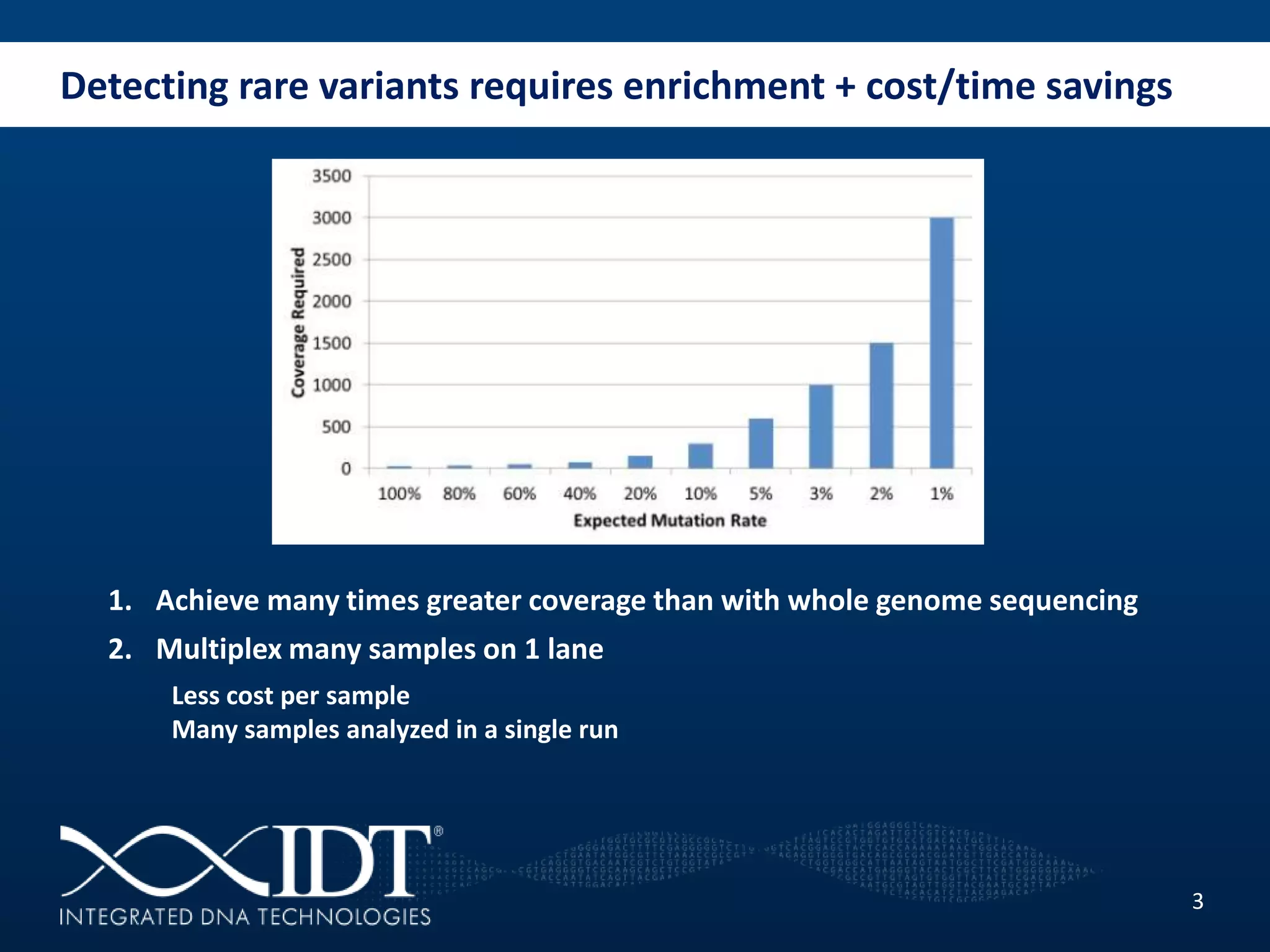
Detecting rare variants requires enrichment + cost/time savings
3
1. Achieve many times greater coverage than with whole genome sequencing
2. Multiplex many samples on 1 lane
Less cost per sample
Many samples analyzed in a single run
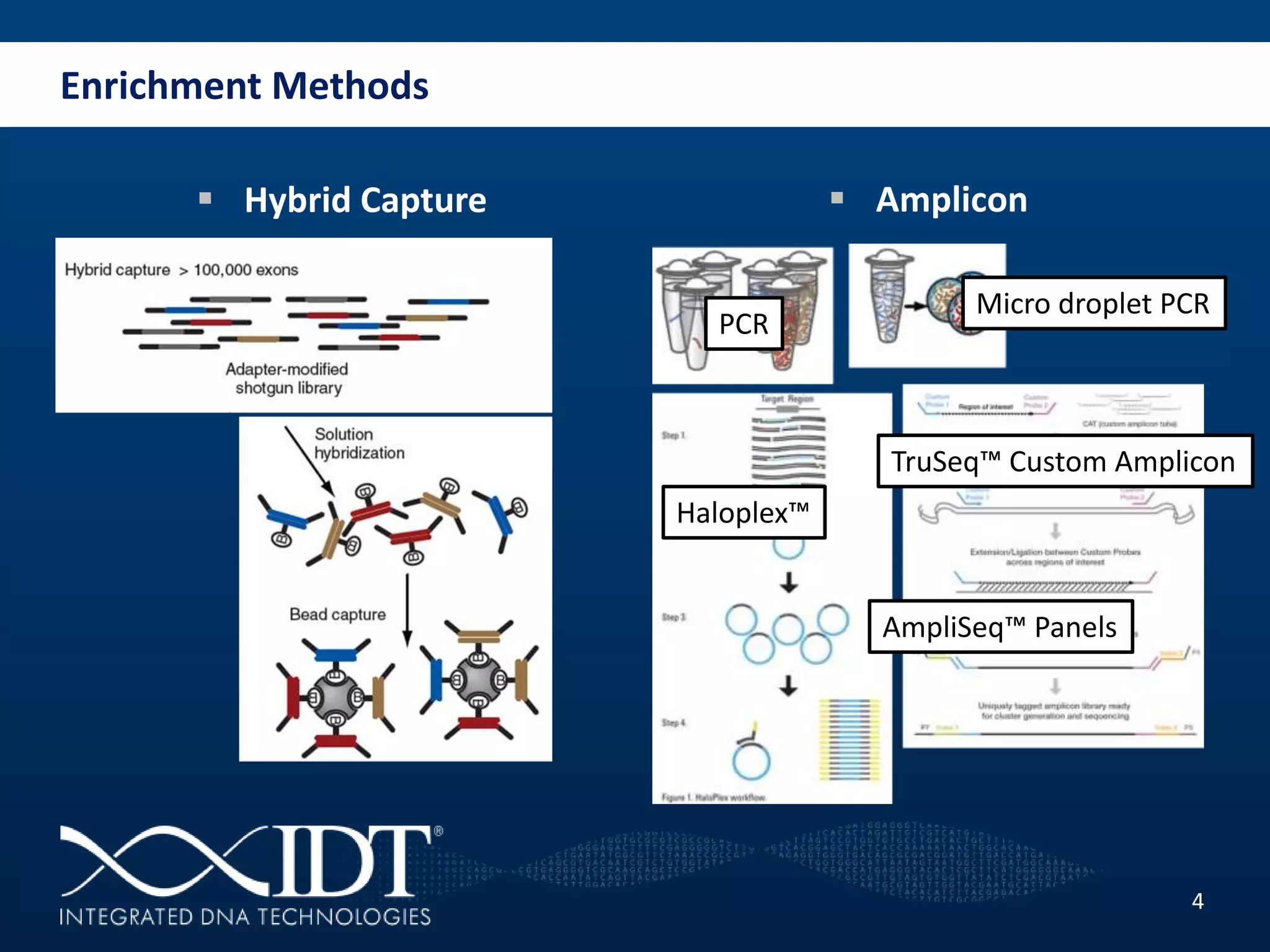
Enrichment Methods
4
 Hybrid Capture  Amplicon
PCR
Micro droplet PCR
Haloplex™
AmpliSeq™ Panels
TruSeq™ Custom Amplicon
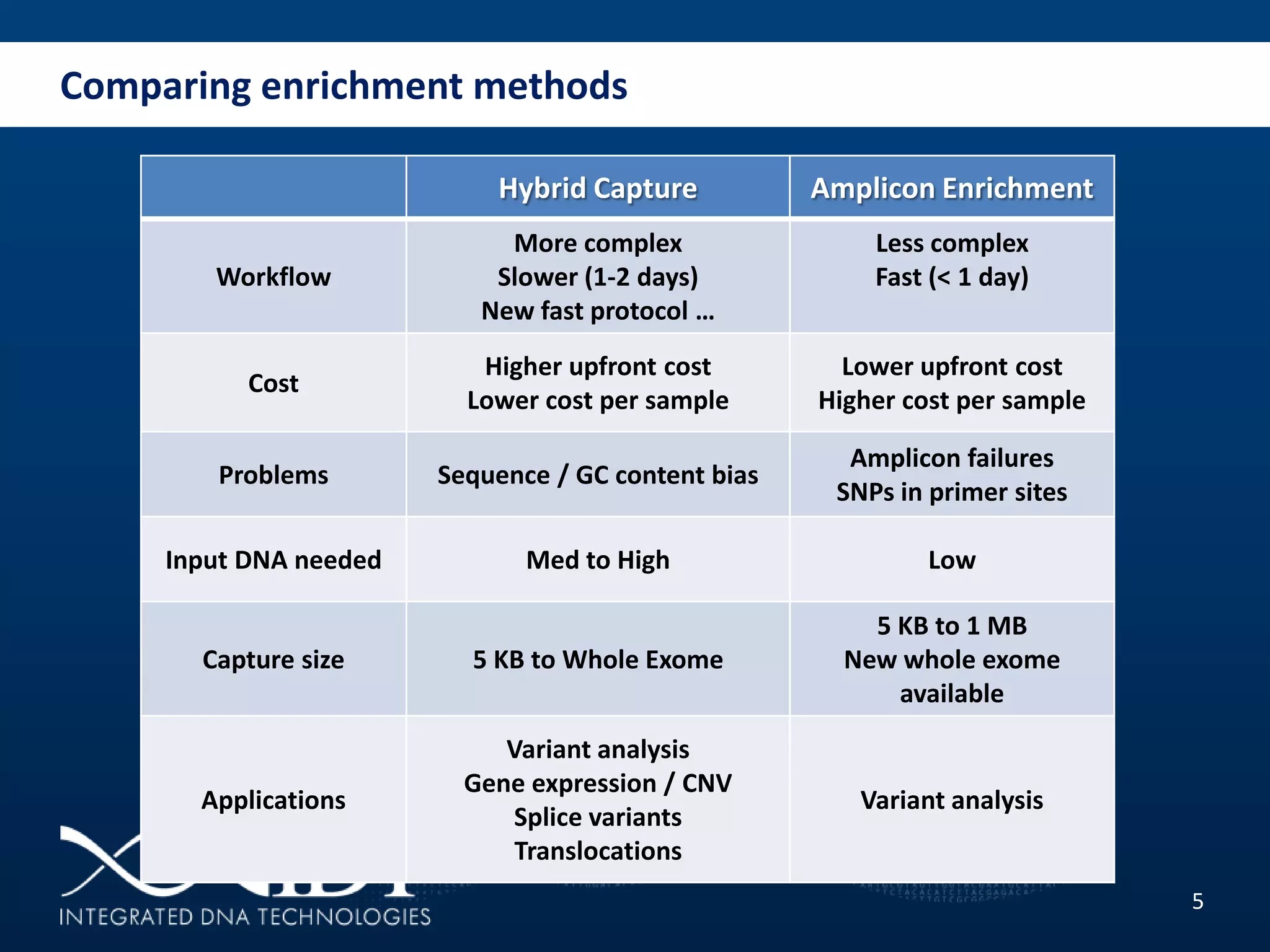
Comparing enrichment methods
5
Hybrid Capture Amplicon Enrichment
Workflow
More complex
Slower (1-2 days)
New fast protocol …
Less complex
Fast (< 1 day)
Cost
Higher upfront cost
Lower cost per sample
Lower upfront cost
Higher cost per sample
Problems Sequence / GC content bias
Amplicon failures
SNPs in primer sites
Input DNA needed Med to High Low
Capture size 5 KB to Whole Exome
5 KB to 1 MB
New whole exome
available
Applications
Variant analysis
Gene expression / CNV
Splice variants
Translocations
Variant analysis
Two different approaches to capture probes
6
• Agilent or NimbleGen whole exome kits
• Low quality, low yield oligo probes made on microarray chips
• Advantage = cheap to make a million probes (capture >50 Mb)
• Perfect way to make whole exome sets
• Disadvantage = low quality probes, cannot QC, no idea about individual
probe concentration
• Variable capture efficiency between target loci, big “GC” bias effect
• Difficult, slow and costly to change content
• IDT xGenTM LockdownTM Probes
• High quality, high yield oligos made individually
• Advantage = QC each oligo, measure and normalize yield prior to pooling
• Improved capture efficiency between many loci
• Disadvantage = higher price per probe (but high yield)
• Use for small focused sets or to spike into whole exome sets
• Easy to change content  just make another oligo and add to pool!
• High yield makes it cheaper when running lots of samples
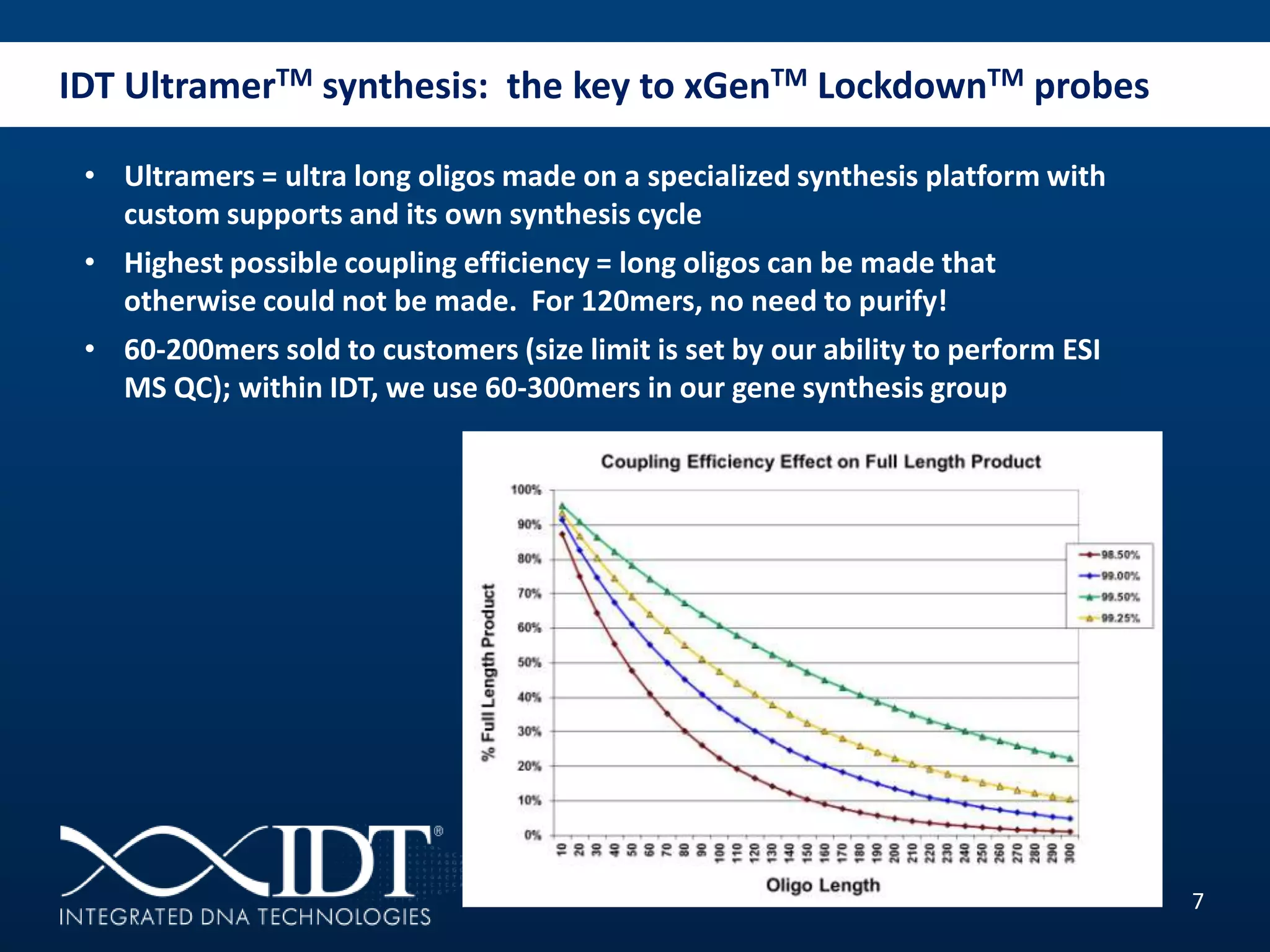
IDT UltramerTM synthesis: the key to xGenTM LockdownTM probes
7
• Ultramers = ultra long oligos made on a specialized synthesis platform with
custom supports and its own synthesis cycle
• Highest possible coupling efficiency = long oligos can be made that
otherwise could not be made. For 120mers, no need to purify!
• 60-200mers sold to customers (size limit is set by our ability to perform ESI
MS QC); within IDT, we use 60-300mers in our gene synthesis group
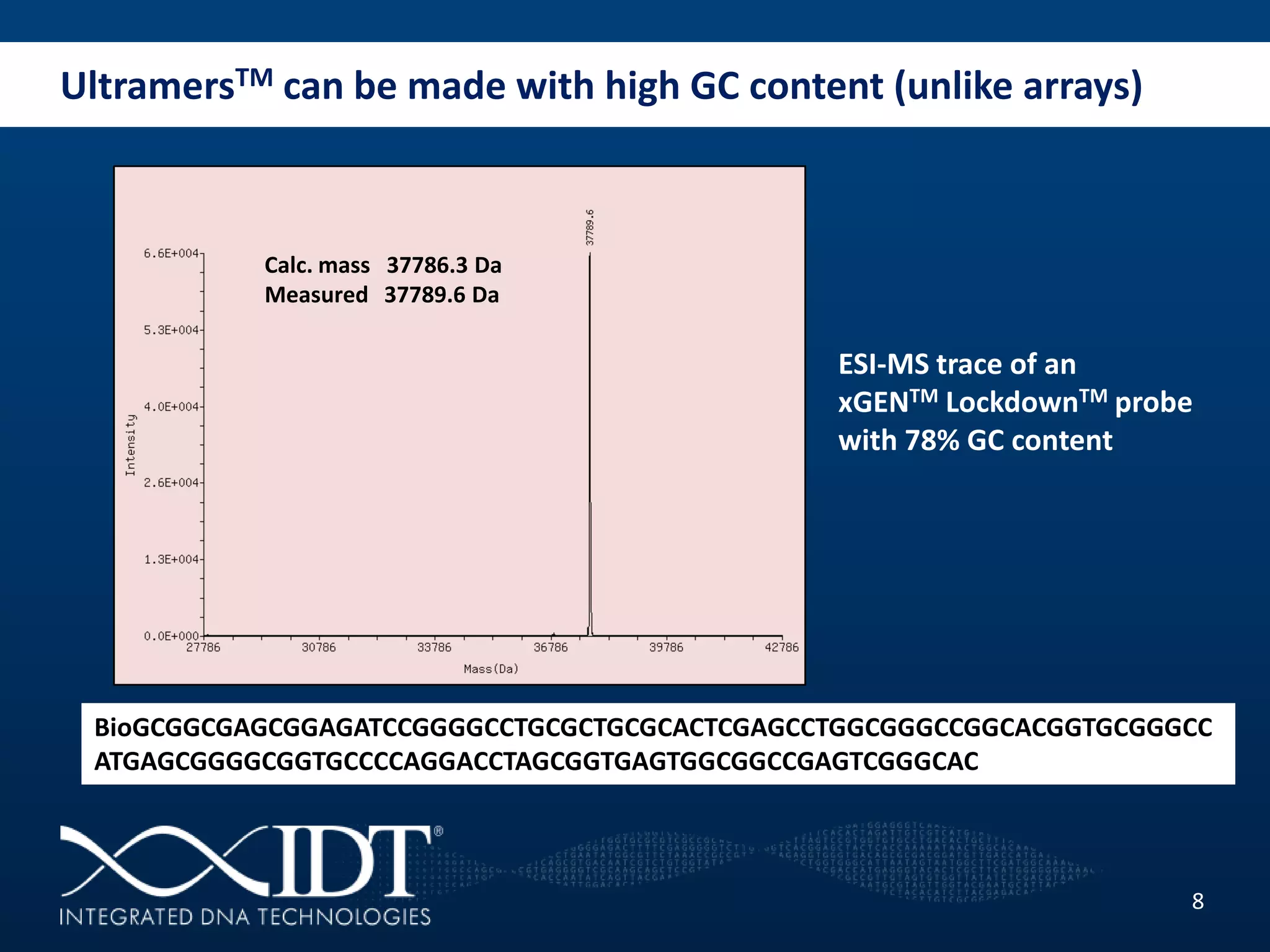
UltramersTM can be made with high GC content (unlike arrays)
8
Calc. mass 37786.3 Da
Measured 37789.6 Da
BioGCGGCGAGCGGAGATCCGGGGCCTGCGCTGCGCACTCGAGCCTGGCGGGCCGGCACGGTGCGGGCC
ATGAGCGGGGCGGTGCCCCAGGACCTAGCGGTGAGTGGCGGCCGAGTCGGGCAC
ESI-MS trace of an
xGENTM LockdownTM probe
with 78% GC content
Two ways to use xGenTM LockdownTM Probes
9
1. Make your own small focused sets with 5-2000 KB coverage
2. Spike into whole exome array oligo sets to improve performance of
products you may already be using
1. NimbleGen
2. Agilent
Improve Agilent SureSelectTM – example from Foundation Medicine
10
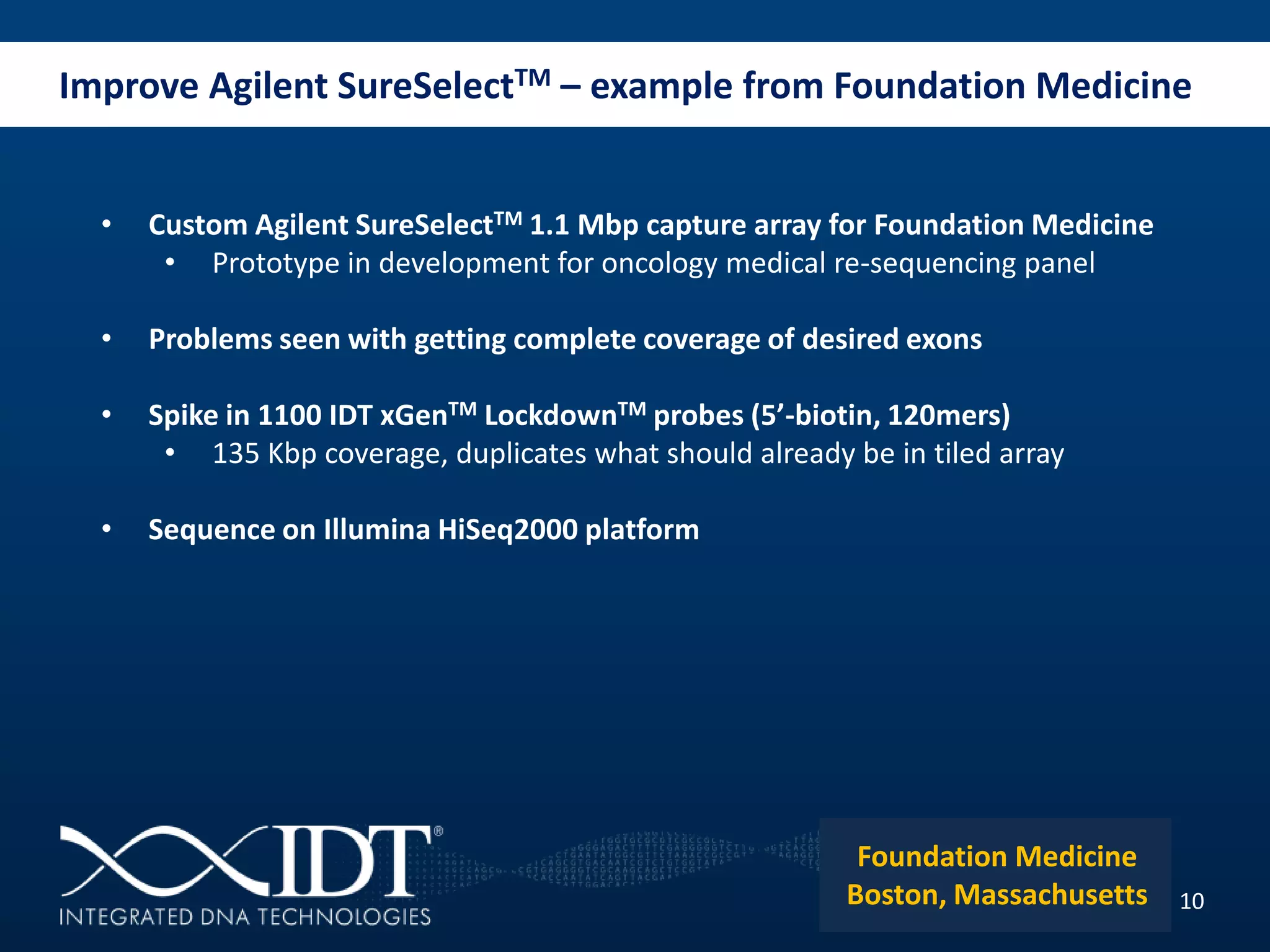
• Custom Agilent SureSelectTM 1.1 Mbp capture array for Foundation Medicine
• Prototype in development for oncology medical re-sequencing panel
• Problems seen with getting complete coverage of desired exons
• Spike in 1100 IDT xGenTM LockdownTM probes (5’-biotin, 120mers)
• 135 Kbp coverage, duplicates what should already be in tiled array
• Sequence on Illumina HiSeq2000 platform
Foundation Medicine
Boston, Massachusetts
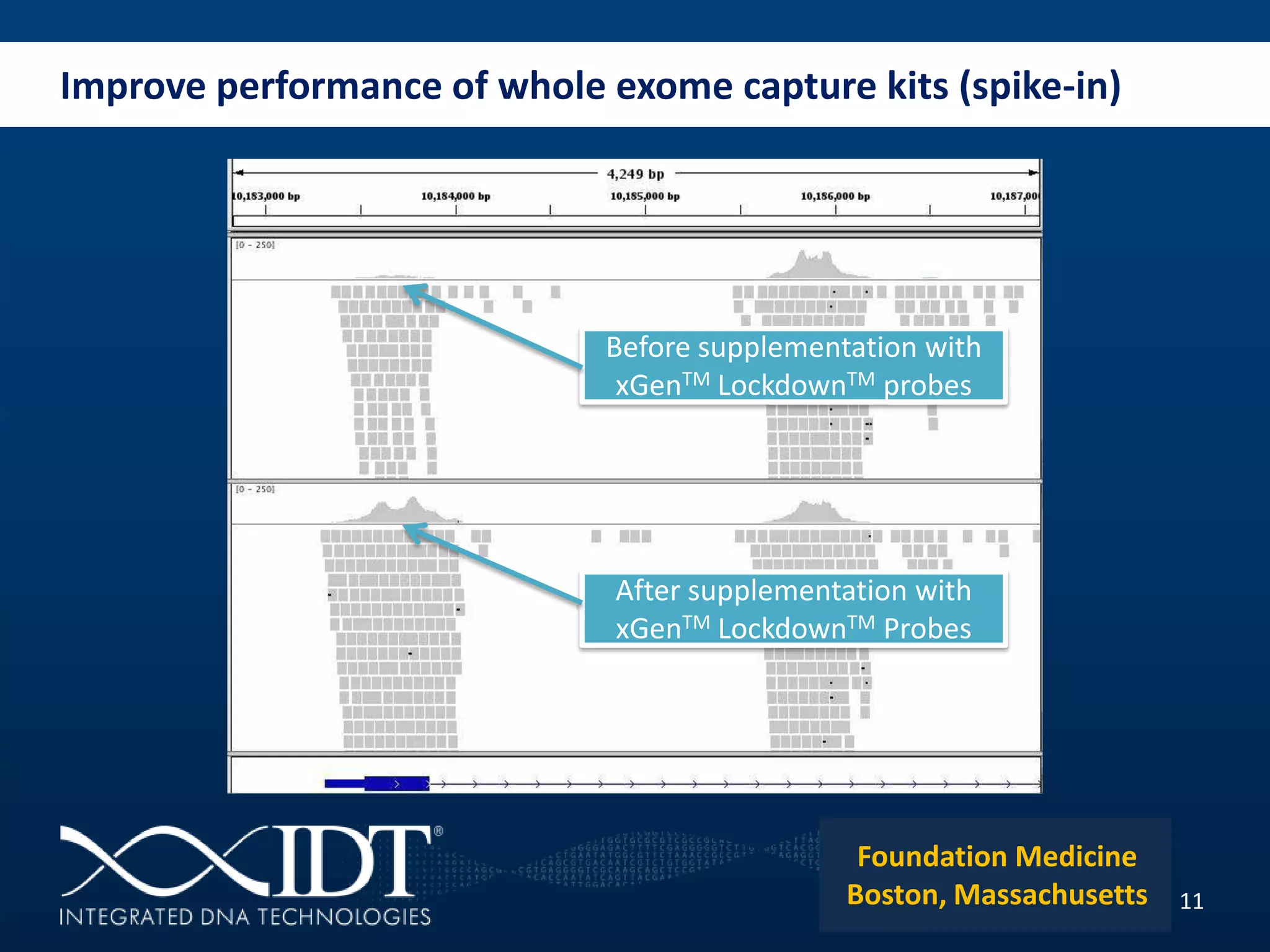
Improve performance of whole exome capture kits (spike-in)
11
Foundation Medicine
Boston, Massachusetts
Before supplementation with
xGenTM LockdownTM probes
After supplementation with
xGenTM LockdownTM Probes
Replace SureSelectTM with custom xGenTM LockdownTM Probe Library
12
Foundation Medicine
Boston, Massachusetts
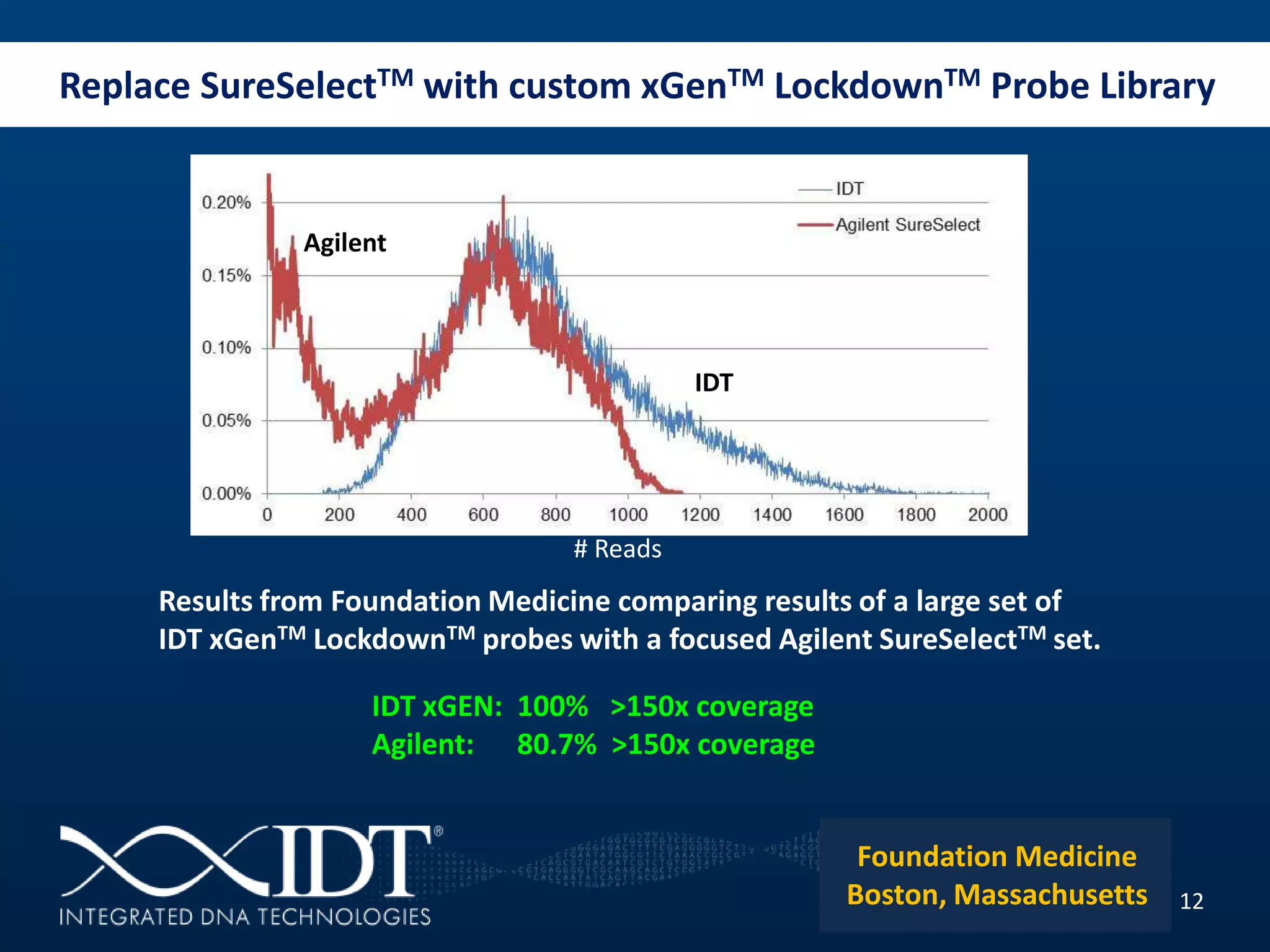
Results from Foundation Medicine comparing results of a large set of
IDT xGenTM LockdownTM probes with a focused Agilent SureSelectTM set.
IDT xGEN: 100% >150x coverage
Agilent: 80.7% >150x coverage
# Reads
IDT
Agilent
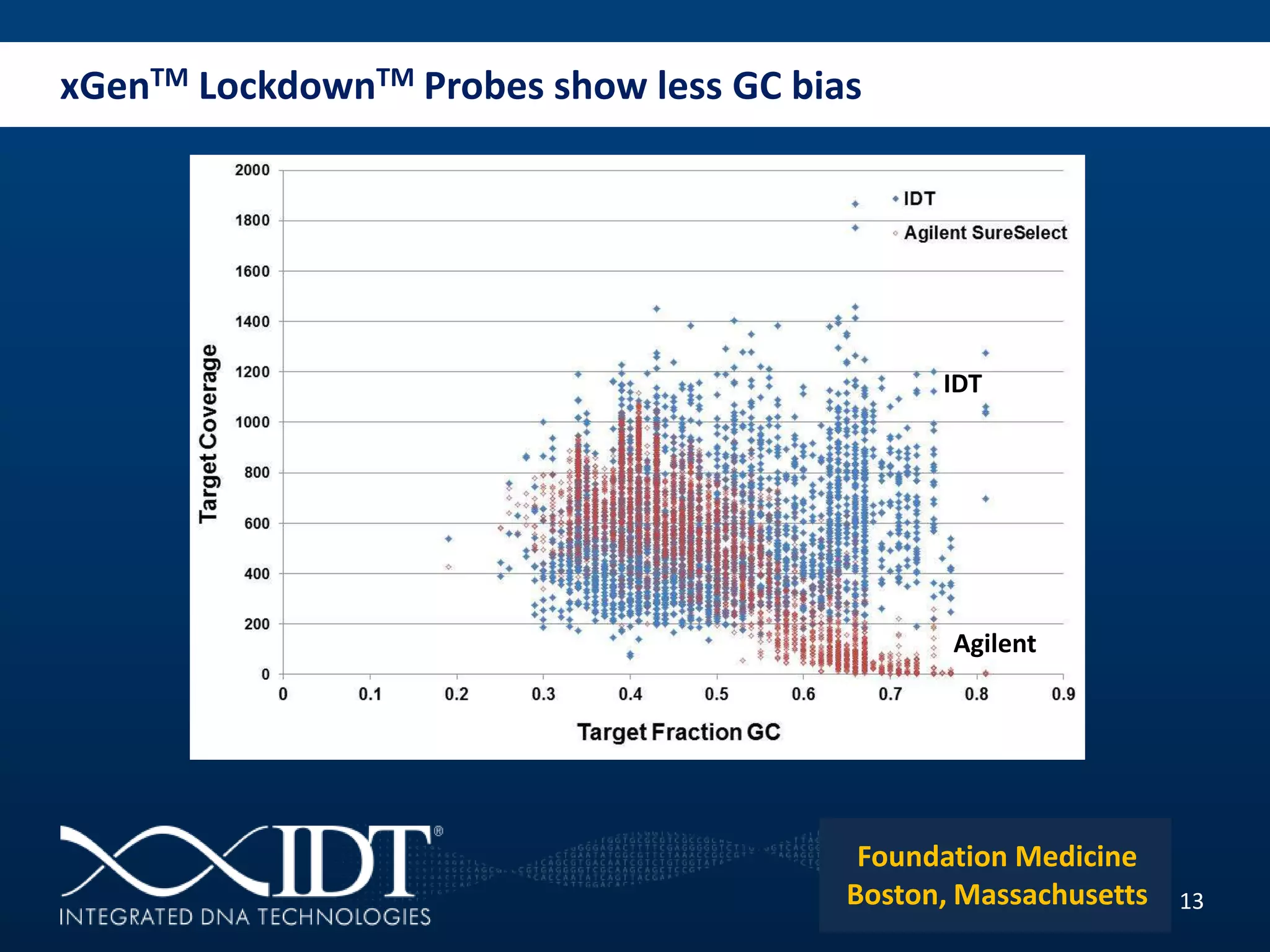
xGenTM LockdownTM Probes show less GC bias
13
Foundation Medicine
Boston, Massachusetts
IDT
Agilent
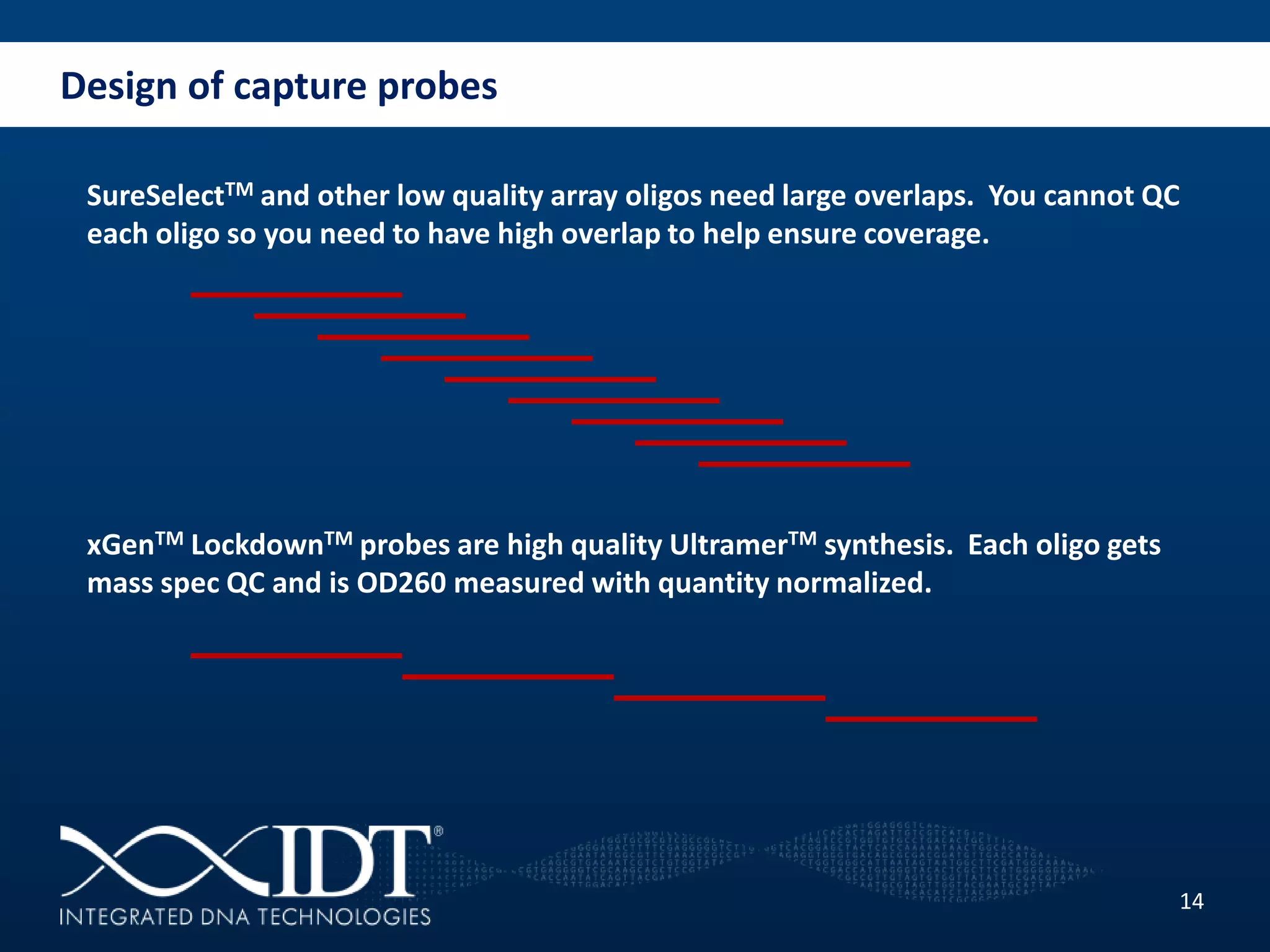
Design of capture probes
14
xGenTM LockdownTM probes are high quality UltramerTM synthesis. Each oligo gets
mass spec QC and is OD260 measured with quantity normalized.
SureSelectTM and other low quality array oligos need large overlaps. You cannot QC
each oligo so you need to have high overlap to help ensure coverage.
Do mutations in target hurt capture efficiency?
15
• Short oligos can distinguish a single SNP site based on hybridization.
Since the goal is to capture variants and detect these by sequencing, do
we risk missing SNPs due to hybridization failure?
• Long 120mers, however, are very tolerant to mismatch
• How tolerant?
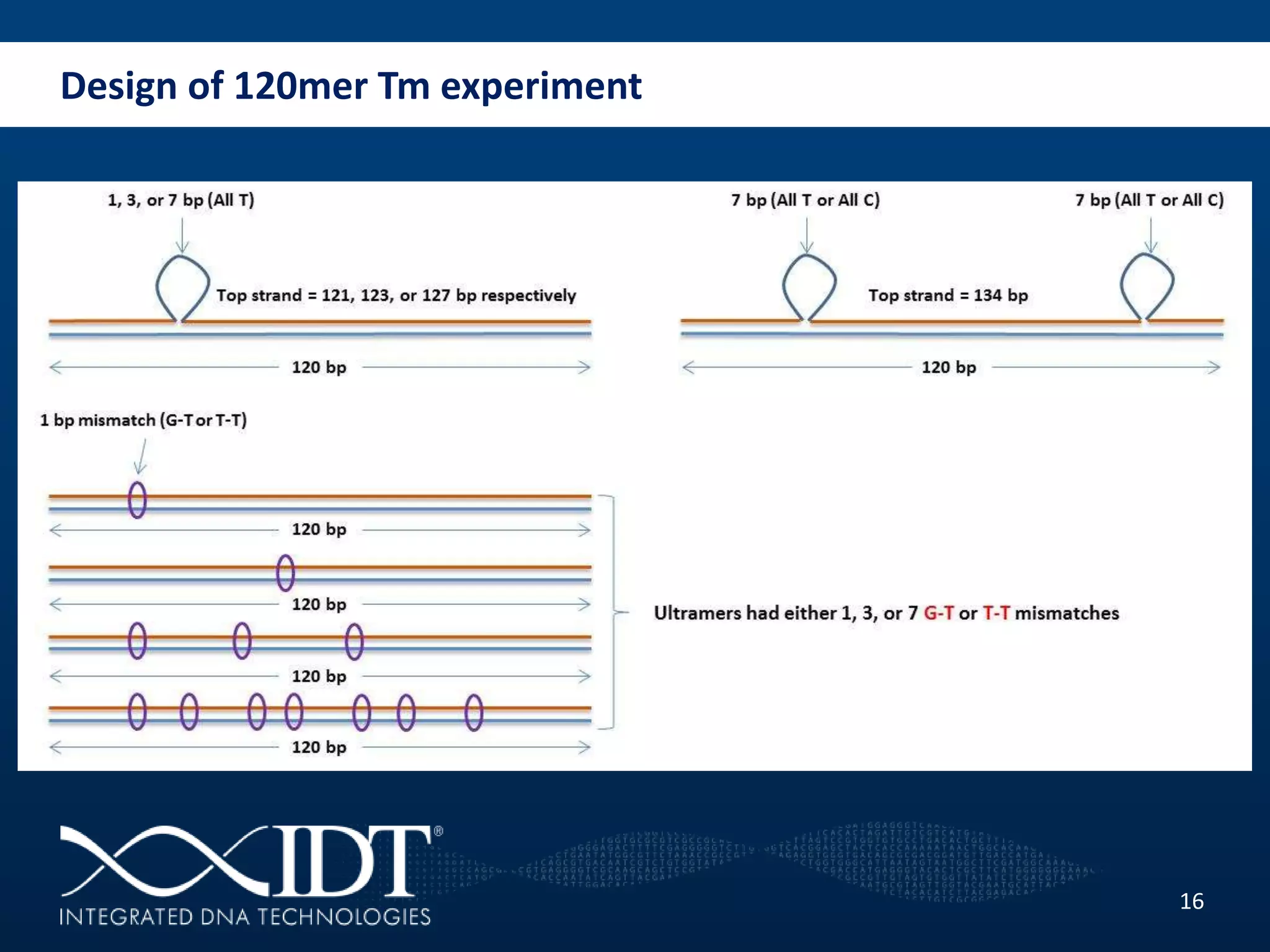
• Studied Tm of hybridization of a single 120mer bait oligo to different
targets having 0-7 bases mismatch (either permissive G:T pairing or
more disruptive T:T pairings)
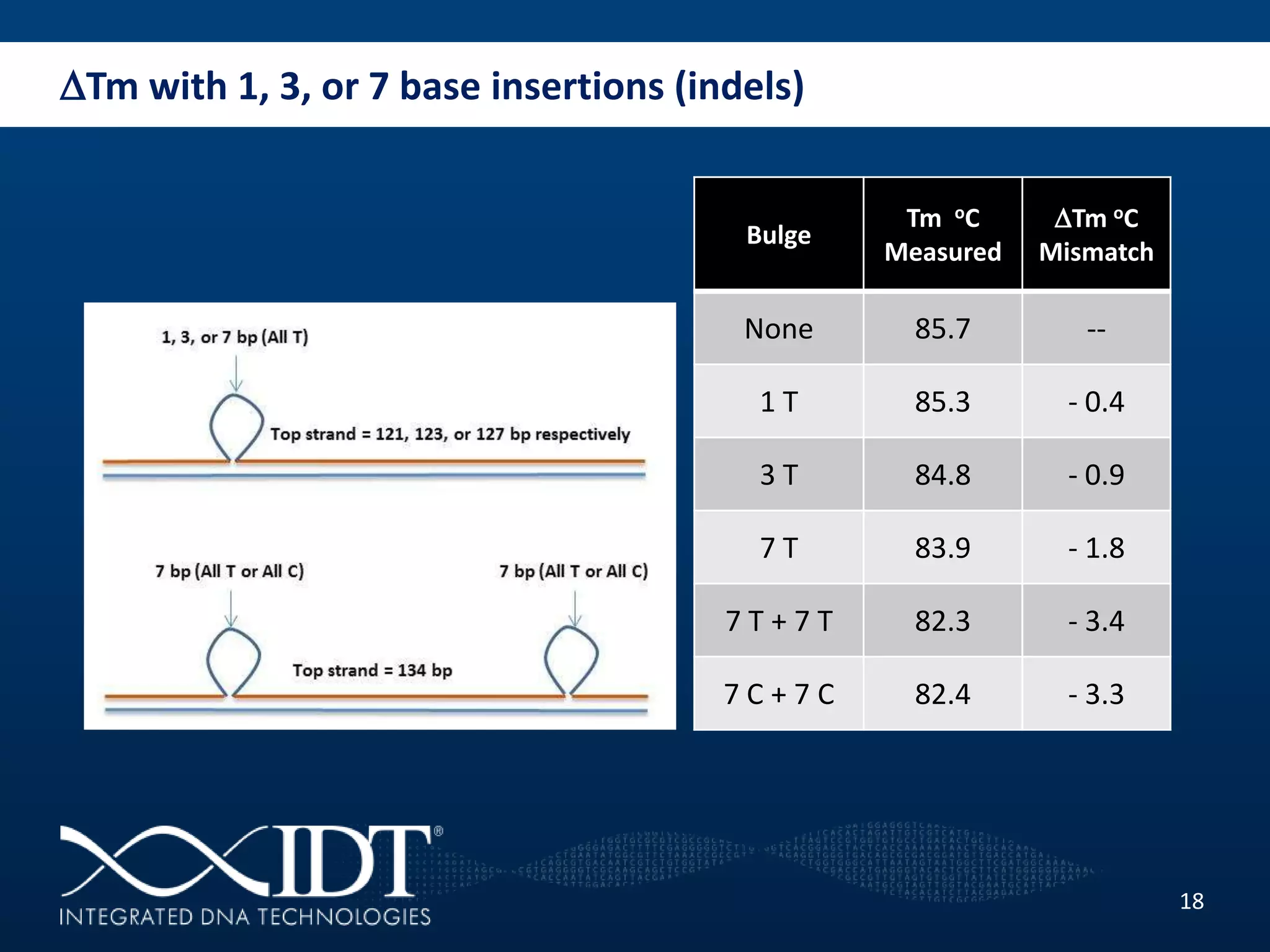
• Also studied targets with 1, 3, or 7 base insertions (indels)
Design of 120mer Tm experiment
16
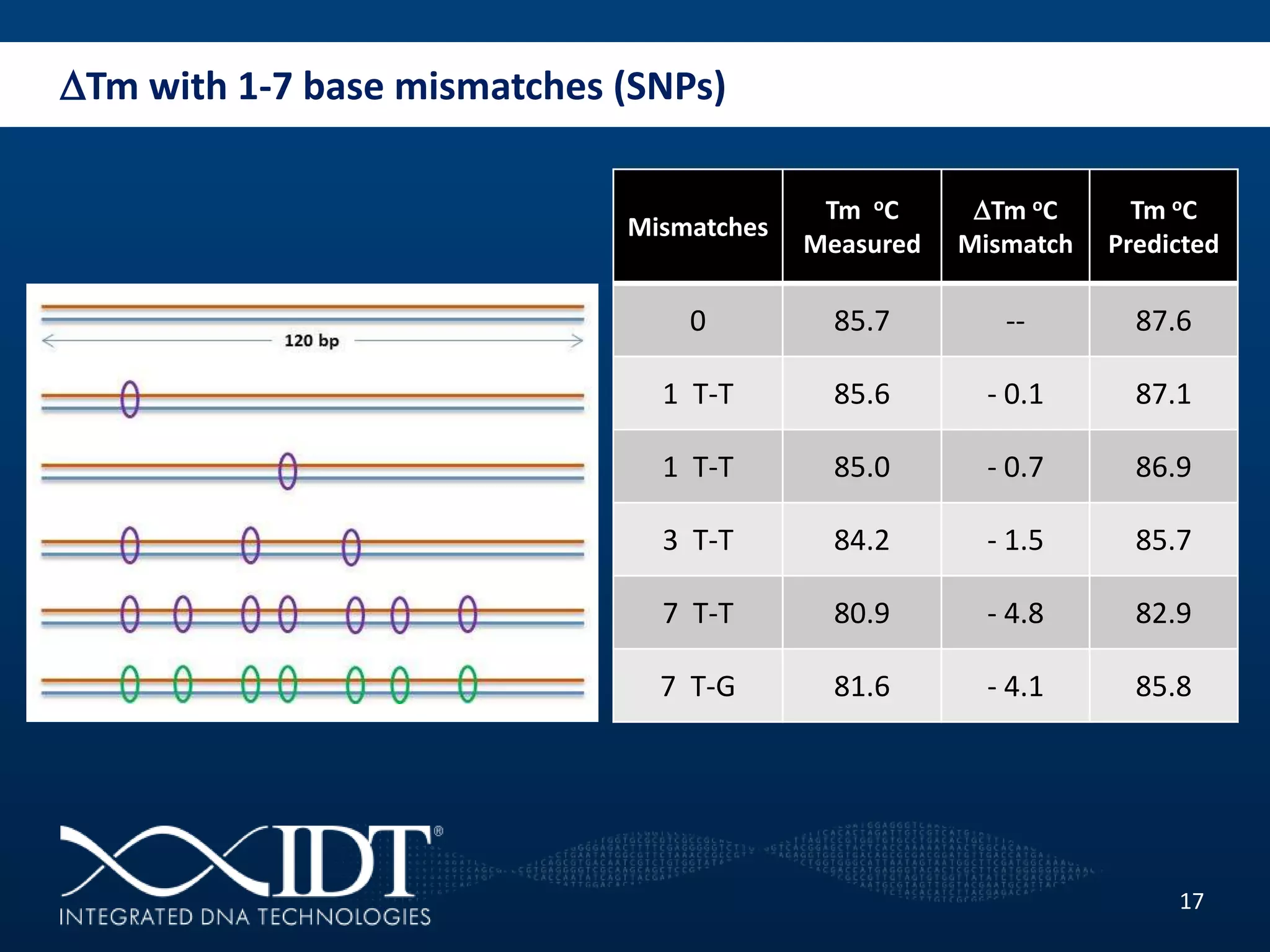
DTm with 1-7 base mismatches (SNPs)
17
Mismatches
Tm oC
Measured
DTm oC
Mismatch
Tm oC
Predicted
0 85.7 -- 87.6
1 T-T 85.6 - 0.1 87.1
1 T-T 85.0 - 0.7 86.9
3 T-T 84.2 - 1.5 85.7
7 T-T 80.9 - 4.8 82.9
7 T-G 81.6 - 4.1 85.8
DTm with 1, 3, or 7 base insertions (indels)
18
Bulge
Tm oC
Measured
DTm oC
Mismatch
None 85.7 --
1 T 85.3 - 0.4
3 T 84.8 - 0.9
7 T 83.9 - 1.8
7 T + 7 T 82.3 - 3.4
7 C + 7 C 82.4 - 3.3
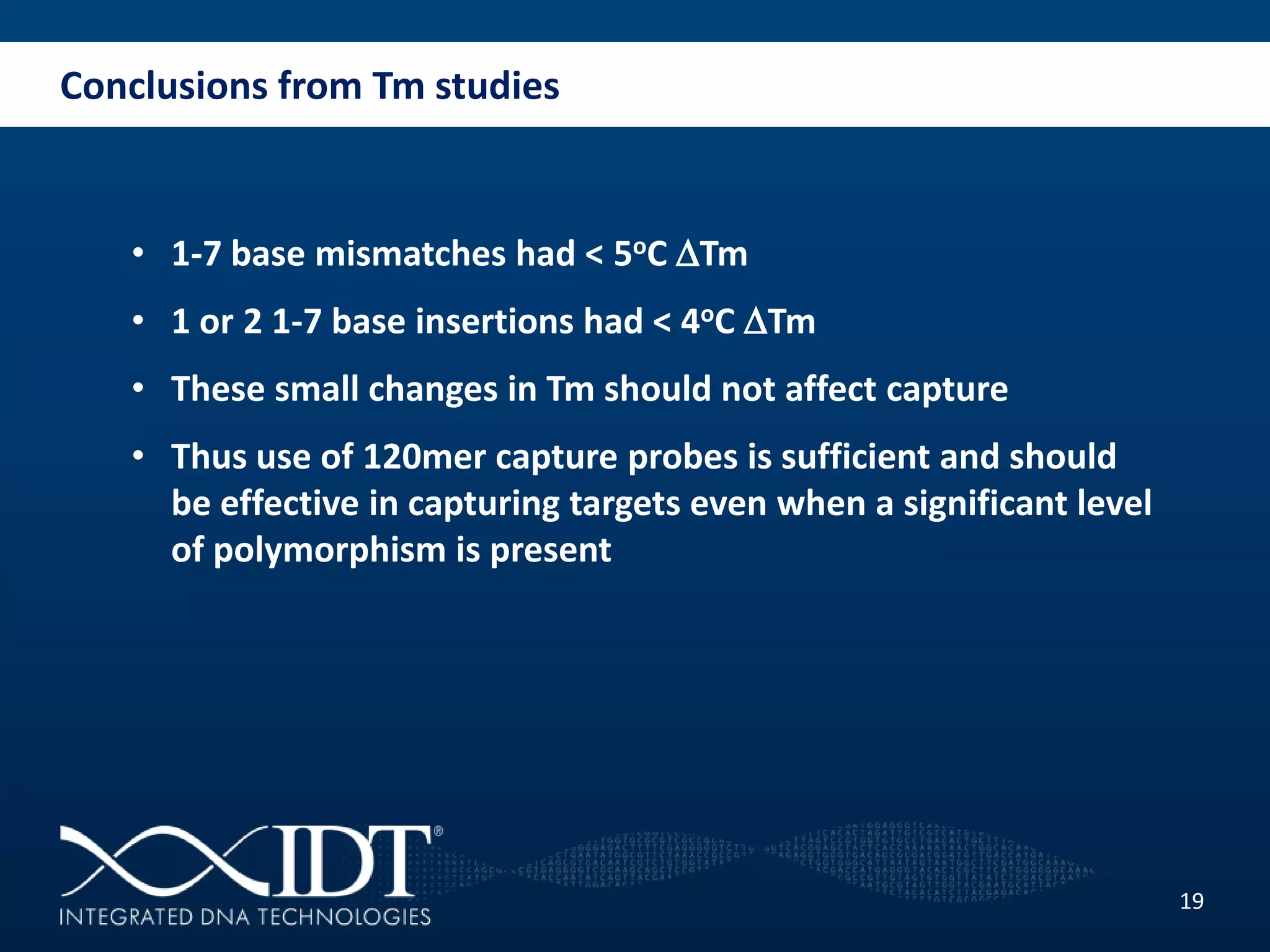
Conclusions from Tm studies
19
• 1-7 base mismatches had < 5oC DTm
• 1 or 2 1-7 base insertions had < 4oC DTm
• These small changes in Tm should not affect capture
• Thus use of 120mer capture probes is sufficient and should
be effective in capturing targets even when a significant level
of polymorphism is present
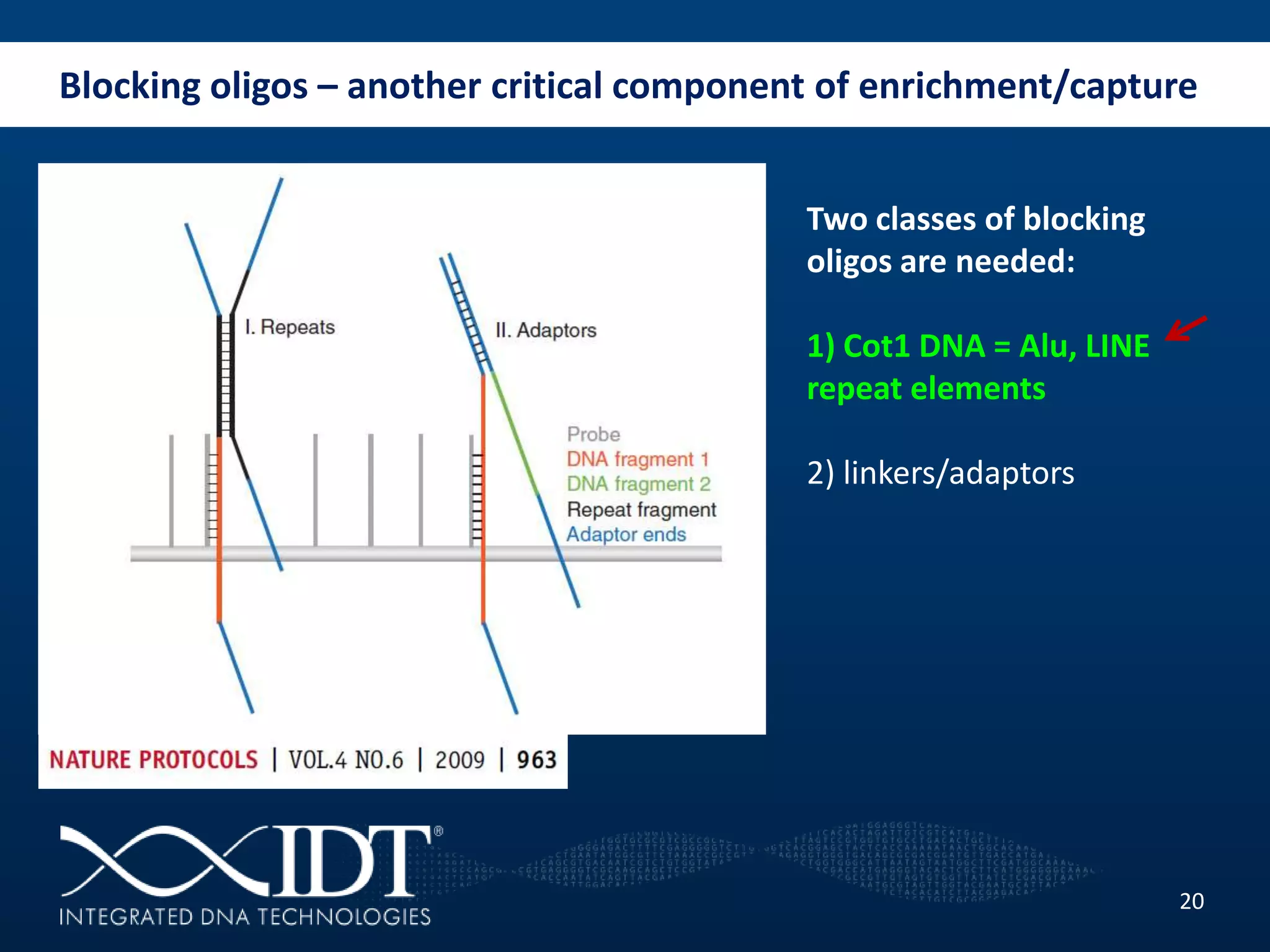
Blocking oligos – another critical component of enrichment/capture
20
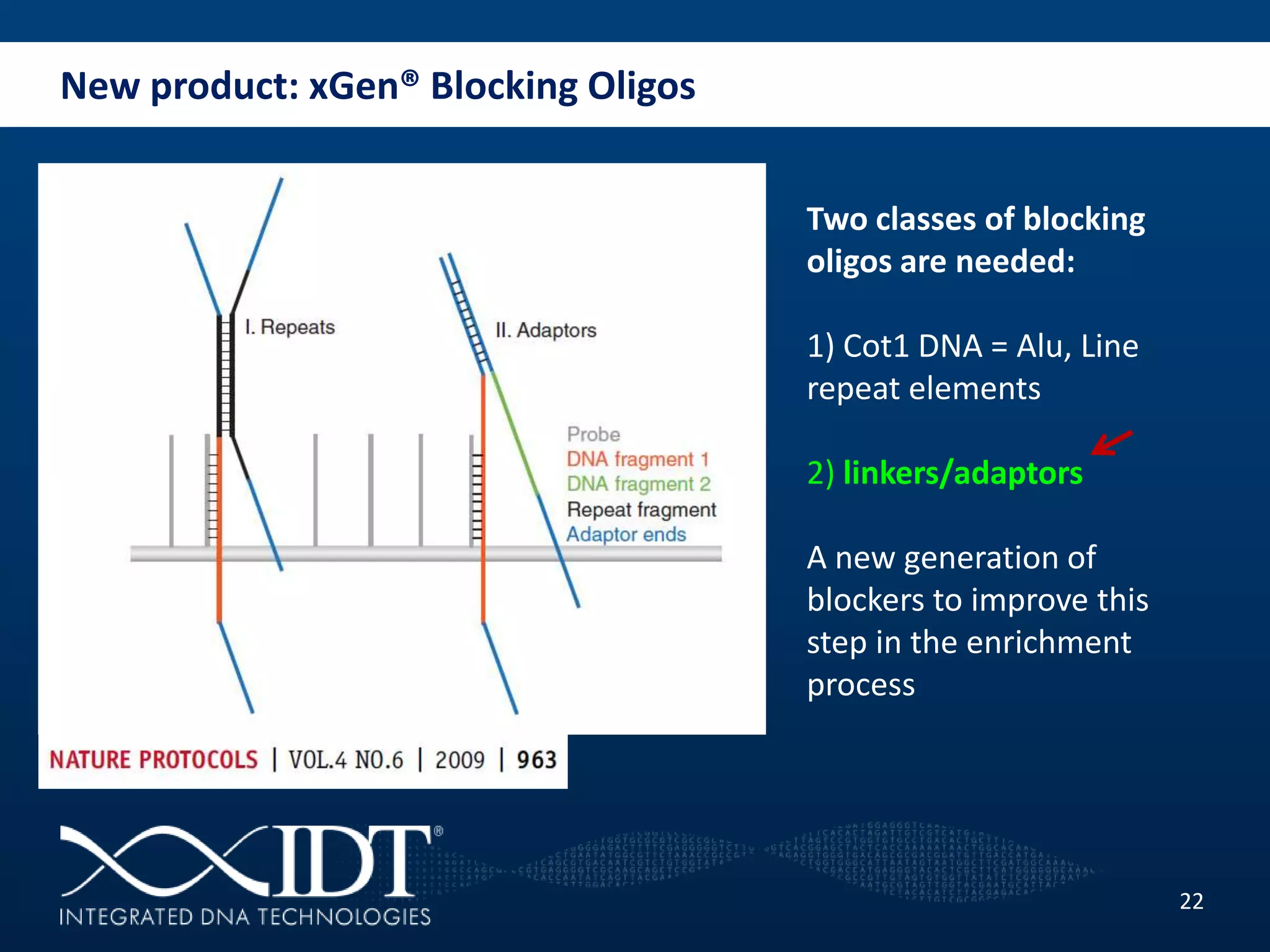
Two classes of blocking
oligos are needed:
1) Cot1 DNA = Alu, LINE
repeat elements
2) linkers/adaptors
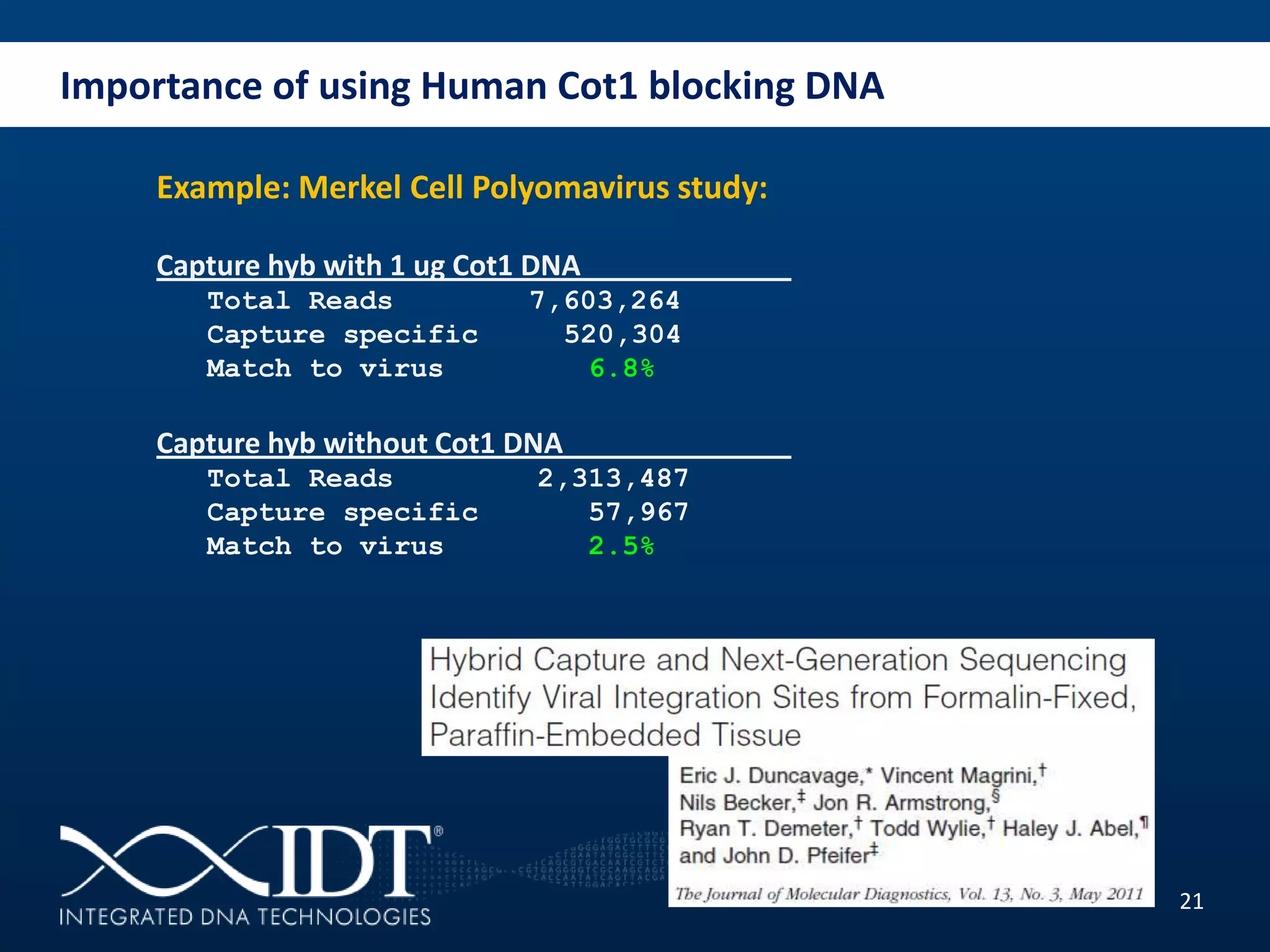
Importance of using Human Cot1 blocking DNA
21
Example: Merkel Cell Polyomavirus study:
Capture hyb with 1 ug Cot1 DNA
Total Reads 7,603,264
Capture specific 520,304
Match to virus 6.8%
Capture hyb without Cot1 DNA
Total Reads 2,313,487
Capture specific 57,967
Match to virus 2.5%
New product: xGen® Blocking Oligos
22
Two classes of blocking
oligos are needed:
1) Cot1 DNA = Alu, Line
repeat elements
2) linkers/adaptors
A new generation of
blockers to improve this
step in the enrichment
process
New xGen® Blocking Oligos
23
In early experiment, simple DNA blockers proved to be effective. By adding excess
blocker, ‘mass action’ drives hybridization in favor of the blocker-adaptor instead
of the undesired blocker-blocker pairing.
However, in most experiments done today, either one or both adaptors contains
an “index” or “bar code” sequence of 6-8 bases. Highly multiplexed experiments
now have mismatched blockers binding to adaptors, and on-target capture rates
dropped.
IDT offers a new solution to this problem: xGen® Blocking Oligos .
The new generation of blockers incorporates Inosine bases to pair with index
domains, so a single blocker can be used with all index variants. Further, the new
blockers have additional improvements which increase effectiveness and give
higher on-target capture rates.
Example of Inosine incorporation in one specific adaptor
24
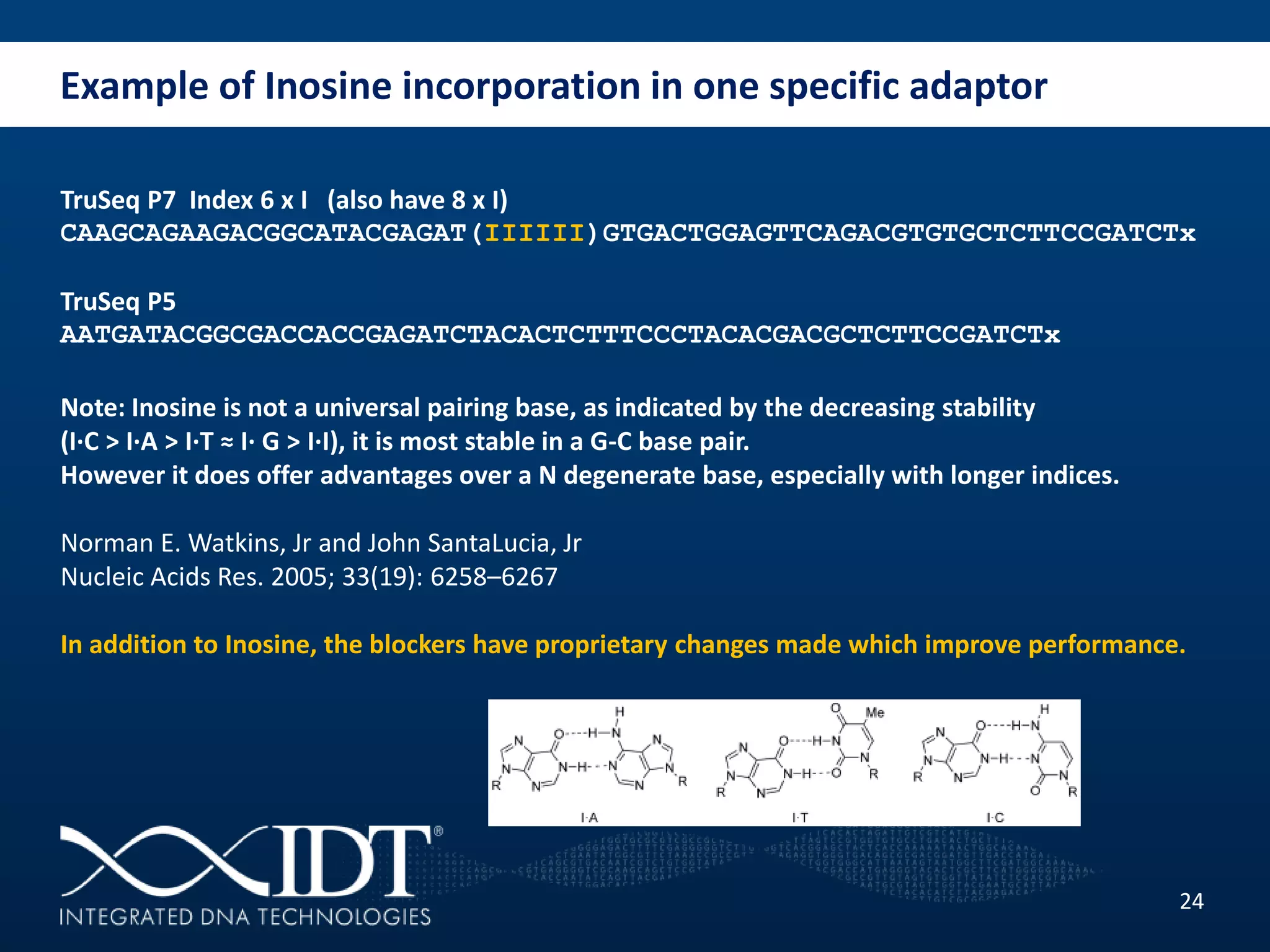
TruSeq P7 Index 6 x I (also have 8 x I)
CAAGCAGAAGACGGCATACGAGAT(IIIIII)GTGACTGGAGTTCAGACGTGTGCTCTTCCGATCTx
TruSeq P5
AATGATACGGCGACCACCGAGATCTACACTCTTTCCCTACACGACGCTCTTCCGATCTx
Note: Inosine is not a universal pairing base, as indicated by the decreasing stability
(I·C > I·A > I·T ≈ I· G > I·I), it is most stable in a G-C base pair.
However it does offer advantages over a N degenerate base, especially with longer indices.
Norman E. Watkins, Jr and John SantaLucia, Jr
Nucleic Acids Res. 2005; 33(19): 6258–6267
In addition to Inosine, the blockers have proprietary changes made which improve performance.
Performance of xGen® Blocking Oligos with an 11,000 probe capture set
25
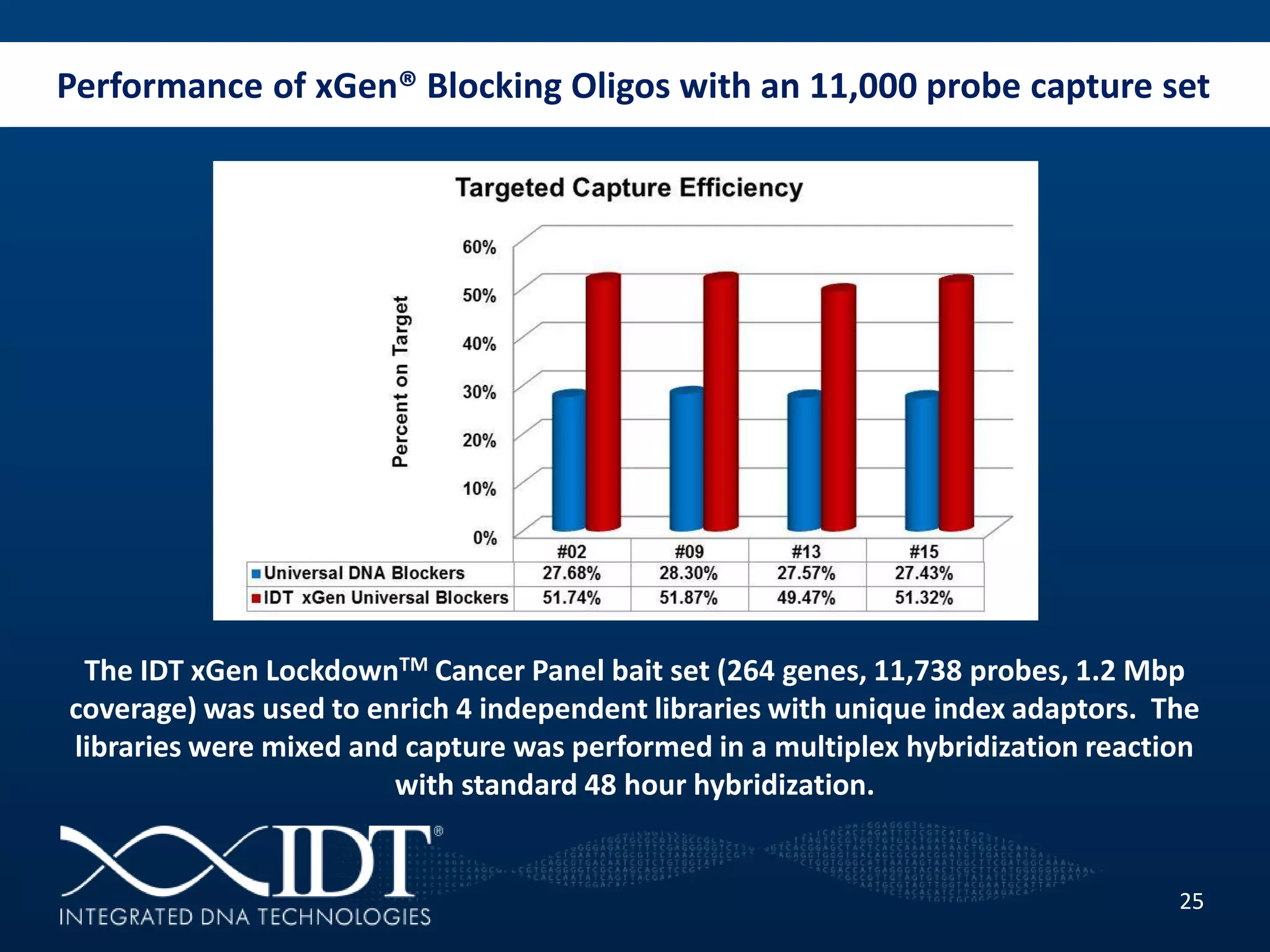
The IDT xGen LockdownTM Cancer Panel bait set (264 genes, 11,738 probes, 1.2 Mbp
coverage) was used to enrich 4 independent libraries with unique index adaptors. The
libraries were mixed and capture was performed in a multiplex hybridization reaction
with standard 48 hour hybridization.
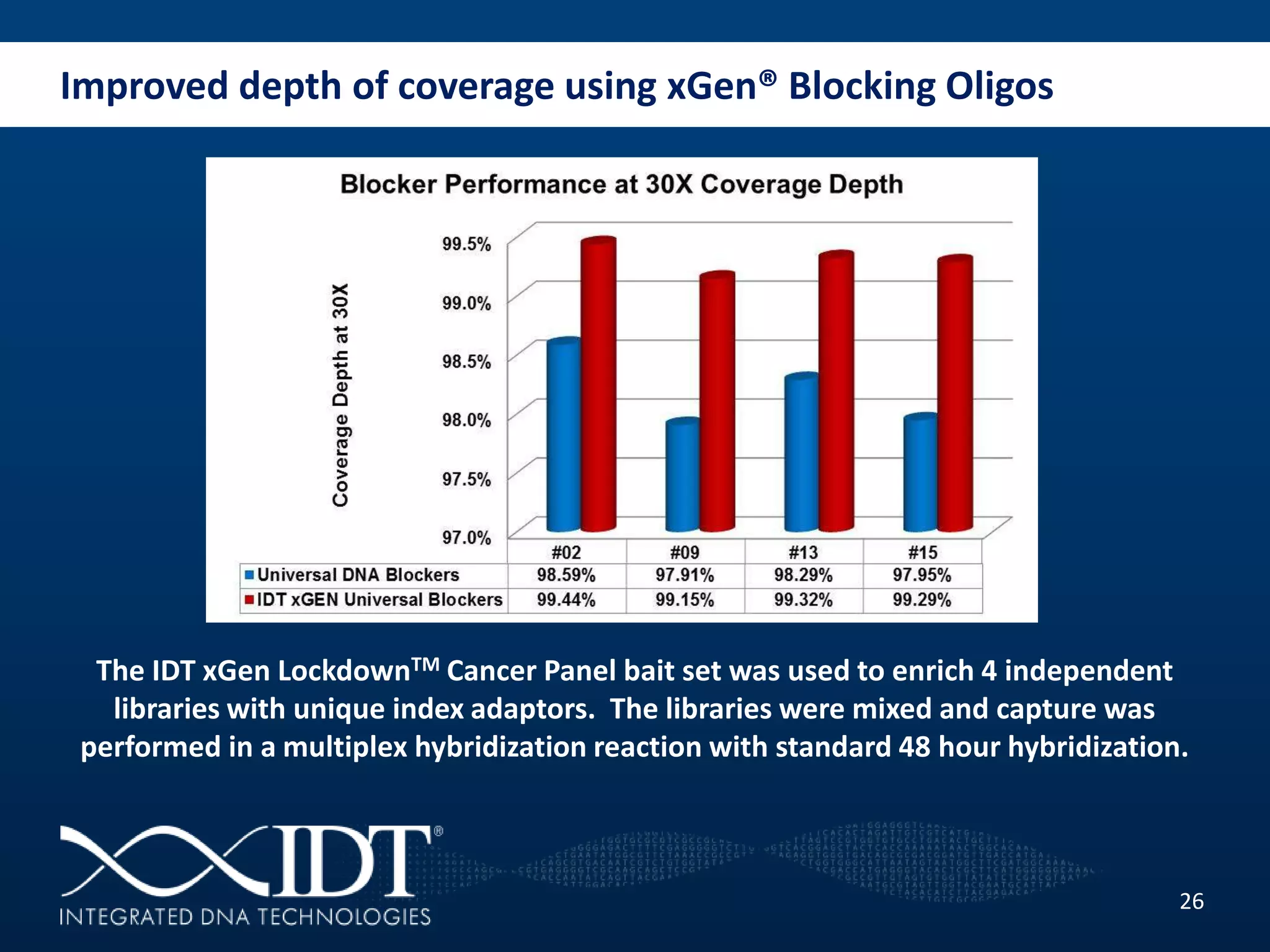
Improved depth of coverage using xGen® Blocking Oligos
26
The IDT xGen LockdownTM Cancer Panel bait set was used to enrich 4 independent
libraries with unique index adaptors. The libraries were mixed and capture was
performed in a multiplex hybridization reaction with standard 48 hour hybridization.
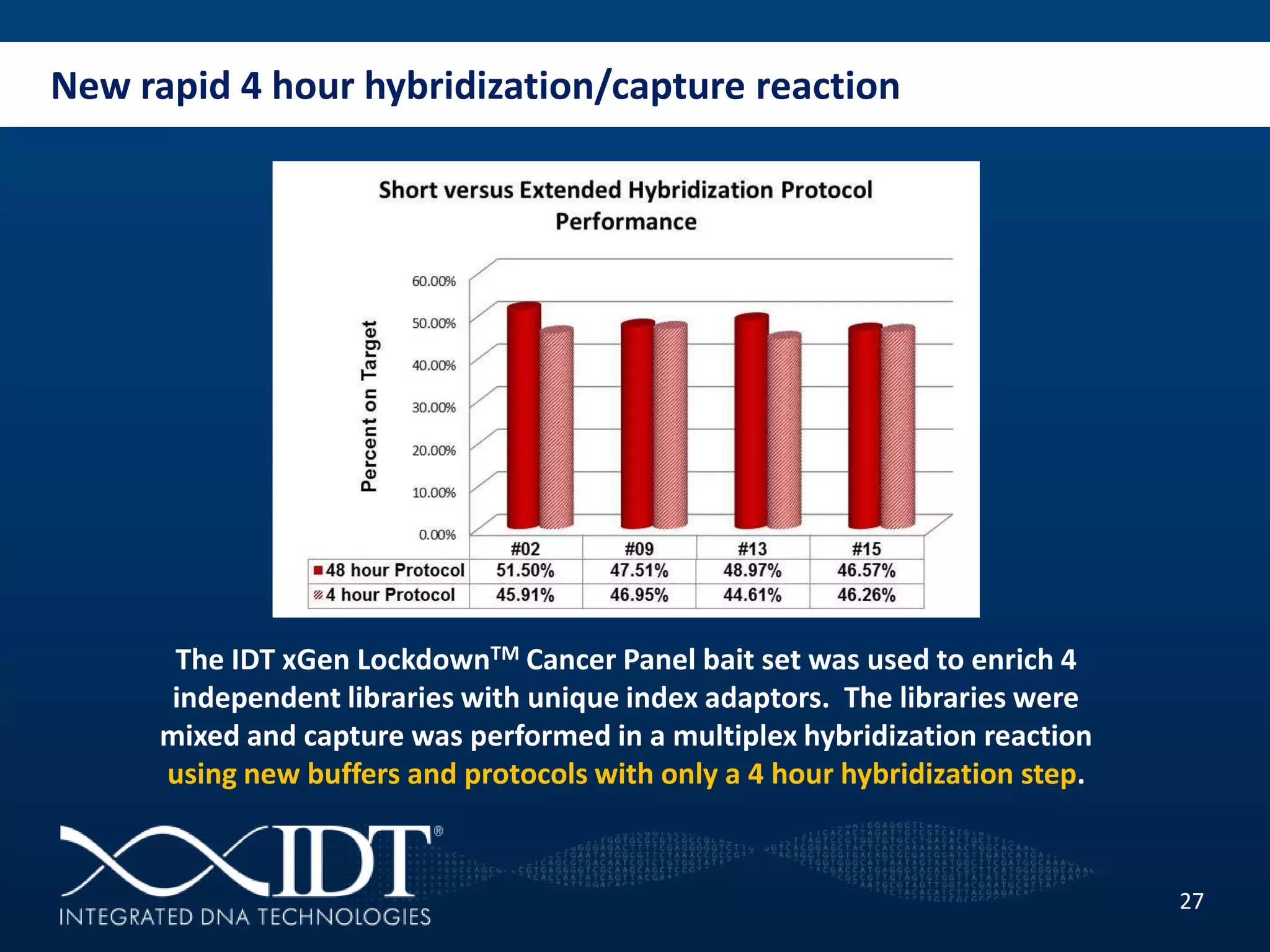
New rapid 4 hour hybridization/capture reaction
27
The IDT xGen LockdownTM Cancer Panel bait set was used to enrich 4
independent libraries with unique index adaptors. The libraries were
mixed and capture was performed in a multiplex hybridization reaction
using new buffers and protocols with only a 4 hour hybridization step.
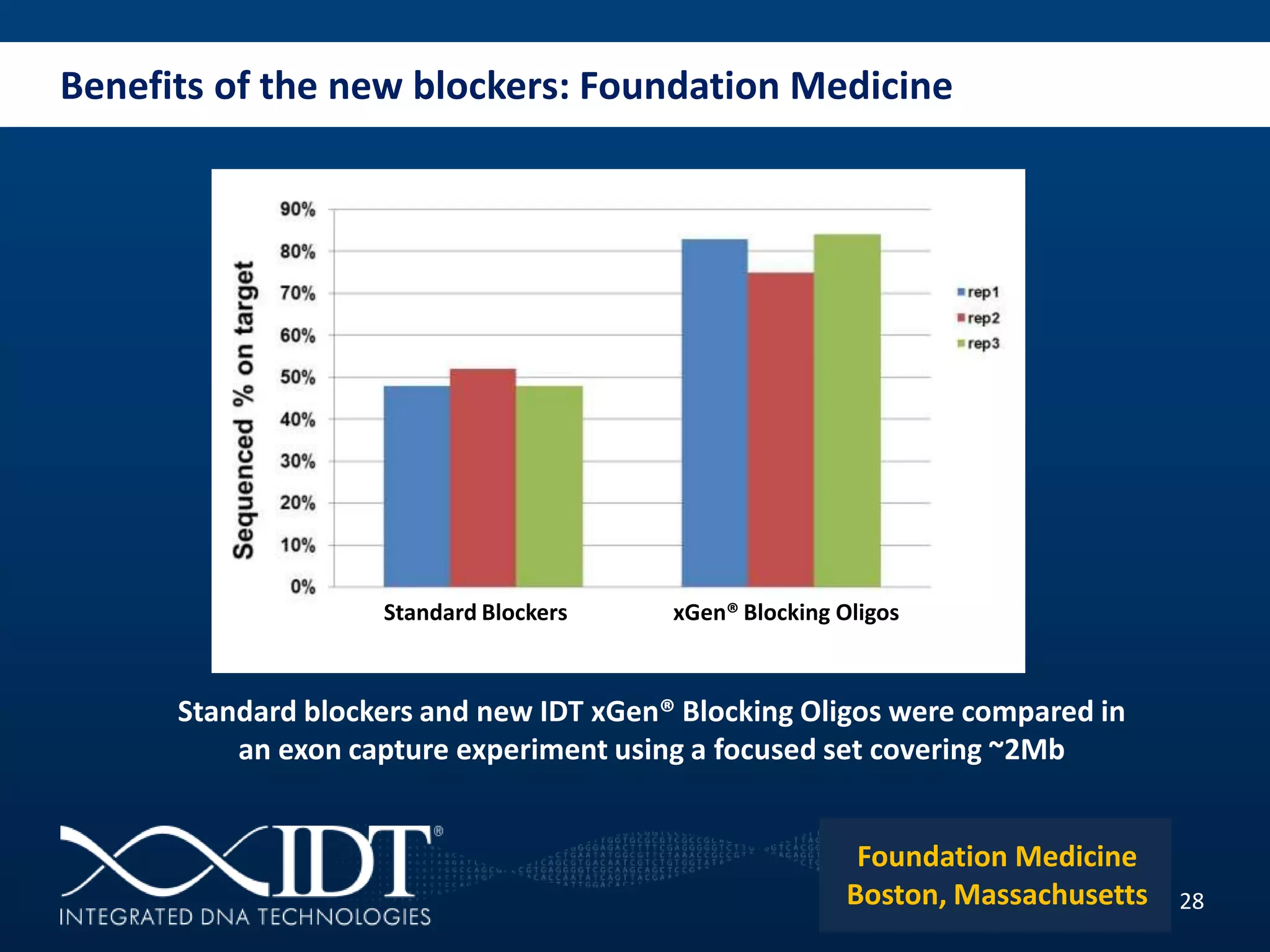
Benefits of the new blockers: Foundation Medicine
28
Standard blockers and new IDT xGen® Blocking Oligos were compared in
an exon capture experiment using a focused set covering ~2Mb
StandardStandard Blockers xGen® Blocking Oligos
Foundation Medicine
Boston, Massachusetts
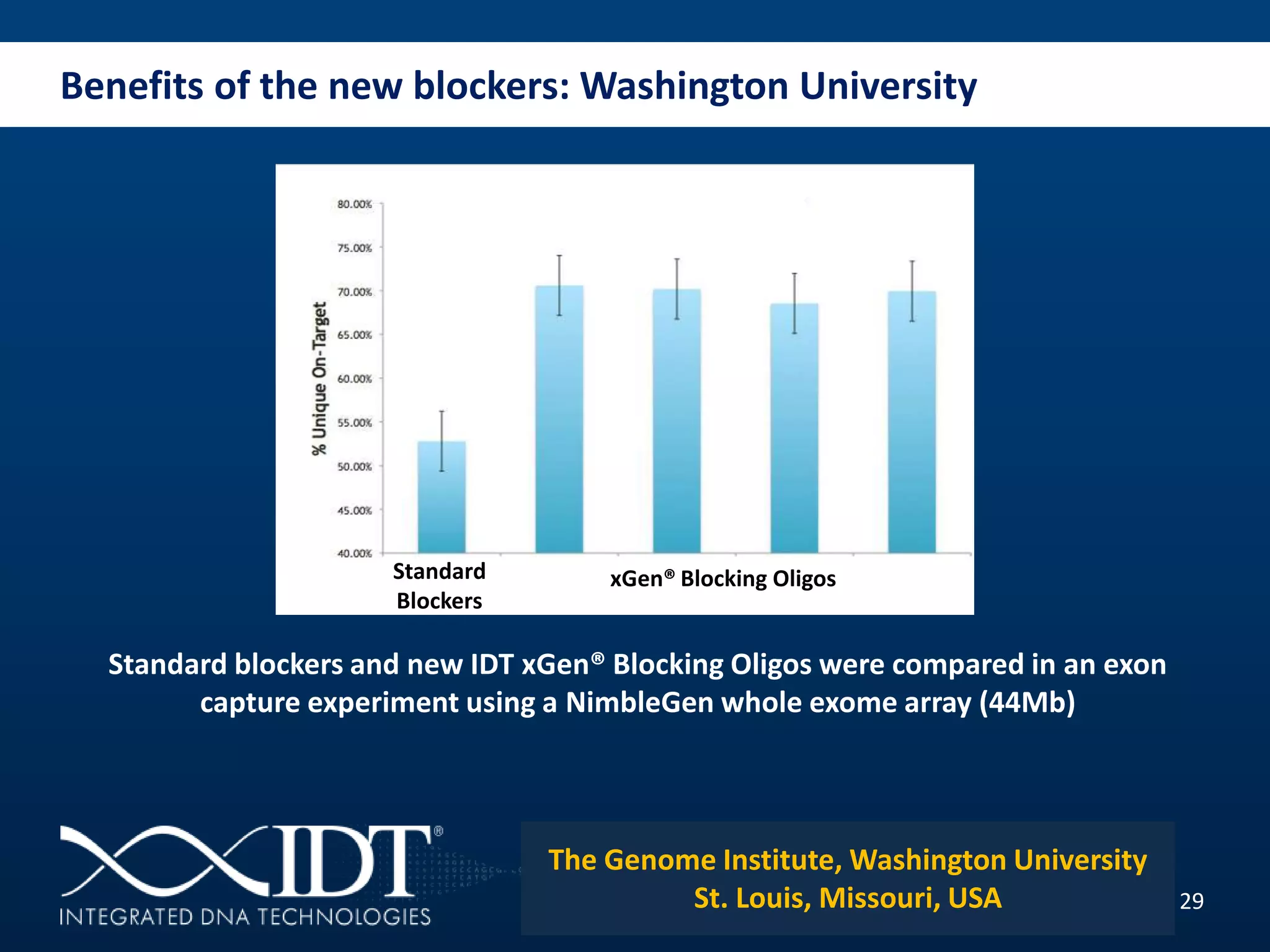
Benefits of the new blockers: Washington University
29
Standard blockers and new IDT xGen® Blocking Oligos were compared in an exon
capture experiment using a NimbleGen whole exome array (44Mb)
The Genome Institute, Washington University
St. Louis, Missouri, USA
UnMod #1 Mod #2 Mod #3 Mod #4UnmodStandard
Blockers
xGen® Blocking Oligos
Thanks to all the scientists who contributed to these studies!
30
Foundation Medicine
Mirna Jarosz
Zac Zwirko
Michele Nahas
The Genome Institute
Washington University
Elaine Mardis
Bob Fulton
Vince Magrini
Ryan Demeter
Integrated DNA Technologies
Scott Rose
Ashley Dvorak
Katie Popp
Bailey Clark
Stephen Groenewold
Richard Owczarzy
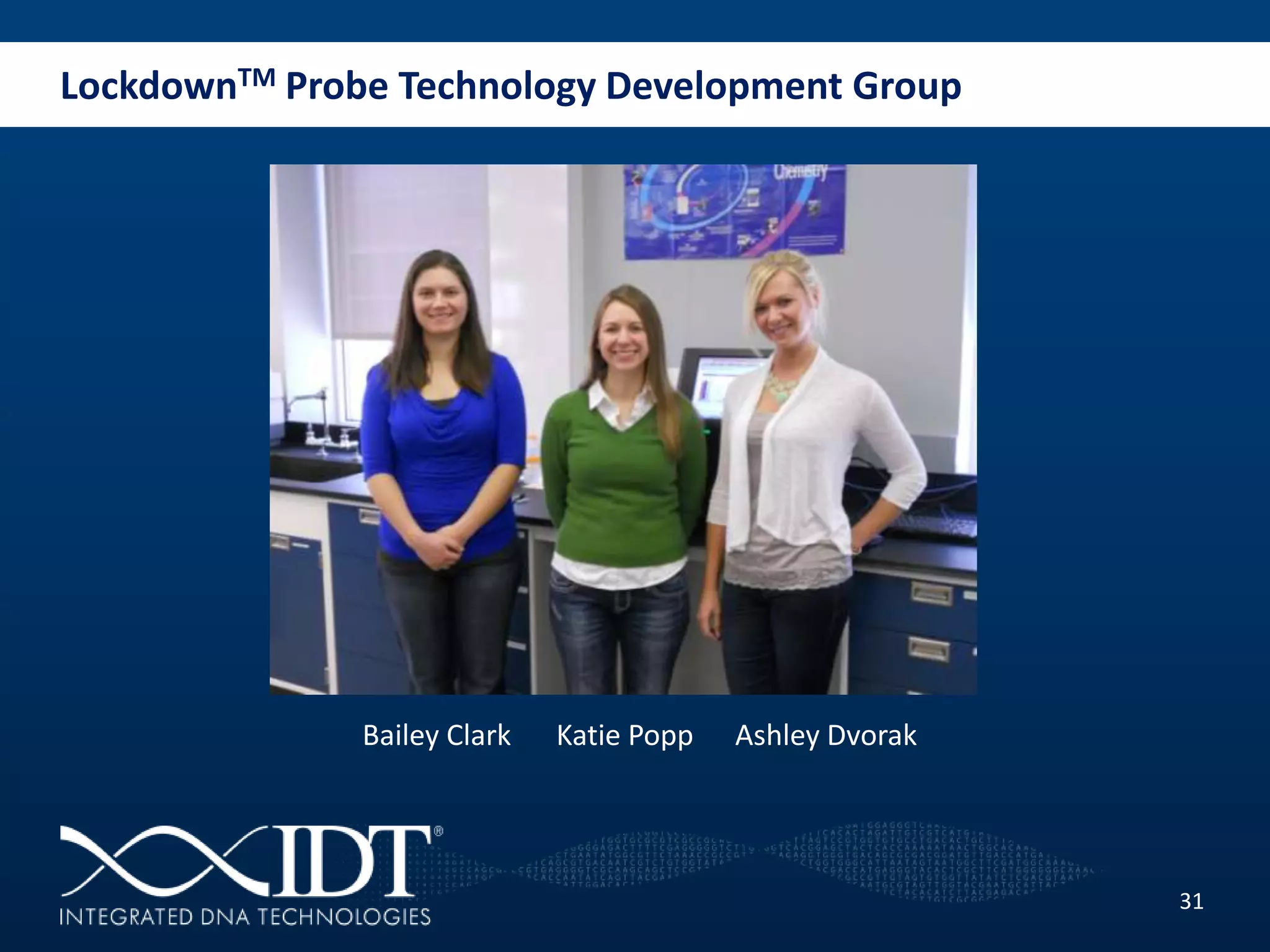
LockdownTM Probe Technology Development Group
31
Ashley DvorakBailey Clark Katie Popp

Improved Reagents & Methods for Target Enrichment in Next Generation Sequencing

  • 1.
    Integrated DNA Technologies MarkBehlke MD, PhD Chief Scientific Officer Ootemachi First Square Conference July 30, 2013 MBL/IDT Next Gen Sequencing Symposium Improved Reagents & Methods for Target Enrichment in Next Generation Sequencing
  • 2.
    General NGS Workflow 2 DNADNA Shearing Adaptor and Barcode [opt] Attachment Enrichment [optional] Template/Library Preparation Sequencing Analysis Why enrich?
  • 3.
    Detecting rare variantsrequires enrichment + cost/time savings 3 1. Achieve many times greater coverage than with whole genome sequencing 2. Multiplex many samples on 1 lane Less cost per sample Many samples analyzed in a single run
  • 4.
    Enrichment Methods 4  HybridCapture  Amplicon PCR Micro droplet PCR Haloplex™ AmpliSeq™ Panels TruSeq™ Custom Amplicon
  • 5.
    Comparing enrichment methods 5 HybridCapture Amplicon Enrichment Workflow More complex Slower (1-2 days) New fast protocol … Less complex Fast (< 1 day) Cost Higher upfront cost Lower cost per sample Lower upfront cost Higher cost per sample Problems Sequence / GC content bias Amplicon failures SNPs in primer sites Input DNA needed Med to High Low Capture size 5 KB to Whole Exome 5 KB to 1 MB New whole exome available Applications Variant analysis Gene expression / CNV Splice variants Translocations Variant analysis
  • 6.
    Two different approachesto capture probes 6 • Agilent or NimbleGen whole exome kits • Low quality, low yield oligo probes made on microarray chips • Advantage = cheap to make a million probes (capture >50 Mb) • Perfect way to make whole exome sets • Disadvantage = low quality probes, cannot QC, no idea about individual probe concentration • Variable capture efficiency between target loci, big “GC” bias effect • Difficult, slow and costly to change content • IDT xGenTM LockdownTM Probes • High quality, high yield oligos made individually • Advantage = QC each oligo, measure and normalize yield prior to pooling • Improved capture efficiency between many loci • Disadvantage = higher price per probe (but high yield) • Use for small focused sets or to spike into whole exome sets • Easy to change content  just make another oligo and add to pool! • High yield makes it cheaper when running lots of samples
  • 7.
    IDT UltramerTM synthesis:the key to xGenTM LockdownTM probes 7 • Ultramers = ultra long oligos made on a specialized synthesis platform with custom supports and its own synthesis cycle • Highest possible coupling efficiency = long oligos can be made that otherwise could not be made. For 120mers, no need to purify! • 60-200mers sold to customers (size limit is set by our ability to perform ESI MS QC); within IDT, we use 60-300mers in our gene synthesis group
  • 8.
    UltramersTM can bemade with high GC content (unlike arrays) 8 Calc. mass 37786.3 Da Measured 37789.6 Da BioGCGGCGAGCGGAGATCCGGGGCCTGCGCTGCGCACTCGAGCCTGGCGGGCCGGCACGGTGCGGGCC ATGAGCGGGGCGGTGCCCCAGGACCTAGCGGTGAGTGGCGGCCGAGTCGGGCAC ESI-MS trace of an xGENTM LockdownTM probe with 78% GC content
  • 9.
    Two ways touse xGenTM LockdownTM Probes 9 1. Make your own small focused sets with 5-2000 KB coverage 2. Spike into whole exome array oligo sets to improve performance of products you may already be using 1. NimbleGen 2. Agilent
  • 10.
    Improve Agilent SureSelectTM– example from Foundation Medicine 10 • Custom Agilent SureSelectTM 1.1 Mbp capture array for Foundation Medicine • Prototype in development for oncology medical re-sequencing panel • Problems seen with getting complete coverage of desired exons • Spike in 1100 IDT xGenTM LockdownTM probes (5’-biotin, 120mers) • 135 Kbp coverage, duplicates what should already be in tiled array • Sequence on Illumina HiSeq2000 platform Foundation Medicine Boston, Massachusetts
  • 11.
    Improve performance ofwhole exome capture kits (spike-in) 11 Foundation Medicine Boston, Massachusetts Before supplementation with xGenTM LockdownTM probes After supplementation with xGenTM LockdownTM Probes
  • 12.
    Replace SureSelectTM withcustom xGenTM LockdownTM Probe Library 12 Foundation Medicine Boston, Massachusetts Results from Foundation Medicine comparing results of a large set of IDT xGenTM LockdownTM probes with a focused Agilent SureSelectTM set. IDT xGEN: 100% >150x coverage Agilent: 80.7% >150x coverage # Reads IDT Agilent
  • 13.
    xGenTM LockdownTM Probesshow less GC bias 13 Foundation Medicine Boston, Massachusetts IDT Agilent
  • 14.
    Design of captureprobes 14 xGenTM LockdownTM probes are high quality UltramerTM synthesis. Each oligo gets mass spec QC and is OD260 measured with quantity normalized. SureSelectTM and other low quality array oligos need large overlaps. You cannot QC each oligo so you need to have high overlap to help ensure coverage.
  • 15.
    Do mutations intarget hurt capture efficiency? 15 • Short oligos can distinguish a single SNP site based on hybridization. Since the goal is to capture variants and detect these by sequencing, do we risk missing SNPs due to hybridization failure? • Long 120mers, however, are very tolerant to mismatch • How tolerant? • Studied Tm of hybridization of a single 120mer bait oligo to different targets having 0-7 bases mismatch (either permissive G:T pairing or more disruptive T:T pairings) • Also studied targets with 1, 3, or 7 base insertions (indels)
  • 16.
    Design of 120merTm experiment 16
  • 17.
    DTm with 1-7base mismatches (SNPs) 17 Mismatches Tm oC Measured DTm oC Mismatch Tm oC Predicted 0 85.7 -- 87.6 1 T-T 85.6 - 0.1 87.1 1 T-T 85.0 - 0.7 86.9 3 T-T 84.2 - 1.5 85.7 7 T-T 80.9 - 4.8 82.9 7 T-G 81.6 - 4.1 85.8
  • 18.
    DTm with 1,3, or 7 base insertions (indels) 18 Bulge Tm oC Measured DTm oC Mismatch None 85.7 -- 1 T 85.3 - 0.4 3 T 84.8 - 0.9 7 T 83.9 - 1.8 7 T + 7 T 82.3 - 3.4 7 C + 7 C 82.4 - 3.3
  • 19.
    Conclusions from Tmstudies 19 • 1-7 base mismatches had < 5oC DTm • 1 or 2 1-7 base insertions had < 4oC DTm • These small changes in Tm should not affect capture • Thus use of 120mer capture probes is sufficient and should be effective in capturing targets even when a significant level of polymorphism is present
  • 20.
    Blocking oligos –another critical component of enrichment/capture 20 Two classes of blocking oligos are needed: 1) Cot1 DNA = Alu, LINE repeat elements 2) linkers/adaptors
  • 21.
    Importance of usingHuman Cot1 blocking DNA 21 Example: Merkel Cell Polyomavirus study: Capture hyb with 1 ug Cot1 DNA Total Reads 7,603,264 Capture specific 520,304 Match to virus 6.8% Capture hyb without Cot1 DNA Total Reads 2,313,487 Capture specific 57,967 Match to virus 2.5%
  • 22.
    New product: xGen®Blocking Oligos 22 Two classes of blocking oligos are needed: 1) Cot1 DNA = Alu, Line repeat elements 2) linkers/adaptors A new generation of blockers to improve this step in the enrichment process
  • 23.
    New xGen® BlockingOligos 23 In early experiment, simple DNA blockers proved to be effective. By adding excess blocker, ‘mass action’ drives hybridization in favor of the blocker-adaptor instead of the undesired blocker-blocker pairing. However, in most experiments done today, either one or both adaptors contains an “index” or “bar code” sequence of 6-8 bases. Highly multiplexed experiments now have mismatched blockers binding to adaptors, and on-target capture rates dropped. IDT offers a new solution to this problem: xGen® Blocking Oligos . The new generation of blockers incorporates Inosine bases to pair with index domains, so a single blocker can be used with all index variants. Further, the new blockers have additional improvements which increase effectiveness and give higher on-target capture rates.
  • 24.
    Example of Inosineincorporation in one specific adaptor 24 TruSeq P7 Index 6 x I (also have 8 x I) CAAGCAGAAGACGGCATACGAGAT(IIIIII)GTGACTGGAGTTCAGACGTGTGCTCTTCCGATCTx TruSeq P5 AATGATACGGCGACCACCGAGATCTACACTCTTTCCCTACACGACGCTCTTCCGATCTx Note: Inosine is not a universal pairing base, as indicated by the decreasing stability (I·C > I·A > I·T ≈ I· G > I·I), it is most stable in a G-C base pair. However it does offer advantages over a N degenerate base, especially with longer indices. Norman E. Watkins, Jr and John SantaLucia, Jr Nucleic Acids Res. 2005; 33(19): 6258–6267 In addition to Inosine, the blockers have proprietary changes made which improve performance.
  • 25.
    Performance of xGen®Blocking Oligos with an 11,000 probe capture set 25 The IDT xGen LockdownTM Cancer Panel bait set (264 genes, 11,738 probes, 1.2 Mbp coverage) was used to enrich 4 independent libraries with unique index adaptors. The libraries were mixed and capture was performed in a multiplex hybridization reaction with standard 48 hour hybridization.
  • 26.
    Improved depth ofcoverage using xGen® Blocking Oligos 26 The IDT xGen LockdownTM Cancer Panel bait set was used to enrich 4 independent libraries with unique index adaptors. The libraries were mixed and capture was performed in a multiplex hybridization reaction with standard 48 hour hybridization.
  • 27.
    New rapid 4hour hybridization/capture reaction 27 The IDT xGen LockdownTM Cancer Panel bait set was used to enrich 4 independent libraries with unique index adaptors. The libraries were mixed and capture was performed in a multiplex hybridization reaction using new buffers and protocols with only a 4 hour hybridization step.
  • 28.
    Benefits of thenew blockers: Foundation Medicine 28 Standard blockers and new IDT xGen® Blocking Oligos were compared in an exon capture experiment using a focused set covering ~2Mb StandardStandard Blockers xGen® Blocking Oligos Foundation Medicine Boston, Massachusetts
  • 29.
    Benefits of thenew blockers: Washington University 29 Standard blockers and new IDT xGen® Blocking Oligos were compared in an exon capture experiment using a NimbleGen whole exome array (44Mb) The Genome Institute, Washington University St. Louis, Missouri, USA UnMod #1 Mod #2 Mod #3 Mod #4UnmodStandard Blockers xGen® Blocking Oligos
  • 30.
    Thanks to allthe scientists who contributed to these studies! 30 Foundation Medicine Mirna Jarosz Zac Zwirko Michele Nahas The Genome Institute Washington University Elaine Mardis Bob Fulton Vince Magrini Ryan Demeter Integrated DNA Technologies Scott Rose Ashley Dvorak Katie Popp Bailey Clark Stephen Groenewold Richard Owczarzy
  • 31.
    LockdownTM Probe TechnologyDevelopment Group 31 Ashley DvorakBailey Clark Katie Popp