Dr Mikael Kubista
Founder and CEO, TATAA Biocenter
Presented by:
High throughput qPCR:
tips for analysis across
multiple plates
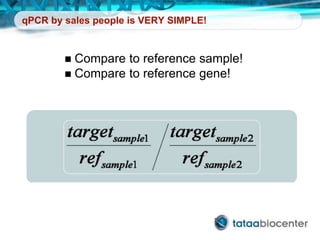
qPCR by sales people is VERY SIMPLE!
 Compare to reference sample!
 Compare to reference gene!
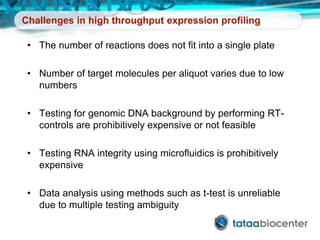
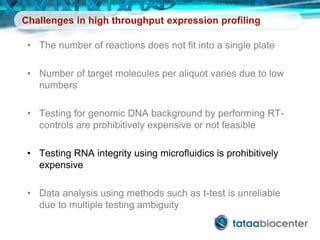
Challenges in high throughput expression profiling
• The number of reactions does not fit into a single plate
• Number of target molecules per aliquot varies due to low
numbers
• Testing for genomic DNA background by performing RT-
controls are prohibitively expensive or not feasible
• Testing RNA integrity using microfluidics is prohibitively
expensive
• Data analysis using methods such as t-test is unreliable
due to multiple testing ambiguity
Challenges in high throughput expression profiling
• The number of reactions does not fit into a single plate
• Number of target molecules per aliquot varies due to low
numbers
• Testing for genomic DNA background by performing RT-
controls are prohibitively expensive or not feasible
• Testing RNA integrity using microfluidics is prohibitively
expensive
• Data analysis using methods such as t-test is unreliable
due to multiple testing ambiguity
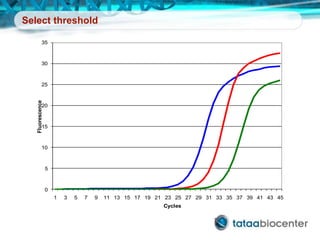
Select threshold
0
5
10
15
20
25
30
35
1 3 5 7 9 11 13 15 17 19 21 23 25 27 29 31 33 35 37 39 41 43 45
Fluorescence
Cycles
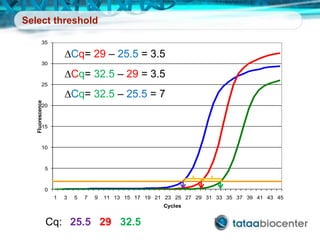
Select threshold
0
5
10
15
20
25
30
35
1 3 5 7 9 11 13 15 17 19 21 23 25 27 29 31 33 35 37 39 41 43 45
Fluorescence
Cycles
Cq: 25.5 29 32.5
DCq= 29 – 25.5 = 3.5
DCq= 32.5 – 25.5 = 7
DCq= 32.5 – 29 = 3.5
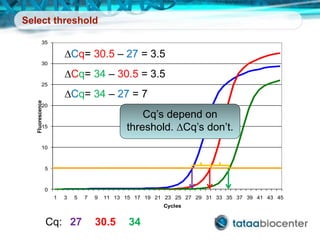
Select threshold
0
5
10
15
20
25
30
35
1 3 5 7 9 11 13 15 17 19 21 23 25 27 29 31 33 35 37 39 41 43 45
Fluorescence
Cycles
Cq: 27 30.5 34
DCq= 30.5 – 27 = 3.5
DCq= 34 – 27 = 7
DCq= 34 – 30.5 = 3.5
Cq’s depend on
threshold. DCq’s don’t.
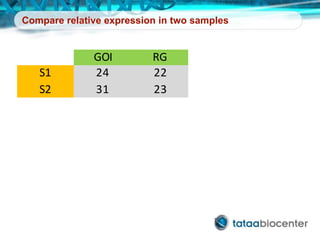
GOI RG
S1 24 22
S2 31 23
Compare relative expression in two samples
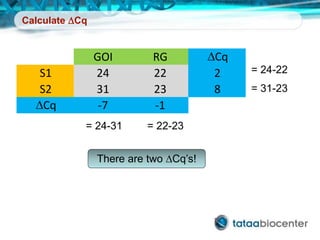
Calculate DCq
= 24-31 = 22-23
= 24-22
= 31-23
There are two DCq’s!
GOI RG DCq
S1 24 22 2
S2 31 23 8
DCq -7 -1
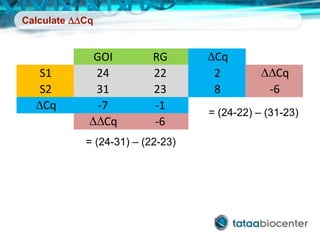
Calculate DDCq
= (24-31) – (22-23)
= (24-22) – (31-23)
GOI RG DCq
S1 24 22 2 DDCq
S2 31 23 8 -6
DCq -7 -1
DDCq -6
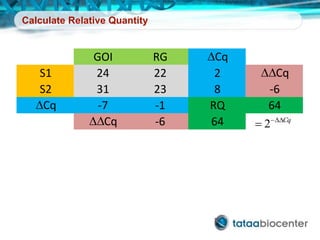
Calculate Relative Quantity
GOI RG DCq
S1 24 22 2 DDCq
S2 31 23 8 -6
DCq -7 -1 RQ 64
DDCq -6 64 CqDD
 2
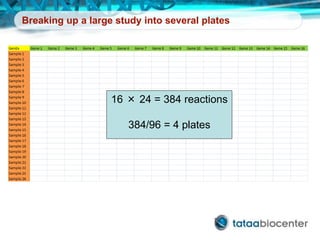
Breaking up a large study into several plates
16 × 24 = 384 reactions
384/96 = 4 plates
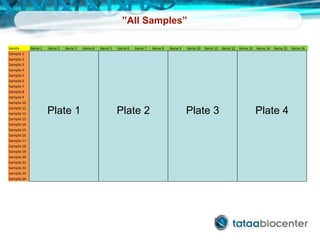
”All Samples”
Plate 1 Plate 2 Plate 3 Plate 4
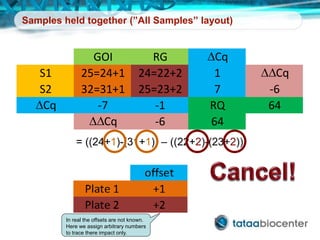
Samples held together (”All Samples” layout)
= ((24+1)-(31+1)) – ((22+2)-(23+2))
GOI RG DCq
S1 25=24+1 24=22+2 1 DDCq
S2 32=31+1 25=23+2 7 -6
DCq -7 -1 RQ 64
DDCq -6 64
In real the offsets are not known.
Here we assign arbitrary numbers
to trace there impact only.
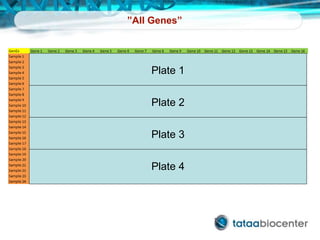
”All Genes”
Plate 1
Plate 2
Plate 3
Plate 4
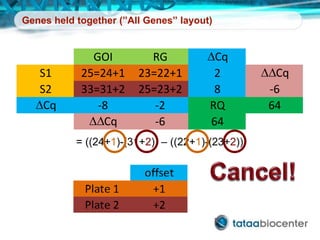
Genes held together (”All Genes” layout)
= ((24+1)-(31+2)) – ((22+1)-(23+2))
GOI RG DCq
S1 25=24+1 23=22+1 2 DDCq
S2 33=31+2 25=23+2 8 -6
DCq -8 -2 RQ 64
DDCq -6 64
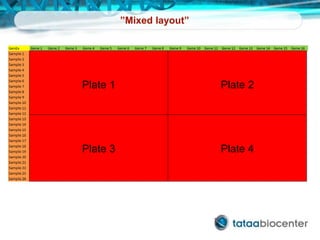
”Mixed layout”
Plate 1 Plate 2
Plate 3 Plate 4
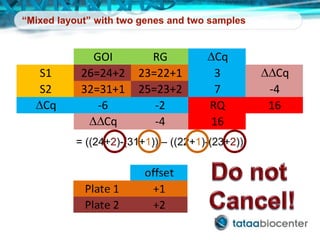
“Mixed layout” with two genes and two samples
= ((24+2)-(31+1)) – ((22+1)-(23+2))
GOI RG DCq
S1 26=24+2 23=22+1 3 DDCq
S2 32=31+1 25=23+2 7 -4
DCq -6 -2 RQ 16
DDCq -4 16
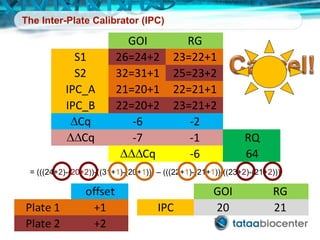
The Inter-Plate Calibrator (IPC)
GOI RG
IPC 20 21
= (((24+2)-(20+2))-((31+1)-(20+1))) – (((22+1)-(21+1))-((23+2)-(21+2)))
GOI RG
S1 26=24+2 23=22+1
S2 32=31+1 25=23+2
IPC_A 21=20+1 22=21+1
IPC_B 22=20+2 23=21+2
DCq -6 -2
DDCq -7 -1 RQ
DDDCq -6 64
Relative quantification on multiple plates
When expression is normalized to reference genes and
samples are compared (DDCq) multiple runs can be
merged for common analysis without correction if either:
• All genes for all sample are measured together in the
same plate (“All genes”)
or
• All samples for all genes are measured together in
the same plate (“All samples”)
Interplate calibrator
• Interplate calibrators are used to compensate for variations between runs due
to instrument settings (base-line correction and threshold settings)
• Interplate variation depends on the instrument channel used, but is virtually
independent of assay.
It is highly discouraged to perform independent inter-plate calibrations per assay!
• The Cq of an interplate calibrator must be measured with very high accuracy,
else interplate calibration may add more variance to the data than the
systematic variation it removes.
• Interplate calibrators should be:
– Very stable assays
– Uncomplicated, purified template at fairly high concentration (20 <Cq < 25)
– Run in replicates (minimum triplicates)
– The Interplate calibrator shall be stable over time
www.tataa.com/products-page/quality-assessment/tataa-interplate-calibrator/
Challenges in high throughput expression profiling
• The number of reactions does not fit into a single plate
• Number of target molecules per aliquot varies due to low
numbers
• Testing for genomic DNA background by performing RT-
controls are prohibitively expensive or not feasible
• Testing RNA integrity using microfluidics is prohibitively
expensive
• Data analysis using methods such as t-test is unreliable
due to multiple testing ambiguity
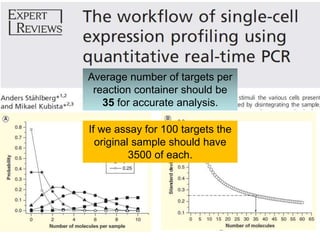
How many preamplification cycles?
Average number of targets per
reaction container should be
35 for accurate analysis.
If we assay for 100 targets the
original sample should have
3500 of each.
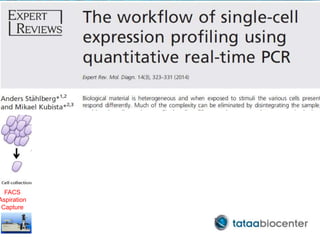
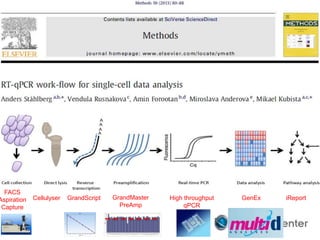
FACS
Aspiration
Capture
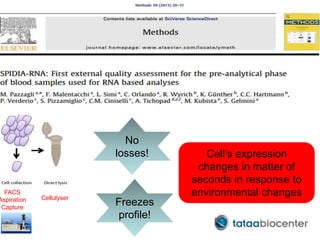
FACS
Aspiration
Capture
Cellulyser
No
losses!
Freezes
profile!
Cell’s expression
changes in matter of
seconds in response to
environmental changes
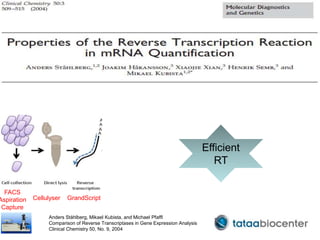
FACS
Aspiration
Capture
Cellulyser GrandScript
Efficient
RT
Anders Ståhlberg, Mikael Kubista, and Michael Pfaffl
Comparison of Reverse Transcriptases in Gene Expression Analysis
Clinical Chemistry 50, No. 9, 2004
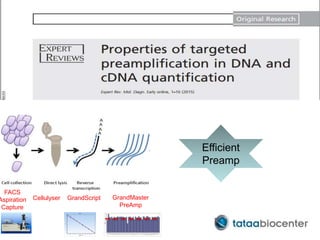
FACS
Aspiration
Capture
Cellulyser GrandScript GrandMaster
PreAmp
Efficient
Preamp
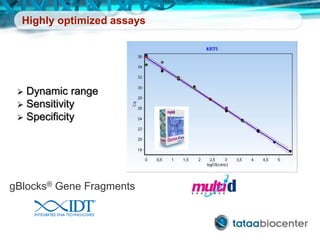
Highly optimized assays
 Dynamic range
 Sensitivity
 Specificity
gBlocks® Gene Fragments
FACS
Aspiration
Capture
Cellulyser GrandScript GrandMaster
PreAmp
High throughput
qPCR
GenEx iReport
Challenges in high throughput expression profiling
• The number of reactions does not fit into a single plate
• Number of target molecules per aliquot varies due to low
numbers
• Testing for genomic DNA background by performing RT-
controls are prohibitively expensive or not feasible
• Testing RNA integrity using microfluidics is prohibitively
expensive
• Data analysis using methods such as t-test is unreliable
due to multiple testing ambiguity
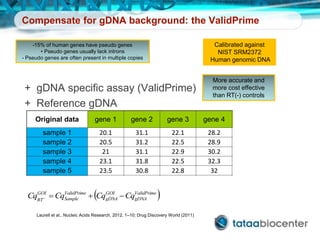
Compensate for gDNA background: the ValidPrime
+ gDNA specific assay (ValidPrime)
+ Reference gDNA
Original data gene 1 gene 2 gene 3 gene 4 ValidPrime
sample 1 20.1 31.1 22.1 28.2 32.5
sample 2 20.5 31.2 22.5 28.9 33.2
sample 3 21 31.1 22.9 30.2 32.3
sample 4 23.1 31.8 22.5 32.3 34.2
sample 5 23.5 30.8 22.8 32 33.1
gDNA standard 25.8 26.9 26.7 26 27
Laurell et al., Nucleic Acids Research, 2012, 1–10; Drug Discovery World (2011)
 ValidPrime
gDNA
GOI
gDNA
ValidPrime
Sample
GOI
RT
CqCqCqCq 
More accurate and
more cost effective
than RT(-) controls
•15% of human genes have pseudo genes
• Pseudo genes usually lack introns
• Pseudo genes are often present in multiple copies
Calibrated against
NIST SRM2372
Human genomic DNA
Challenges in high throughput expression profiling
• The number of reactions does not fit into a single plate
• Number of target molecules per aliquot varies due to low
numbers
• Testing for genomic DNA background by performing RT-
controls are prohibitively expensive or not feasible
• Testing RNA integrity using microfluidics is prohibitively
expensive
• Data analysis using methods such as t-test is unreliable
due to multiple testing ambiguity
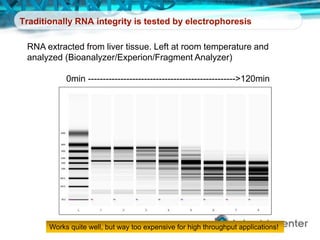
Traditionally RNA integrity is tested by electrophoresis
RNA extracted from liver tissue. Left at room temperature and
analyzed (Bioanalyzer/Experion/Fragment Analyzer)
0min -------------------------------------------------->120min
Works quite well, but way too expensive for high throughput applications!
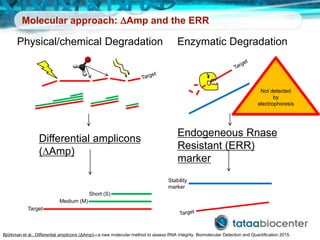
Molecular approach: DAmp and the ERR
Differential amplicons
(DAmp)
Target
Short (S)
Medium (M)
Physical/chemical Degradation
Björkman et al., Differential amplicons (ΔAmp)—a new molecular method to assess RNA integrity. Biomolecular Detection and Quantification 2015.
Enzymatic Degradation
Endogeneous Rnase
Resistant (ERR)
marker
Stability
marker
Not detected
by
electrophoresis
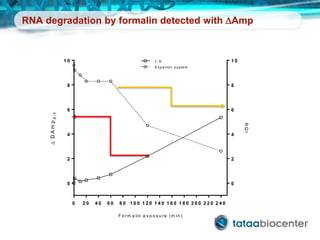
RNA degradation by formalin detected with DAmp
0 2 0 4 0 6 0 8 0 1 0 0 1 2 0 1 4 0 1 6 0 1 8 0 2 0 0 2 2 0 2 4 0
0
2
4
6
8
1 0
0
2
4
6
8
1 0
F o rm a lin e x p o s u re (m in )
DDAmpX-Y
RQI
L -S
E xp e rio n system
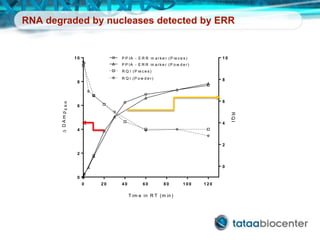
RNA degraded by nucleases detected by ERR
0 2 0 4 0 6 0 8 0 1 0 0 1 2 0
0
2
4
6
8
1 0
0
2
4
6
8
1 0
C
T im e in R T (m in )
DDAmpERR
RQI
R Q I (P ie c e s )
P P IA - E R R m a rk e r (P ie c e s )
R Q I (P o w d e r)
P P IA - E R R m a rk e r (P o w d e r)
Challenges in high throughput expression profiling
• The number of reactions does not fit into a single plate
• Number of target molecules per aliquot varies due to low
numbers
• Testing for genomic DNA background by performing RT-
controls are prohibitively expensive or not feasible
• Testing RNA integrity using microfluidics is prohibitively
expensive
• Data analysis using methods such as t-test is unreliable
due to multiple testing ambiguity
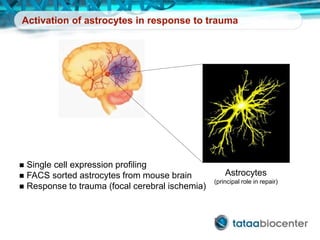
Activation of astrocytes in response to trauma
Astrocytes
(principal role in repair)
 Single cell expression profiling
 FACS sorted astrocytes from mouse brain
 Response to trauma (focal cerebral ischemia)
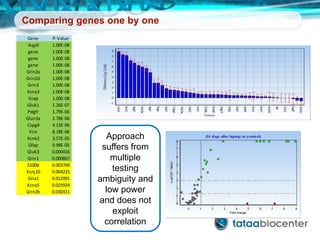
Comparing genes one by one
Gene P-Value
Aqp9 1.00E-08
gene 1.00E-08
gene 1.00E-08
gene 1.00E-08
Grin2a 1.00E-08
Grin2d 1.00E-08
Grin3 1.00E-08
Kcna3 1.00E-08
Snap 1.00E-08
Gluk1 1.26E-07
Pdgfr 1.79E-06
Glun3a 2.78E-06
Cspg4 4.13E-06
Vim 8.18E-06
Kcnk2 3.57E-05
Gfap 9.98E-05
Gluk3 0.000416
Grin1 0.000867
S100b 0.003769
Kcnj10 0.004225
Gria1 0.012991
Kcna5 0.025924
Grin2b 0.030311
Approach
suffers from
multiple
testing
ambiguity and
low power
and does not
exploit
correlation
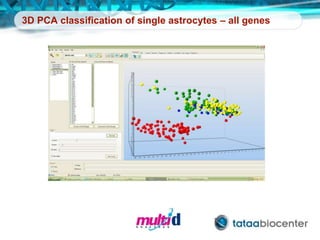
3D PCA classification of single astrocytes – all genes
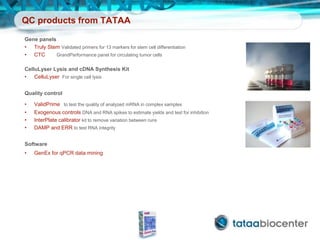
QC products from TATAA
Gene panels
• Truly Stem Validated primers for 13 markers for stem cell differentiation
• CTC GrandPerformance panel for circulating tumor cells
CelluLyser Lysis and cDNA Synthesis Kit
• CelluLyser For single cell lysis
Quality control
• ValidPrime to test the quality of analyzed mRNA in complex samples
• Exogenous controls DNA and RNA spikes to estimate yields and test for inhibition
• InterPlate calibrator kit to remove variation between runs
• DAMP and ERR to test RNA integrity
Software
• GenEx for qPCR data mining
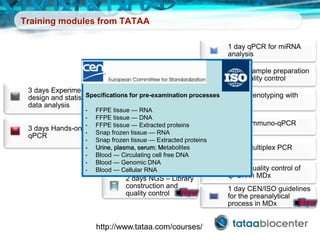
Training modules from TATAA
1 day qPCR for miRNA
analysis
1 day Sample preparation
and quality control
1 day Genotyping with
qPCR
1 day Immuno-qPCR
1 day Multiplex PCR
1 day Quality control of
qPCR in MDx
1 day CEN/ISO guidelines
for the preanalytical
process in MDx
2 days Hands-on
qPCR
2 days Single cell
analysis
2 days Experimental
design and statistical
data analysis
2 days Digital PCR –
Applications and
analyiss
2 days NGS – Library
construction and
quality control
3 days Experimental
design and statistical
data analysis
3 days Hands-on
qPCR
Specifications for pre-examination processes
• FFPE tissue — RNA
• FFPE tissue — DNA
• FFPE tissue — Extracted proteins
• Snap frozen tissue — RNA
• Snap frozen tissue — Extracted proteins
• Urine, plasma, serum: Metabolites
• Blood — Circulating cell free DNA
• Blood — Genomic DNA
• Blood — Cellular RNA
http://www.tataa.com/courses/
gene expression
PrimeTime® qPCR Assays
• Primer and probe sequences provided
• Free design tools
• Available predesigned for human, mouse, and
rat
www.idtdna.com/primetime
Thank you!
Questions?

High throughput qPCR: tips for analysis across multiple plates

  • 1.
    Dr Mikael Kubista Founderand CEO, TATAA Biocenter Presented by: High throughput qPCR: tips for analysis across multiple plates
  • 3.
    qPCR by salespeople is VERY SIMPLE!  Compare to reference sample!  Compare to reference gene!
  • 4.
    Challenges in highthroughput expression profiling • The number of reactions does not fit into a single plate • Number of target molecules per aliquot varies due to low numbers • Testing for genomic DNA background by performing RT- controls are prohibitively expensive or not feasible • Testing RNA integrity using microfluidics is prohibitively expensive • Data analysis using methods such as t-test is unreliable due to multiple testing ambiguity
  • 5.
    Challenges in highthroughput expression profiling • The number of reactions does not fit into a single plate • Number of target molecules per aliquot varies due to low numbers • Testing for genomic DNA background by performing RT- controls are prohibitively expensive or not feasible • Testing RNA integrity using microfluidics is prohibitively expensive • Data analysis using methods such as t-test is unreliable due to multiple testing ambiguity
  • 6.
    Select threshold 0 5 10 15 20 25 30 35 1 35 7 9 11 13 15 17 19 21 23 25 27 29 31 33 35 37 39 41 43 45 Fluorescence Cycles
  • 7.
    Select threshold 0 5 10 15 20 25 30 35 1 35 7 9 11 13 15 17 19 21 23 25 27 29 31 33 35 37 39 41 43 45 Fluorescence Cycles Cq: 25.5 29 32.5 DCq= 29 – 25.5 = 3.5 DCq= 32.5 – 25.5 = 7 DCq= 32.5 – 29 = 3.5
  • 8.
    Select threshold 0 5 10 15 20 25 30 35 1 35 7 9 11 13 15 17 19 21 23 25 27 29 31 33 35 37 39 41 43 45 Fluorescence Cycles Cq: 27 30.5 34 DCq= 30.5 – 27 = 3.5 DCq= 34 – 27 = 7 DCq= 34 – 30.5 = 3.5 Cq’s depend on threshold. DCq’s don’t.
  • 9.
    GOI RG S1 2422 S2 31 23 Compare relative expression in two samples
  • 10.
    Calculate DCq = 24-31= 22-23 = 24-22 = 31-23 There are two DCq’s! GOI RG DCq S1 24 22 2 S2 31 23 8 DCq -7 -1
  • 11.
    Calculate DDCq = (24-31)– (22-23) = (24-22) – (31-23) GOI RG DCq S1 24 22 2 DDCq S2 31 23 8 -6 DCq -7 -1 DDCq -6
  • 12.
    Calculate Relative Quantity GOIRG DCq S1 24 22 2 DDCq S2 31 23 8 -6 DCq -7 -1 RQ 64 DDCq -6 64 CqDD  2
  • 13.
    Breaking up alarge study into several plates 16 × 24 = 384 reactions 384/96 = 4 plates
  • 14.
    ”All Samples” Plate 1Plate 2 Plate 3 Plate 4
  • 15.
    Samples held together(”All Samples” layout) = ((24+1)-(31+1)) – ((22+2)-(23+2)) GOI RG DCq S1 25=24+1 24=22+2 1 DDCq S2 32=31+1 25=23+2 7 -6 DCq -7 -1 RQ 64 DDCq -6 64 In real the offsets are not known. Here we assign arbitrary numbers to trace there impact only.
  • 16.
  • 17.
    Genes held together(”All Genes” layout) = ((24+1)-(31+2)) – ((22+1)-(23+2)) GOI RG DCq S1 25=24+1 23=22+1 2 DDCq S2 33=31+2 25=23+2 8 -6 DCq -8 -2 RQ 64 DDCq -6 64
  • 18.
    ”Mixed layout” Plate 1Plate 2 Plate 3 Plate 4
  • 19.
    “Mixed layout” withtwo genes and two samples = ((24+2)-(31+1)) – ((22+1)-(23+2)) GOI RG DCq S1 26=24+2 23=22+1 3 DDCq S2 32=31+1 25=23+2 7 -4 DCq -6 -2 RQ 16 DDCq -4 16
  • 20.
    The Inter-Plate Calibrator(IPC) GOI RG IPC 20 21 = (((24+2)-(20+2))-((31+1)-(20+1))) – (((22+1)-(21+1))-((23+2)-(21+2))) GOI RG S1 26=24+2 23=22+1 S2 32=31+1 25=23+2 IPC_A 21=20+1 22=21+1 IPC_B 22=20+2 23=21+2 DCq -6 -2 DDCq -7 -1 RQ DDDCq -6 64
  • 21.
    Relative quantification onmultiple plates When expression is normalized to reference genes and samples are compared (DDCq) multiple runs can be merged for common analysis without correction if either: • All genes for all sample are measured together in the same plate (“All genes”) or • All samples for all genes are measured together in the same plate (“All samples”)
  • 22.
    Interplate calibrator • Interplatecalibrators are used to compensate for variations between runs due to instrument settings (base-line correction and threshold settings) • Interplate variation depends on the instrument channel used, but is virtually independent of assay. It is highly discouraged to perform independent inter-plate calibrations per assay! • The Cq of an interplate calibrator must be measured with very high accuracy, else interplate calibration may add more variance to the data than the systematic variation it removes. • Interplate calibrators should be: – Very stable assays – Uncomplicated, purified template at fairly high concentration (20 <Cq < 25) – Run in replicates (minimum triplicates) – The Interplate calibrator shall be stable over time www.tataa.com/products-page/quality-assessment/tataa-interplate-calibrator/
  • 23.
    Challenges in highthroughput expression profiling • The number of reactions does not fit into a single plate • Number of target molecules per aliquot varies due to low numbers • Testing for genomic DNA background by performing RT- controls are prohibitively expensive or not feasible • Testing RNA integrity using microfluidics is prohibitively expensive • Data analysis using methods such as t-test is unreliable due to multiple testing ambiguity
  • 24.
    How many preamplificationcycles? Average number of targets per reaction container should be 35 for accurate analysis. If we assay for 100 targets the original sample should have 3500 of each.
  • 25.
  • 26.
  • 27.
    FACS Aspiration Capture Cellulyser GrandScript Efficient RT Anders Ståhlberg,Mikael Kubista, and Michael Pfaffl Comparison of Reverse Transcriptases in Gene Expression Analysis Clinical Chemistry 50, No. 9, 2004
  • 28.
  • 30.
    Highly optimized assays Dynamic range  Sensitivity  Specificity gBlocks® Gene Fragments
  • 31.
  • 32.
    Challenges in highthroughput expression profiling • The number of reactions does not fit into a single plate • Number of target molecules per aliquot varies due to low numbers • Testing for genomic DNA background by performing RT- controls are prohibitively expensive or not feasible • Testing RNA integrity using microfluidics is prohibitively expensive • Data analysis using methods such as t-test is unreliable due to multiple testing ambiguity
  • 33.
    Compensate for gDNAbackground: the ValidPrime + gDNA specific assay (ValidPrime) + Reference gDNA Original data gene 1 gene 2 gene 3 gene 4 ValidPrime sample 1 20.1 31.1 22.1 28.2 32.5 sample 2 20.5 31.2 22.5 28.9 33.2 sample 3 21 31.1 22.9 30.2 32.3 sample 4 23.1 31.8 22.5 32.3 34.2 sample 5 23.5 30.8 22.8 32 33.1 gDNA standard 25.8 26.9 26.7 26 27 Laurell et al., Nucleic Acids Research, 2012, 1–10; Drug Discovery World (2011)  ValidPrime gDNA GOI gDNA ValidPrime Sample GOI RT CqCqCqCq  More accurate and more cost effective than RT(-) controls •15% of human genes have pseudo genes • Pseudo genes usually lack introns • Pseudo genes are often present in multiple copies Calibrated against NIST SRM2372 Human genomic DNA
  • 34.
    Challenges in highthroughput expression profiling • The number of reactions does not fit into a single plate • Number of target molecules per aliquot varies due to low numbers • Testing for genomic DNA background by performing RT- controls are prohibitively expensive or not feasible • Testing RNA integrity using microfluidics is prohibitively expensive • Data analysis using methods such as t-test is unreliable due to multiple testing ambiguity
  • 35.
    Traditionally RNA integrityis tested by electrophoresis RNA extracted from liver tissue. Left at room temperature and analyzed (Bioanalyzer/Experion/Fragment Analyzer) 0min -------------------------------------------------->120min Works quite well, but way too expensive for high throughput applications!
  • 36.
    Molecular approach: DAmpand the ERR Differential amplicons (DAmp) Target Short (S) Medium (M) Physical/chemical Degradation Björkman et al., Differential amplicons (ΔAmp)—a new molecular method to assess RNA integrity. Biomolecular Detection and Quantification 2015. Enzymatic Degradation Endogeneous Rnase Resistant (ERR) marker Stability marker Not detected by electrophoresis
  • 37.
    RNA degradation byformalin detected with DAmp 0 2 0 4 0 6 0 8 0 1 0 0 1 2 0 1 4 0 1 6 0 1 8 0 2 0 0 2 2 0 2 4 0 0 2 4 6 8 1 0 0 2 4 6 8 1 0 F o rm a lin e x p o s u re (m in ) DDAmpX-Y RQI L -S E xp e rio n system
  • 38.
    RNA degraded bynucleases detected by ERR 0 2 0 4 0 6 0 8 0 1 0 0 1 2 0 0 2 4 6 8 1 0 0 2 4 6 8 1 0 C T im e in R T (m in ) DDAmpERR RQI R Q I (P ie c e s ) P P IA - E R R m a rk e r (P ie c e s ) R Q I (P o w d e r) P P IA - E R R m a rk e r (P o w d e r)
  • 39.
    Challenges in highthroughput expression profiling • The number of reactions does not fit into a single plate • Number of target molecules per aliquot varies due to low numbers • Testing for genomic DNA background by performing RT- controls are prohibitively expensive or not feasible • Testing RNA integrity using microfluidics is prohibitively expensive • Data analysis using methods such as t-test is unreliable due to multiple testing ambiguity
  • 40.
    Activation of astrocytesin response to trauma Astrocytes (principal role in repair)  Single cell expression profiling  FACS sorted astrocytes from mouse brain  Response to trauma (focal cerebral ischemia)
  • 41.
    Comparing genes oneby one Gene P-Value Aqp9 1.00E-08 gene 1.00E-08 gene 1.00E-08 gene 1.00E-08 Grin2a 1.00E-08 Grin2d 1.00E-08 Grin3 1.00E-08 Kcna3 1.00E-08 Snap 1.00E-08 Gluk1 1.26E-07 Pdgfr 1.79E-06 Glun3a 2.78E-06 Cspg4 4.13E-06 Vim 8.18E-06 Kcnk2 3.57E-05 Gfap 9.98E-05 Gluk3 0.000416 Grin1 0.000867 S100b 0.003769 Kcnj10 0.004225 Gria1 0.012991 Kcna5 0.025924 Grin2b 0.030311 Approach suffers from multiple testing ambiguity and low power and does not exploit correlation
  • 42.
    3D PCA classificationof single astrocytes – all genes
  • 43.
    QC products fromTATAA Gene panels • Truly Stem Validated primers for 13 markers for stem cell differentiation • CTC GrandPerformance panel for circulating tumor cells CelluLyser Lysis and cDNA Synthesis Kit • CelluLyser For single cell lysis Quality control • ValidPrime to test the quality of analyzed mRNA in complex samples • Exogenous controls DNA and RNA spikes to estimate yields and test for inhibition • InterPlate calibrator kit to remove variation between runs • DAMP and ERR to test RNA integrity Software • GenEx for qPCR data mining
  • 44.
    Training modules fromTATAA 1 day qPCR for miRNA analysis 1 day Sample preparation and quality control 1 day Genotyping with qPCR 1 day Immuno-qPCR 1 day Multiplex PCR 1 day Quality control of qPCR in MDx 1 day CEN/ISO guidelines for the preanalytical process in MDx 2 days Hands-on qPCR 2 days Single cell analysis 2 days Experimental design and statistical data analysis 2 days Digital PCR – Applications and analyiss 2 days NGS – Library construction and quality control 3 days Experimental design and statistical data analysis 3 days Hands-on qPCR Specifications for pre-examination processes • FFPE tissue — RNA • FFPE tissue — DNA • FFPE tissue — Extracted proteins • Snap frozen tissue — RNA • Snap frozen tissue — Extracted proteins • Urine, plasma, serum: Metabolites • Blood — Circulating cell free DNA • Blood — Genomic DNA • Blood — Cellular RNA http://www.tataa.com/courses/
  • 45.
    gene expression PrimeTime® qPCRAssays • Primer and probe sequences provided • Free design tools • Available predesigned for human, mouse, and rat www.idtdna.com/primetime
  • 47.