Impression
Management

Junaid Ashraf
13

Impression Management
 Impression management is an attempt to
control the perceptions or impressions of others.
 Targets are especially likely to use impression
management tactics when interacting with
perceivers who have power over them and on
whom they are dependent for evaluations, raises,
and promotions.
 Individuals who are high in self-monitoring are
more likely than individuals who are low in selfmonitoring to engage in impression management
tactics.
Impression Management
 An attempt to manipulate or control
the impressions that others form
about the person.
 Non verbal communication, clothes,
hair cut, style, etc.
 Feigning interest in a boring lecture
 Behaving nicely when grandparents
come to visit
Impression Motivation
 The degree to which an individual actually
manages the impression that he or she
makes.
 Sometimes people are strongly motivated
for impression management, such as going
for an interview
 Sometimes people are not as strongly
motivated for impression management,
such as going to meet old friends
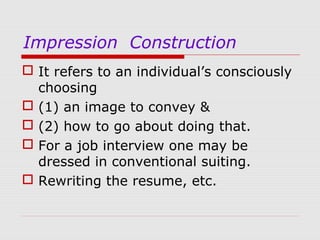
Impression Construction
 It refers to an individual’s consciously
choosing
 (1) an image to convey &
 (2) how to go about doing that.
 For a job interview one may be
dressed in conventional suiting.
 Rewriting the resume, etc.
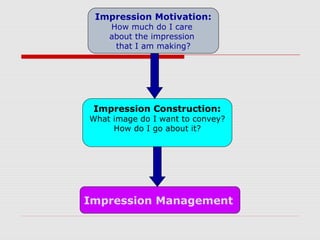
Impression Motivation:
How much do I care
about the impression
that I am making?

Impression Construction:

What image do I want to convey?
How do I go about it?

Impression Management
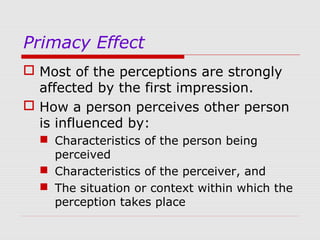
Primacy Effect
 Most of the perceptions are strongly
affected by the first impression.
 How a person perceives other person
is influenced by:
 Characteristics of the person being
perceived
 Characteristics of the perceiver, and
 The situation or context within which the
perception takes place
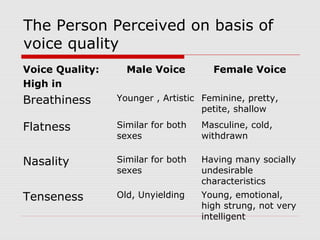
The Person Perceived on basis of
voice quality
Voice Quality:
High in

Male Voice

Female Voice

Breathiness

Younger , Artistic Feminine, pretty,
petite, shallow

Flatness

Similar for both
sexes

Masculine, cold,
withdrawn

Nasality

Similar for both
sexes

Having many socially
undesirable
characteristics

Tenseness

Old, Unyielding

Young, emotional,
high strung, not very
intelligent
15

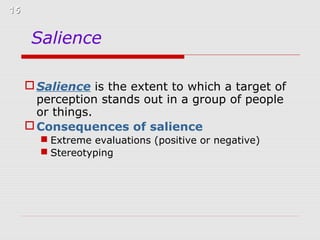
Salience
 Salience is the extent to which a target of
perception stands out in a group of people
or things.
 Consequences of salience
 Extreme evaluations (positive or negative)
 Stereotyping
15

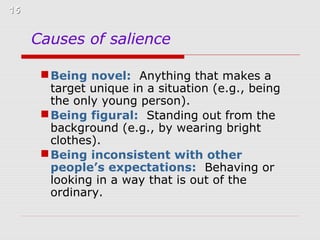
Causes of salience
 Being novel: Anything that makes a
target unique in a situation (e.g., being
the only young person).
 Being figural: Standing out from the
background (e.g., by wearing bright
clothes).
 Being inconsistent with other
people’s expectations: Behaving or
looking in a way that is out of the
ordinary.
17

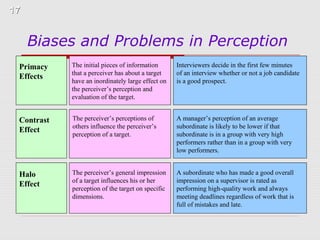
Biases and Problems in Perception
Primacy
Effects

The initial pieces of information
that a perceiver has about a target
have an inordinately large effect on
the perceiver’s perception and
evaluation of the target.

Interviewers decide in the first few minutes
of an interview whether or not a job candidate
is a good prospect.

Contrast
Effect

The perceiver’s perceptions of
others influence the perceiver’s
perception of a target.

A manager’s perception of an average
subordinate is likely to be lower if that
subordinate is in a group with very high
performers rather than in a group with very
low performers.

Halo
Effect

The perceiver’s general impression
of a target influences his or her
perception of the target on specific
dimensions.

A subordinate who has made a good overall
impression on a supervisor is rated as
performing high-quality work and always
meeting deadlines regardless of work that is
full of mistakes and late.
18

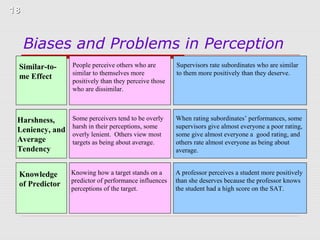
Biases and Problems in Perception
Similar-tome Effect

People perceive others who are
similar to themselves more
positively than they perceive those
who are dissimilar.

Supervisors rate subordinates who are similar
to them more positively than they deserve.

Harshness,
Leniency, and
Average
Tendency

Some perceivers tend to be overly
harsh in their perceptions, some
overly lenient. Others view most
targets as being about average.

When rating subordinates’ performances, some
supervisors give almost everyone a poor rating,
some give almost everyone a good rating, and
others rate almost everyone as being about
average.

Knowledge
of Predictor

Knowing how a target stands on a
predictor of performance influences
perceptions of the target.

A professor perceives a student more positively
than she deserves because the professor knows
the student had a high score on the SAT.
Errors in Attribution
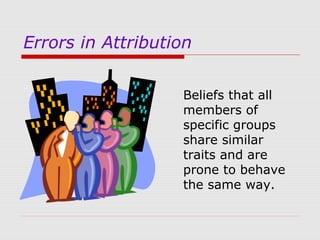
Beliefs that all
members of
specific groups
share similar
traits and are
prone to behave
the same way.
Errors in Attribution
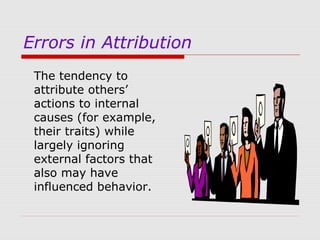
The tendency to
attribute others’
actions to internal
causes (for example,
their traits) while
largely ignoring
external factors that
also may have
influenced behavior.
Errors in Attribution
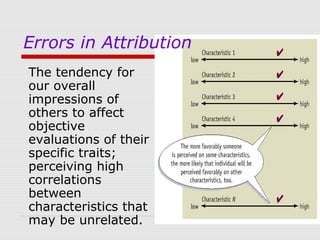
The tendency for
our overall
impressions of
others to affect
objective
evaluations of their
specific traits;
perceiving high
correlations
between
characteristics that
may be unrelated.
Errors in Attribution
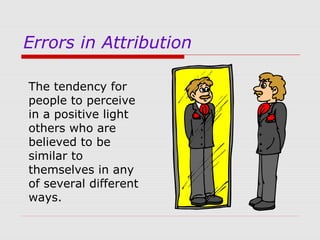
The tendency for
people to perceive
in a positive light
others who are
believed to be
similar to
themselves in any
of several different
ways.
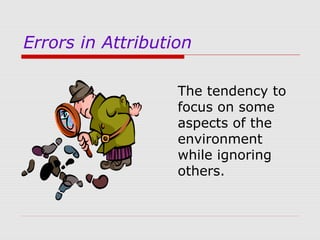
Errors in Attribution
The tendency to
focus on some
aspects of the
environment
while ignoring
others.
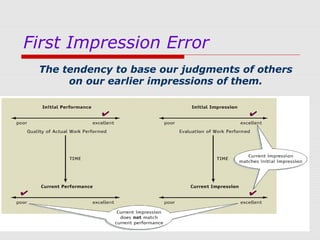
First Impression Error
The tendency to base our judgments of others
on our earlier impressions of them.
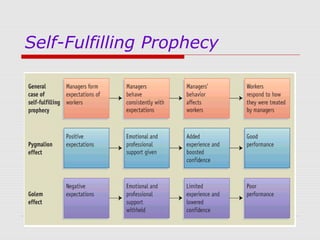
Self-Fulfilling Prophecy
Self-Fulfilling Prophecy: The tendency for someone’s
Prophecy
expectations about another to cause that person to
behave in a manner consistent with those
expectations.
Pygmalion Effect: A positive instance of the selfEffect
fulfilling prophecy, in which people holding high
expectations of another tend to improve that
individual’s performance.
Golem Effect: A negative instance of the selfEffect
fulfilling prophecy, in which people holding low
expectations of another tend to lower that
individual’s performance.
Self-Fulfilling Prophecy
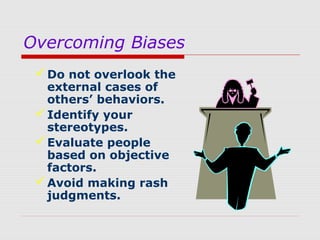
Overcoming Biases
 Do not overlook the
external cases of
others’ behaviors.
 Identify your
stereotypes.
 Evaluate people
based on objective
factors.
 Avoid making rash
judgments.
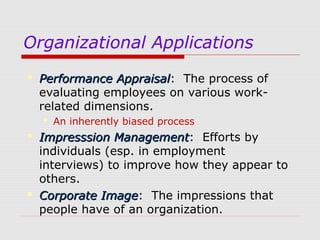
Organizational Applications
 Performance Appraisal: The process of
Appraisal
evaluating employees on various workrelated dimensions.
 An inherently biased process

 Impresssion Management: Efforts by
Management
individuals (esp. in employment
interviews) to improve how they appear to
others.
 Corporate Image: The impressions that
Image
people have of an organization.
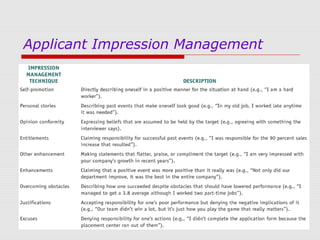
Applicant Impression Management

Impression management

  • 1.
  • 2.
    13 Impression Management  Impressionmanagement is an attempt to control the perceptions or impressions of others.  Targets are especially likely to use impression management tactics when interacting with perceivers who have power over them and on whom they are dependent for evaluations, raises, and promotions.  Individuals who are high in self-monitoring are more likely than individuals who are low in selfmonitoring to engage in impression management tactics.
  • 3.
    Impression Management  Anattempt to manipulate or control the impressions that others form about the person.  Non verbal communication, clothes, hair cut, style, etc.  Feigning interest in a boring lecture  Behaving nicely when grandparents come to visit
  • 4.
    Impression Motivation  Thedegree to which an individual actually manages the impression that he or she makes.  Sometimes people are strongly motivated for impression management, such as going for an interview  Sometimes people are not as strongly motivated for impression management, such as going to meet old friends
  • 5.
    Impression Construction  Itrefers to an individual’s consciously choosing  (1) an image to convey &  (2) how to go about doing that.  For a job interview one may be dressed in conventional suiting.  Rewriting the resume, etc.
  • 6.
    Impression Motivation: How muchdo I care about the impression that I am making? Impression Construction: What image do I want to convey? How do I go about it? Impression Management
  • 7.
    Primacy Effect  Mostof the perceptions are strongly affected by the first impression.  How a person perceives other person is influenced by:  Characteristics of the person being perceived  Characteristics of the perceiver, and  The situation or context within which the perception takes place
  • 8.
    The Person Perceivedon basis of voice quality Voice Quality: High in Male Voice Female Voice Breathiness Younger , Artistic Feminine, pretty, petite, shallow Flatness Similar for both sexes Masculine, cold, withdrawn Nasality Similar for both sexes Having many socially undesirable characteristics Tenseness Old, Unyielding Young, emotional, high strung, not very intelligent
  • 9.
    15 Salience  Salience isthe extent to which a target of perception stands out in a group of people or things.  Consequences of salience  Extreme evaluations (positive or negative)  Stereotyping
  • 10.
    15 Causes of salience Being novel: Anything that makes a target unique in a situation (e.g., being the only young person).  Being figural: Standing out from the background (e.g., by wearing bright clothes).  Being inconsistent with other people’s expectations: Behaving or looking in a way that is out of the ordinary.
  • 11.
    17 Biases and Problemsin Perception Primacy Effects The initial pieces of information that a perceiver has about a target have an inordinately large effect on the perceiver’s perception and evaluation of the target. Interviewers decide in the first few minutes of an interview whether or not a job candidate is a good prospect. Contrast Effect The perceiver’s perceptions of others influence the perceiver’s perception of a target. A manager’s perception of an average subordinate is likely to be lower if that subordinate is in a group with very high performers rather than in a group with very low performers. Halo Effect The perceiver’s general impression of a target influences his or her perception of the target on specific dimensions. A subordinate who has made a good overall impression on a supervisor is rated as performing high-quality work and always meeting deadlines regardless of work that is full of mistakes and late.
  • 12.
    18 Biases and Problemsin Perception Similar-tome Effect People perceive others who are similar to themselves more positively than they perceive those who are dissimilar. Supervisors rate subordinates who are similar to them more positively than they deserve. Harshness, Leniency, and Average Tendency Some perceivers tend to be overly harsh in their perceptions, some overly lenient. Others view most targets as being about average. When rating subordinates’ performances, some supervisors give almost everyone a poor rating, some give almost everyone a good rating, and others rate almost everyone as being about average. Knowledge of Predictor Knowing how a target stands on a predictor of performance influences perceptions of the target. A professor perceives a student more positively than she deserves because the professor knows the student had a high score on the SAT.
  • 13.
    Errors in Attribution Beliefsthat all members of specific groups share similar traits and are prone to behave the same way.
  • 14.
    Errors in Attribution Thetendency to attribute others’ actions to internal causes (for example, their traits) while largely ignoring external factors that also may have influenced behavior.
  • 15.
    Errors in Attribution Thetendency for our overall impressions of others to affect objective evaluations of their specific traits; perceiving high correlations between characteristics that may be unrelated.
  • 16.
    Errors in Attribution Thetendency for people to perceive in a positive light others who are believed to be similar to themselves in any of several different ways.
  • 17.
    Errors in Attribution Thetendency to focus on some aspects of the environment while ignoring others.
  • 18.
    First Impression Error Thetendency to base our judgments of others on our earlier impressions of them.
  • 19.
    Self-Fulfilling Prophecy Self-Fulfilling Prophecy:The tendency for someone’s Prophecy expectations about another to cause that person to behave in a manner consistent with those expectations. Pygmalion Effect: A positive instance of the selfEffect fulfilling prophecy, in which people holding high expectations of another tend to improve that individual’s performance. Golem Effect: A negative instance of the selfEffect fulfilling prophecy, in which people holding low expectations of another tend to lower that individual’s performance.
  • 20.
  • 21.
    Overcoming Biases  Donot overlook the external cases of others’ behaviors.  Identify your stereotypes.  Evaluate people based on objective factors.  Avoid making rash judgments.
  • 22.
    Organizational Applications  PerformanceAppraisal: The process of Appraisal evaluating employees on various workrelated dimensions.  An inherently biased process  Impresssion Management: Efforts by Management individuals (esp. in employment interviews) to improve how they appear to others.  Corporate Image: The impressions that Image people have of an organization.
  • 23.