ORGANISATIONAL 
ATTITUDE 
By ANOOP MOHAN
OVERVIEW 
 NATURE & DIMENSIONS OF ATTITUDE 
 TYPES OF ATTITUDE 
 COMPONENTS OF ATTITUDE 
 FORMATION OF ATTITUDE 
 FUNCTIONS OF ATTITUDE 
 MEASUREEMNT OF ATTITUDE 
 SUMMARY 
 REFERENCES
THE NATURE AND DIMENSIONS 
OF ATTITUDES 
“Attitudes” 
The attitude is the evaluative statements or 
judgments concerning objects, people, or 
events. More precisely attitudes can be defined as 
a persistent tendency to feel and behave in a 
particular way toward some object which may 
include events or individuals as well. 
Characteristics of Attitudes 
 They tend to persist unless something is done to 
change them. 
 They can fall anywhere along a continuum from very 
favorable to very unfavorable. 
 They are directed toward some object about which a 
person has feelings and beliefs.
TYPES OF ATTITUDES 
 Job Satisfaction 
A collection of positive and or negative feelings that an individual holds 
toward his or her job. 
 Job Involvement 
Identifying with the job, actively participating in it, and considering 
performance important to self-worth. 
 Organizational Commitment 
Identifying with a particular organization and its goals, and wishing to 
maintain membership in the organization.
THE NATURE AND DIMENSIONS 
OF ATTITUDES 
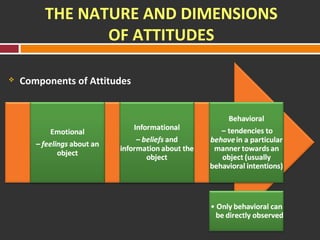
 Components of Attitudes
COMPONENTS OF ATTITUDES 
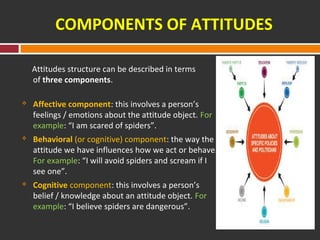
Attitudes structure can be described in terms 
of three components. 
 Affective component: this involves a person’s 
feelings / emotions about the attitude object. For 
example: “I am scared of spiders”. 
 Behavioral (or cognitive) component: the way the 
attitude we have influences how we act or behave. 
For example: “I will avoid spiders and scream if I 
see one”. 
 Cognitive component: this involves a person’s 
belief / knowledge about an attitude object. For 
example: “I believe spiders are dangerous”.
This model is known as the ABC model of attitudes. The 
three components are usually linked. However, there is 
evidence that the cognitive and affective components of 
behavior do not always match with behavior. 
They evaluative statements in an attitude are either 
favorable or unfavorable. They reflect how one feel 
about something. 
A person can have thousands of attitudes. But OB 
focuses on a limited number of job-related attitudes. 
These include job satisfaction 
job involvement (the degree to which person identifies 
with his or her job and actively participates in it) 
 And organizational commitment (an indicator of 
loyalty to, and, identification with the organization).
FORMATION OF ATTITUDE 
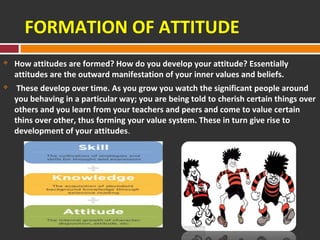
 How attitudes are formed? How do you develop your attitude? Essentially 
attitudes are the outward manifestation of your inner values and beliefs. 
 These develop over time. As you grow you watch the significant people around 
you behaving in a particular way; you are being told to cherish certain things over 
others and you learn from your teachers and peers and come to value certain 
thins over other, thus forming your value system. These in turn give rise to 
development of your attitudes.
 Attitudes help predict work behavior. The following example might help 
to illustrate it. After introducing a particular policy, it is found from an 
attitude survey, that the workers are not too happy about it. During the 
subsequent week it is found that the attendance of the employees drops 
sharply from the previous standard. Here management may conclude 
that a negative attitude toward new work rules led to increased 
absenteeism. 
 Attitudes help people to adapt to their work environment. An 
understanding of attitudes is also important because attitudes help the 
employees to get adjusted to their work. If the management can 
successfully develop a- positive attitude among the employees, they will 
be better adjusted to their work.
PROCESS OF FORMATION OF ATTITUDE 
A) Social Learning: it is acquiring attitudes from others. There are 
broadly three processes of acquiring attitudes through social 
learning: Classical Conditioning, instrumental Conditioning, and 
Modeling. 
 Classical Conditioning is a basic form of learning in which one 
stimulus regularly precedes another. It is learning based of 
association, that when first stimulus is represent, the second would 
follow. Prejudices and preferences are created through classical 
conditioning. Classical Conditioning can play a role in the 
development of attitudes. 
 Instrumental Conditioning is concerned with learning to express the 
“right” views. Instrumental Conditioning is created through 
rewarding a desirable behavior and discouraging an undesirable 
behavior. Thus a particular type of attitude is created towards a 
particular type of action through Instrumental Conditioning.
Modeling as a concept deals with individuals acquiring new behaviors 
through observing the actions of others. Individuals tend to do what 
others do, not what others say. Thus attitudes may be transmitted from 
one person to other or from one group to other, or from one generation to 
other. 
B) Direct Experience: Attitudes are also formed through real life 
experience, which may be also called as direct experience or personal 
experience. Various studies suggest that strength of the attitudes 
acquired through direct experience is stronger than the strength of 
attitudes acquired indirectly. Attitudes acquired through direct experience 
are held more confidently and are more difficult to be subjected to 
change. If you hold strong attitude about an object, issue, or a person, 
and you want others to properly understand your stand, it is better to let 
others have direct experience with the attitude object.
FUNCTIONS OF ATTITUDE 
According to Katz, attitudes serve four important functions from the 
viewpoint of organizational behavior. These are as follows. 
 The Adjustment Function. Attitudes often help people to adjust to their 
work environment. Well-treated employees tend to develop a positive 
attitude towards their job, management and the organization in general 
while berated and ill treated organizational members develop a 
negative attitude. In other words, attitudes help employees adjust to 
their environment and form a basis for future behavior. 
 Ego-Defensive Function. Attitudes help people to retain their dignity 
and self- image. When a young faculty member who is full of fresh 
ideas and enthusiasm, joins the organization, the older members might 
feel somewhat threatened by him. But they tend to disapprove his 
creative ideas as ‘crazy’ and ‘impractical’ and dismiss him altogether.
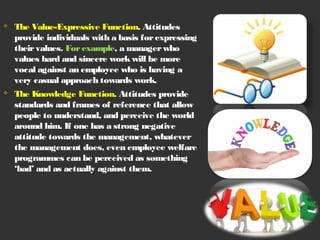
 The Value-Expressive Function. Attitudes 
provide individuals with a basis for expressing 
their values. For example, a manager who 
values hard and sincere work will be more 
vocal against an employee who is having a 
very casual approach towards work. 
 The Knowledge Function. Attitudes provide 
standards and frames of reference that allow 
people to understand, and perceive the world 
around him. If one has a strong negative 
attitude towards the management, whatever 
the management does, even employee welfare 
programmes can be perceived as something 
‘bad’ and as actually against them.
Measurement Of Attitude 
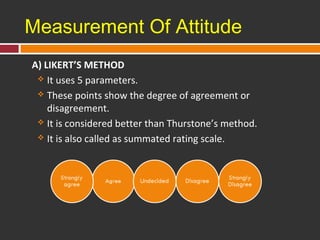
A) LIKERT’S METHOD 
 It uses 5 parameters. 
 These points show the degree of agreement or 
disagreement. 
 It is considered better than Thurstone’s method. 
 It is also called as summated rating scale.
THURSTSONE’S TECHNIQUE OF SCALING 
 Developed by THURSTSONE & CHAVE. 
 This technique was based on 11 statements. 
Most favorable statement was put under pile-1 
while the most unfavorable under pile-11. 
 The scale is shown to the respondent. 
 His attitude score is then calculated on the 
average of what he has checked.
SUMMARY 
 Attitudes have traditionally been described as a process in 
which we logically calculate our feelings toward the attitude 
object based on an analysis of our beliefs. Thus, beliefs 
predict feelings, which predict behavioral intentions, which 
predict behavior. But this traditional perspective overlooks 
the role of emotions, which have an important influence on 
attitudes and behavior 
 Behavior sometimes influences our subsequent attitudes 
through cognitive dissonance. People also have personality 
traits which affect their emotions and attitudes.
REFERENCES 
 Attitudes Influence on Behavior. (n.d.). Retrieved from boundless 
- Better than your assigned text books: 
https://www.boundless.com/management/organizational-behavior/ 
drivers-of-behavior/attitudes-influence-on-behavior/ 
 Luthans, F. (2008). Organizational Behavior. Mc Graw Hill 
International Edition. 
 ORGANISATION BEHAVIOUR – ATTITUDE. (n.d.). Retrieved from 
http://mbanotesravi.com/2012/11/27/organisation-behaviour-attitude/. 
 What Are Attitudes? (n.d.). Retrieved from Pearson Education : 
http://wps.pearsoned.ca/ca_ph_johns_ob_7/67/17350/4441642. 
cw/index.html
 WORKPLACE EMOTIONS. (n.d.). Retrieved from 
http://highered.mcgraw-hill. 
com/sites/dl/free/0070876940/355897/sample_ch04.pdf. 
 www.ftms.edu. (n.d.). Values, Attitudes, and Job Satisfaction. 
Retrieved from 
 Values, Attitudes, and Job Satisfaction: 
http://www.ftms.edu.my/pdf/Download/PostgraduateStudent/OB 
-lecture%202%20values,%20attitude%20and%20job 
%20satisfaction.pdf 
 McLeod, S. A. (2009). Attitudes and Behavior - Simply Psychology. 
Retrieved from http://www.simplypsychology.org/attitudes.html 
 Hogg, M., & Vaughan, G. (2005). Social Psychology (4th edition). 
London: Prentice-Hall .
Organisational Attitude

Organisational Attitude

  • 1.
  • 2.
    OVERVIEW  NATURE& DIMENSIONS OF ATTITUDE  TYPES OF ATTITUDE  COMPONENTS OF ATTITUDE  FORMATION OF ATTITUDE  FUNCTIONS OF ATTITUDE  MEASUREEMNT OF ATTITUDE  SUMMARY  REFERENCES
  • 3.
    THE NATURE ANDDIMENSIONS OF ATTITUDES “Attitudes” The attitude is the evaluative statements or judgments concerning objects, people, or events. More precisely attitudes can be defined as a persistent tendency to feel and behave in a particular way toward some object which may include events or individuals as well. Characteristics of Attitudes  They tend to persist unless something is done to change them.  They can fall anywhere along a continuum from very favorable to very unfavorable.  They are directed toward some object about which a person has feelings and beliefs.
  • 4.
    TYPES OF ATTITUDES  Job Satisfaction A collection of positive and or negative feelings that an individual holds toward his or her job.  Job Involvement Identifying with the job, actively participating in it, and considering performance important to self-worth.  Organizational Commitment Identifying with a particular organization and its goals, and wishing to maintain membership in the organization.
  • 5.
    THE NATURE ANDDIMENSIONS OF ATTITUDES  Components of Attitudes
  • 6.
    COMPONENTS OF ATTITUDES Attitudes structure can be described in terms of three components.  Affective component: this involves a person’s feelings / emotions about the attitude object. For example: “I am scared of spiders”.  Behavioral (or cognitive) component: the way the attitude we have influences how we act or behave. For example: “I will avoid spiders and scream if I see one”.  Cognitive component: this involves a person’s belief / knowledge about an attitude object. For example: “I believe spiders are dangerous”.
  • 7.
    This model isknown as the ABC model of attitudes. The three components are usually linked. However, there is evidence that the cognitive and affective components of behavior do not always match with behavior. They evaluative statements in an attitude are either favorable or unfavorable. They reflect how one feel about something. A person can have thousands of attitudes. But OB focuses on a limited number of job-related attitudes. These include job satisfaction job involvement (the degree to which person identifies with his or her job and actively participates in it)  And organizational commitment (an indicator of loyalty to, and, identification with the organization).
  • 8.
    FORMATION OF ATTITUDE  How attitudes are formed? How do you develop your attitude? Essentially attitudes are the outward manifestation of your inner values and beliefs.  These develop over time. As you grow you watch the significant people around you behaving in a particular way; you are being told to cherish certain things over others and you learn from your teachers and peers and come to value certain thins over other, thus forming your value system. These in turn give rise to development of your attitudes.
  • 9.
     Attitudes helppredict work behavior. The following example might help to illustrate it. After introducing a particular policy, it is found from an attitude survey, that the workers are not too happy about it. During the subsequent week it is found that the attendance of the employees drops sharply from the previous standard. Here management may conclude that a negative attitude toward new work rules led to increased absenteeism.  Attitudes help people to adapt to their work environment. An understanding of attitudes is also important because attitudes help the employees to get adjusted to their work. If the management can successfully develop a- positive attitude among the employees, they will be better adjusted to their work.
  • 10.
    PROCESS OF FORMATIONOF ATTITUDE A) Social Learning: it is acquiring attitudes from others. There are broadly three processes of acquiring attitudes through social learning: Classical Conditioning, instrumental Conditioning, and Modeling.  Classical Conditioning is a basic form of learning in which one stimulus regularly precedes another. It is learning based of association, that when first stimulus is represent, the second would follow. Prejudices and preferences are created through classical conditioning. Classical Conditioning can play a role in the development of attitudes.  Instrumental Conditioning is concerned with learning to express the “right” views. Instrumental Conditioning is created through rewarding a desirable behavior and discouraging an undesirable behavior. Thus a particular type of attitude is created towards a particular type of action through Instrumental Conditioning.
  • 11.
    Modeling as aconcept deals with individuals acquiring new behaviors through observing the actions of others. Individuals tend to do what others do, not what others say. Thus attitudes may be transmitted from one person to other or from one group to other, or from one generation to other. B) Direct Experience: Attitudes are also formed through real life experience, which may be also called as direct experience or personal experience. Various studies suggest that strength of the attitudes acquired through direct experience is stronger than the strength of attitudes acquired indirectly. Attitudes acquired through direct experience are held more confidently and are more difficult to be subjected to change. If you hold strong attitude about an object, issue, or a person, and you want others to properly understand your stand, it is better to let others have direct experience with the attitude object.
  • 12.
    FUNCTIONS OF ATTITUDE According to Katz, attitudes serve four important functions from the viewpoint of organizational behavior. These are as follows.  The Adjustment Function. Attitudes often help people to adjust to their work environment. Well-treated employees tend to develop a positive attitude towards their job, management and the organization in general while berated and ill treated organizational members develop a negative attitude. In other words, attitudes help employees adjust to their environment and form a basis for future behavior.  Ego-Defensive Function. Attitudes help people to retain their dignity and self- image. When a young faculty member who is full of fresh ideas and enthusiasm, joins the organization, the older members might feel somewhat threatened by him. But they tend to disapprove his creative ideas as ‘crazy’ and ‘impractical’ and dismiss him altogether.
  • 13.
     The Value-ExpressiveFunction. Attitudes provide individuals with a basis for expressing their values. For example, a manager who values hard and sincere work will be more vocal against an employee who is having a very casual approach towards work.  The Knowledge Function. Attitudes provide standards and frames of reference that allow people to understand, and perceive the world around him. If one has a strong negative attitude towards the management, whatever the management does, even employee welfare programmes can be perceived as something ‘bad’ and as actually against them.
  • 14.
    Measurement Of Attitude A) LIKERT’S METHOD  It uses 5 parameters.  These points show the degree of agreement or disagreement.  It is considered better than Thurstone’s method.  It is also called as summated rating scale.
  • 15.
    THURSTSONE’S TECHNIQUE OFSCALING  Developed by THURSTSONE & CHAVE.  This technique was based on 11 statements. Most favorable statement was put under pile-1 while the most unfavorable under pile-11.  The scale is shown to the respondent.  His attitude score is then calculated on the average of what he has checked.
  • 16.
    SUMMARY  Attitudeshave traditionally been described as a process in which we logically calculate our feelings toward the attitude object based on an analysis of our beliefs. Thus, beliefs predict feelings, which predict behavioral intentions, which predict behavior. But this traditional perspective overlooks the role of emotions, which have an important influence on attitudes and behavior  Behavior sometimes influences our subsequent attitudes through cognitive dissonance. People also have personality traits which affect their emotions and attitudes.
  • 17.
    REFERENCES  AttitudesInfluence on Behavior. (n.d.). Retrieved from boundless - Better than your assigned text books: https://www.boundless.com/management/organizational-behavior/ drivers-of-behavior/attitudes-influence-on-behavior/  Luthans, F. (2008). Organizational Behavior. Mc Graw Hill International Edition.  ORGANISATION BEHAVIOUR – ATTITUDE. (n.d.). Retrieved from http://mbanotesravi.com/2012/11/27/organisation-behaviour-attitude/.  What Are Attitudes? (n.d.). Retrieved from Pearson Education : http://wps.pearsoned.ca/ca_ph_johns_ob_7/67/17350/4441642. cw/index.html
  • 18.
     WORKPLACE EMOTIONS.(n.d.). Retrieved from http://highered.mcgraw-hill. com/sites/dl/free/0070876940/355897/sample_ch04.pdf.  www.ftms.edu. (n.d.). Values, Attitudes, and Job Satisfaction. Retrieved from  Values, Attitudes, and Job Satisfaction: http://www.ftms.edu.my/pdf/Download/PostgraduateStudent/OB -lecture%202%20values,%20attitude%20and%20job %20satisfaction.pdf  McLeod, S. A. (2009). Attitudes and Behavior - Simply Psychology. Retrieved from http://www.simplypsychology.org/attitudes.html  Hogg, M., & Vaughan, G. (2005). Social Psychology (4th edition). London: Prentice-Hall .