MODULE 1 MIDTERM
PREPARED BY : GENEVIEVE L.
CAVAIANI
ATTRIBUTION
• DEFINITION
• Attribution theory is a theory about how people
explain things.
• Attribution refer to the way people try to understand
the behavior of others or interpret events around
them.
• Attribution theory seeks to explain how and why
people make these causal attributions.
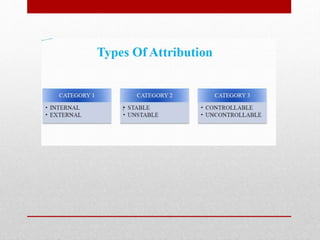
Internal vs. External
• In an internal, or dispositional, attribution, people
infer that an event
• or a person’s behavior is due to personal factors such
as traits, abilities, or feelings.
• In an external, or situational, attribution, people infer
that a person’s behavior is due to situational factors
Stable vs. Unstable
• Researchers also distinguish between stable and
unstable attributions.
• When people make a Stable attribution, they infer
that an event or behavior is due to stable, unchanging
factors.
• When making an Unstable attribution, they infer that
an event or behavior is due to unstable, temporary
factors
Controllable vs.
Uncontrollable
• If something is controllable, we can alter it if we wish
to do so.
• If something is uncontrollable, it is outside our sphere
of influence
The Fundamental
Attribution Error
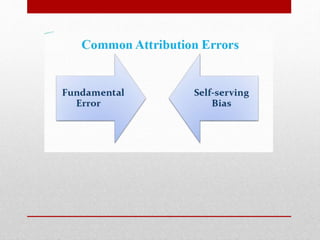
• The fundamental attribution error is the tendency to
attribute other people’s behavior to internal factors
such as personality traits, abilities, and feelings.
• The fundamental attribution error is also called the
correspondence bias, because it is assumed that other
people’s behavior corresponds to their personal
attributes.
• When explaining their own behavior, on the other
hand, people tend to attribute it to situational factors
The Self-Serving Bias
• The self-serving bias is the tendency to attribute
successes to internal factors and failures to situational
factors.
• This bias tends to increase as time passes after an
event.
• Therefore, the further in the past an event is, the more
likely people are to congratulate themselves for
successes and to blame the situation for failures
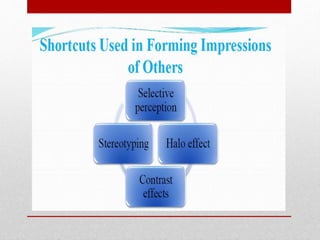
Selective perception
• happens when a person selectively interprets what he
sees on the basis of his interests, background,
experience, and attitudes.
• It is impossible for a person to assimilate everything
he sees, hears, smells, touches or tastes. Only a limited
number of stimuli can be taken in. As a result, people
engage in selective perception, but the process is
affected by personal interests, background, experience
and attitude of the perceiver
Halo effect
• It occurs when one attribute of a person or situation is
used to develop an overall impression of the person or
situation.
• In short, this occurs when we draw a general
impression on the basis of a single characteristic.
Contrast Effect
• It is an evaluations of a person’s characteristics that
are affected by comparisons with other people
recently encountered who rank higher or lower on the
same characteristics.
• Here, we do not evaluate a person in isolation. Our
reaction to one person is influenced by other persons
we have recently encountered
Stereotype
• It is judging someone on the basis of one’s perception
of the group to which that person belongs.
Generalization is not without advantages.
• It is a means of simplifying a complex world, and it
permits us to maintain consistency. The problem, of
course, is when we inaccurately stereotype.
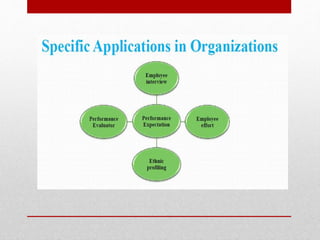
Employment Interview
• It is during an interview the interviewers make an
perceptual judgement and draw early impressions.
• As a result information elicited early in the interview
carries greater weight than does information elicited later
Performance
expectations
• It is Self-fulfilling prophecy (pygmalion effect): The
lower or higher performance of employees reflects
preconceived leader expectations about employee
capabilities.
Performance evaluation
• Appraisals are often the subjective (judgmental)
perceptions of appraisers of another employee’s job
performance.
Employee Effort
• Assessment of individual effort is a subjective judgment
subject to perceptual distortion and bias
Ethnic profiling
• A form of stereotyping in which a group of individuals is
singled out—typically on the basis of race or ethnicity—
for intensive inquiry, scrutinizing, or investigation.
THANK YOU!
Module 2
SELF CONCEPT
• People do not have common self-concept.
• Always think of themselves in numerous manners in
different circumstances
• It refers to how a person thinks about , evaluates or
perceives himself
• It is an important and useful way to understand and
improve performance and welfare.
Three dimensions
• COMPLEXITY- a person ‘s self-concept has higher
complexity when it consists of many categories
• CONSISTENCY- a person has high consistency when
similar personality traits and values are required across all
aspects of self-concept
• CLARITY- this mean the level of a person’s self concepts
are clearly and confidently described, internally
consistent and stable across time
SELF-ENHANCEMENT
• A desire to magnify positive aspects iof self conceptions
while isolating oneself from negative feedback and
information
• Most often people desires to rate themselves as above
average, selectively recall positive while forgetting
negative ones
SELF VERIFICATION
• Assumes that people work to preserve their self-views by
seeking to confirm the stabilizes a persons self concept which
help guide his though and actions.
• Implications:
• It affects the perpetual process because employees are likely to
remember information that is consistent with their self-
concepts
• The more confident employees are in their self- concepts, the
less they accept feedbacks whether positive or negative, that is
at odds with their self-concepts
• employees are motivated to interact with others who affirm
their self-concepts and this affect how well they get along with
their boss and with co-employees in team
SELF EVALUATION
• It is an individual’s honest and objectives assessment of
himself.
• It is usually desired by three concepts which are self-
esteem, self- efficacy and locus of control
SELF-ESTEEM
• Is the extent to which a person has generally positive
feelings about himself.
• View themselves in positive light, are confident, and
respect themselves.
SELF- EFFICACY
• It is a personal belief on competencies and abilities
• Person’s belief of his ability to do definite task fruitfully
• People low self efficacy tend to procastinate
LOCUS OF CONTROL
• Deals with the degree to which people feel answerable for
their own behaviors
• People with high internal locus of control or internal
believe that they can influence their own destiny and
what happens to them is caused by their own doing
• High external locus of control suppose things happen to
them because of their people, luck or a powerful Being
• Internal feels greater control over their own lives and so
they act in ways that will add to their chances of succcess
SELF- MONITORING
• Refer to level to which person is able of checking his
actions and appearance in social situation.
• People who are social monitors understand what the
situation demands and act accordingly
• the greater the ability to modify their behavior according
to the demands of the situation and to manage their
impression effectively is a great advantage to them

Attribution and Self concepts

  • 1.
    MODULE 1 MIDTERM PREPAREDBY : GENEVIEVE L. CAVAIANI
  • 2.
    ATTRIBUTION • DEFINITION • Attributiontheory is a theory about how people explain things. • Attribution refer to the way people try to understand the behavior of others or interpret events around them. • Attribution theory seeks to explain how and why people make these causal attributions.
  • 4.
    Internal vs. External •In an internal, or dispositional, attribution, people infer that an event • or a person’s behavior is due to personal factors such as traits, abilities, or feelings. • In an external, or situational, attribution, people infer that a person’s behavior is due to situational factors
  • 5.
    Stable vs. Unstable •Researchers also distinguish between stable and unstable attributions. • When people make a Stable attribution, they infer that an event or behavior is due to stable, unchanging factors. • When making an Unstable attribution, they infer that an event or behavior is due to unstable, temporary factors
  • 6.
    Controllable vs. Uncontrollable • Ifsomething is controllable, we can alter it if we wish to do so. • If something is uncontrollable, it is outside our sphere of influence
  • 9.
    The Fundamental Attribution Error •The fundamental attribution error is the tendency to attribute other people’s behavior to internal factors such as personality traits, abilities, and feelings. • The fundamental attribution error is also called the correspondence bias, because it is assumed that other people’s behavior corresponds to their personal attributes. • When explaining their own behavior, on the other hand, people tend to attribute it to situational factors
  • 10.
    The Self-Serving Bias •The self-serving bias is the tendency to attribute successes to internal factors and failures to situational factors. • This bias tends to increase as time passes after an event. • Therefore, the further in the past an event is, the more likely people are to congratulate themselves for successes and to blame the situation for failures
  • 12.
    Selective perception • happenswhen a person selectively interprets what he sees on the basis of his interests, background, experience, and attitudes. • It is impossible for a person to assimilate everything he sees, hears, smells, touches or tastes. Only a limited number of stimuli can be taken in. As a result, people engage in selective perception, but the process is affected by personal interests, background, experience and attitude of the perceiver
  • 13.
    Halo effect • Itoccurs when one attribute of a person or situation is used to develop an overall impression of the person or situation. • In short, this occurs when we draw a general impression on the basis of a single characteristic.
  • 14.
    Contrast Effect • Itis an evaluations of a person’s characteristics that are affected by comparisons with other people recently encountered who rank higher or lower on the same characteristics. • Here, we do not evaluate a person in isolation. Our reaction to one person is influenced by other persons we have recently encountered
  • 15.
    Stereotype • It isjudging someone on the basis of one’s perception of the group to which that person belongs. Generalization is not without advantages. • It is a means of simplifying a complex world, and it permits us to maintain consistency. The problem, of course, is when we inaccurately stereotype.
  • 17.
    Employment Interview • Itis during an interview the interviewers make an perceptual judgement and draw early impressions. • As a result information elicited early in the interview carries greater weight than does information elicited later
  • 18.
    Performance expectations • It isSelf-fulfilling prophecy (pygmalion effect): The lower or higher performance of employees reflects preconceived leader expectations about employee capabilities.
  • 19.
    Performance evaluation • Appraisalsare often the subjective (judgmental) perceptions of appraisers of another employee’s job performance.
  • 20.
    Employee Effort • Assessmentof individual effort is a subjective judgment subject to perceptual distortion and bias
  • 21.
    Ethnic profiling • Aform of stereotyping in which a group of individuals is singled out—typically on the basis of race or ethnicity— for intensive inquiry, scrutinizing, or investigation.
  • 22.
  • 23.
  • 24.
    SELF CONCEPT • Peopledo not have common self-concept. • Always think of themselves in numerous manners in different circumstances • It refers to how a person thinks about , evaluates or perceives himself • It is an important and useful way to understand and improve performance and welfare.
  • 25.
    Three dimensions • COMPLEXITY-a person ‘s self-concept has higher complexity when it consists of many categories • CONSISTENCY- a person has high consistency when similar personality traits and values are required across all aspects of self-concept • CLARITY- this mean the level of a person’s self concepts are clearly and confidently described, internally consistent and stable across time
  • 26.
    SELF-ENHANCEMENT • A desireto magnify positive aspects iof self conceptions while isolating oneself from negative feedback and information • Most often people desires to rate themselves as above average, selectively recall positive while forgetting negative ones
  • 27.
    SELF VERIFICATION • Assumesthat people work to preserve their self-views by seeking to confirm the stabilizes a persons self concept which help guide his though and actions. • Implications: • It affects the perpetual process because employees are likely to remember information that is consistent with their self- concepts • The more confident employees are in their self- concepts, the less they accept feedbacks whether positive or negative, that is at odds with their self-concepts • employees are motivated to interact with others who affirm their self-concepts and this affect how well they get along with their boss and with co-employees in team
  • 28.
    SELF EVALUATION • Itis an individual’s honest and objectives assessment of himself. • It is usually desired by three concepts which are self- esteem, self- efficacy and locus of control
  • 29.
    SELF-ESTEEM • Is theextent to which a person has generally positive feelings about himself. • View themselves in positive light, are confident, and respect themselves.
  • 30.
    SELF- EFFICACY • Itis a personal belief on competencies and abilities • Person’s belief of his ability to do definite task fruitfully • People low self efficacy tend to procastinate
  • 31.
    LOCUS OF CONTROL •Deals with the degree to which people feel answerable for their own behaviors • People with high internal locus of control or internal believe that they can influence their own destiny and what happens to them is caused by their own doing • High external locus of control suppose things happen to them because of their people, luck or a powerful Being • Internal feels greater control over their own lives and so they act in ways that will add to their chances of succcess
  • 32.
    SELF- MONITORING • Referto level to which person is able of checking his actions and appearance in social situation. • People who are social monitors understand what the situation demands and act accordingly • the greater the ability to modify their behavior according to the demands of the situation and to manage their impression effectively is a great advantage to them