What is Perception?
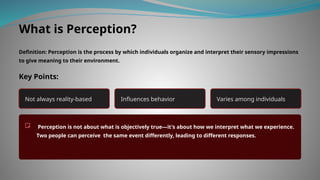
Definition:Perception is the process by which individuals organize and interpret their sensory impressions
to give meaning to their environment.
Key Points:
Not always reality-based Influences behavior Varies among individuals
Perception is not about what is objectively true—it's about how we interpret what we experience.
Two people can perceive the same event differently, leading to different responses.
4.
Factors Influencing Perception
ThreeCategories:
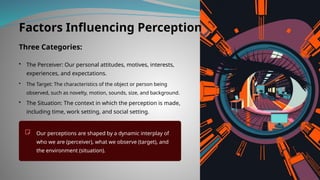
• The Perceiver: Our personal attitudes, motives, interests,
experiences, and expectations.
• The Target: The characteristics of the object or person being
observed, such as novelty, motion, sounds, size, and background.
• The Situation: The context in which the perception is made,
including time, work setting, and social setting.
Our perceptions are shaped by a dynamic interplay of
who we are (perceiver), what we observe (target), and
the environment (situation).
5.
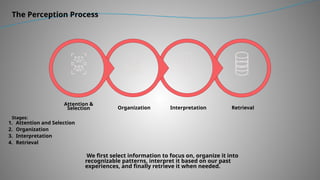
The Perception Process
Retrieval
Interpretation
Organization
Attention&
Selection
Stages:
1. Attention and Selection
2. Organization
3. Interpretation
4. Retrieval
We first select information to focus on, organize it into
recognizable patterns, interpret it based on our past
experiences, and finally retrieve it when needed.
6.
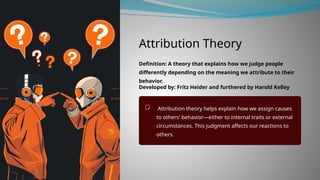
Attribution Theory
Definition: Atheory that explains how we judge people
differently depending on the meaning we attribute to their
behavior.
Developed by: Fritz Heider and furthered by Harold Kelley
Attribution theory helps explain how we assign causes
to others' behavior—either to internal traits or external
circumstances. This judgment affects our reactions to
others.
7.
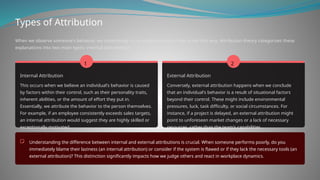
Types of Attribution
Whenwe observe someone's behavior, we instinctively try to understand why they acted that way. Attribution theory categorizes these
explanations into two main types: internal and external.
1
Internal Attribution
This occurs when we believe an individual's behavior is caused
by factors within their control, such as their personality traits,
inherent abilities, or the amount of effort they put in.
Essentially, we attribute the behavior to the person themselves.
For example, if an employee consistently exceeds sales targets,
an internal attribution would suggest they are highly skilled or
exceptionally motivated.
2
External Attribution
Conversely, external attribution happens when we conclude
that an individual's behavior is a result of situational factors
beyond their control. These might include environmental
pressures, luck, task difficulty, or social circumstances. For
instance, if a project is delayed, an external attribution might
point to unforeseen market changes or a lack of necessary
resources, rather than the team's capabilities.
Understanding the difference between internal and external attributions is crucial. When someone performs poorly, do you
immediately blame their laziness (an internal attribution) or consider if the system is flawed or if they lack the necessary tools (an
external attribution)? This distinction significantly impacts how we judge others and react in workplace dynamics.
8.
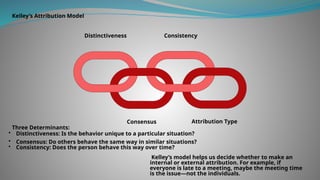
Kelley’s Attribution Model
Distinctiveness
Consensus
Consistency
AttributionType
Three Determinants:
• Distinctiveness: Is the behavior unique to a particular situation?
• Consensus: Do others behave the same way in similar situations?
• Consistency: Does the person behave this way over time?
Kelley’s model helps us decide whether to make an
internal or external attribution. For example, if
everyone is late to a meeting, maybe the meeting time
is the issue—not the individuals.
9.
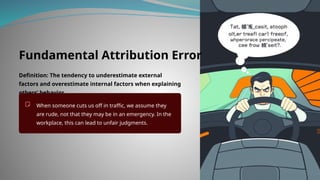
Fundamental Attribution Error
Definition:The tendency to underestimate external
factors and overestimate internal factors when explaining
others’ behavior.
When someone cuts us off in traffic, we assume they
are rude, not that they may be in an emergency. In the
workplace, this can lead to unfair judgments.
10.
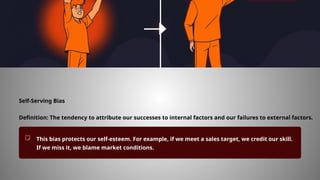
Self-Serving Bias
Definition: Thetendency to attribute our successes to internal factors and our failures to external factors.
This bias protects our self-esteem. For example, if we meet a sales target, we credit our skill.
If we miss it, we blame market conditions.
11.
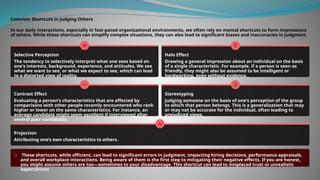
Common Shortcuts inJudging Others
In our daily interactions, especially in fast-paced organizational environments, we often rely on mental shortcuts to form impressions
of others. While these shortcuts can simplify complex situations, they can also lead to significant biases and inaccuracies in judgment.
Selective Perception
The tendency to selectively interpret what one sees based on
one's interests, background, experience, and attitudes. We see
what we want to see, or what we expect to see, which can lead
to a distorted view of reality.
Halo Effect
Drawing a general impression about an individual on the basis
of a single characteristic. For example, if a person is seen as
friendly, they might also be assumed to be intelligent or
hardworking, even without evidence.
Contrast Effect
Evaluating a person's characteristics that are affected by
comparisons with other people recently encountered who rank
higher or lower on the same characteristics. For instance, an
average candidate might seem excellent if interviewed after
several poor candidates.
Stereotyping
Judging someone on the basis of one's perception of the group
to which that person belongs. This is a generalization that may
or may not be accurate for the individual, often leading to
prejudiced views.
Projection
Attributing one’s own characteristics to others.
These shortcuts, while efficient, can lead to significant errors in judgment, impacting hiring decisions, performance appraisals,
and overall workplace interactions. Being aware of them is the first step to mitigating their negative effects. If you are honest,
you might assume others are too—sometimes to your disadvantage. This shortcut can lead to misplaced trust or unrealistic
expectations
12.
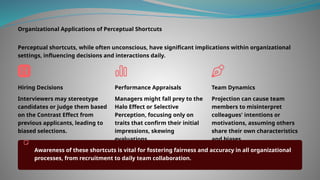
Organizational Applications ofPerceptual Shortcuts
Perceptual shortcuts, while often unconscious, have significant implications within organizational
settings, influencing decisions and interactions daily.
Hiring Decisions
Interviewers may stereotype
candidates or judge them based
on the Contrast Effect from
previous applicants, leading to
biased selections.
Performance Appraisals
Managers might fall prey to the
Halo Effect or Selective
Perception, focusing only on
traits that confirm their initial
impressions, skewing
evaluations.
Team Dynamics
Projection can cause team
members to misinterpret
colleagues' intentions or
motivations, assuming others
share their own characteristics
and biases.
Awareness of these shortcuts is vital for fostering fairness and accuracy in all organizational
processes, from recruitment to daily team collaboration.
13.
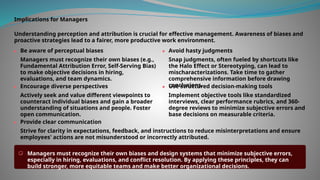
Implications for Managers
Understandingperception and attribution is crucial for effective management. Awareness of biases and
proactive strategies lead to a fairer, more productive work environment.
Be aware of perceptual biases
Managers must recognize their own biases (e.g.,
Fundamental Attribution Error, Self-Serving Bias)
to make objective decisions in hiring,
evaluations, and team dynamics.
Avoid hasty judgments
Snap judgments, often fueled by shortcuts like
the Halo Effect or Stereotyping, can lead to
mischaracterizations. Take time to gather
comprehensive information before drawing
conclusions.
Encourage diverse perspectives
Actively seek and value different viewpoints to
counteract individual biases and gain a broader
understanding of situations and people. Foster
open communication.
Use structured decision-making tools
Implement objective tools like standardized
interviews, clear performance rubrics, and 360-
degree reviews to minimize subjective errors and
base decisions on measurable criteria.
Provide clear communication
Strive for clarity in expectations, feedback, and instructions to reduce misinterpretations and ensure
employees' actions are not misunderstood or incorrectly attributed.
Managers must recognize their own biases and design systems that minimize subjective errors,
especially in hiring, evaluations, and conflict resolution. By applying these principles, they can
build stronger, more equitable teams and make better organizational decisions.