Process Improvement: Which Methodology is Best for  Your Project? PMI Skyline Luncheon Sharon Valencia, PMP
Agenda Definitions Business Improvement Methodologies Methodology Comparison Process Management Process Mapping Enabling Project Success
What is a Process?  Any set of  activities  that when taken together,  transform  a series of  inputs  into an  output , producing a result of  value  to a customer Process Suppliers Customer SIPOC Input Output
What is a Business Improvement Methodology? A documented set of procedures, guidelines, and tools intended to develop better processes Business improvement methodologies covered in this presentation: Kaizen Lean Six Sigma Lean Six Sigma Design for Six Sigma (DFSS)
Kaizen Defined: Philosophy of gradual, incremental, and orderly continuous improvement, creating more value and less waste; emphasis on process improvement and process control; Japanese word meaning “ongoing improvement” Objective: Small improvements by optimizing existing systems Requires: Taking action on obvious problems and deviations to maintain process control Establishing control through Standard Operating Procedures (SOPs) 1-10 days
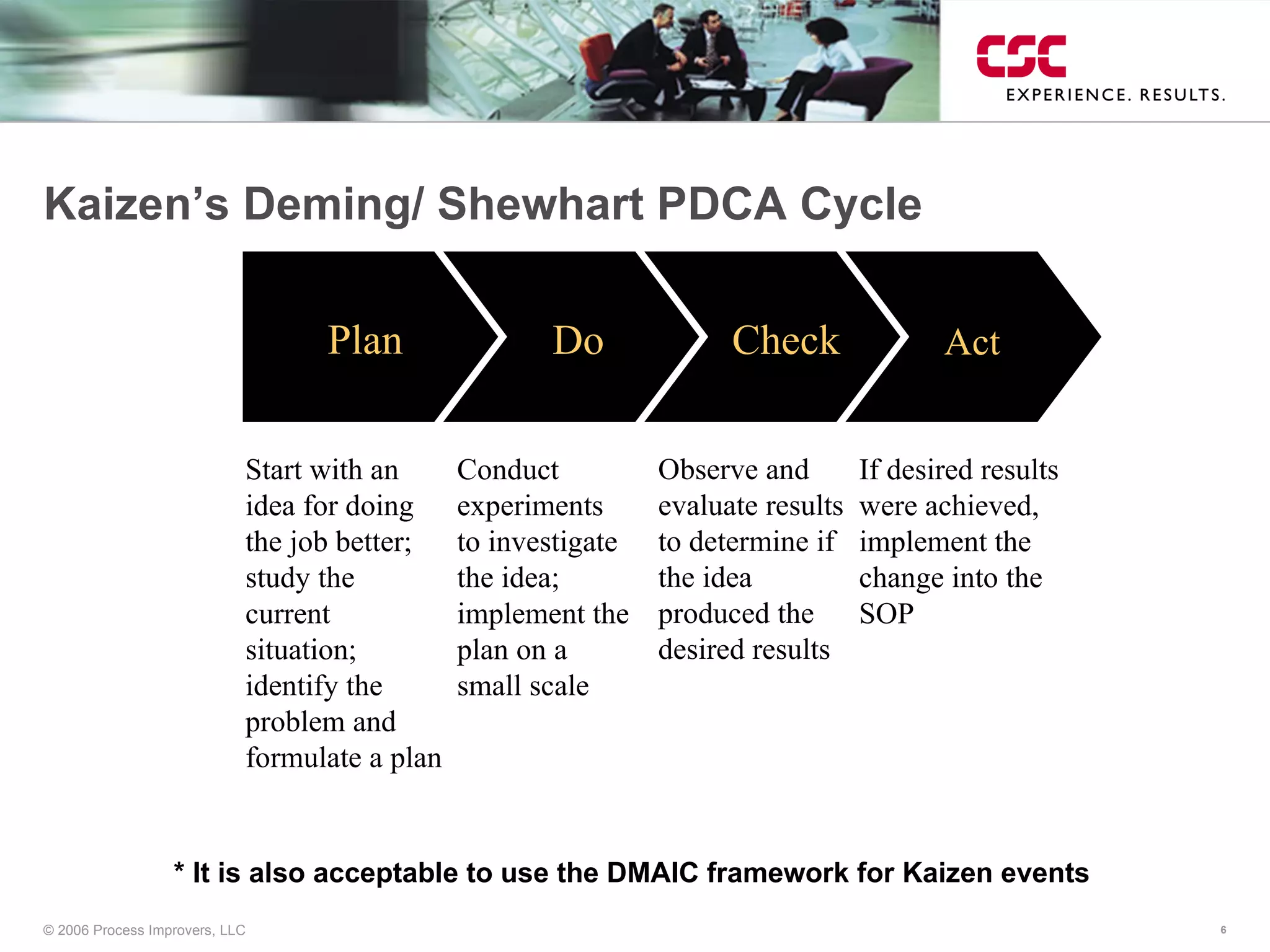
Kaizen’s Deming/ Shewhart PDCA Cycle  Plan  Start with an idea for doing the job better; study the current situation; identify the problem and formulate a plan Conduct  experiments to investigate the idea; implement the plan on a small scale If desired results were achieved, implement the change into the SOP Observe and evaluate results to determine if the idea produced the desired results Act Do Check * It is also acceptable to use the DMAIC framework for Kaizen events
Lean Defined: Focus on speed, efficiency, and elimination of waste Objective: Maximizing process speed (cycle time) by reducing waste Requires: Elimination of waste ( muda) : Defects, overproduction, inventories, unnecessary processing, unnecessary movement of people, unnecessary transport of goods, waiting, designing goods and services that don’t meet customers’ needs  Value stream mapping: Map process and focus on elimination of non-value add activities Ask what activities the customer is willing to pay for Focus on process standardization
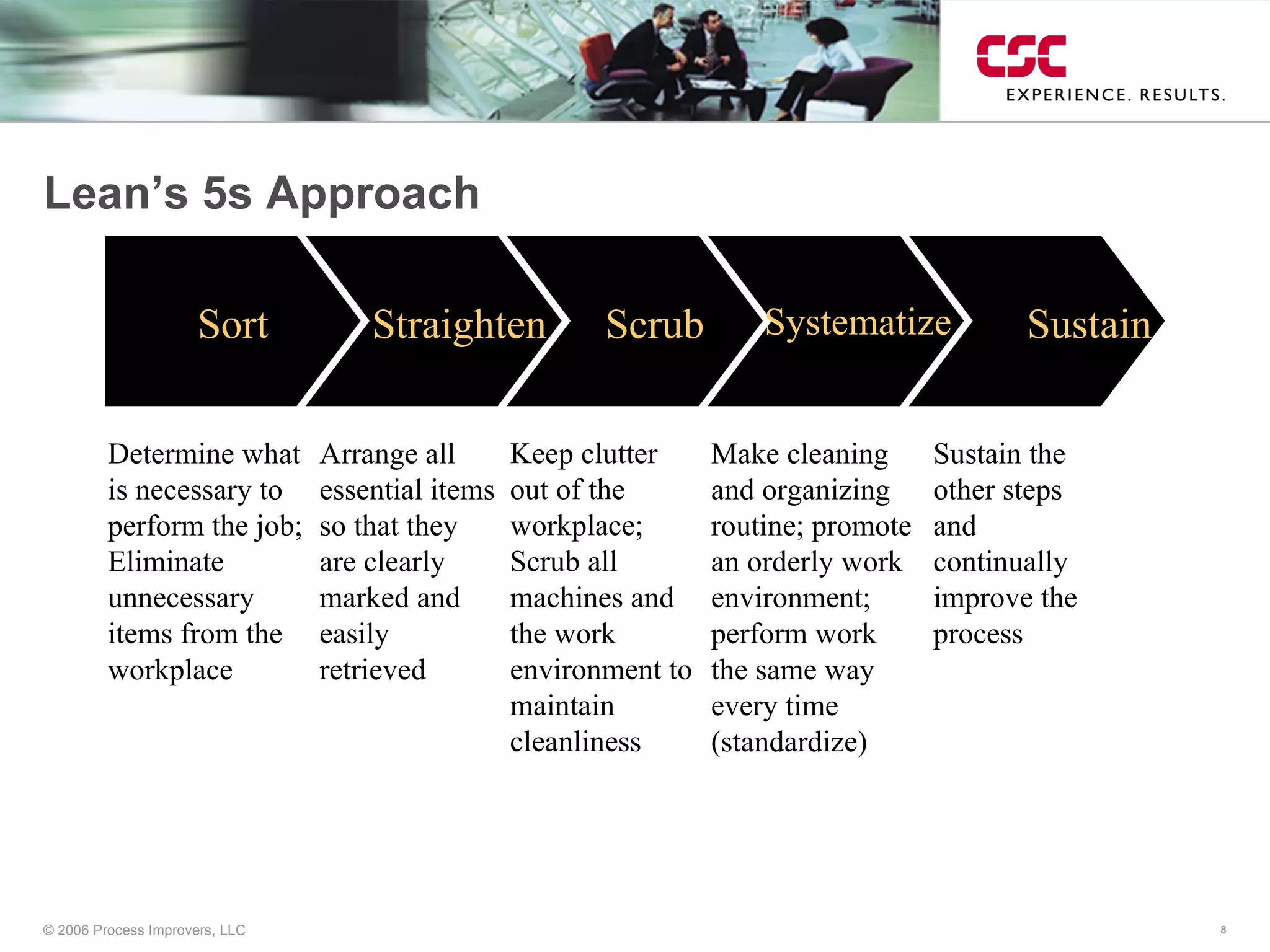
Lean’s 5s Approach Sort Sustain Determine what is necessary to perform the job; Eliminate unnecessary items from the workplace Arrange all essential items so that they are clearly marked and easily retrieved Sustain the other steps and continually improve the process Make cleaning and organizing routine; promote an orderly work environment; perform work the same way every time (standardize) Keep clutter out of the workplace; Scrub all machines and the work environment to maintain cleanliness Systematize Straighten Scrub
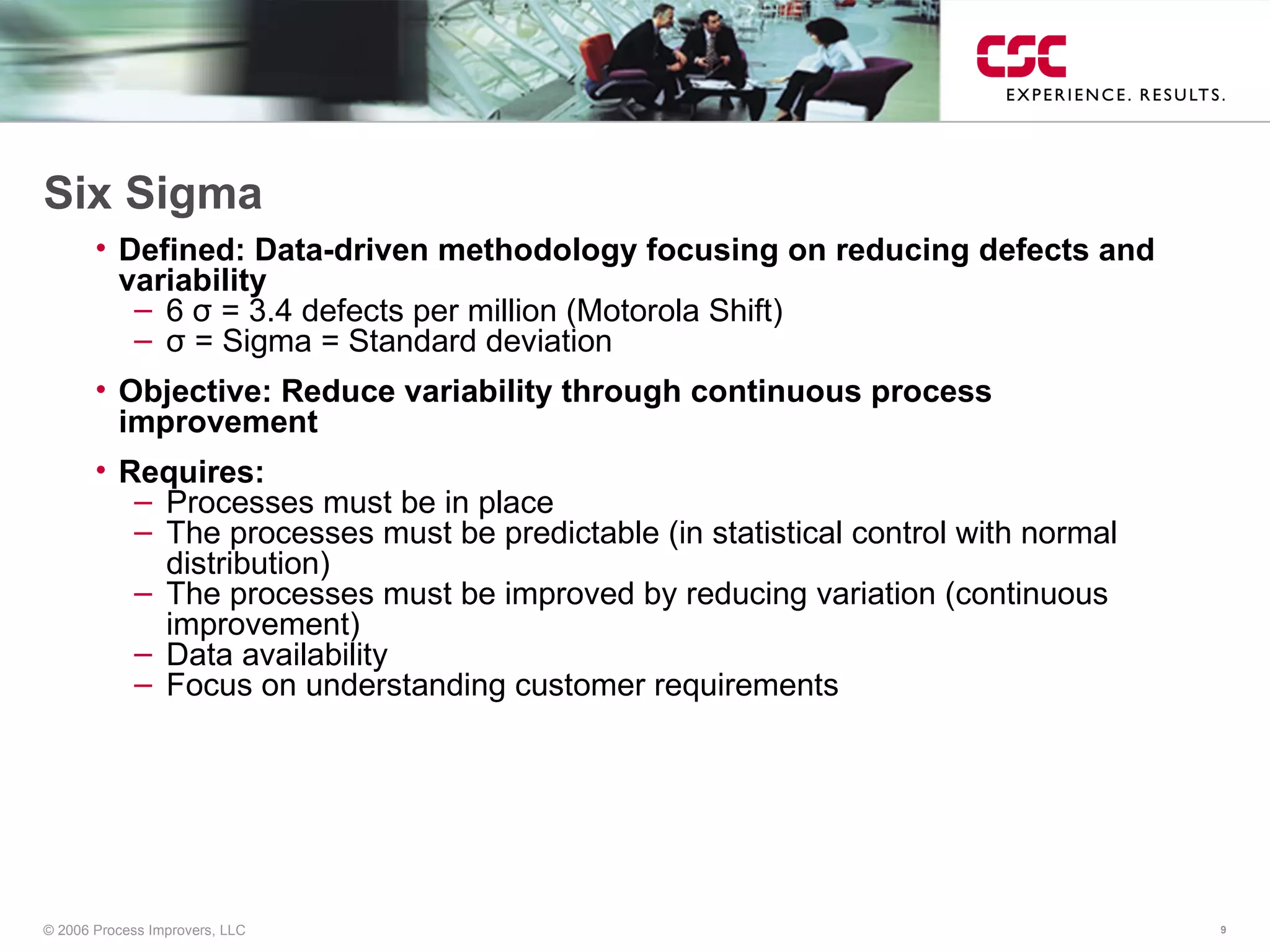
Six Sigma Defined: Data-driven methodology focusing on reducing defects and variability 6  σ  = 3.4 defects per million (Motorola Shift) σ  =  Sigma = Standard deviation Objective: Reduce variability through continuous process improvement Requires: Processes must be in place The processes must be predictable (in statistical control with normal distribution) The processes must be improved by reducing variation (continuous improvement) Data availability Focus on understanding customer requirements
Six Sigma Distribution Upper Control Limit/ Specification Lower Control Limit/ Specification Normal, Bell-Shaped Curve/ Distribution of Values Defects Defects
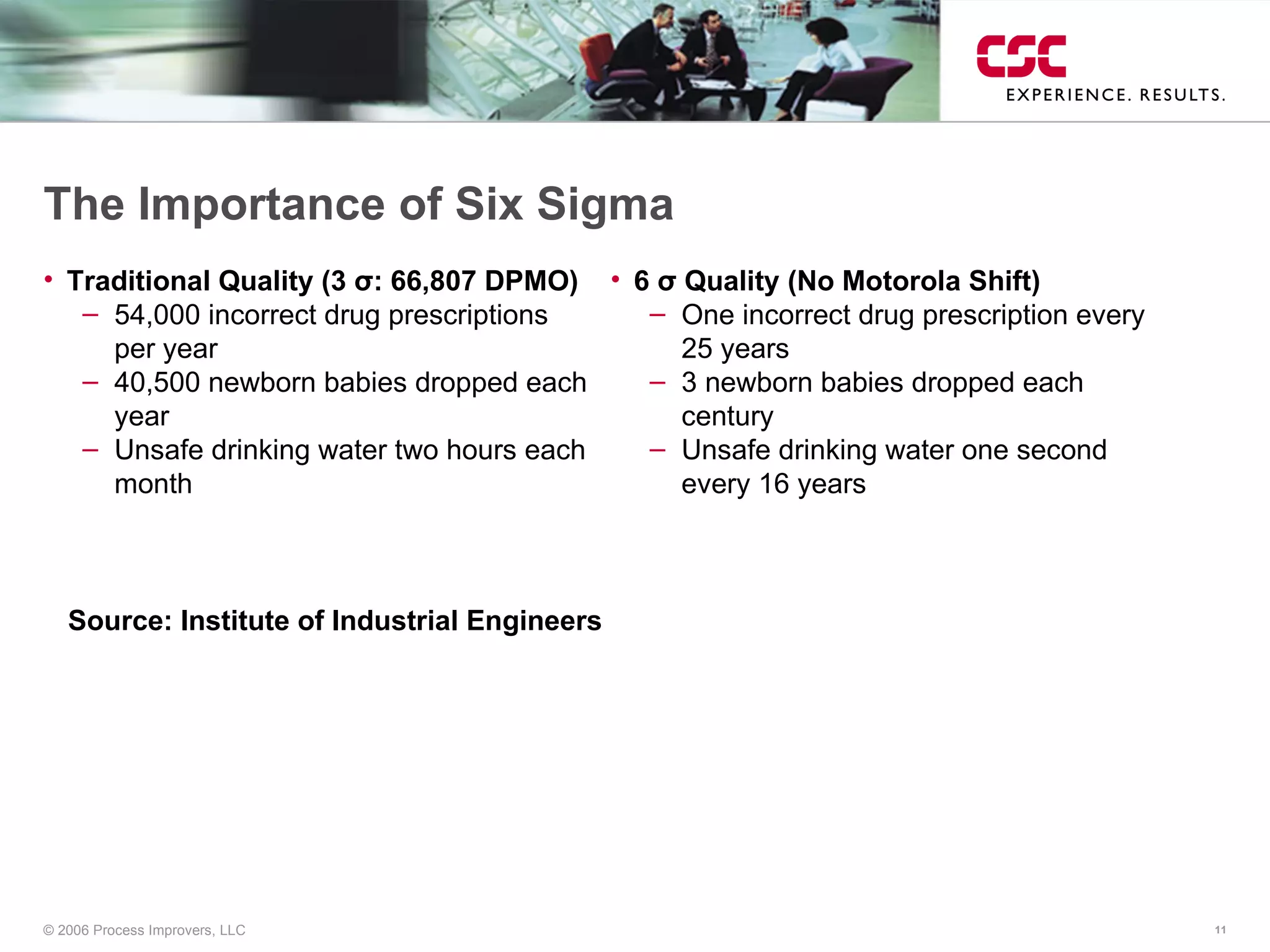
The Importance of Six Sigma Traditional Quality (3  σ : 66,807 DPMO) 54,000 incorrect drug prescriptions per year 40,500 newborn babies dropped each year Unsafe drinking water two hours each month 6  σ  Quality (No Motorola Shift) One incorrect drug prescription every 25 years 3 newborn babies dropped each century Unsafe drinking water one second every 16 years Source: Institute of Industrial Engineers
DMAIC Framework for Six Sigma Define Measure Analyze Control Improve Define the goals of the improvement activity; determine project’s business case; identify customer; map current & future state processes; determine scope Measure the existing system or process; determine metrics; define project success factors Control the system or process, including risk, quality, cost, scope, change management; determine reporting needs Improve and implement the system or process; determine necessary activities to achieve goals Analyze the system to eliminate gap between current system or process and the desired goal; determine and reduce obstacles to achievement
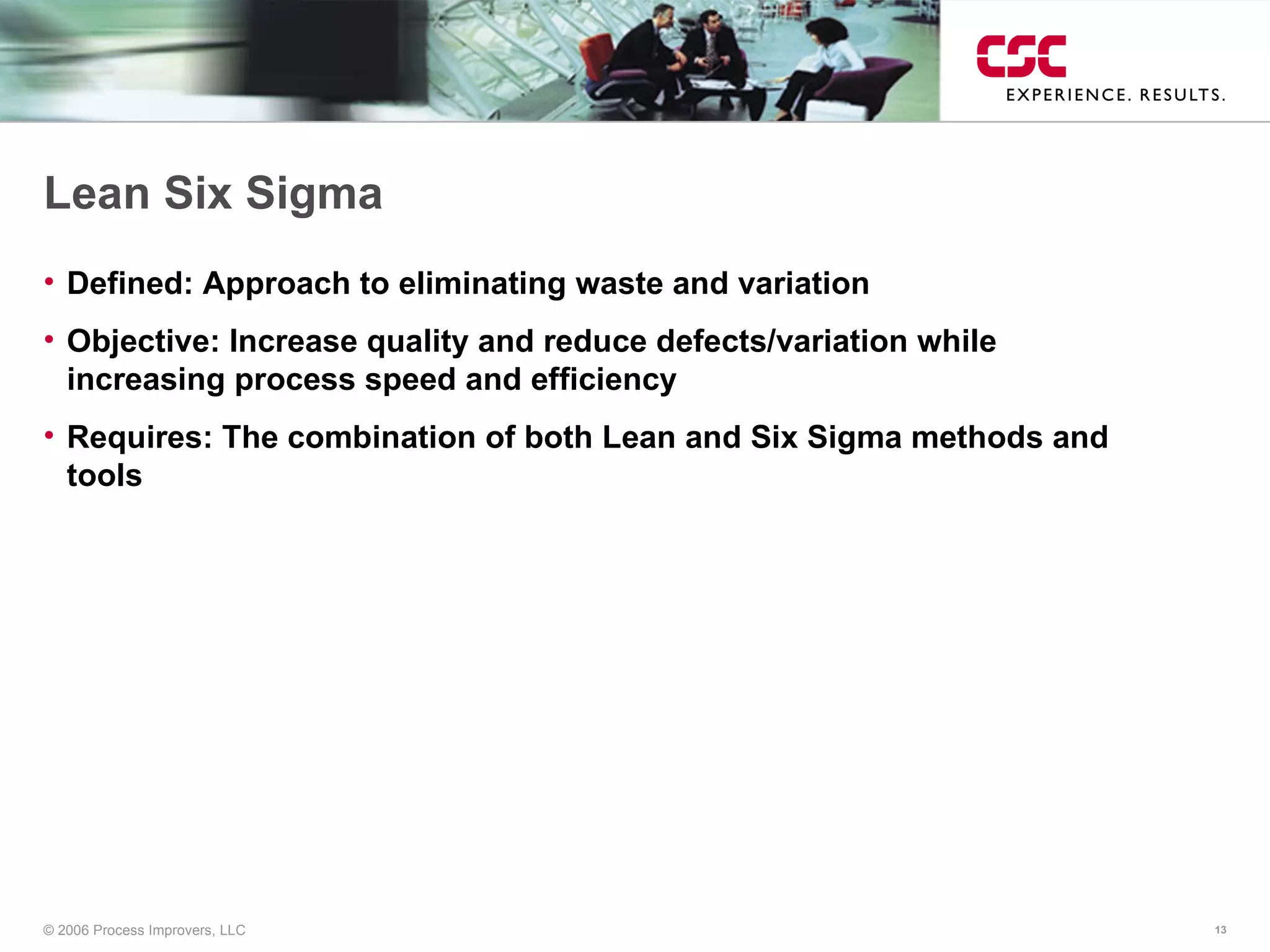
Lean Six Sigma Defined: Approach to eliminating waste and variation Objective: Increase quality and reduce defects/variation while increasing process speed and efficiency Requires: The combination of both Lean and Six Sigma methods and tools
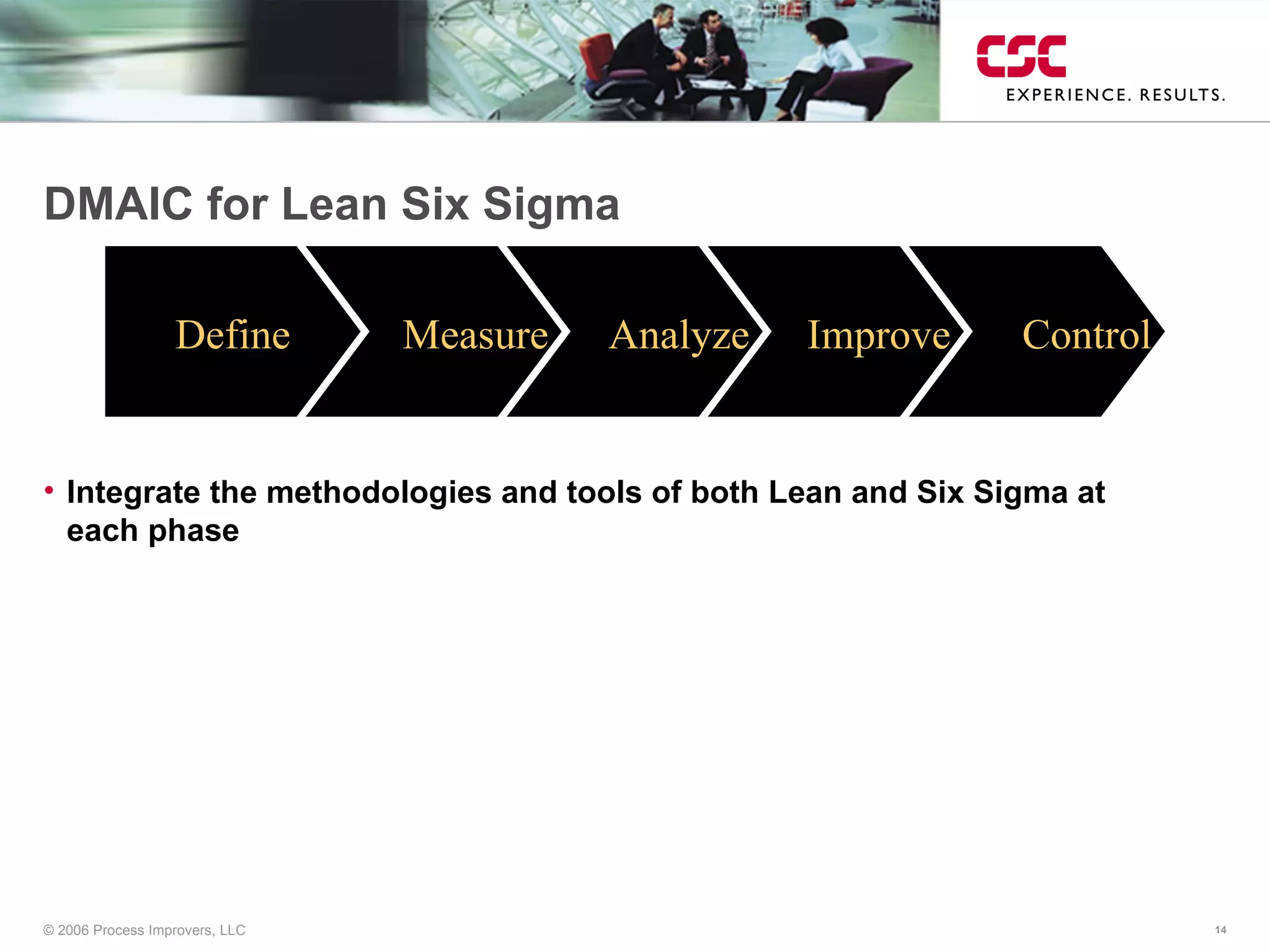
DMAIC for Lean Six Sigma Integrate the methodologies and tools of both Lean and Six Sigma at each phase Define Measure Analyze Control Improve
Design For Six Sigma (DFSS) Defined: DFSS uses tools, training, and measurements to enable the  design  and  development  of products, services, and processes that meet customer expectations at Six Sigma quality levels Objective: Optimize the design and development processes to achieve Six Sigma quality levels from the beginning  Requires: A new product, service, or process to design and develop
DMADV Framework for DFSS Define Measure Analyze Verify Design Define the goals of the design act; determine critical to quality (CTQ) characteristics and their relative importance Identify CTQs to be addressed; establish metrics for CTQs; determine how customer satisfaction will be measured Standardize; establish control metrics; develop transition plan Detain selected design; simulate process; ensure design meets CTQs; develop implementation plan Link CTQs to features & determine importance; perform process benchmarking; develop, evaluate, and select designs
Methodology Analogy Design For Six  Sigma Lean Six  Sigma Kaizen Lean  Six  Sigma
Methodology Comparison
Lean and Six Sigma Lean cannot bring a process under statistical control Six Sigma does not dramatically improve process speed or reduce invested resources Combining Lean and Six Sigma maximizes advantages and reduces the disadvantages of each individual approach
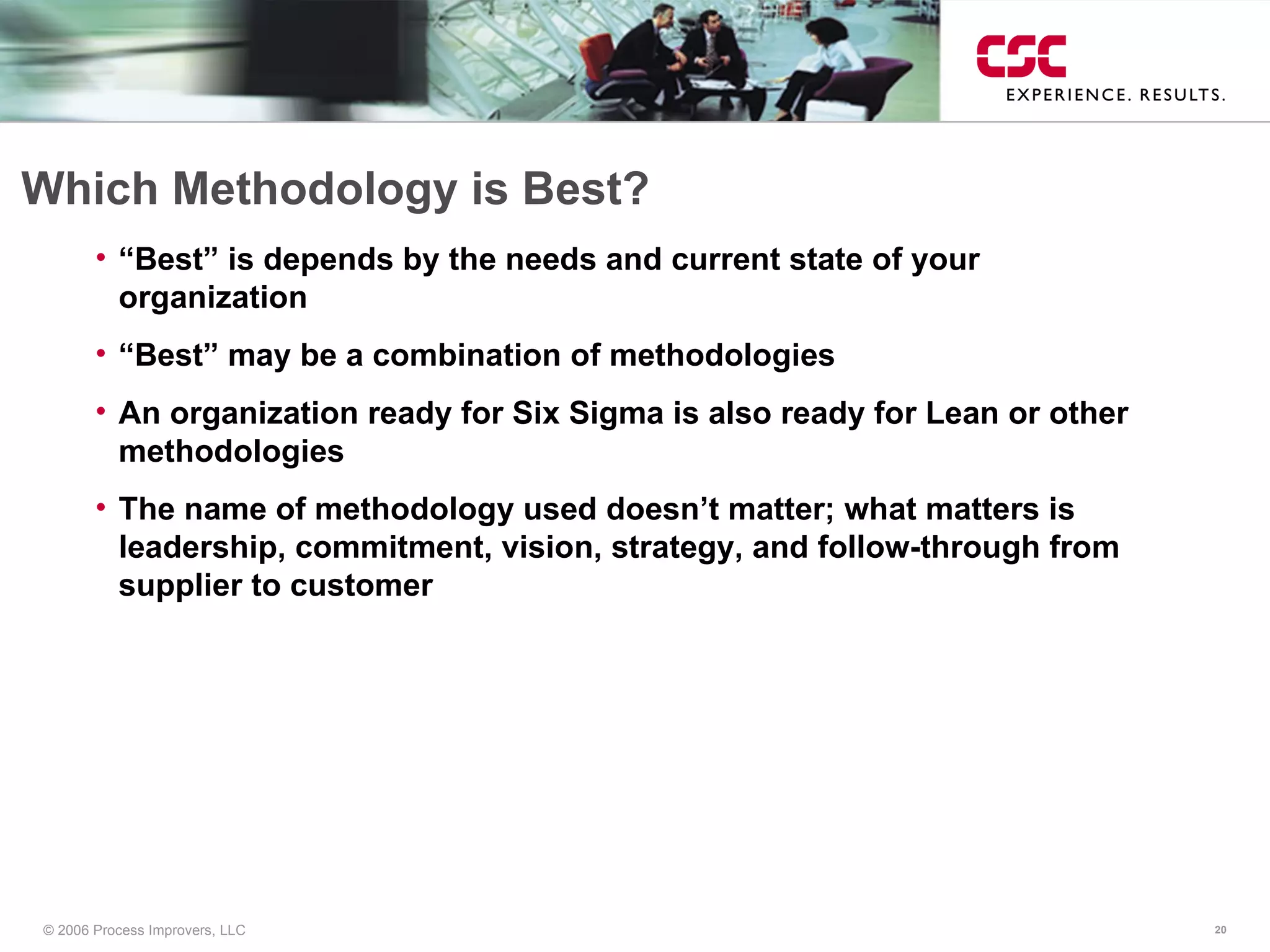
Which Methodology is Best? “Best” is depends by the needs and current state of your organization “Best” may be a combination of methodologies An organization ready for Six Sigma is also ready for Lean or other methodologies The name of methodology used doesn’t matter; what matters is leadership, commitment, vision, strategy, and follow-through from supplier to customer
Business Process Management The future of business processes lies not in one methodology, but in the integration of technologies and methodologies in order to facilitate execution of the process Customers are demanding customizations and total solutions Innovative business processes can lead to competitive advantage Business processes will drive IT
Changing Competitive Environment The only thing certain in business is change Industry boundaries are evaporating The entire value chain is involved in providing total solutions to customers: Competition Collaboration Partners may also be competitors
Process Mapping Regardless of the methodology, start with mapping the current processes Identifies current state, opportunities for improvement, process time Allows identification of all process steps in order to determine which steps are value added or bottlenecks Knowing current state will assist in identifying improvement opportunities As-is vs. future process time, number of steps, handoffs, etc. Determine steps which add value
Benefits of Process Mapping Gain understanding of the process and process objectives Answers who (including suppliers and customers), what, when, where, how, and duration Identifies the information or data used in the process, decisions, bottlenecks Identify sources of waste Improve supplier and customer relations Provides a common language for talking about the process
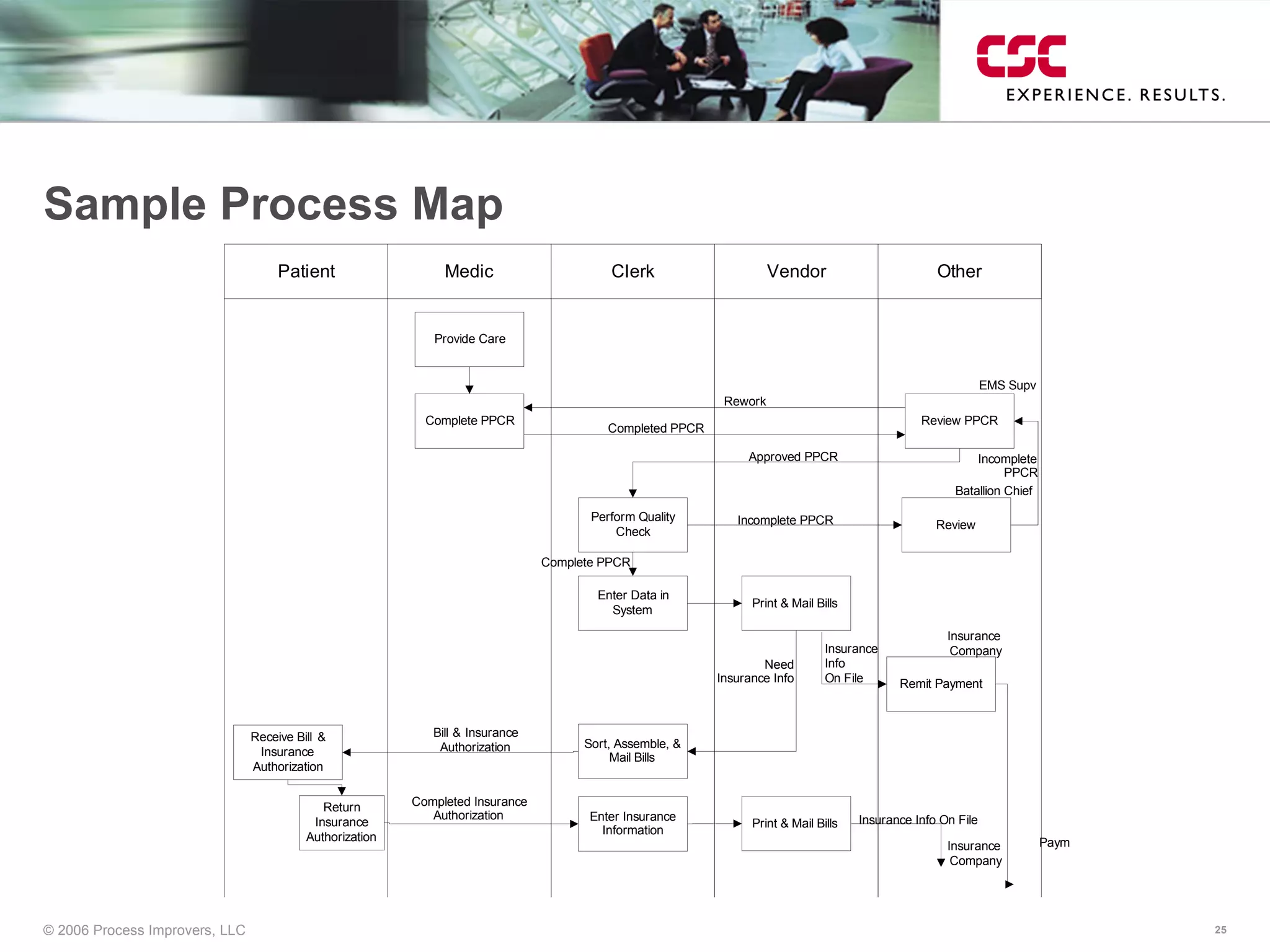
Sample Process Map
Indications of Process Improvement Opportunities Internal Non-compliance to Industry Standards Scrap Rework Short Cuts to Beat the System Excess Inventory Capacity Constraints Low Efficiency/ Productivity/Yields Employee Symptoms Shared Responsibility External Benchmarking Company vs. World Class Performers Market Share Drop Negative Publicity Pricing Inflexibility Warranty Costs
Enabling Project Success Management buy in is required from the  start Align goals with the strategic direction of the organization Combine project ownership and accountability Manage change – do it early, do it often Allocate appropriate staff and time Train staff in applicable techniques Eliminate process variation
Experience. Results. Sharon Valencia, PMP Principal Computer Sciences Corporation [email_address]

Workharderand Harder

  • 1.
    Process Improvement: WhichMethodology is Best for Your Project? PMI Skyline Luncheon Sharon Valencia, PMP
  • 2.
    Agenda Definitions BusinessImprovement Methodologies Methodology Comparison Process Management Process Mapping Enabling Project Success
  • 3.
    What is aProcess? Any set of activities that when taken together, transform a series of inputs into an output , producing a result of value to a customer Process Suppliers Customer SIPOC Input Output
  • 4.
    What is aBusiness Improvement Methodology? A documented set of procedures, guidelines, and tools intended to develop better processes Business improvement methodologies covered in this presentation: Kaizen Lean Six Sigma Lean Six Sigma Design for Six Sigma (DFSS)
  • 5.
    Kaizen Defined: Philosophyof gradual, incremental, and orderly continuous improvement, creating more value and less waste; emphasis on process improvement and process control; Japanese word meaning “ongoing improvement” Objective: Small improvements by optimizing existing systems Requires: Taking action on obvious problems and deviations to maintain process control Establishing control through Standard Operating Procedures (SOPs) 1-10 days
  • 6.
    Kaizen’s Deming/ ShewhartPDCA Cycle Plan Start with an idea for doing the job better; study the current situation; identify the problem and formulate a plan Conduct experiments to investigate the idea; implement the plan on a small scale If desired results were achieved, implement the change into the SOP Observe and evaluate results to determine if the idea produced the desired results Act Do Check * It is also acceptable to use the DMAIC framework for Kaizen events
  • 7.
    Lean Defined: Focuson speed, efficiency, and elimination of waste Objective: Maximizing process speed (cycle time) by reducing waste Requires: Elimination of waste ( muda) : Defects, overproduction, inventories, unnecessary processing, unnecessary movement of people, unnecessary transport of goods, waiting, designing goods and services that don’t meet customers’ needs Value stream mapping: Map process and focus on elimination of non-value add activities Ask what activities the customer is willing to pay for Focus on process standardization
  • 8.
    Lean’s 5s ApproachSort Sustain Determine what is necessary to perform the job; Eliminate unnecessary items from the workplace Arrange all essential items so that they are clearly marked and easily retrieved Sustain the other steps and continually improve the process Make cleaning and organizing routine; promote an orderly work environment; perform work the same way every time (standardize) Keep clutter out of the workplace; Scrub all machines and the work environment to maintain cleanliness Systematize Straighten Scrub
  • 9.
    Six Sigma Defined:Data-driven methodology focusing on reducing defects and variability 6 σ = 3.4 defects per million (Motorola Shift) σ = Sigma = Standard deviation Objective: Reduce variability through continuous process improvement Requires: Processes must be in place The processes must be predictable (in statistical control with normal distribution) The processes must be improved by reducing variation (continuous improvement) Data availability Focus on understanding customer requirements
  • 10.
    Six Sigma DistributionUpper Control Limit/ Specification Lower Control Limit/ Specification Normal, Bell-Shaped Curve/ Distribution of Values Defects Defects
  • 11.
    The Importance ofSix Sigma Traditional Quality (3 σ : 66,807 DPMO) 54,000 incorrect drug prescriptions per year 40,500 newborn babies dropped each year Unsafe drinking water two hours each month 6 σ Quality (No Motorola Shift) One incorrect drug prescription every 25 years 3 newborn babies dropped each century Unsafe drinking water one second every 16 years Source: Institute of Industrial Engineers
  • 12.
    DMAIC Framework forSix Sigma Define Measure Analyze Control Improve Define the goals of the improvement activity; determine project’s business case; identify customer; map current & future state processes; determine scope Measure the existing system or process; determine metrics; define project success factors Control the system or process, including risk, quality, cost, scope, change management; determine reporting needs Improve and implement the system or process; determine necessary activities to achieve goals Analyze the system to eliminate gap between current system or process and the desired goal; determine and reduce obstacles to achievement
  • 13.
    Lean Six SigmaDefined: Approach to eliminating waste and variation Objective: Increase quality and reduce defects/variation while increasing process speed and efficiency Requires: The combination of both Lean and Six Sigma methods and tools
  • 14.
    DMAIC for LeanSix Sigma Integrate the methodologies and tools of both Lean and Six Sigma at each phase Define Measure Analyze Control Improve
  • 15.
    Design For SixSigma (DFSS) Defined: DFSS uses tools, training, and measurements to enable the design and development of products, services, and processes that meet customer expectations at Six Sigma quality levels Objective: Optimize the design and development processes to achieve Six Sigma quality levels from the beginning Requires: A new product, service, or process to design and develop
  • 16.
    DMADV Framework forDFSS Define Measure Analyze Verify Design Define the goals of the design act; determine critical to quality (CTQ) characteristics and their relative importance Identify CTQs to be addressed; establish metrics for CTQs; determine how customer satisfaction will be measured Standardize; establish control metrics; develop transition plan Detain selected design; simulate process; ensure design meets CTQs; develop implementation plan Link CTQs to features & determine importance; perform process benchmarking; develop, evaluate, and select designs
  • 17.
    Methodology Analogy DesignFor Six Sigma Lean Six Sigma Kaizen Lean Six Sigma
  • 18.
  • 19.
    Lean and SixSigma Lean cannot bring a process under statistical control Six Sigma does not dramatically improve process speed or reduce invested resources Combining Lean and Six Sigma maximizes advantages and reduces the disadvantages of each individual approach
  • 20.
    Which Methodology isBest? “Best” is depends by the needs and current state of your organization “Best” may be a combination of methodologies An organization ready for Six Sigma is also ready for Lean or other methodologies The name of methodology used doesn’t matter; what matters is leadership, commitment, vision, strategy, and follow-through from supplier to customer
  • 21.
    Business Process ManagementThe future of business processes lies not in one methodology, but in the integration of technologies and methodologies in order to facilitate execution of the process Customers are demanding customizations and total solutions Innovative business processes can lead to competitive advantage Business processes will drive IT
  • 22.
    Changing Competitive EnvironmentThe only thing certain in business is change Industry boundaries are evaporating The entire value chain is involved in providing total solutions to customers: Competition Collaboration Partners may also be competitors
  • 23.
    Process Mapping Regardlessof the methodology, start with mapping the current processes Identifies current state, opportunities for improvement, process time Allows identification of all process steps in order to determine which steps are value added or bottlenecks Knowing current state will assist in identifying improvement opportunities As-is vs. future process time, number of steps, handoffs, etc. Determine steps which add value
  • 24.
    Benefits of ProcessMapping Gain understanding of the process and process objectives Answers who (including suppliers and customers), what, when, where, how, and duration Identifies the information or data used in the process, decisions, bottlenecks Identify sources of waste Improve supplier and customer relations Provides a common language for talking about the process
  • 25.
  • 26.
    Indications of ProcessImprovement Opportunities Internal Non-compliance to Industry Standards Scrap Rework Short Cuts to Beat the System Excess Inventory Capacity Constraints Low Efficiency/ Productivity/Yields Employee Symptoms Shared Responsibility External Benchmarking Company vs. World Class Performers Market Share Drop Negative Publicity Pricing Inflexibility Warranty Costs
  • 27.
    Enabling Project SuccessManagement buy in is required from the start Align goals with the strategic direction of the organization Combine project ownership and accountability Manage change – do it early, do it often Allocate appropriate staff and time Train staff in applicable techniques Eliminate process variation
  • 28.
    Experience. Results. SharonValencia, PMP Principal Computer Sciences Corporation [email_address]