
Implant COMPONENTS AND FUNCTION
Presented by :
SK AZIZ IKBAL
Dept of Prosthodontics & Crown & Bridge
NORTH BENGAL DENTAL COLLEGE
&HOSPITAL
What is the implant ?
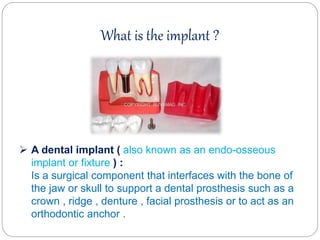
 A dental implant ( also known as an endo-osseous
implant or fixture ) :
Is a surgical component that interfaces with the bone of
the jaw or skull to support a dental prosthesis such as a
crown , ridge , denture , facial prosthesis or to act as an
orthodontic anchor .
DEFINITION:
 A prosthetic device made of alloplastic material(s)
implanted into the oral tissues beneath the mucosal
or/and periosteal layer, and on/or within the bone to
provide retention and support for a fixed or
removable dental prosthesis, a substance that is
placed into or/and upon the jaw bone to support a
fixed or removable dental prosthesis.
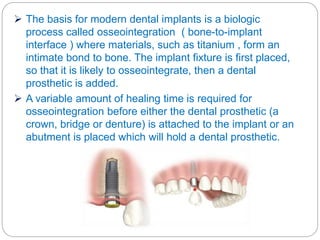
 The basis for modern dental implants is a biologic
process called osseointegration ( bone-to-implant
interface ) where materials, such as titanium , form an
intimate bond to bone. The implant fixture is first placed,
so that it is likely to osseointegrate, then a dental
prosthetic is added.
 A variable amount of healing time is required for
osseointegration before either the dental prosthetic (a
crown, bridge or denture) is attached to the implant or an
abutment is placed which will hold a dental prosthetic.
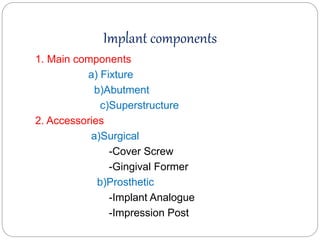
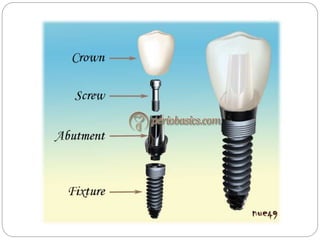
Implant components
1. Main components
a) Fixture
b)Abutment
c)Superstructure
2. Accessories
a)Surgical
-Cover Screw
-Gingival Former
b)Prosthetic
-Implant Analogue
-Impression Post
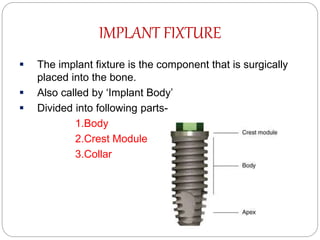
IMPLANT FIXTURE
 The implant fixture is the component that is surgically
placed into the bone.
 Also called by ‘Implant Body’
 Divided into following parts-
1.Body
2.Crest Module
3.Collar
Body
 May be cylindrical or tapered cylindrical.
 Smooth or threaded surface
 Solid or contain holes or vents to allow bone grow
through
 Threaded is suitable for placement.
 Threads maximize initial contact with bone
facilitate dissipation of stresses
Functional surface depends on-
Thread pitch- Distance between the threads
Thread shape- ‘V’ shaped square and buttress
Thread depth- Distance between the most outside thread
and most inside thread
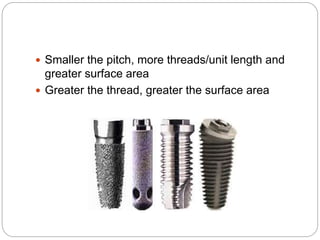
 Smaller the pitch, more threads/unit length and
greater surface area
 Greater the thread, greater the surface area
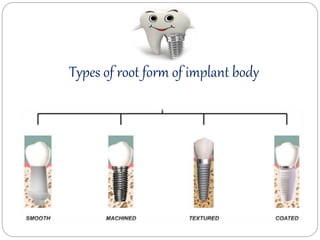
Types of root form of implant body
Crest Module
 Portion of fixture that provides a connection to the
abutment or attachment.
 Offers resistance to axial occlusal loads and aims
to provide a precise fitting for abutment on the
fixture
 It consists of a platform and antirotation features.
Implant Collar
 Superior part of fixture.
 For submerged implant it is 0.5-1mm in height, for
non-submerged 3-5mm.
 Purpose-
 Allows functional remodeling of bone
 Improves abutment-fixture interface
 Prevents exposure of surface coatings
Abutments
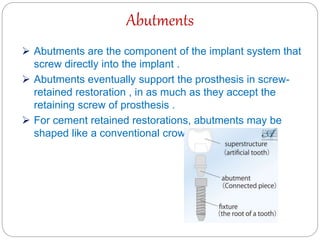
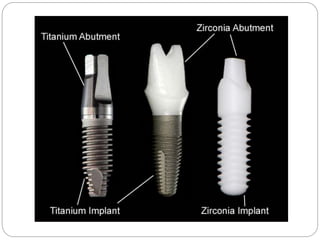
 Abutments are the component of the implant system that
screw directly into the implant .
 Abutments eventually support the prosthesis in screw-
retained restoration , in as much as they accept the
retaining screw of prosthesis .
 For cement retained restorations, abutments may be
shaped like a conventional crown preparation .
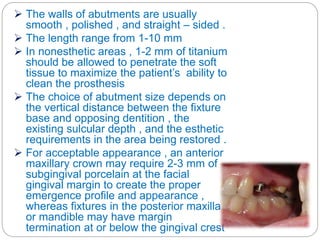
 The walls of abutments are usually
smooth , polished , and straight – sided .
 The length range from 1-10 mm
 In nonesthetic areas , 1-2 mm of titanium
should be allowed to penetrate the soft
tissue to maximize the patient’s ability to
clean the prosthesis
 The choice of abutment size depends on
the vertical distance between the fixture
base and opposing dentition , the
existing sulcular depth , and the esthetic
requirements in the area being restored .
 For acceptable appearance , an anterior
maxillary crown may require 2-3 mm of
subgingival porcelain at the facial
gingival margin to create the proper
emergence profile and appearance ,
whereas fixtures in the posterior maxilla
or mandible may have margin
termination at or below the gingival crest
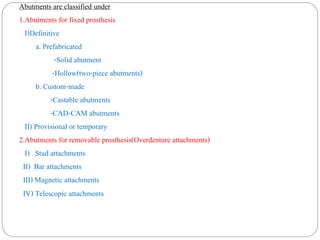
Abutments are classified under
1.Abutments for fixed prosthesis
I)Definitive
a. Prefabricated
-Solid abutment
-Hollow(two-piece abutments)
b. Custom-made
-Castable abutments
-CAD-CAM abutments
II) Provisional or temporary
2.Abutments for removable prosthesis(Overdenture attachments)
I) Stud attachments
II) Bar attachments
III) Magnetic attachments
IV) Telescopic attachments
IMPLANT sUperstructure
 This is the prosthesis that is fabricated with the
support of dental implants.
 They can be of following types
1.Fixed Prosthesis
i) Crowns
II) Bridges
2. Removable Prosthesis
i) Overdenture
3. Fixed-detachable Prosthesis
i) Hybrid dentures
Surgical
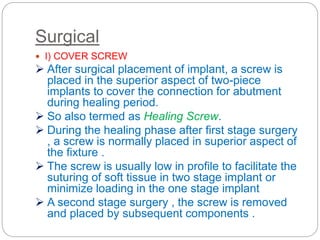
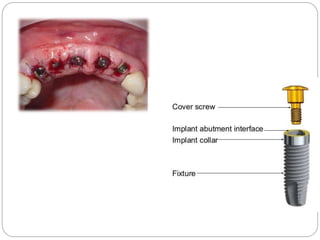
 I) COVER SCREW
 After surgical placement of implant, a screw is
placed in the superior aspect of two-piece
implants to cover the connection for abutment
during healing period.
 So also termed as Healing Screw.
 During the healing phase after first stage surgery
, a screw is normally placed in superior aspect of
the fixture .
 The screw is usually low in profile to facilitate the
suturing of soft tissue in two stage implant or
minimize loading in the one stage implant
 A second stage surgery , the screw is removed
and placed by subsequent components .
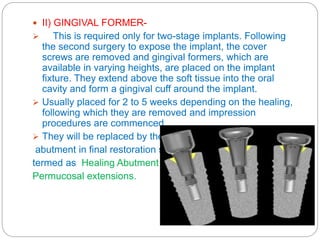
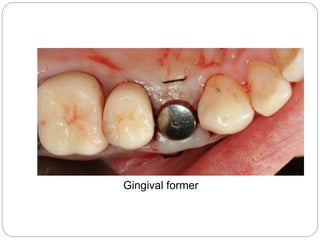
 II) GINGIVAL FORMER-
 This is required only for two-stage implants. Following
the second surgery to expose the implant, the cover
screws are removed and gingival formers, which are
available in varying heights, are placed on the implant
fixture. They extend above the soft tissue into the oral
cavity and form a gingival cuff around the implant.
 Usually placed for 2 to 5 weeks depending on the healing,
following which they are removed and impression
procedures are commenced.
 They will be replaced by the
abutment in final restoration so
termed as Healing Abutment or
Permucosal extensions.
Gingival former
Prosthetic
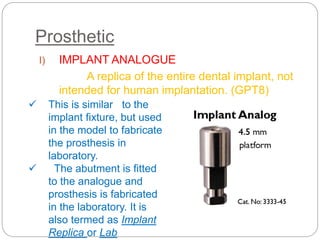
I) IMPLANT ANALOGUE
A replica of the entire dental implant, not
intended for human implantation. (GPT8)
 This is similar to the
implant fixture, but used
in the model to fabricate
the prosthesis in
laboratory.
 The abutment is fitted
to the analogue and
prosthesis is fabricated
in the laboratory. It is
also termed as Implant
Replica or Lab
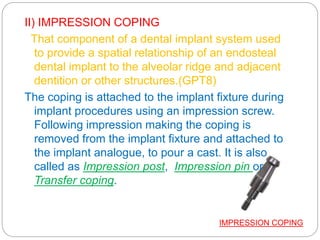
II) IMPRESSION COPING
That component of a dental implant system used
to provide a spatial relationship of an endosteal
dental implant to the alveolar ridge and adjacent
dentition or other structures.(GPT8)
The coping is attached to the implant fixture during
implant procedures using an impression screw.
Following impression making the coping is
removed from the implant fixture and attached to
the implant analogue, to pour a cast. It is also
called as Impression post, Impression pin or
Transfer coping.
IMPRESSION COPING
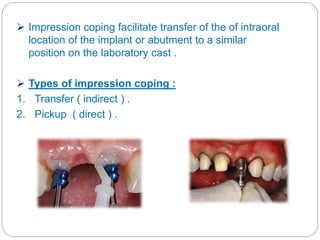
 Impression coping facilitate transfer of the of intraoral
location of the implant or abutment to a similar
position on the laboratory cast .
 Types of impression coping :
1. Transfer ( indirect ) .
2. Pickup ( direct ) .
Functions Of components
 IMPLANT FIXTURE:
Body: It goes within bone to provide physical
resistance to axial occlusal load and retains the whole
structure of implant.
Crest Module: Portion of fixture that provides a
connection to the abutment or attachment.
Offers resistance to axial occlusal
loads and aims to provide a precise fitting for
abutment on the fixture
Implant Collar: Allows functional remodeling of bone
Improves abutment-fixture interface
Prevents exposure of surface coatings
 ABUTMENTS: It supports and/or retains a prosthesis
or implant superstructure.
 SUPERSTRUCTURE: Either provides retaining of an
I. MAIN COMPONENTS
 COVER SREW: covers the connection for abutment during
healing period.
Facilitates the suturing of soft tissue in two stage
implant or minimize loading in the one stage implant .
 GINGIVAL FORMER: They extend above the soft tissue
into the oral cavity and form a gingival cuff around the
implant.
 IMPLANT ANALOGUE: It is used in the fabrication of
master cast to replicate the retentive portion of the implant
body or abutment.
 IMPRESSION COPING: It provides a spatial relationship
of an endosteal dental implant to the alveolar ridge and
adjacent dentition or other structures.
Facilitates transfer of the of intraoral location of the
implant or abutment to a similar position on the laboratory
cast .
II. ACCESSORIES
Keep smiling
REFERENCES
Bouchers Prosthodontics
Zarb
John J.Manapallil SECOND EDITION CD

Implant components and function

  • 1.
    Implant COMPONENTS ANDFUNCTION Presented by : SK AZIZ IKBAL Dept of Prosthodontics & Crown & Bridge NORTH BENGAL DENTAL COLLEGE &HOSPITAL
  • 2.
    What is theimplant ?  A dental implant ( also known as an endo-osseous implant or fixture ) : Is a surgical component that interfaces with the bone of the jaw or skull to support a dental prosthesis such as a crown , ridge , denture , facial prosthesis or to act as an orthodontic anchor .
  • 3.
    DEFINITION:  A prostheticdevice made of alloplastic material(s) implanted into the oral tissues beneath the mucosal or/and periosteal layer, and on/or within the bone to provide retention and support for a fixed or removable dental prosthesis, a substance that is placed into or/and upon the jaw bone to support a fixed or removable dental prosthesis.
  • 4.
     The basisfor modern dental implants is a biologic process called osseointegration ( bone-to-implant interface ) where materials, such as titanium , form an intimate bond to bone. The implant fixture is first placed, so that it is likely to osseointegrate, then a dental prosthetic is added.  A variable amount of healing time is required for osseointegration before either the dental prosthetic (a crown, bridge or denture) is attached to the implant or an abutment is placed which will hold a dental prosthetic.
  • 5.
    Implant components 1. Maincomponents a) Fixture b)Abutment c)Superstructure 2. Accessories a)Surgical -Cover Screw -Gingival Former b)Prosthetic -Implant Analogue -Impression Post
  • 7.
    IMPLANT FIXTURE  Theimplant fixture is the component that is surgically placed into the bone.  Also called by ‘Implant Body’  Divided into following parts- 1.Body 2.Crest Module 3.Collar
  • 8.
    Body  May becylindrical or tapered cylindrical.  Smooth or threaded surface  Solid or contain holes or vents to allow bone grow through  Threaded is suitable for placement.  Threads maximize initial contact with bone facilitate dissipation of stresses Functional surface depends on- Thread pitch- Distance between the threads Thread shape- ‘V’ shaped square and buttress Thread depth- Distance between the most outside thread and most inside thread
  • 9.
     Smaller thepitch, more threads/unit length and greater surface area  Greater the thread, greater the surface area
  • 10.
    Types of rootform of implant body
  • 11.
    Crest Module  Portionof fixture that provides a connection to the abutment or attachment.  Offers resistance to axial occlusal loads and aims to provide a precise fitting for abutment on the fixture  It consists of a platform and antirotation features.
  • 12.
    Implant Collar  Superiorpart of fixture.  For submerged implant it is 0.5-1mm in height, for non-submerged 3-5mm.  Purpose-  Allows functional remodeling of bone  Improves abutment-fixture interface  Prevents exposure of surface coatings
  • 13.
    Abutments  Abutments arethe component of the implant system that screw directly into the implant .  Abutments eventually support the prosthesis in screw- retained restoration , in as much as they accept the retaining screw of prosthesis .  For cement retained restorations, abutments may be shaped like a conventional crown preparation .
  • 14.
     The wallsof abutments are usually smooth , polished , and straight – sided .  The length range from 1-10 mm  In nonesthetic areas , 1-2 mm of titanium should be allowed to penetrate the soft tissue to maximize the patient’s ability to clean the prosthesis  The choice of abutment size depends on the vertical distance between the fixture base and opposing dentition , the existing sulcular depth , and the esthetic requirements in the area being restored .  For acceptable appearance , an anterior maxillary crown may require 2-3 mm of subgingival porcelain at the facial gingival margin to create the proper emergence profile and appearance , whereas fixtures in the posterior maxilla or mandible may have margin termination at or below the gingival crest
  • 15.
    Abutments are classifiedunder 1.Abutments for fixed prosthesis I)Definitive a. Prefabricated -Solid abutment -Hollow(two-piece abutments) b. Custom-made -Castable abutments -CAD-CAM abutments II) Provisional or temporary 2.Abutments for removable prosthesis(Overdenture attachments) I) Stud attachments II) Bar attachments III) Magnetic attachments IV) Telescopic attachments
  • 17.
    IMPLANT sUperstructure  Thisis the prosthesis that is fabricated with the support of dental implants.  They can be of following types 1.Fixed Prosthesis i) Crowns II) Bridges 2. Removable Prosthesis i) Overdenture 3. Fixed-detachable Prosthesis i) Hybrid dentures
  • 19.
    Surgical  I) COVERSCREW  After surgical placement of implant, a screw is placed in the superior aspect of two-piece implants to cover the connection for abutment during healing period.  So also termed as Healing Screw.  During the healing phase after first stage surgery , a screw is normally placed in superior aspect of the fixture .  The screw is usually low in profile to facilitate the suturing of soft tissue in two stage implant or minimize loading in the one stage implant  A second stage surgery , the screw is removed and placed by subsequent components .
  • 21.
     II) GINGIVALFORMER-  This is required only for two-stage implants. Following the second surgery to expose the implant, the cover screws are removed and gingival formers, which are available in varying heights, are placed on the implant fixture. They extend above the soft tissue into the oral cavity and form a gingival cuff around the implant.  Usually placed for 2 to 5 weeks depending on the healing, following which they are removed and impression procedures are commenced.  They will be replaced by the abutment in final restoration so termed as Healing Abutment or Permucosal extensions.
  • 22.
  • 23.
    Prosthetic I) IMPLANT ANALOGUE Areplica of the entire dental implant, not intended for human implantation. (GPT8)  This is similar to the implant fixture, but used in the model to fabricate the prosthesis in laboratory.  The abutment is fitted to the analogue and prosthesis is fabricated in the laboratory. It is also termed as Implant Replica or Lab
  • 24.
    II) IMPRESSION COPING Thatcomponent of a dental implant system used to provide a spatial relationship of an endosteal dental implant to the alveolar ridge and adjacent dentition or other structures.(GPT8) The coping is attached to the implant fixture during implant procedures using an impression screw. Following impression making the coping is removed from the implant fixture and attached to the implant analogue, to pour a cast. It is also called as Impression post, Impression pin or Transfer coping. IMPRESSION COPING
  • 25.
     Impression copingfacilitate transfer of the of intraoral location of the implant or abutment to a similar position on the laboratory cast .  Types of impression coping : 1. Transfer ( indirect ) . 2. Pickup ( direct ) .
  • 26.
    Functions Of components IMPLANT FIXTURE: Body: It goes within bone to provide physical resistance to axial occlusal load and retains the whole structure of implant. Crest Module: Portion of fixture that provides a connection to the abutment or attachment. Offers resistance to axial occlusal loads and aims to provide a precise fitting for abutment on the fixture Implant Collar: Allows functional remodeling of bone Improves abutment-fixture interface Prevents exposure of surface coatings  ABUTMENTS: It supports and/or retains a prosthesis or implant superstructure.  SUPERSTRUCTURE: Either provides retaining of an I. MAIN COMPONENTS
  • 27.
     COVER SREW:covers the connection for abutment during healing period. Facilitates the suturing of soft tissue in two stage implant or minimize loading in the one stage implant .  GINGIVAL FORMER: They extend above the soft tissue into the oral cavity and form a gingival cuff around the implant.  IMPLANT ANALOGUE: It is used in the fabrication of master cast to replicate the retentive portion of the implant body or abutment.  IMPRESSION COPING: It provides a spatial relationship of an endosteal dental implant to the alveolar ridge and adjacent dentition or other structures. Facilitates transfer of the of intraoral location of the implant or abutment to a similar position on the laboratory cast . II. ACCESSORIES
  • 28.