
IMPLANT
COMPONENTS
& SYSTEMS
Presented by
Dr. Shuchi Jain
Department of Prosthodontics
MDS 2nd Year
CONTENTS
INTRODUCTION
TERMINOLOGIES
DEFINITION
CLASSIFICATION OF IMPLANTS
IMPLANT COMPONENTS
VARIOUS IMPLANT SYSTEMS
TAKE AWAY MESSAGE
REFERENCES
2
3
INTRODUCTION
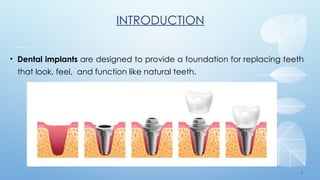
• Dental implants are designed to provide a foundation for replacing teeth
that look, feel, and function like natural teeth.
4
• As treatment with dental implants gained widespread acceptance in
the 1980s and 1990s, several manufacturers developed instruments and
components for commercial distribution.
• These companies also developed proprietary naming systems for their
components that were usually different, and sometimes conflicting,
from one manufacturer to another.
• For example, Nobel Pharma, the Swedish company formed to
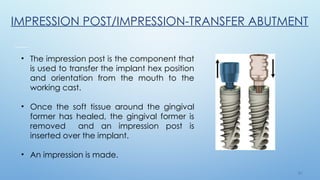
commercialize Professor brånemark’s treatment methods, discouraged
using the term implant, preferring to call its anchoring devices fixtures to
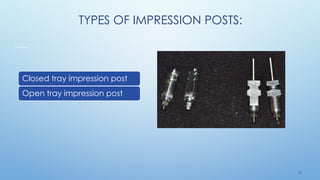
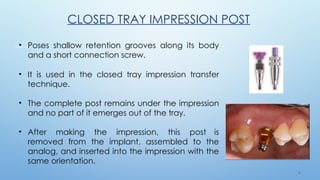
differentiate them from the previous generation of dental implants.
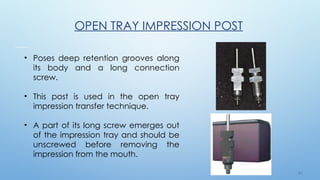
• Thus a generic nomenclature system for instruments and components
has been developed over time and entered common usage in the
literature.
5
TERMINOLOGIES
• Biocompatibility – Being harmonious with life and not having
toxic or injurious effects on biofunction.
- (Dorland's illustrated medical dictionary)
• Biomaterial – Any substance other than drug that can be used
for any period as a part of a system that treats, augments or
replaces any tissue, organ or function of the body.
6
DEFINITION OF IMPLANT
A biocompatible alloplastic
material or device that is surgically
placed into oro-facial tissues and
used for anchorage, functional,
therapeutic, and/or aesthetic
purposes.
-GLOSSARY OF IMPLANT DENTISTRY
Any object or material, such as an
alloplastic substance or other
tissue, partially or completely
inserted or grafted into the body
for therapeutic, diagnostic,
prosthetic, or experimental
purposes.
–GPT 10
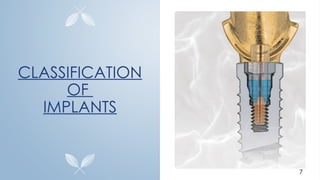
CLASSIFICATION
OF
IMPLANTS
7
8
DEPENDING ON :
Implant
placement
within the tissues
Their reaction
with bone
Materials used
• Epiosteal
• Endosteal
• Transosteal
• Bioactive
• Bioinert
• Biotolerant
• Metallic
• Non metallic
9
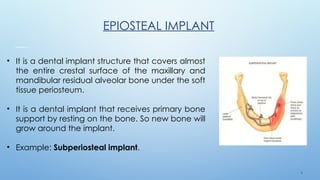
EPIOSTEAL IMPLANT
• It is a dental implant structure that covers almost
the entire crestal surface of the maxillary and
mandibular residual alveolar bone under the soft
tissue periosteum.
• It is a dental implant that receives primary bone
support by resting on the bone. So new bone will
grow around the implant.
• Example: Subperiosteal implant.
1 0
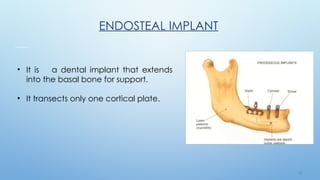
ENDOSTEAL IMPLANT
• It is a dental implant that extends
into the basal bone for support.
• It transects only one cortical plate.
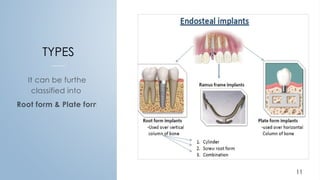
TYPES
It can be further
classified into:
Root form & Plate form
11
1 2
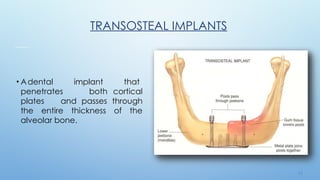
TRANSOSTEAL IMPLANTS
• Adental implant that
penetrates both cortical
plates and passes through
the entire thickness of the
alveolar bone.
1 3
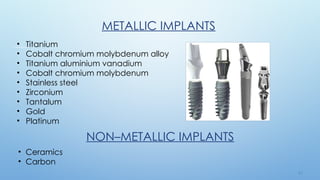
METALLIC IMPLANTS
• Titanium
• Cobalt chromium molybdenum alloy
• Titanium aluminium vanadium
• Cobalt chromium molybdenum
• Stainless steel
• Zirconium
• Tantalum
• Gold
• Platinum
NON–METALLIC IMPLANTS
• Ceramics
• Carbon
1 4
Bioactive –
Materials that allow the formation of new bone onto their surface, but ion
exchange with host tissue leads to forming a chemical bond along the
interface (bonding osteogenesis).
• Hydroxyapatite
• Tri Calcium Phosphate
• Calcium Phosphate
1 5
Bioinert –
Material that allows close apposition of bone on its surface, leading to
contact osteogenesis.
• Metals such as Titanium alloys and CP – titanium alloys.
Biotolerant –
Material that is not necessarily rejected but is surrounded by a fibrous layer in
the form of a capsule.
• Metals such as gold, cobalt-chromium alloys, stainless steel, etc.
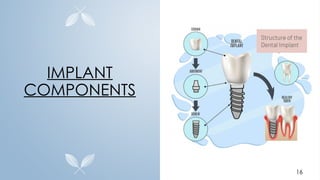
IMPLANT
COMPONENTS
16
1 7
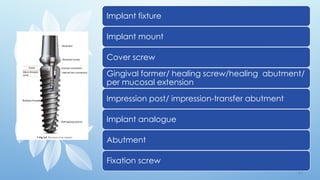
Implant fixture
Implant mount
Cover screw
Gingival former/ healing screw/healing abutment/
per mucosal extension
Impression post/ impression-transfer abutment
Implant analogue
Abutment
Fixation screw
1 8
IMPLANT FIXTURE
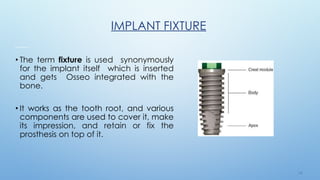
• The term fixture is used synonymously
for the implant itself which is inserted
and gets Osseo integrated with the
bone.
• It works as the tooth root, and various
components are used to cover it, make
its impression, and retain or fix the
prosthesis on top of it.
1 9
CREST MODULE
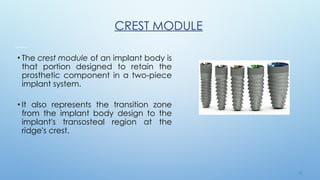
• The crest module of an implant body is
that portion designed to retain the
prosthetic component in a two-piece
implant system.
• It also represents the transition zone
from the implant body design to the
implant's transosteal region at the
ridge's crest.
20
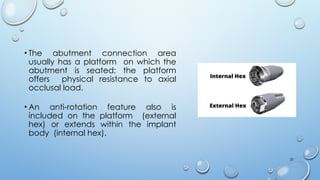
• The abutment connection area
usually has a platform on which the
abutment is seated; the platform
offers physical resistance to axial
occlusal load.
• An anti-rotation feature also is
included on the platform (external
hex) or extends within the implant
body (internal hex).
21
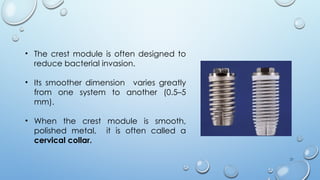
• The crest module is often designed to
reduce bacterial invasion.
• Its smoother dimension varies greatly
from one system to another (0.5–5
mm).
• When the crest module is smooth,
polished metal, it is often called a
cervical collar.
2 2
IMPLANT APEX
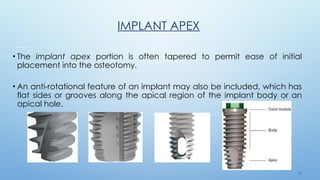
• The implant apex portion is often tapered to permit ease of initial
placement into the osteotomy.
• An anti-rotational feature of an implant may also be included, which has
flat sides or grooves along the apical region of the implant body or an
apical hole.
23
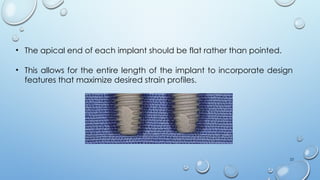
• The apical end of each implant should be flat rather than pointed.
• This allows for the entire length of the implant to incorporate design
features that maximize desired strain profiles.
2 4
IMPLANT MOUNT
Implant Fixture
Implant Mount
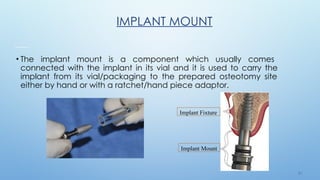
• The implant mount is a component which usually comes
connected with the implant in its vial and it is used to carry the
implant from its vial/packaging to the prepared osteotomy site
either by hand or with a ratchet/hand piece adaptor.
2 5
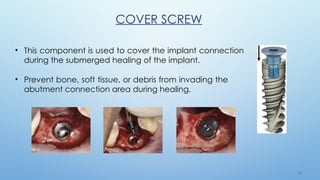
• This component is used to cover the implant connection
during the submerged healing of the implant.
• Prevent bone, soft tissue, or debris from invading the
abutment connection area during healing.
COVER SCREW
2 6
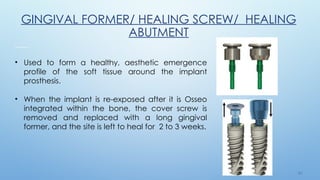
GINGIVAL FORMER/ HEALING SCREW/ HEALING
ABUTMENT
• Used to form a healthy, aesthetic emergence
profile of the soft tissue around the implant
prosthesis.
• When the implant is re-exposed after it is Osseo
integrated within the bone, the cover screw is
removed and replaced with a long gingival
former, and the site is left to heal for 2 to 3 weeks.
27
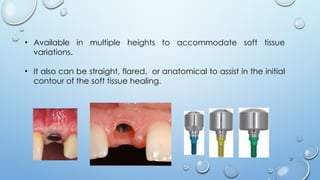
• Available in multiple heights to accommodate soft tissue
variations.
• It also can be straight, flared, or anatomical to assist in the initial
contour of the soft tissue healing.
28
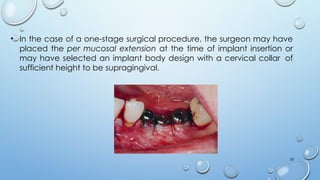
• In the case of a one-stage surgical procedure, the surgeon may have
placed the per mucosal extension at the time of implant insertion or
may have selected an implant body design with a cervical collar of
sufficient height to be supragingival.
2 9
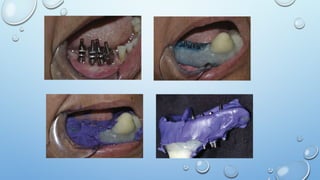
• The impression post is the component that
is used to transfer the implant hex position
and orientation from the mouth to the
working cast.
• Once the soft tissue around the gingival
former has healed, the gingival former is
removed and an impression post is
inserted over the implant.
• An impression is made.
IMPRESSION POST/IMPRESSION-TRANSFER ABUTMENT
3 0
TYPES OF IMPRESSION POSTS:
Closed tray impression post
Open tray impression post
3 1
CLOSED TRAY IMPRESSION POST
• Poses shallow retention grooves along its body
and a short connection screw.
• It is used in the closed tray impression transfer
technique.
• The complete post remains under the impression
and no part of it emerges out of the tray.
• After making the impression, this post is
removed from the implant, assembled to the
analog, and inserted into the impression with the
same orientation.
3 2
OPEN TRAY IMPRESSION POST
• Poses deep retention grooves along
its body and a long connection
screw.
• This post is used in the open tray
impression transfer technique.
• A part of its long screw emerges out
of the impression tray and should be
unscrewed before removing the
impression from the mouth.
3 4
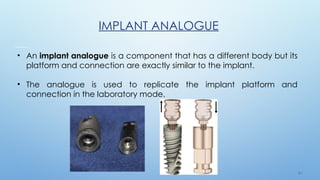
IMPLANT ANALOGUE
• An implant analogue is a component that has a different body but its
platform and connection are exactly similar to the implant.
• The analogue is used to replicate the implant platform and
connection in the laboratory mode.
3 5
PROSTHETIC ATTACHMENTS
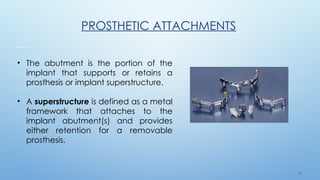
• The abutment is the portion of the
implant that supports or retains a
prosthesis or implant superstructure.
• A superstructure is defined as a metal
framework that attaches to the
implant abutment(s) and provides
either retention for a removable
prosthesis.
36
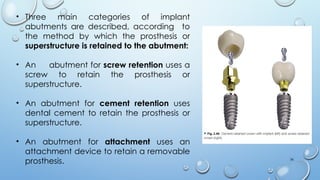
• Three main categories of implant
abutments are described, according to
the method by which the prosthesis or
superstructure is retained to the abutment:
• An abutment for screw retention uses a
screw to retain the prosthesis or
superstructure.
• An abutment for cement retention uses
dental cement to retain the prosthesis or
superstructure.
• An abutment for attachment uses an
attachment device to retain a removable
prosthesis.
37
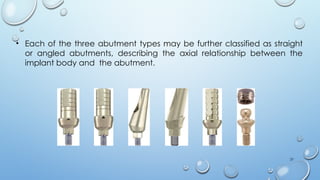
• Each of the three abutment types may be further classified as straight
or angled abutments, describing the axial relationship between the
implant body and the abutment.
38
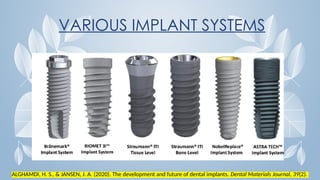
VARIOUS IMPLANT SYSTEMS
ALGHAMDI, H. S., & JANSEN, J. A. (2020). The development and future of dental implants. Dental Materials Journal, 39(2).
40
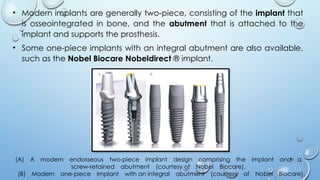
• Modern implants are generally two-piece, consisting of the implant that
is osseointegrated in bone, and the abutment that is attached to the
implant and supports the prosthesis.
• Some one-piece implants with an integral abutment are also available,
such as the Nobel Biocare Nobeldirect ® implant.
(A) A modern endosseous two-piece implant design comprising the implant and a
screw-retained abutment (courtesy of Nobel Biocare).
(B) Modern one-piece implant with an integral abutment (courtesy of Nobel Biocare).
41
• The Brånemark system was a two-piece implant with an external hex
anti-rotation feature.
• ITI initially used a one-piece implant-abutment combination, IMZ had a
screw connection with no anti-rotation feature, and Tübingen had a
proprietary post connection.
• Currently, Nobel biocare is the worldwide market leader, followed closely
by Straumann and others.
• Straumann, Dentsply, Biomet 3i, Biohorizons, and Zimmer also have a
large share of the implant market and have comprehensive systems,
training programs, and support.
42
When selecting an implant company and system, the following should be
considered:
The history, reputation, and longevity
of the company
The quality of service and support from the
company
The quality and strength of the company’s research
The preferences of other members of the implant team
4 3
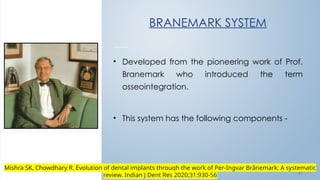
BRANEMARK SYSTEM
• Developed from the pioneering work of Prof.
Branemark who introduced the term
osseointegration.
• This system has the following components -
Mishra SK, Chowdhary R. Evolution of dental implants through the work of Per-Ingvar Brånemark: A systematic
review. Indian J Dent Res 2020;31:930-56
4 4
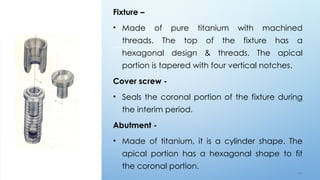
Fixture –
• Made of pure titanium with machined
threads. The top of the fixture has a
hexagonal design & threads. The apical
portion is tapered with four vertical notches.
Cover screw -
• Seals the coronal portion of the fixture during
the interim period.
Abutment -
• Made of titanium, it is a cylinder shape. The
apical portion has a hexagonal shape to fit
the coronal portion.
4 5
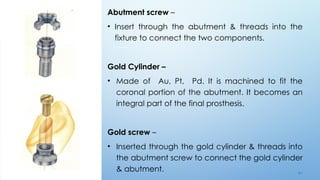
Abutment screw –
• Insert through the abutment & threads into the
fixture to connect the two components.
Gold Cylinder –
• Made of Au, Pt, Pd. It is machined to fit the
coronal portion of the abutment. It becomes an
integral part of the final prosthesis.
Gold screw –
• Inserted through the gold cylinder & threads into
the abutment screw to connect the gold cylinder
& abutment.
4 6
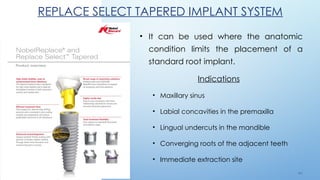
REPLACE SELECT TAPERED IMPLANT SYSTEM
• It can be used where the anatomic
condition limits the placement of a
standard root implant.
Indications
• Maxillary sinus
• Labial concavities in the premaxilla
• Lingual undercuts in the mandible
• Converging roots of the adjacent teeth
• Immediate extraction site
4 7
4 8
FRIALIT IMPLANT SYSTEM
• In 1974 Dr. Willi Schulte developed Frialit 1 also
known as Tubingen implants.
• It is the world’s first root analog system.
4 9
• Implant concept: Root analog stepped cylinder, stepped screws, and
synchro-stepped screw.
• Surgical indications: Immediate implant placement, delayed implant
placement, late implant placement.
• Material: Pure titanium
• Implant surface: TPS coating, HA coating (stepped cylinder), DPS
(stepped screw, Synchro stepped screw)
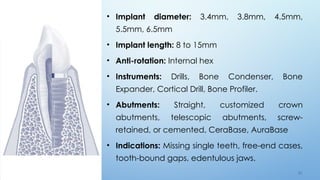
5 0
• Implant diameter: 3.4mm, 3.8mm, 4.5mm,
5.5mm, 6.5mm
• Implant length: 8 to 15mm
• Anti-rotation: Internal hex
• Instruments: Drills, Bone Condenser, Bone
Expander, Cortical Drill, Bone Profiler.
• Abutments: Straight, customized crown
abutments, telescopic abutments, screw-
retained, or cemented, CeraBase, AuraBase
• Indications: Missing single teeth, free-end cases,
tooth-bound gaps, edentulous jaws.
5 1
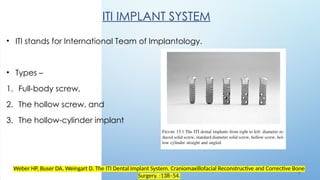
ITI IMPLANT SYSTEM
• ITI stands for International Team of Implantology.
• Types –
1. Full-body screw,
2. The hollow screw, and
3. The hollow-cylinder implant
Weber HP, Buser DA, Weingart D. The ITI Dental Implant System. Craniomaxillofacial Reconstructive and Corrective Bone
Surgery. :138–54.
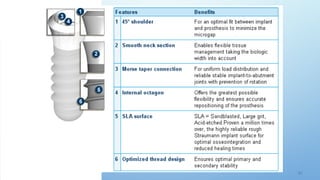
5 2
5 3
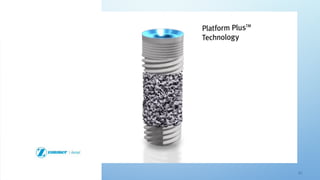
CORE VENT SYSTEM
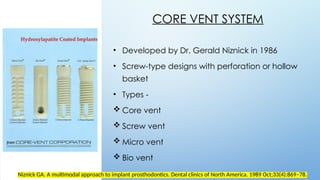
• Developed by Dr. Gerald Niznick in 1986
• Screw-type designs with perforation or hollow
basket
• Types -
 Core vent
 Screw vent
 Micro vent
 Bio vent
Niznick GA. A multimodal approach to implant prosthodontics. Dental clinics of North America. 1989 Oct;33(4):869–78.‌
5 4
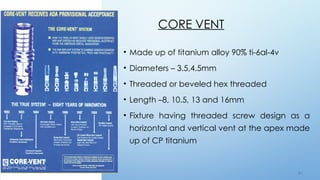
CORE VENT
• Made up of titanium alloy 90% ti-6al-4v
• Diameters – 3.5,4.5mm
• Threaded or beveled hex threaded
• Length –8, 10.5, 13 and 16mm
• Fixture having threaded screw design as a
horizontal and vertical vent at the apex made
up of CP titanium
5 5
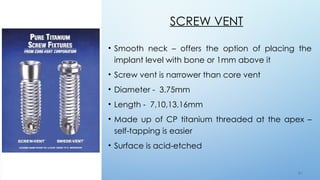
SCREW VENT
• Smooth neck – offers the option of placing the
implant level with bone or 1mm above it
• Screw vent is narrower than core vent
• Diameter - 3.75mm
• Length - 7,10,13,16mm
• Made up of CP titanium threaded at the apex –
self-tapping is easier
• Surface is acid-etched
5 6
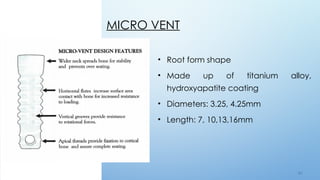
MICRO VENT
• Root form shape
• Made up of titanium alloy,
hydroxyapatite coating
• Diameters: 3.25, 4.25mm
• Length: 7, 10,13,16mm
5 7
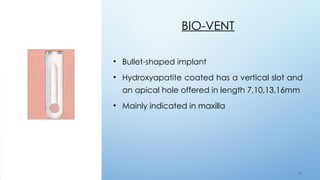
BIO-VENT
• Bullet-shaped implant
• Hydroxyapatite coated has a vertical slot and
an apical hole offered in length 7,10,13,16mm
• Mainly indicated in maxilla
5 8
5 9
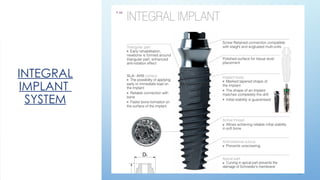
INTEGRAL
IMPLANT
SYSTEM
6 0
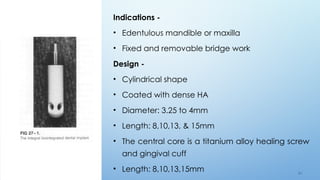
Indications -
• Edentulous mandible or maxilla
• Fixed and removable bridge work
Design -
• Cylindrical shape
• Coated with dense HA
• Diameter: 3.25 to 4mm
• Length: 8,10,13, & 15mm
• The central core is a titanium alloy healing screw
and gingival cuff
• Length: 8,10,13,15mm
6 1
Advantages –
• Different diameters so wide selection for the
dentist
• Cylindrical shape
• More favorable stress distribution
6 2
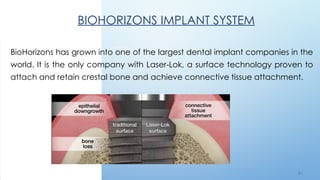
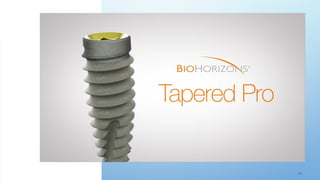
BIOHORIZONS IMPLANT SYSTEM
BioHorizons has grown into one of the largest dental implant companies in the
world. It is the only company with Laser-Lok, a surface technology proven to
attach and retain crestal bone and achieve connective tissue attachment.
6 3
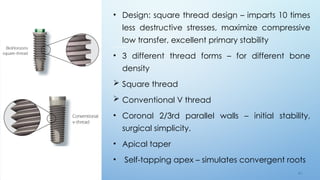
• Design: square thread design – imparts 10 times
less destructive stresses, maximize compressive
low transfer, excellent primary stability
• 3 different thread forms – for different bone
density
 Square thread
 Conventional V thread
• Coronal 2/3rd parallel walls – initial stability,
surgical simplicity.
• Apical taper
• Self-tapping apex – simulates convergent roots
6 4
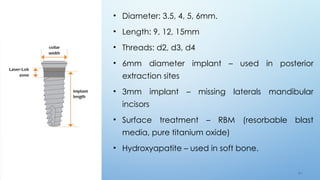
• Diameter: 3.5, 4, 5, 6mm.
• Length: 9, 12, 15mm
• Threads: d2, d3, d4
• 6mm diameter implant – used in posterior
extraction sites
• 3mm implant – missing laterals mandibular
incisors
• Surface treatment – RBM (resorbable blast
media, pure titanium oxide)
• Hydroxyapatite – used in soft bone.
6 5
Advantages –
• Less marginal bone loss because of 0.5mm
length polished collar = better esthetics.
• Spiral lock technology reduces the chances of
screw loosening.
Indications -
• Single tooth replacement (mandibular central
lateral incisor, maxillary lateral incisor)
6 6
6 7
ASTRA TECH IMPLANT SYSTEM
• Two stage implant – manufactured from pure
titanium
• Submerged implant
• Got unique conical seal design
• Surface treatment
• Grit blasting – titanium oxide particles
• Conical head
• Taper is 11°
6 8
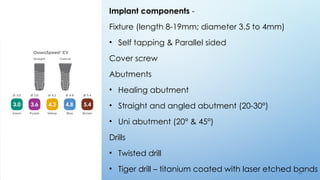
Implant components -
Fixture (length 8-19mm; diameter 3.5 to 4mm)
• Self tapping & Parallel sided
Cover screw
Abutments
• Healing abutment
• Straight and angled abutment (20-30°)
• Uni abutment (20° & 45°)
Drills
• Twisted drill
• Tiger drill – titanium coated with laser etched bands
6 9
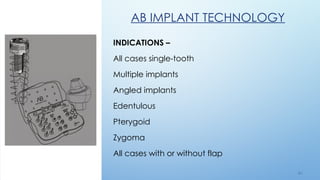
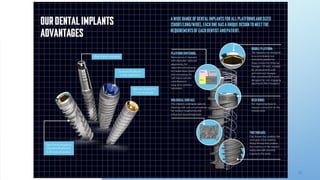
AB IMPLANT TECHNOLOGY
INDICATIONS –
All cases single-tooth
Multiple implants
Angled implants
Edentulous
Pterygoid
Zygoma
All cases with or without flap
7 0
7 1
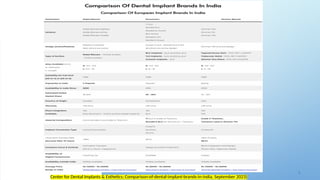
Center for Dental Implants & Esthetics; Comparison-of-dental-implant-brands-in-india, September 2023)
7 2
7 3
In modern dentistry, dental implants have revolutionized the
way we address tooth loss. These remarkable prosthetics offer
patients a permanent and aesthetical solution to restore their
smiles.
However, what many patients may not realize is that there are
various brands of dental implants available, each with its
unique characteristics and advantages.
TAKEAWAY MESSAGE
7 4
Nobel Biocare: The Pioneer
Nobel Biocare is often recognized as the pioneer in the
field of dental implantology.
Established in 1952, they have a rich history of innovation
and precision.
Their implants are renowned for their high-quality
materials and long-term success rates.
Nobel Biocare implants are ideal for patients seeking a
proven and reliable solution.
Nobel Biocare is the company that invented the All-on-4
Dental Implants.
7 5
Straumann: Swiss Precision
Swiss precision and engineering excellence characterize
Straumann dental implants.
With a history dating back to 1954, Straumann has
earned a reputation for its durable, state-of-the-art
implants.
These implants are known for their exceptional fit,
making them a preferred choice for many dentists
worldwide.
7 6
Zimmer Biomet: Versatility and Durability
Zimmer Biomet offers a wide range of dental implants to
suit different clinical scenarios.
Their implant designs emphasize versatility and durability,
making them suitable for diverse patient needs.
Dentists appreciate the flexibility Zimmer Biomet implants
provide during the treatment planning process.
7 7
Dentsply Sirona: A Comprehensive Approach
Dentsply Sirona is a trusted name in the dental industry,
known for its comprehensive solutions.
Their dental implants come in various types, including
ceramic options, providing patients with a wide array of
choices to meet their aesthetic and functional
demands.
7 8
Osstem: Affordable Excellence
For those seeking affordable yet high-quality dental
implant options, Osstem is a noteworthy choice.
This South Korean company has gained recognition for
its cost-effective implants without compromising on
quality or performance.
Osstem offers accessibility to dental implants for a
broader range of patients.
7 9
MIS Implants: Innovation in Simplicity
MIS Implants focuses on innovation and simplicity.
Their implants are designed to simplify the implantation
process, making it easier for dentists to achieve optimal
results.
This brand is an excellent choice for dental professionals
seeking efficient and straightforward solutions.
8 0
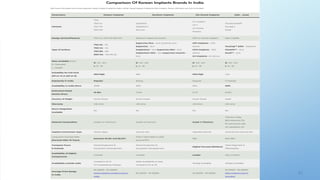
The diversity of dental implant brands in the market
provides patients and dental professionals with a range
of options.
Each brand has its own set of advantages, whether it's
Nobel Biocare's pioneering history, Straumann's
precision, Zimmer Biomet's versatility, Dentsply Sirona's
comprehensive approach, Osstem's affordability, or MIS
Implants' simplicity.
The key to making the right choice is to consult with a
qualified dentist who can recommend the most suitable
implant based on individual needs.
8 1
REFERENCES
• THE GLOSSARY OF PROSTHODONTIC TERMS. THE JOURNAL OF PROSTHETIC DENTISTRY. 2023
MAY;117(5):C1-E105.
• AMERICAN ACADEMY OF IMPLANT DENTISTRY. GLOSSARY OF IMPLANT TERMS. 2022 JAN 1;12(2):284–
94.
• ENGLISH CE. DENTAL IMPLANT PROSTHETICS CARL E. MISCH. IMPLANT DENTISTRY. 2005 MAR;14(1):11–2.‌
• Misch CE, Misch CM. Generic terminology for endosseous implant prosthodontics. J Prosthet Dent
1992;68:809–12.
• Elaine Mc Clarence ’s Close to the edge.
• Hubertus Spikerman’s Color atlas of Dental medicine (Implantology).
• Malvin E. Ring’s Dentistry An Illustrated History.
• Sumiya Hobo’s oseointegration and occlusal rehabilitation.
• Ralph V. McKinney, Jr’s endosteal dental implants.
• ADA council on scientific affairs Dental endosseous implants. An update. JADA, Vol. 135, January 2004.
THANK
YOU

IMPLANT COMPONENTS & SYSTEMS_DR SHUCHI JAIN.pptx

  • 1.
    IMPLANT COMPONENTS & SYSTEMS Presented by Dr.Shuchi Jain Department of Prosthodontics MDS 2nd Year
  • 2.
    CONTENTS INTRODUCTION TERMINOLOGIES DEFINITION CLASSIFICATION OF IMPLANTS IMPLANTCOMPONENTS VARIOUS IMPLANT SYSTEMS TAKE AWAY MESSAGE REFERENCES 2
  • 3.
    3 INTRODUCTION • Dental implantsare designed to provide a foundation for replacing teeth that look, feel, and function like natural teeth.
  • 4.
    4 • As treatmentwith dental implants gained widespread acceptance in the 1980s and 1990s, several manufacturers developed instruments and components for commercial distribution. • These companies also developed proprietary naming systems for their components that were usually different, and sometimes conflicting, from one manufacturer to another. • For example, Nobel Pharma, the Swedish company formed to commercialize Professor brånemark’s treatment methods, discouraged using the term implant, preferring to call its anchoring devices fixtures to differentiate them from the previous generation of dental implants. • Thus a generic nomenclature system for instruments and components has been developed over time and entered common usage in the literature.
  • 5.
    5 TERMINOLOGIES • Biocompatibility –Being harmonious with life and not having toxic or injurious effects on biofunction. - (Dorland's illustrated medical dictionary) • Biomaterial – Any substance other than drug that can be used for any period as a part of a system that treats, augments or replaces any tissue, organ or function of the body.
  • 6.
    6 DEFINITION OF IMPLANT Abiocompatible alloplastic material or device that is surgically placed into oro-facial tissues and used for anchorage, functional, therapeutic, and/or aesthetic purposes. -GLOSSARY OF IMPLANT DENTISTRY Any object or material, such as an alloplastic substance or other tissue, partially or completely inserted or grafted into the body for therapeutic, diagnostic, prosthetic, or experimental purposes. –GPT 10
  • 7.
  • 8.
    8 DEPENDING ON : Implant placement withinthe tissues Their reaction with bone Materials used • Epiosteal • Endosteal • Transosteal • Bioactive • Bioinert • Biotolerant • Metallic • Non metallic
  • 9.
    9 EPIOSTEAL IMPLANT • Itis a dental implant structure that covers almost the entire crestal surface of the maxillary and mandibular residual alveolar bone under the soft tissue periosteum. • It is a dental implant that receives primary bone support by resting on the bone. So new bone will grow around the implant. • Example: Subperiosteal implant.
  • 10.
    1 0 ENDOSTEAL IMPLANT •It is a dental implant that extends into the basal bone for support. • It transects only one cortical plate.
  • 11.
    TYPES It can befurther classified into: Root form & Plate form 11
  • 12.
    1 2 TRANSOSTEAL IMPLANTS •Adental implant that penetrates both cortical plates and passes through the entire thickness of the alveolar bone.
  • 13.
    1 3 METALLIC IMPLANTS •Titanium • Cobalt chromium molybdenum alloy • Titanium aluminium vanadium • Cobalt chromium molybdenum • Stainless steel • Zirconium • Tantalum • Gold • Platinum NON–METALLIC IMPLANTS • Ceramics • Carbon
  • 14.
    1 4 Bioactive – Materialsthat allow the formation of new bone onto their surface, but ion exchange with host tissue leads to forming a chemical bond along the interface (bonding osteogenesis). • Hydroxyapatite • Tri Calcium Phosphate • Calcium Phosphate
  • 15.
    1 5 Bioinert – Materialthat allows close apposition of bone on its surface, leading to contact osteogenesis. • Metals such as Titanium alloys and CP – titanium alloys. Biotolerant – Material that is not necessarily rejected but is surrounded by a fibrous layer in the form of a capsule. • Metals such as gold, cobalt-chromium alloys, stainless steel, etc.
  • 16.
  • 17.
    1 7 Implant fixture Implantmount Cover screw Gingival former/ healing screw/healing abutment/ per mucosal extension Impression post/ impression-transfer abutment Implant analogue Abutment Fixation screw
  • 18.
    1 8 IMPLANT FIXTURE •The term fixture is used synonymously for the implant itself which is inserted and gets Osseo integrated with the bone. • It works as the tooth root, and various components are used to cover it, make its impression, and retain or fix the prosthesis on top of it.
  • 19.
    1 9 CREST MODULE •The crest module of an implant body is that portion designed to retain the prosthetic component in a two-piece implant system. • It also represents the transition zone from the implant body design to the implant's transosteal region at the ridge's crest.
  • 20.
    20 • The abutmentconnection area usually has a platform on which the abutment is seated; the platform offers physical resistance to axial occlusal load. • An anti-rotation feature also is included on the platform (external hex) or extends within the implant body (internal hex).
  • 21.
    21 • The crestmodule is often designed to reduce bacterial invasion. • Its smoother dimension varies greatly from one system to another (0.5–5 mm). • When the crest module is smooth, polished metal, it is often called a cervical collar.
  • 22.
    2 2 IMPLANT APEX •The implant apex portion is often tapered to permit ease of initial placement into the osteotomy. • An anti-rotational feature of an implant may also be included, which has flat sides or grooves along the apical region of the implant body or an apical hole.
  • 23.
    23 • The apicalend of each implant should be flat rather than pointed. • This allows for the entire length of the implant to incorporate design features that maximize desired strain profiles.
  • 24.
    2 4 IMPLANT MOUNT ImplantFixture Implant Mount • The implant mount is a component which usually comes connected with the implant in its vial and it is used to carry the implant from its vial/packaging to the prepared osteotomy site either by hand or with a ratchet/hand piece adaptor.
  • 25.
    2 5 • Thiscomponent is used to cover the implant connection during the submerged healing of the implant. • Prevent bone, soft tissue, or debris from invading the abutment connection area during healing. COVER SCREW
  • 26.
    2 6 GINGIVAL FORMER/HEALING SCREW/ HEALING ABUTMENT • Used to form a healthy, aesthetic emergence profile of the soft tissue around the implant prosthesis. • When the implant is re-exposed after it is Osseo integrated within the bone, the cover screw is removed and replaced with a long gingival former, and the site is left to heal for 2 to 3 weeks.
  • 27.
    27 • Available inmultiple heights to accommodate soft tissue variations. • It also can be straight, flared, or anatomical to assist in the initial contour of the soft tissue healing.
  • 28.
    28 • In thecase of a one-stage surgical procedure, the surgeon may have placed the per mucosal extension at the time of implant insertion or may have selected an implant body design with a cervical collar of sufficient height to be supragingival.
  • 29.
    2 9 • Theimpression post is the component that is used to transfer the implant hex position and orientation from the mouth to the working cast. • Once the soft tissue around the gingival former has healed, the gingival former is removed and an impression post is inserted over the implant. • An impression is made. IMPRESSION POST/IMPRESSION-TRANSFER ABUTMENT
  • 30.
    3 0 TYPES OFIMPRESSION POSTS: Closed tray impression post Open tray impression post
  • 31.
    3 1 CLOSED TRAYIMPRESSION POST • Poses shallow retention grooves along its body and a short connection screw. • It is used in the closed tray impression transfer technique. • The complete post remains under the impression and no part of it emerges out of the tray. • After making the impression, this post is removed from the implant, assembled to the analog, and inserted into the impression with the same orientation.
  • 32.
    3 2 OPEN TRAYIMPRESSION POST • Poses deep retention grooves along its body and a long connection screw. • This post is used in the open tray impression transfer technique. • A part of its long screw emerges out of the impression tray and should be unscrewed before removing the impression from the mouth.
  • 34.
    3 4 IMPLANT ANALOGUE •An implant analogue is a component that has a different body but its platform and connection are exactly similar to the implant. • The analogue is used to replicate the implant platform and connection in the laboratory mode.
  • 35.
    3 5 PROSTHETIC ATTACHMENTS •The abutment is the portion of the implant that supports or retains a prosthesis or implant superstructure. • A superstructure is defined as a metal framework that attaches to the implant abutment(s) and provides either retention for a removable prosthesis.
  • 36.
    36 • Three maincategories of implant abutments are described, according to the method by which the prosthesis or superstructure is retained to the abutment: • An abutment for screw retention uses a screw to retain the prosthesis or superstructure. • An abutment for cement retention uses dental cement to retain the prosthesis or superstructure. • An abutment for attachment uses an attachment device to retain a removable prosthesis.
  • 37.
    37 • Each ofthe three abutment types may be further classified as straight or angled abutments, describing the axial relationship between the implant body and the abutment.
  • 38.
  • 39.
    VARIOUS IMPLANT SYSTEMS ALGHAMDI,H. S., & JANSEN, J. A. (2020). The development and future of dental implants. Dental Materials Journal, 39(2).
  • 40.
    40 • Modern implantsare generally two-piece, consisting of the implant that is osseointegrated in bone, and the abutment that is attached to the implant and supports the prosthesis. • Some one-piece implants with an integral abutment are also available, such as the Nobel Biocare Nobeldirect ® implant. (A) A modern endosseous two-piece implant design comprising the implant and a screw-retained abutment (courtesy of Nobel Biocare). (B) Modern one-piece implant with an integral abutment (courtesy of Nobel Biocare).
  • 41.
    41 • The Brånemarksystem was a two-piece implant with an external hex anti-rotation feature. • ITI initially used a one-piece implant-abutment combination, IMZ had a screw connection with no anti-rotation feature, and Tübingen had a proprietary post connection. • Currently, Nobel biocare is the worldwide market leader, followed closely by Straumann and others. • Straumann, Dentsply, Biomet 3i, Biohorizons, and Zimmer also have a large share of the implant market and have comprehensive systems, training programs, and support.
  • 42.
    42 When selecting animplant company and system, the following should be considered: The history, reputation, and longevity of the company The quality of service and support from the company The quality and strength of the company’s research The preferences of other members of the implant team
  • 43.
    4 3 BRANEMARK SYSTEM •Developed from the pioneering work of Prof. Branemark who introduced the term osseointegration. • This system has the following components - Mishra SK, Chowdhary R. Evolution of dental implants through the work of Per-Ingvar Brånemark: A systematic review. Indian J Dent Res 2020;31:930-56
  • 44.
    4 4 Fixture – •Made of pure titanium with machined threads. The top of the fixture has a hexagonal design & threads. The apical portion is tapered with four vertical notches. Cover screw - • Seals the coronal portion of the fixture during the interim period. Abutment - • Made of titanium, it is a cylinder shape. The apical portion has a hexagonal shape to fit the coronal portion.
  • 45.
    4 5 Abutment screw– • Insert through the abutment & threads into the fixture to connect the two components. Gold Cylinder – • Made of Au, Pt, Pd. It is machined to fit the coronal portion of the abutment. It becomes an integral part of the final prosthesis. Gold screw – • Inserted through the gold cylinder & threads into the abutment screw to connect the gold cylinder & abutment.
  • 46.
    4 6 REPLACE SELECTTAPERED IMPLANT SYSTEM • It can be used where the anatomic condition limits the placement of a standard root implant. Indications • Maxillary sinus • Labial concavities in the premaxilla • Lingual undercuts in the mandible • Converging roots of the adjacent teeth • Immediate extraction site
  • 47.
  • 48.
    4 8 FRIALIT IMPLANTSYSTEM • In 1974 Dr. Willi Schulte developed Frialit 1 also known as Tubingen implants. • It is the world’s first root analog system.
  • 49.
    4 9 • Implantconcept: Root analog stepped cylinder, stepped screws, and synchro-stepped screw. • Surgical indications: Immediate implant placement, delayed implant placement, late implant placement. • Material: Pure titanium • Implant surface: TPS coating, HA coating (stepped cylinder), DPS (stepped screw, Synchro stepped screw)
  • 50.
    5 0 • Implantdiameter: 3.4mm, 3.8mm, 4.5mm, 5.5mm, 6.5mm • Implant length: 8 to 15mm • Anti-rotation: Internal hex • Instruments: Drills, Bone Condenser, Bone Expander, Cortical Drill, Bone Profiler. • Abutments: Straight, customized crown abutments, telescopic abutments, screw- retained, or cemented, CeraBase, AuraBase • Indications: Missing single teeth, free-end cases, tooth-bound gaps, edentulous jaws.
  • 51.
    5 1 ITI IMPLANTSYSTEM • ITI stands for International Team of Implantology. • Types – 1. Full-body screw, 2. The hollow screw, and 3. The hollow-cylinder implant Weber HP, Buser DA, Weingart D. The ITI Dental Implant System. Craniomaxillofacial Reconstructive and Corrective Bone Surgery. :138–54.
  • 52.
  • 53.
    5 3 CORE VENTSYSTEM • Developed by Dr. Gerald Niznick in 1986 • Screw-type designs with perforation or hollow basket • Types -  Core vent  Screw vent  Micro vent  Bio vent Niznick GA. A multimodal approach to implant prosthodontics. Dental clinics of North America. 1989 Oct;33(4):869–78.‌
  • 54.
    5 4 CORE VENT •Made up of titanium alloy 90% ti-6al-4v • Diameters – 3.5,4.5mm • Threaded or beveled hex threaded • Length –8, 10.5, 13 and 16mm • Fixture having threaded screw design as a horizontal and vertical vent at the apex made up of CP titanium
  • 55.
    5 5 SCREW VENT •Smooth neck – offers the option of placing the implant level with bone or 1mm above it • Screw vent is narrower than core vent • Diameter - 3.75mm • Length - 7,10,13,16mm • Made up of CP titanium threaded at the apex – self-tapping is easier • Surface is acid-etched
  • 56.
    5 6 MICRO VENT •Root form shape • Made up of titanium alloy, hydroxyapatite coating • Diameters: 3.25, 4.25mm • Length: 7, 10,13,16mm
  • 57.
    5 7 BIO-VENT • Bullet-shapedimplant • Hydroxyapatite coated has a vertical slot and an apical hole offered in length 7,10,13,16mm • Mainly indicated in maxilla
  • 58.
  • 59.
  • 60.
    6 0 Indications - •Edentulous mandible or maxilla • Fixed and removable bridge work Design - • Cylindrical shape • Coated with dense HA • Diameter: 3.25 to 4mm • Length: 8,10,13, & 15mm • The central core is a titanium alloy healing screw and gingival cuff • Length: 8,10,13,15mm
  • 61.
    6 1 Advantages – •Different diameters so wide selection for the dentist • Cylindrical shape • More favorable stress distribution
  • 62.
    6 2 BIOHORIZONS IMPLANTSYSTEM BioHorizons has grown into one of the largest dental implant companies in the world. It is the only company with Laser-Lok, a surface technology proven to attach and retain crestal bone and achieve connective tissue attachment.
  • 63.
    6 3 • Design:square thread design – imparts 10 times less destructive stresses, maximize compressive low transfer, excellent primary stability • 3 different thread forms – for different bone density  Square thread  Conventional V thread • Coronal 2/3rd parallel walls – initial stability, surgical simplicity. • Apical taper • Self-tapping apex – simulates convergent roots
  • 64.
    6 4 • Diameter:3.5, 4, 5, 6mm. • Length: 9, 12, 15mm • Threads: d2, d3, d4 • 6mm diameter implant – used in posterior extraction sites • 3mm implant – missing laterals mandibular incisors • Surface treatment – RBM (resorbable blast media, pure titanium oxide) • Hydroxyapatite – used in soft bone.
  • 65.
    6 5 Advantages – •Less marginal bone loss because of 0.5mm length polished collar = better esthetics. • Spiral lock technology reduces the chances of screw loosening. Indications - • Single tooth replacement (mandibular central lateral incisor, maxillary lateral incisor)
  • 66.
  • 67.
    6 7 ASTRA TECHIMPLANT SYSTEM • Two stage implant – manufactured from pure titanium • Submerged implant • Got unique conical seal design • Surface treatment • Grit blasting – titanium oxide particles • Conical head • Taper is 11°
  • 68.
    6 8 Implant components- Fixture (length 8-19mm; diameter 3.5 to 4mm) • Self tapping & Parallel sided Cover screw Abutments • Healing abutment • Straight and angled abutment (20-30°) • Uni abutment (20° & 45°) Drills • Twisted drill • Tiger drill – titanium coated with laser etched bands
  • 69.
    6 9 AB IMPLANTTECHNOLOGY INDICATIONS – All cases single-tooth Multiple implants Angled implants Edentulous Pterygoid Zygoma All cases with or without flap
  • 70.
  • 71.
    7 1 Center forDental Implants & Esthetics; Comparison-of-dental-implant-brands-in-india, September 2023)
  • 72.
  • 73.
    7 3 In moderndentistry, dental implants have revolutionized the way we address tooth loss. These remarkable prosthetics offer patients a permanent and aesthetical solution to restore their smiles. However, what many patients may not realize is that there are various brands of dental implants available, each with its unique characteristics and advantages. TAKEAWAY MESSAGE
  • 74.
    7 4 Nobel Biocare:The Pioneer Nobel Biocare is often recognized as the pioneer in the field of dental implantology. Established in 1952, they have a rich history of innovation and precision. Their implants are renowned for their high-quality materials and long-term success rates. Nobel Biocare implants are ideal for patients seeking a proven and reliable solution. Nobel Biocare is the company that invented the All-on-4 Dental Implants.
  • 75.
    7 5 Straumann: SwissPrecision Swiss precision and engineering excellence characterize Straumann dental implants. With a history dating back to 1954, Straumann has earned a reputation for its durable, state-of-the-art implants. These implants are known for their exceptional fit, making them a preferred choice for many dentists worldwide.
  • 76.
    7 6 Zimmer Biomet:Versatility and Durability Zimmer Biomet offers a wide range of dental implants to suit different clinical scenarios. Their implant designs emphasize versatility and durability, making them suitable for diverse patient needs. Dentists appreciate the flexibility Zimmer Biomet implants provide during the treatment planning process.
  • 77.
    7 7 Dentsply Sirona:A Comprehensive Approach Dentsply Sirona is a trusted name in the dental industry, known for its comprehensive solutions. Their dental implants come in various types, including ceramic options, providing patients with a wide array of choices to meet their aesthetic and functional demands.
  • 78.
    7 8 Osstem: AffordableExcellence For those seeking affordable yet high-quality dental implant options, Osstem is a noteworthy choice. This South Korean company has gained recognition for its cost-effective implants without compromising on quality or performance. Osstem offers accessibility to dental implants for a broader range of patients.
  • 79.
    7 9 MIS Implants:Innovation in Simplicity MIS Implants focuses on innovation and simplicity. Their implants are designed to simplify the implantation process, making it easier for dentists to achieve optimal results. This brand is an excellent choice for dental professionals seeking efficient and straightforward solutions.
  • 80.
    8 0 The diversityof dental implant brands in the market provides patients and dental professionals with a range of options. Each brand has its own set of advantages, whether it's Nobel Biocare's pioneering history, Straumann's precision, Zimmer Biomet's versatility, Dentsply Sirona's comprehensive approach, Osstem's affordability, or MIS Implants' simplicity. The key to making the right choice is to consult with a qualified dentist who can recommend the most suitable implant based on individual needs.
  • 81.
    8 1 REFERENCES • THEGLOSSARY OF PROSTHODONTIC TERMS. THE JOURNAL OF PROSTHETIC DENTISTRY. 2023 MAY;117(5):C1-E105. • AMERICAN ACADEMY OF IMPLANT DENTISTRY. GLOSSARY OF IMPLANT TERMS. 2022 JAN 1;12(2):284– 94. • ENGLISH CE. DENTAL IMPLANT PROSTHETICS CARL E. MISCH. IMPLANT DENTISTRY. 2005 MAR;14(1):11–2.‌ • Misch CE, Misch CM. Generic terminology for endosseous implant prosthodontics. J Prosthet Dent 1992;68:809–12. • Elaine Mc Clarence ’s Close to the edge. • Hubertus Spikerman’s Color atlas of Dental medicine (Implantology). • Malvin E. Ring’s Dentistry An Illustrated History. • Sumiya Hobo’s oseointegration and occlusal rehabilitation. • Ralph V. McKinney, Jr’s endosteal dental implants. • ADA council on scientific affairs Dental endosseous implants. An update. JADA, Vol. 135, January 2004.
  • 82.

Editor's Notes

  • #9 The subperiosteal implant is used principally for treatment of the edentulous mandible. The predominant treatment method involves two surgical interventions.
  • #10 A cylinder or press-fit implant is an endosseous design consist ing of a straight cylinder that is pushed or tapped into the sur gical osteotomy Primary stability of these designs relies on a highly roughened surface texture to increase frictional resistance to dislodgement from the bone. Surfaces used for these implants included hydroxyapatite (HA), titanium plasma spray (TPS), and small metal balls sintered to the surface of the implant
  • #11 blade implant - significant bone loss
  • #12 Implants included in this category include the Smooth Staple implant and the Bosker.
  • #19 The crest is the outer surface of the thread, and it joins the two sides of the thread. The diam eter measured around the crest is the outer diameter (OD) of the implant. The root is the inner surface of the thread, and it joins the two sides of the thread. The diameter measured around the root is the inner diameter (ID) of the implant. The helix angle describes the angulation between the wall of the thread and the perpendicular axis. The pitch is the distance between two adjacent threads. Greater pitch is considered to be more aggressive in cut ting through bone.
  • #20 Disadvantage of external hex – limited height (0.7mm external hexagon earlier, now 0.7-1.5mm) and configuration makes it ineffective when excessive off axial load is applied, Abutment screw loosening, fracture and micromotion is common. Internal hex – one point of contact so loosens easily, bone loss may be seen because of microgaps and micro movements, loosens easily, only held by hex..no wedging effect like conical connections.
  • #24 Some implant systems incorporate a direct-drive feature, in which an instrument engages directly into the implant, allowing for a simpler procedure and better vision during implant place ment
  • #31 There are two major techniques used for making impressions using impression copings. Each method is facilitated by a specific coping design. In the transfer or closed-tray technique, the impression coping has a tapered shape and is attached to the implant or abutment, and it remains attached when the impression is removed from the mouth. The copings are then removed from the mouth and inserted into the impression. Analogs are attached to the impression copings before or after insertion, and the cast is poured.
  • #32 With the pick-up or open-tray technique, the impression coping features squares or other retentive elements and is attached to the implant or abutment before the impression is made. The screws, which retain the impression copings, project through the impression tray and are loosened before impression removal. The impression copings are removed with the impression, analogs are connected, and the cast is poured.
  • #35 Classification of abutments – Based on implant abutment connection – external connection, internal connection, connection with antirotational feature, without antirotational feature. Based on type of material used – titanium, ceramic, peek, other metals such as cast gold UCLA abutment Based on method of fabrication – prefabricated/stock and custom Based on retentive modality – cement retained, screw retained, abutment for attachment (ball attachment, bar and clip, metal reinforcement, locator, ) Engaging (used for single unit crown) vs non engaging abutment (bridges), (abutment can rotate on implant)
  • #36 For cement retained prosthesis – stock abutment/ non preppable abutments are used. Self removal mechanism, Click facilitates positioning and aids in retention between the parts. UCLA abutment – screw retained/ cement retained abutment.
  • #37 Straight abutment (3.5 degree) Angled (15-35 degree) abutment– allow correction of angulation and positional discrepancy To address anatomic concerns and to preserve the bone plate and fenestrations. Complication with angled abutment – failure with retention screw, screw fracture, excess crestal bone loss, as angulation increases stress and strain on bone increases. Customizable abutment – oval shaped abutment like natural tooth, 2 gingival height (2, 3.5mm) 2 angles (0, 15 degree)
  • #38 Video - components
  • #40 IMZ = intramobile zylinder T he two-piece implant design consists of an implant body, which provides anchorage within the bone, and a platform, which pro vides a connection. This connection is used to join the implant to various instruments and components and, finally, to an abutment or prosthesis. A one-piece implant, as seen in Fig. 2.10, has an abutment as part of the implant. 
  • #41 IMZ = intramobile zylinder
  • #44 T he original Brånemark implant was a parallel-walled design, featuring an implant body that maintained the same diameter throughout its length. Current designs feature a tapered screw design, in which the diameter of the implant body decreases toward the apex
  • #49 DPS (Diamond-Like Carbon) coating
  • #53 Core vent system = morse taper/ conical connection (taper of 15 degree)
  • #70 Platform switching – a smaller diameter prosthetic component was connected to a larger diameter implant platform to create a step between the implant and the abutment. It helps in preservation of peri implant bone. Advantages – Shifting of inflammatory cell infiltrate inwards and away from the adjacent crestal bone Maintenance of biological width and increased distance of Implant abutment junction from crestal bone level in horizontal way Influence of microgaps on crestal bone is reduced Stress level in pre implant bone are reduced. Traditional implant designs, such as the Brånemark external hex, maintained the same diameter from the implant collar to the por tion of the abutment that connects to the implant in a design known as a butt-joint or platform matched. With the advent of the internal conical connection, it became possible to create a stable implant abutment connection while reducing the diameter of the abutment. T he situation in which the abutment is narrower than the implant at the connection is termed platform switching.