Dr. K. Sathyamurthi
HOD, Madras School of Social Work
Egmore, Chennai, Tamil Nadu
5th
September
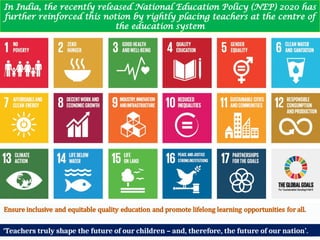
In India, the recently released National Education Policy (NEP) 2020 has
further reinforced this notion by rightly placing teachers at the centre of
the education system
‘Teachers truly shape the future of our children – and, therefore, the future of our nation’.
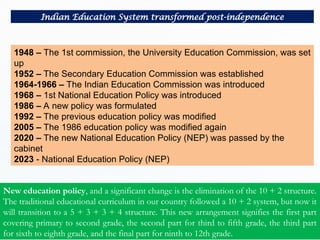
1948 – The 1st commission, the University Education Commission, was set
up
1952 – The Secondary Education Commission was established
1964-1966 – The Indian Education Commission was introduced
1968 – 1st National Education Policy was introduced
1986 – A new policy was formulated
1992 – The previous education policy was modified
2005 – The 1986 education policy was modified again
2020 – The new National Education Policy (NEP) was passed by the
cabinet
2023 - National Education Policy (NEP)
Indian Education System transformed post-independence
New education policy, and a significant change is the elimination of the 10 + 2 structure.
The traditional educational curriculum in our country followed a 10 + 2 system, but now it
will transition to a 5 + 3 + 3 + 4 structure. This new arrangement signifies the first part
covering primary to second grade, the second part for third to fifth grade, the third part
for sixth to eighth grade, and the final part for ninth to 12th grade.
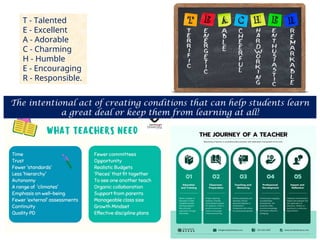
T - Talented
E - Excellent
A - Adorable
C - Charming
H - Humble
E - Encouraging
R - Responsible.
The intentional act of creating conditions that can help students learn
a great deal or keep them from learning at all!
Background
Some teachers taught the curriculum today , Other teachers taught
students today and there’s a big difference
•Teaching is the greatest job on earth. it is a noble profession but
maintaining motivation can be challenging .
•Finding joy in helping students succeed boosts teacher motivation.
•Successful students lead to happier teachers.
•A good teacher must not only be a smart and approachable scholar,
but also a dramatic success. Like actors, teachers can develop specific
skills to enhance their communication of ideas. As a teacher you do
need to perform. which means becoming salesperson, a performance
artist, and an enthusiastic, passionate person in the classroom.
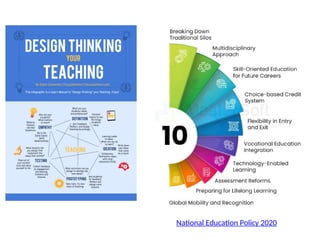
National Education Policy 2020
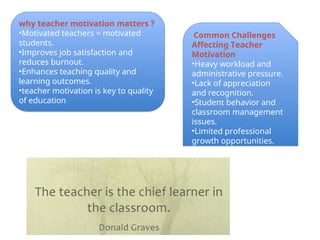
why teacher motivation matters ?
•Motivated teachers = motivated
students.
•Improves job satisfaction and
reduces burnout.
•Enhances teaching quality and
learning outcomes.
•teacher motivation is key to quality
of education
Common Challenges
Affecting Teacher
Motivation
•Heavy workload and
administrative pressure.
•Lack of appreciation
and recognition.
•Student behavior and
classroom management
issues.
•Limited professional
growth opportunities.
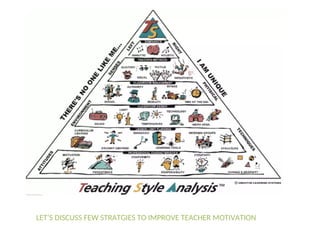
LET’S DISCUSS FEW STRATGIES TO IMPROVE TEACHER MOTIVATION
SUBJECT MATTER MASTERY
Of course you must know the material well before you can deliver your
message effectively. Consider the extent to which your classroom
performance might be enhanced simply by better preparation.
DEVELOP YOUR OWN CURRICULUM,LESSONS
AND TEACHING METHODS
The best parts of any course are the parts you could not possibly
standardize or test. Don't be afraid to be creative.
VOCAL ANIMATION ,ROLE PLAY FOR INTERACTION BASED
TEACHING
Interaction between teacher and students is crucial
Varying the pitch, volume, quality, and rate of your voice
enhances your expressiveness and overall style .
Taking the role of a narrator and tell a story to the class
Physical gestures--such as sweeping the air with hands--help you
clarify, describe, and emphasize points. Gesturing and moving
about the room can help constructively use up some of your
nervous energy .
Respect and mutual understanding foster motivation.
HUMOUR
students want there teachers to be real humans. Try using
constructive (i.e., nonhostile) humor ,Showing funny vidoes related to subject
, real life incidents , being spontaneous and natural , asking students to share
there life stories encourages interaction. Humour also helps in building a
positive classroom environment .
PROPS , SUSPENSE AND SURPRISES
bringing objects or something to use with elctronic media into
the classroom which can be integrated into the lecture and
discussion .
the use of surprise activities and questions which arouse
curiousity in students can make them feel part of the class .
PATIENCE
Best teachers were those who were willing to keep explaining, knowing that
eventually it would make sense. They are willing to wait until a distraction
calmed students down, or abandon a lesson entirely if it was clear material
needed to be revisited.
CONFIDENCE
The best teachers laugh off their mistakes: chalk breaking, books
dropped, Smart TVs not working. a confident teach inspires a
student to be confident
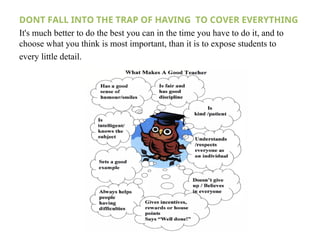
DONT FALL INTO THE TRAP OF HAVING TO COVER EVERYTHING
It's much better to do the best you can in the time you have to do it, and to
choose what you think is most important, than it is to expose students to
every little detail.
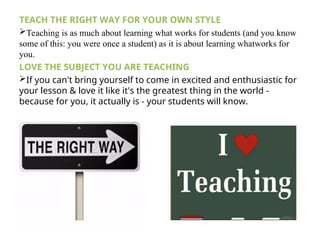
TEACH THE RIGHT WAY FOR YOUR OWN STYLE
Teaching is as much about learning what works for students (and you know
some of this: you were once a student) as it is about learning whatworks for
you.
LOVE THE SUBJECT YOU ARE TEACHING
If you can't bring yourself to come in excited and enthusiastic for
your lesson & love it like it's the greatest thing in the world -
because for you, it actually is - your students will know.
TAKE PRIDE IN BEING AS GOOD A TEACHER AS YOUCAN !
If you can't bring yourself to care enough to really bring an outstanding
effort to your teaching, in terms of planning, preparation and delivery, there is
nothing that will make you a good teacher.
building strong teacher student relationship by understanding student needs
and backgrounds
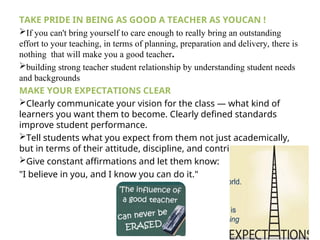
MAKE YOUR EXPECTATIONS CLEAR
Clearly communicate your vision for the class — what kind of
learners you want them to become. Clearly defined standards
improve student performance.
Tell students what you expect from them not just academically,
but in terms of their attitude, discipline, and contributions.
Give constant affirmations and let them know:
"I believe in you, and I know you can do it."
WILLINGNESS TO HELP STUDENTS ACHIEVE
Best teachers are those that don't stop teaching when the bell rings. They
know that some need extra attention or assistance, and they don't act like it's
not their job. They take that job seriously and know they aren't just employed
to get students to be able to do higher math, but do well in life.
PRIDE IN STUDENTS ACHIEVEMENTS
Celebrate small victories and milestones — no achievement is too
small.
Publicly appreciate students' efforts in front of their peers (even if
the result is not perfect).
Connect their achievements to real-world impact — show how
their small actions could make a difference in the future.
Encourage students to celebrate each
other’s success to create a positive
classroom culture.
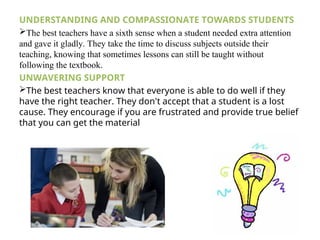
UNDERSTANDING AND COMPASSIONATE TOWARDS STUDENTS
The best teachers have a sixth sense when a student needed extra attention
and gave it gladly. They take the time to discuss subjects outside their
teaching, knowing that sometimes lessons can still be taught without
following the textbook.
UNWAVERING SUPPORT
The best teachers know that everyone is able to do well if they
have the right teacher. They don't accept that a student is a lost
cause. They encourage if you are frustrated and provide true belief
that you can get the material
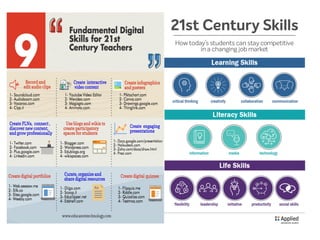
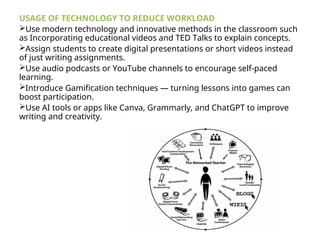
USAGE OF TECHNOLOGY TO REDUCE WORKLOAD
Use modern technology and innovative methods in the classroom such
as Incorporating educational videos and TED Talks to explain concepts.
Assign students to create digital presentations or short videos instead
of just writing assignments.
Use audio podcasts or YouTube channels to encourage self-paced
learning.
Introduce Gamification techniques — turning lessons into games can
boost participation.
Use AI tools or apps like Canva, Grammarly, and ChatGPT to improve
writing and creativity.
THINK OUT OF THE BOX
Encourage students to ask WHY instead of just memorizing facts.
Give creative assignments like role-playing, debates, or
storytelling instead of routine tasks.
Use the "What If?" technique —
Allow brainstorming sessions where every idea is accepted
without judgment.
Assign open-ended projects where students can choose their
own
method of presentation.
Introduce Design Thinking Approach
Problem Ideate Prototype Present.
➡ ➡ ➡
Appreciate effort over perfection
make them understand that thinking
creatively matters more than giving
the "right" answer.
CONCLUSION
 Motivated teachers create motivated students.
 Positive attitude, humor, and high expectations foster better
learning.
 Teachers who keep learning inspire students
 Self motivation translates to student
motivation
 Professional development opportunities
by encouarging further studies and certifications
 Addressing mental health and well being
of teachers
Thank You!
Let's inspire the future together!

Motivation_Among_Teachers_Presentation.ppt

  • 1.
    Dr. K. Sathyamurthi HOD,Madras School of Social Work Egmore, Chennai, Tamil Nadu 5th September
  • 2.
    In India, therecently released National Education Policy (NEP) 2020 has further reinforced this notion by rightly placing teachers at the centre of the education system ‘Teachers truly shape the future of our children – and, therefore, the future of our nation’.
  • 3.
    1948 – The1st commission, the University Education Commission, was set up 1952 – The Secondary Education Commission was established 1964-1966 – The Indian Education Commission was introduced 1968 – 1st National Education Policy was introduced 1986 – A new policy was formulated 1992 – The previous education policy was modified 2005 – The 1986 education policy was modified again 2020 – The new National Education Policy (NEP) was passed by the cabinet 2023 - National Education Policy (NEP) Indian Education System transformed post-independence New education policy, and a significant change is the elimination of the 10 + 2 structure. The traditional educational curriculum in our country followed a 10 + 2 system, but now it will transition to a 5 + 3 + 3 + 4 structure. This new arrangement signifies the first part covering primary to second grade, the second part for third to fifth grade, the third part for sixth to eighth grade, and the final part for ninth to 12th grade.
  • 6.
    T - Talented E- Excellent A - Adorable C - Charming H - Humble E - Encouraging R - Responsible. The intentional act of creating conditions that can help students learn a great deal or keep them from learning at all!
  • 8.
    Background Some teachers taughtthe curriculum today , Other teachers taught students today and there’s a big difference •Teaching is the greatest job on earth. it is a noble profession but maintaining motivation can be challenging . •Finding joy in helping students succeed boosts teacher motivation. •Successful students lead to happier teachers. •A good teacher must not only be a smart and approachable scholar, but also a dramatic success. Like actors, teachers can develop specific skills to enhance their communication of ideas. As a teacher you do need to perform. which means becoming salesperson, a performance artist, and an enthusiastic, passionate person in the classroom.
  • 9.
  • 10.
    why teacher motivationmatters ? •Motivated teachers = motivated students. •Improves job satisfaction and reduces burnout. •Enhances teaching quality and learning outcomes. •teacher motivation is key to quality of education Common Challenges Affecting Teacher Motivation •Heavy workload and administrative pressure. •Lack of appreciation and recognition. •Student behavior and classroom management issues. •Limited professional growth opportunities.
  • 11.
    LET’S DISCUSS FEWSTRATGIES TO IMPROVE TEACHER MOTIVATION
  • 13.
    SUBJECT MATTER MASTERY Ofcourse you must know the material well before you can deliver your message effectively. Consider the extent to which your classroom performance might be enhanced simply by better preparation. DEVELOP YOUR OWN CURRICULUM,LESSONS AND TEACHING METHODS The best parts of any course are the parts you could not possibly standardize or test. Don't be afraid to be creative.
  • 15.
    VOCAL ANIMATION ,ROLEPLAY FOR INTERACTION BASED TEACHING Interaction between teacher and students is crucial Varying the pitch, volume, quality, and rate of your voice enhances your expressiveness and overall style . Taking the role of a narrator and tell a story to the class Physical gestures--such as sweeping the air with hands--help you clarify, describe, and emphasize points. Gesturing and moving about the room can help constructively use up some of your nervous energy . Respect and mutual understanding foster motivation.
  • 16.
    HUMOUR students want thereteachers to be real humans. Try using constructive (i.e., nonhostile) humor ,Showing funny vidoes related to subject , real life incidents , being spontaneous and natural , asking students to share there life stories encourages interaction. Humour also helps in building a positive classroom environment . PROPS , SUSPENSE AND SURPRISES bringing objects or something to use with elctronic media into the classroom which can be integrated into the lecture and discussion . the use of surprise activities and questions which arouse curiousity in students can make them feel part of the class .
  • 18.
    PATIENCE Best teachers werethose who were willing to keep explaining, knowing that eventually it would make sense. They are willing to wait until a distraction calmed students down, or abandon a lesson entirely if it was clear material needed to be revisited. CONFIDENCE The best teachers laugh off their mistakes: chalk breaking, books dropped, Smart TVs not working. a confident teach inspires a student to be confident
  • 19.
    DONT FALL INTOTHE TRAP OF HAVING TO COVER EVERYTHING It's much better to do the best you can in the time you have to do it, and to choose what you think is most important, than it is to expose students to every little detail.
  • 20.
    TEACH THE RIGHTWAY FOR YOUR OWN STYLE Teaching is as much about learning what works for students (and you know some of this: you were once a student) as it is about learning whatworks for you. LOVE THE SUBJECT YOU ARE TEACHING If you can't bring yourself to come in excited and enthusiastic for your lesson & love it like it's the greatest thing in the world - because for you, it actually is - your students will know.
  • 21.
    TAKE PRIDE INBEING AS GOOD A TEACHER AS YOUCAN ! If you can't bring yourself to care enough to really bring an outstanding effort to your teaching, in terms of planning, preparation and delivery, there is nothing that will make you a good teacher. building strong teacher student relationship by understanding student needs and backgrounds MAKE YOUR EXPECTATIONS CLEAR Clearly communicate your vision for the class — what kind of learners you want them to become. Clearly defined standards improve student performance. Tell students what you expect from them not just academically, but in terms of their attitude, discipline, and contributions. Give constant affirmations and let them know: "I believe in you, and I know you can do it."
  • 22.
    WILLINGNESS TO HELPSTUDENTS ACHIEVE Best teachers are those that don't stop teaching when the bell rings. They know that some need extra attention or assistance, and they don't act like it's not their job. They take that job seriously and know they aren't just employed to get students to be able to do higher math, but do well in life. PRIDE IN STUDENTS ACHIEVEMENTS Celebrate small victories and milestones — no achievement is too small. Publicly appreciate students' efforts in front of their peers (even if the result is not perfect). Connect their achievements to real-world impact — show how their small actions could make a difference in the future. Encourage students to celebrate each other’s success to create a positive classroom culture.
  • 23.
    UNDERSTANDING AND COMPASSIONATETOWARDS STUDENTS The best teachers have a sixth sense when a student needed extra attention and gave it gladly. They take the time to discuss subjects outside their teaching, knowing that sometimes lessons can still be taught without following the textbook. UNWAVERING SUPPORT The best teachers know that everyone is able to do well if they have the right teacher. They don't accept that a student is a lost cause. They encourage if you are frustrated and provide true belief that you can get the material
  • 25.
    USAGE OF TECHNOLOGYTO REDUCE WORKLOAD Use modern technology and innovative methods in the classroom such as Incorporating educational videos and TED Talks to explain concepts. Assign students to create digital presentations or short videos instead of just writing assignments. Use audio podcasts or YouTube channels to encourage self-paced learning. Introduce Gamification techniques — turning lessons into games can boost participation. Use AI tools or apps like Canva, Grammarly, and ChatGPT to improve writing and creativity.
  • 26.
    THINK OUT OFTHE BOX Encourage students to ask WHY instead of just memorizing facts. Give creative assignments like role-playing, debates, or storytelling instead of routine tasks. Use the "What If?" technique — Allow brainstorming sessions where every idea is accepted without judgment. Assign open-ended projects where students can choose their own method of presentation. Introduce Design Thinking Approach Problem Ideate Prototype Present. ➡ ➡ ➡ Appreciate effort over perfection make them understand that thinking creatively matters more than giving the "right" answer.
  • 27.
    CONCLUSION  Motivated teacherscreate motivated students.  Positive attitude, humor, and high expectations foster better learning.  Teachers who keep learning inspire students  Self motivation translates to student motivation  Professional development opportunities by encouarging further studies and certifications  Addressing mental health and well being of teachers
  • 28.
    Thank You! Let's inspirethe future together!