Curriculum Development
and
Instruction
(Master of Education)
CONCEPT OF TEACHING
Previously teaching meant nothing more than
“giving information and imparting knowledge”. It was
the time when teaching was regarded as a bio-polar
process: Teacher and the subject being its two poles.
The child way altogether ignored.
Modern concept of the nature of teaching is that,
it is a triangular or tri- polar process. The three focal
points of this process are the teacher, the child and the
subject
Characteristics of Good Teaching
Good Teaching is Stimulating
Simulation and inspiration are of fundamental importance in teaching.
A good teacher will try to stimulate his, pupils for work.
Good Teaching Involves Skill of Guiding, Learning
The pupils need guidance to do the right things, in the right manner
and at the right time. But guidance is not to be imposed on the child.
Good Teaching is well planned
A good teacher organizes and plans the subject matter in advance.
Without proper planning, effective delivery of the lesson is not
possible.
Good Teaching is suggestive and Cooperative
A good teacher will not impose anything on the child. Rather he will
seek his co-operation and suggest activities, ideas, materials, etc.
Characteristics of Good Teaching (Contd)
Good Teaching is Kindly and Sympathetic
A good teacher is always kind and attends to his pupils’ difficulties and doubts sympathetically.
Good Teaching is a Democratic
Good teaching should be based on democratic principles. The teacher should have due regard for
the rights and individuality of the child.
Good Teaching is Both Diagnostic and Remedial
The teacher must study and assess the inborn qualities of the children individually. Their
limitations, handicaps and difficulties are to be discovered and remedial measures suggested.
Good Teaching is Co-relative
A good teacher does not simply narrate various items of knowledge in watertight compartments.
He tries to link the new knowledge and experience of pupils. He also tries to co-relate his subject
with craft, their physical and social environment.
Good Teaching Literates the Learner
Good teaching develops in the child habits of initiative, dependent thinking, self-reliance arid self-
confidence. It enables him to learn for himself and reduces his dependence upon the teacher.
Need of Teaching
Patterns from Teaching Traditions
The teachers teach generally the same way as they were taught by their
teachers and specially by the way of the teacher whom they identify as
their ideals.
. .
Patterns from Social Learning
The teachers work generally as a prisoner of their own background and
develop the same type of behavior among their students as seen by
them.
Patterns from Philosophical Traditions
Each and every teacher, whether he knows or not. teaches according to
one or other philosophy of education.
Need of Teaching (Contd)
Patterns from Conditions of School and Community
The teachers generally work in the school in the way, which the
school administration and the members of community expect
from them.
Patterns from Research
Some teachers conduct research on learning and teach
according to that pattern.
However, it has also been seen that several teachers fail to
work in the way.
Teaching Process
The task of teaching is complex and has cyclical nature.
Complexity of Teaching Process
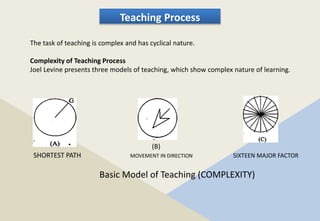
Joel Levine presents three models of teaching, which show complex nature of learning.
(B)
SHORTEST PATH MOVEMENT IN DIRECTION SIXTEEN MAJOR FACTOR
Basic Model of Teaching (COMPLEXITY)
Teaching Process (Contd)
Joel M. Levine points the following about complex nature of
learning in the above shown three circles.
• Point A is beginning of teaching work in all the three circles.
• Circle (A) provides shortest path to the goal, which means in other
words, it is the most successful path of reaching.
• Circle (B) shows that the teacher started into wrong direction from
his starting point ”A”. If he goes either way i.e. AD or AB or ABC or
ADB, he is creating problems for the students. In order to be
successful in achieving his goal the teacher will have to come back to
“A” point to reach “G” point, which is the goal. If he continues to
move in different directions, he cannot reach the goal.
• Circle (C) shows that there are sixteen major factors to bring into line.
Teaching Process (Contd)
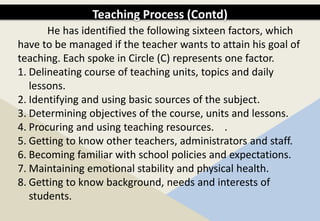
He has identified the following sixteen factors, which
have to be managed if the teacher wants to attain his goal of
teaching. Each spoke in Circle (C) represents one factor.
1. Delineating course of teaching units, topics and daily
lessons.
2. Identifying and using basic sources of the subject.
3. Determining objectives of the course, units and lessons.
4. Procuring and using teaching resources. .
5. Getting to know other teachers, administrators and staff.
6. Becoming familiar with school policies and expectations.
7. Maintaining emotional stability and physical health.
8. Getting to know background, needs and interests of
students.
Teaching Process (Contd)
9. Establishing roles and standards of conduct.
10. Managing routine duties.
11. Motivating students.
12. Determining teaching strategies and pace of
instruction.
13. Utilizing various teaching methods and activities.
14. Assessing readiness of students for learning.
15. Designing and using various assessment techniques.
16. Assessing students ’progress and achievement
regularly!
CONCEPT OF INSTRUCTION
The specific teaching akin to skill training rather than to education in
a broader sense is called “instruction”. May be audio-visual correspondence,
individual, etc. From the observation and analysis of forty-nine tape-
recorded lessons, the following operational definitions of strategy and tactic,
as these terms apply to instruction, were developed:
Strategy
A generalized plan for a lesson (s), which includes structure, desired learner
behavior in terms of the goals of instruction and ah outline of planned
tactics necessary to implement the strategy. The lesson strategy is part of a
larger development scheme.
Tactic
Goal-linked influenced/influencing behavior of the teacher - the way a
teacher behaves in the instructional situation in working towards the
development ' of the strategy; units of teacher behavior through which the
he fulfils his various instructional roles with the students of his class from
moment to moment; the components of teacher behavior through which
the teacher, the students and the subject matter interact.
INSTRUCTION
After an operational definition of tactics and strategies had been
build, attention was turned to searching for the ways in which tactics and
strategies fit into the total picture of instruction; that is, an attempt was
made to seek relationships among tactics, strategies, teacher behavior,
goals of education and the learners.
The Phases of Instruction
The phases of instruction as related to the processes of learning may be
identified as follows:
Motivation Phase
The preparation for learning is accomplished by instruction, which
activates motivation by appealing to student interests. Communications
of the teacher during this phase have the additional purpose of relating
these interests in an expectancy of “what the student will be able to do”
once he has learned.
The Phases of Instruction
Apprehending Phase
During this phase, teaching is concerned with arousing attention in a general
sense and also with providing stimulation (often verbal), which “directs” attention
so that particular features of the stimulus situation are selectively perceived.
Acquisition Phase
This phase of instruction supports the process of entry into long-term store.
Coding processes may be provided or suggested. Alternatively, a set to employ a
strategy of coding may be activated by communications from the teacher.
Retention Phase
This phase pertaining to “storage” is included for the sake of completeness. The
manner in which internal processes of storage (such as interference, simplification
and the like) can be directly influenced by instruction, if indeed they can be, is not
entirely clear.
Recall Phase
External instructional events dining this phase may take the form of providing cues
to retrieval or of monitoring the process of retrieval to insure that suitable
strategies of search are employed. Teachings also include the conduct of “spaced
reviews”, providing opportunities for retrieval or occur.
The Phases of Instruction
Generalization Phase
During the Generalization phase, the teacher provides situations calling for
the transfer of learned knowledge and skills in novel ways, and providing
cues for application to previously un-encountered situations.
Performing Phase
. Instruction oriented to this phase of learning is largely a matter of setting
occasions for the student to “show” that he has learned. Obviously, these
occasions set the stage for the feedback that comes next.
Feedback Phase
The feedback phase is one in which information is supplied to the student
concerning the extent to which his performance has reached or
approached a criterion standard reflected in his expectancy
INDIVIDUALIZED INSTRUCTION
Almighty Lord created a universe. To beautify Lord made
a lot of different things. If we look around it is crystal clear that
everything is graced with the opposite. In teaching world even
when we take a small group of pupils, we do not find two
children alike. So individuality exists all around us. We can’t deny
this fact and to make teaching more effective we should accept
this reality.
Education and growth, both are two individual affairs, and can
be well shaped only in healthy and free atmosphere. Any form
of pressure or stress stops a child’s natural growth and learning.
So we recognize the child, and child- centered education is
responsible to give rise to the thinking of individual freedom.
Principles
If we follow these principles as guidelines this method would be
more fruitful and effective.
Individual Capability.
Individualized instruction should be in accordance with child’s aptitude,
interest, demand and learning rate.
Integration
Educational purposes must be integrated with ethics and morals to make
this method meaningful and helpful for building stronger foundations of
one’s own standards.
Instructional Method
It must be adopted as a stimulant or motive so that educational motivation
can be propagated into our learners.
Liberty
A learner should get opportunities to flourish in stress-free environment.
Freedom helps to mold a child’s capabilities in the framework of nature.
Principles (Contd)
Fundamental Skills
It is crucial to teach fundamental skills to our learners like
reading, writing, and speaking. Once he has learnt, it would
facilitate him towards study, exercise, assignments, etc.
Practice
A child should be provided with opportunities to experiment
with what he learns. It would inculcate the habit of self-study
along with developing a sense of responsibility.
Supervision
Teachers should guide and assist only when needed. They
should eliminate the obstacles and let learner work
independently so that they may grow and shape their natural
abilities.
6503 unit 2 a.pptx
6503 unit 2 a.pptx

6503 unit 2 a.pptx

  • 1.
  • 3.
    CONCEPT OF TEACHING Previouslyteaching meant nothing more than “giving information and imparting knowledge”. It was the time when teaching was regarded as a bio-polar process: Teacher and the subject being its two poles. The child way altogether ignored. Modern concept of the nature of teaching is that, it is a triangular or tri- polar process. The three focal points of this process are the teacher, the child and the subject
  • 4.
    Characteristics of GoodTeaching Good Teaching is Stimulating Simulation and inspiration are of fundamental importance in teaching. A good teacher will try to stimulate his, pupils for work. Good Teaching Involves Skill of Guiding, Learning The pupils need guidance to do the right things, in the right manner and at the right time. But guidance is not to be imposed on the child. Good Teaching is well planned A good teacher organizes and plans the subject matter in advance. Without proper planning, effective delivery of the lesson is not possible. Good Teaching is suggestive and Cooperative A good teacher will not impose anything on the child. Rather he will seek his co-operation and suggest activities, ideas, materials, etc.
  • 5.
    Characteristics of GoodTeaching (Contd) Good Teaching is Kindly and Sympathetic A good teacher is always kind and attends to his pupils’ difficulties and doubts sympathetically. Good Teaching is a Democratic Good teaching should be based on democratic principles. The teacher should have due regard for the rights and individuality of the child. Good Teaching is Both Diagnostic and Remedial The teacher must study and assess the inborn qualities of the children individually. Their limitations, handicaps and difficulties are to be discovered and remedial measures suggested. Good Teaching is Co-relative A good teacher does not simply narrate various items of knowledge in watertight compartments. He tries to link the new knowledge and experience of pupils. He also tries to co-relate his subject with craft, their physical and social environment. Good Teaching Literates the Learner Good teaching develops in the child habits of initiative, dependent thinking, self-reliance arid self- confidence. It enables him to learn for himself and reduces his dependence upon the teacher.
  • 6.
    Need of Teaching Patternsfrom Teaching Traditions The teachers teach generally the same way as they were taught by their teachers and specially by the way of the teacher whom they identify as their ideals. . . Patterns from Social Learning The teachers work generally as a prisoner of their own background and develop the same type of behavior among their students as seen by them. Patterns from Philosophical Traditions Each and every teacher, whether he knows or not. teaches according to one or other philosophy of education.
  • 7.
    Need of Teaching(Contd) Patterns from Conditions of School and Community The teachers generally work in the school in the way, which the school administration and the members of community expect from them. Patterns from Research Some teachers conduct research on learning and teach according to that pattern. However, it has also been seen that several teachers fail to work in the way.
  • 8.
    Teaching Process The taskof teaching is complex and has cyclical nature. Complexity of Teaching Process Joel Levine presents three models of teaching, which show complex nature of learning. (B) SHORTEST PATH MOVEMENT IN DIRECTION SIXTEEN MAJOR FACTOR Basic Model of Teaching (COMPLEXITY)
  • 9.
    Teaching Process (Contd) JoelM. Levine points the following about complex nature of learning in the above shown three circles. • Point A is beginning of teaching work in all the three circles. • Circle (A) provides shortest path to the goal, which means in other words, it is the most successful path of reaching. • Circle (B) shows that the teacher started into wrong direction from his starting point ”A”. If he goes either way i.e. AD or AB or ABC or ADB, he is creating problems for the students. In order to be successful in achieving his goal the teacher will have to come back to “A” point to reach “G” point, which is the goal. If he continues to move in different directions, he cannot reach the goal. • Circle (C) shows that there are sixteen major factors to bring into line.
  • 10.
    Teaching Process (Contd) Hehas identified the following sixteen factors, which have to be managed if the teacher wants to attain his goal of teaching. Each spoke in Circle (C) represents one factor. 1. Delineating course of teaching units, topics and daily lessons. 2. Identifying and using basic sources of the subject. 3. Determining objectives of the course, units and lessons. 4. Procuring and using teaching resources. . 5. Getting to know other teachers, administrators and staff. 6. Becoming familiar with school policies and expectations. 7. Maintaining emotional stability and physical health. 8. Getting to know background, needs and interests of students.
  • 11.
    Teaching Process (Contd) 9.Establishing roles and standards of conduct. 10. Managing routine duties. 11. Motivating students. 12. Determining teaching strategies and pace of instruction. 13. Utilizing various teaching methods and activities. 14. Assessing readiness of students for learning. 15. Designing and using various assessment techniques. 16. Assessing students ’progress and achievement regularly!
  • 12.
    CONCEPT OF INSTRUCTION Thespecific teaching akin to skill training rather than to education in a broader sense is called “instruction”. May be audio-visual correspondence, individual, etc. From the observation and analysis of forty-nine tape- recorded lessons, the following operational definitions of strategy and tactic, as these terms apply to instruction, were developed: Strategy A generalized plan for a lesson (s), which includes structure, desired learner behavior in terms of the goals of instruction and ah outline of planned tactics necessary to implement the strategy. The lesson strategy is part of a larger development scheme. Tactic Goal-linked influenced/influencing behavior of the teacher - the way a teacher behaves in the instructional situation in working towards the development ' of the strategy; units of teacher behavior through which the he fulfils his various instructional roles with the students of his class from moment to moment; the components of teacher behavior through which the teacher, the students and the subject matter interact.
  • 13.
    INSTRUCTION After an operationaldefinition of tactics and strategies had been build, attention was turned to searching for the ways in which tactics and strategies fit into the total picture of instruction; that is, an attempt was made to seek relationships among tactics, strategies, teacher behavior, goals of education and the learners. The Phases of Instruction The phases of instruction as related to the processes of learning may be identified as follows: Motivation Phase The preparation for learning is accomplished by instruction, which activates motivation by appealing to student interests. Communications of the teacher during this phase have the additional purpose of relating these interests in an expectancy of “what the student will be able to do” once he has learned.
  • 14.
    The Phases ofInstruction Apprehending Phase During this phase, teaching is concerned with arousing attention in a general sense and also with providing stimulation (often verbal), which “directs” attention so that particular features of the stimulus situation are selectively perceived. Acquisition Phase This phase of instruction supports the process of entry into long-term store. Coding processes may be provided or suggested. Alternatively, a set to employ a strategy of coding may be activated by communications from the teacher. Retention Phase This phase pertaining to “storage” is included for the sake of completeness. The manner in which internal processes of storage (such as interference, simplification and the like) can be directly influenced by instruction, if indeed they can be, is not entirely clear. Recall Phase External instructional events dining this phase may take the form of providing cues to retrieval or of monitoring the process of retrieval to insure that suitable strategies of search are employed. Teachings also include the conduct of “spaced reviews”, providing opportunities for retrieval or occur.
  • 15.
    The Phases ofInstruction Generalization Phase During the Generalization phase, the teacher provides situations calling for the transfer of learned knowledge and skills in novel ways, and providing cues for application to previously un-encountered situations. Performing Phase . Instruction oriented to this phase of learning is largely a matter of setting occasions for the student to “show” that he has learned. Obviously, these occasions set the stage for the feedback that comes next. Feedback Phase The feedback phase is one in which information is supplied to the student concerning the extent to which his performance has reached or approached a criterion standard reflected in his expectancy
  • 16.
    INDIVIDUALIZED INSTRUCTION Almighty Lordcreated a universe. To beautify Lord made a lot of different things. If we look around it is crystal clear that everything is graced with the opposite. In teaching world even when we take a small group of pupils, we do not find two children alike. So individuality exists all around us. We can’t deny this fact and to make teaching more effective we should accept this reality. Education and growth, both are two individual affairs, and can be well shaped only in healthy and free atmosphere. Any form of pressure or stress stops a child’s natural growth and learning. So we recognize the child, and child- centered education is responsible to give rise to the thinking of individual freedom.
  • 17.
    Principles If we followthese principles as guidelines this method would be more fruitful and effective. Individual Capability. Individualized instruction should be in accordance with child’s aptitude, interest, demand and learning rate. Integration Educational purposes must be integrated with ethics and morals to make this method meaningful and helpful for building stronger foundations of one’s own standards. Instructional Method It must be adopted as a stimulant or motive so that educational motivation can be propagated into our learners. Liberty A learner should get opportunities to flourish in stress-free environment. Freedom helps to mold a child’s capabilities in the framework of nature.
  • 18.
    Principles (Contd) Fundamental Skills Itis crucial to teach fundamental skills to our learners like reading, writing, and speaking. Once he has learnt, it would facilitate him towards study, exercise, assignments, etc. Practice A child should be provided with opportunities to experiment with what he learns. It would inculcate the habit of self-study along with developing a sense of responsibility. Supervision Teachers should guide and assist only when needed. They should eliminate the obstacles and let learner work independently so that they may grow and shape their natural abilities.