EFFECTIVE TEACHING
Foundations of Education: Group 3
1. Soraya Agustina S. (0203519031)
2. Diyana Sulistyani (0203519032)
3. Nur Rohman (0203519033)
4. Wening Nur Habibah (0203519086)
SUB TOPICS
1. Introduction to Effective Teaching
2. Researches on Effective Teaching
3. Key Elements in Effective Teaching
4. Effective Classroom Management
5. Technology and Innovation
INTRODUCTION
TO
EFFECTIVE TEACHING
What is Effective Teaching?
• Effective teaching is a behaviorist position, -the teacher does
something, the student responds, is in some way rewarded or
reinforced, and learning takes place. (James K, and Pamela & Linda, 2014)
• Focuses on how the teaching competencies and skills of the teacher
facilitate the students’ intellectual growth. (James K, and Pamela & Linda, 2014)
• Effective teaching is one of the key propellers for school
improvement. (James K, and Pamela & Linda, 2013)
Some Selected Features Of Effective Teaching:
(Peter Westwood, Flinders University)
• Presentations and explanations
• Questioning
• Teaching Task-Approach Strategies
• Adapting instruction
How teaching is called effective?
Teaching is effective when it influences the knowledge, skills,
and dispositions that students need to become responsible
citizens who think critically and participate actively in
constructing a just and equitable society (Burbules & Torres
2000, McLaren & Farahmandpur, 2001)
Effective Teaching is affected by Effective Teacher
Teacher effectiveness is generally referred to in terms of a
focus on student outcomes and the teacher behaviors and
classroom processes that promote better student outcomes.
Effective teachers:
• Clear about instructional goals
• Knowledgeable about curriculum content and the strategies
for teaching
• Communicate to the students what is expected to them
• Make expert use of existing instructional materials in order
to devote more time to practices that enrich and clarify the
content
Effective teaching is carried out in an environment of
cooperation and trust, then effective teachers are actually
warm, concerned and flexible in their general approach to
students (Kindsvatter, Wilen and Ishler: 1992).
Effective Teaching
1. Teaching
According to Smith (2004) teaching is the process of carrying out activities that experience has shown
to be effective in getting students to learn.
The process whereby a teacher imparts knowledge, skills, attitudes, and value to a learner or group
learners (Frimpong, 1990).
2. Effective effectiveness
A contested term that can evoke strong emotions because of its perceived links with notion of
professional competency and high stakes accountability in some systems.
(James K, Pamela S, Linda, 2014)
RESEARCHES ON EFFECTIVE TEACHING
AND
KEY ELEMENTS IN EFFECTIVE TEACHING PRACTICE
Early Researches on Effective Teaching
Over the years, thinking about effective teaching has been approached in a number of different ways.
• In the past times, research on effective teaching was largely dominated by attempts to identify
attributes of teachers, such as personality traits, sex, age, knowledge and training, which might have
a bearing on their effectiveness.
• As long ago as 1931, for example, Cattell asked 254 people, including directors of education, teacher
trainers, schoolteachers and pupils, to write down the most important qualities of the good teacher.
Overall, the five most frequently reported were (in order of frequency): Personality and will,
intelligence, sympathy and tact, open-mindedness, a sense of humour.
Studies that attempted to relate such teacher attributes to educational outcomes have sometimes been
referred to as ‘black-box’ research.
Researches Development on Effective Teaching
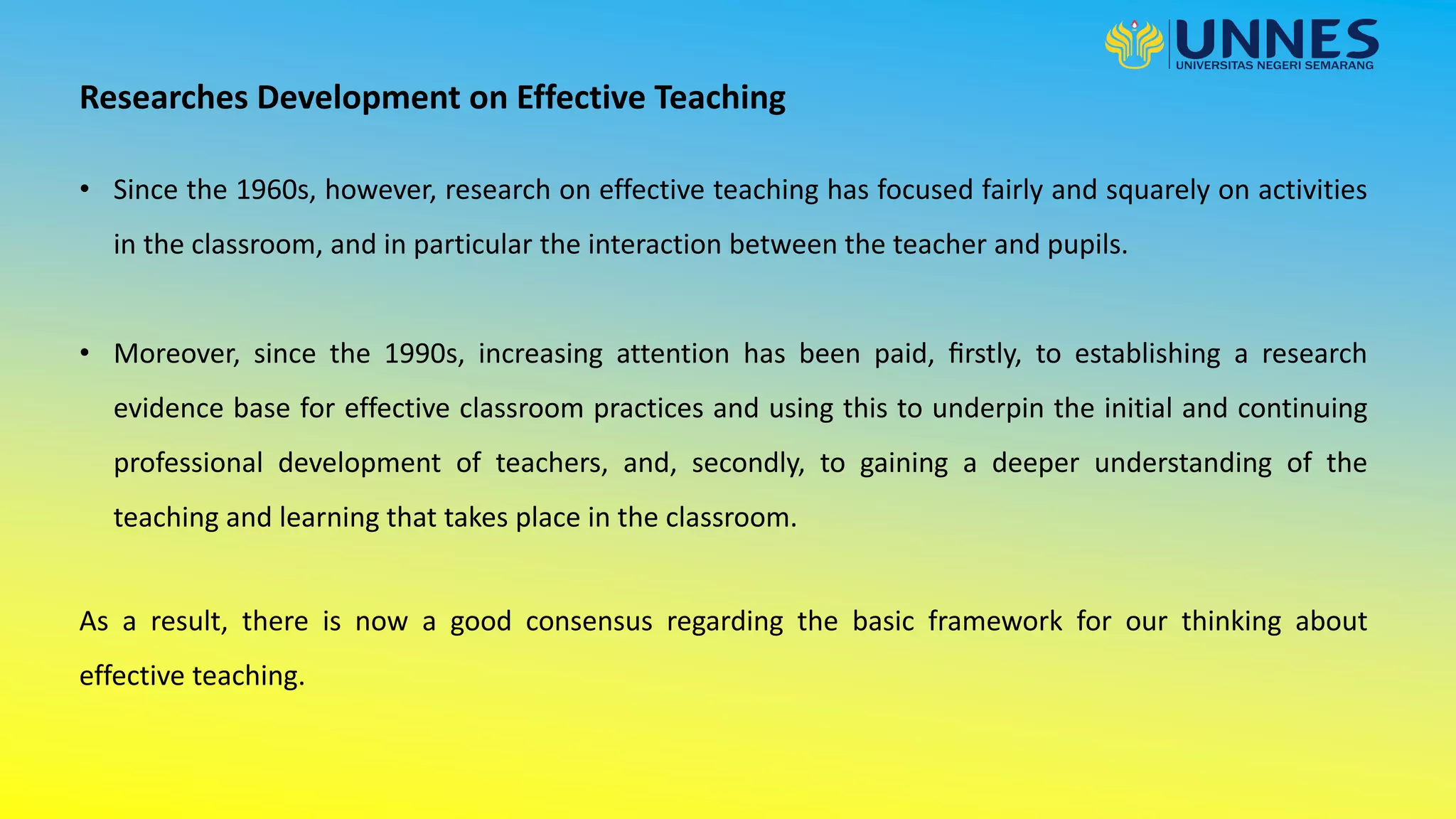
• Since the 1960s, however, research on effective teaching has focused fairly and squarely on activities
in the classroom, and in particular the interaction between the teacher and pupils.
• Moreover, since the 1990s, increasing attention has been paid, firstly, to establishing a research
evidence base for effective classroom practices and using this to underpin the initial and continuing
professional development of teachers, and, secondly, to gaining a deeper understanding of the
teaching and learning that takes place in the classroom.
As a result, there is now a good consensus regarding the basic framework for our thinking about
effective teaching.
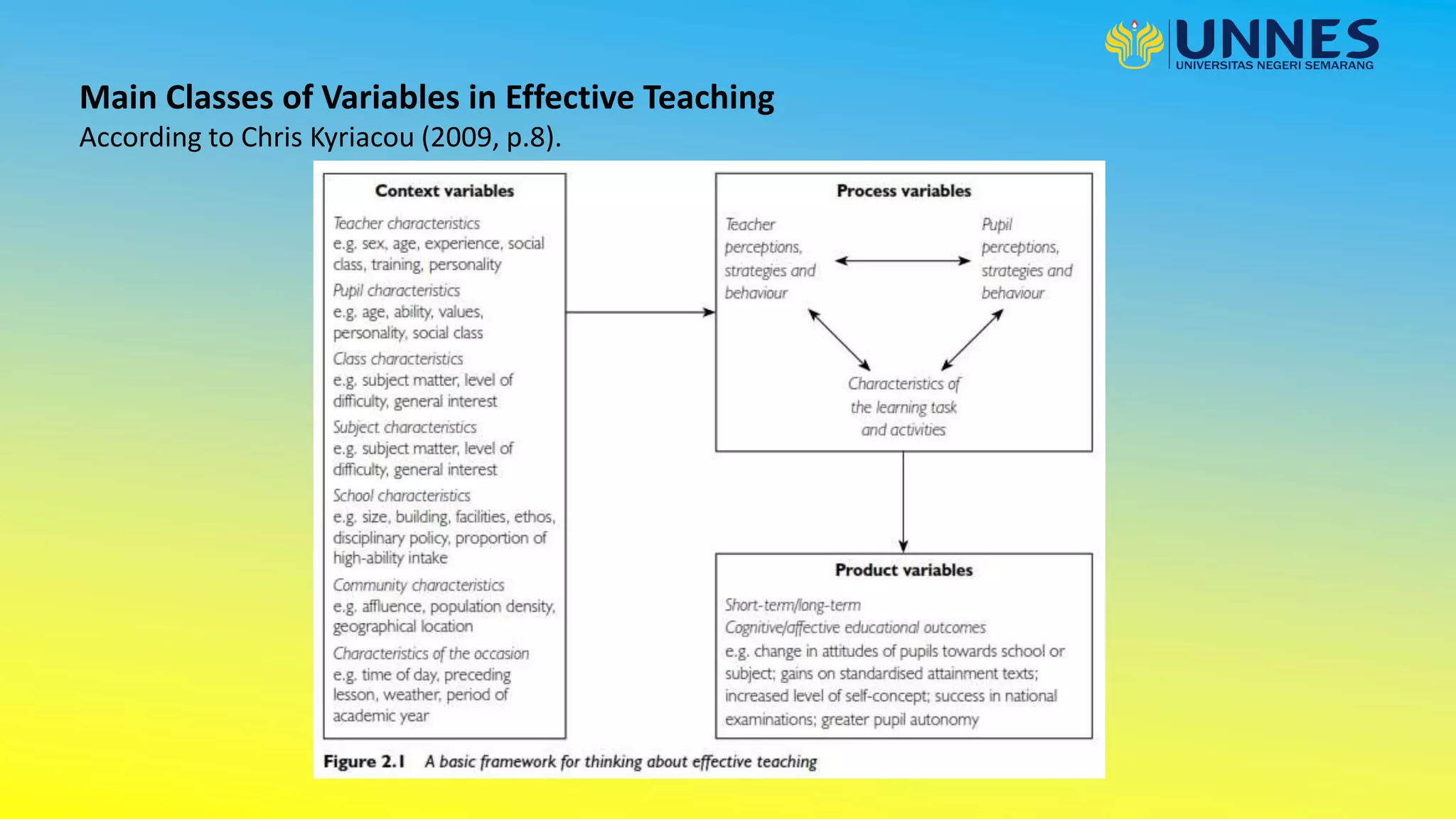
Main Classes of Variables in Effective Teaching
According to Chris Kyriacou (2009, p.8).
• Context variables refer to all those characteristics of the context of the learning activity, usually a
classroom-based lesson, which may have some bearing on the success of the learning activity.
• Process variables refer to what actually goes on in the classroom, and deals with the perceptions,
strategies and behavior of the teacher and pupils, and characteristics of the learning tasks and
activities themselves, and how these interact with each other.
• Product variables refer to all those educational outcomes that are desired by teachers and that have
formed a basis of teachers’ planning of lessons and the criteria they use or others use to judge
effectiveness.
Main Classes of Variables in Effective Teaching
According to Chris Kyriacou (2009).
This overall framework of Context–Process –Product has provided the basis for almost all research on
effective teaching reported over the last few decades (Borich, 2007; Muijs and Reynolds, 2005; Ornstein
and Lasley, 2004).
Impacts of Basic Framework in Effective Teaching
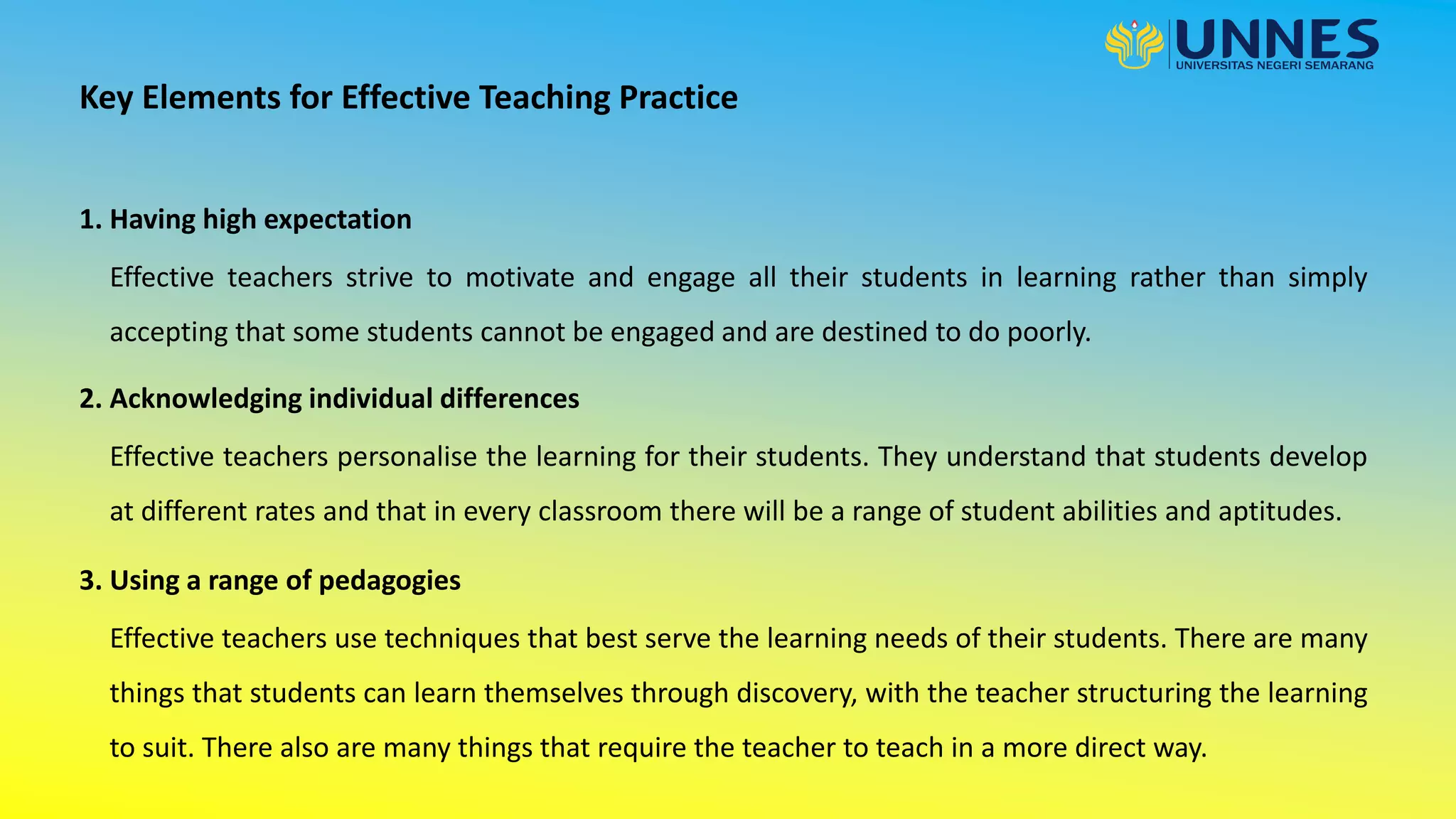
1. Having high expectation
Key Elements for Effective Teaching Practice
Effective teachers strive to motivate and engage all their students in learning rather than simply
accepting that some students cannot be engaged and are destined to do poorly.
2. Acknowledging individual differences
Effective teachers personalise the learning for their students. They understand that students develop
at different rates and that in every classroom there will be a range of student abilities and aptitudes.
3. Using a range of pedagogies
Effective teachers use techniques that best serve the learning needs of their students. There are many
things that students can learn themselves through discovery, with the teacher structuring the learning
to suit. There also are many things that require the teacher to teach in a more direct way.
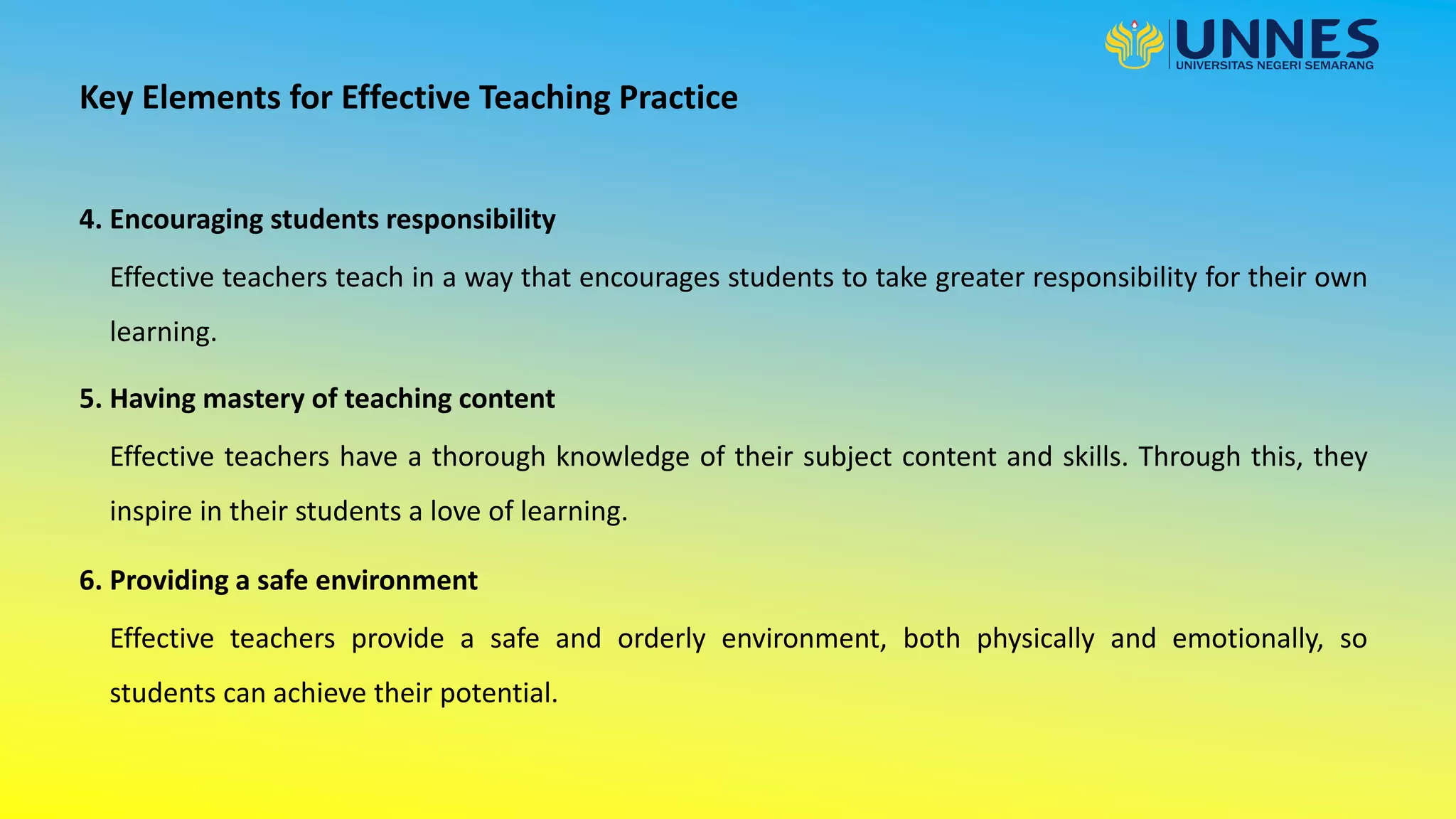
4. Encouraging students responsibility
Key Elements for Effective Teaching Practice
Effective teachers teach in a way that encourages students to take greater responsibility for their own
learning.
5. Having mastery of teaching content
Effective teachers have a thorough knowledge of their subject content and skills. Through this, they
inspire in their students a love of learning.
6. Providing a safe environment
Effective teachers provide a safe and orderly environment, both physically and emotionally, so
students can achieve their potential.
7. Monitoring progress and providing feedbacks
Key Elements for Effective Teaching Practice
Effective teachers closely monitor each student’s achievements. This enables them to provide every
one of their students with regular feedback on their performance, and gives them valuable
information to assess the impact of their teaching.
8. Building positive relationship
Effective teachers develop productive relationships with their students – they get to know them and
take a particular interest in their overall development and progress.
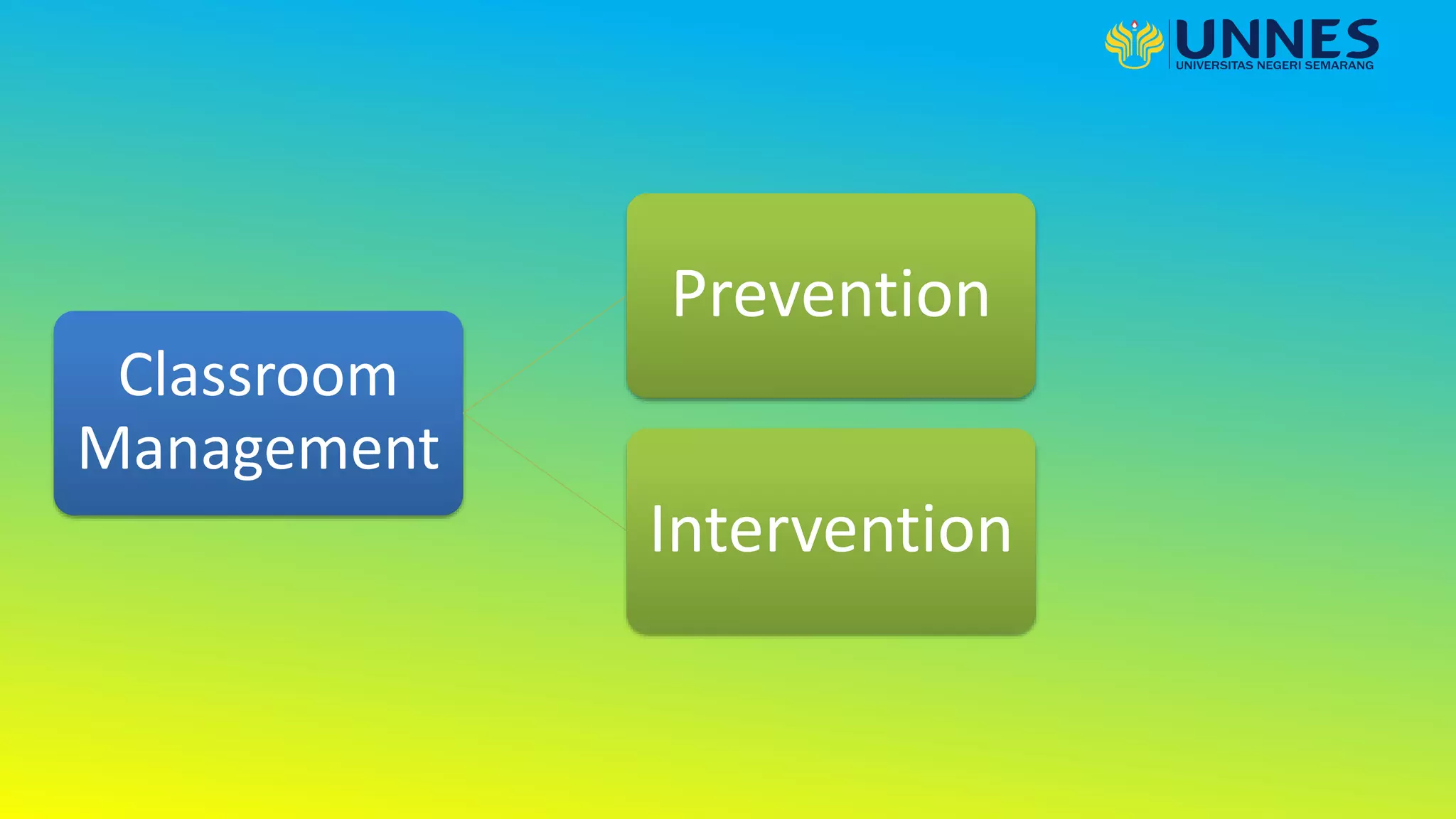
CLASSROOM MANAGEMENT
Classroom
Management
Prevention
Intervention
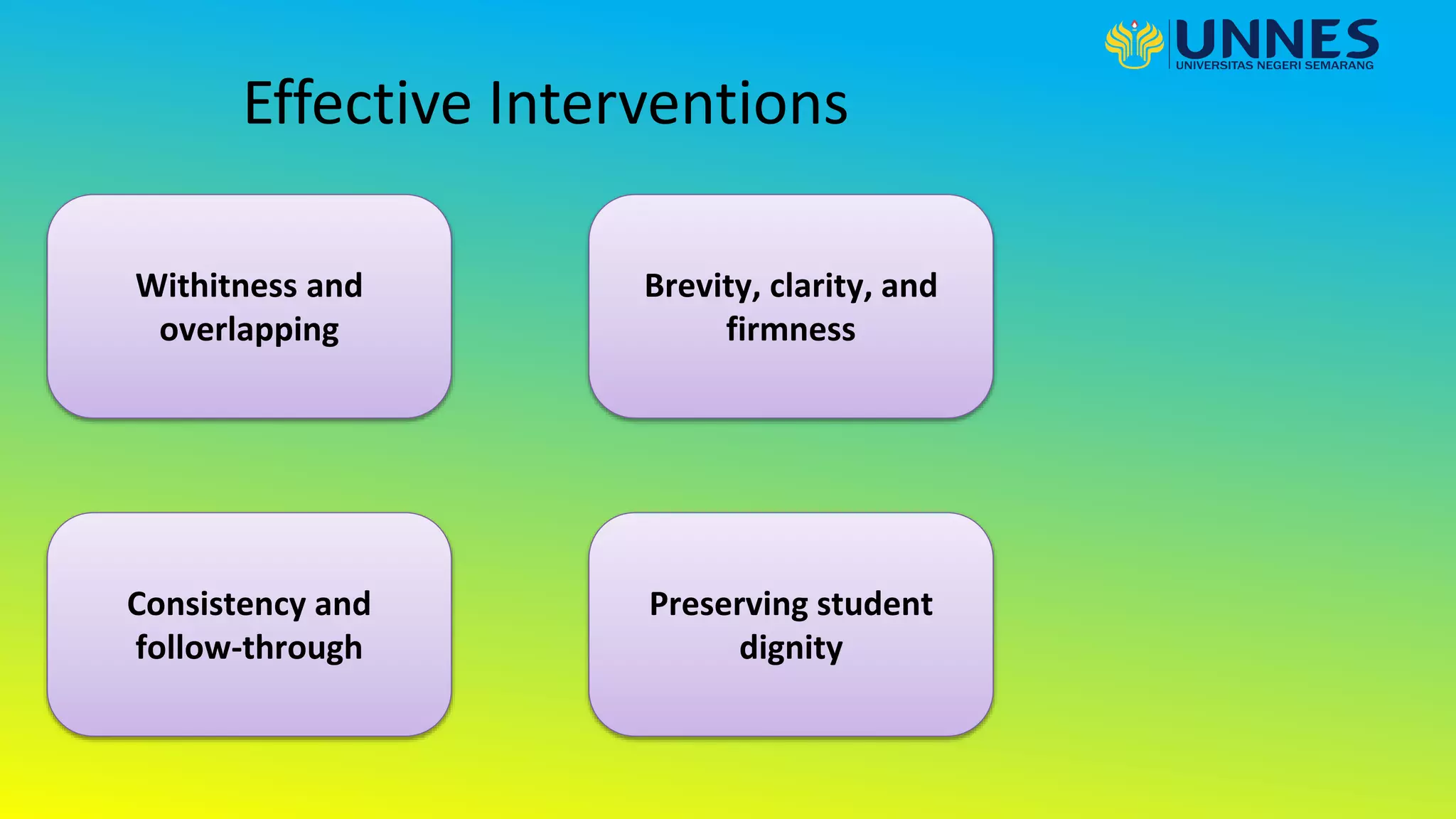
Effective Interventions
Withitness and
overlapping
Brevity, clarity, and
firmness
Consistency and
follow-through
Preserving student
dignity
Withitness and Overlapping
• Withitness means that the teacher knowing
what is going on in all parts of the classroom
all the time.
• Overlapping refers to the teacher’s ability to
do more than one thing at a time.
Consistency and Follow-Through
• The teacher should be consistent to the
classroom rules.
• The teacher knows when to intervene.
• The teacher finishes all interventions to make
sure the undesirable behavior has completely
stopped (Good & Brophy, 2008 in Jacobsen,
Eggen, & Kauchak, 2009, p. 72).
Brevity, Clarity, and Firmness
• Intervention should be brief, firm, and clear.
• Clarity refers to the precision of the teacher’s
communication with respect to the desired
behavior.
• Firmness means the ability to communicate
that the teacher means it and intends to
follow through to make sure the behavior
stops.
Preserving Student Dignity
• The teacher’s tone when interacting with the
students affects both their compliance and
attitudes toward the teacher and the class.
• Loud public reprimands, public criticism, and
sarcasm reduce the students’ sense of safety,
create resentment, and detract from a
productive learning environment.
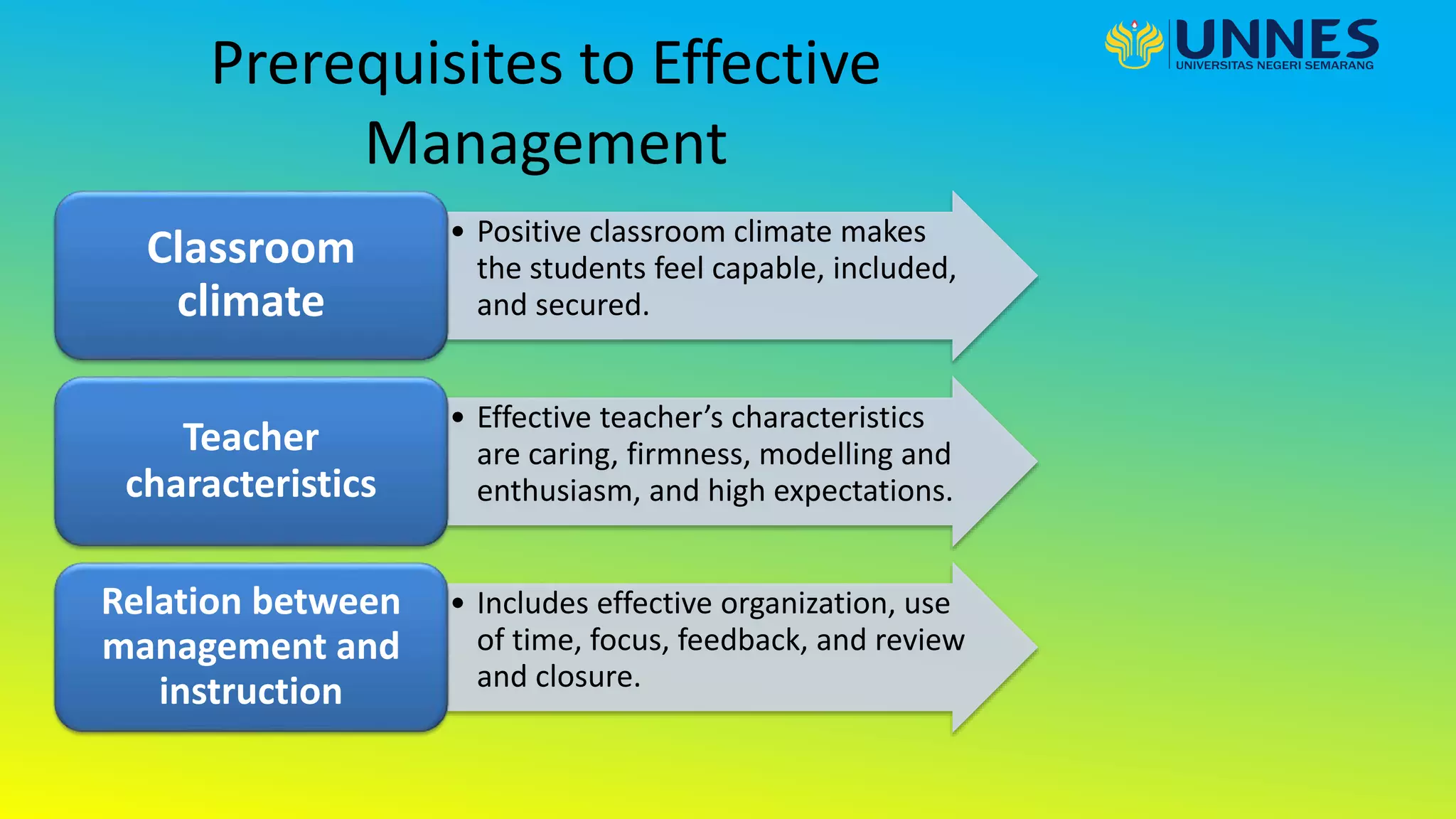
Prerequisites to Effective
Management
• Positive classroom climate makes
the students feel capable, included,
and secured.
Classroom
climate
• Effective teacher’s characteristics
are caring, firmness, modelling and
enthusiasm, and high expectations.
Teacher
characteristics
• Includes effective organization, use
of time, focus, feedback, and review
and closure.
Relation between
management and
instruction
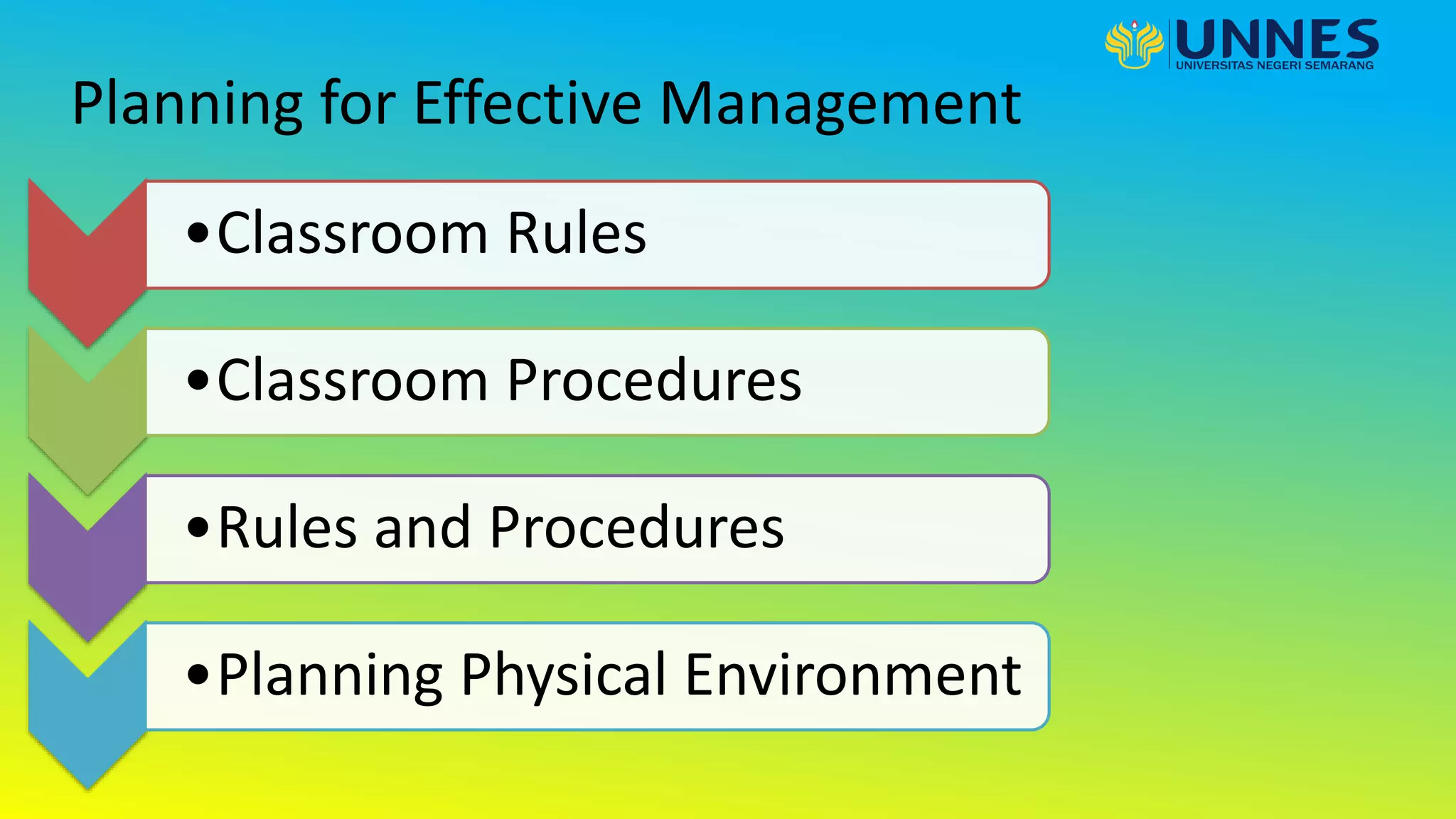
Planning for Effective Management
•Classroom Rules
•Classroom Procedures
•Rules and Procedures
•Planning Physical Environment
TECHNOLOGY AND INNOVATION
Technology
Technology derived from the word ‘techno’
which means technique, act or skill, and ‘logos’
which means science.
Technology especially in education is well known as ICT or
Information and Communication Technology.
Technology or ICT in education point of view refers to
Information and Communication Technology (ICT) such as
computers, communications facilities and features that
variously support teaching, learning and a range of activities
in education. (QCA Schemes of Work of ICT in Kent County
Council. 2004).
Technology facilities
• Exposure to ‘authentic’ language
• Access to wider sources of information and varieties of
language
• Opportunities to communicate with the outside world
• A learner-centered approach
• Development of learner autonomy
Technology that used in learning
• CALL (Computer-Assisted Language Learning)
• Internet
• Computer Applications
(Fitzpatrick and Davies, 2002)
Technology used in learning
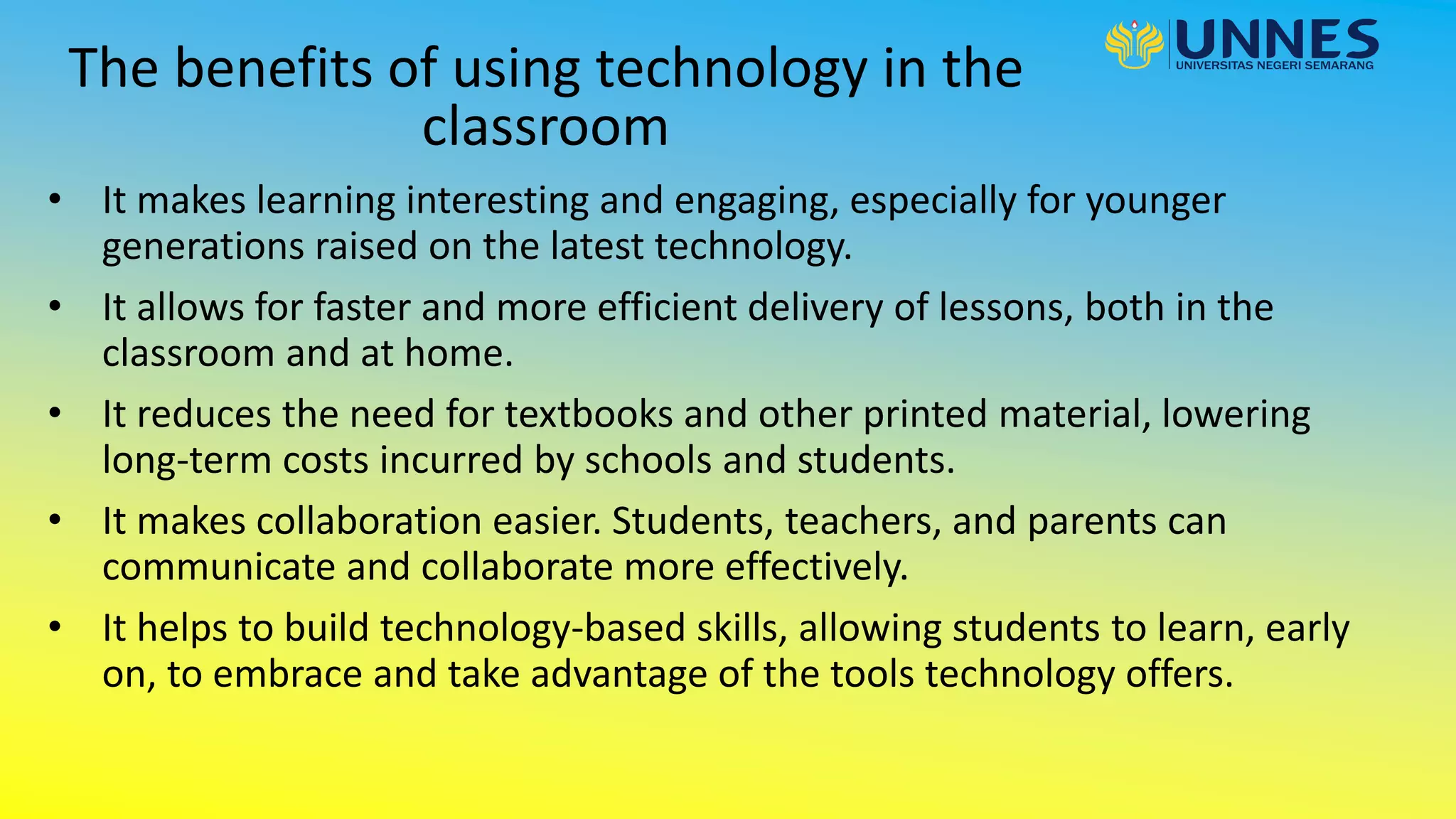
The benefits of using technology in the
classroom
• It makes learning interesting and engaging, especially for younger
generations raised on the latest technology.
• It allows for faster and more efficient delivery of lessons, both in the
classroom and at home.
• It reduces the need for textbooks and other printed material, lowering
long-term costs incurred by schools and students.
• It makes collaboration easier. Students, teachers, and parents can
communicate and collaborate more effectively.
• It helps to build technology-based skills, allowing students to learn, early
on, to embrace and take advantage of the tools technology offers.
Innovations in Teaching Methods
• Focus on STEM (science, technology, engineering, and math)
• Addressing the Needs of Individual Students
• Practical Education and Soft Skills

Group 3 presentation on Effective Teaching

  • 1.
    EFFECTIVE TEACHING Foundations ofEducation: Group 3 1. Soraya Agustina S. (0203519031) 2. Diyana Sulistyani (0203519032) 3. Nur Rohman (0203519033) 4. Wening Nur Habibah (0203519086)
  • 2.
    SUB TOPICS 1. Introductionto Effective Teaching 2. Researches on Effective Teaching 3. Key Elements in Effective Teaching 4. Effective Classroom Management 5. Technology and Innovation
  • 3.
  • 4.
    What is EffectiveTeaching? • Effective teaching is a behaviorist position, -the teacher does something, the student responds, is in some way rewarded or reinforced, and learning takes place. (James K, and Pamela & Linda, 2014) • Focuses on how the teaching competencies and skills of the teacher facilitate the students’ intellectual growth. (James K, and Pamela & Linda, 2014) • Effective teaching is one of the key propellers for school improvement. (James K, and Pamela & Linda, 2013)
  • 5.
    Some Selected FeaturesOf Effective Teaching: (Peter Westwood, Flinders University) • Presentations and explanations • Questioning • Teaching Task-Approach Strategies • Adapting instruction
  • 6.
    How teaching iscalled effective? Teaching is effective when it influences the knowledge, skills, and dispositions that students need to become responsible citizens who think critically and participate actively in constructing a just and equitable society (Burbules & Torres 2000, McLaren & Farahmandpur, 2001)
  • 7.
    Effective Teaching isaffected by Effective Teacher Teacher effectiveness is generally referred to in terms of a focus on student outcomes and the teacher behaviors and classroom processes that promote better student outcomes.
  • 8.
    Effective teachers: • Clearabout instructional goals • Knowledgeable about curriculum content and the strategies for teaching • Communicate to the students what is expected to them • Make expert use of existing instructional materials in order to devote more time to practices that enrich and clarify the content
  • 9.
    Effective teaching iscarried out in an environment of cooperation and trust, then effective teachers are actually warm, concerned and flexible in their general approach to students (Kindsvatter, Wilen and Ishler: 1992).
  • 10.
    Effective Teaching 1. Teaching Accordingto Smith (2004) teaching is the process of carrying out activities that experience has shown to be effective in getting students to learn. The process whereby a teacher imparts knowledge, skills, attitudes, and value to a learner or group learners (Frimpong, 1990). 2. Effective effectiveness A contested term that can evoke strong emotions because of its perceived links with notion of professional competency and high stakes accountability in some systems. (James K, Pamela S, Linda, 2014)
  • 11.
    RESEARCHES ON EFFECTIVETEACHING AND KEY ELEMENTS IN EFFECTIVE TEACHING PRACTICE
  • 12.
    Early Researches onEffective Teaching Over the years, thinking about effective teaching has been approached in a number of different ways. • In the past times, research on effective teaching was largely dominated by attempts to identify attributes of teachers, such as personality traits, sex, age, knowledge and training, which might have a bearing on their effectiveness. • As long ago as 1931, for example, Cattell asked 254 people, including directors of education, teacher trainers, schoolteachers and pupils, to write down the most important qualities of the good teacher. Overall, the five most frequently reported were (in order of frequency): Personality and will, intelligence, sympathy and tact, open-mindedness, a sense of humour. Studies that attempted to relate such teacher attributes to educational outcomes have sometimes been referred to as ‘black-box’ research.
  • 13.
    Researches Development onEffective Teaching • Since the 1960s, however, research on effective teaching has focused fairly and squarely on activities in the classroom, and in particular the interaction between the teacher and pupils. • Moreover, since the 1990s, increasing attention has been paid, firstly, to establishing a research evidence base for effective classroom practices and using this to underpin the initial and continuing professional development of teachers, and, secondly, to gaining a deeper understanding of the teaching and learning that takes place in the classroom. As a result, there is now a good consensus regarding the basic framework for our thinking about effective teaching.
  • 14.
    Main Classes ofVariables in Effective Teaching According to Chris Kyriacou (2009, p.8).
  • 15.
    • Context variablesrefer to all those characteristics of the context of the learning activity, usually a classroom-based lesson, which may have some bearing on the success of the learning activity. • Process variables refer to what actually goes on in the classroom, and deals with the perceptions, strategies and behavior of the teacher and pupils, and characteristics of the learning tasks and activities themselves, and how these interact with each other. • Product variables refer to all those educational outcomes that are desired by teachers and that have formed a basis of teachers’ planning of lessons and the criteria they use or others use to judge effectiveness. Main Classes of Variables in Effective Teaching According to Chris Kyriacou (2009).
  • 16.
    This overall frameworkof Context–Process –Product has provided the basis for almost all research on effective teaching reported over the last few decades (Borich, 2007; Muijs and Reynolds, 2005; Ornstein and Lasley, 2004). Impacts of Basic Framework in Effective Teaching
  • 17.
    1. Having highexpectation Key Elements for Effective Teaching Practice Effective teachers strive to motivate and engage all their students in learning rather than simply accepting that some students cannot be engaged and are destined to do poorly. 2. Acknowledging individual differences Effective teachers personalise the learning for their students. They understand that students develop at different rates and that in every classroom there will be a range of student abilities and aptitudes. 3. Using a range of pedagogies Effective teachers use techniques that best serve the learning needs of their students. There are many things that students can learn themselves through discovery, with the teacher structuring the learning to suit. There also are many things that require the teacher to teach in a more direct way.
  • 18.
    4. Encouraging studentsresponsibility Key Elements for Effective Teaching Practice Effective teachers teach in a way that encourages students to take greater responsibility for their own learning. 5. Having mastery of teaching content Effective teachers have a thorough knowledge of their subject content and skills. Through this, they inspire in their students a love of learning. 6. Providing a safe environment Effective teachers provide a safe and orderly environment, both physically and emotionally, so students can achieve their potential.
  • 19.
    7. Monitoring progressand providing feedbacks Key Elements for Effective Teaching Practice Effective teachers closely monitor each student’s achievements. This enables them to provide every one of their students with regular feedback on their performance, and gives them valuable information to assess the impact of their teaching. 8. Building positive relationship Effective teachers develop productive relationships with their students – they get to know them and take a particular interest in their overall development and progress.
  • 20.
  • 21.
  • 22.
  • 23.
    Effective Interventions Withitness and overlapping Brevity,clarity, and firmness Consistency and follow-through Preserving student dignity
  • 24.
    Withitness and Overlapping •Withitness means that the teacher knowing what is going on in all parts of the classroom all the time. • Overlapping refers to the teacher’s ability to do more than one thing at a time.
  • 25.
    Consistency and Follow-Through •The teacher should be consistent to the classroom rules. • The teacher knows when to intervene. • The teacher finishes all interventions to make sure the undesirable behavior has completely stopped (Good & Brophy, 2008 in Jacobsen, Eggen, & Kauchak, 2009, p. 72).
  • 26.
    Brevity, Clarity, andFirmness • Intervention should be brief, firm, and clear. • Clarity refers to the precision of the teacher’s communication with respect to the desired behavior. • Firmness means the ability to communicate that the teacher means it and intends to follow through to make sure the behavior stops.
  • 27.
    Preserving Student Dignity •The teacher’s tone when interacting with the students affects both their compliance and attitudes toward the teacher and the class. • Loud public reprimands, public criticism, and sarcasm reduce the students’ sense of safety, create resentment, and detract from a productive learning environment.
  • 28.
    Prerequisites to Effective Management •Positive classroom climate makes the students feel capable, included, and secured. Classroom climate • Effective teacher’s characteristics are caring, firmness, modelling and enthusiasm, and high expectations. Teacher characteristics • Includes effective organization, use of time, focus, feedback, and review and closure. Relation between management and instruction
  • 29.
    Planning for EffectiveManagement •Classroom Rules •Classroom Procedures •Rules and Procedures •Planning Physical Environment
  • 30.
  • 31.
    Technology Technology derived fromthe word ‘techno’ which means technique, act or skill, and ‘logos’ which means science.
  • 32.
    Technology especially ineducation is well known as ICT or Information and Communication Technology. Technology or ICT in education point of view refers to Information and Communication Technology (ICT) such as computers, communications facilities and features that variously support teaching, learning and a range of activities in education. (QCA Schemes of Work of ICT in Kent County Council. 2004).
  • 33.
    Technology facilities • Exposureto ‘authentic’ language • Access to wider sources of information and varieties of language • Opportunities to communicate with the outside world • A learner-centered approach • Development of learner autonomy
  • 34.
    Technology that usedin learning • CALL (Computer-Assisted Language Learning) • Internet • Computer Applications (Fitzpatrick and Davies, 2002)
  • 35.
  • 36.
    The benefits ofusing technology in the classroom • It makes learning interesting and engaging, especially for younger generations raised on the latest technology. • It allows for faster and more efficient delivery of lessons, both in the classroom and at home. • It reduces the need for textbooks and other printed material, lowering long-term costs incurred by schools and students. • It makes collaboration easier. Students, teachers, and parents can communicate and collaborate more effectively. • It helps to build technology-based skills, allowing students to learn, early on, to embrace and take advantage of the tools technology offers.
  • 37.
    Innovations in TeachingMethods • Focus on STEM (science, technology, engineering, and math) • Addressing the Needs of Individual Students • Practical Education and Soft Skills