SCHOOL
RITUALS,
TRADITION AND
CEREMONIES
WHAT IS
CULTURE?
WHAT IS
SCHOOL
CULTURE?
School Rituals, Traditions,
and Ceremonies
There are set of rituals,
traditions, and ceremonies in every
school. These make a school
unique from other schools and make
the school active and alive. Joining
rituals, celebrating traditions, and
conducting ceremonies are great
opportunities to convene as one
while integrating the vision, mission,
values and goals of the school
(Confeld, 2016).
SCHOOL RITUALS
•Peterson and Deal (2009)
defined school rituals as
produces or routines that are
infused with deeper significance.
Examples of SCHOOL RITUALS:
•Greeting the teacher as students encounter
them along the corridor
•Conducting flag ceremonies every morning
•Observing the honoring gesture or
“pagmamano” gesture.
SCHOOL TRADITIONS
School traditions are significant
events that have special history and
meaning and occur year in and year
out.
Examples of SCHOOL TRADITIONS:
•Holding Recollection activities to the
graduating batch
•Arranging school Camping
•Conducting freshman orientation
SCHOOL CEREMONIES
•School ceremonies are elaborated as
culturally sanctioned events that
provide a welcome spiritual boost.
These periodic communal events bind
people to each otherand shape
unwritten cultural values.
Examples of SCHOOL CEREMONIES:
• Holding the annual graduation rites
• Joining some local cultural activities
• Celebrating Christmas and
Christmas party
School History and Stories
A school’s mission, vision, values, rituals,
traditions, and ceremonies are all elements of the
culture that are current and happening in the
present. When discussing the history and stories of
an organization, the past is being represented
(Confeld, 2016).
Peterson and Deal (2009) shared that learning
from past mistakes and successes is vital to creating
and maintaining a positive school culture. The retelling
of the past can bring some necessary initiatives into
action, revive traditions and rituals that have shriveled
away, and assist staff in surrendering previous
obsolete memories.
School Artifacts,
Architecture, and Symbols
Finally, these three-school
artifacts, architecture, and
symbols are the key to create
and sustain a positive school
culture. The artifacts and
symbols are the tangible
objects that represent the
intangible values and beliefs of
the school (Peterson & Deal,
2009).
Moreover, these have variety of
possibilities such as logos,
mascots, banners, awards, flag,
trophies, and the like. In addition,
even school administrators may
serve as a walking symbols as he
or she send messages through
words, actions, and body
language.
Moreover, Confeld (2016) claimed that
physical environment of the school building
and the surrounding area are essential in
influencing how individuals think and feel
about what is valued. It is not necessary for
schools to have an endless budget in order
to maintain the physical environment.
Displaying student’s colorful artwork, awards
and the values of the school can be enough
to support individuals in feeling optimistic
and happy about being at school (Peterson
& Deal, 2009).
Levels of School Culture
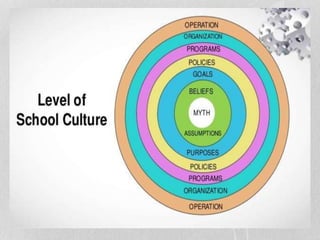
Starratt (1993) crafted a diagram that might help us imagine the
school as being comprised of layers resembling an onion.
-The outer layer represents the operational level of the school.
- Underneath that layer is the organizational level of the school.
- The next layer is made up of programs of the school.
- Under program layer, is policy layer.
- Beneath that layer, we find goals and purposes level.
- Nearing the center or core of the onion, we find the level of beliefs and
assumptions. Here would be what might be called the school’s tacit
educational platform.
- Confeld (2016) claimed that physical environment of the school building
and the surrounding area are essentials influencing how individuals think
and feel about what is valued.
Assessing School Culture
In assessing the culture within
your school, you may use the
instrument developed by Gruenert
and Valentine (2015). The Culture
Typology Survey allows individual to
recognize and rate the degree to
which he or she observes and
engages in certain behaviors within
the school environment.
There are twelve key
aspects of school
culture and six types
of culture
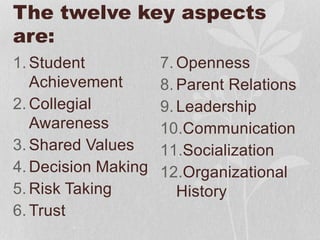
The twelve key aspects
are:
1. Student
Achievement
2. Collegial
Awareness
3. Shared Values
4. Decision Making
5. Risk Taking
6. Trust
7. Openness
8. Parent Relations
9. Leadership
10.Communication
11.Socialization
12.Organizational
History
Along with these are the
six types of school
cultures:
1.Toxic
2.Fragmented
3.Balkanized
4.Contrived-Collegial
5.Comfortable-Collaborative
6.Collaborative
Toxic School Cultures
School culture is the underlying
set of norms, values, traditions,
ceremonies, and unwritten rules of
behavior, action, and thinking. The
school culture is built over time as
educators cope with problems, deal
with changing students and staff and
deal with success and failures.
According to Peterson (2002),
schools with negative or toxic
culture:
1. Lack a clear sense of purpose.
2. Have norms that reinforce inertia.
3. Blame students for lack of progress.
4. Discourage collaboration.
5. Often have actively hostile relations
among staff.
Toxic culture, staff:
1. View student as the problem
rather than as there valued clients.
2. Parts of negative subcultures
that are hostile and critical of
change.
3. Believe they are doing the best
they can and do not search out new
ideas.
4. Frequently share stories and
historical perspectives on the
school that are often negative,
discouraging, and demoralizing.
5. Complain, criticize, and distrust
any new ideas, approaches, or
suggestions for improvement.
6. Rarely share ideas, materials, or
solutions to classroom problems.
7. Have few ceremonies or school
traditions.
Creating a Positive
School Culture
An obvious goal for school
leaders is for schools to
develop and maintain string
cultures.
The following
successful practices:
•Defining
•Scheduling
•Sharing
•Visualizing
Eight attributes of effective
schools with strong cultures
1. Shared values and a consensus on
“how we get thongs done around here.”
2. The principal as a hero or heroine
who embodies core values
3. Distinctive rituals that embody widely
shared beliefs.
4. Employees as situational heroes or
heroine.
5. Rituals of acculturation and cultural
renewal.
6. Significant rituals to celebrate and
transform core values.
7. Balance between innovation and
tradition and between autonomy and
control.
8. Widespread participation in cultural
rituals.
13 possible characteristics for
cultural improvement in
schools:
1. Collegiality
2. Efficacy
3. High Expectation
4. Experimentation and
Entrepreneurship
5. Trust and Confidence
6. Tangible Support
7. Appreciation and Recognition
Improvement
8. Humor
9. Shared Decision-making by all
participants
10. Protect what is important
11. Traditions
12. Open and honest communication
13. Metaphors and Stories

School-Rituals-Traditions-and-Ceremonies.pptx

  • 1.
  • 2.
  • 3.
  • 4.
    School Rituals, Traditions, andCeremonies There are set of rituals, traditions, and ceremonies in every school. These make a school unique from other schools and make the school active and alive. Joining rituals, celebrating traditions, and conducting ceremonies are great opportunities to convene as one while integrating the vision, mission, values and goals of the school (Confeld, 2016).
  • 5.
    SCHOOL RITUALS •Peterson andDeal (2009) defined school rituals as produces or routines that are infused with deeper significance.
  • 6.
    Examples of SCHOOLRITUALS: •Greeting the teacher as students encounter them along the corridor •Conducting flag ceremonies every morning •Observing the honoring gesture or “pagmamano” gesture.
  • 7.
    SCHOOL TRADITIONS School traditionsare significant events that have special history and meaning and occur year in and year out.
  • 8.
    Examples of SCHOOLTRADITIONS: •Holding Recollection activities to the graduating batch •Arranging school Camping •Conducting freshman orientation
  • 9.
    SCHOOL CEREMONIES •School ceremoniesare elaborated as culturally sanctioned events that provide a welcome spiritual boost. These periodic communal events bind people to each otherand shape unwritten cultural values.
  • 10.
    Examples of SCHOOLCEREMONIES: • Holding the annual graduation rites • Joining some local cultural activities • Celebrating Christmas and Christmas party
  • 11.
    School History andStories A school’s mission, vision, values, rituals, traditions, and ceremonies are all elements of the culture that are current and happening in the present. When discussing the history and stories of an organization, the past is being represented (Confeld, 2016). Peterson and Deal (2009) shared that learning from past mistakes and successes is vital to creating and maintaining a positive school culture. The retelling of the past can bring some necessary initiatives into action, revive traditions and rituals that have shriveled away, and assist staff in surrendering previous obsolete memories.
  • 12.
    School Artifacts, Architecture, andSymbols Finally, these three-school artifacts, architecture, and symbols are the key to create and sustain a positive school culture. The artifacts and symbols are the tangible objects that represent the intangible values and beliefs of the school (Peterson & Deal, 2009).
  • 13.
    Moreover, these havevariety of possibilities such as logos, mascots, banners, awards, flag, trophies, and the like. In addition, even school administrators may serve as a walking symbols as he or she send messages through words, actions, and body language.
  • 14.
    Moreover, Confeld (2016)claimed that physical environment of the school building and the surrounding area are essential in influencing how individuals think and feel about what is valued. It is not necessary for schools to have an endless budget in order to maintain the physical environment. Displaying student’s colorful artwork, awards and the values of the school can be enough to support individuals in feeling optimistic and happy about being at school (Peterson & Deal, 2009).
  • 15.
    Levels of SchoolCulture Starratt (1993) crafted a diagram that might help us imagine the school as being comprised of layers resembling an onion. -The outer layer represents the operational level of the school. - Underneath that layer is the organizational level of the school. - The next layer is made up of programs of the school. - Under program layer, is policy layer. - Beneath that layer, we find goals and purposes level. - Nearing the center or core of the onion, we find the level of beliefs and assumptions. Here would be what might be called the school’s tacit educational platform. - Confeld (2016) claimed that physical environment of the school building and the surrounding area are essentials influencing how individuals think and feel about what is valued.
  • 17.
    Assessing School Culture Inassessing the culture within your school, you may use the instrument developed by Gruenert and Valentine (2015). The Culture Typology Survey allows individual to recognize and rate the degree to which he or she observes and engages in certain behaviors within the school environment.
  • 18.
    There are twelvekey aspects of school culture and six types of culture
  • 19.
    The twelve keyaspects are: 1. Student Achievement 2. Collegial Awareness 3. Shared Values 4. Decision Making 5. Risk Taking 6. Trust 7. Openness 8. Parent Relations 9. Leadership 10.Communication 11.Socialization 12.Organizational History
  • 20.
    Along with theseare the six types of school cultures: 1.Toxic 2.Fragmented 3.Balkanized 4.Contrived-Collegial 5.Comfortable-Collaborative 6.Collaborative
  • 21.
    Toxic School Cultures Schoolculture is the underlying set of norms, values, traditions, ceremonies, and unwritten rules of behavior, action, and thinking. The school culture is built over time as educators cope with problems, deal with changing students and staff and deal with success and failures.
  • 22.
    According to Peterson(2002), schools with negative or toxic culture: 1. Lack a clear sense of purpose. 2. Have norms that reinforce inertia. 3. Blame students for lack of progress. 4. Discourage collaboration. 5. Often have actively hostile relations among staff.
  • 23.
    Toxic culture, staff: 1.View student as the problem rather than as there valued clients. 2. Parts of negative subcultures that are hostile and critical of change. 3. Believe they are doing the best they can and do not search out new ideas.
  • 24.
    4. Frequently sharestories and historical perspectives on the school that are often negative, discouraging, and demoralizing. 5. Complain, criticize, and distrust any new ideas, approaches, or suggestions for improvement. 6. Rarely share ideas, materials, or solutions to classroom problems. 7. Have few ceremonies or school traditions.
  • 25.
    Creating a Positive SchoolCulture An obvious goal for school leaders is for schools to develop and maintain string cultures.
  • 26.
  • 27.
    Eight attributes ofeffective schools with strong cultures 1. Shared values and a consensus on “how we get thongs done around here.” 2. The principal as a hero or heroine who embodies core values 3. Distinctive rituals that embody widely shared beliefs. 4. Employees as situational heroes or heroine.
  • 28.
    5. Rituals ofacculturation and cultural renewal. 6. Significant rituals to celebrate and transform core values. 7. Balance between innovation and tradition and between autonomy and control. 8. Widespread participation in cultural rituals.
  • 29.
    13 possible characteristicsfor cultural improvement in schools: 1. Collegiality 2. Efficacy 3. High Expectation 4. Experimentation and Entrepreneurship 5. Trust and Confidence 6. Tangible Support
  • 30.
    7. Appreciation andRecognition Improvement 8. Humor 9. Shared Decision-making by all participants 10. Protect what is important 11. Traditions 12. Open and honest communication 13. Metaphors and Stories