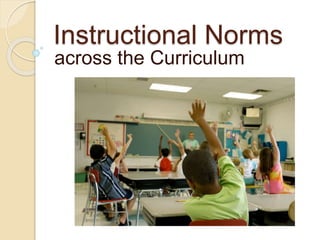
Instructional Norms
across the Curriculum
Objective:
We must become
focused on student
learning, teacher-directed
instruction, and
professional
collaboration.
Changing Education in
America
“Education in America reflects
the values and ideologies of the
community. Specifically, it will
reflect the values and ideologies
of those in power.”
 Freire, P. (1998). Politics and Education. Los
Angeles: UCLA Latin American Center
Publications, p. 43.
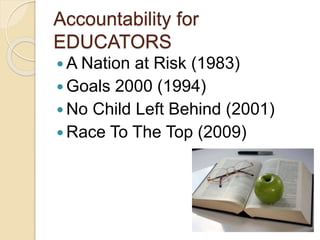
Accountability for
EDUCATORS
 A Nation at Risk (1983)
 Goals 2000 (1994)
 No Child Left Behind (2001)
 Race To The Top (2009)
Teacher Effectiveness
“Effective teachers have
a profound influence on
student achievement.”
 Marzano, R. (2003) What Works in Schools.
Alexandria, VA: Association for Supervision and
Curriculum Development, pp. 77-78.
Teacher Efficacy
“When a teacher is excited
and enthusiastic about their
courses, the students take
interest and are more likely to
engage in learning the
lesson.”
 Thomas, J. (2007). Teaching with passion.
Education Digest, 73(3), 63-65. Retrieved from
http://web.ebscohost.com
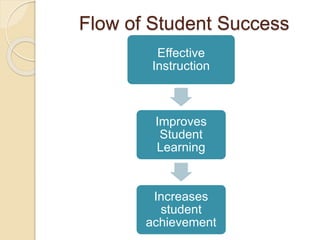
Flow of Student Success
Effective
Instruction
Improves
Student
Learning
Increases
student
achievement
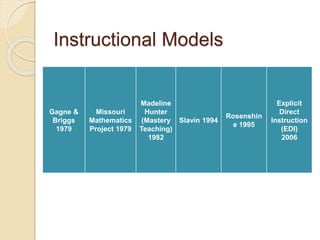
Instructional Models
Gagne &
Briggs
1979
Missouri
Mathematics
Project 1979
Madeline
Hunter
(Mastery
Teaching)
1982
Slavin 1994
Rosenshin
e 1995
Explicit
Direct
Instruction
(EDI)
2006
Instructional Strategies
 Learning Objectives: A statement describing
what students will be able to do by the end of
the lesson. It must match the Independent
Practice and be clearly stated to the students
and frequently revisited.
 Activate Prior Knowledge: Purposefully
moving something connected to the new
lesson from students’ long term memories into
their working memories so they can build
upon existing knowledge.
 Concept/Skill Development: Teaching
students the concepts contained in the
Learning Objective or the skills necessary to
execute the Learning Objective. Teach the
Instructional Strategies Cont.
 Guided Practice: Working problems with
students at the same time, step by step, while
checking for understanding that they are
executing each step correctly.
 Lesson Closure: Having Students work
problems or answer questions to prove that they
have learned the concepts and skills in the
Learning Objective before they are given
independent practice.
 Independent Practice: Having students
successfully practice what they were just taught.
 Cornell Note Taking: Engages students in
lesson, organization, and reference material.
T.A.P.P.L.E.
◦Teach First
◦Ask a Question
◦Pause
◦Pick a Non-Volunteer
◦Listen to the Response
◦Effective Feedback (Echo, Elaborate,
Explain)
Checking for Understanding:
Continually verifying, through
a variety of methods, that
students are learning while
being taught (i.e. – calling on
non-volunteers, pair-share,
wait time, proximity,
paraphrase, whiteboard
responses).
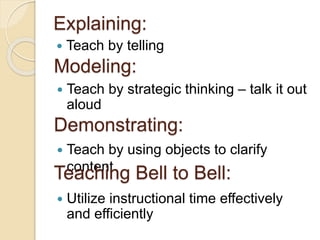
Explaining:
 Teach by telling
Modeling:
 Teach by strategic thinking – talk it out
aloud
 Teach by using objects to clarify
content
Demonstrating:
Teaching Bell to Bell:
 Utilize instructional time effectively
and efficiently
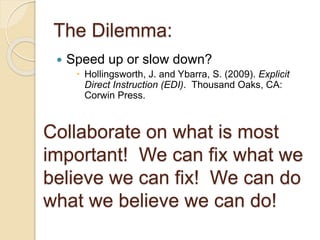
The Dilemma:
 Speed up or slow down?
 Hollingsworth, J. and Ybarra, S. (2009). Explicit
Direct Instruction (EDI). Thousand Oaks, CA:
Corwin Press.
Collaborate on what is most
important! We can fix what we
believe we can fix! We can do
what we believe we can do!
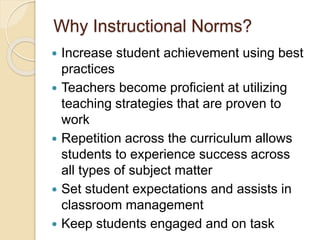
Why Instructional Norms?
 Increase student achievement using best
practices
 Teachers become proficient at utilizing
teaching strategies that are proven to
work
 Repetition across the curriculum allows
students to experience success across
all types of subject matter
 Set student expectations and assists in
classroom management
 Keep students engaged and on task
When learning becomes
meaningful….
INCREASES!

Instructional Norms Presentation

  • 1.
  • 2.
    Objective: We must become focusedon student learning, teacher-directed instruction, and professional collaboration.
  • 3.
    Changing Education in America “Educationin America reflects the values and ideologies of the community. Specifically, it will reflect the values and ideologies of those in power.”  Freire, P. (1998). Politics and Education. Los Angeles: UCLA Latin American Center Publications, p. 43.
  • 4.
    Accountability for EDUCATORS  ANation at Risk (1983)  Goals 2000 (1994)  No Child Left Behind (2001)  Race To The Top (2009)
  • 5.
    Teacher Effectiveness “Effective teachershave a profound influence on student achievement.”  Marzano, R. (2003) What Works in Schools. Alexandria, VA: Association for Supervision and Curriculum Development, pp. 77-78.
  • 6.
    Teacher Efficacy “When ateacher is excited and enthusiastic about their courses, the students take interest and are more likely to engage in learning the lesson.”  Thomas, J. (2007). Teaching with passion. Education Digest, 73(3), 63-65. Retrieved from http://web.ebscohost.com
  • 7.
    Flow of StudentSuccess Effective Instruction Improves Student Learning Increases student achievement
  • 8.
    Instructional Models Gagne & Briggs 1979 Missouri Mathematics Project1979 Madeline Hunter (Mastery Teaching) 1982 Slavin 1994 Rosenshin e 1995 Explicit Direct Instruction (EDI) 2006
  • 9.
    Instructional Strategies  LearningObjectives: A statement describing what students will be able to do by the end of the lesson. It must match the Independent Practice and be clearly stated to the students and frequently revisited.  Activate Prior Knowledge: Purposefully moving something connected to the new lesson from students’ long term memories into their working memories so they can build upon existing knowledge.  Concept/Skill Development: Teaching students the concepts contained in the Learning Objective or the skills necessary to execute the Learning Objective. Teach the
  • 10.
    Instructional Strategies Cont. Guided Practice: Working problems with students at the same time, step by step, while checking for understanding that they are executing each step correctly.  Lesson Closure: Having Students work problems or answer questions to prove that they have learned the concepts and skills in the Learning Objective before they are given independent practice.  Independent Practice: Having students successfully practice what they were just taught.  Cornell Note Taking: Engages students in lesson, organization, and reference material.
  • 11.
    T.A.P.P.L.E. ◦Teach First ◦Ask aQuestion ◦Pause ◦Pick a Non-Volunteer ◦Listen to the Response ◦Effective Feedback (Echo, Elaborate, Explain)
  • 12.
    Checking for Understanding: Continuallyverifying, through a variety of methods, that students are learning while being taught (i.e. – calling on non-volunteers, pair-share, wait time, proximity, paraphrase, whiteboard responses).
  • 13.
    Explaining:  Teach bytelling Modeling:  Teach by strategic thinking – talk it out aloud  Teach by using objects to clarify content Demonstrating: Teaching Bell to Bell:  Utilize instructional time effectively and efficiently
  • 14.
    The Dilemma:  Speedup or slow down?  Hollingsworth, J. and Ybarra, S. (2009). Explicit Direct Instruction (EDI). Thousand Oaks, CA: Corwin Press. Collaborate on what is most important! We can fix what we believe we can fix! We can do what we believe we can do!
  • 15.
    Why Instructional Norms? Increase student achievement using best practices  Teachers become proficient at utilizing teaching strategies that are proven to work  Repetition across the curriculum allows students to experience success across all types of subject matter  Set student expectations and assists in classroom management  Keep students engaged and on task
  • 16.