TEACHING AND LEARNING STYLES
By
Sunday N. Orji
Senior Research Officer – NERDC Sheda, Abuja
nsorji@yahoo.com; 08069259978
Presented at a one-week Training Seminar for NMC-IMSA Staff
10th – 13th September, 2012
NATIONAL MATHEMATICAL CENTRE
INTERNATIONAL MODEL SCIENCE ACADEMY
SHEDA-KWALI ABUJA
2
 CONTENTS
 Introduction: Factors influencing student performance
 Defining teaching and Learning
 Teaching a process or product?
 Teaching as Science; teaching as an art
 Dimensions of teacher’s role: Planning, Instruction, and Management
 Teacher characteristics and classroom behaviours
 Learner characteristics and behaviours
 Teaching Styles and strategies
 Learning styles and preferences
 Classroom learning environment
 Instructional strategies
 Questioning skills
3
 INTRODUCTION: FACTORS INFLUENCING STUDENT PERFORMANCE
School transactions = Teaching & Learning
[Any other activity must be to promote that!]
 The primary objective of teaching is to facilitate learning which involves
the process of interaction aimed at acquiring knowledge, skills, attitudes,
among others.
 The best test of teaching is amount of student learning.
 Teaching quality can be improved if specific skills are identified, one’s
own skills assessed and a plan for improvement is identified
For learning to take place, there has to be interaction between
the learner, the teacher and the institutional environment.
 Teacher [Teaching styles and Teacher Orientation]
 Learner [Learning style; and Preference for learning environment
and Teacher behaviour]
 The Institution [Methodology of teaching and nature of content
matter; and The institutional context and climate]
4
 DEFINING TEACHING AND LEARNING
 TEACHING: A PROCESS OR PRODUCT?
 TEACHING: A SCIENCE OR ART?
 INTERACTIVE SEGMENT!
5
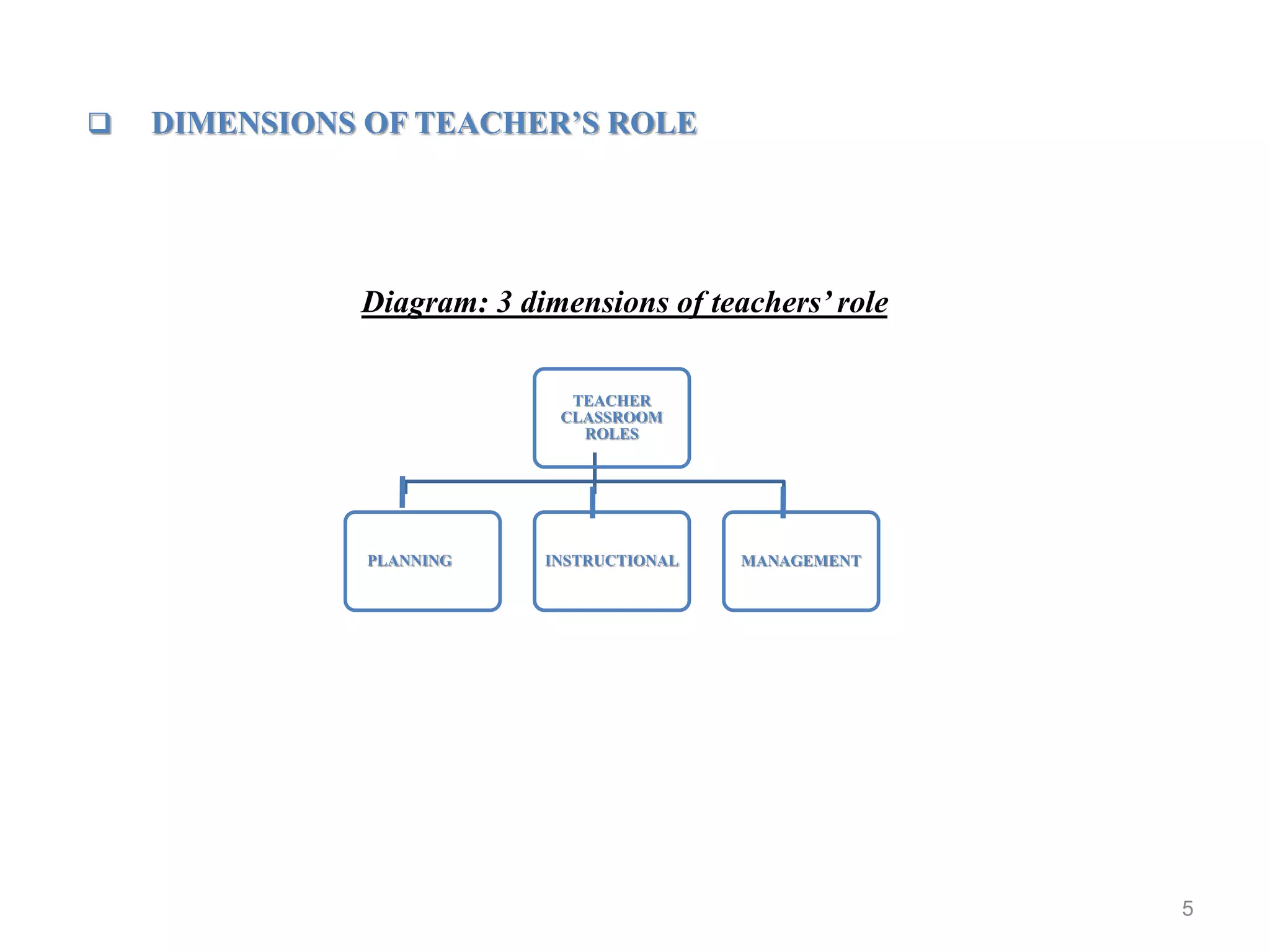
 DIMENSIONS OF TEACHER’S ROLE
Diagram: 3 dimensions of teachers’ role
TEACHER
CLASSROOM
ROLES
PLANNING INSTRUCTIONAL MANAGEMENT
6
 10 ROLES OF THE TEACHER
1. Organizing role
(goal setting, setting instructional goals strategies, grouping students).
2. Motivating role (gaining participation, managing stress).
3. Communicator role (adopting flexible communication styles, control)
4. Managing role (developing classroom management platform, developing
rules and procedures, discipline and control)
5. The Innovator role (Changing teaching behaviour & attitude, linking
research to practice, encouraging higher-level thinking)
6. The Counselor role (advising and counseling students, promoting student
self-concept, learning cooperatively)
7. The Ethical role (school values/ethical principles, teacher’s expectation
and judgment, promoting democracy in school and society)
8. The Professional role (using action research for problem-solving,
successful interviewing, monitoring, assisting other teachers)
9. Political role (defining & recognizing political behaviours in schools,
understanding classroom politics and other influences)
10. The Legal role (understanding and promoting academic freedom,
recognizing torts and liability issues, complying with statutory
requirement, upholding teacher rights & student rights). [Orji, 2006]
7
 TEACHER CHARACTERISTICS AND CLASSROOM BEHAVIOURS
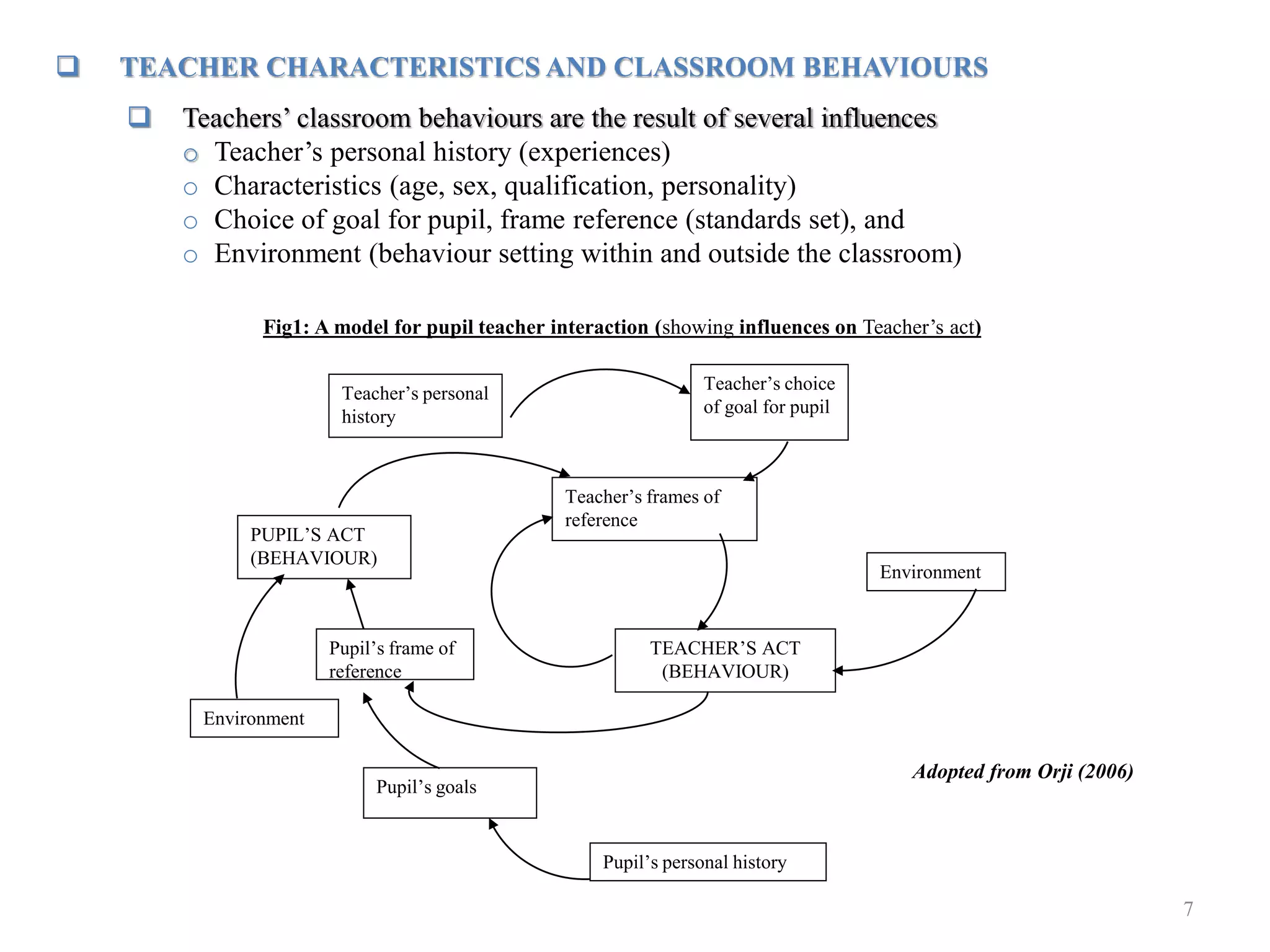
 Teachers’ classroom behaviours are the result of several influences
o Teacher’s personal history (experiences)
o Characteristics (age, sex, qualification, personality)
o Choice of goal for pupil, frame reference (standards set), and
o Environment (behaviour setting within and outside the classroom)
Environment
Teacher’s personal
history
Teacher’s choice
of goal for pupil
Teacher’s frames of
reference
TEACHER’S ACT
(BEHAVIOUR)
PUPIL’S ACT
(BEHAVIOUR)
Pupil’s frame of
reference
Pupil’s goals
Environment
Pupil’s personal history
Fig1: A model for pupil teacher interaction (showing influences on Teacher’s act)
Adopted from Orji (2006)
8
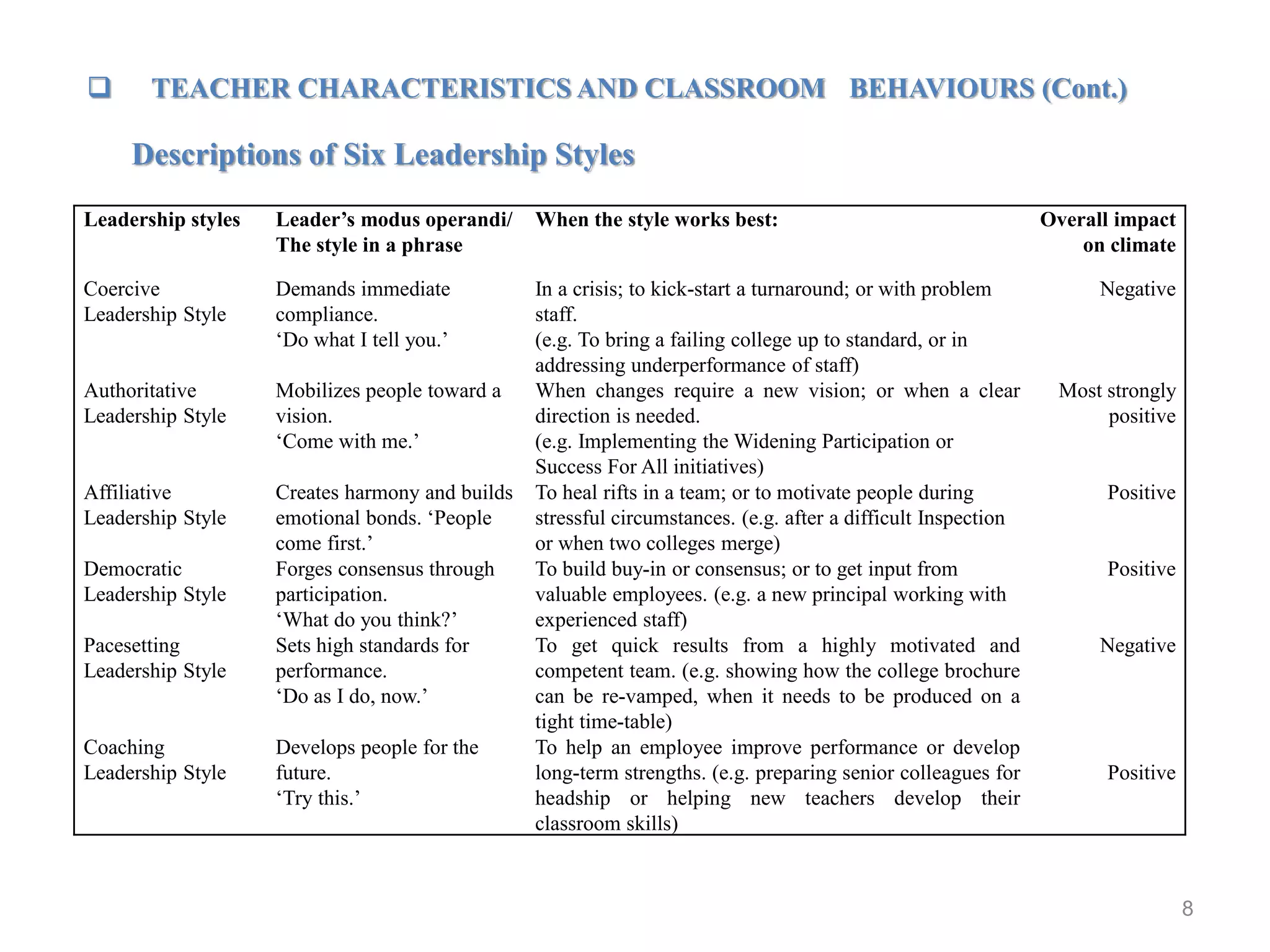
 TEACHER CHARACTERISTICS AND CLASSROOM BEHAVIOURS (Cont.)
Leadership styles Leader’s modus operandi/
The style in a phrase
When the style works best: Overall impact
on climate
Coercive
Leadership Style
Demands immediate
compliance.
‘Do what I tell you.’
In a crisis; to kick-start a turnaround; or with problem
staff.
(e.g. To bring a failing college up to standard, or in
addressing underperformance of staff)
Negative
Authoritative
Leadership Style
Mobilizes people toward a
vision.
‘Come with me.’
When changes require a new vision; or when a clear
direction is needed.
(e.g. Implementing the Widening Participation or
Success For All initiatives)
Most strongly
positive
Affiliative
Leadership Style
Creates harmony and builds
emotional bonds. ‘People
come first.’
To heal rifts in a team; or to motivate people during
stressful circumstances. (e.g. after a difficult Inspection
or when two colleges merge)
Positive
Democratic
Leadership Style
Forges consensus through
participation.
‘What do you think?’
To build buy-in or consensus; or to get input from
valuable employees. (e.g. a new principal working with
experienced staff)
Positive
Pacesetting
Leadership Style
Sets high standards for
performance.
‘Do as I do, now.’
To get quick results from a highly motivated and
competent team. (e.g. showing how the college brochure
can be re-vamped, when it needs to be produced on a
tight time-table)
Negative
Coaching
Leadership Style
Develops people for the
future.
‘Try this.’
To help an employee improve performance or develop
long-term strengths. (e.g. preparing senior colleagues for
headship or helping new teachers develop their
classroom skills)
Positive
Descriptions of Six Leadership Styles
9
 LEARNING STYLES AND PREFERENCES
[LEARNING DEFINED]
Behavioural – learning as a permanent change in behaviour
Cognitive: the development of ones mind, or accumulation of concepts,
knowledge, ideas, skill and attitudes necessary for solving situational problems
Distinction between learning style, strategy and approach
Style is defined as a means of identifying distinctive personality types or types of
behaviour. Strategy conveys task-related preference; while Approaches has been
used to convey processes and dispositions to adopt particular processes
Learning styles (discuss only 2 models)
 Instructional preference model (environment, emotional, sociological,
physiological, Psychological)
 Information processing models
xxx
a. Independent learning style (prefers to work alone and requires little direction.)
b. Dependent learning styles (becomes frustrated when facing new challenges not directly
addressed in classroom)
c. Avoidance (take little responsibility for self-learning)
d. Participant learning style (accept responsibility for self learning and relate well to peer)
e. Collaborative learning style (enjoys working harmoniously with peers)
f. Competitive (suspicious of peers)
10
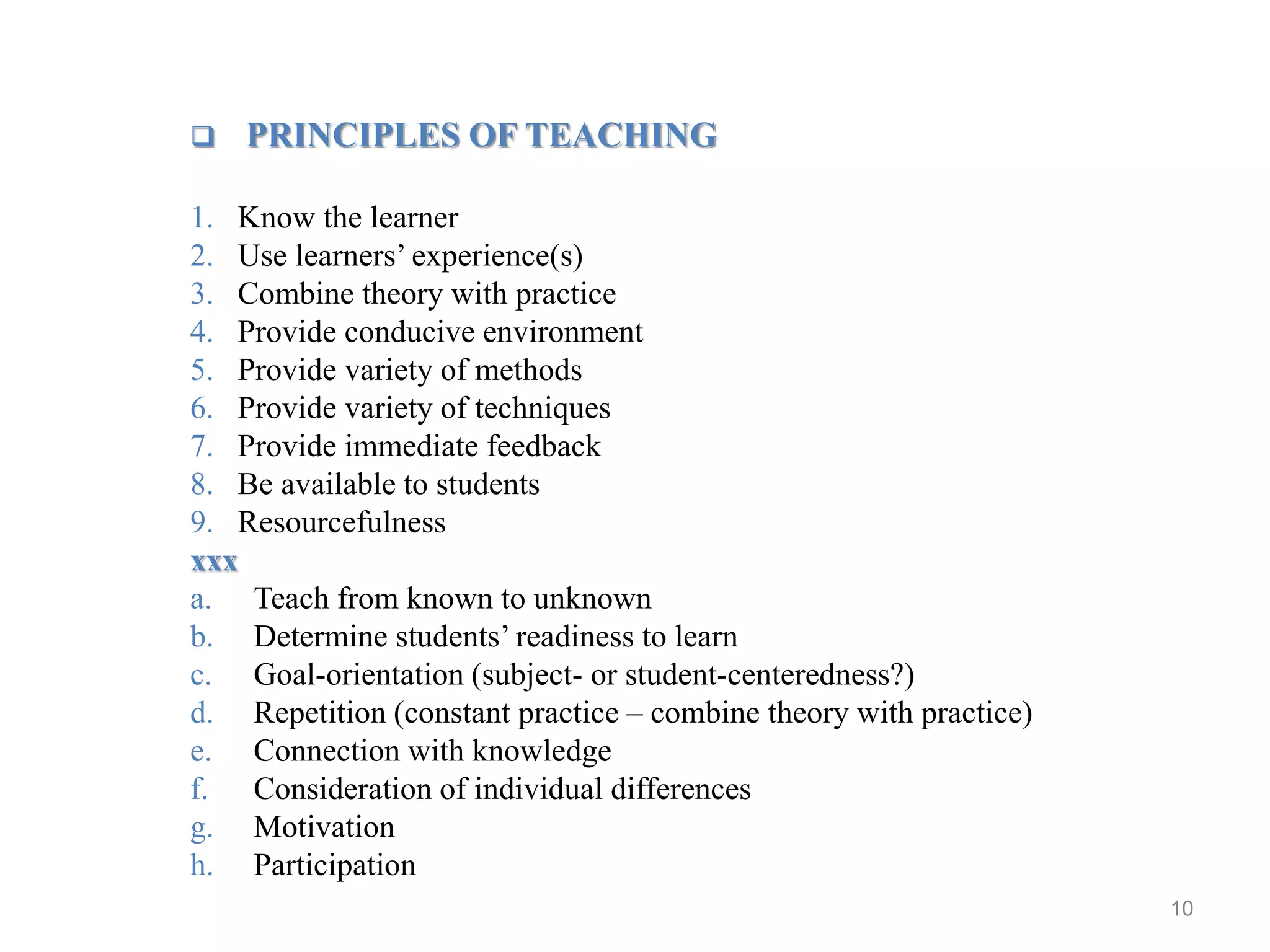
 PRINCIPLES OF TEACHING
1. Know the learner
2. Use learners’ experience(s)
3. Combine theory with practice
4. Provide conducive environment
5. Provide variety of methods
6. Provide variety of techniques
7. Provide immediate feedback
8. Be available to students
9. Resourcefulness
xxx
a. Teach from known to unknown
b. Determine students’ readiness to learn
c. Goal-orientation (subject- or student-centeredness?)
d. Repetition (constant practice – combine theory with practice)
e. Connection with knowledge
f. Consideration of individual differences
g. Motivation
h. Participation
11
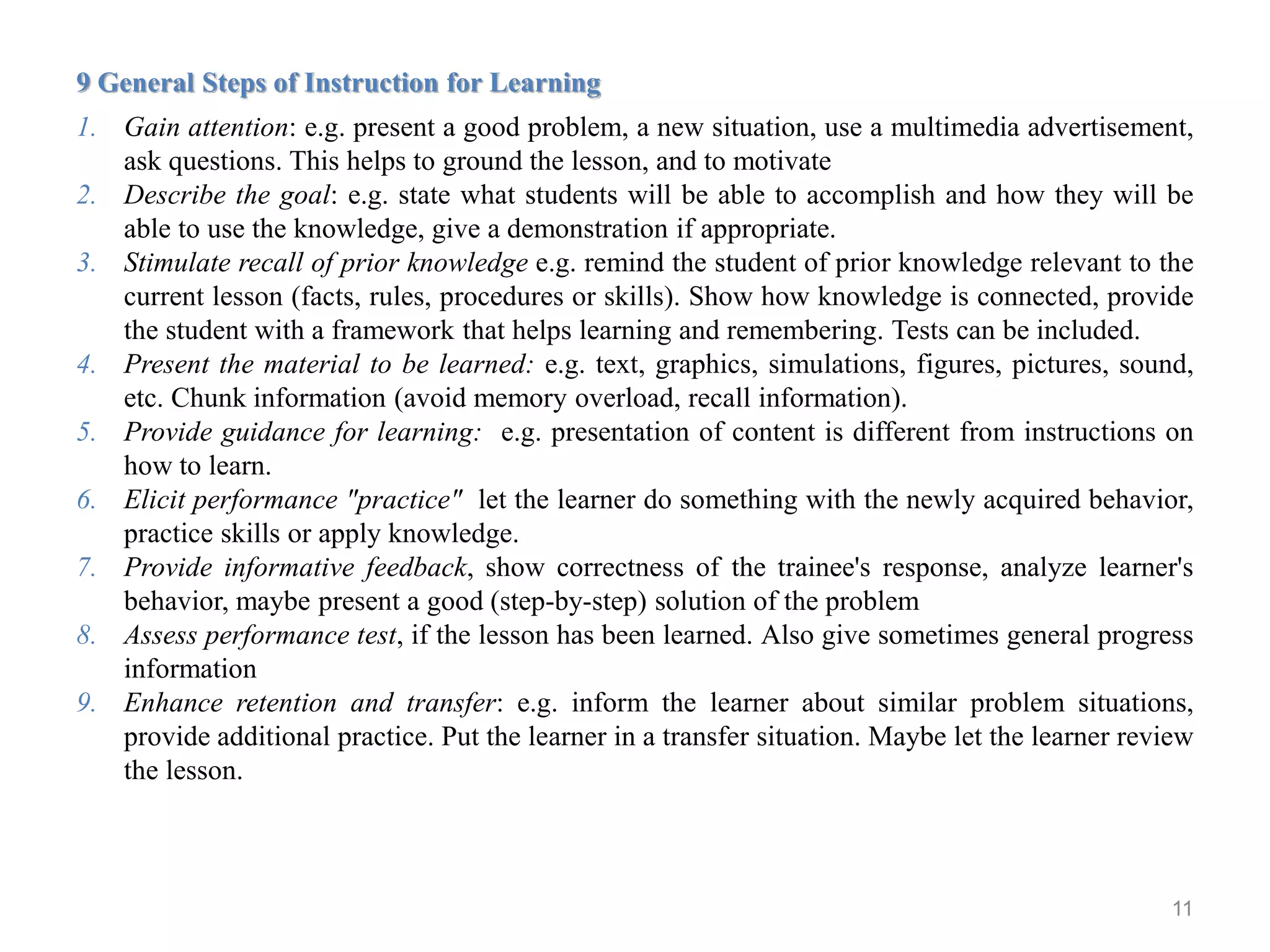
9 General Steps of Instruction for Learning
1. Gain attention: e.g. present a good problem, a new situation, use a multimedia advertisement,
ask questions. This helps to ground the lesson, and to motivate
2. Describe the goal: e.g. state what students will be able to accomplish and how they will be
able to use the knowledge, give a demonstration if appropriate.
3. Stimulate recall of prior knowledge e.g. remind the student of prior knowledge relevant to the
current lesson (facts, rules, procedures or skills). Show how knowledge is connected, provide
the student with a framework that helps learning and remembering. Tests can be included.
4. Present the material to be learned: e.g. text, graphics, simulations, figures, pictures, sound,
etc. Chunk information (avoid memory overload, recall information).
5. Provide guidance for learning: e.g. presentation of content is different from instructions on
how to learn.
6. Elicit performance "practice" let the learner do something with the newly acquired behavior,
practice skills or apply knowledge.
7. Provide informative feedback, show correctness of the trainee's response, analyze learner's
behavior, maybe present a good (step-by-step) solution of the problem
8. Assess performance test, if the lesson has been learned. Also give sometimes general progress
information
9. Enhance retention and transfer: e.g. inform the learner about similar problem situations,
provide additional practice. Put the learner in a transfer situation. Maybe let the learner review
the lesson.
12
 INSTRUCTIONAL STRATEGIES
Some selected best practices/skills in teaching
The Teacher should:
 Be enthusiastic about the subject
 Plan skills in advance
 Practice the skills before going to teach
 Share lesson objectives and procedure with students
 Adapt content to suit the needs of students
 Motivate the student and foster active participation
 Encourage team work and sharing of material
 Develop their keen sense of observation
 Use varieties of teaching methods
 Improvise relevant instructional materials
 Handling difficult concepts
13
 INSTRUCTIONAL STRATEGIES cont…
Guidelines for motivating students to learn:
 Making every subject interesting, making student as active, investigative,
“adventurous”, social, and useful as possible.
 Using behaviour modification techniques to help students exert themselves and
work toward remote goals
 Making sure that students know what they are to do, how to proceed, how they
will know they have achieved goals
 Taking into account individual differences in ability, background, and attitudes
towards school and specific subjects.
 Doing everything possible to satisfy the deficiency need physiological, safety,
belonging, and esteem
 Enhancing the attractions and minimizing the dangers of growth choices.
 Directing learning experiences toward feelings of success in an effort to
encourage a realistic level of aspiration, an orientation toward achievement, and
a positive self-concept.
 Encouraging a sense of personal agency or self-efficiency, self-confidence and
self-direction.
 Trying to “send students away from instruction anxious to use what they have
been taught-eager to learn more”.
14
 CLASSROOM LEARNING ENVIRONMENT
 Learning environment is one of the most essential elements in
teaching and learning.
 Dimensions:
 The physical environment
 Social environment
 Psychological environment
 Organizational environment
 Strategies for creating enabling learning environment

15
 INTERACTIVE SEGMENT 2
 QUESTIONING SKILLS
 Planned questioning as an instructional strategy
 Taxonomy
 Validity, specification, etc
Thank you for
listening!
16

Teaching_and_Learning_Styles.ppt

  • 1.
    TEACHING AND LEARNINGSTYLES By Sunday N. Orji Senior Research Officer – NERDC Sheda, Abuja nsorji@yahoo.com; 08069259978 Presented at a one-week Training Seminar for NMC-IMSA Staff 10th – 13th September, 2012 NATIONAL MATHEMATICAL CENTRE INTERNATIONAL MODEL SCIENCE ACADEMY SHEDA-KWALI ABUJA
  • 2.
    2  CONTENTS  Introduction:Factors influencing student performance  Defining teaching and Learning  Teaching a process or product?  Teaching as Science; teaching as an art  Dimensions of teacher’s role: Planning, Instruction, and Management  Teacher characteristics and classroom behaviours  Learner characteristics and behaviours  Teaching Styles and strategies  Learning styles and preferences  Classroom learning environment  Instructional strategies  Questioning skills
  • 3.
    3  INTRODUCTION: FACTORSINFLUENCING STUDENT PERFORMANCE School transactions = Teaching & Learning [Any other activity must be to promote that!]  The primary objective of teaching is to facilitate learning which involves the process of interaction aimed at acquiring knowledge, skills, attitudes, among others.  The best test of teaching is amount of student learning.  Teaching quality can be improved if specific skills are identified, one’s own skills assessed and a plan for improvement is identified For learning to take place, there has to be interaction between the learner, the teacher and the institutional environment.  Teacher [Teaching styles and Teacher Orientation]  Learner [Learning style; and Preference for learning environment and Teacher behaviour]  The Institution [Methodology of teaching and nature of content matter; and The institutional context and climate]
  • 4.
    4  DEFINING TEACHINGAND LEARNING  TEACHING: A PROCESS OR PRODUCT?  TEACHING: A SCIENCE OR ART?  INTERACTIVE SEGMENT!
  • 5.
    5  DIMENSIONS OFTEACHER’S ROLE Diagram: 3 dimensions of teachers’ role TEACHER CLASSROOM ROLES PLANNING INSTRUCTIONAL MANAGEMENT
  • 6.
    6  10 ROLESOF THE TEACHER 1. Organizing role (goal setting, setting instructional goals strategies, grouping students). 2. Motivating role (gaining participation, managing stress). 3. Communicator role (adopting flexible communication styles, control) 4. Managing role (developing classroom management platform, developing rules and procedures, discipline and control) 5. The Innovator role (Changing teaching behaviour & attitude, linking research to practice, encouraging higher-level thinking) 6. The Counselor role (advising and counseling students, promoting student self-concept, learning cooperatively) 7. The Ethical role (school values/ethical principles, teacher’s expectation and judgment, promoting democracy in school and society) 8. The Professional role (using action research for problem-solving, successful interviewing, monitoring, assisting other teachers) 9. Political role (defining & recognizing political behaviours in schools, understanding classroom politics and other influences) 10. The Legal role (understanding and promoting academic freedom, recognizing torts and liability issues, complying with statutory requirement, upholding teacher rights & student rights). [Orji, 2006]
  • 7.
    7  TEACHER CHARACTERISTICSAND CLASSROOM BEHAVIOURS  Teachers’ classroom behaviours are the result of several influences o Teacher’s personal history (experiences) o Characteristics (age, sex, qualification, personality) o Choice of goal for pupil, frame reference (standards set), and o Environment (behaviour setting within and outside the classroom) Environment Teacher’s personal history Teacher’s choice of goal for pupil Teacher’s frames of reference TEACHER’S ACT (BEHAVIOUR) PUPIL’S ACT (BEHAVIOUR) Pupil’s frame of reference Pupil’s goals Environment Pupil’s personal history Fig1: A model for pupil teacher interaction (showing influences on Teacher’s act) Adopted from Orji (2006)
  • 8.
    8  TEACHER CHARACTERISTICSAND CLASSROOM BEHAVIOURS (Cont.) Leadership styles Leader’s modus operandi/ The style in a phrase When the style works best: Overall impact on climate Coercive Leadership Style Demands immediate compliance. ‘Do what I tell you.’ In a crisis; to kick-start a turnaround; or with problem staff. (e.g. To bring a failing college up to standard, or in addressing underperformance of staff) Negative Authoritative Leadership Style Mobilizes people toward a vision. ‘Come with me.’ When changes require a new vision; or when a clear direction is needed. (e.g. Implementing the Widening Participation or Success For All initiatives) Most strongly positive Affiliative Leadership Style Creates harmony and builds emotional bonds. ‘People come first.’ To heal rifts in a team; or to motivate people during stressful circumstances. (e.g. after a difficult Inspection or when two colleges merge) Positive Democratic Leadership Style Forges consensus through participation. ‘What do you think?’ To build buy-in or consensus; or to get input from valuable employees. (e.g. a new principal working with experienced staff) Positive Pacesetting Leadership Style Sets high standards for performance. ‘Do as I do, now.’ To get quick results from a highly motivated and competent team. (e.g. showing how the college brochure can be re-vamped, when it needs to be produced on a tight time-table) Negative Coaching Leadership Style Develops people for the future. ‘Try this.’ To help an employee improve performance or develop long-term strengths. (e.g. preparing senior colleagues for headship or helping new teachers develop their classroom skills) Positive Descriptions of Six Leadership Styles
  • 9.
    9  LEARNING STYLESAND PREFERENCES [LEARNING DEFINED] Behavioural – learning as a permanent change in behaviour Cognitive: the development of ones mind, or accumulation of concepts, knowledge, ideas, skill and attitudes necessary for solving situational problems Distinction between learning style, strategy and approach Style is defined as a means of identifying distinctive personality types or types of behaviour. Strategy conveys task-related preference; while Approaches has been used to convey processes and dispositions to adopt particular processes Learning styles (discuss only 2 models)  Instructional preference model (environment, emotional, sociological, physiological, Psychological)  Information processing models xxx a. Independent learning style (prefers to work alone and requires little direction.) b. Dependent learning styles (becomes frustrated when facing new challenges not directly addressed in classroom) c. Avoidance (take little responsibility for self-learning) d. Participant learning style (accept responsibility for self learning and relate well to peer) e. Collaborative learning style (enjoys working harmoniously with peers) f. Competitive (suspicious of peers)
  • 10.
    10  PRINCIPLES OFTEACHING 1. Know the learner 2. Use learners’ experience(s) 3. Combine theory with practice 4. Provide conducive environment 5. Provide variety of methods 6. Provide variety of techniques 7. Provide immediate feedback 8. Be available to students 9. Resourcefulness xxx a. Teach from known to unknown b. Determine students’ readiness to learn c. Goal-orientation (subject- or student-centeredness?) d. Repetition (constant practice – combine theory with practice) e. Connection with knowledge f. Consideration of individual differences g. Motivation h. Participation
  • 11.
    11 9 General Stepsof Instruction for Learning 1. Gain attention: e.g. present a good problem, a new situation, use a multimedia advertisement, ask questions. This helps to ground the lesson, and to motivate 2. Describe the goal: e.g. state what students will be able to accomplish and how they will be able to use the knowledge, give a demonstration if appropriate. 3. Stimulate recall of prior knowledge e.g. remind the student of prior knowledge relevant to the current lesson (facts, rules, procedures or skills). Show how knowledge is connected, provide the student with a framework that helps learning and remembering. Tests can be included. 4. Present the material to be learned: e.g. text, graphics, simulations, figures, pictures, sound, etc. Chunk information (avoid memory overload, recall information). 5. Provide guidance for learning: e.g. presentation of content is different from instructions on how to learn. 6. Elicit performance "practice" let the learner do something with the newly acquired behavior, practice skills or apply knowledge. 7. Provide informative feedback, show correctness of the trainee's response, analyze learner's behavior, maybe present a good (step-by-step) solution of the problem 8. Assess performance test, if the lesson has been learned. Also give sometimes general progress information 9. Enhance retention and transfer: e.g. inform the learner about similar problem situations, provide additional practice. Put the learner in a transfer situation. Maybe let the learner review the lesson.
  • 12.
    12  INSTRUCTIONAL STRATEGIES Someselected best practices/skills in teaching The Teacher should:  Be enthusiastic about the subject  Plan skills in advance  Practice the skills before going to teach  Share lesson objectives and procedure with students  Adapt content to suit the needs of students  Motivate the student and foster active participation  Encourage team work and sharing of material  Develop their keen sense of observation  Use varieties of teaching methods  Improvise relevant instructional materials  Handling difficult concepts
  • 13.
    13  INSTRUCTIONAL STRATEGIEScont… Guidelines for motivating students to learn:  Making every subject interesting, making student as active, investigative, “adventurous”, social, and useful as possible.  Using behaviour modification techniques to help students exert themselves and work toward remote goals  Making sure that students know what they are to do, how to proceed, how they will know they have achieved goals  Taking into account individual differences in ability, background, and attitudes towards school and specific subjects.  Doing everything possible to satisfy the deficiency need physiological, safety, belonging, and esteem  Enhancing the attractions and minimizing the dangers of growth choices.  Directing learning experiences toward feelings of success in an effort to encourage a realistic level of aspiration, an orientation toward achievement, and a positive self-concept.  Encouraging a sense of personal agency or self-efficiency, self-confidence and self-direction.  Trying to “send students away from instruction anxious to use what they have been taught-eager to learn more”.
  • 14.
    14  CLASSROOM LEARNINGENVIRONMENT  Learning environment is one of the most essential elements in teaching and learning.  Dimensions:  The physical environment  Social environment  Psychological environment  Organizational environment  Strategies for creating enabling learning environment 
  • 15.
    15  INTERACTIVE SEGMENT2  QUESTIONING SKILLS  Planned questioning as an instructional strategy  Taxonomy  Validity, specification, etc
  • 16.