CSTs and Classroom Grades:
Are grades a good measure of CST scores?
by
James Lake
The Study
 Using eleventh graders’ CST scores in
summative mathematics and
English/language arts and final
semester grades from spring of 2010,
this study intended to discover
whether there is a correlation between
students’ grades as assigned by their
teachers and their performance on the
CSTs.
Methodology
 The study was conducted by
acquiring each student’s previous
year CST scores and printing out a
copy of their final transcripts and
comparing their spring 2010 CST
scores to their 2010 final grades
using a 0 to 4 scale for both
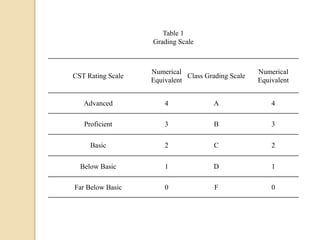
assessments as shown in Table 1.
Table 1
Grading Scale
CST Rating Scale
Numerical
Equivalent
Class Grading Scale
Numerical
Equivalent
Advanced 4 A 4
Proficient 3 B 3
Basic 2 C 2
Below Basic 1 D 1
Far Below Basic 0 F 0
English/language arts Findings
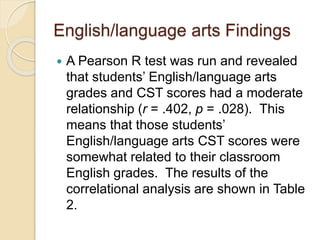
 A Pearson R test was run and revealed
that students’ English/language arts
grades and CST scores had a moderate
relationship (r = .402, p = .028). This
means that those students’
English/language arts CST scores were
somewhat related to their classroom
English grades. The results of the
correlational analysis are shown in Table
2.
Table 2
English Correlation
N M SD r p*
11th CST English 30 2.53 1.042 .402 .028
11th English Grade 30 2.30 1.088
*p = <.05
Mathematics Findings
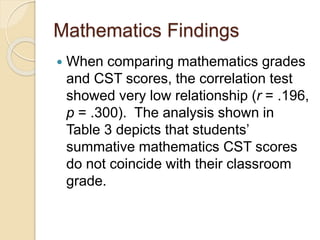
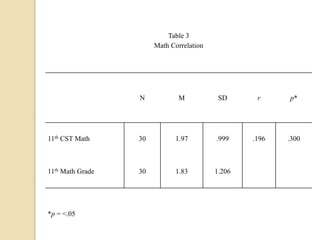
 When comparing mathematics grades
and CST scores, the correlation test
showed very low relationship (r = .196,
p = .300). The analysis shown in
Table 3 depicts that students’
summative mathematics CST scores
do not coincide with their classroom
grade.
Table 3
Math Correlation
N M SD r p*
11th CST Math 30 1.97 .999 .196 .300
11th Math Grade 30 1.83 1.206
*p = <.05
Conclusions
 Consistency needs to improve between
test results and classroom grades.
Numerous factors influence this
irregularity. Every thing from poor
instruction, to student’s lack of effort
shape student test scores and grades.
(What happens when STAR scores and
classroom grades don’t agree? 2010).
Conclusions continued….
 As Eisner (2002),
asserts “standardized
test scores and grades
have become the basis
for judging educational
quality” (p.188). When
students do not measure
up, or when a dichotomy
exists between the two
assessments, research
needs to be done to
figure out why.
Summary  It is important for
educators to realize
that the most
important part of
assessing students in
class is to determine
how to enhance or
modify the lessons for
them so that teachers
are effectively
engaging students in
meaningful instruction.
 As accountability in education
becomes more and more politicized,
so is the relationship between a
student’s classroom achievement
(grades) and standardized test scores.
 This topic certainly deserves further
research to find out which teachers
are successful and why, as well as
which are failing to teach to the
California Content Standards.
3 Recommendations for Further Study
1. Conduct a study going back 4 to 5 years into CST scores of
students and grades enrolled in the same teachers’ classes in
mathematics and English/language arts to see what, if any,
correlation existed when the school was scoring better on its API.
2. Conduct a larger study using the CST scores and grades in
mathematics and English/language arts from all 4 high schools in
the district to determine if a stronger or weaker relationship exists
in other teachers classes.
3. Utilizing strong correlative data among English and mathematics
grades and scores on the CST, conduct observations of effective
teachers to evaluate what instructional methods and strategies
they implement that achieve correlational success in the
classroom and on the CSTs for students.

Research Presentation on Grades and Standardized Testing

  • 1.
    CSTs and ClassroomGrades: Are grades a good measure of CST scores? by James Lake
  • 2.
    The Study  Usingeleventh graders’ CST scores in summative mathematics and English/language arts and final semester grades from spring of 2010, this study intended to discover whether there is a correlation between students’ grades as assigned by their teachers and their performance on the CSTs.
  • 3.
    Methodology  The studywas conducted by acquiring each student’s previous year CST scores and printing out a copy of their final transcripts and comparing their spring 2010 CST scores to their 2010 final grades using a 0 to 4 scale for both assessments as shown in Table 1.
  • 4.
    Table 1 Grading Scale CSTRating Scale Numerical Equivalent Class Grading Scale Numerical Equivalent Advanced 4 A 4 Proficient 3 B 3 Basic 2 C 2 Below Basic 1 D 1 Far Below Basic 0 F 0
  • 5.
    English/language arts Findings A Pearson R test was run and revealed that students’ English/language arts grades and CST scores had a moderate relationship (r = .402, p = .028). This means that those students’ English/language arts CST scores were somewhat related to their classroom English grades. The results of the correlational analysis are shown in Table 2.
  • 6.
    Table 2 English Correlation NM SD r p* 11th CST English 30 2.53 1.042 .402 .028 11th English Grade 30 2.30 1.088 *p = <.05
  • 7.
    Mathematics Findings  Whencomparing mathematics grades and CST scores, the correlation test showed very low relationship (r = .196, p = .300). The analysis shown in Table 3 depicts that students’ summative mathematics CST scores do not coincide with their classroom grade.
  • 8.
    Table 3 Math Correlation NM SD r p* 11th CST Math 30 1.97 .999 .196 .300 11th Math Grade 30 1.83 1.206 *p = <.05
  • 9.
    Conclusions  Consistency needsto improve between test results and classroom grades. Numerous factors influence this irregularity. Every thing from poor instruction, to student’s lack of effort shape student test scores and grades. (What happens when STAR scores and classroom grades don’t agree? 2010).
  • 10.
    Conclusions continued….  AsEisner (2002), asserts “standardized test scores and grades have become the basis for judging educational quality” (p.188). When students do not measure up, or when a dichotomy exists between the two assessments, research needs to be done to figure out why.
  • 11.
    Summary  Itis important for educators to realize that the most important part of assessing students in class is to determine how to enhance or modify the lessons for them so that teachers are effectively engaging students in meaningful instruction.
  • 12.
     As accountabilityin education becomes more and more politicized, so is the relationship between a student’s classroom achievement (grades) and standardized test scores.
  • 13.
     This topiccertainly deserves further research to find out which teachers are successful and why, as well as which are failing to teach to the California Content Standards.
  • 14.
    3 Recommendations forFurther Study
  • 15.
    1. Conduct astudy going back 4 to 5 years into CST scores of students and grades enrolled in the same teachers’ classes in mathematics and English/language arts to see what, if any, correlation existed when the school was scoring better on its API. 2. Conduct a larger study using the CST scores and grades in mathematics and English/language arts from all 4 high schools in the district to determine if a stronger or weaker relationship exists in other teachers classes. 3. Utilizing strong correlative data among English and mathematics grades and scores on the CST, conduct observations of effective teachers to evaluate what instructional methods and strategies they implement that achieve correlational success in the classroom and on the CSTs for students.