
Dr. P. Saranraj M.Sc., M.Phil., Ph.D., NET
Assistant Professor
Department of Microbiology
Sacred Heart College (Autonomous)
Tirupattur, Vellore District.
Mobile: 9994146964
E.mail: microsaranraj@gmail.com
IMMUNOGLOBULINS
IMMUNOGLOBULINS
Antibody, also known as an Immunoglobulin (Ig), is a
large, Y-shaped protein (Soluble Glycoprotein) produced
mainly by Plasma cells that is used by the immune
system to neutralize microbial pathogens.
Antibodies are present in the Blood serum,Tissue fluids
and Mucosal surfaces of vertebrate animals.
Each antibody has at least two identical sites that bind to
Antigens.These sites are known as Antigen-binding sites
(or) Paratopes.
The number of Antigen-binding sites on an
antibody is called the Valence of that antibody. For
example, most human antibodies have two binding sites;
therefore, they arc Bivalent.
The first use of the term "antibody" occurred in a text
by Paul Ehrlich.
Gerald Maurice Edelman who shared the 1972 Nobel
Prize in Physiology or Medicine for work with Rodney
Robert Porter on the immune system. Edelman's Nobel
Prize-winning research concerned discovery of the
structure of Antibody molecules.
The first evidence that antibodies were contained in
particular serum protein fractions came from a classic
experiment by A.Tiselius and E.A. Kabat in 1939.
Immunoglobulins constitute 20 to 25 % of total serum
protein.
STRUCTURE OF IMMUNOGLOBULINS
Gerald Maurice Edelman shared the 1972 Nobel Prize
with Rodney Robert Porter for the discovery of the
structure of Antibody molecules.
A bivalent (arranged in pairs) antibody has the simplest
molecular structure, it is called a Monomer.
Heavy and Light Chains
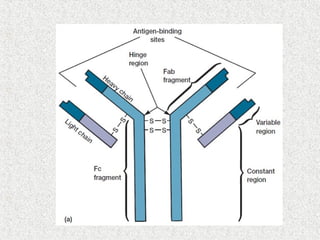
A typical antibody monomer has 4 protein chains: 2
identical Light chains and 2 identical Heavy chains.
Each Light chain polypeptide usually consists of about 220
amino acids and has a mass of approximately 25,000 Da.
Each Heavy chain consists of about 440 amino acids and
has a mass of about 50,000 to 70,000 Da.
Disulfide Bonds
The chains (Light and Heavy chains) are joined by Disulfide
links and other bonds to form aY-shaped molecule.
TheY-shaped molecule is flexible and can assume a T shape.
Variable (V) and Constant Regions (C)
Both Light and Heavy chains contain two different regions.
They are (i)Variable region and (ii) Constant region.
The two sections located at the ends of the “Y” arms are
calledVariable (V) regions.
The Variable region is present in both Light chain (VL) (110
Amino acids) and the Heavy chain (VH) (110Amino acids).
The Variable regions folded together and forms the
Antigen binding site (Paratope).
The stem of the antibody monomer and the lower parts of
the arms of the “Y” are called the Constant regions (C).
The Constant region is present in both Light chain (CL) (110
Amino acids) and the Heavy chain (CH) (330 - 440 Amino
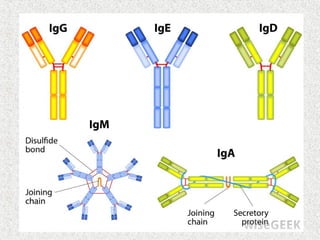
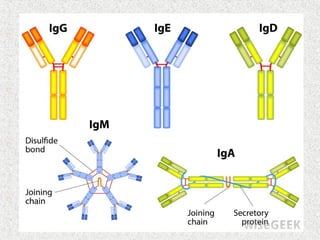
acids). Five major types of C regions
There arc, which account for the five major classes of
Immunoglobulins.
Hinge region
The four chains are arranged in the form of a
flexible “Y” with a Hinge region.
The Hinge region allows the antibody molecule to be more
flexible, adjusting to the different spatial
arrangements of Epitopes orAntigenic determinants.
Fab region
The top of the Y consists of two Antigen-binding
fragments (Fab) that bind with compatibleAntigens.
Fab regions are composed of bothVariable and Constant
region (MW 45,000 D).
Fc region or Crystallizable Fragments
The stem of the “Y” shaped antibody monomer is called the
Fc region (MW 50,000 D).
Fc regions are important in Immunological reactions.
Fc regions are composed of only Constant region.
Fc region interacts with cell surface receptors
called Fc receptors and some proteins of the complement
system. This property allows antibodies to activate
the immune system.
Immunoglobulins
Immunoglobulins
Immunoglobulins

Immunoglobulins

  • 1.
    Dr. P. SaranrajM.Sc., M.Phil., Ph.D., NET Assistant Professor Department of Microbiology Sacred Heart College (Autonomous) Tirupattur, Vellore District. Mobile: 9994146964 E.mail: microsaranraj@gmail.com IMMUNOGLOBULINS
  • 2.
    IMMUNOGLOBULINS Antibody, also knownas an Immunoglobulin (Ig), is a large, Y-shaped protein (Soluble Glycoprotein) produced mainly by Plasma cells that is used by the immune system to neutralize microbial pathogens. Antibodies are present in the Blood serum,Tissue fluids and Mucosal surfaces of vertebrate animals. Each antibody has at least two identical sites that bind to Antigens.These sites are known as Antigen-binding sites (or) Paratopes. The number of Antigen-binding sites on an antibody is called the Valence of that antibody. For example, most human antibodies have two binding sites; therefore, they arc Bivalent.
  • 3.
    The first useof the term "antibody" occurred in a text by Paul Ehrlich. Gerald Maurice Edelman who shared the 1972 Nobel Prize in Physiology or Medicine for work with Rodney Robert Porter on the immune system. Edelman's Nobel Prize-winning research concerned discovery of the structure of Antibody molecules. The first evidence that antibodies were contained in particular serum protein fractions came from a classic experiment by A.Tiselius and E.A. Kabat in 1939. Immunoglobulins constitute 20 to 25 % of total serum protein.
  • 4.
    STRUCTURE OF IMMUNOGLOBULINS GeraldMaurice Edelman shared the 1972 Nobel Prize with Rodney Robert Porter for the discovery of the structure of Antibody molecules. A bivalent (arranged in pairs) antibody has the simplest molecular structure, it is called a Monomer. Heavy and Light Chains A typical antibody monomer has 4 protein chains: 2 identical Light chains and 2 identical Heavy chains. Each Light chain polypeptide usually consists of about 220 amino acids and has a mass of approximately 25,000 Da. Each Heavy chain consists of about 440 amino acids and has a mass of about 50,000 to 70,000 Da.
  • 5.
    Disulfide Bonds The chains(Light and Heavy chains) are joined by Disulfide links and other bonds to form aY-shaped molecule. TheY-shaped molecule is flexible and can assume a T shape. Variable (V) and Constant Regions (C) Both Light and Heavy chains contain two different regions. They are (i)Variable region and (ii) Constant region. The two sections located at the ends of the “Y” arms are calledVariable (V) regions. The Variable region is present in both Light chain (VL) (110 Amino acids) and the Heavy chain (VH) (110Amino acids). The Variable regions folded together and forms the Antigen binding site (Paratope).
  • 6.
    The stem ofthe antibody monomer and the lower parts of the arms of the “Y” are called the Constant regions (C). The Constant region is present in both Light chain (CL) (110 Amino acids) and the Heavy chain (CH) (330 - 440 Amino acids). Five major types of C regions There arc, which account for the five major classes of Immunoglobulins. Hinge region The four chains are arranged in the form of a flexible “Y” with a Hinge region. The Hinge region allows the antibody molecule to be more flexible, adjusting to the different spatial arrangements of Epitopes orAntigenic determinants.
  • 7.
    Fab region The topof the Y consists of two Antigen-binding fragments (Fab) that bind with compatibleAntigens. Fab regions are composed of bothVariable and Constant region (MW 45,000 D). Fc region or Crystallizable Fragments The stem of the “Y” shaped antibody monomer is called the Fc region (MW 50,000 D). Fc regions are important in Immunological reactions. Fc regions are composed of only Constant region. Fc region interacts with cell surface receptors called Fc receptors and some proteins of the complement system. This property allows antibodies to activate the immune system.