Immediate denture
Prepared by:
Dr. Ibrahim H. Al-fahdawi
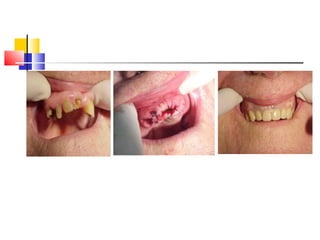
Immediate Denture
Definition:
Is a denture constructed and fabricated
before the remaining natural teeth have
removed to be placed and inserted
immediately after removal of remaining
natural teeth.
Is the most effective way of making the
transition from the natural to the artificial
dentition.
 Immediate denture are more challenging
to dentist and the patient because a try
in is not possible before and, the patient
may not be completely comfortable with
the resulting appearance and fitness .
Indication:
 1.hopless remaining teeth .
 2.educated patient with daily social
activities ;Dr,lawyers,teachers.
 3.patient with stable health condition.
Contraindication:
 1.patient with poor general health (systemic
disease )
 2.patient is not wiling to accept the treatment
mentally and psychologically.
 3.uncooprative patient.
 4.patient at risk from bacterimia.
 5.patient with genuine history of post
extraction hemorrhage .
 6.the presence of oral sepsis .
Advantages of immediate
denture:
 A. advantages related to patient :
 1.maintainance of dental appearance and facial
contour because there is no edentulous period.
 2.minimizing disturbances of mastication and speech.
 3.less post-operative pain and bleeding (protecting
splint over the extracted sight )
 4.the patient is likely to adapt more easily to denture
 5.overall the patient”s psychological and social well
being is preserved .
Advantages of immediate
denture:
 B.related to dentist :
 1.transfer of the jaw relationship :if the
jaw relationship determined by the
occlusion of the remaining of the natural
teeth is acceptable in both horizontal
and vertical planes.
 2.achieving good appearance .
 3.haemostasis .
Disadvantages of immediate
denture
 It is important for the dentist to fully explain to the patient the
following limitations of immediate denture , treatment should not
normally be started unless the patient fully appreciate and
accepts these limitations .
 1.inability to complete a comprehensive trail stage so patient
esthetic may not be fulfilled specially when anterior teeth are to
be replaced.
 2.increased maintenance and more clinical visits.
 3.short service life.
 4. Immediate dentures are usually more expensive because of
the additional time required for their construction
Classification of immediate
denture:
 According to treatment plan.
 A. conventional immediate denture
 B. interim immediate denture
 According to flange design .
 A. flanged type.
 B. flangeless type (open face or close
fit )
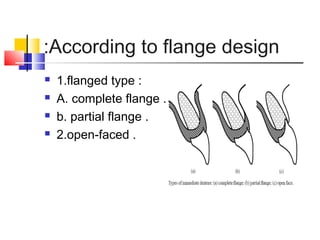
According to flange design:
 1.flanged type :
 A. complete flange .
 b. partial flange .
 2.open-faced .
Comparisons of flanged and
open faced denture:
 1.Appearance
 2.stability
 3.Strength
 4.Maintenance
 5.Heamostasis
 6.Remodelling of the ridge
 7.Tolerance of replacement denture
Appearance
 1.appearance of flanged denture does not altered after
fitting where the appearance of open – face denture
(although good initially) can deteriorate rapidly as
resorption create a gap between the necks of the teeth
and ridge
 2.the flanged denture allows freedom in the positioning
of teeth ,where,in open face denture teeth have to be
positioned in the sockets of the natural teeth
 *so on case of malpositional teeth we can do good
alignment in flanged denture while we can not in open
face type
stability
 In upper denture:
a flange on an upper denture create a more effective
borders seal , therefore , better retention than is
achieved with an open face denture
 In lower denture:
open face denture is not usually constructed because
of poor stability of lower denture during function , so
flange denture is commonly used
*so flange denture is better from the point of stability
strength
 1.the presence of labial flange produces
a stronger denture .
 2.labial flange will make the denture
stiffer so the midline fatigue fracture
cause by repeated flexing across the
midline is reduced .
 *so from the point of strength the flange
denture is better .
maintenance
 1.as the bone resorped following extraction
the denture become loose and a reline is
required , so the presence of labial flange
make it easer to add either a short – term soft
lining materials or a cold curing relining
materials as a chair side procedure.
 2.as the color of some reline materials is not
always ideal they may be visible when used
with open face denture.
haemostasis
 1.the flange denture cover the clot
completely and protect them more
effectively .
 2.the flange denture exerts pressure on
both lingual and labial gingiva reducing
post extraction hemorrhage .
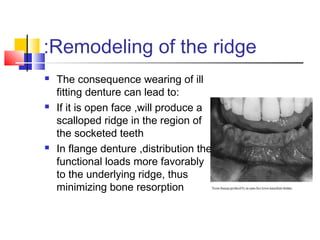
Remodeling of the ridge:
 The consequence wearing of ill
fitting denture can lead to:
 If it is open face ,will produce a
scalloped ridge in the region of
the socketed teeth
 In flange denture ,distribution the
functional loads more favorably
to the underlying ridge, thus
minimizing bone resorption
Tolerance of replacement
denture
 When patient have got used to an open
face immediate denture there is
difficulty to accept a denture with labial
flange in future and patient will complain
from the fullness of the lip
 If flange denture had worn from the
beginning this problem does not occur .
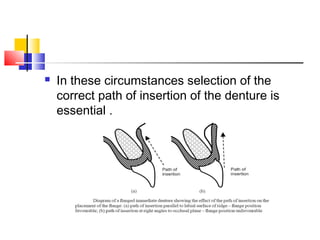
 When the ridge morphology produce
deeply undercut area it may not be
possible to fit a full labial flange unless
there is surgical reduction
 In this case the using of partially flange
denture or open face denture is
preferable when surgical procedure is
contraindication .
 In these circumstances selection of the
correct path of insertion of the denture is
essential .
Preparation stage:
 Before the beginning of the procedure the
patient should be prepared :
 1.proper patient selection .
 2.maitaining good oral hygiene prior to
extraction to enhance healing .
 3.if multiple extraction is needed (posterior
and anterior ) its advisable to extract posterior
teeth keeping some to preserve vertical
dimension .
 4.study (primary ) cast ,to plan the treatment
and to construct special tray .
Clinical and laboratory
procedures:
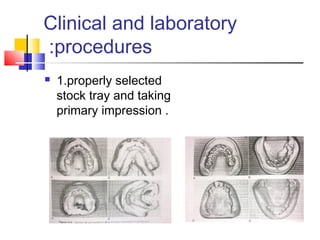
 1.properly selected
stock tray and taking
primary impression .
 In case of hyper mobile anterior teeth
impression materials can act as instrument of
extraction ,so avoiding of the problem can
done by:
 1.applying a lubricant medium to the teeth .
 2. in case of adjacent teeth to each others
applying moulding soft wax into sub-contact
point spaces and around the necks of teeth
so that the impression material is prevented
from locking into the undercuts .
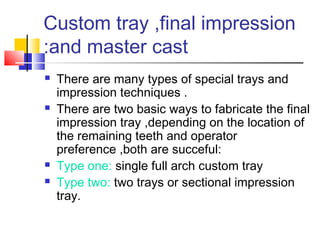
Custom tray ,final impression
and master cast:
 There are many types of special trays and
impression techniques .
 There are two basic ways to fabricate the final
impression tray ,depending on the location of
the remaining teeth and operator
preference ,both are succeful:
 Type one: single full arch custom tray
 Type two: two trays or sectional impression
tray.
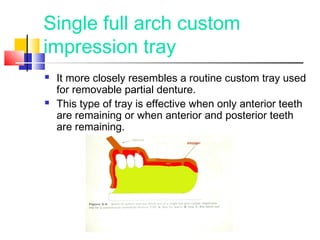
Single full arch custom
impression tray
 It more closely resembles a routine custom tray used
for removable partial denture.
 This type of tray is effective when only anterior teeth
are remaining or when anterior and posterior teeth
are remaining.
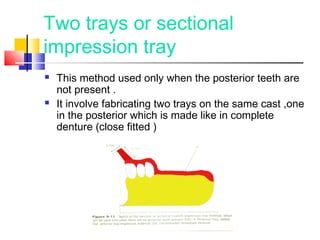
Two trays or sectional
impression tray
 This method used only when the posterior teeth are
not present .
 It involve fabricating two trays on the same cast ,one
in the posterior which is made like in complete
denture (close fitted )
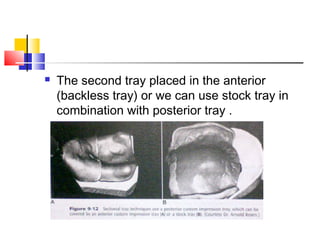
 The second tray placed in the anterior
(backless tray) or we can use stock tray in
combination with posterior tray .
Jaw relation
 Doing that by using record bases and
occlusion bit rims , and the vertical
dimension recorded , centric relation is
recoded also and transferring to
articulator in the normal procedure used
with complete or partial denture .
Setting the posterior teeth, verifying jaw
relation ,and try-in of posterior teeth
appointment
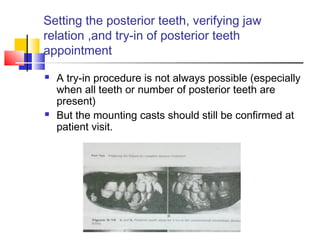
 A try-in procedure is not always possible (especially
when all teeth or number of posterior teeth are
present)
 But the mounting casts should still be confirmed at
patient visit.
Try-in appointment:
 1.Set the posterior teeth .
 2.the denture base and posterior teeth are try-in the mouth :
 -verifying vertical dimension of occlusion
 -centric relation as with complete denture
 3.record land marks on the cast to confirm the patient”s esthetic
 A : midline or newly selected midline is recorded on the base
area of the master cast.
 B :the anterior plane of occlusion
 C :ala-tragus plane should be located and noted .
 D :high lip line should be determined on the cast.
 4.anterior teeth selection is confirmed with patient .
Setting the anterior teeth
 If the arrangement of the natural
anterior teeth is to be reproduced in
denture a recording of their position
must be obtained in one of the following
ways
Setting of anterior teeth
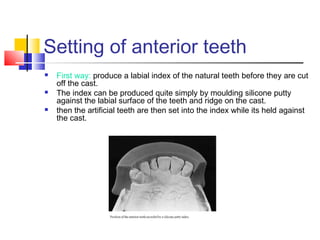
 First way: produce a labial index of the natural teeth before they are cut
off the cast.
 The index can be produced quite simply by moulding silicone putty
against the labial surface of the teeth and ridge on the cast.
 then the artificial teeth are then set into the index while its held against
the cast.
Setting of anterior teeth
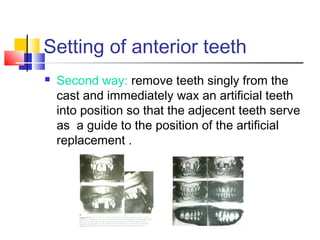
 Second way: remove teeth singly from the
cast and immediately wax an artificial teeth
into position so that the adjecent teeth serve
as a guide to the position of the artificial
replacement .
Setting of anterior teeth
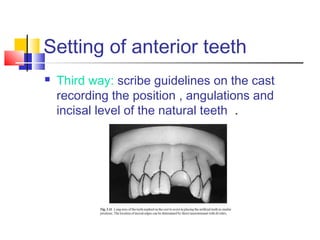
 Third way: scribe guidelines on the cast
recording the position , angulations and
incisal level of the natural teeth .
In case of elimination moderate labial
alveolar undercut (alvealoplasty(
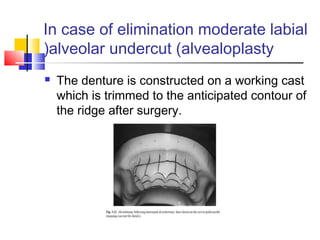
 The denture is constructed on a working cast
which is trimmed to the anticipated contour of
the ridge after surgery.
 1.the gingival margins are
marked and teeth removed.
 2.guidlines are drawn on the
cast .
 3.all the part of the cast
contained within these two lines
is trimmed away and the edges
are rounded over .
 4.a clear acrylic template is
processed on a duplication of
this cast and is used as a guide
to control the amount of bone
removal at operation .
Surgical procedure:
 1.extraction of the teeth .
 2.removal of the associated interseptal bone and
reducing the undercut .
 3.collape ( squeezing ) of the labial cortical plate of
the bone .
 4.isertion of the clear acrylic template to check if
bone removal has been sufficient .
 5.farther bone removal ,if necessory, until re-insertion
of the template cease to cause blanching .
 6.suturing the socket and insertion of the immediate
denture.
Arrangement of the anterior
teeth in open face denture:
 1.prepertion of tooth socket on the cast,
2-5mm depth depending on the amount of
the gingival retraction which depend on the
degree of pocketing and bone loose that is
present around the natural teeth.
 2.the neck of the artificial tooth is placed in
preparation site.
 3.at the time of insertion the neck will just
enter the socket of natural tooth after
extraction.
Clinical report of try-in
procedure of anterior teeth
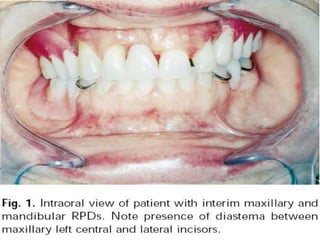
Fig 1
 Intra oral view of patient with interim
maxillary and mandibular R.P.D ,note
presence of diastema between
maxillary left central and lateral incisors
 Step1: primary impression were made and
cast were prepared .
 Step2: final impression is made and stone
cast is made .
 Step3: jaw relation is recorded and vertical
dimension also recorded .
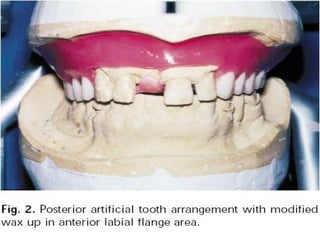
 Step4: arrangement of posterior teeth is done
and tried in the patient mouth as seen in the
fig 2
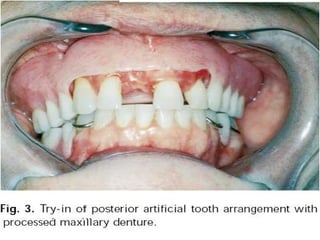
 Posterior artificial teeth arranged with
the processed maxillary denture as in
the fig 3
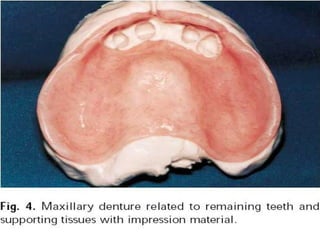
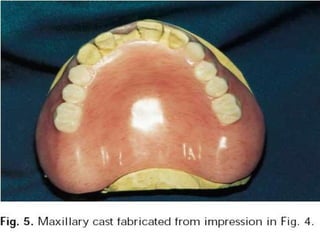
 To relate the new maxillary denture to
remaining teeth and supporting tissue ,
an impression of the adjusted denture
was made with an irreversible
hydrocolloid impression material and
new maxillary cast was fabricated as
shown in fig 4,5
 The maxillary denture was then inserted in
the patient mouth and centric relation record
was made to facilitated the mounting of the
maxillary cast .
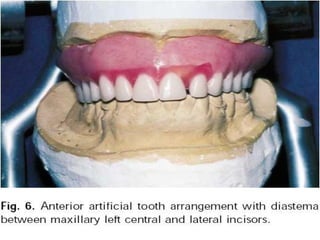
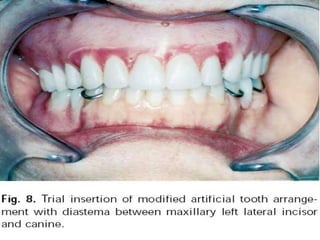
 The maxillary artificial anterior teeth were
arranged to reflect the position of the patient
natural teeth , this duplicated the diastema
between the maxillary left central and lateral
incisors .
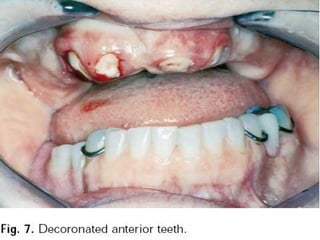
 To place the completed artificial teeth
arrangement in the patient mouth for
esthetic observation , modifications had
to be made to the remaining natural
teeth .
 Teeth will sectioned at the gingival
margins .
 The completed artificial teeth
arrangement could then be tried in the
mouth in a blood –free field
 To preserve the final position of try in
anterior teeth arrangement , a thin layer
of separating medium was painted on
the portion of stone cast and labial
index of the completed anterior artificial
teeth arrangement was made with
plaster .
 After plaster had set immersion of the
cast in hot water this allowed the wax in
the anterior region to soften and
facilitated the separation of the labial
index , remaining wax was eliminated
by boiling , the anterior artificial teeth
were secured to the labial index with
sticky wax .
 The exposed portion of the anterior
maxillary cast , visible through the
window in the processed denture was
painted with separating medium .
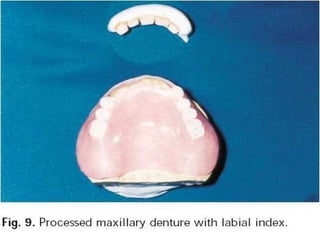
 Labial index containing the artificial
teeth was placed back on the stone
cast and autopolymerization acrylic
resin .
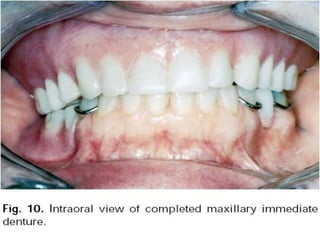
 After acrylic resin had set the denture
should polished and adjusted , the
remaining teeth were then extracted
and the immediate maxillary denture
was inserted .
Surgery and immediate
denture insertion
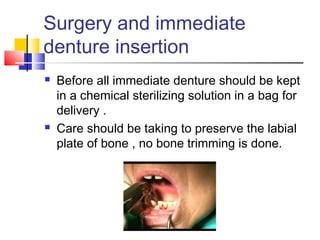
 Before all immediate denture should be kept
in a chemical sterilizing solution in a bag for
delivery .
 Care should be taking to preserve the labial
plate of bone , no bone trimming is done.
Surgery and immediate
denture insertion
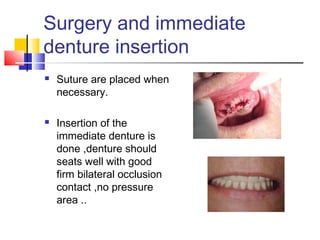
 Suture are placed when
necessary.
 Insertion of the
immediate denture is
done ,denture should
seats well with good
firm bilateral occlusion
contact ,no pressure
area ..
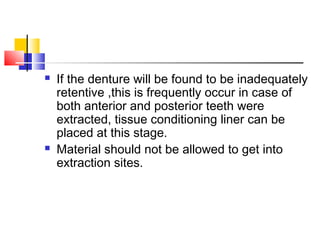
 If the denture will be found to be inadequately
retentive ,this is frequently occur in case of
both anterior and posterior teeth were
extracted, tissue conditioning liner can be
placed at this stage.
 Material should not be allowed to get into
extraction sites.
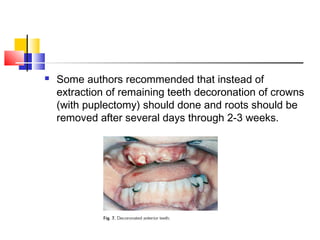
 Some authors recommended that instead of
extraction of remaining teeth decoronation of crowns
(with puplectomy) should done and roots should be
removed after several days through 2-3 weeks.
Advantages
 1.better visualization (less blood)
 2.shorter placement visit .
 3.minimum pain and swelling .
 4.easily distinguishing sore spots at
adjustment visit .
Disadvantages
 1.no tissue collapse that can be
planned when setting denture.
 2.root extraction may be more difficult
without the clinical crown .
 **Contraindication of this procedure:
 Acutely infected teeth and sever
bilateral undercut.
Post-operative care and
patient instruction
 First 24 hour :
 Patient should avoid removing the immediate
denture.
 Patient should avoid hard food and drinking hot fluids
or alcohol .
 Patient can partially control inflammation and swelling
by using ice pack .
 Patient should be reminded that the pain from
extraction will not reduced by removal the denture.
 Analgesic , antibiotic , are prescribed to patient.
Patient should be seen after
24 hours for:
 Denture should be rinsed and washing
patient mouth with dilute mouth wash.
 Quickly checking the tissue sore spots
related to denture.
 Adjustment of over extension and any
gross occlusal discrepancy .
 The denture should be kept out of
patient mouth only for short time.
First post-operative week
 Patient should wear the denture at night
for first 7 days after extraction or until
swelling reduction .
 Suture removal if present and changing
tissue conditioner if use .
Farther follow up care
 Patient should be seen one month later,
4-6 months intervals .
 The major reason for frequency of
changing temporary liner depend on the
rate and amount of bone resorption and
ability of patient to keep the liner clean.
 Relining may be necessary to achieve
esthetic and occlusion requirement.
Immediate denture

Immediate denture

  • 2.
  • 3.
    Immediate Denture Definition: Is adenture constructed and fabricated before the remaining natural teeth have removed to be placed and inserted immediately after removal of remaining natural teeth. Is the most effective way of making the transition from the natural to the artificial dentition.
  • 5.
     Immediate dentureare more challenging to dentist and the patient because a try in is not possible before and, the patient may not be completely comfortable with the resulting appearance and fitness .
  • 6.
    Indication:  1.hopless remainingteeth .  2.educated patient with daily social activities ;Dr,lawyers,teachers.  3.patient with stable health condition.
  • 7.
    Contraindication:  1.patient withpoor general health (systemic disease )  2.patient is not wiling to accept the treatment mentally and psychologically.  3.uncooprative patient.  4.patient at risk from bacterimia.  5.patient with genuine history of post extraction hemorrhage .  6.the presence of oral sepsis .
  • 8.
    Advantages of immediate denture: A. advantages related to patient :  1.maintainance of dental appearance and facial contour because there is no edentulous period.  2.minimizing disturbances of mastication and speech.  3.less post-operative pain and bleeding (protecting splint over the extracted sight )  4.the patient is likely to adapt more easily to denture  5.overall the patient”s psychological and social well being is preserved .
  • 9.
    Advantages of immediate denture: B.related to dentist :  1.transfer of the jaw relationship :if the jaw relationship determined by the occlusion of the remaining of the natural teeth is acceptable in both horizontal and vertical planes.  2.achieving good appearance .  3.haemostasis .
  • 10.
    Disadvantages of immediate denture It is important for the dentist to fully explain to the patient the following limitations of immediate denture , treatment should not normally be started unless the patient fully appreciate and accepts these limitations .  1.inability to complete a comprehensive trail stage so patient esthetic may not be fulfilled specially when anterior teeth are to be replaced.  2.increased maintenance and more clinical visits.  3.short service life.  4. Immediate dentures are usually more expensive because of the additional time required for their construction
  • 11.
    Classification of immediate denture: According to treatment plan.  A. conventional immediate denture  B. interim immediate denture  According to flange design .  A. flanged type.  B. flangeless type (open face or close fit )
  • 12.
    According to flangedesign:  1.flanged type :  A. complete flange .  b. partial flange .  2.open-faced .
  • 13.
    Comparisons of flangedand open faced denture:  1.Appearance  2.stability  3.Strength  4.Maintenance  5.Heamostasis  6.Remodelling of the ridge  7.Tolerance of replacement denture
  • 14.
    Appearance  1.appearance offlanged denture does not altered after fitting where the appearance of open – face denture (although good initially) can deteriorate rapidly as resorption create a gap between the necks of the teeth and ridge  2.the flanged denture allows freedom in the positioning of teeth ,where,in open face denture teeth have to be positioned in the sockets of the natural teeth  *so on case of malpositional teeth we can do good alignment in flanged denture while we can not in open face type
  • 15.
    stability  In upperdenture: a flange on an upper denture create a more effective borders seal , therefore , better retention than is achieved with an open face denture  In lower denture: open face denture is not usually constructed because of poor stability of lower denture during function , so flange denture is commonly used *so flange denture is better from the point of stability
  • 16.
    strength  1.the presenceof labial flange produces a stronger denture .  2.labial flange will make the denture stiffer so the midline fatigue fracture cause by repeated flexing across the midline is reduced .  *so from the point of strength the flange denture is better .
  • 17.
    maintenance  1.as thebone resorped following extraction the denture become loose and a reline is required , so the presence of labial flange make it easer to add either a short – term soft lining materials or a cold curing relining materials as a chair side procedure.  2.as the color of some reline materials is not always ideal they may be visible when used with open face denture.
  • 18.
    haemostasis  1.the flangedenture cover the clot completely and protect them more effectively .  2.the flange denture exerts pressure on both lingual and labial gingiva reducing post extraction hemorrhage .
  • 19.
    Remodeling of theridge:  The consequence wearing of ill fitting denture can lead to:  If it is open face ,will produce a scalloped ridge in the region of the socketed teeth  In flange denture ,distribution the functional loads more favorably to the underlying ridge, thus minimizing bone resorption
  • 20.
    Tolerance of replacement denture When patient have got used to an open face immediate denture there is difficulty to accept a denture with labial flange in future and patient will complain from the fullness of the lip  If flange denture had worn from the beginning this problem does not occur .
  • 21.
     When theridge morphology produce deeply undercut area it may not be possible to fit a full labial flange unless there is surgical reduction  In this case the using of partially flange denture or open face denture is preferable when surgical procedure is contraindication .
  • 22.
     In thesecircumstances selection of the correct path of insertion of the denture is essential .
  • 23.
    Preparation stage:  Beforethe beginning of the procedure the patient should be prepared :  1.proper patient selection .  2.maitaining good oral hygiene prior to extraction to enhance healing .  3.if multiple extraction is needed (posterior and anterior ) its advisable to extract posterior teeth keeping some to preserve vertical dimension .  4.study (primary ) cast ,to plan the treatment and to construct special tray .
  • 24.
    Clinical and laboratory procedures: 1.properly selected stock tray and taking primary impression .
  • 25.
     In caseof hyper mobile anterior teeth impression materials can act as instrument of extraction ,so avoiding of the problem can done by:  1.applying a lubricant medium to the teeth .  2. in case of adjacent teeth to each others applying moulding soft wax into sub-contact point spaces and around the necks of teeth so that the impression material is prevented from locking into the undercuts .
  • 26.
    Custom tray ,finalimpression and master cast:  There are many types of special trays and impression techniques .  There are two basic ways to fabricate the final impression tray ,depending on the location of the remaining teeth and operator preference ,both are succeful:  Type one: single full arch custom tray  Type two: two trays or sectional impression tray.
  • 27.
    Single full archcustom impression tray  It more closely resembles a routine custom tray used for removable partial denture.  This type of tray is effective when only anterior teeth are remaining or when anterior and posterior teeth are remaining.
  • 28.
    Two trays orsectional impression tray  This method used only when the posterior teeth are not present .  It involve fabricating two trays on the same cast ,one in the posterior which is made like in complete denture (close fitted )
  • 29.
     The secondtray placed in the anterior (backless tray) or we can use stock tray in combination with posterior tray .
  • 30.
    Jaw relation  Doingthat by using record bases and occlusion bit rims , and the vertical dimension recorded , centric relation is recoded also and transferring to articulator in the normal procedure used with complete or partial denture .
  • 31.
    Setting the posteriorteeth, verifying jaw relation ,and try-in of posterior teeth appointment  A try-in procedure is not always possible (especially when all teeth or number of posterior teeth are present)  But the mounting casts should still be confirmed at patient visit.
  • 32.
    Try-in appointment:  1.Setthe posterior teeth .  2.the denture base and posterior teeth are try-in the mouth :  -verifying vertical dimension of occlusion  -centric relation as with complete denture  3.record land marks on the cast to confirm the patient”s esthetic  A : midline or newly selected midline is recorded on the base area of the master cast.  B :the anterior plane of occlusion  C :ala-tragus plane should be located and noted .  D :high lip line should be determined on the cast.  4.anterior teeth selection is confirmed with patient .
  • 33.
    Setting the anteriorteeth  If the arrangement of the natural anterior teeth is to be reproduced in denture a recording of their position must be obtained in one of the following ways
  • 34.
    Setting of anteriorteeth  First way: produce a labial index of the natural teeth before they are cut off the cast.  The index can be produced quite simply by moulding silicone putty against the labial surface of the teeth and ridge on the cast.  then the artificial teeth are then set into the index while its held against the cast.
  • 35.
    Setting of anteriorteeth  Second way: remove teeth singly from the cast and immediately wax an artificial teeth into position so that the adjecent teeth serve as a guide to the position of the artificial replacement .
  • 36.
    Setting of anteriorteeth  Third way: scribe guidelines on the cast recording the position , angulations and incisal level of the natural teeth .
  • 37.
    In case ofelimination moderate labial alveolar undercut (alvealoplasty(  The denture is constructed on a working cast which is trimmed to the anticipated contour of the ridge after surgery.
  • 38.
     1.the gingivalmargins are marked and teeth removed.  2.guidlines are drawn on the cast .  3.all the part of the cast contained within these two lines is trimmed away and the edges are rounded over .  4.a clear acrylic template is processed on a duplication of this cast and is used as a guide to control the amount of bone removal at operation .
  • 39.
    Surgical procedure:  1.extractionof the teeth .  2.removal of the associated interseptal bone and reducing the undercut .  3.collape ( squeezing ) of the labial cortical plate of the bone .  4.isertion of the clear acrylic template to check if bone removal has been sufficient .  5.farther bone removal ,if necessory, until re-insertion of the template cease to cause blanching .  6.suturing the socket and insertion of the immediate denture.
  • 40.
    Arrangement of theanterior teeth in open face denture:  1.prepertion of tooth socket on the cast, 2-5mm depth depending on the amount of the gingival retraction which depend on the degree of pocketing and bone loose that is present around the natural teeth.  2.the neck of the artificial tooth is placed in preparation site.  3.at the time of insertion the neck will just enter the socket of natural tooth after extraction.
  • 41.
    Clinical report oftry-in procedure of anterior teeth
  • 42.
    Fig 1  Intraoral view of patient with interim maxillary and mandibular R.P.D ,note presence of diastema between maxillary left central and lateral incisors
  • 44.
     Step1: primaryimpression were made and cast were prepared .  Step2: final impression is made and stone cast is made .  Step3: jaw relation is recorded and vertical dimension also recorded .  Step4: arrangement of posterior teeth is done and tried in the patient mouth as seen in the fig 2
  • 46.
     Posterior artificialteeth arranged with the processed maxillary denture as in the fig 3
  • 48.
     To relatethe new maxillary denture to remaining teeth and supporting tissue , an impression of the adjusted denture was made with an irreversible hydrocolloid impression material and new maxillary cast was fabricated as shown in fig 4,5
  • 51.
     The maxillarydenture was then inserted in the patient mouth and centric relation record was made to facilitated the mounting of the maxillary cast .  The maxillary artificial anterior teeth were arranged to reflect the position of the patient natural teeth , this duplicated the diastema between the maxillary left central and lateral incisors .
  • 53.
     To placethe completed artificial teeth arrangement in the patient mouth for esthetic observation , modifications had to be made to the remaining natural teeth .  Teeth will sectioned at the gingival margins .
  • 55.
     The completedartificial teeth arrangement could then be tried in the mouth in a blood –free field
  • 57.
     To preservethe final position of try in anterior teeth arrangement , a thin layer of separating medium was painted on the portion of stone cast and labial index of the completed anterior artificial teeth arrangement was made with plaster .
  • 58.
     After plasterhad set immersion of the cast in hot water this allowed the wax in the anterior region to soften and facilitated the separation of the labial index , remaining wax was eliminated by boiling , the anterior artificial teeth were secured to the labial index with sticky wax .
  • 60.
     The exposedportion of the anterior maxillary cast , visible through the window in the processed denture was painted with separating medium .  Labial index containing the artificial teeth was placed back on the stone cast and autopolymerization acrylic resin .
  • 61.
     After acrylicresin had set the denture should polished and adjusted , the remaining teeth were then extracted and the immediate maxillary denture was inserted .
  • 63.
    Surgery and immediate dentureinsertion  Before all immediate denture should be kept in a chemical sterilizing solution in a bag for delivery .  Care should be taking to preserve the labial plate of bone , no bone trimming is done.
  • 64.
    Surgery and immediate dentureinsertion  Suture are placed when necessary.  Insertion of the immediate denture is done ,denture should seats well with good firm bilateral occlusion contact ,no pressure area ..
  • 65.
     If thedenture will be found to be inadequately retentive ,this is frequently occur in case of both anterior and posterior teeth were extracted, tissue conditioning liner can be placed at this stage.  Material should not be allowed to get into extraction sites.
  • 66.
     Some authorsrecommended that instead of extraction of remaining teeth decoronation of crowns (with puplectomy) should done and roots should be removed after several days through 2-3 weeks.
  • 67.
    Advantages  1.better visualization(less blood)  2.shorter placement visit .  3.minimum pain and swelling .  4.easily distinguishing sore spots at adjustment visit .
  • 68.
    Disadvantages  1.no tissuecollapse that can be planned when setting denture.  2.root extraction may be more difficult without the clinical crown .  **Contraindication of this procedure:  Acutely infected teeth and sever bilateral undercut.
  • 69.
    Post-operative care and patientinstruction  First 24 hour :  Patient should avoid removing the immediate denture.  Patient should avoid hard food and drinking hot fluids or alcohol .  Patient can partially control inflammation and swelling by using ice pack .  Patient should be reminded that the pain from extraction will not reduced by removal the denture.  Analgesic , antibiotic , are prescribed to patient.
  • 70.
    Patient should beseen after 24 hours for:  Denture should be rinsed and washing patient mouth with dilute mouth wash.  Quickly checking the tissue sore spots related to denture.  Adjustment of over extension and any gross occlusal discrepancy .  The denture should be kept out of patient mouth only for short time.
  • 71.
    First post-operative week Patient should wear the denture at night for first 7 days after extraction or until swelling reduction .  Suture removal if present and changing tissue conditioner if use .
  • 72.
    Farther follow upcare  Patient should be seen one month later, 4-6 months intervals .  The major reason for frequency of changing temporary liner depend on the rate and amount of bone resorption and ability of patient to keep the liner clean.  Relining may be necessary to achieve esthetic and occlusion requirement.