CENTRIC JAW RELATION
PRESENTED BY –
DR. PRAJAKTA BALI GIR
MDS 2ND YEAR PG
1
CONTENT
 INTRODUCTION
 TERMINOLOGIES
 MUSCLES INVOLVED IN CENTRIC RELATION
 THEORIES OF CENTRIC RELATION
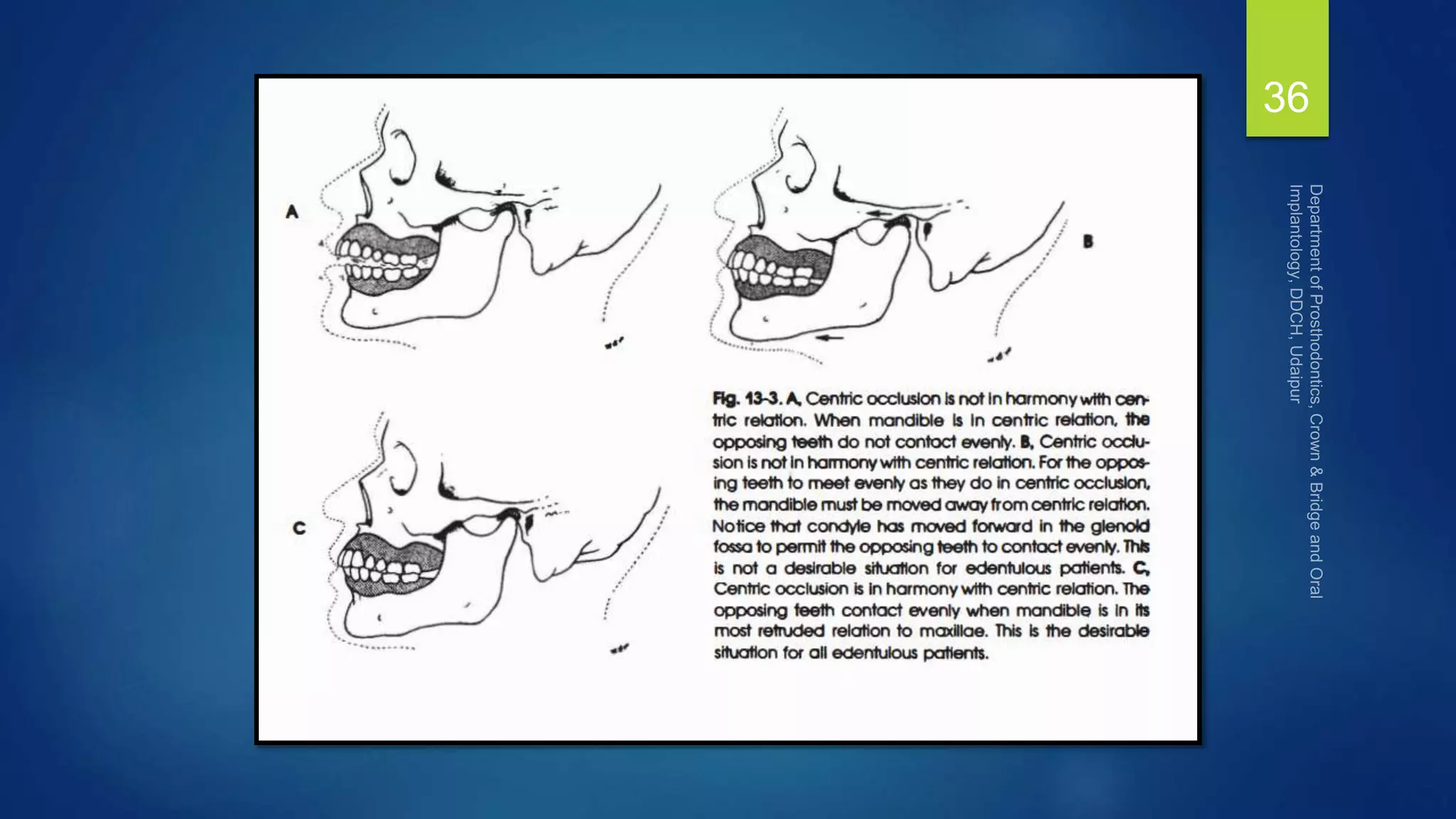
 RELATING CENTRIC RELATION TO CENTRIC OCCLUSION
 RELATING CENTRIC RELATION TO HINGE AXIS
 RELATING CENTRIC AND VERTICAL RELATIONS
2
CONTENT
 RECORDING CENTRIC RELATION :
o CONFLICTING CONCEPTS AND OBJECTIVES IN RECORDING CENTRIC
RELATION
o COMPLICATIONS IN RECORDING CENTRIC RELATION
o RETRUDING THE MANDIBLE IN CENTRIC RELATION
• METHODS OF RECORDING CENTRIC RELATION
• SIGNIFICANCE OF CENTRIC RELATION
• CONCLUSION
• REVIEW OF LITERATURE
• REFERENCES
3
INTRODUCTION
 Following the orientation of maxilla and determination of vertical dimension, the
final relation to be recorded is the horizontal relation.
 Horizontal jaw relation is the relation that is established antero-posteriorly and
medio-laterally.
4
INTRODUCTION
 IT IS CLASSIFIED AS:
 1. Centric relation.
 2. Eccentric relation.
A. Protrusive relation.
B. Lateral relation.
 I. Right lateral relation.
 II. Left lateral relation
5
CENTRIC RELATION
 Theoretically CR is being discussed under the heading of jaw relations.
 Jaw relations are the relationships of the mandible with the maxilla.
 In this context too much importance was given to the position of the head of the
condyles in the glenoid fossa which ultimately resulted in a lot of confusion.
 This confusion was due to the invisibility of the most unique, enigmatic
temporomandibular joint.
6
Palaskar, J.N., Murali, R. & Bansal, S.
Centric Relation Definition: A Historical
and Contemporary Prosthodontic
Perspective. J Indian Prosthodont Soc
CENTRIC RELATION
 For almost the last six decades we assumed CR to be the most retruded position of
the heads of the condyles in the glenoid fossae.
 Recently we could come to a conclusion that it is not the most retruded position of
the heads of the condyles but rather the most anterior and superior position.
 The acceptance of one definition is necessary to improve communication at all
levels of dentistry.
 Definition of CR has created more controversy than any other dental subjects,
several factors contributed to this confusion.
7
Palaskar, J.N., Murali, R. & Bansal, S.
Centric Relation Definition: A Historical
and Contemporary Prosthodontic
Perspective. J Indian Prosthodont Soc
CENTRIC RELATION
 This article is a review of all the definitions given till date and it has been
organized as follows :
1) CR from 1929 to 1970,
2) in 1970–1980,

3) and through 1980–2010
8
Palaskar, J.N., Murali, R. & Bansal, S.
Centric Relation Definition: A Historical
and Contemporary Prosthodontic
Perspective. J Indian Prosthodont Soc
CENTRIC RELATION FROM 1929 TO 1970’S
 Hanau [1929] defined CR as ‘the position of the mandible in which the condylar
heads are resting upon the menisci in the sockets of the glenoid fossa, regardless
of the opening of the jaws’.
 Goodfriend [1933] considered the ‘centricity of the condyles in centric relation to
be an abnormal position’.
 Niswonger [1934] described CR as a position where the patient can ‘clench the
back teeth’
 Schuyler [1935] defined CR as ‘upper lingual cusps are resting in the central
fossae of the opposing lower bicuspids and molars’
9
CENTRIC RELATION FROM 1929 TO 1970’S
 Thompson [1946] stated that ‘some believed that, in CR, the condyles are in the
most retruded position in the fossae, while others maintained they are not’.
 Robinson [1951] stated that the mandible ‘can be retruded beyond what we should
consider centric into a strained retruded position’.
 McCollum and Stuart [1955] proposed a definition for CR in which the condyles
are in a ‘rearmost, uppermost and midmost (RUM) position in the glenoid fossae’
 Moyers [1956] defined CR as ‘the position of the mandible as determined by the
neuromuscular reflex first learned for controlling the mandibular position when
the primary teeth were in occlusion’
10
CENTRIC RELATION FROM 1929 TO 1970’S
 Stallard [1959] defined CR of the mandible as ‘the rearmost, midmost,
untranslated hinged position. It is a strained relation as are all border relations. It is
the only maxillamandibular relation that can be statically repeated’
 Avant [1960] declared the ‘seven definitions of CR’ that appeared in GPT-2
[1960], as ‘regrettable’ and stated that CR is a bone-to-bone (mandible to maxilla)
relation, whereas centric occlusion is a tooth-to-tooth (mandibular teeth to
maxillary teeth) relation.
 McCollum [1960] defined CR position as ‘the most retruded position of the idle
condyles in the glenoid fossa’
11
CENTRIC RELATION FROM 1929 TO 1970’S
 Boucher [1964] stated ‘CR is the most posterior relation of the mandible to
maxillae at the established vertical relation’ .
 Graber [1966] thought that CR was an ‘unstrained, neutral position of the
mandible and is deviating neither to the right nor to the left and is neither
protruded nor retruded’ .
 Glickman [1966] stated that CR was ‘the most retruded position to which the
mandible can be carried by the patient’s musculature’
12
CENTRIC RELATION FROM 1929 TO 1970’S
 Goldman and Cohen [1968] defined CR as ‘the most posterior relation of the
mandible to maxilla from which lateral movements can be made’
 Debate on the definition of CR escalated.
 Posterior border closure, relaxed closure, bracing position, hinge position,
ligamentous position, retruded contact position, terminal hinge position added
confusion to term
 CR. Schweitzer [1969] gave ‘almost 40 definitions of CR
13
CENTRIC RELATION FROM 1970 TO 1980’S
 Dawson [1973] defined CR as ‘the most superior position the condyle can assume
in the glenoid fossa and it is not unstrained’ .
 Smith [1975] considered CR to be ‘the most retruded position of the mandible’
and concluded that the gothic arch tracing provides the most retruded and most
repeatable position and thus was the most precise method.
 Williamson et al. [1977] stated that the hinge axis and CR are the same; adding
that this axis occurs when the mandible is in CR and a pure rotational movement
of the mandible is produced in the sagittal plane
14
CENTRIC RELATION FROM 1970 TO 1980’S
 Lucia [1979] stated that ‘the mandible is in CR when the centers of vertical and
lateral motion are in the terminal hinge position’ .
 Myers et al. [1980] defined CR as ‘the most posterior unstrained relation of the
mandible to the maxilla at a given degree of jaw separation’. They stated that the
more posterior the condyles, the more acceptable the position
15
CENTRIC RELATION FROM 1980 TO 2010
 Gilbe [1983] defined CR as ‘the most superior position of the mandibular
condyles with the central bearing area of the disc in contact with the articular
surface of the condyle and the articular eminence. This position may not always be
possible to attain due to anterior dislocation of the disc .
 Dawson in 1985 stated that ‘CR is achieved when the properly aligned condyle-
disk assemblies are in the most superior position against the eminentia irrespective
of tooth position or vertical dimension’
16
CENTRIC RELATION FROM 1980 TO 2010
 American College of Prosthodontist [1994] defined CR as ‘the spatial relationship
between the maxilla and mandible where the condyles relate to the articular
eminence in a ventro-cranial position with the pars intermedia of the disc’
17
GPT DEFINITIONS
 GPT-1 [1956] defined CR as ‘the most retruded relation of the mandible to the
maxilla when the condyles are in the most posterior unstrained position in the
glenoid fossa from which lateral movements can be made, at any given degrees of
jaw separation’
18
GPT DEFINITIONS
 GPT-2 [1960] defined the CR as ‘the most posterior relation of the mandible to the
maxilla at the established vertical relation’,
 GPT-3 [1968] defined CR as ‘the most retruded physiologic relation of the
mandible to the maxilla and from which the individual can make lateral
movements’. It is a condition that can exist at various degrees of jaw separation. It
occurs around the terminal hinge axis .
19
GPT DEFINITIONS
 GPT-4 [1977] defined CR as ‘the jaw relation when the condyles are in the most
posterior, unstrained position in the glenoid fossa at any given degree of jaw
separation from which lateral movements can be made’
20
GPT DEFINITIONS
 GPT-5 and 6 [1987, 1994] defined the CR as ‘the relation of the mandible to the
maxilla when the condyles are in their most posterior position in the glenoid fossa
from which unstrained lateral movements can be made at occluding vertical
dimension normal for the individual’
21
GPT DEFINITIONS
 GPT-7 [1999] defined centric relation as ‘a maxillomandibular relationship in
which the condyles articulate with the thinnest avascular portion of their
respective disks with the complex in the anterosuperior position against the shapes
of the articular eminences. This position is independent of tooth contact. This
position is clinically discernible when the mandible is directed superiorly and
anteriorly and restricted to a purely rotary movement about a transverse horizontal
axis’
22
GPT DEFINITIONS
 GPT – 8 the maxillomandibular relationship in which the condyles articulate with
the thinnest avascular portion of their respective disks with the complex in the
anterior– superior position against the shapes of the articular eminencies. This
position is independent of tooth contact. This position is clinically discernible
when the mandible is directed superior and anteriorly. It is restricted to a purely
rotary movement about the transverse horizontal axis
23
Meaning and Controversies in definitions of
GPT 4(static morphological definition) and
GPT5(Functional definition)
 The two definitions taken from glossary of prosthodontic terms (GPT-4 and GPT-
5) appear to contradict each other.
 The earlier definition mentions of a most posterior position of condyles in glenoid
fossa while the latter definition speaks of an anterior superior position of condyle
against the slopes of the articular eminence.
24
Meaning and Controversies in definitions of
GPT 4(static morphological definition) and
GPT5(Functional definition)
 But surprisingly, the discrepancy between the two positions is only approximately
0.2 mm.
 Theoretically, the difference is only on the emphasis of the condylar position.
25
 Maximal intercuspal position (MIP): The complete intercuspation of the opposing
teeth independent of condylar position, sometimes referred to as the best fit of the
teeth regardless of the condylar position, is also called maximal intercuspation.
 Centric occlusion (CO): The occlusion of opposing teeth when the mandible is in
CR. This may or may not coincide with the MIP.
 CR is a bone-to-bone relation, while MIP and CO are tooth-to-tooth relation.
26
MUSCLES INVOLVED IN CENTRIC
RELATION
 Centric relation is not resting or postural position of the mandible.
 Contraction of muscles is necessary to move and fix the mandible in this position.
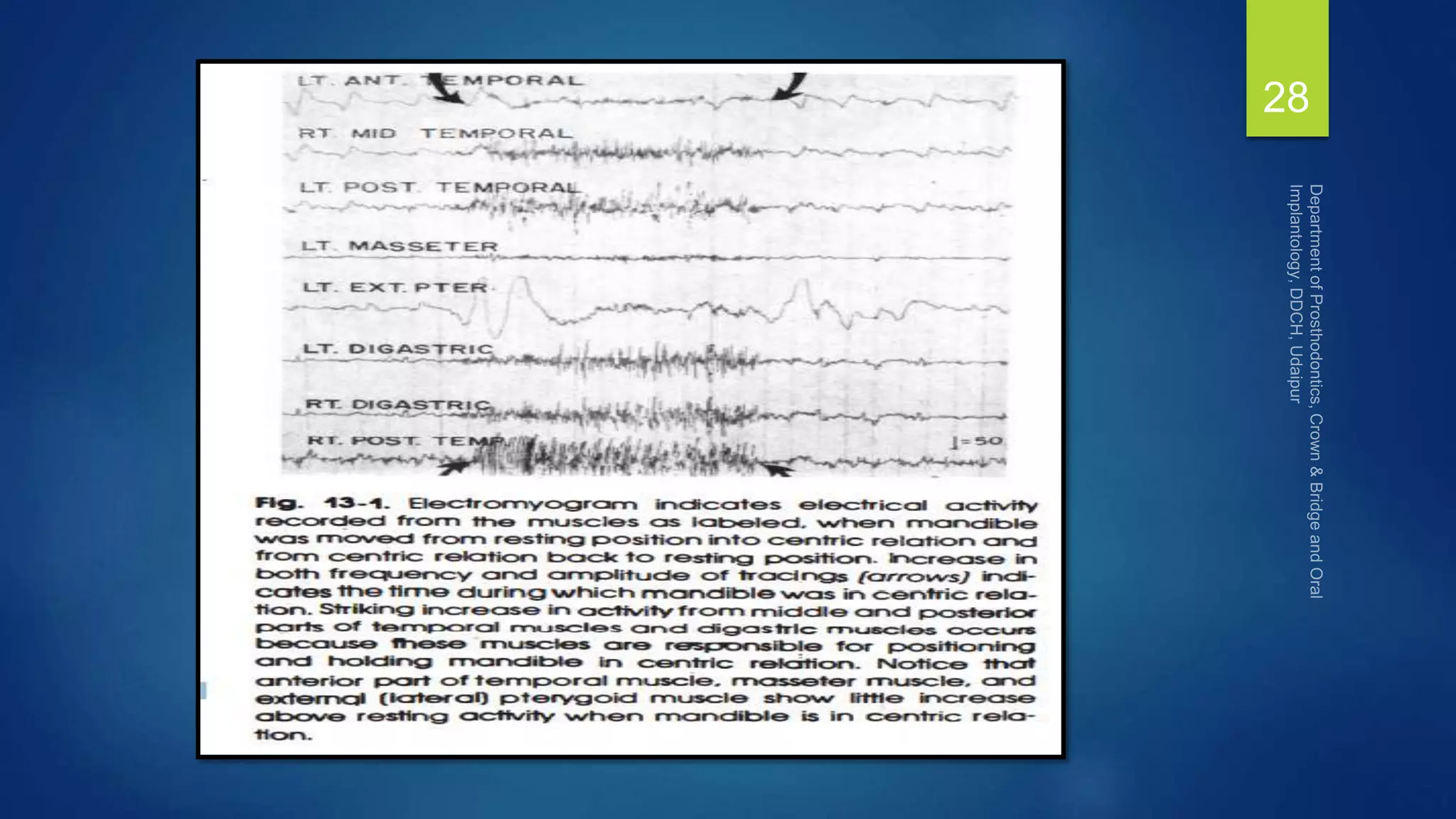
 The anatomic attachments of the posterior and middle parts of the temporal and
suprahyoid muscles together with EMG studies show that these muscles move and
fix the mandible in its most retruded relation to maxilla.
 Temporal , masseter and medial pterygoid muscles elevate the mandible.
 The lateral pterygoid muscle shows little activity when mandible is in centric
relation.
27
28
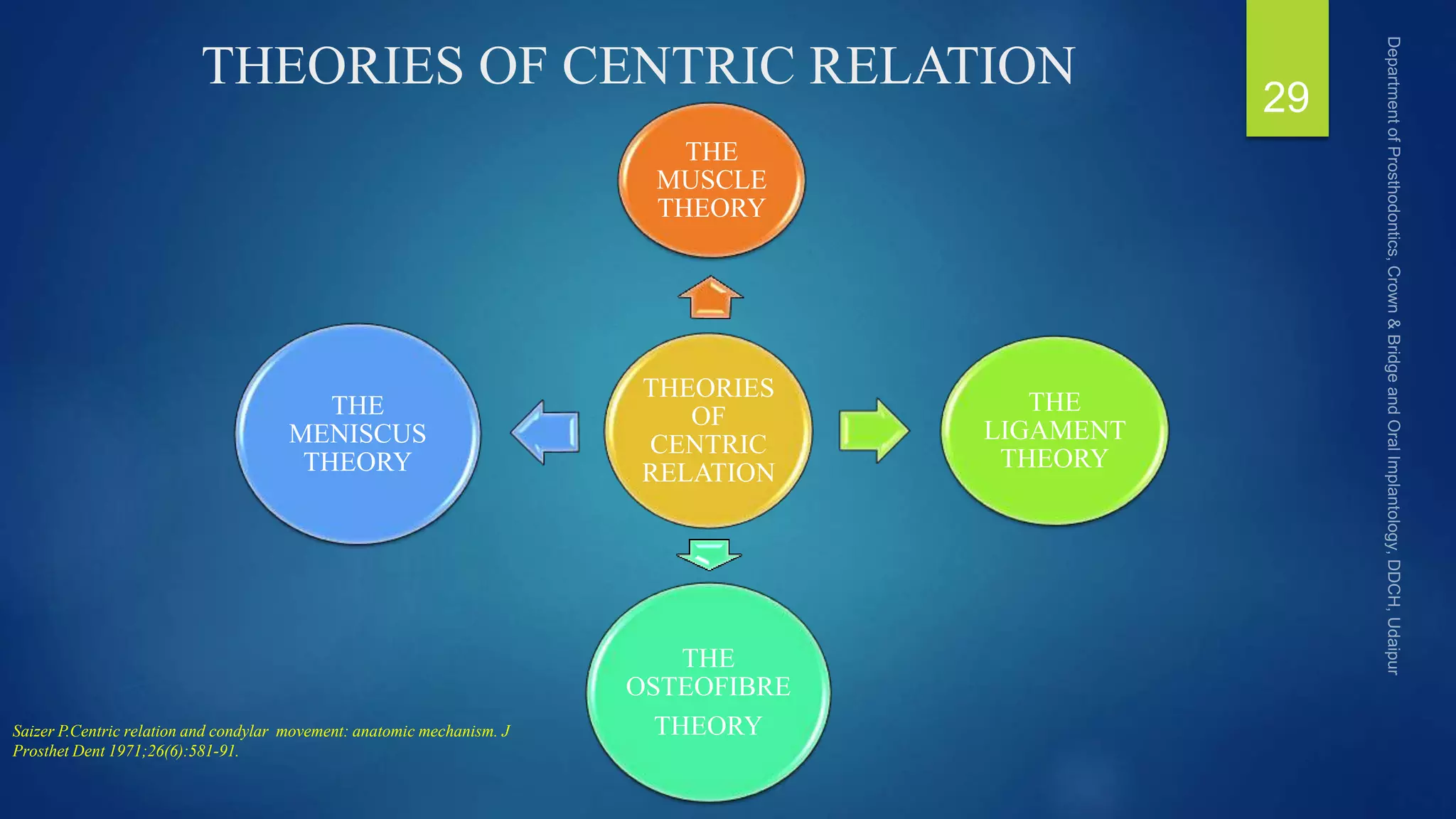
THEORIES OF CENTRIC RELATION
THEORIES
OF
CENTRIC
RELATION
THE
MUSCLE
THEORY
THE
LIGAMENT
THEORY
THE
OSTEOFIBRE
THEORY
THE
MENISCUS
THEORY
29
Saizer P.Centric relation and condylar movement: anatomic mechanism. J
Prosthet Dent 1971;26(6):581-91.
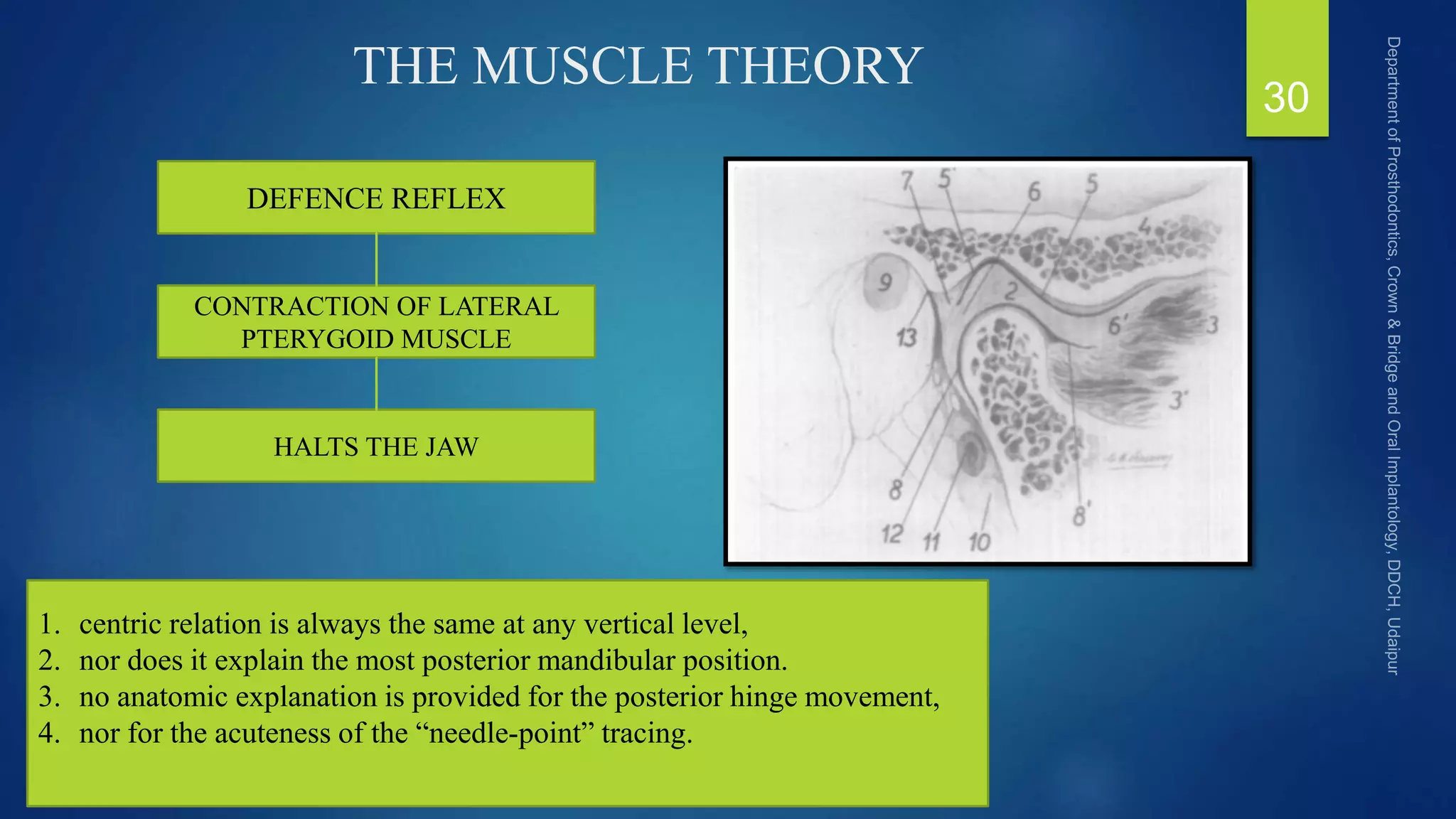
THE MUSCLE THEORY
30
DEFENCE REFLEX
CONTRACTION OF LATERAL
PTERYGOID MUSCLE
HALTS THE JAW
1. centric relation is always the same at any vertical level,
2. nor does it explain the most posterior mandibular position.
3. no anatomic explanation is provided for the posterior hinge movement,
4. nor for the acuteness of the “needle-point” tracing.
THE LIGAMENT THEORY
31
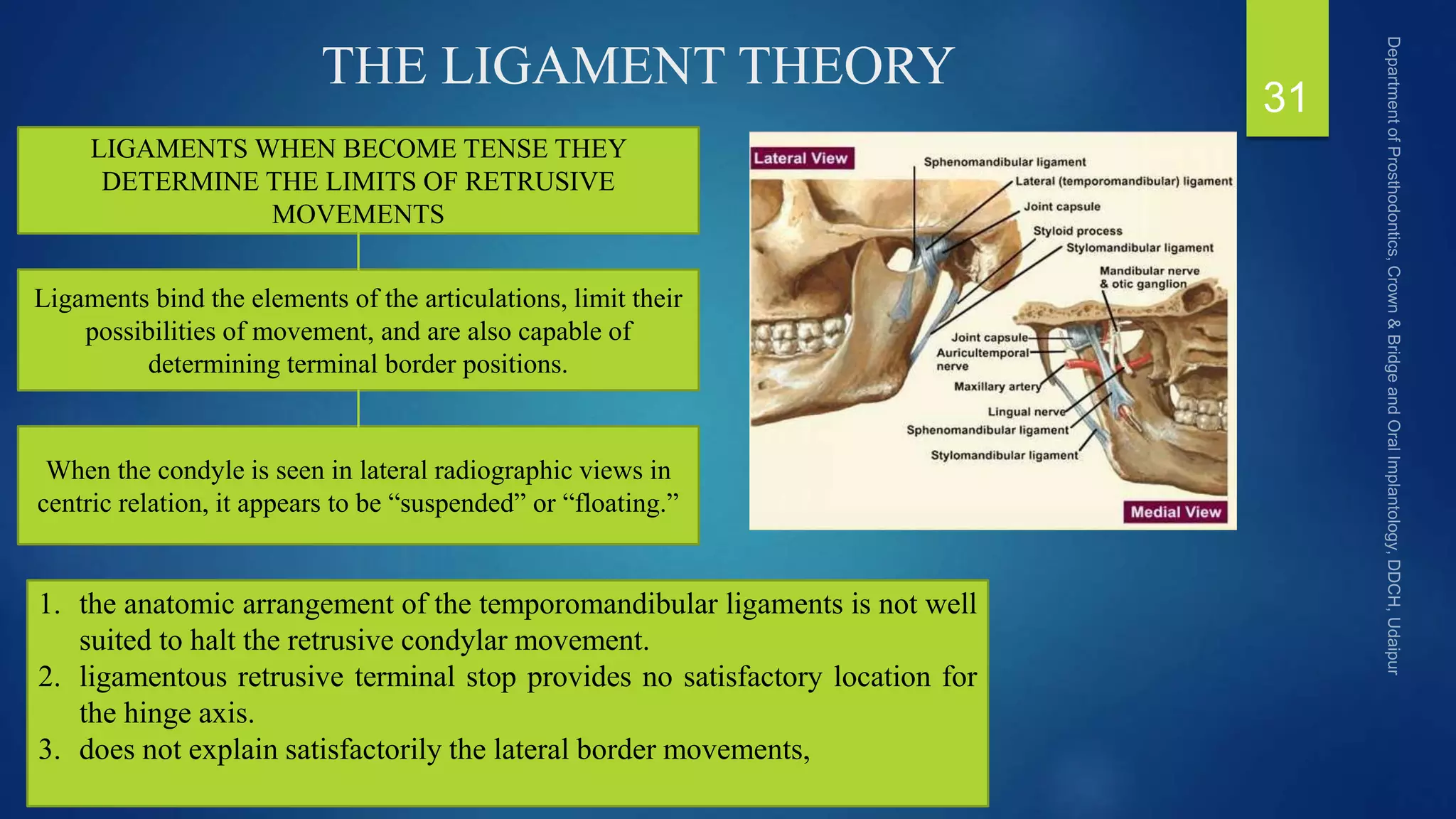
LIGAMENTS WHEN BECOME TENSE THEY
DETERMINE THE LIMITS OF RETRUSIVE
MOVEMENTS
Ligaments bind the elements of the articulations, limit their
possibilities of movement, and are also capable of
determining terminal border positions.
When the condyle is seen in lateral radiographic views in
centric relation, it appears to be “suspended” or “floating.”
1. the anatomic arrangement of the temporomandibular ligaments is not well
suited to halt the retrusive condylar movement.
2. ligamentous retrusive terminal stop provides no satisfactory location for
the hinge axis.
3. does not explain satisfactorily the lateral border movements,
THE OSTEOFIBER THEORY
32
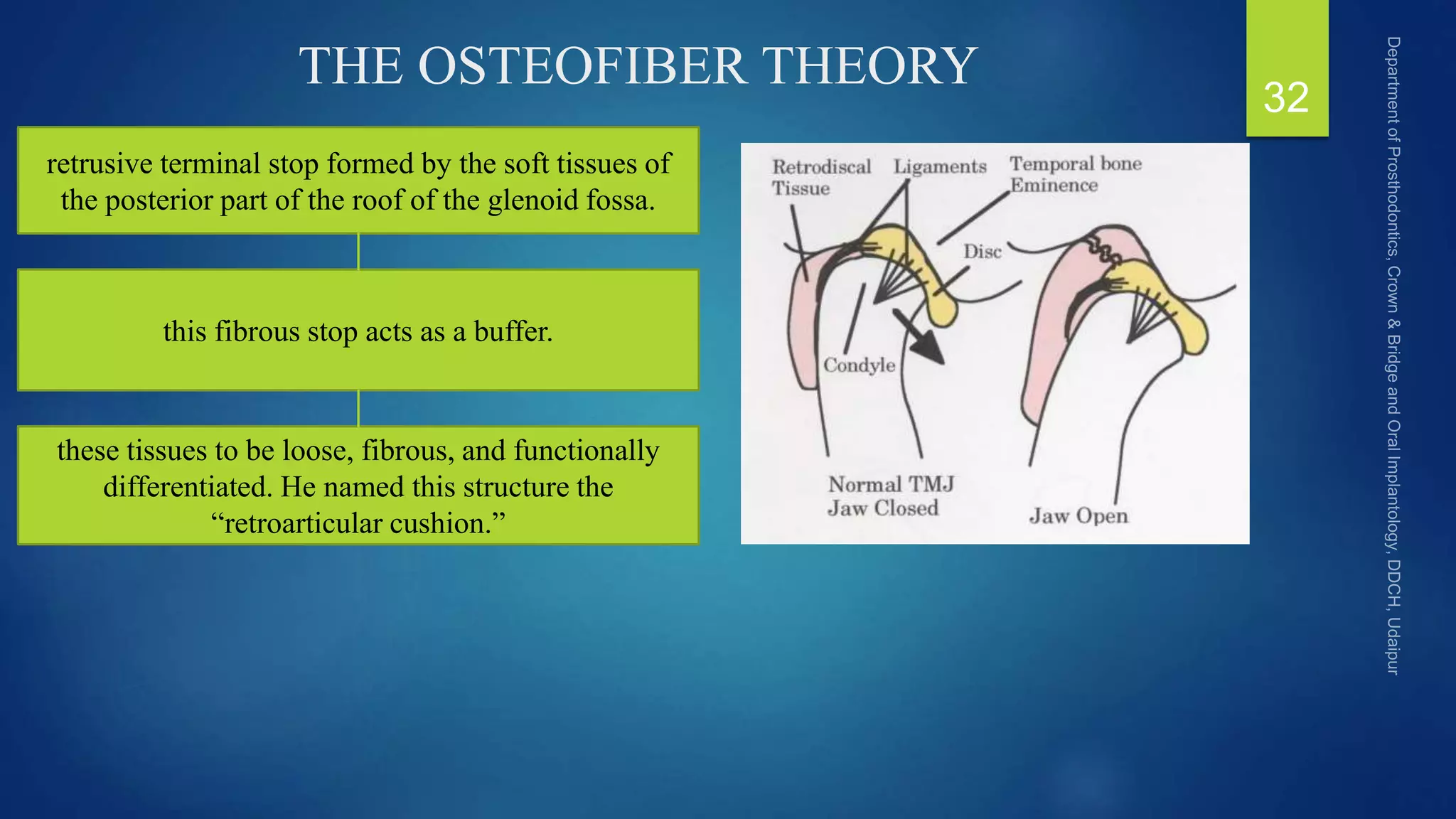
retrusive terminal stop formed by the soft tissues of
the posterior part of the roof of the glenoid fossa.
this fibrous stop acts as a buffer.
these tissues to be loose, fibrous, and functionally
differentiated. He named this structure the
“retroarticular cushion.”
THE MENISCUS THEORY
33
When the disc is in its postural position, or close to it,
the upper synovial cavity continues down and
backward, within the retroarticular fibrous tissues
Discs with their retromeniscal fibrous tissues--stop
the retrusive condylar movements
RELATING CENTRIC RELATION TO
CENTRIC OCCLUSION
 Centric relation must be accurately recorded so that centric occlusion can be made
to coincide with it.
34
 In the natural dentition CO is usually located anterior to CR, the average
distance being 0.5 to 1 mm. If natural tooth has interferences in CR
it initiate impulses and responses that direct the mandible away
from deflective occlusal contacts into CO.
 Impulses created by closure of the teeth into CO establish memory
patterns that
 permit the mandible to return to this position, usually without tooth
interferences
RELATING CENTRIC RELATION TO
CENTRIC OCCLUSION
35
The edentulous patient cannot control mandibular movements
or avoid deflective occlusal contacts in CR in the same
manner as the dentulous patient.
Deflective occlusal contacts in CR cause movement of denture
bases and displacement of the supporting tissues or direct the
mandible away from this relation
36
RELATING CENTRIC RELATION TO HINGE
AXIS
37
The upper cast can be accurately oriented to the opening axis of the articulator by
the location of the physiologic transverse hinge axis and a facebow transfer.
Opening and closing the jaws with mandible in its most retruded position to maxilla
( terminal hinge axis ) is the method used to locate transverse hinge axis. They
occur without translation.
Centric relation is the most retruded relation of mandible to maxilla at a particular
vertical relation along pathway of terminal hinge movement.
So the lower cast automatically gets oriented to opening axis of articulator with
accurate centric relation recorded.
RELATING CENTRIC AND VERTICAL
RELATIONS
38
There is a most retruded relation of mandible to maxilla for each
vertical relation, and there is a change in the horizontal relationship
of mandible to maxilla with each change in vertical relation
Thus when the centric relation record is made at or very close to
the desired vertical relation of occlusion, little or no vertical change
will be required on the articulator and the likelihood of the errors
will be reduced.
SIGNIFICANCE OF CENTRIC RELATION
 More definite than VD
 Most comfortable position(home of the mandible)
 Optimum position for health comfort and functioning of TMJ
 Movements of mandible start from here and end up here.
 physiologically acceptable position for mastication of food.
 Most posterior border position
 Acts as a reference point.
39
SIGNIFICANCE OF CENTRIC RELATION
 Pure rotations take place.
 Bone to bone relation
 Independent of position of tooth.
 Constant for an individual.
 Reproducible, repeatable and recordable.
40
FACTORS INFLUENCING CENTRIC
RELATION RECORDS
 Resiliency of supporting tissues
 Fit of denture bases – Stability - Retention
 The TMJ and its associated neuromuscular mechanism
 The character of the pressure applied in making the recording.
 The technique used in making the recording and the associated recording devices
used.
 Maxillo-mandibular relationship .
41
Yurkstas AA, Kapur KK. Factors influencing centric
relation records in edentulous mouths. J Prosthet Dent
2005;93:305-10.
FACTORS INFLUENCING CENTRIC
RELATION RECORDS
 The skill of the dentist.
 The health and co-operation of the patient.
 Posture of the patient.
 Character or size of the residual alveolar arch.
 Amount and character of saliva.
 Size and position of the tongue.
42
Yurkstas AA, Kapur KK. Factors influencing
centric relation records in edentulous mouths. J
Prosthet Dent 2005;93:305-10.
FACTORS INFLUENCING CENTRIC
RELATION RECORDS
 Psychic or emotional tension.
 Protective reflex action caused by faulty occlusal contacts.
 Materials and equipment used for record making.
 The use of articulators that do not accurately adjust to all inter occlusal check
records.
43
Yurkstas AA, Kapur KK. Factors influencing
centric relation records in edentulous mouths. J
Prosthet Dent 2005;93:305-10.
RECORDING CENTRIC
RELATION
44
CONFLICTING CONCEPTS AND OBJECTIVES IN
RECORDING CENTRIC RELATION
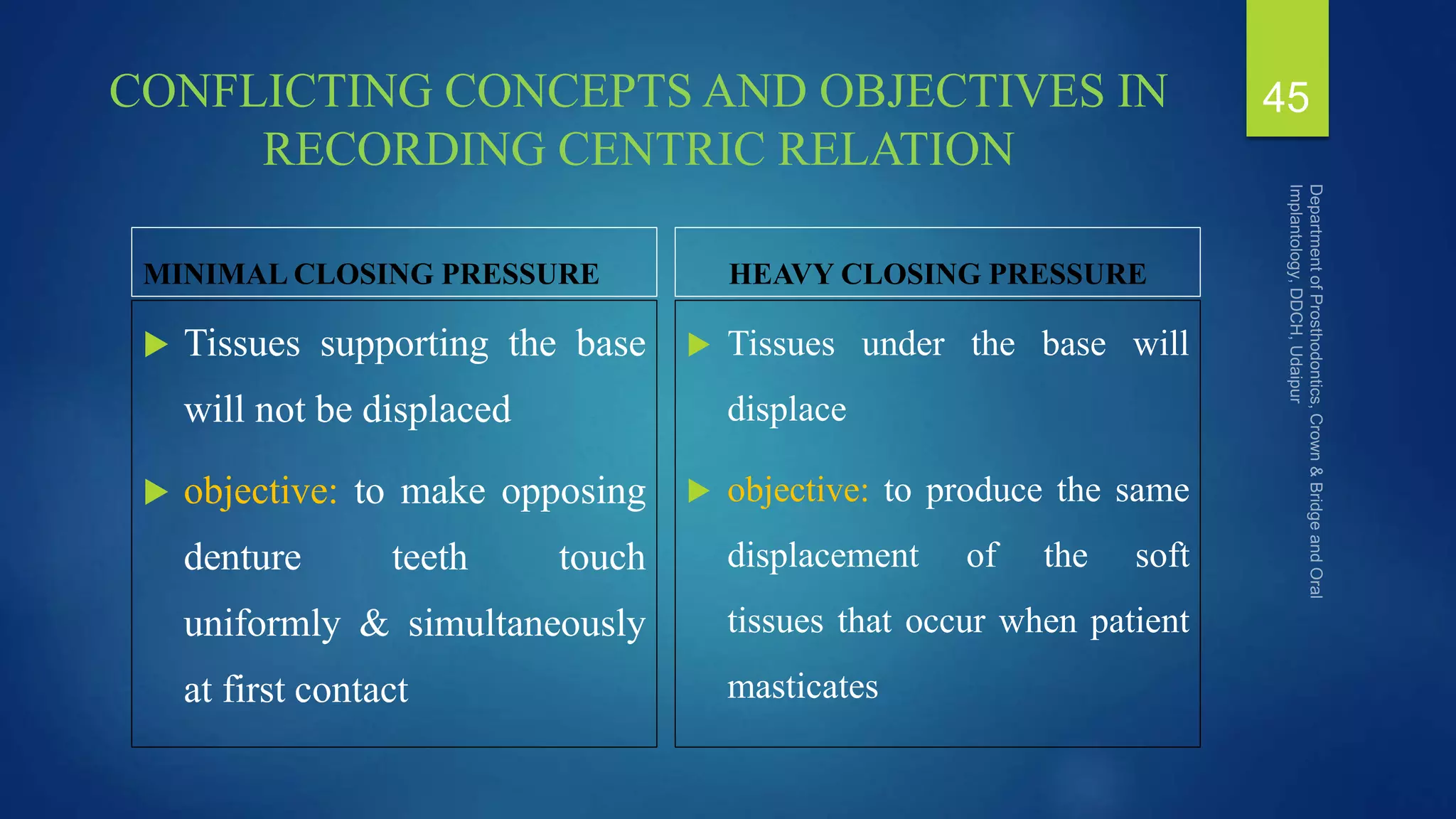
MINIMAL CLOSING PRESSURE
 Tissues supporting the base
will not be displaced
 objective: to make opposing
denture teeth touch
uniformly & simultaneously
at first contact
HEAVY CLOSING PRESSURE
 Tissues under the base will
displace
 objective: to produce the same
displacement of the soft
tissues that occur when patient
masticates
45
COMPLICATIONS IN RECORDING CENTRIC
RELATION
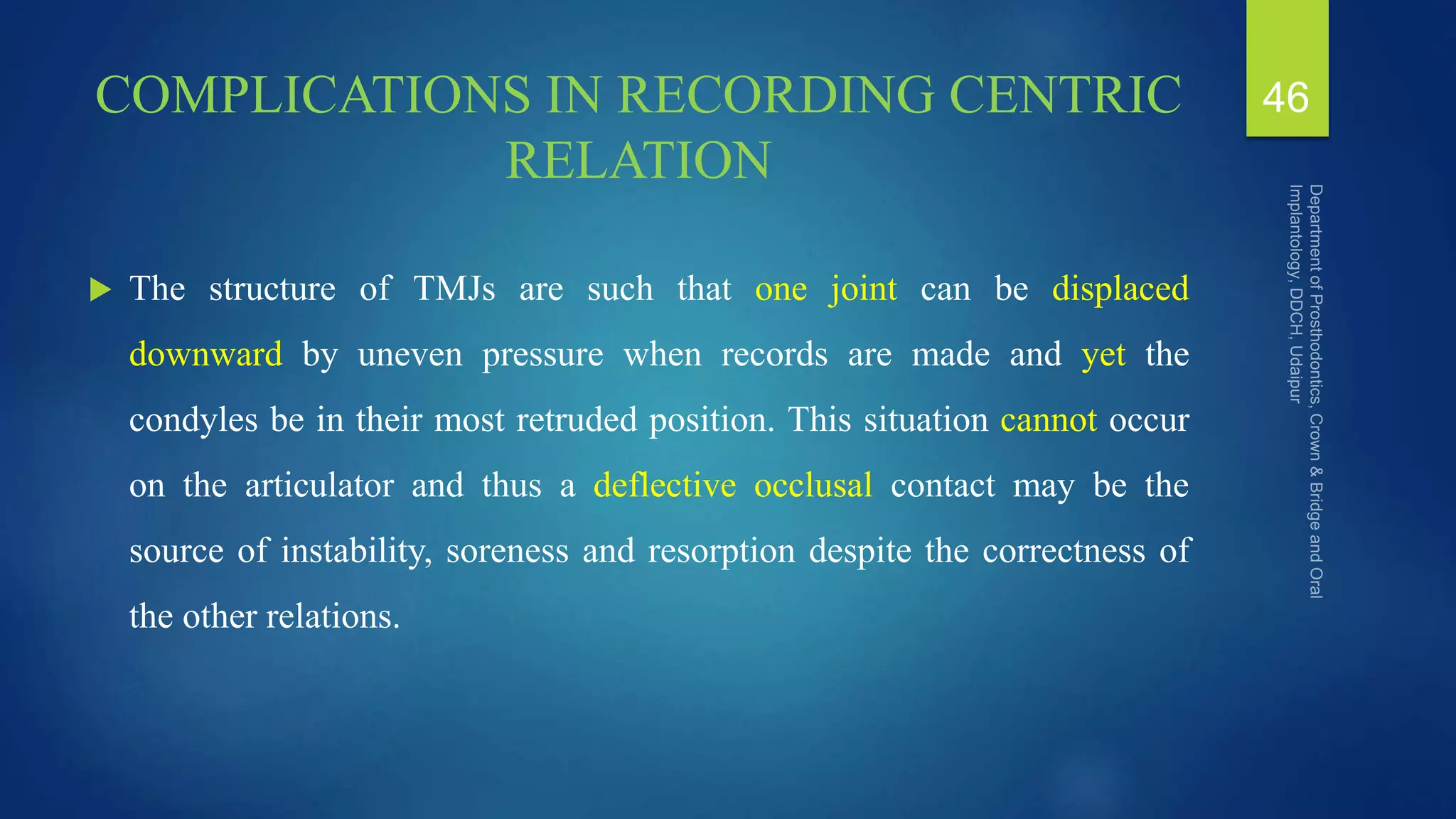
 The structure of TMJs are such that one joint can be displaced
downward by uneven pressure when records are made and yet the
condyles be in their most retruded position. This situation cannot occur
on the articulator and thus a deflective occlusal contact may be the
source of instability, soreness and resorption despite the correctness of
the other relations.
46
COMPLICATIONS IN RECORDING CENTRIC
RELATION
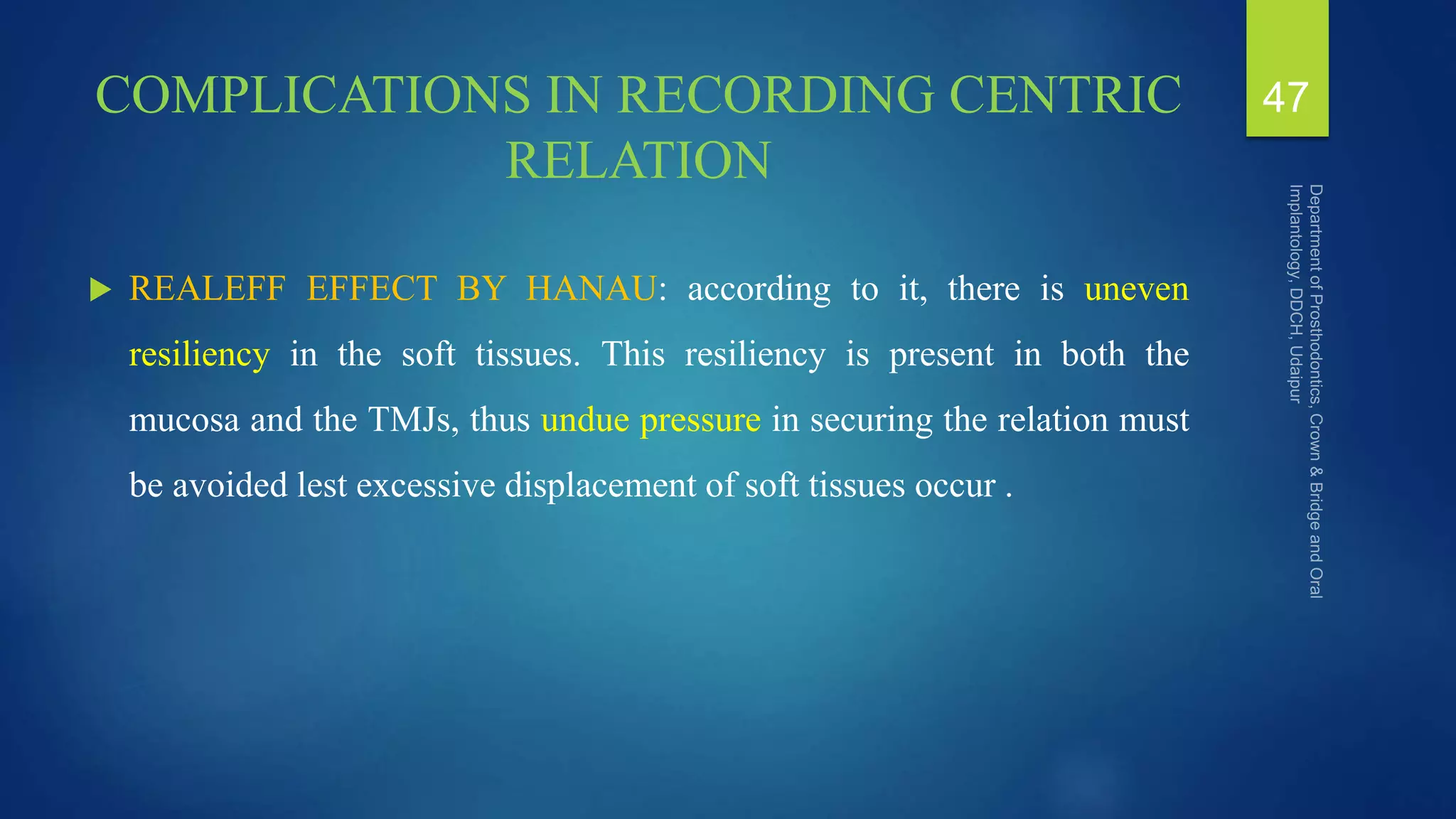
 REALEFF EFFECT BY HANAU: according to it, there is uneven
resiliency in the soft tissues. This resiliency is present in both the
mucosa and the TMJs, thus undue pressure in securing the relation must
be avoided lest excessive displacement of soft tissues occur .
47
COMPLICATIONS IN RECORDING CENTRIC
RELATION
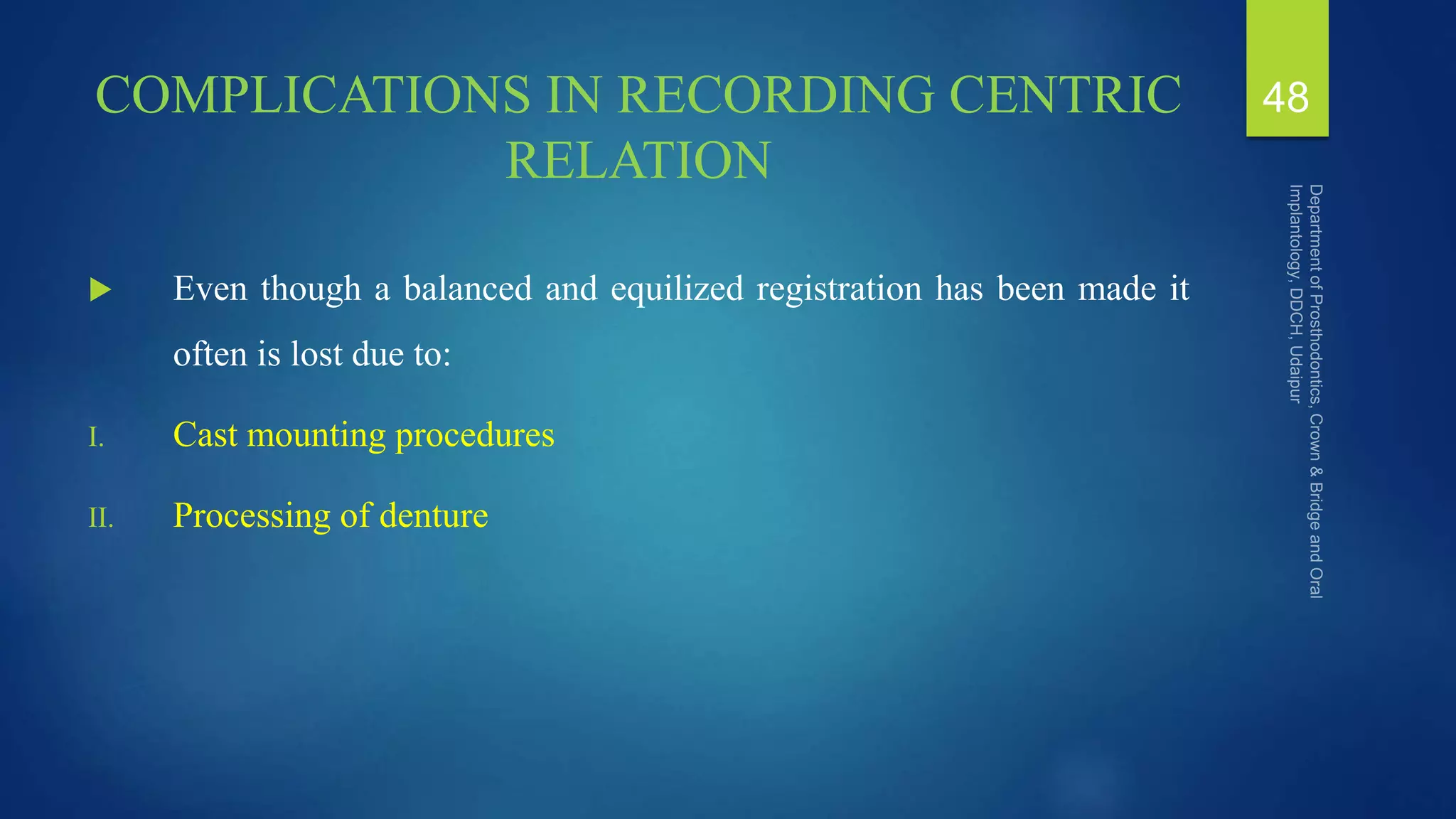
 Even though a balanced and equilized registration has been made it
often is lost due to:
I. Cast mounting procedures
II. Processing of denture
48
RETRUDING THE MANDIBLE IN CENTRIC
RELATION
BIOLOGIC
 Lack of
coordination
between muscles.
 Habitual
eccentric jaw
positions
 Senility or neuro-
muscular disorder
PSYCHOLOGIC
 Inability to follow
the dentist
instructions
MECHANICAL
 Poorly fitting base
plate
49
METHODS
PASSIVE METHODS : The mandible is retruded by the patients themselves,
following the dentist’s instructions without any physical participation by the
dentist. The patient is instructed to
1. Relax, pull the jaw back and close on the back teeth.
2. Get the feeling of pushing the upper jaw out and close on back teeth.
3. Touch the posterior part of the upper denture with tongue and close till the
rims contact.
50
METHODS
4. Swallow and close.
5. Tap the occlusal rims together repeatedly and rapidly.
6. Tilt the head back while performing the above exercises.
7. Protrude and retrude the mandible repeatedly holding his/her fingers lightly
against the chin.
51
METHODS
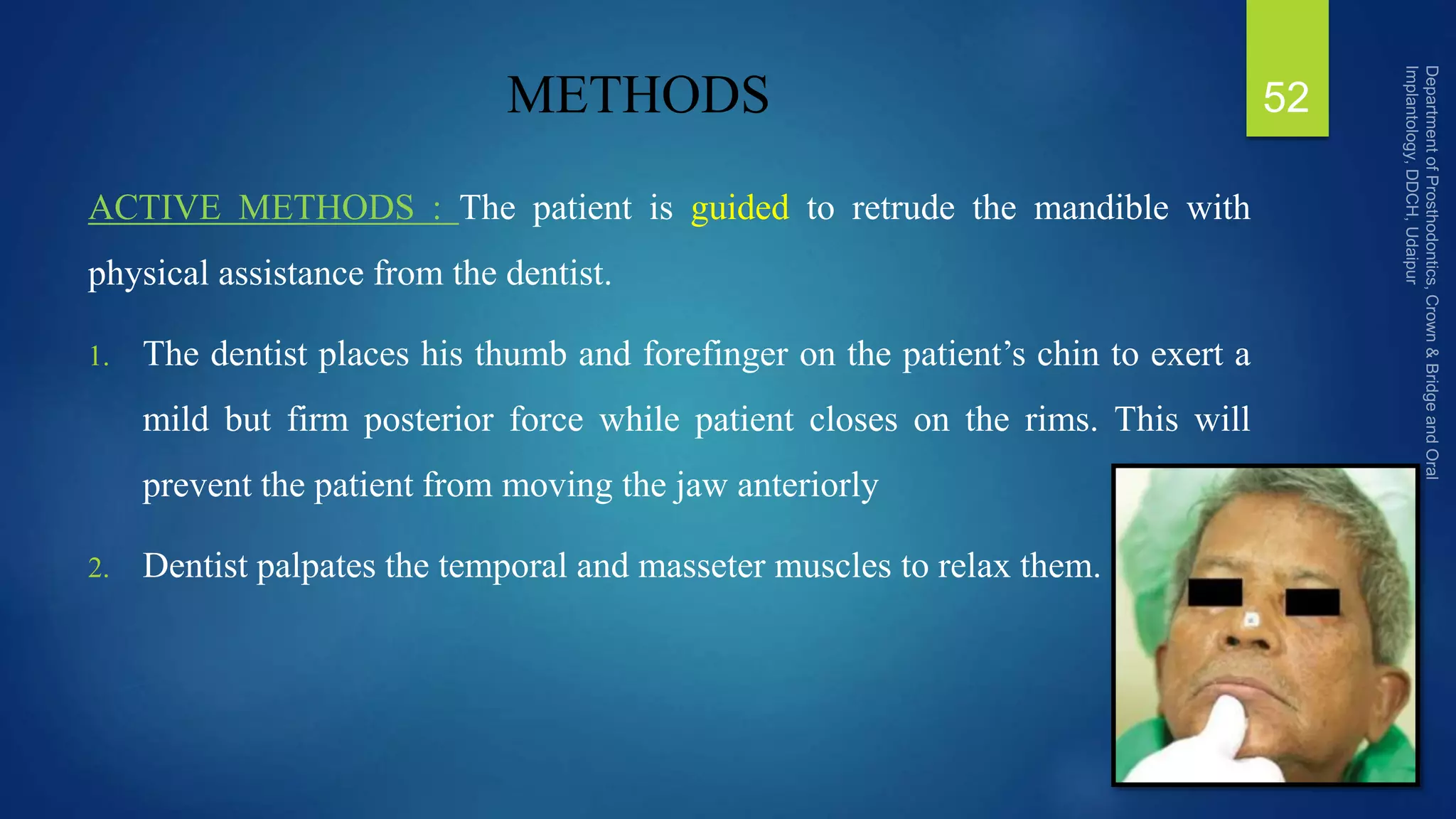
ACTIVE METHODS : The patient is guided to retrude the mandible with
physical assistance from the dentist.
1. The dentist places his thumb and forefinger on the patient’s chin to exert a
mild but firm posterior force while patient closes on the rims. This will
prevent the patient from moving the jaw anteriorly
2. Dentist palpates the temporal and masseter muscles to relax them.
52
METHODS
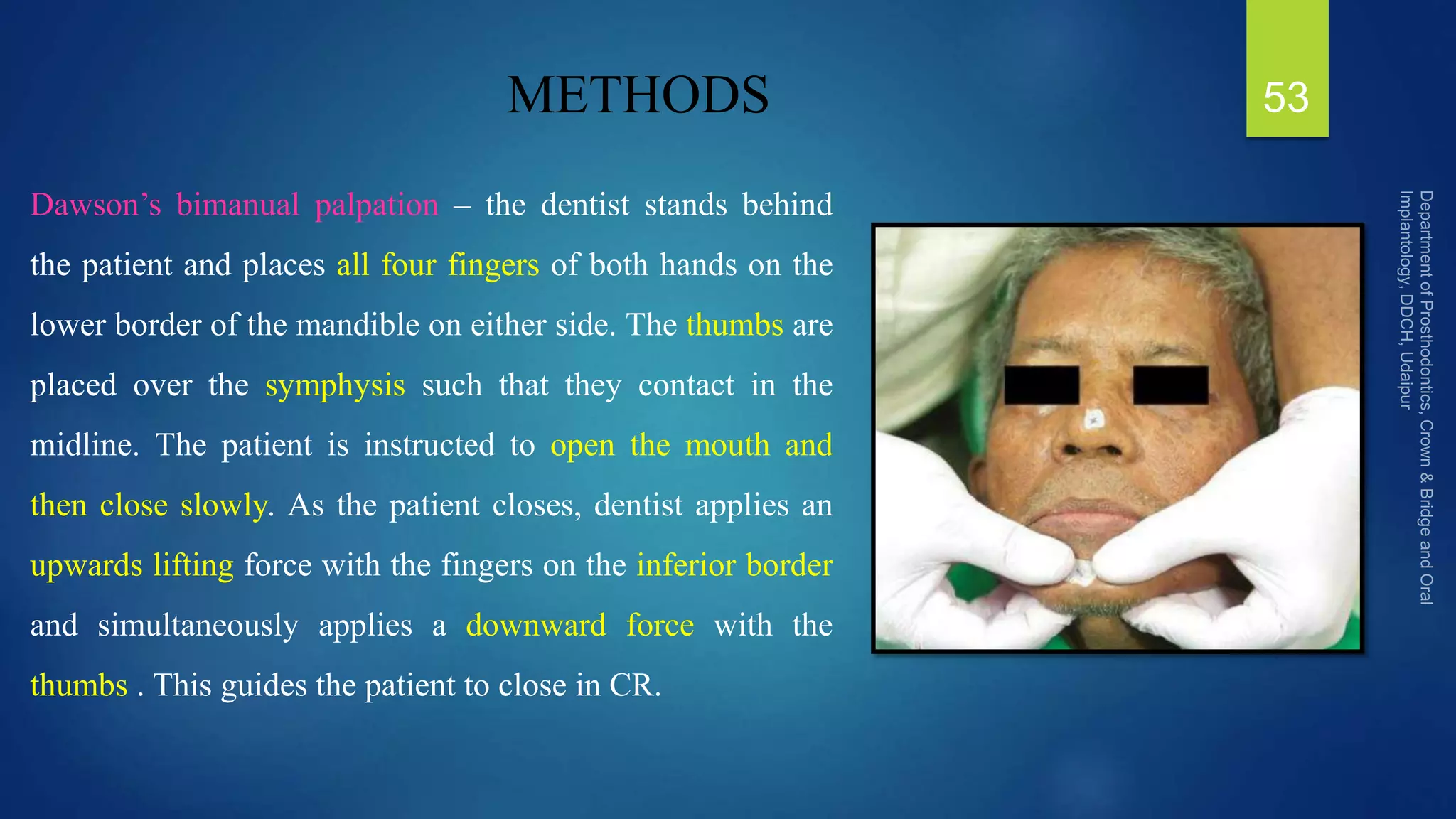
Dawson’s bimanual palpation – the dentist stands behind
the patient and places all four fingers of both hands on the
lower border of the mandible on either side. The thumbs are
placed over the symphysis such that they contact in the
midline. The patient is instructed to open the mouth and
then close slowly. As the patient closes, dentist applies an
upwards lifting force with the fingers on the inferior border
and simultaneously applies a downward force with the
thumbs . This guides the patient to close in CR.
53
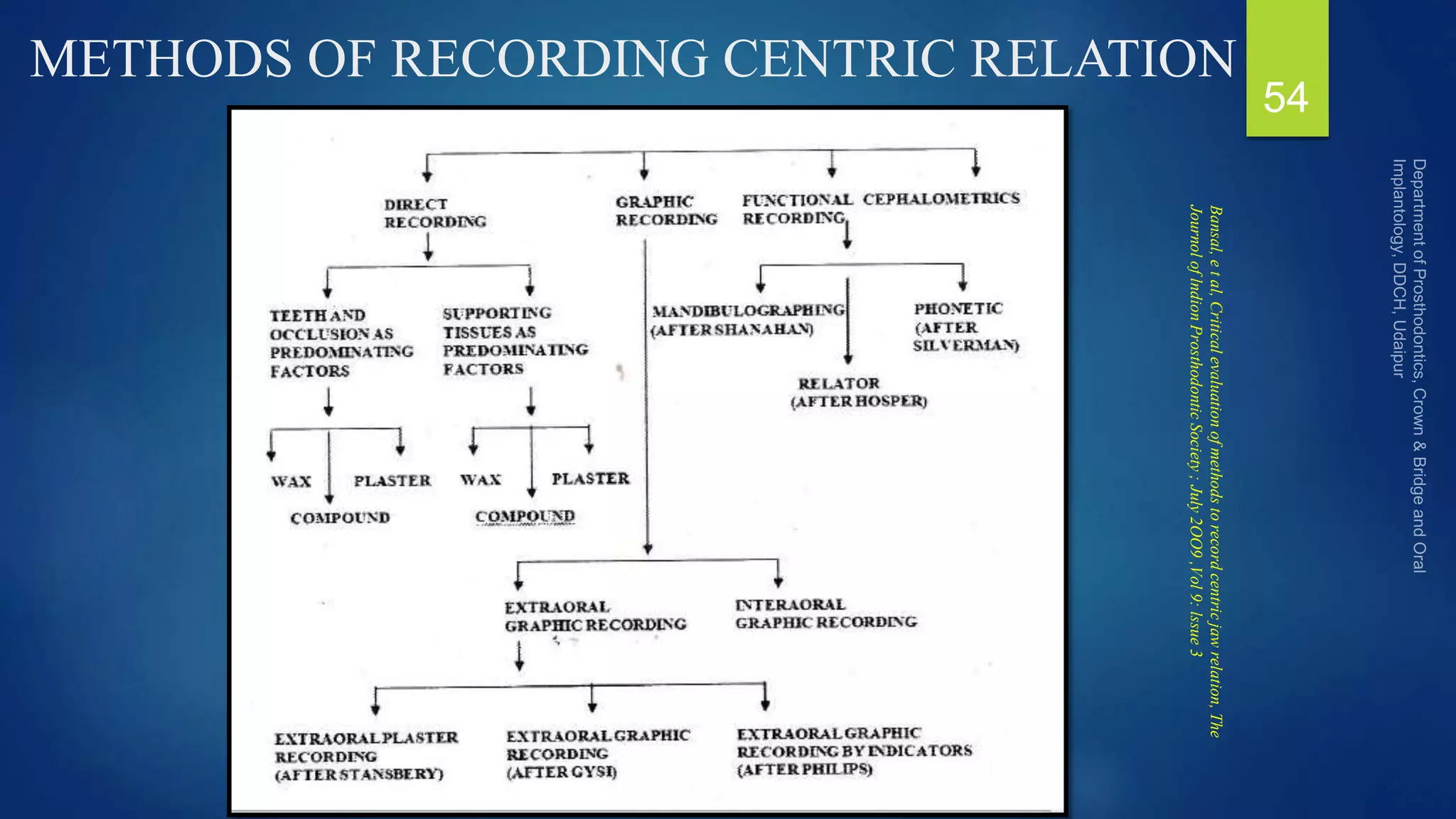
METHODS OF RECORDING CENTRIC RELATION
54
Bansal,
e
t
al,
Critical
evaluation
of
methods
to
record
centric
jaw
relation,
The
Journol
of
lndion
Prosthodontic
Society
;
July
2OO9
,Vol
9:
lssue
3
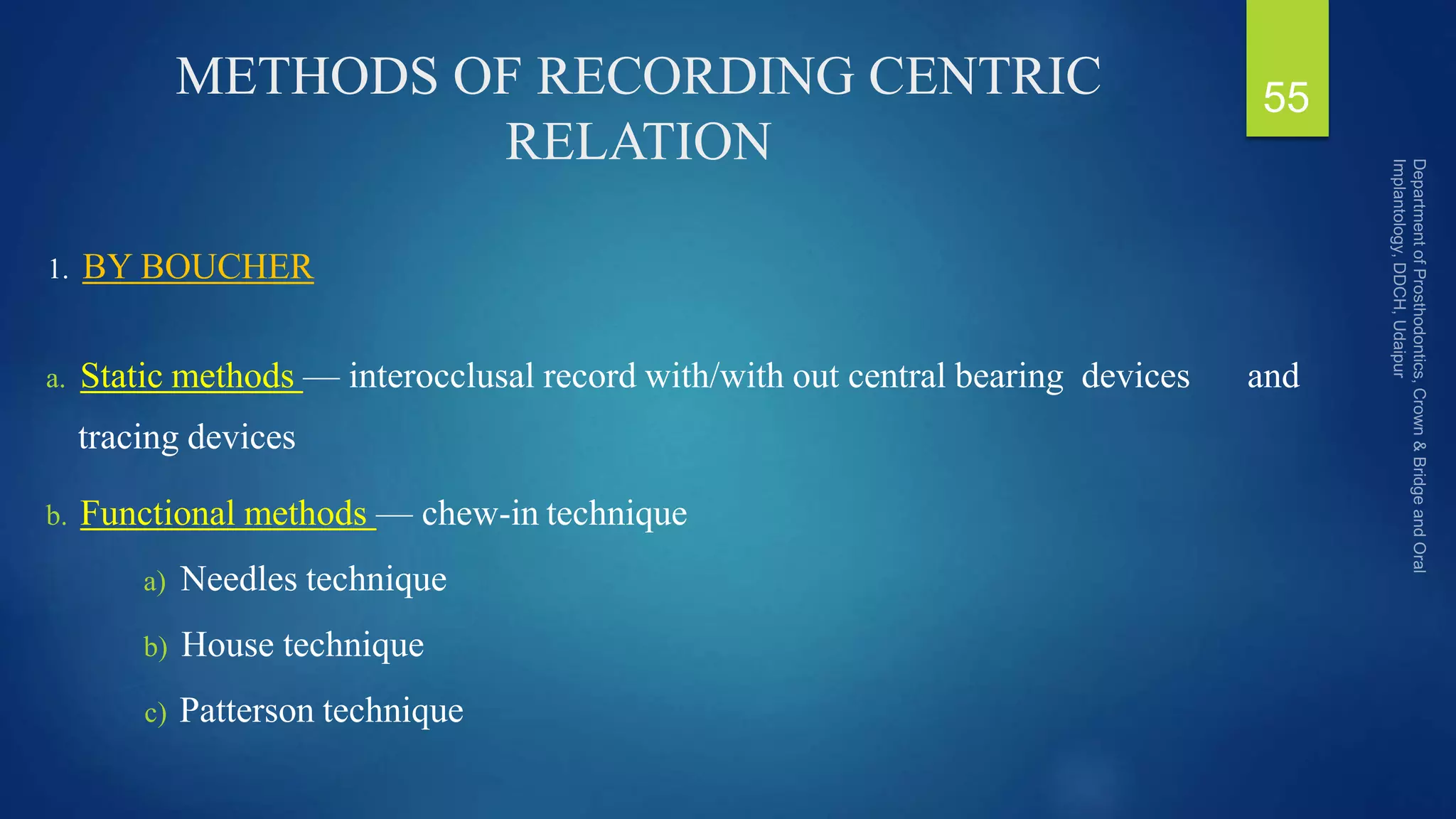
METHODS OF RECORDING CENTRIC
RELATION
1. BY BOUCHER
a. Static methods — interocclusal record with/with out central bearing devices and
tracing devices
b. Functional methods — chew-in technique
a) Needles technique
b) House technique
c) Patterson technique
55
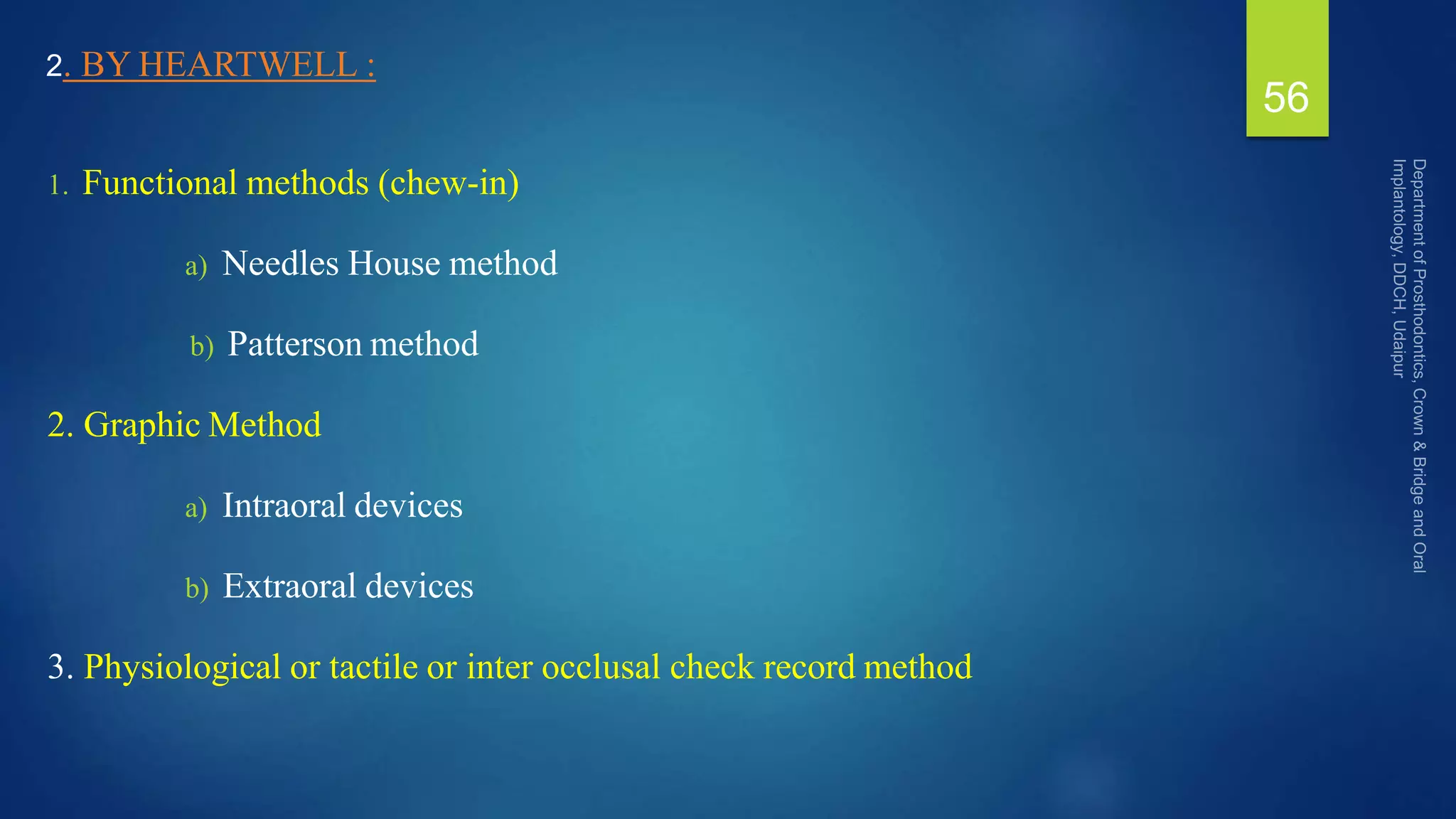
2. BY HEARTWELL :
1. Functional methods (chew-in)
a) Needles House method
b) Patterson method
2. Graphic Method
a) Intraoral devices
b) Extraoral devices
3. Physiological or tactile or inter occlusal check record method
56
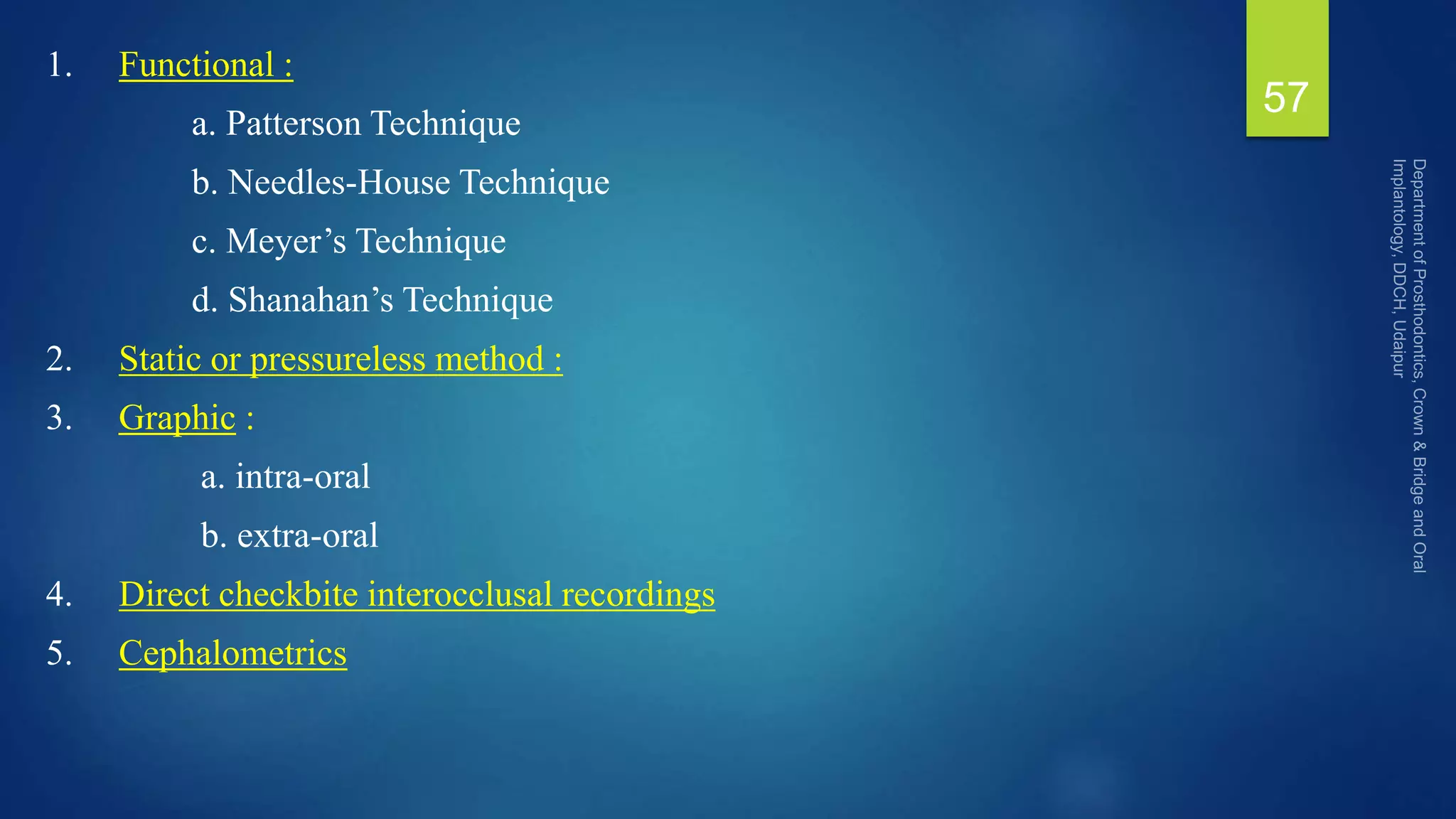
1. Functional :
a. Patterson Technique
b. Needles-House Technique
c. Meyer’s Technique
d. Shanahan’s Technique
2. Static or pressureless method :
3. Graphic :
a. intra-oral
b. extra-oral
4. Direct checkbite interocclusal recordings
5. Cephalometrics
57
 KINGERY classified techniques for recording centric relation as:
 Direct
 Graphic
 Functional
58
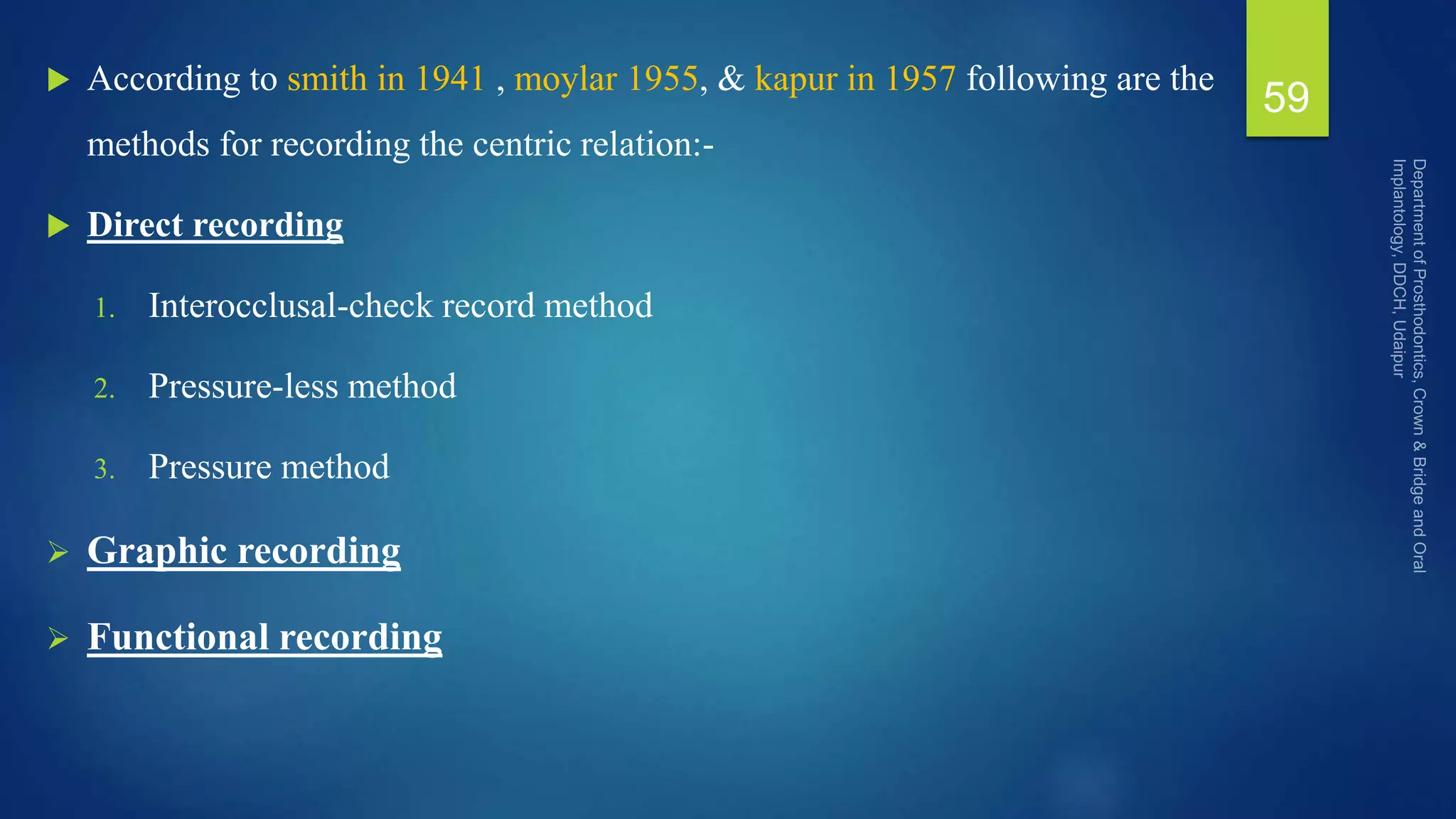
 According to smith in 1941 , moylar 1955, & kapur in 1957 following are the
methods for recording the centric relation:-
 Direct recording
1. Interocclusal-check record method
2. Pressure-less method
3. Pressure method
 Graphic recording
 Functional recording
59
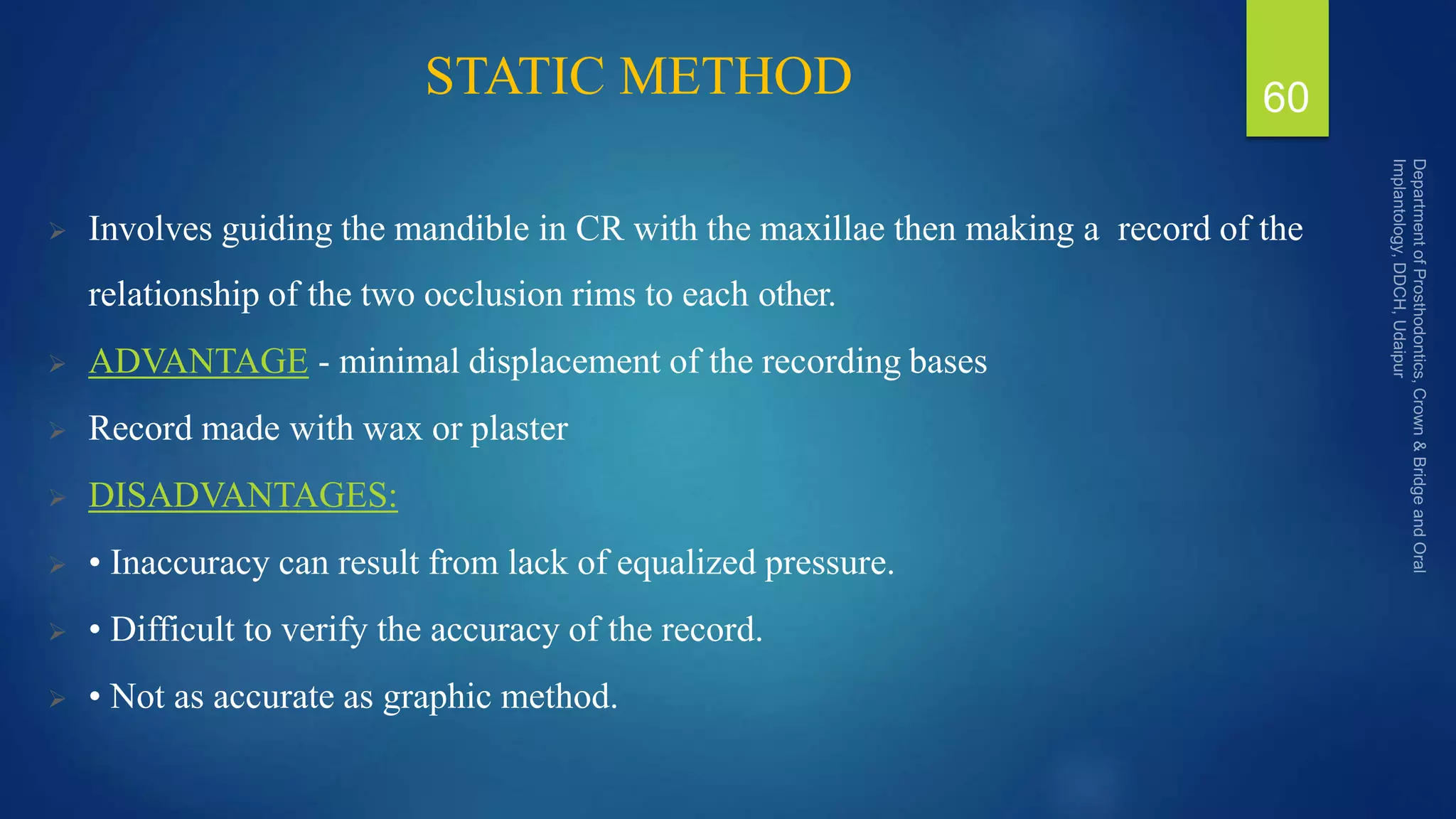
STATIC METHOD
 Involves guiding the mandible in CR with the maxillae then making a record of the
relationship of the two occlusion rims to each other.
 ADVANTAGE - minimal displacement of the recording bases
 Record made with wax or plaster
 DISADVANTAGES:
 • Inaccuracy can result from lack of equalized pressure.
 • Difficult to verify the accuracy of the record.
 • Not as accurate as graphic method.
60
1. WAX OCCLUSAL RIMS
 One of the most commonly used methods to record CR.
 The wax occlusal rims are contoured and the vertical dimension of occlusion is
established ensuring even contact of the maxillary and mandibular rims anteriorly
and posteriorly.
 The patient is trained to retrude the mandible.
 The various ‘guidelines’ are marked and the patient is asked to close in centric and
hold the position.
61
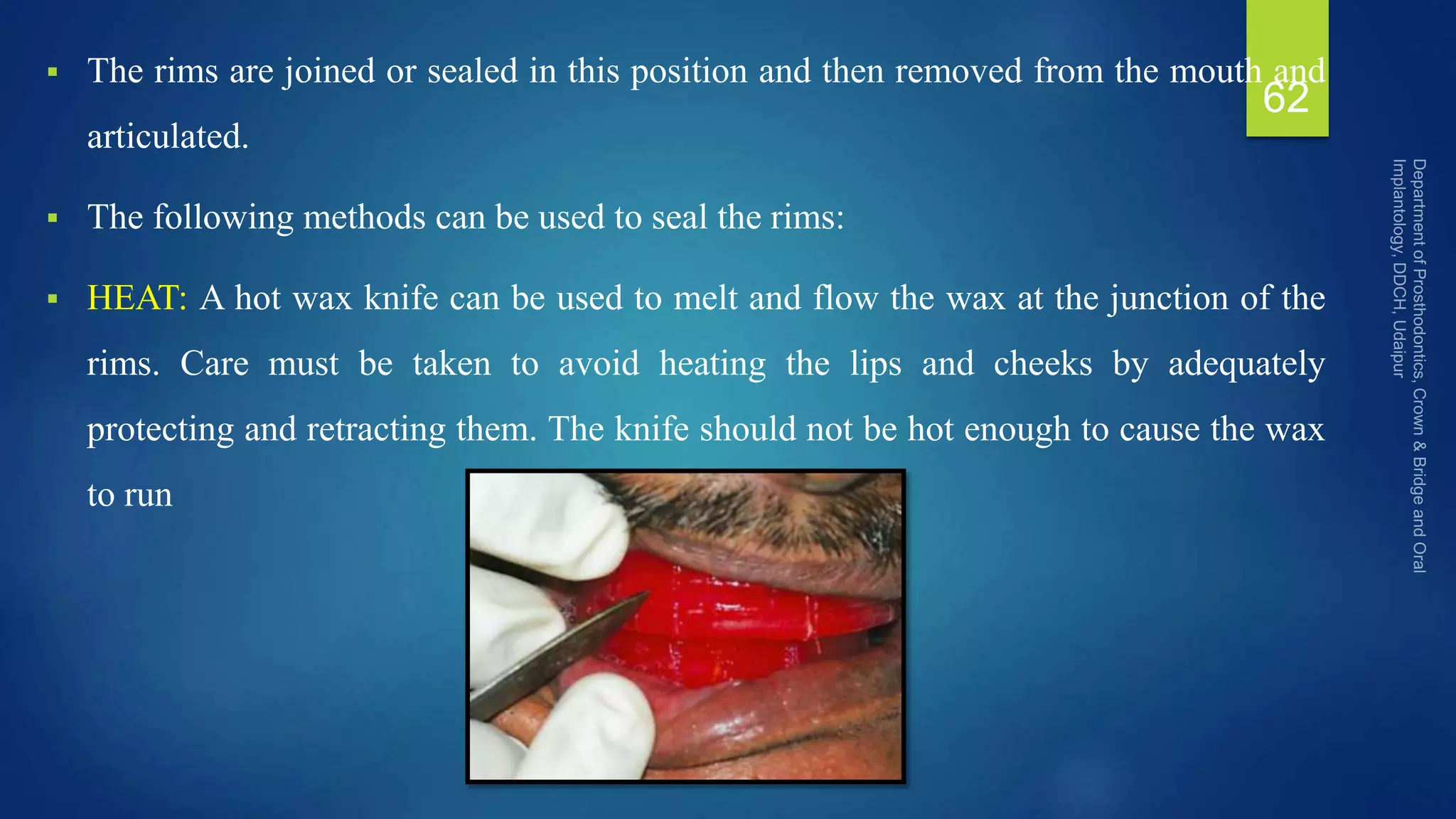
 The rims are joined or sealed in this position and then removed from the mouth and
articulated.
 The following methods can be used to seal the rims:
 HEAT: A hot wax knife can be used to melt and flow the wax at the junction of the
rims. Care must be taken to avoid heating the lips and cheeks by adequately
protecting and retracting them. The knife should not be hot enough to cause the wax
to run
62
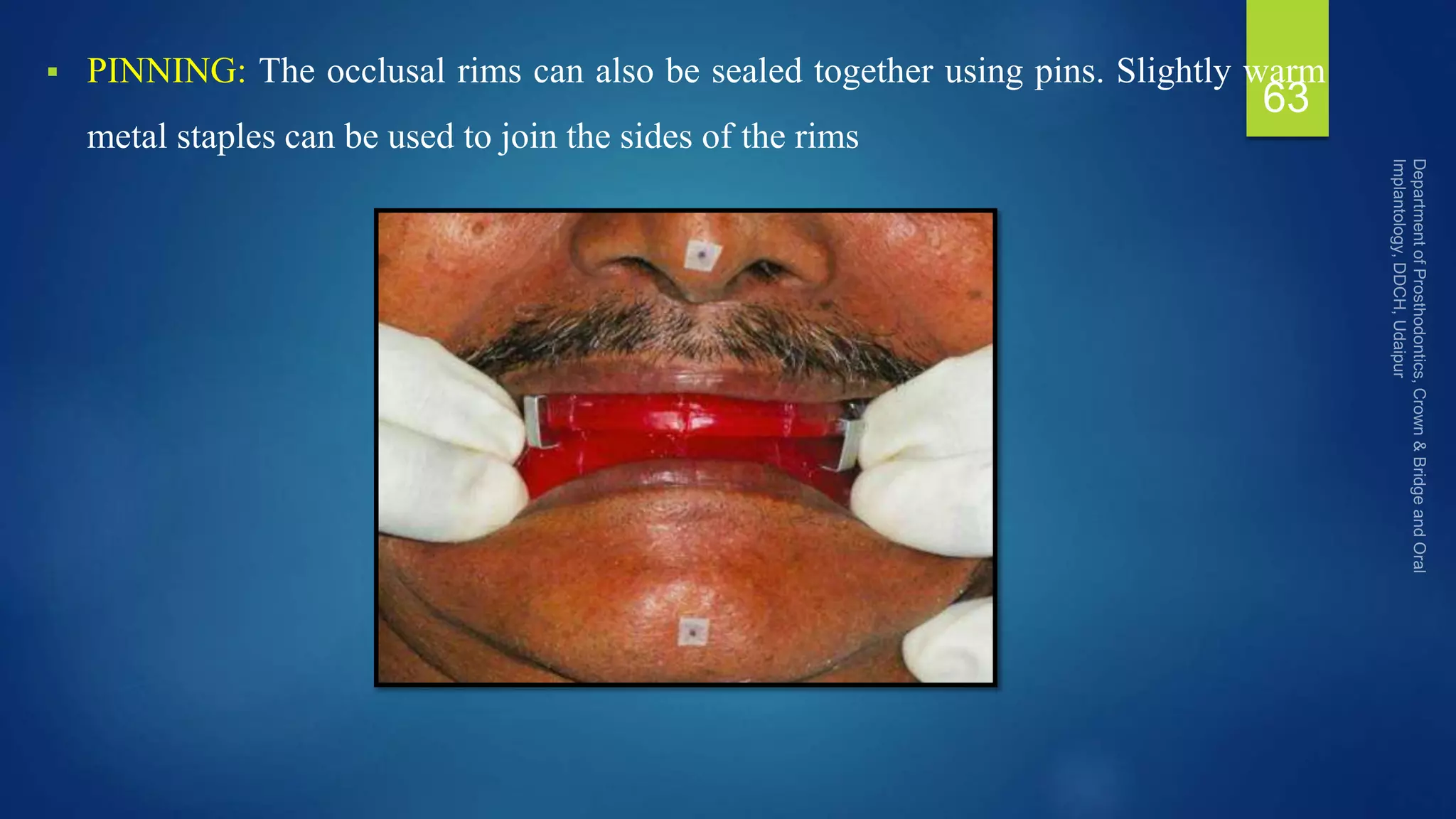
 PINNING: The occlusal rims can also be sealed together using pins. Slightly warm
metal staples can be used to join the sides of the rims
63
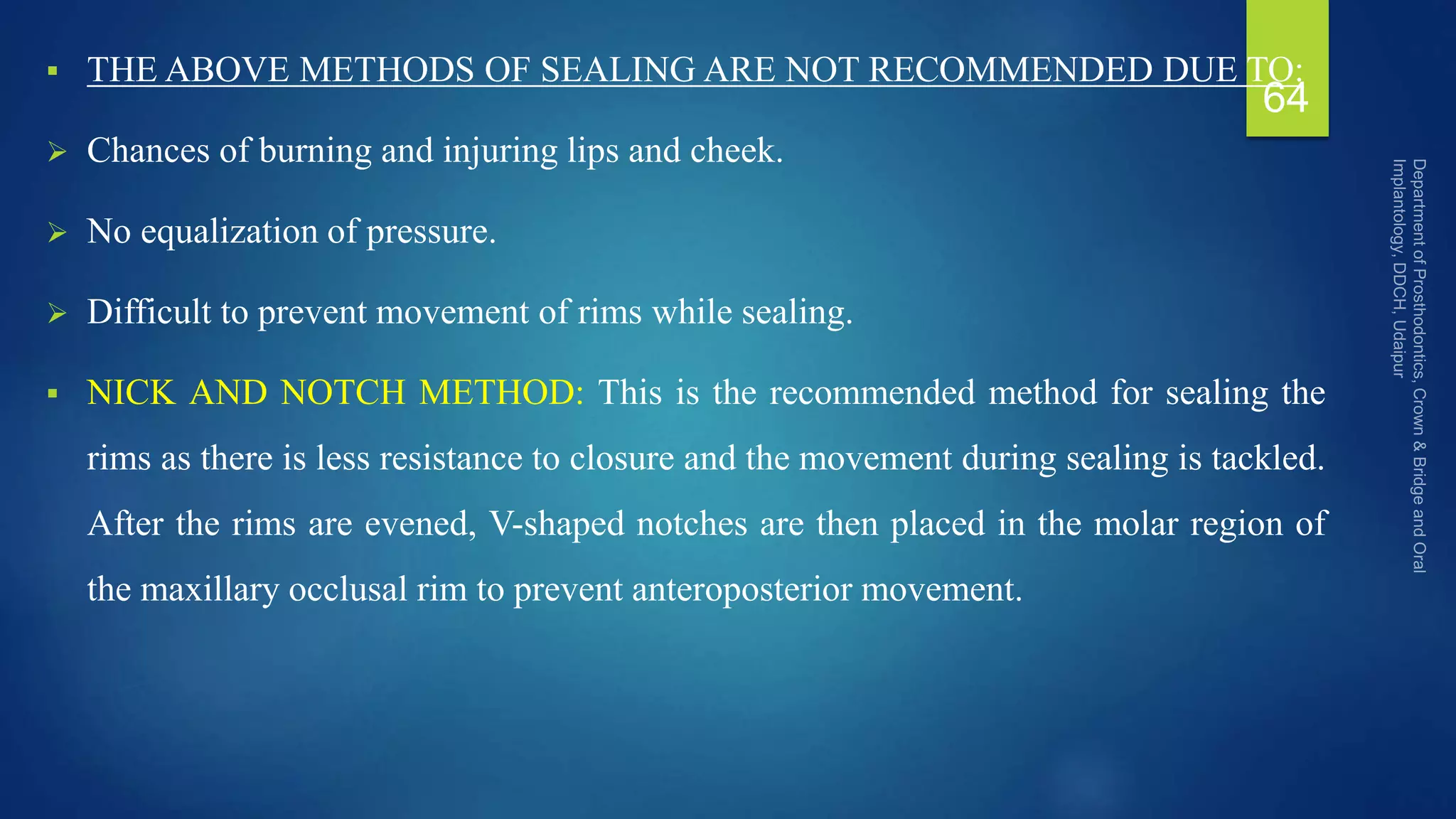
 THE ABOVE METHODS OF SEALING ARE NOT RECOMMENDED DUE TO:
 Chances of burning and injuring lips and cheek.
 No equalization of pressure.
 Difficult to prevent movement of rims while sealing.
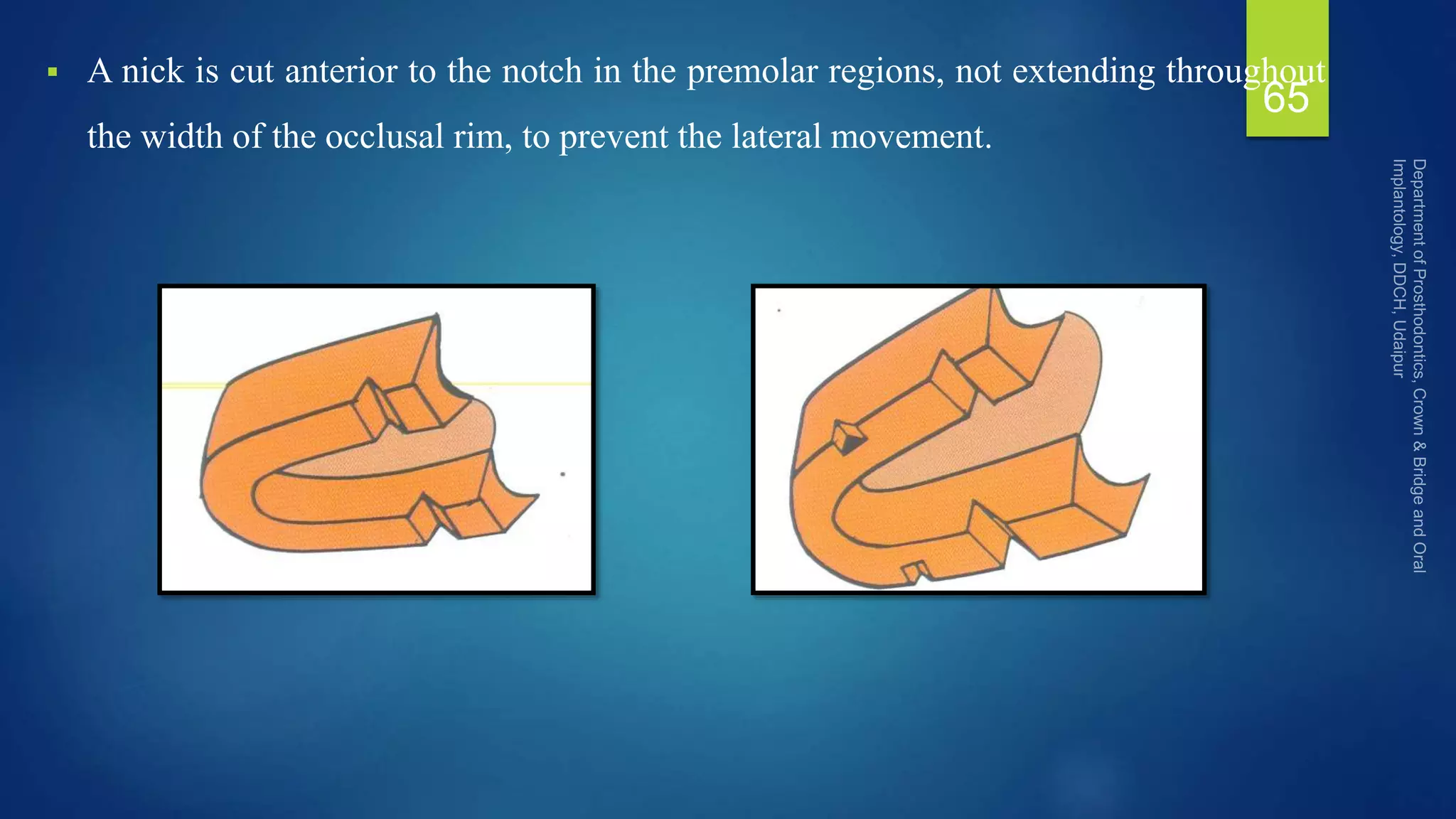
 NICK AND NOTCH METHOD: This is the recommended method for sealing the
rims as there is less resistance to closure and the movement during sealing is tackled.
After the rims are evened, V-shaped notches are then placed in the molar region of
the maxillary occlusal rim to prevent anteroposterior movement.
64
 A nick is cut anterior to the notch in the premolar regions, not extending throughout
the width of the occlusal rim, to prevent the lateral movement.
65
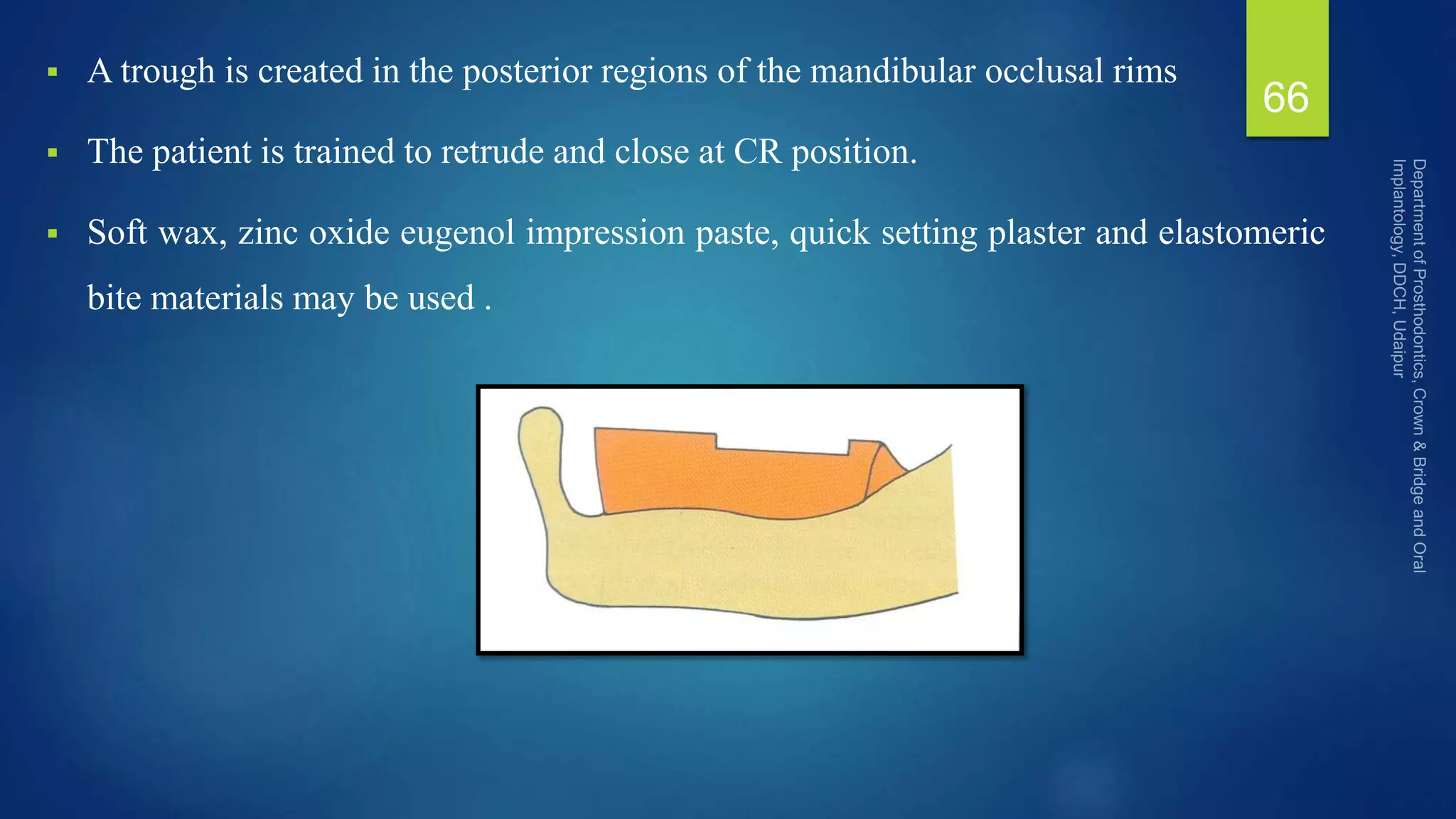
 A trough is created in the posterior regions of the mandibular occlusal rims
 The patient is trained to retrude and close at CR position.
 Soft wax, zinc oxide eugenol impression paste, quick setting plaster and elastomeric
bite materials may be used .
66
 The recording material is loaded in the trough created on the mandibular rim.
 Occlusal rims are inserted in the patient’s mouth and the patient is instructed to
retrude and close.
 Contact should be observed in the maxillary and mandibular rims anteriorly.
 Once the intervening recording material sets, the rims get sealed and are removed
together
67
2. INTER-OCCLUAL CHECK RECORS
 As the name suggests, these records are used to verify the centric jaw relation at the
time of try-in or denture insertion.
 They are also used to check the occlusion of teeth in existing dentures.
 These are also called ‘physiologic’ methods as the patient’s proprioception and
tactile sense is essential in the making of an accurate record.
 The same recording mediums used for static registrations can also be used for this
procedure
68
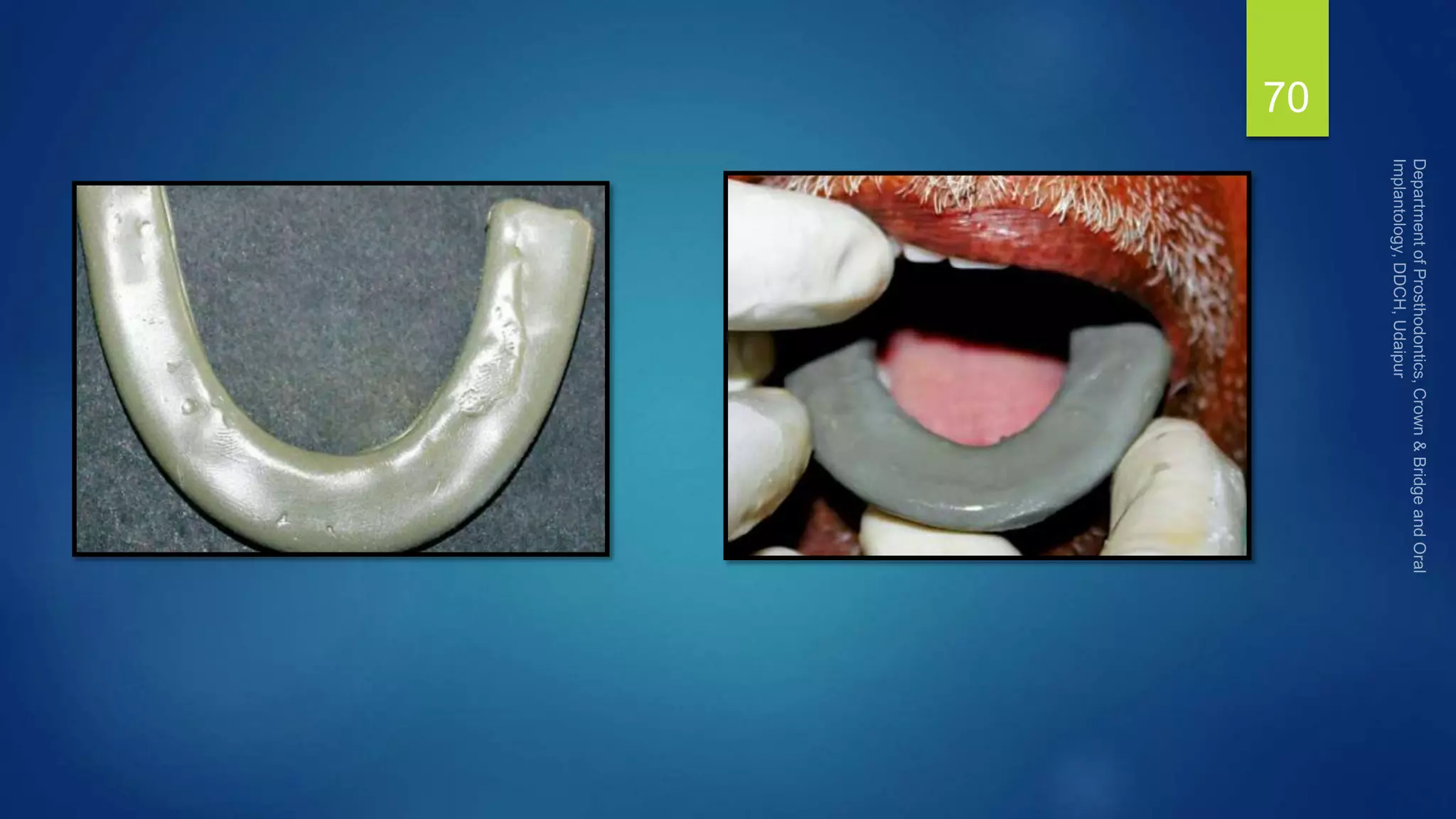
 After the occlusal rims have been articulated with a static record, the artificial teeth
are arranged and a trial denture is fabricated.
 At the time of try-in (or denture insertion) if the dentist feels the need to verify the
CR, then this procedure is adopted.
 Patient is asked to rehearse retruding the mandible.
 The maxillary trial denture is inserted in the patient’s mouth.
 The recording medium like aluwax is loaded onto the occlusal surface of the teeth in
the mandibular occlusal rim
69
70
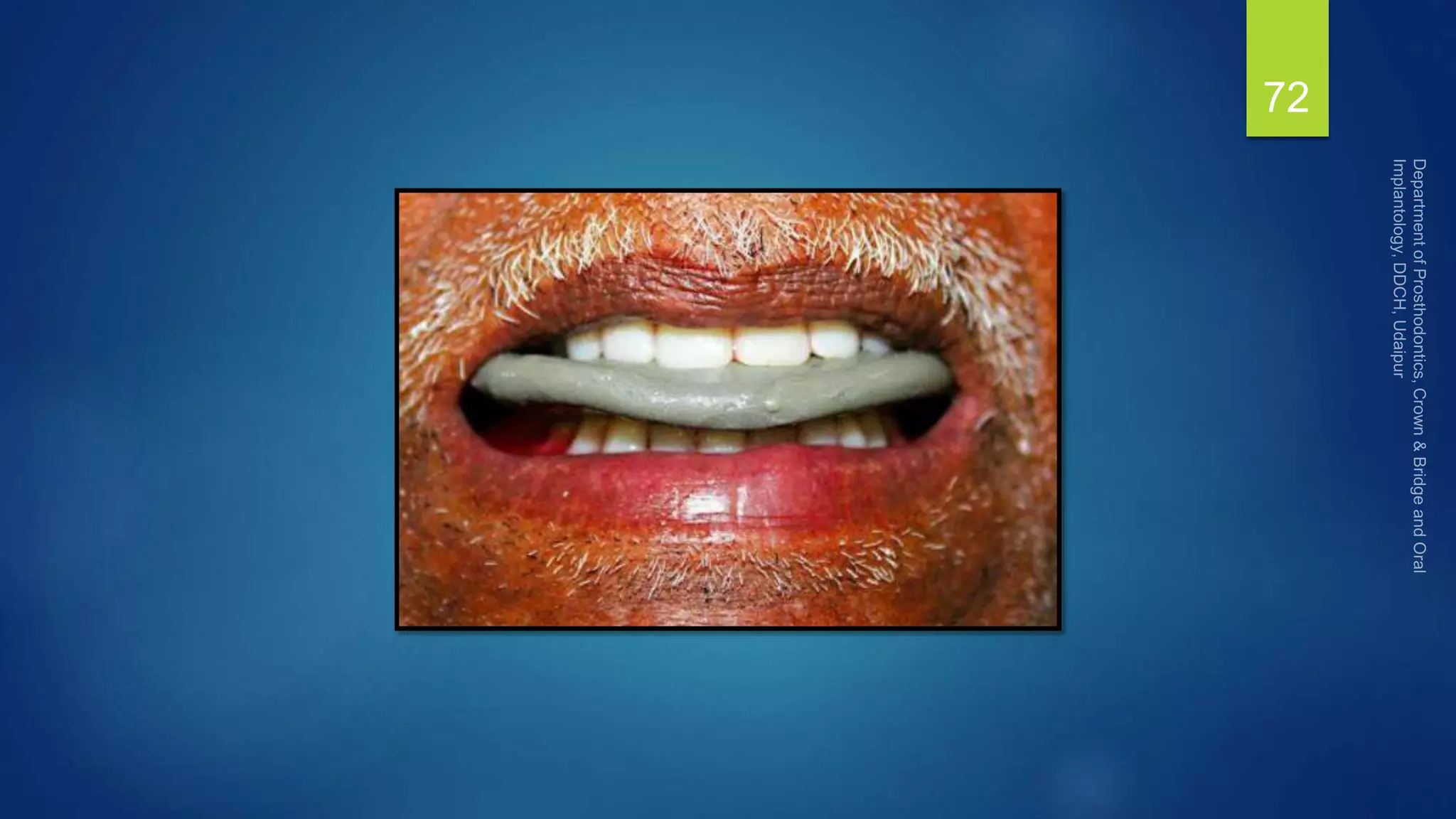
 The patient is asked to slowly retrude the mandible and close on the wax till the
tooth contact occurs .
 They should not bite through the material.
 The recording material is allowed to set and the trial dentures are removed with the
recording material.
 The maxillary trial denture is removed from the record and placed on the mounted
maxillary cast in the articulator.
 The mandibular trial denture with the record is now returned to the mandibular cast
on the articulator.
 The horizontal condylar guide locks in the articulator are released.
71
72
 The maxillary teeth are now seated over the record.
 If the previous recording of CR is the same as the check record, then both the
condylar elements of the articulator will contact the centric stops, i.e. the articulated
casts need not move to fit into the check records.
 If anyone or both of the condylar elements of the articulator does not contact the
centric stops, it indicates that one of the records is inaccurate.
73
 INDICATIONS: It may be advisable to make interocclusal check records to verify
the CR in the following conditions:
 Abnormally related jaws
 Displaceable, flabby tissues
 Large tongue
 Uncontrolled mandibular movements
 Factors affecting the success of interocclusal records:
 Uniform consistency of the recording material
 Accurate vertical jaw relation records
 Stability and fit of the record base
74
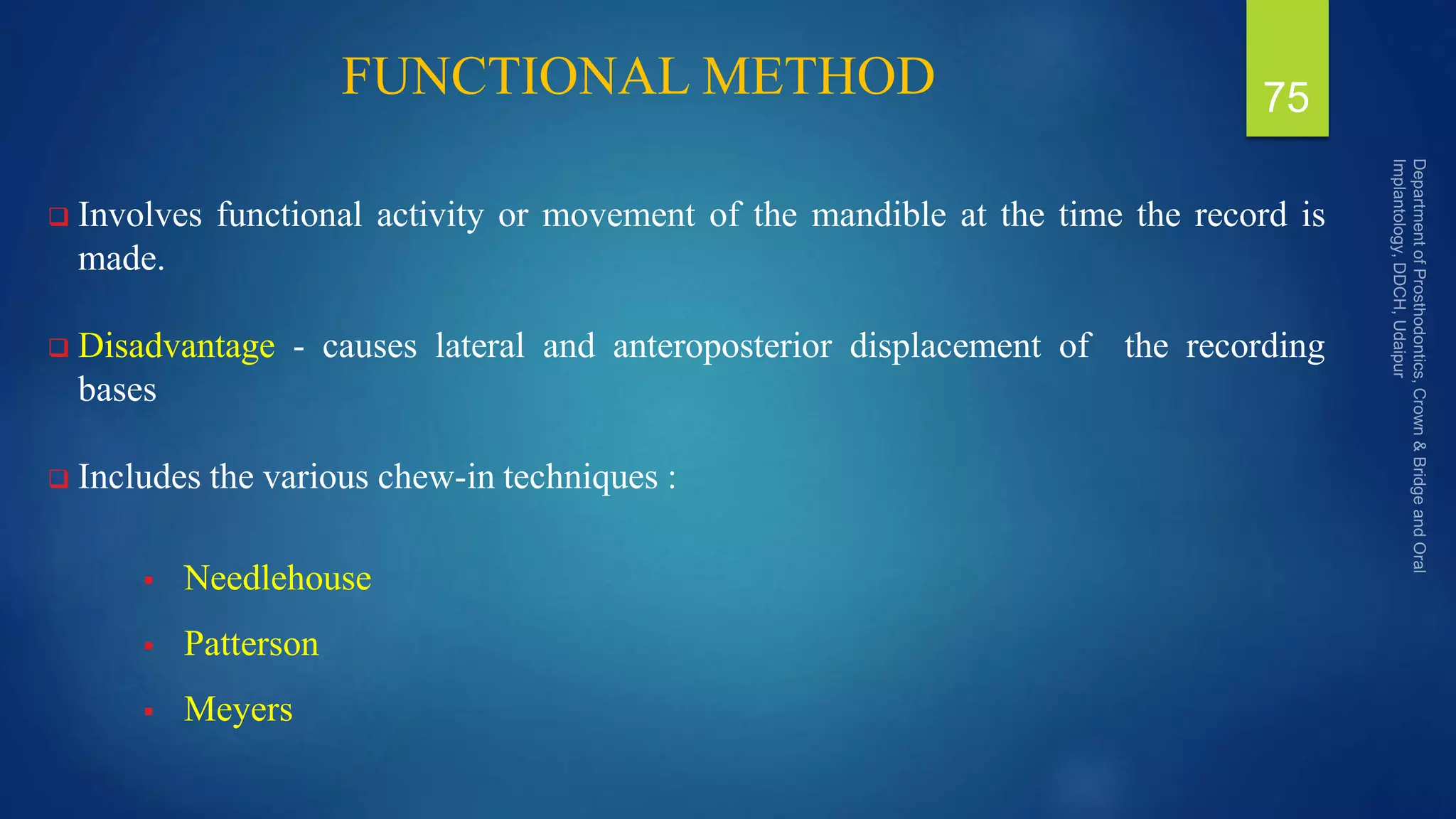
FUNCTIONAL METHOD
 Involves functional activity or movement of the mandible at the time the record is
made.
 Disadvantage - causes lateral and anteroposterior displacement of the recording
bases
 Includes the various chew-in techniques :
 Needlehouse
 Patterson
 Meyers
75
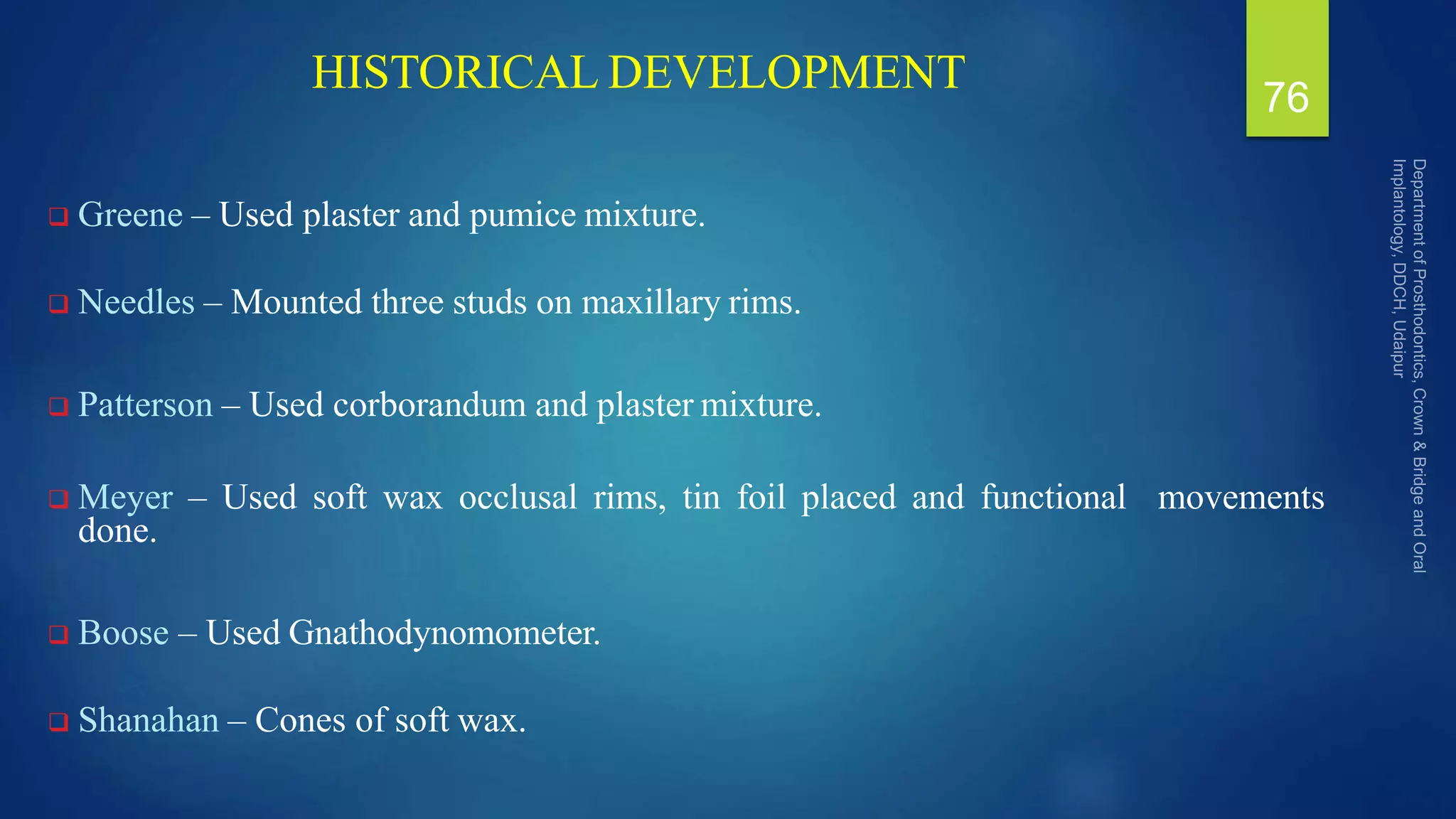
HISTORICAL DEVELOPMENT
 Greene – Used plaster and pumice mixture.
 Needles – Mounted three studs on maxillary rims.
 Patterson – Used corborandum and plaster mixture.
 Meyer – Used soft wax occlusal rims, tin foil placed and functional movements
done.
 Boose – Used Gnathodynomometer.
 Shanahan – Cones of soft wax.
76
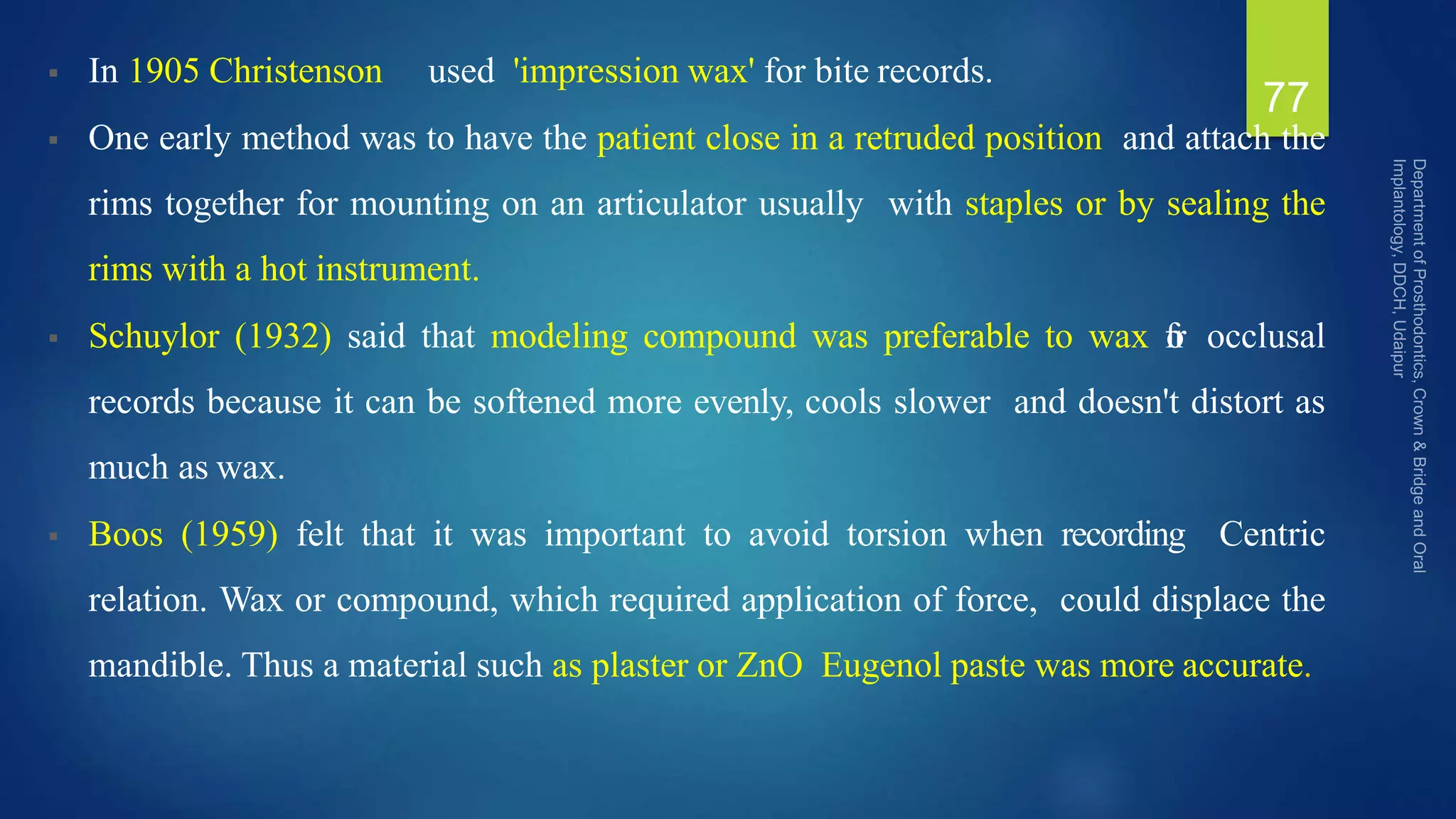
 In 1905 Christenson used 'impression wax' for bite records.
 One early method was to have the patient close in a retruded position and attach the
rims together for mounting on an articulator usually with staples or by sealing the
rims with a hot instrument.
 Schuylor (1932) said that modeling compound was preferable to wax f
o
r occlusal
records because it can be softened more evenly, cools slower and doesn't distort as
much as wax.
 Boos (1959) felt that it was important to avoid torsion when recording Centric
relation. Wax or compound, which required application of force, could displace the
mandible. Thus a material such as plaster or ZnO Eugenol paste was more accurate.
77
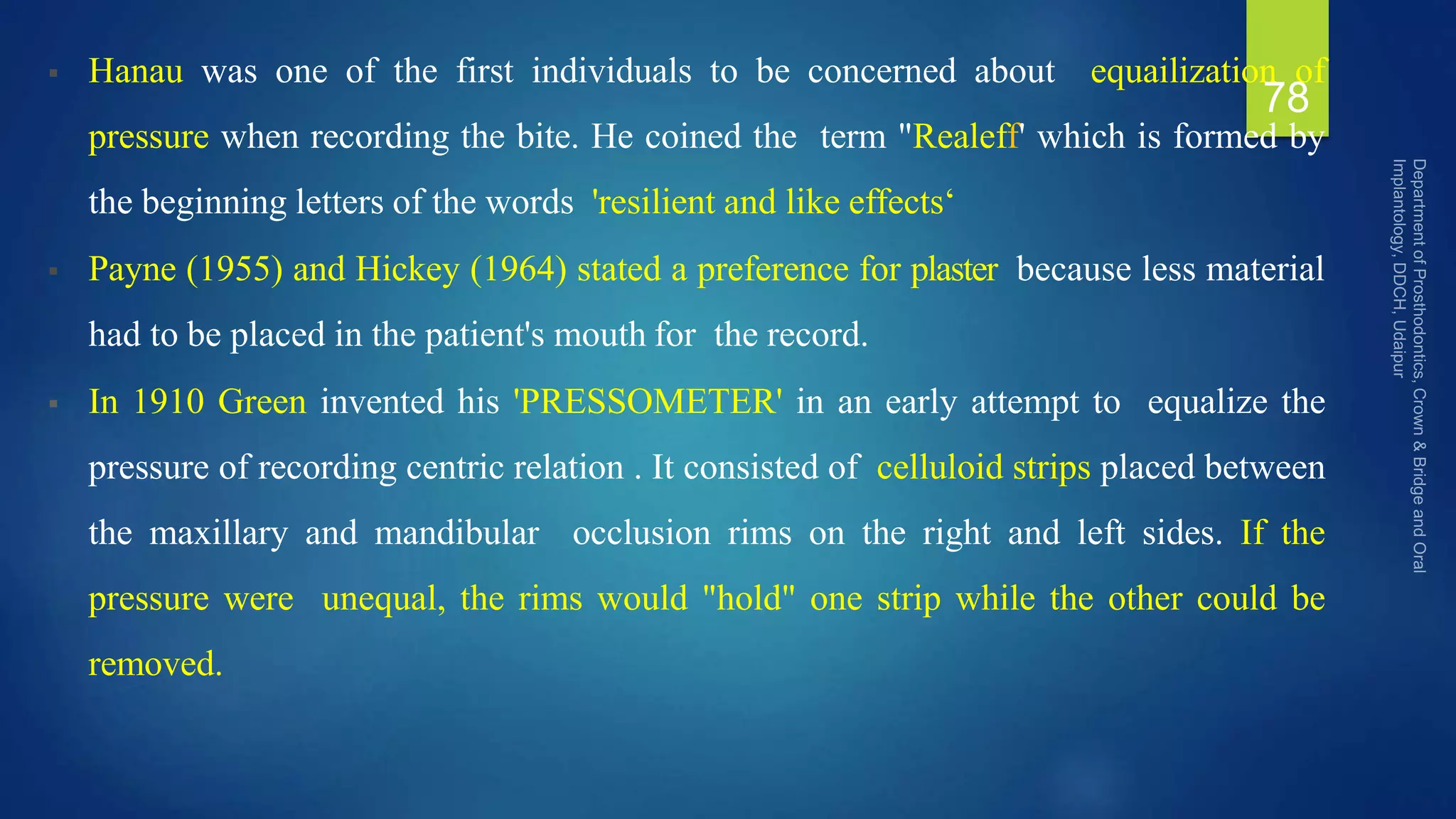
 Hanau was one of the first individuals to be concerned about equailization of
pressure when recording the bite. He coined the term "Realeff' which is formed by
the beginning letters of the words 'resilient and like effects‘
 Payne (1955) and Hickey (1964) stated a preference for plaster because less material
had to be placed in the patient's mouth for the record.
 In 1910 Green invented his 'PRESSOMETER' in an early attempt to equalize the
pressure of recording centric relation . It consisted of celluloid strips placed between
the maxillary and mandibular occlusion rims on the right and left sides. If the
pressure were unequal, the rims would "hold" one strip while the other could be
removed.
78
 In 1954 Brown recommended repeated closure into softened wax rims.
 Wright(1939) described the four factors he believed affected accuracy of records:
(i) resiliency of tissue
(ii) saliva film
(iii) fit of bases
(iv) pressure applied.
He concluded that the best technique was to record the occlusal record at zero
pressure
79
 Kingery (1952) discussed 2 fundamental principles that contribute to the success of
direct recording method:
1) The dentist's ability to recognize the Centric relation position
2) Understanding that the recording medium directly influences the pressure developed
in the recording and the subsequent equilibration of the recording.
80
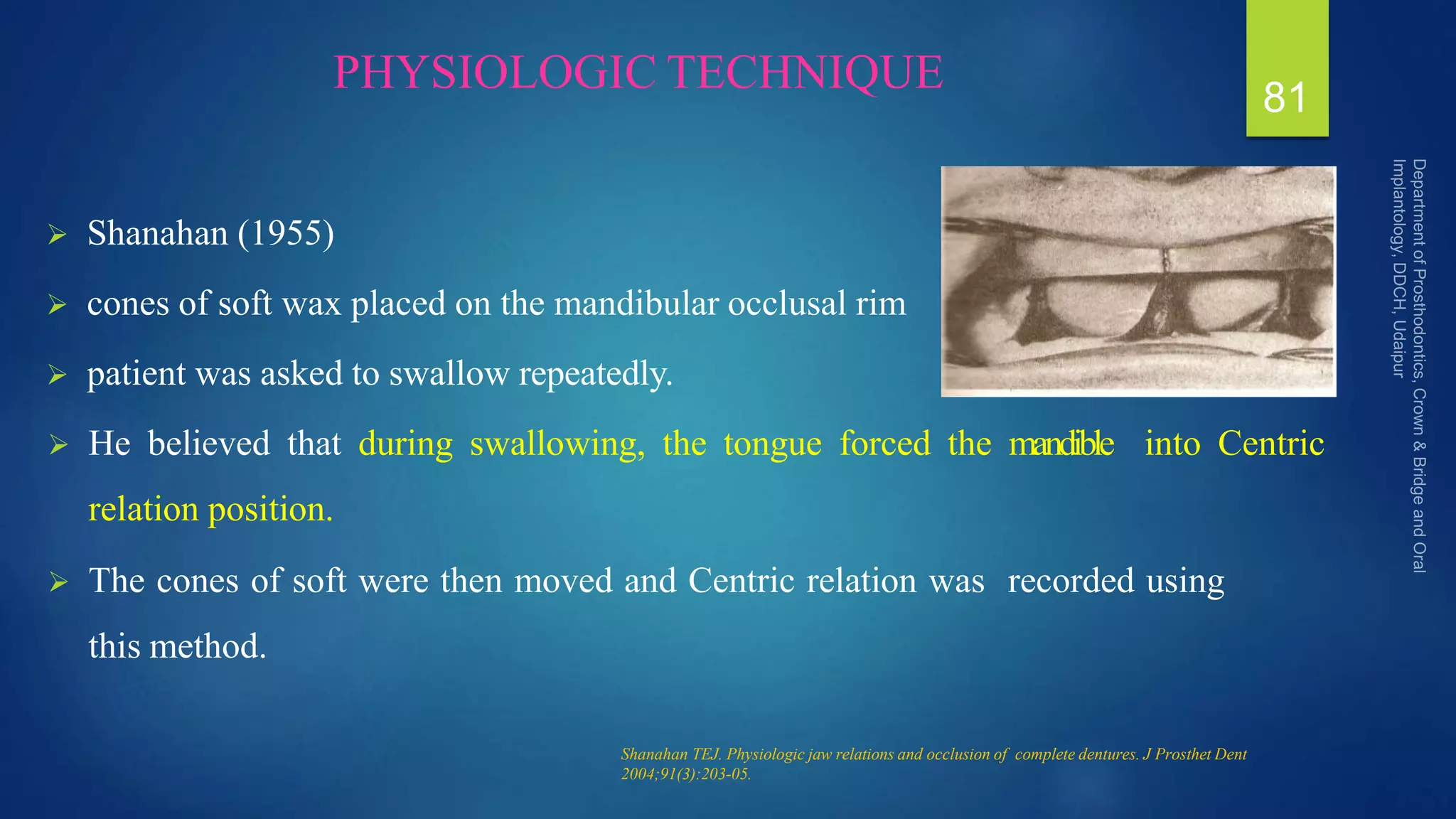
PHYSIOLOGIC TECHNIQUE
 Shanahan (1955)
 cones of soft wax placed on the mandibular occlusal rim
 patient was asked to swallow repeatedly.
 He believed that during swallowing, the tongue forced the mandible into Centric
relation position.
 The cones of soft were then moved and Centric relation was recorded using
this method.
81
Shanahan TEJ. Physiologic jaw relations and occlusion of complete dentures. J Prosthet Dent
2004;91(3):203-05.
 INDICATIONS :
 Supporting tissues are excessively displaceable
 Large awkward tongues
 Uncontrollable/ abnormal mandibular movements
 Check occlusion of teeth in existing dentures.
82
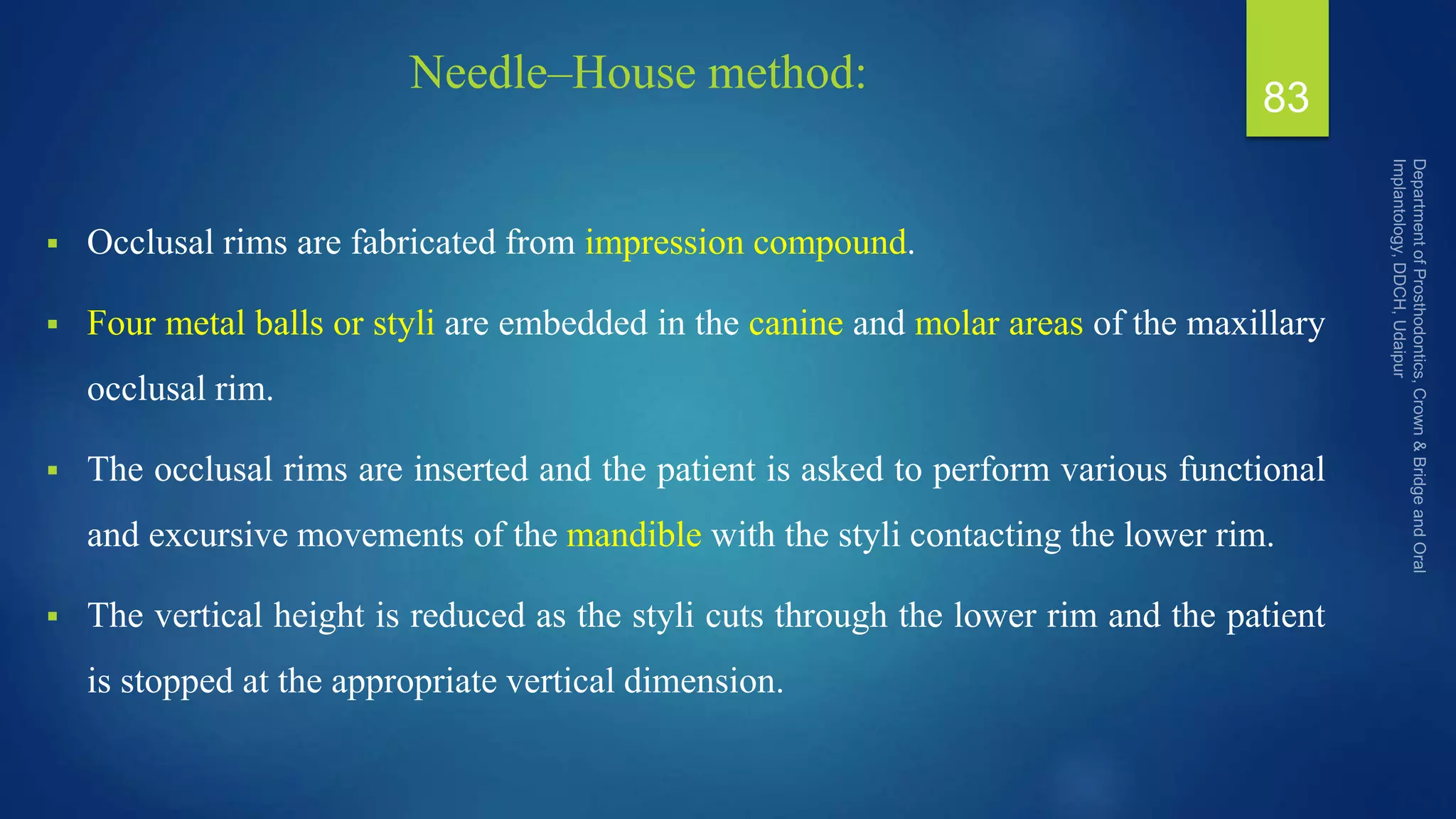
Needle–House method:
 Occlusal rims are fabricated from impression compound.
 Four metal balls or styli are embedded in the canine and molar areas of the maxillary
occlusal rim.
 The occlusal rims are inserted and the patient is asked to perform various functional
and excursive movements of the mandible with the styli contacting the lower rim.
 The vertical height is reduced as the styli cuts through the lower rim and the patient
is stopped at the appropriate vertical dimension.
83
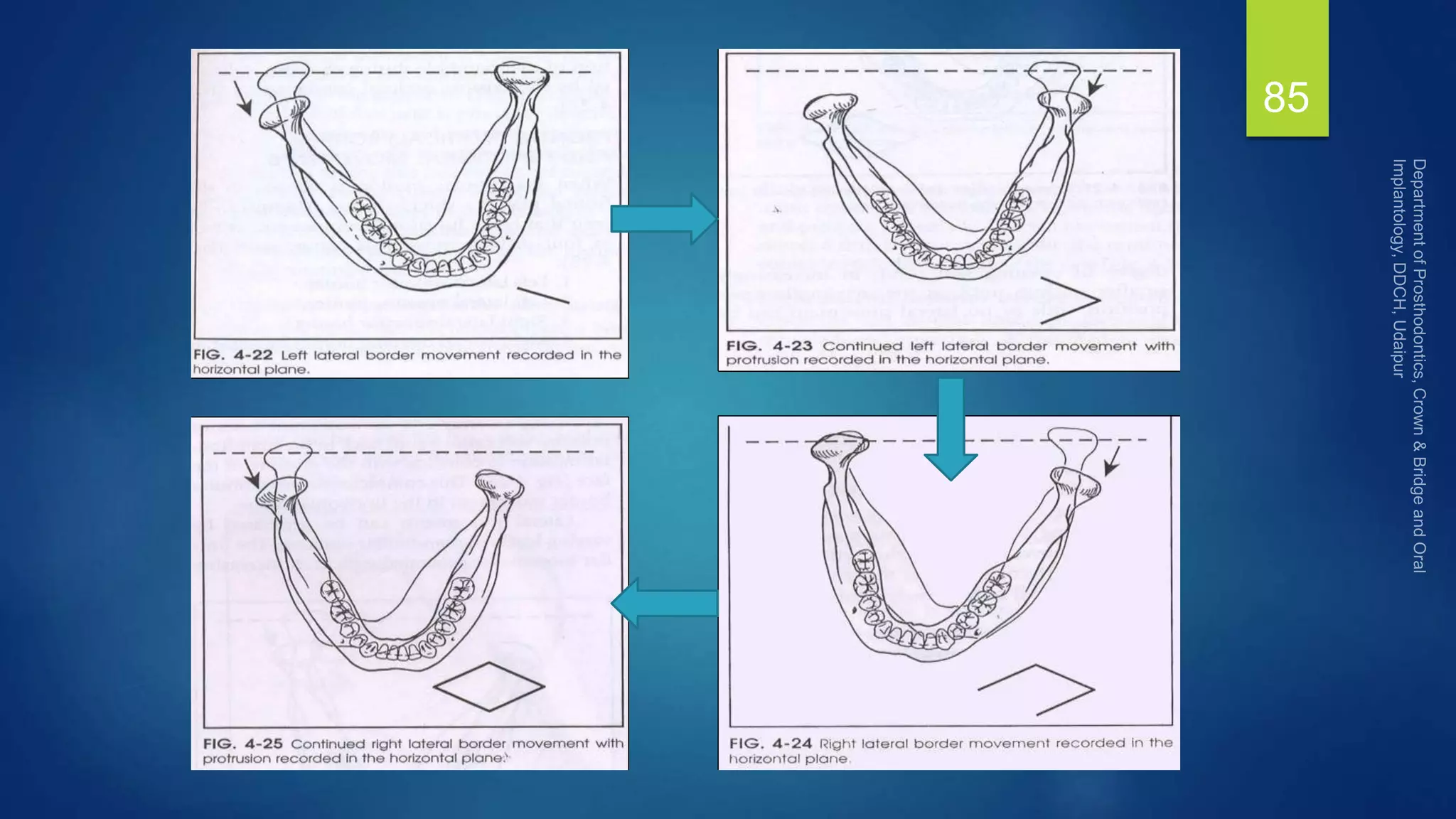
 The styli makes three-dimensional diamond-shaped tracings, which can be
transferred to a suitable articulator to duplicate the movements.
 The most anterior point of the marking denotes CR and can be used to mount on any
articulator
84
85
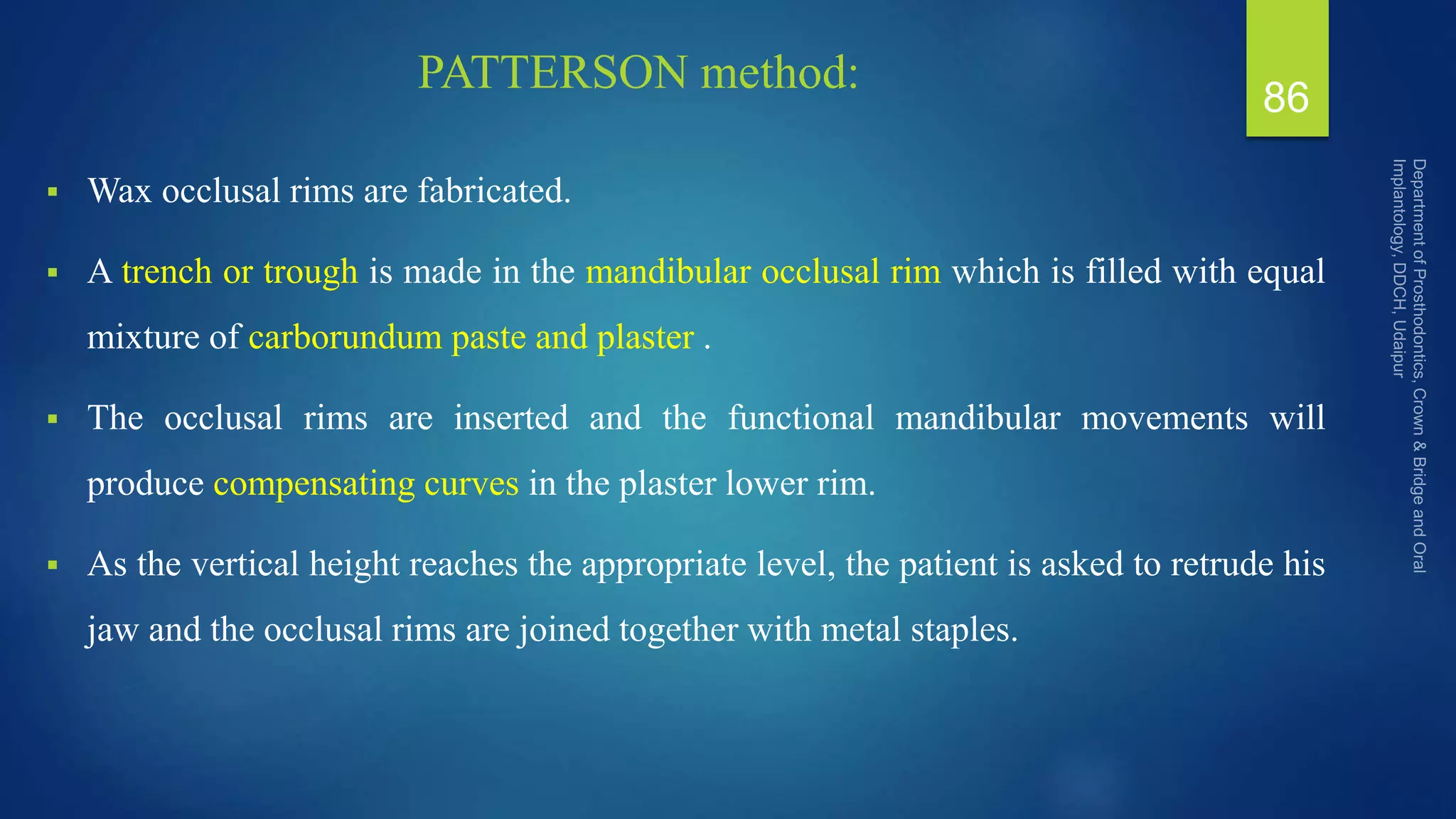
PATTERSON method:
 Wax occlusal rims are fabricated.
 A trench or trough is made in the mandibular occlusal rim which is filled with equal
mixture of carborundum paste and plaster .
 The occlusal rims are inserted and the functional mandibular movements will
produce compensating curves in the plaster lower rim.
 As the vertical height reaches the appropriate level, the patient is asked to retrude his
jaw and the occlusal rims are joined together with metal staples.
86
87
MEYER’S method:
 Used soft wax occlusal rims.
 Tinfoil was placed over the wax and lubricated.
 Patient performed functional movements to produce a wax path
 Plaster index was made
88
GRAPHIC METHODS
 The earliest graphic recordings were based on studies of mandibular movements by
Balkwill in 1866.
 The intersection of the arcs produced by the right and left condyles formed the apex
of what is known as GOTHIC ARCH TRACING.
 Hesse (1897)– First to make a Needle point tracing.
 Gysi (1910)– Improved needle point tracing.
 Phillips (1927)– He developed a plate for the maxillar occlusal rims and a tripoded
ball bearing mounted on a jackscrew for the mandibular occlusal rim. He called this
as the "Central Bearing Point".
89
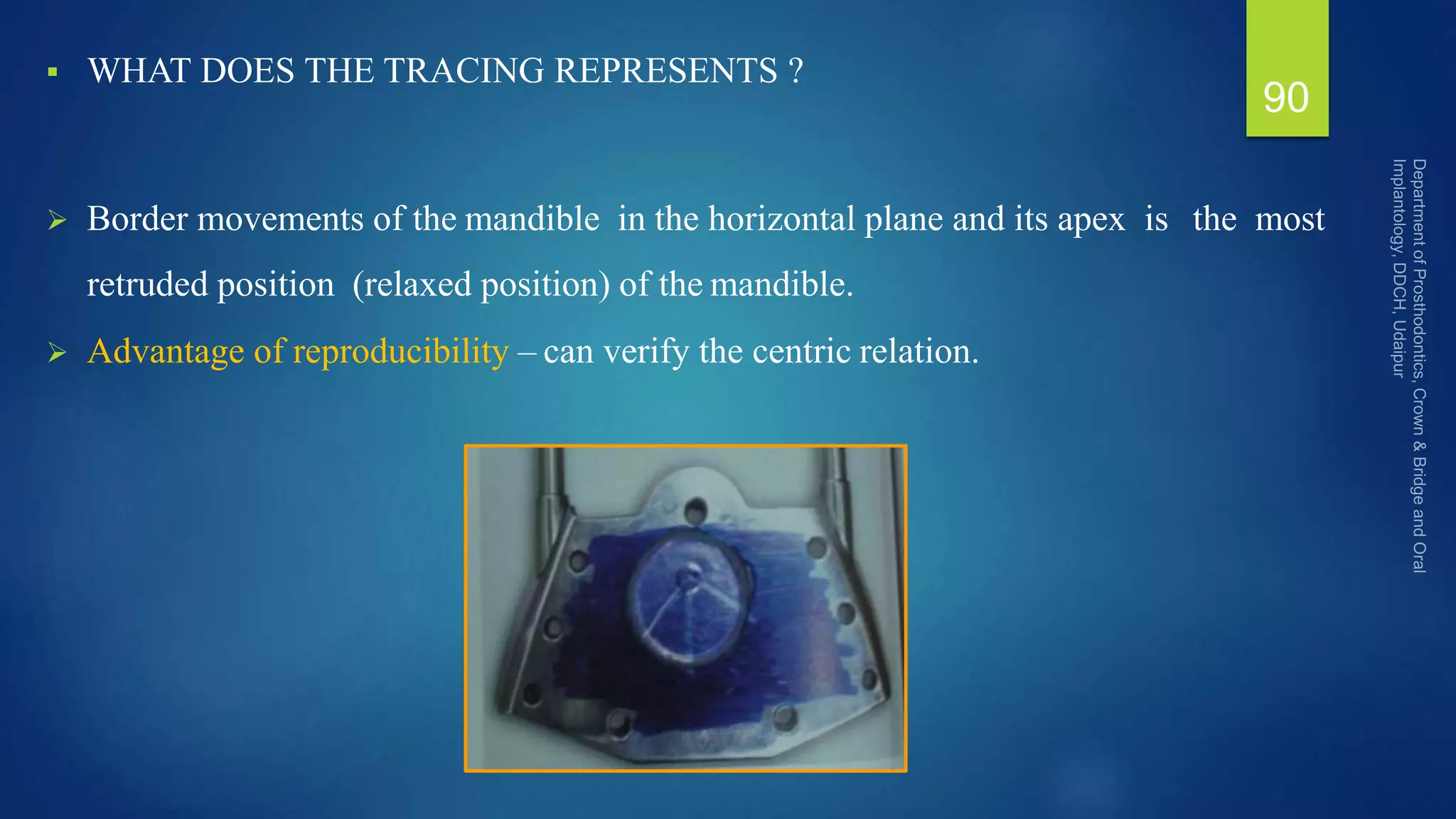
 WHAT DOES THE TRACING REPRESENTS ?
 Border movements of the mandible in the horizontal plane and its apex is the most
retruded position (relaxed position) of the mandible.
 Advantage of reproducibility – can verify the centric relation.
90
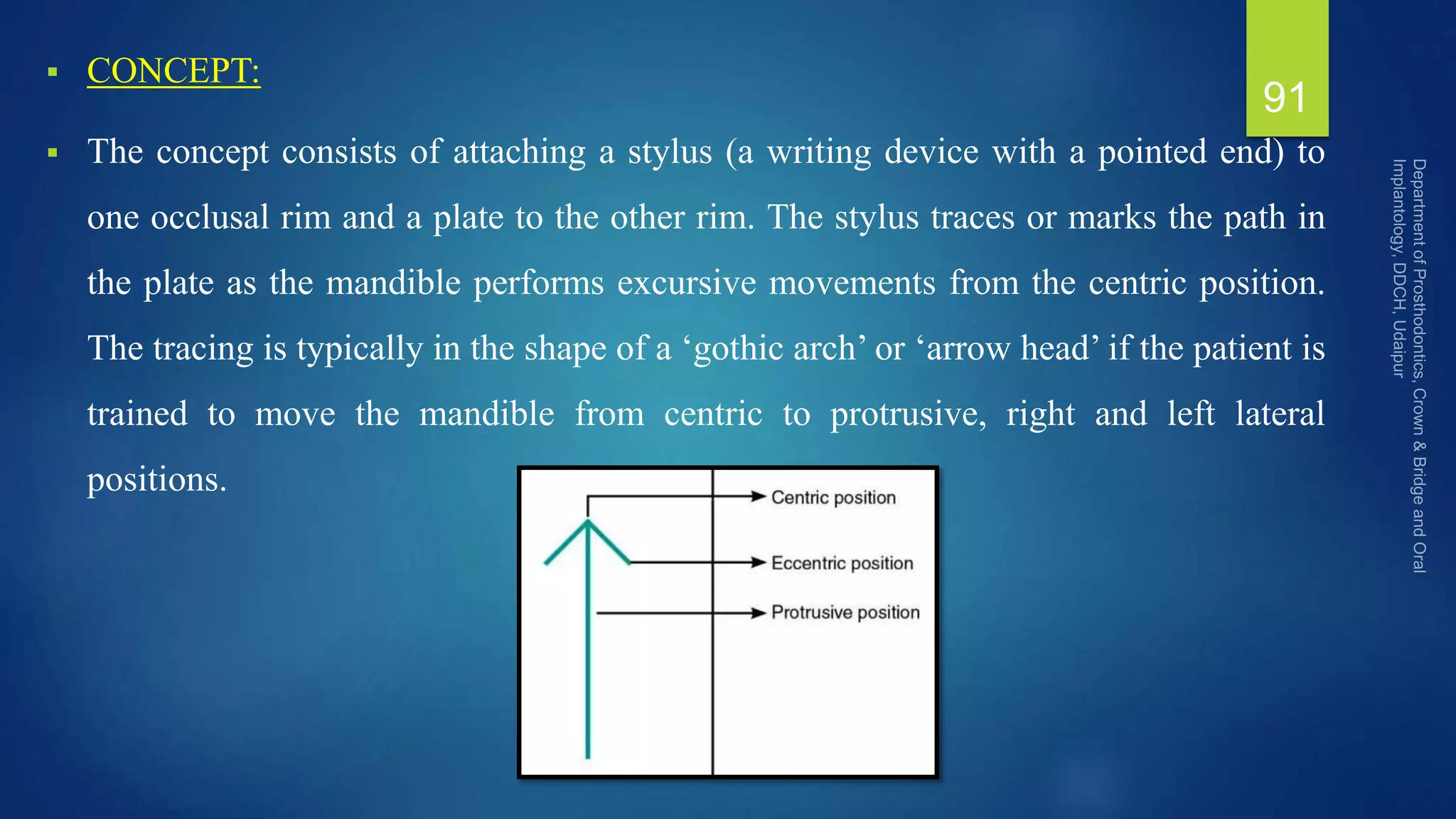
 CONCEPT:
 The concept consists of attaching a stylus (a writing device with a pointed end) to
one occlusal rim and a plate to the other rim. The stylus traces or marks the path in
the plate as the mandible performs excursive movements from the centric position.
The tracing is typically in the shape of a ‘gothic arch’ or ‘arrow head’ if the patient is
trained to move the mandible from centric to protrusive, right and left lateral
positions.
91
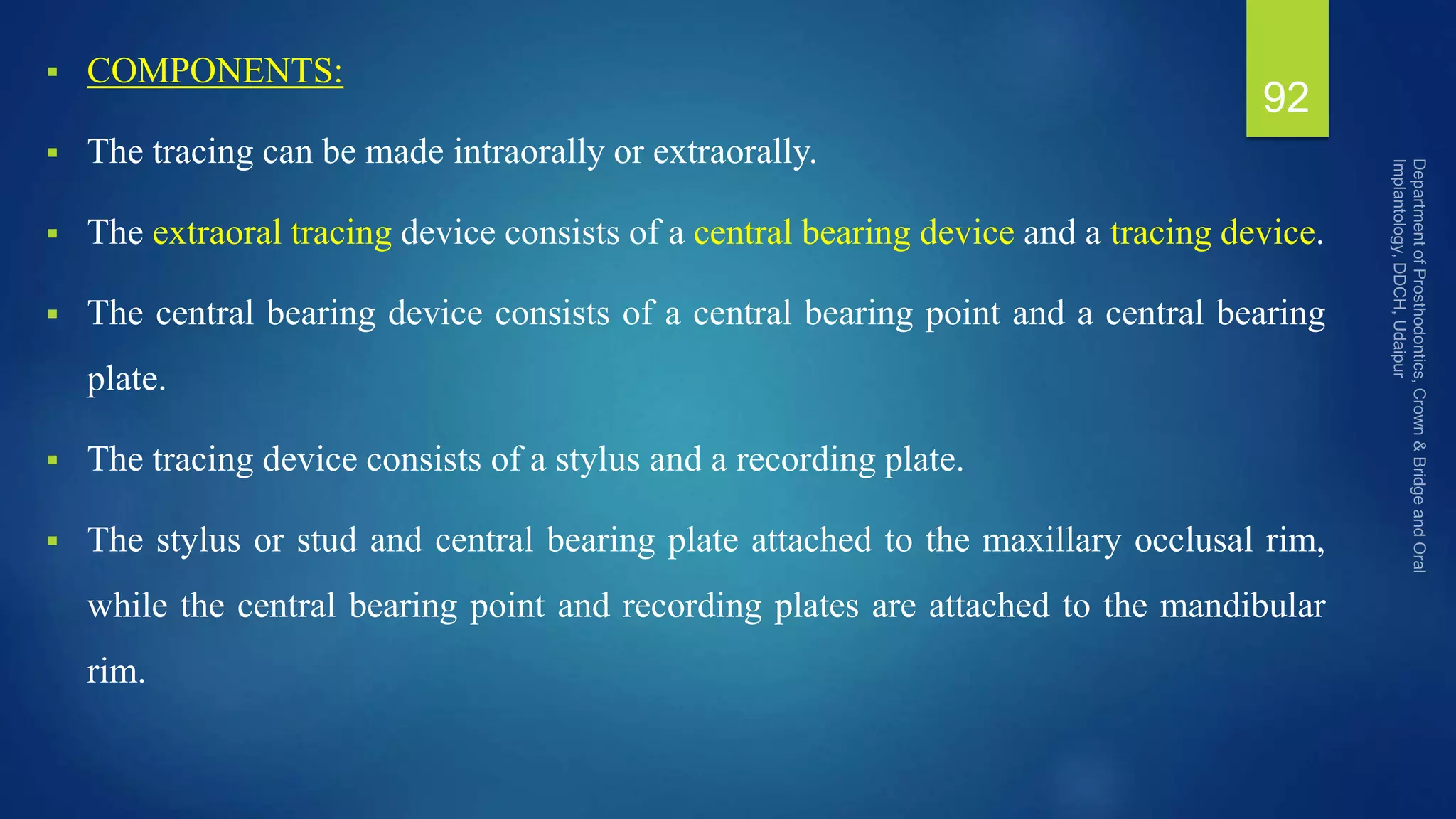
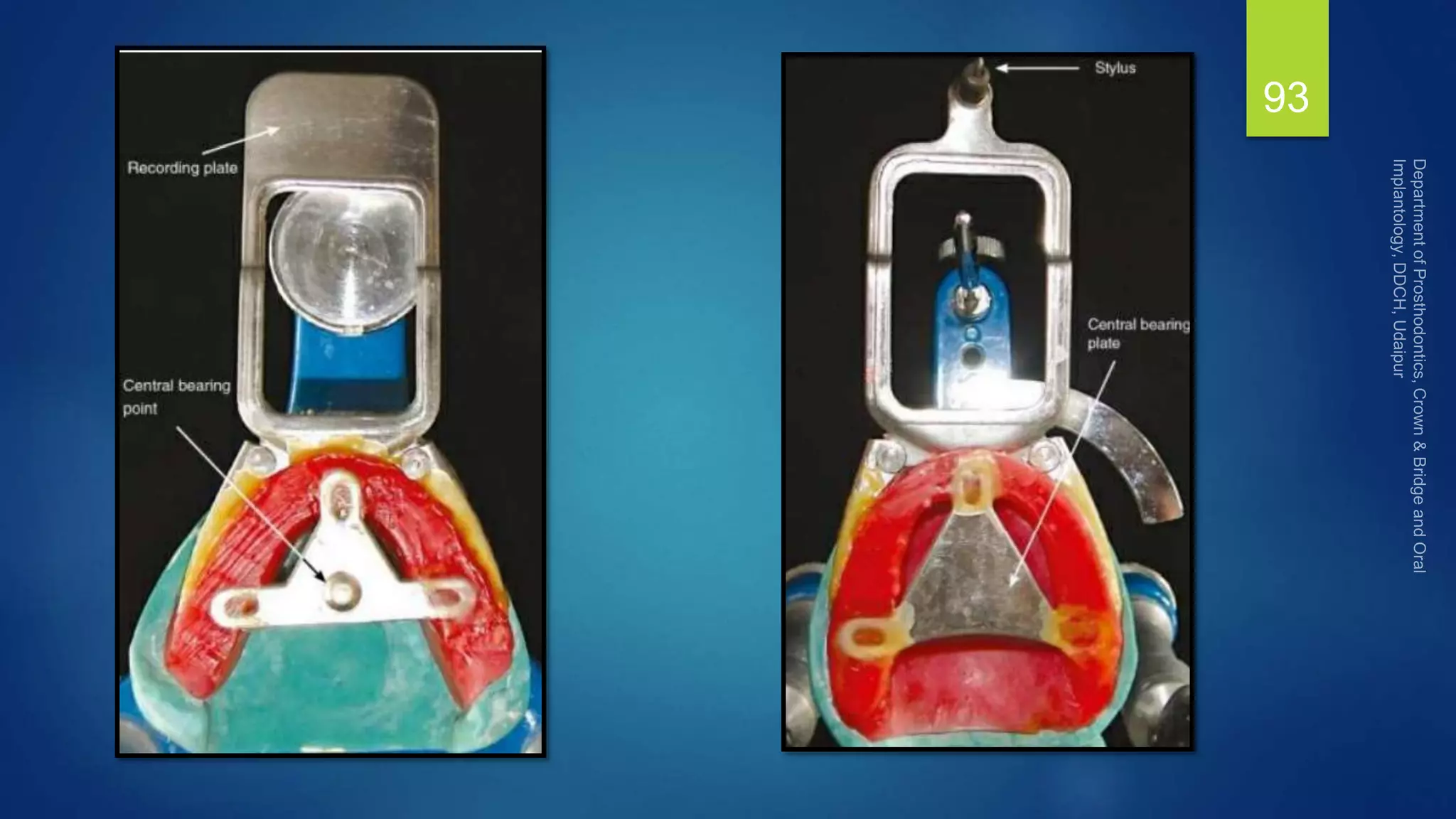
 COMPONENTS:
 The tracing can be made intraorally or extraorally.
 The extraoral tracing device consists of a central bearing device and a tracing device.
 The central bearing device consists of a central bearing point and a central bearing
plate.
 The tracing device consists of a stylus and a recording plate.
 The stylus or stud and central bearing plate attached to the maxillary occlusal rim,
while the central bearing point and recording plates are attached to the mandibular
rim.
92
93
 COMPONENTS:
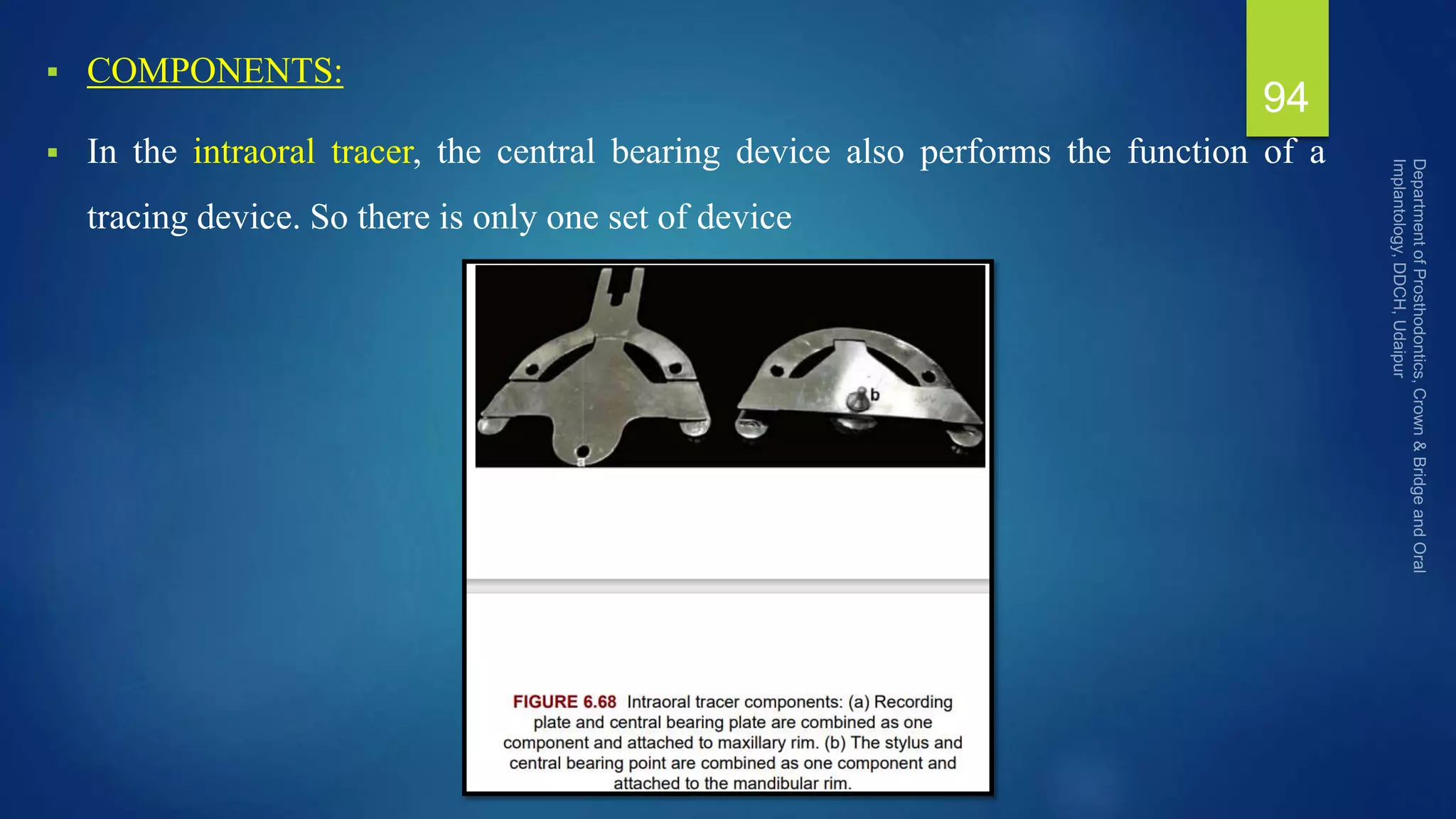
 In the intraoral tracer, the central bearing device also performs the function of a
tracing device. So there is only one set of device
94
 Central bearing device is a very important aspect of the device.
 It should be placed in the geometric centre of the maxillary and mandibular arches to
serve the following functions:
 ▪ Maintains vertical dimension.
 ▪ Equalizes the pressure by distributing the forces throughout the supporting tissues.
 ▪ Allows mandibular movement to be dictated by the condyles.
95
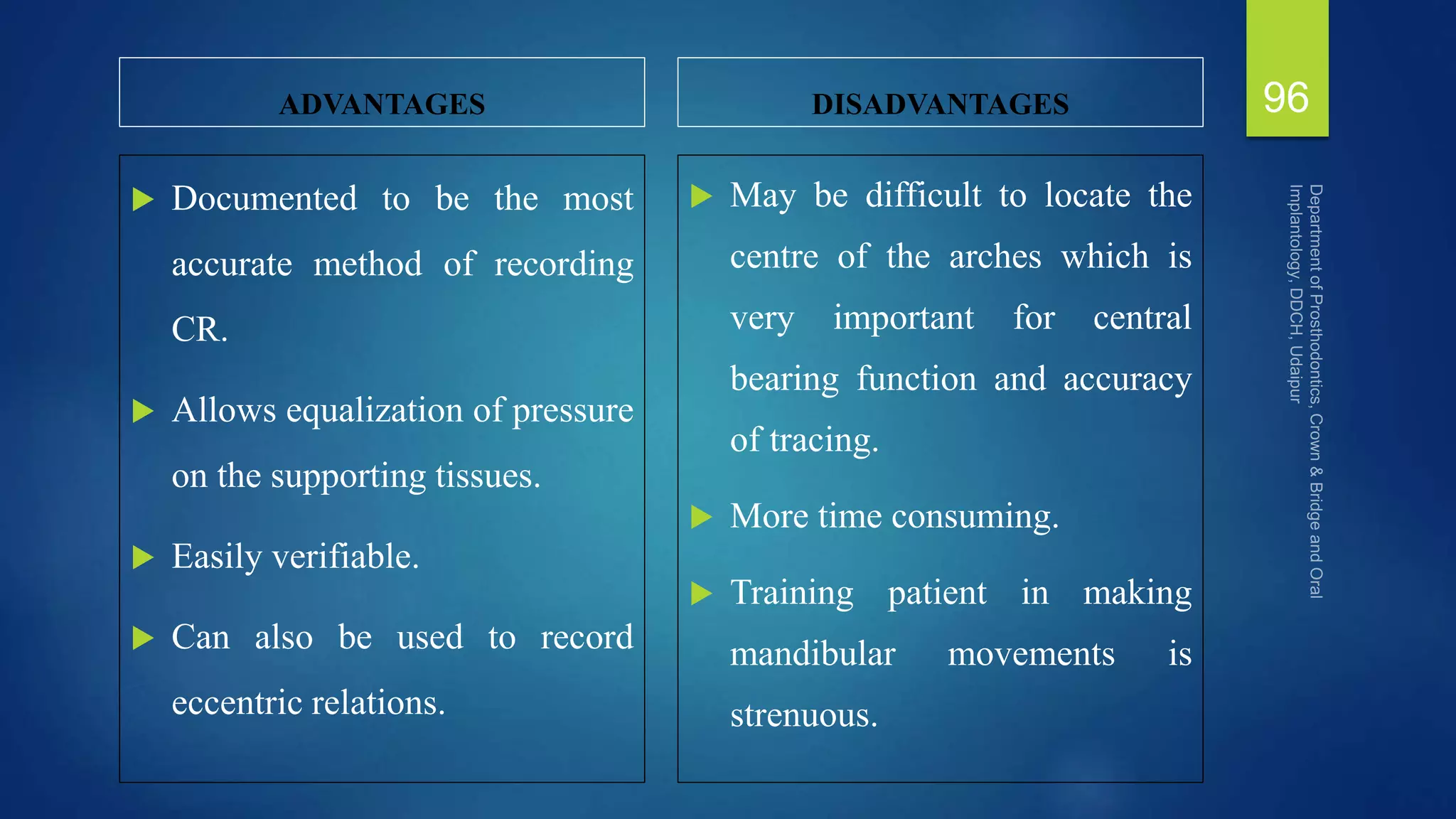
ADVANTAGES
 Documented to be the most
accurate method of recording
CR.
 Allows equalization of pressure
on the supporting tissues.
 Easily verifiable.
 Can also be used to record
eccentric relations.
DISADVANTAGES
 May be difficult to locate the
centre of the arches which is
very important for central
bearing function and accuracy
of tracing.
 More time consuming.
 Training patient in making
mandibular movements is
strenuous.
96
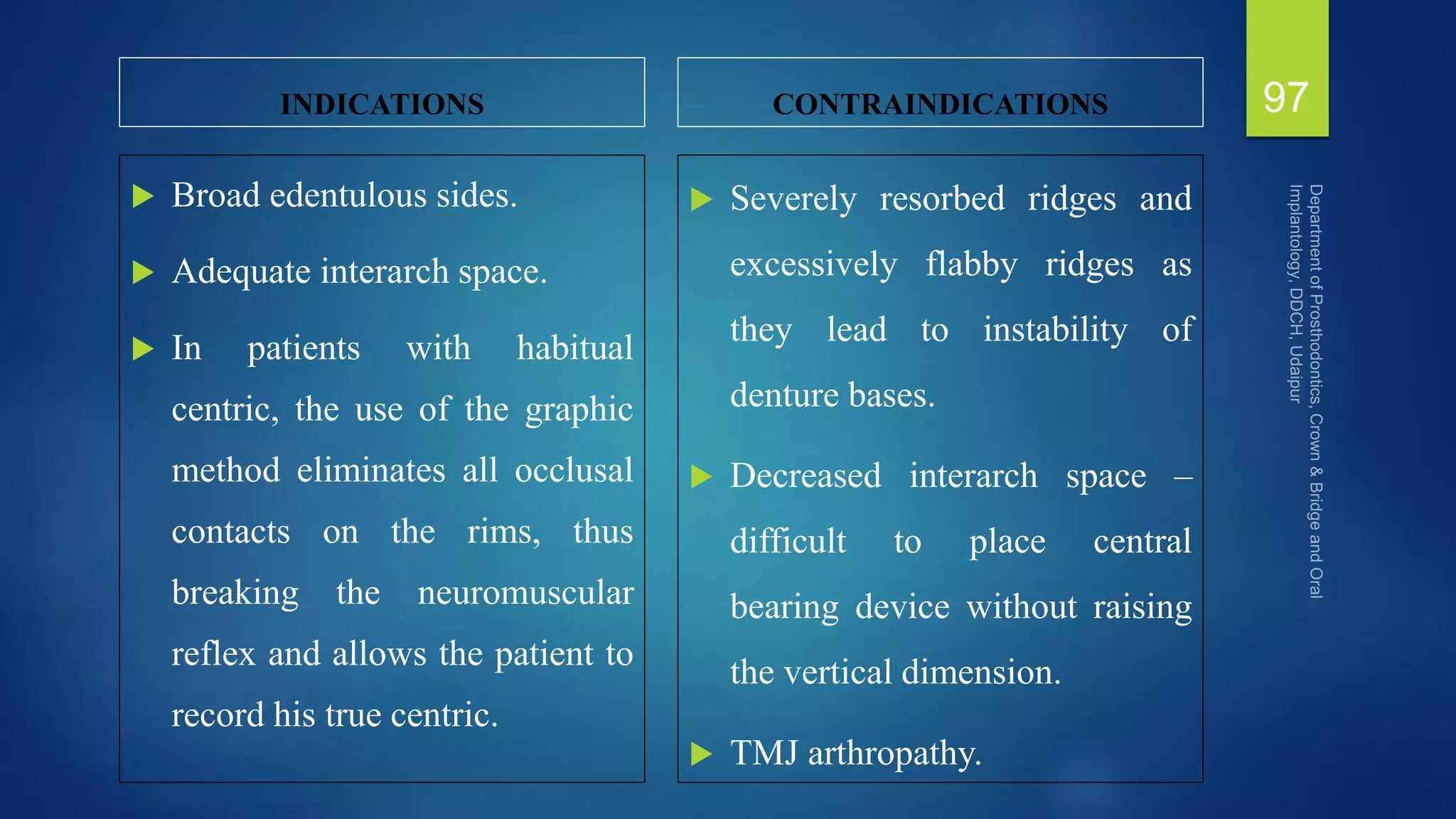
INDICATIONS
 Broad edentulous sides.
 Adequate interarch space.
 In patients with habitual
centric, the use of the graphic
method eliminates all occlusal
contacts on the rims, thus
breaking the neuromuscular
reflex and allows the patient to
record his true centric.
CONTRAINDICATIONS
 Severely resorbed ridges and
excessively flabby ridges as
they lead to instability of
denture bases.
 Decreased interarch space –
difficult to place central
bearing device without raising
the vertical dimension.
 TMJ arthropathy.
97
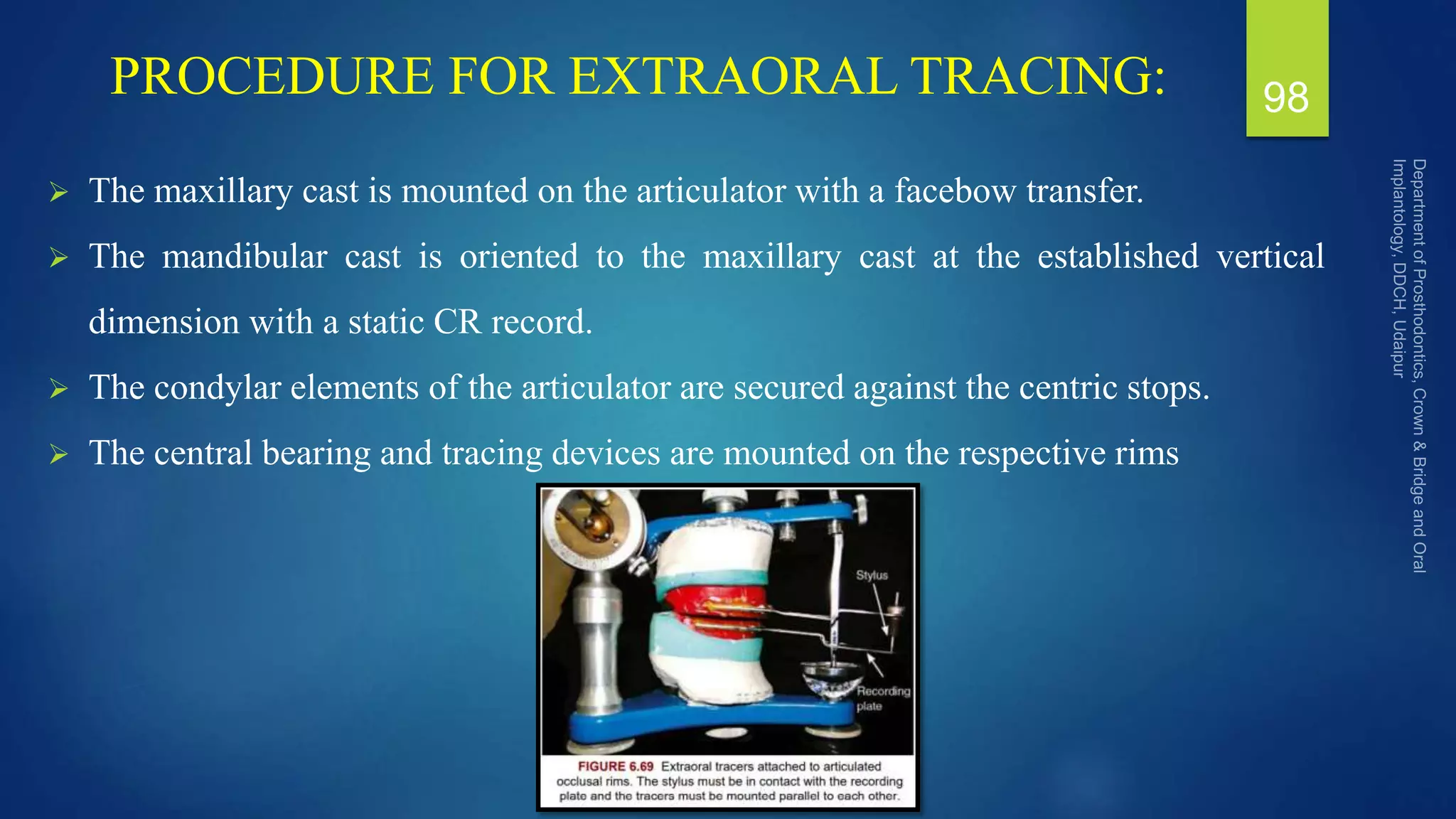
PROCEDURE FOR EXTRAORAL TRACING:
 The maxillary cast is mounted on the articulator with a facebow transfer.
 The mandibular cast is oriented to the maxillary cast at the established vertical
dimension with a static CR record.
 The condylar elements of the articulator are secured against the centric stops.
 The central bearing and tracing devices are mounted on the respective rims
98
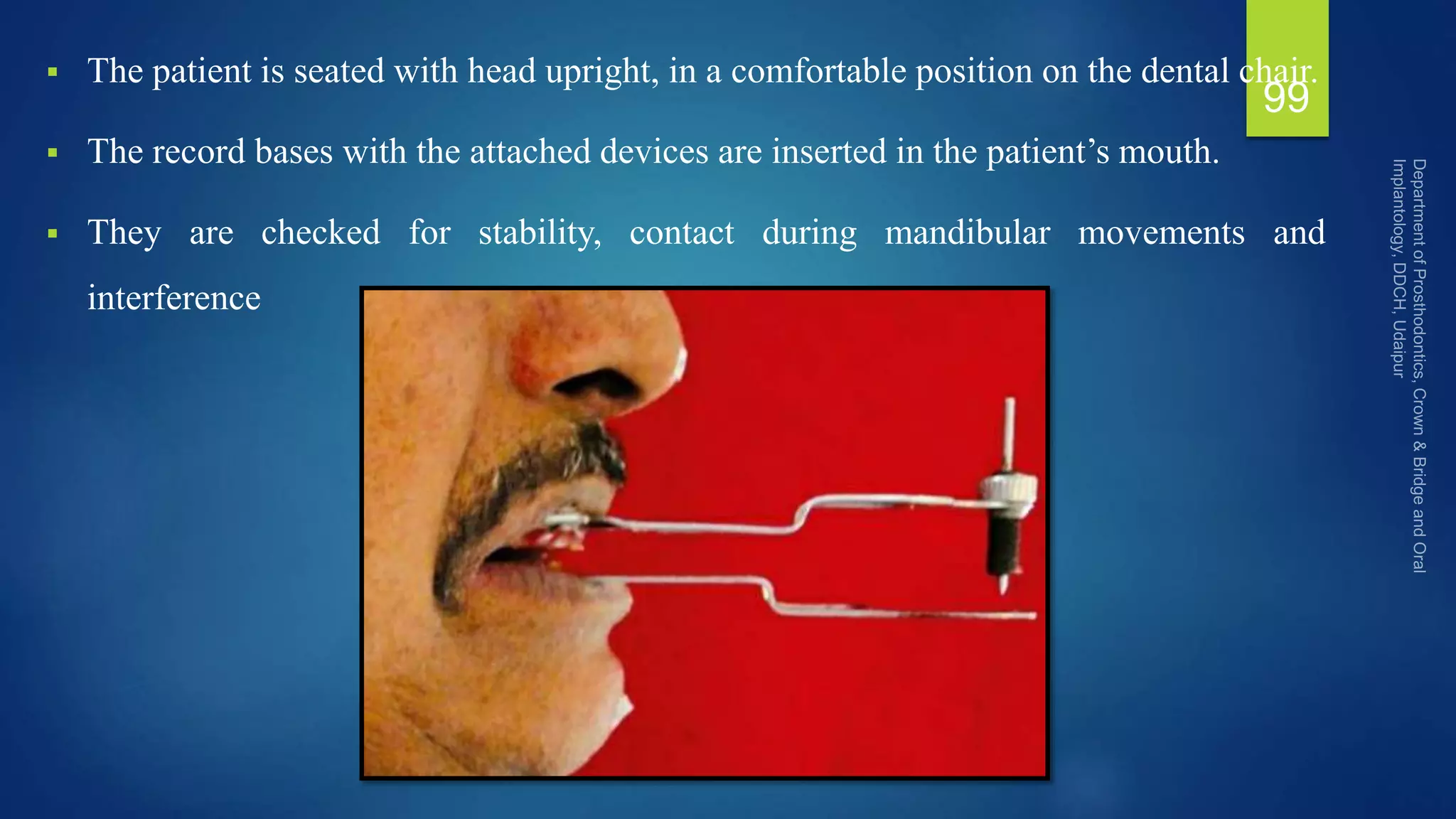
 The patient is seated with head upright, in a comfortable position on the dental chair.
 The record bases with the attached devices are inserted in the patient’s mouth.
 They are checked for stability, contact during mandibular movements and
interference
99
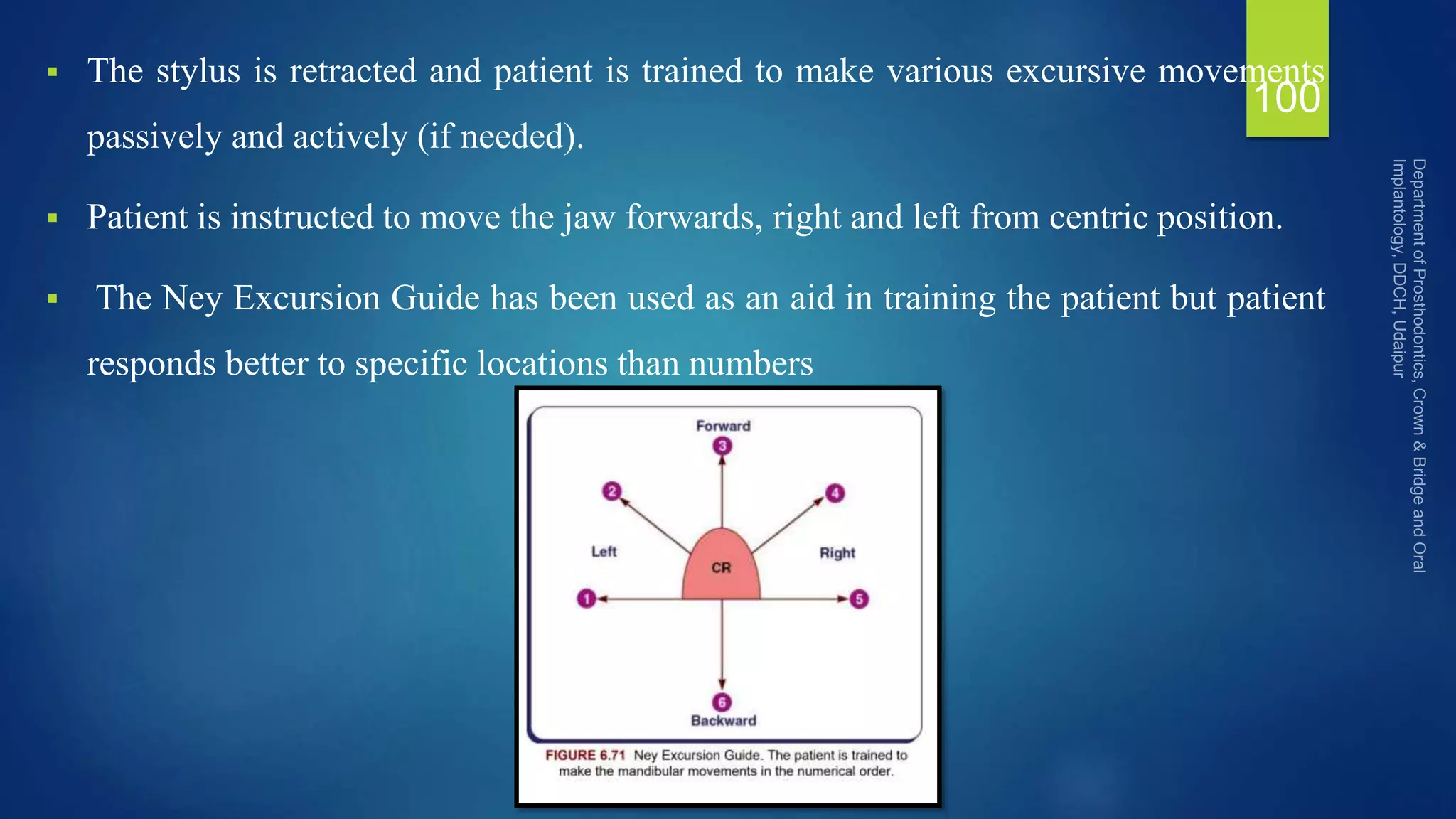
 The stylus is retracted and patient is trained to make various excursive movements
passively and actively (if needed).
 Patient is instructed to move the jaw forwards, right and left from centric position.
 The Ney Excursion Guide has been used as an aid in training the patient but patient
responds better to specific locations than numbers
100
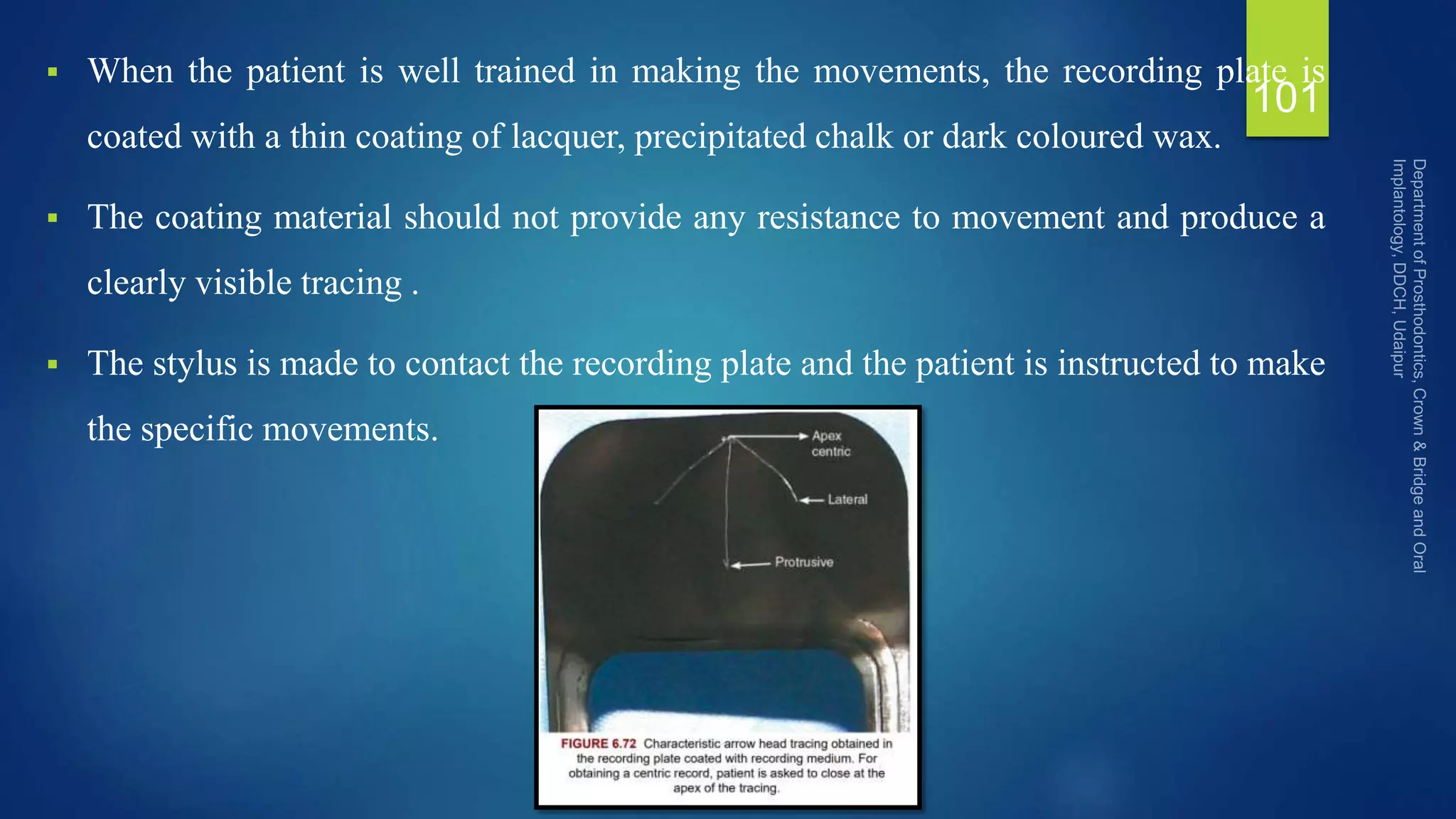
 When the patient is well trained in making the movements, the recording plate is
coated with a thin coating of lacquer, precipitated chalk or dark coloured wax.
 The coating material should not provide any resistance to movement and produce a
clearly visible tracing .
 The stylus is made to contact the recording plate and the patient is instructed to make
the specific movements.
101
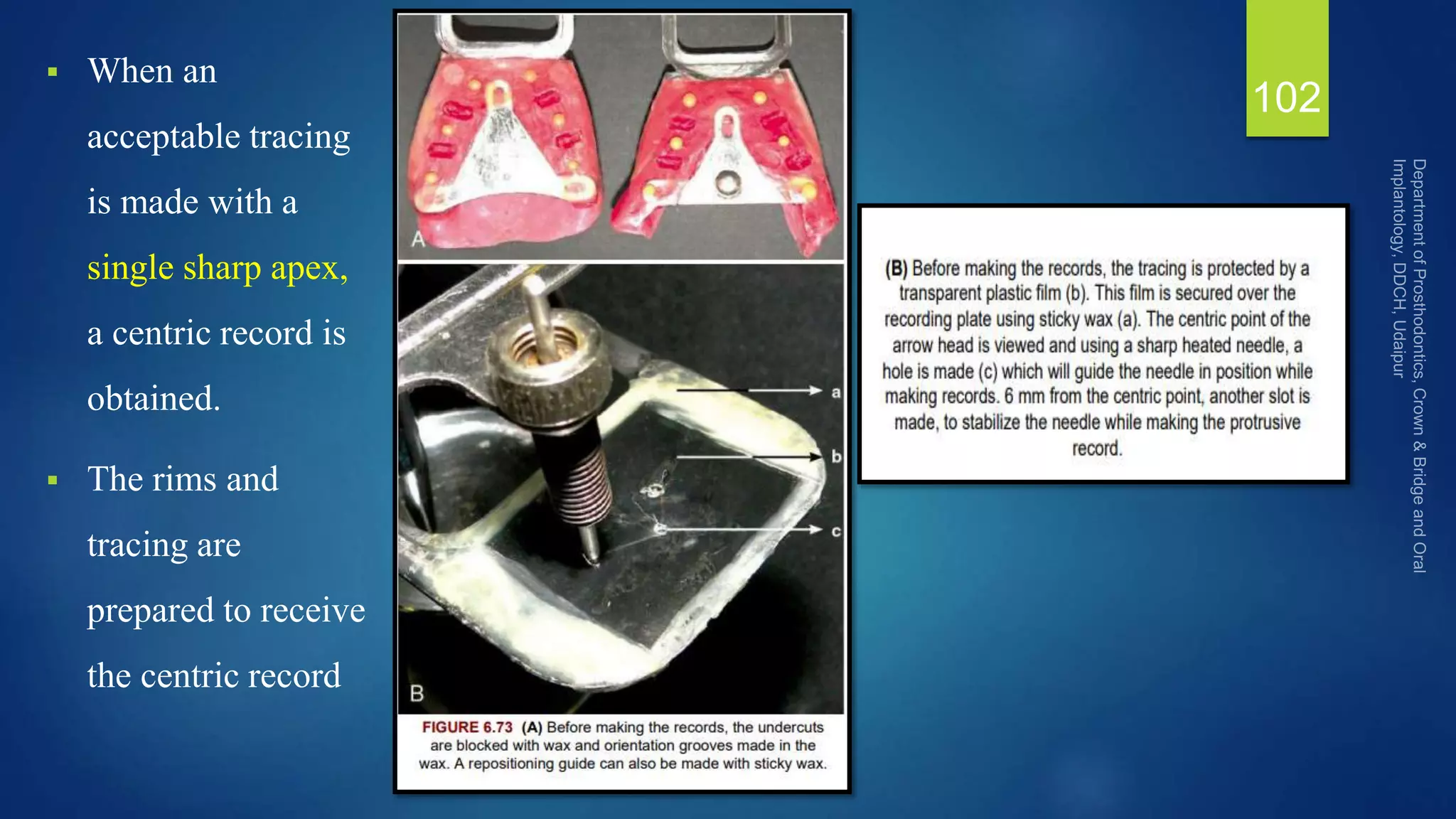
 When an
acceptable tracing
is made with a
single sharp apex,
a centric record is
obtained.
 The rims and
tracing are
prepared to receive
the centric record
102
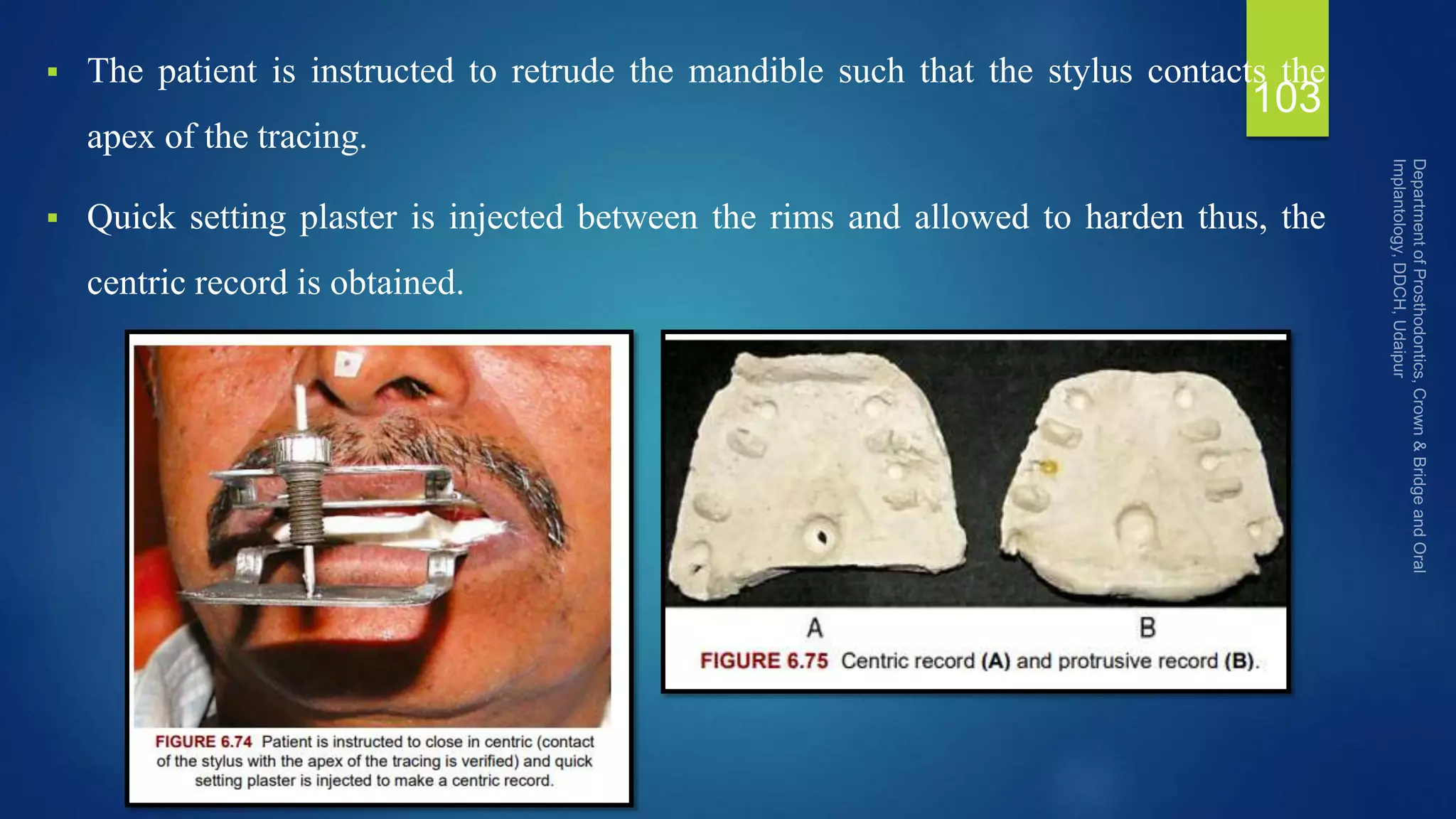
 The patient is instructed to retrude the mandible such that the stylus contacts the
apex of the tracing.
 Quick setting plaster is injected between the rims and allowed to harden thus, the
centric record is obtained.
103
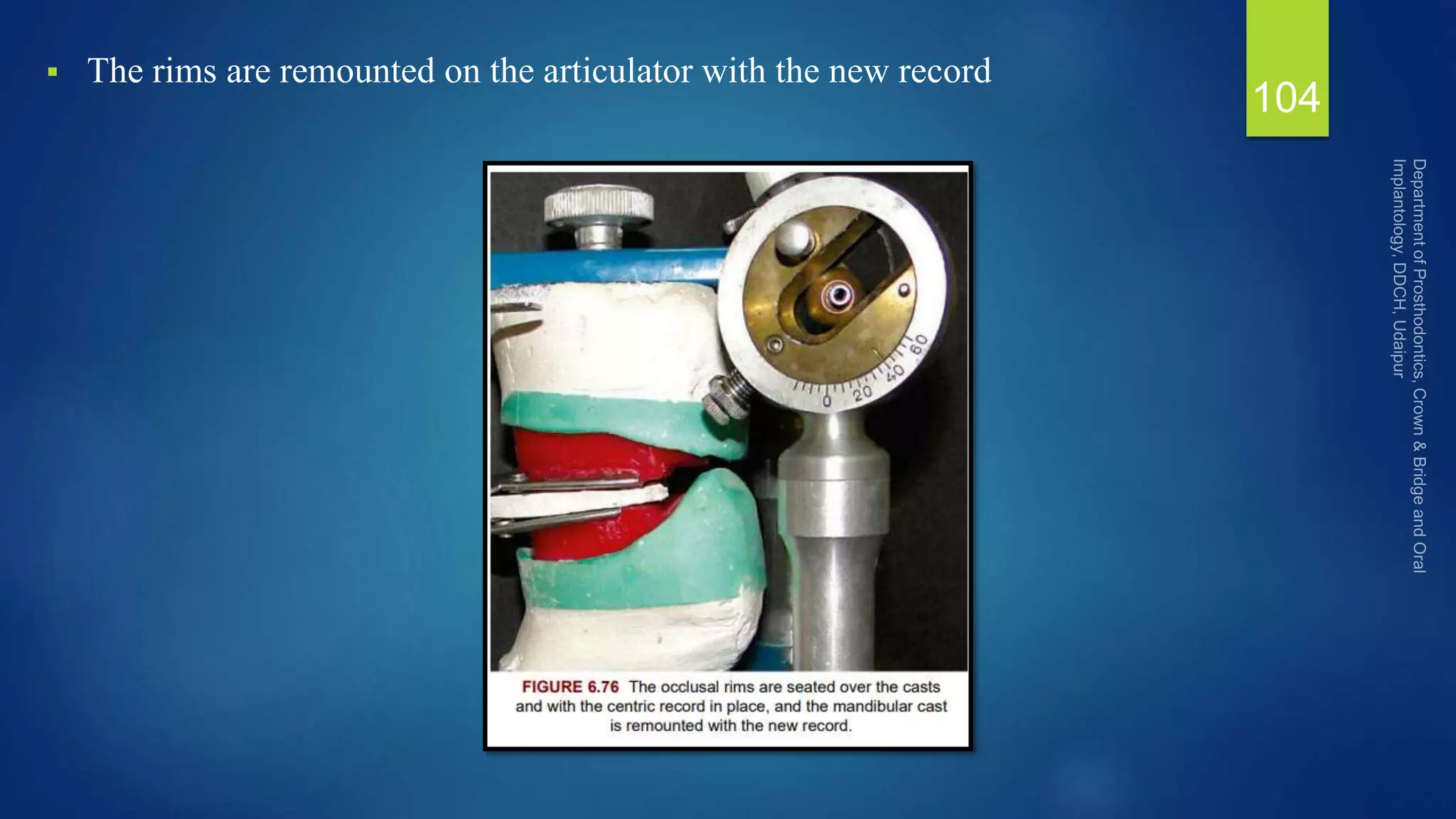
 The rims are remounted on the articulator with the new record
104
DEVICES:
 a. Hight tracer
b. Sears tracer
c. Phillips tracer
d. Chandra tracer
e. Stansbery tracing device
105
PROCEDURE FOR INTRAORAL TRACING:
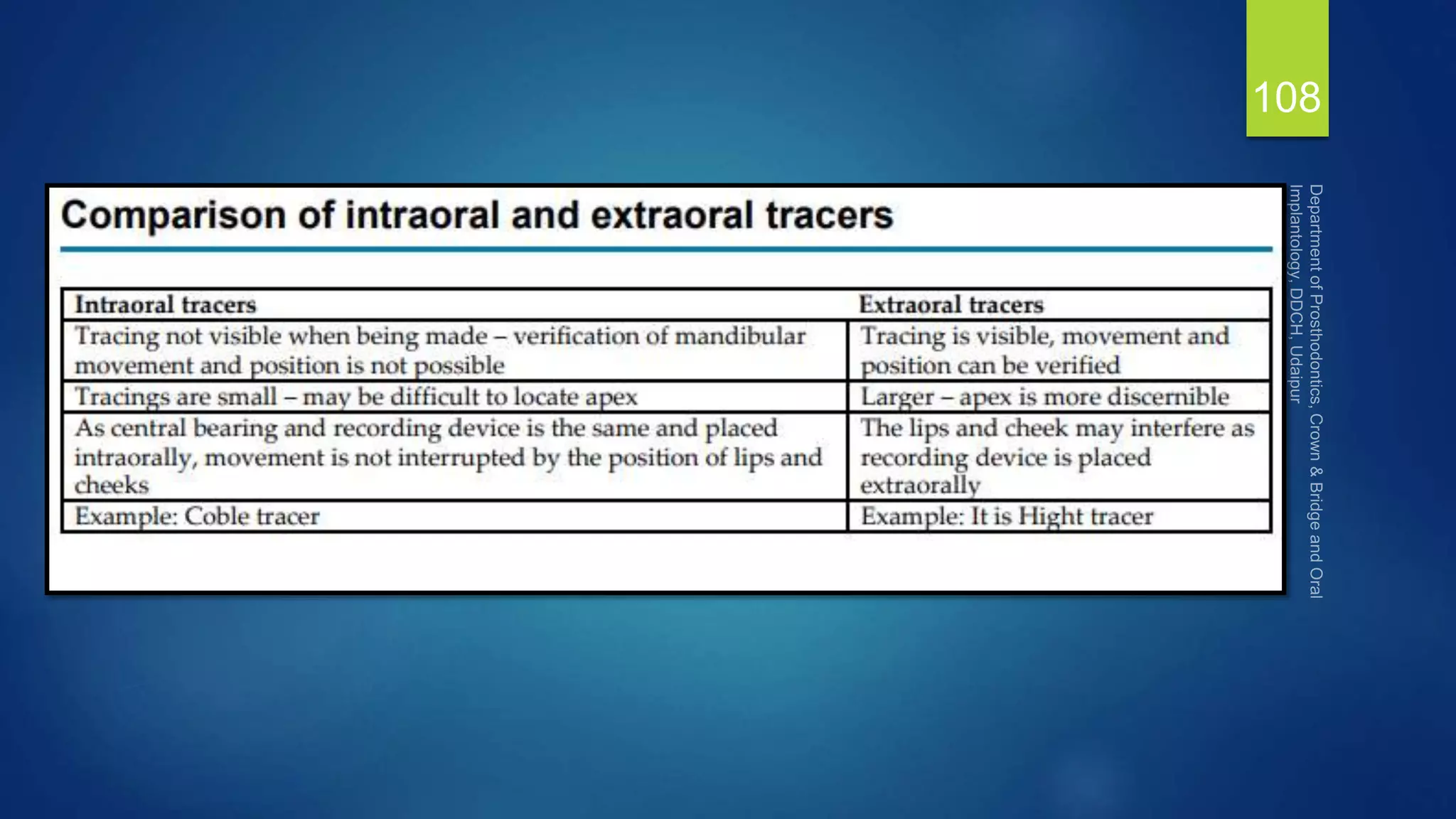
 The procedure with intraoral tracer is similar, but as the tracing is not visible while
being made, a thin plastic disc with a central hole is fixed on the recording plate such
that the hole is placed on the apex of the tracing.
 The patient closes with the tip of the stylus in the hole and this ensures that the
patient closes in centric and maintains the position while the record is being made.
106
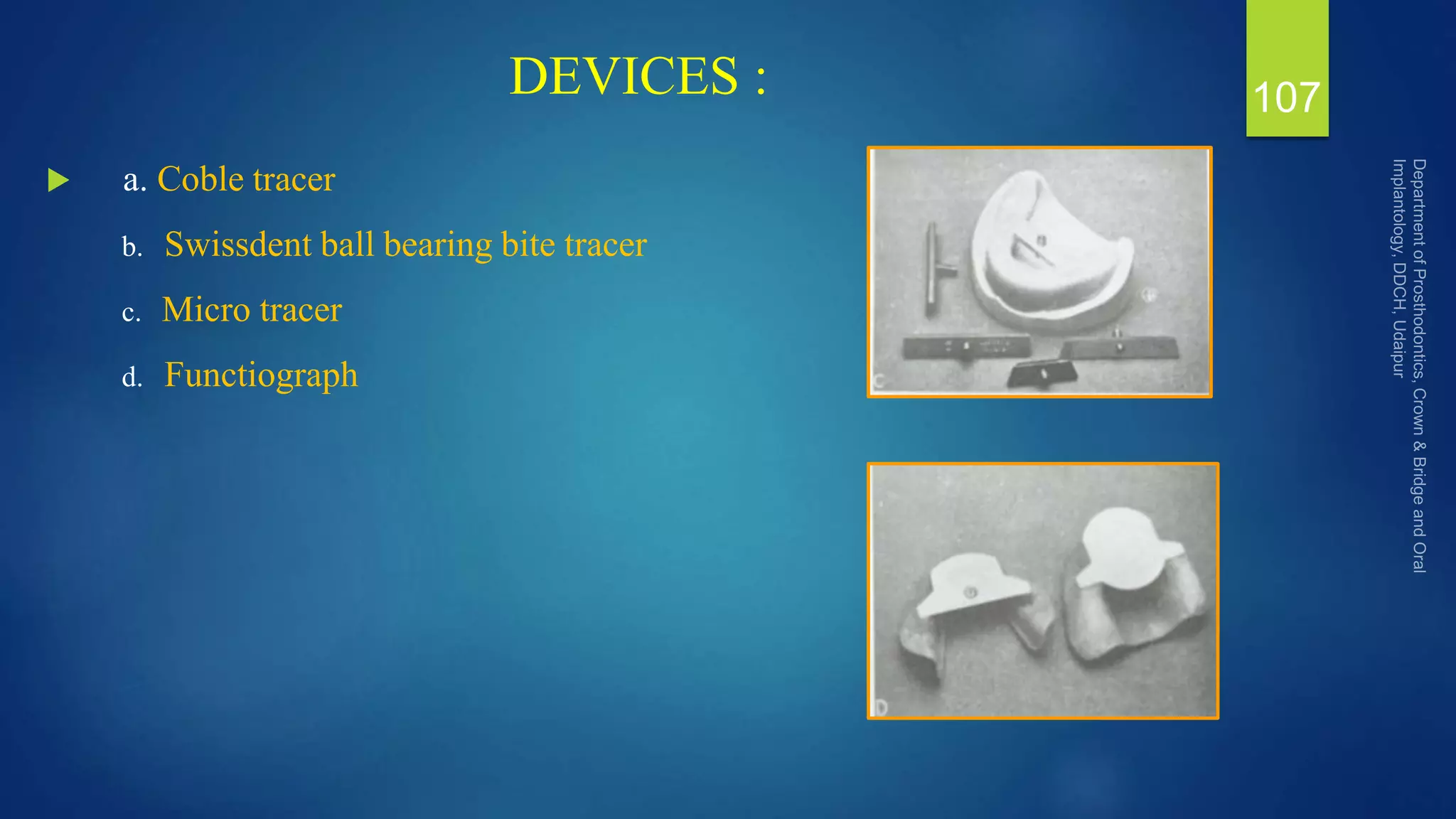
DEVICES :
 a. Coble tracer
b. Swissdent ball bearing bite tracer
c. Micro tracer
d. Functiograph
107
108
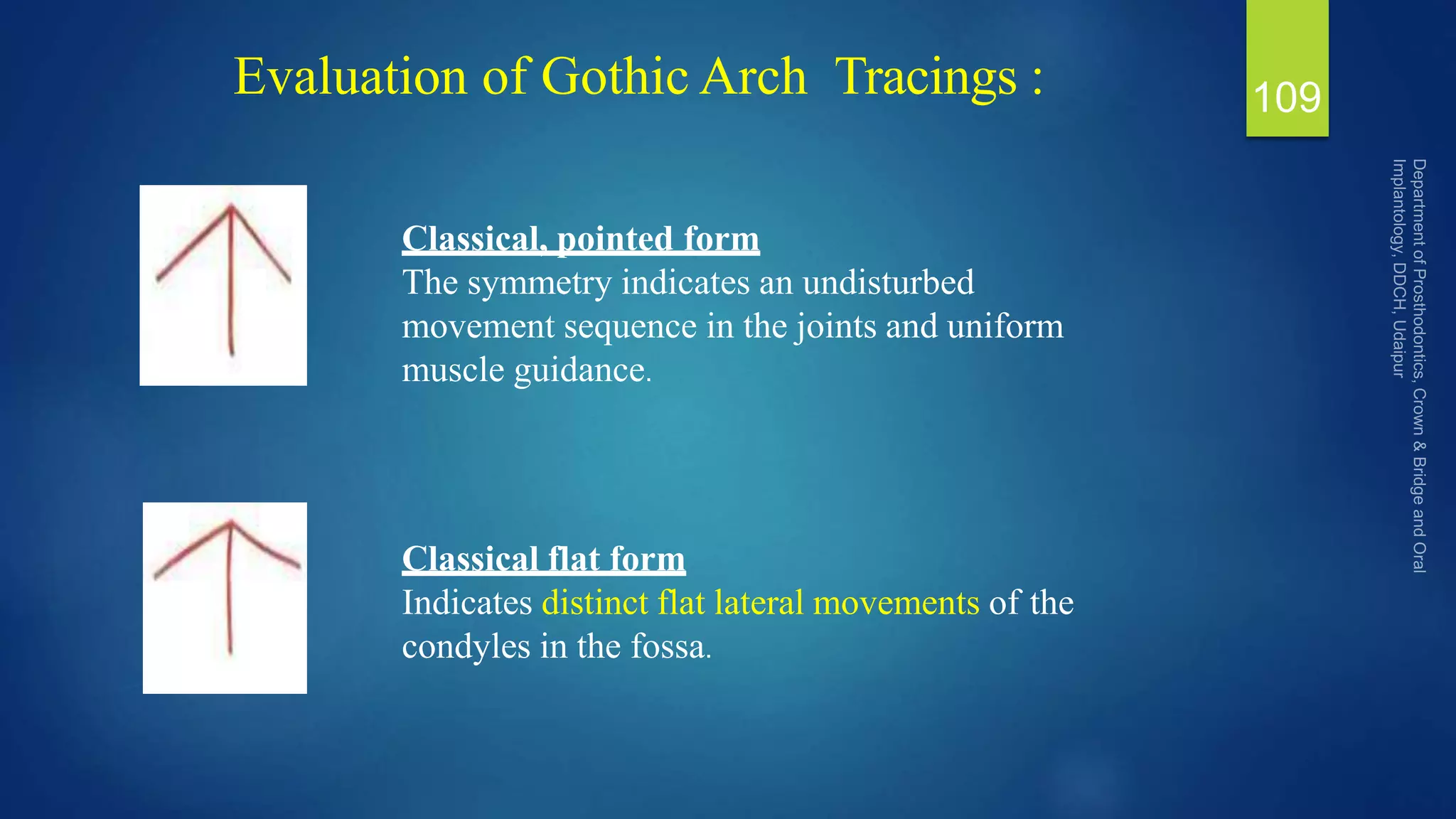
Evaluation of Gothic Arch Tracings : 109
Classical, pointed form
The symmetry indicates an undisturbed
movement sequence in the joints and uniform
muscle guidance.
Classical flat form
Indicates distinct flat lateral movements of the
condyles in the fossa.
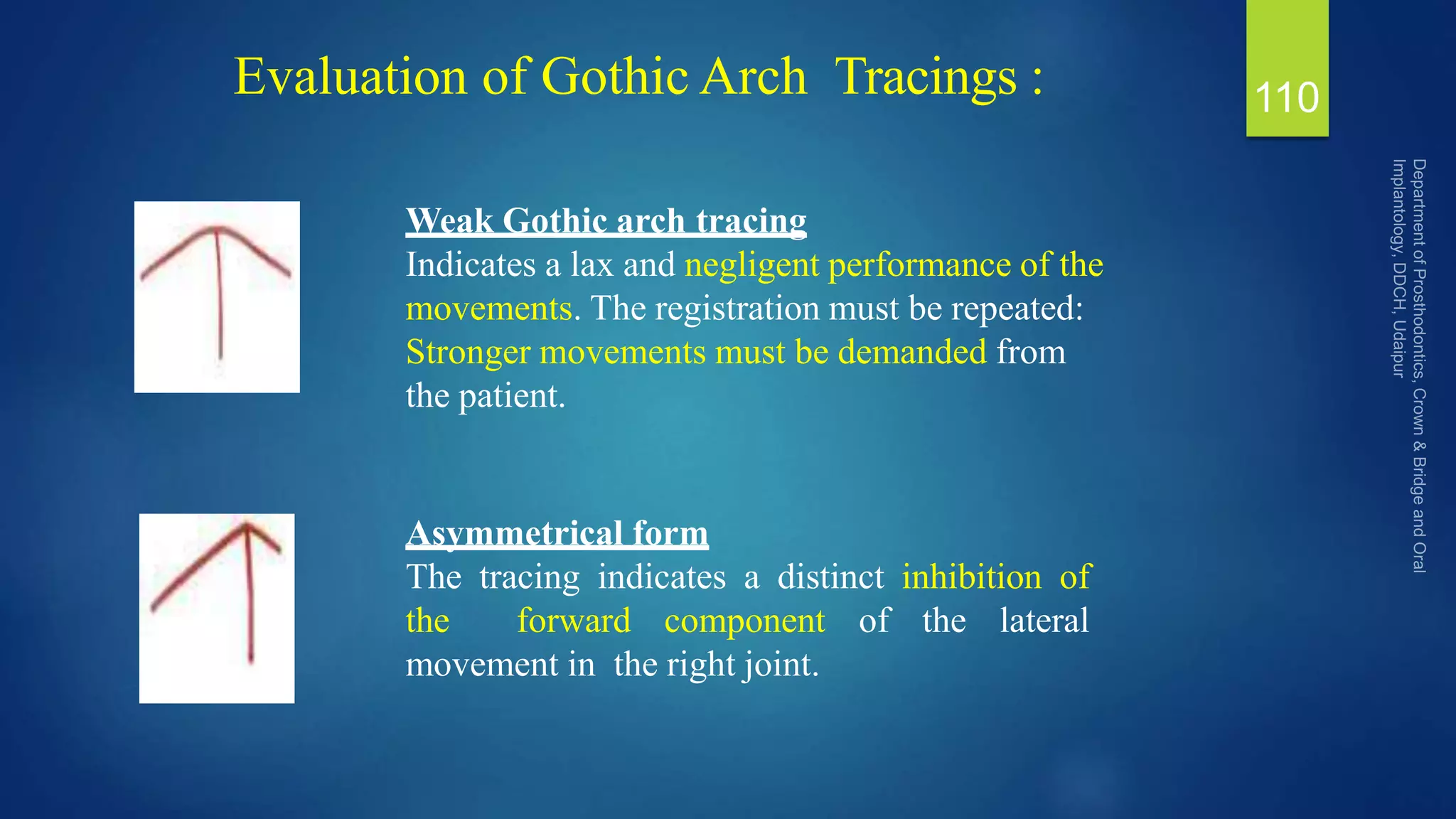
Evaluation of Gothic Arch Tracings : 110
Weak Gothic arch tracing
Indicates a lax and negligent performance of the
movements. The registration must be repeated:
Stronger movements must be demanded from
the patient.
Asymmetrical form
The tracing indicates a distinct inhibition of
the forward component of the lateral
movement in the right joint.
Evaluation of Gothic Arch Tracings : 111
Miniature Gothic arch tracing
This tracing points restricted mandibular movements.
•Due to badly fitting and pain-causing record bases
or
•Long standing edentulous state with inhibited
movement in the joints.
Vertical line protrudes beyond the arrow
point
forcible retraction or pushing of the mandible
or tracing obtained with protruded mandible
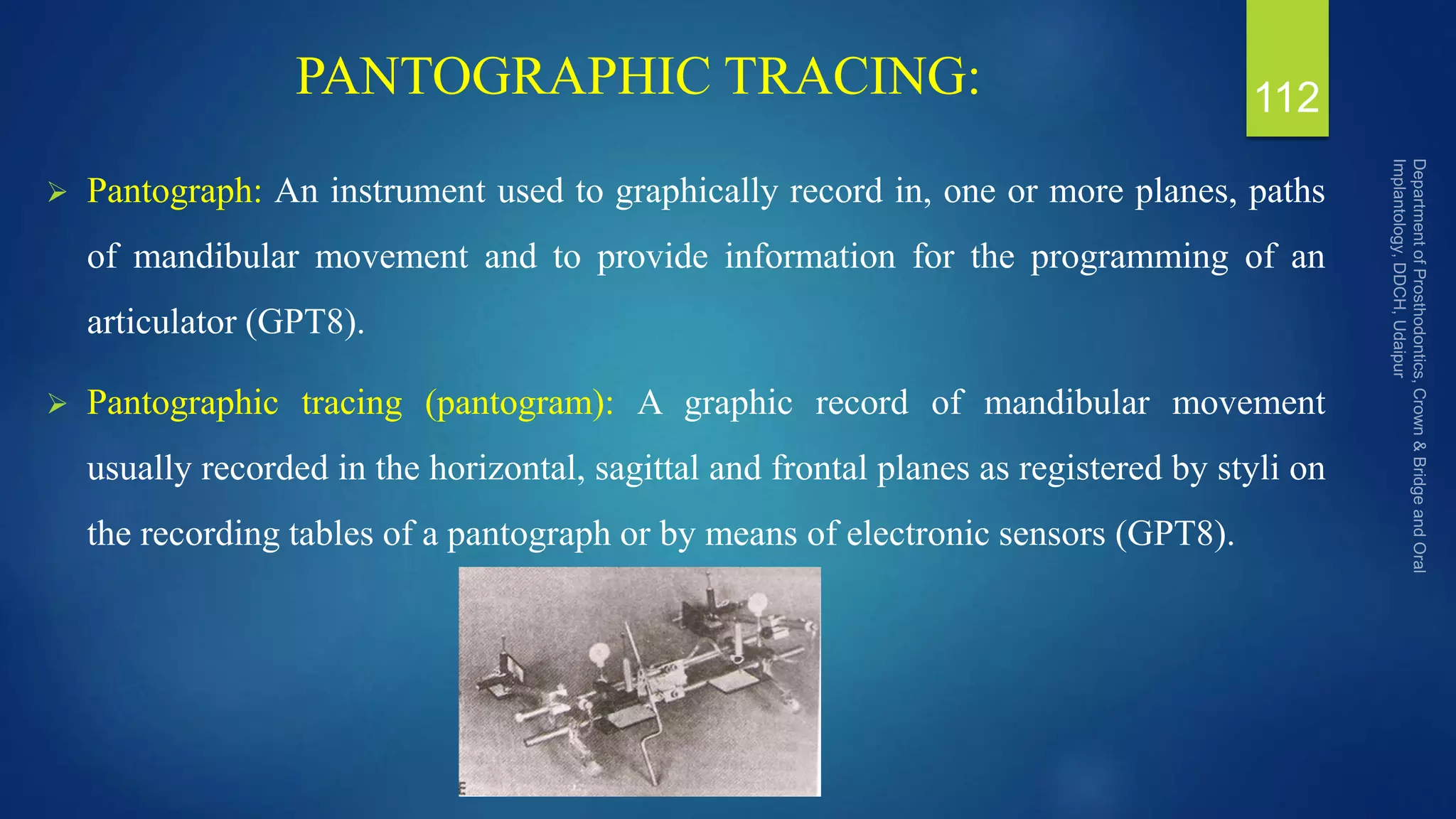
PANTOGRAPHIC TRACING:
 Pantograph: An instrument used to graphically record in, one or more planes, paths
of mandibular movement and to provide information for the programming of an
articulator (GPT8).
 Pantographic tracing (pantogram): A graphic record of mandibular movement
usually recorded in the horizontal, sagittal and frontal planes as registered by styli on
the recording tables of a pantograph or by means of electronic sensors (GPT8).
112
PANTOGRAPHIC TRACING:
 The pantograph is a device that records the movement in all three planes. The tracing
is called a pantographic tracing or pantogram.
 To put it simply, it will consist of styli and recording plates placed in all three planes
and the various jaw movements from centric position traced in all the planes .
 The recordings are transferred to a fully adjustable articulator, which is capable of
accepting and reproducing these movements.
 This can also be used to record eccentric relations.
 Records are very accurate but procedure is complex
113
CEPHALOMETRICS:
 Use of cephalometrics to record CR was described by Pyott and Schaeffer.
 The proper CR and vertical dimension of occlusion were determined by
cephalometric radiographs.
 This method, however, was somewhat impractical and never gained widespread
usage.
114
ECCENTRIC RECORDS
 DEFINITION: Any relationship of the mandible to the maxilla other than CR
(GPT8).
• The relation recorded by moving the mandible forward is called protrusive relation
record.
• The relation recorded by moving the mandible mesio- laterally is called lateral
relation record.
• Eccentric relation depends on the shape of the mandibular fossae.
115
ECCENTRIC RECORDS
1. Functional method- Needles-House and patterson technique.
2. Graphic method.
3. Tactile or Direct check methods.
4. Pantography
116
 GRAPHIC METHOD :
 A distance of 5-6 mm is measured from the apex and is marked.
 Instruct the patient to protrude until the stylus rests on the marked point.
 Inject the plaster between the occlusal rims and allow it to set.
 Remove the occlusal rims from the mouth and transfer this
 relation to the articulator.
 the eccentric jaw relation is made with a protrusive distance of 5-6 mm because it is
believed that with a shorter distance, the condyle would not move down its path and
the distance is sufficient to be recorded on the articulator.
117
 TACTILE OR DIRECT CHECK RECORD METHOD :
 Thisis the most common method to make a protrusive relation record using soft wax.
 The preferred time to make the eccentric jaw relation records is after the teeth have
been arranged for try in.
 LATERAL RECORDS :
 more harmony will exist between the mandibular movements and cuspal inclines.
 The most common methods of lateral relation record are.
1.Graphic method.
2.Check bites of wax.
3. Positional records of stone/plaster.
4. 4.pantography.
118
 GRAPHIC METHOD :
 Requires 2 records
 -one on left side
 -one on right side
 Articulator is adjusted as record is made
 Additional layers of wax are placed on balancing side
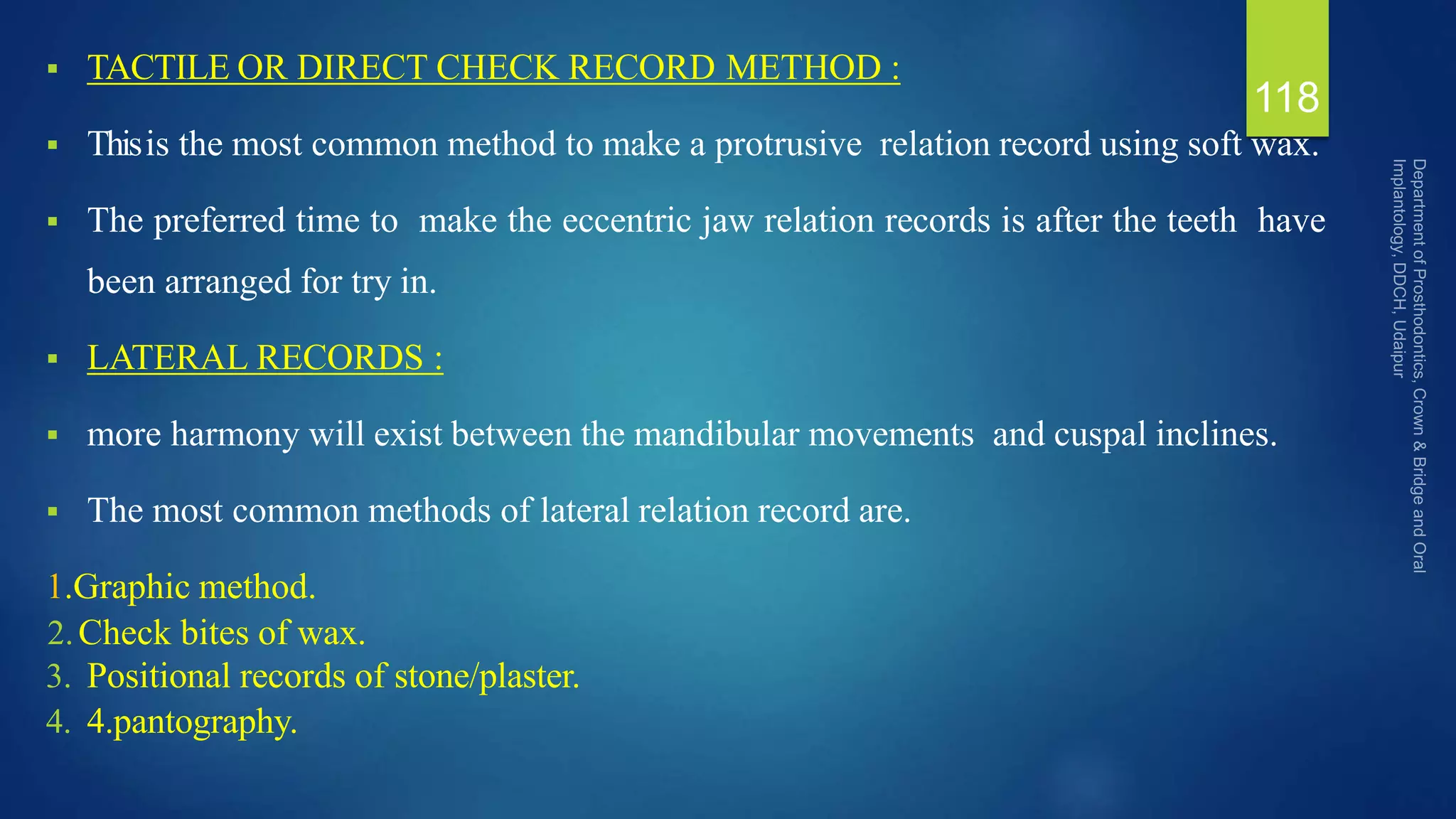
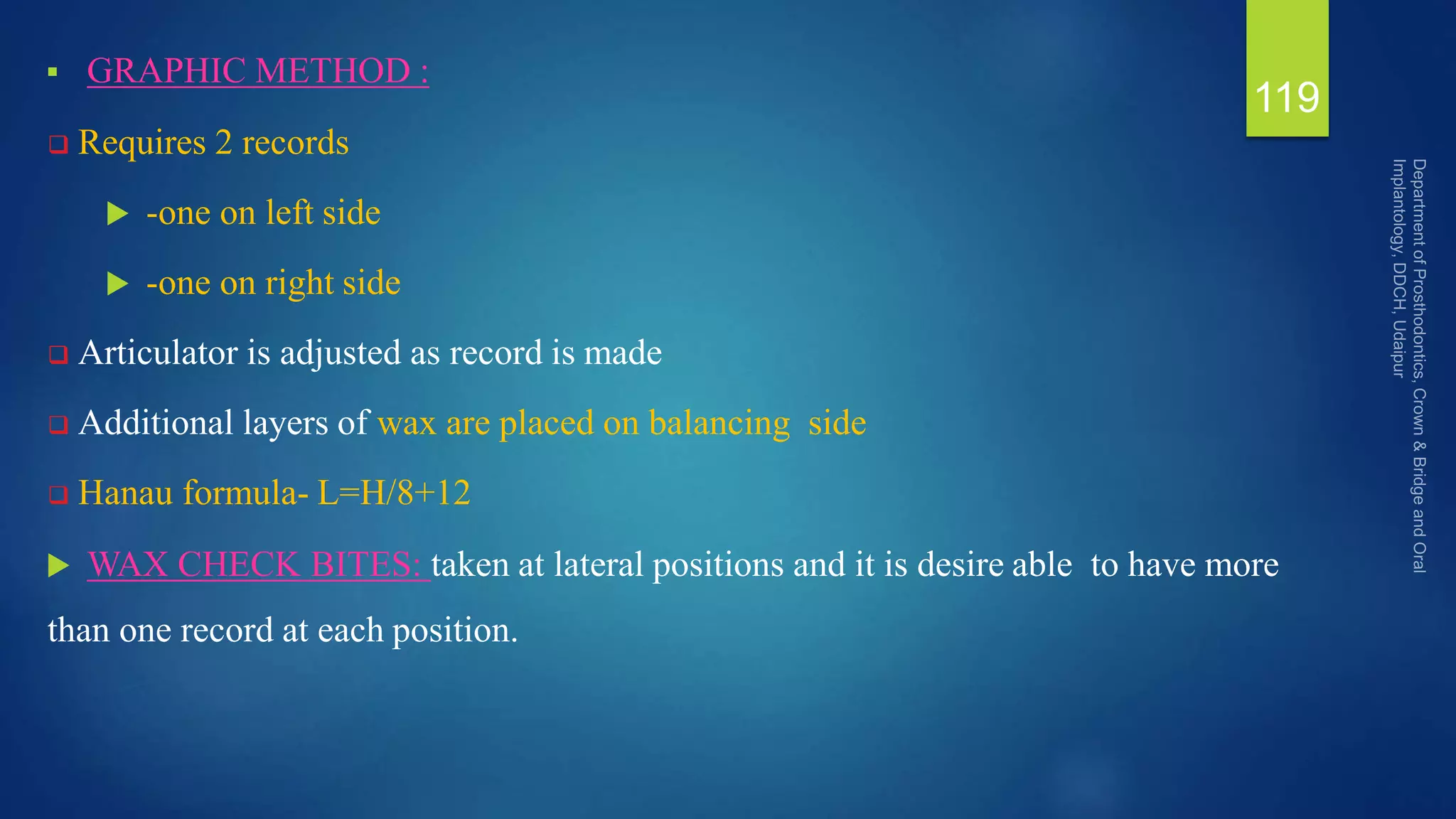
 Hanau formula- L=H/8+12
 WAX CHECK BITES: taken at lateral positions and it is desire able to have more
than one record at each position.
119
 PLASTER/STONE POSITIONAL RECORDS:
 records are taken at lateral extremes of the intra oral or extra oral tracings
120
SUMMARY
 Centric relation is a most
 Reproducible
 Reliable
 Repeatable
 Recordable
 Reference position.
121
de Moraes Melo Neto CL, da Silva EV, de Sousa Ervolino IC, Dos Santos
DM, de Magalhães Bertoz AP, Goiato MC. Comparison of different
methods for obtaining centric relation: a systematic review. General
Dentistry. 2020 Jan 1;69(1):31-6.
 The objective of this study was to compare techniques of different methods of
obtaining centric relation to verify which technique generates the greatest
reproducibility of the centric relation. The PubMed/MEDLINE, Cochrane Library,
SciELO, Scopus, and Web of Science databases were searched for articles
published up to May 15, 2018. The search terms were combinations of "dental
centric relation" with each of the following terms (individually): "reproducibility
of findings"; "jaw relation record"; "chin point"; "gothic arch"; "bimanual
manipulation"; "swallowing"; and "jig."
122
 The inclusion criteria included clinical studies in English that had to compare at least
2 techniques representing different methods for obtaining centric relation (based on
the reproducibility of the centric relation) in individuals without temporomandibular
dysfunction; and studies performed in individuals with complete or nearly complete
dentition or complete edentulism. Methods (techniques) included in this study were
guided methods (chin point guidance and bimanual manipulation); graphic methods
(intraoral and extraoral gothic arch tracing); and physiologic methods (swallowing
and tongue retrusion along the palate). A total of 1638 articles were identified. After
the inclusion and exclusion criteria were applied, 7 articles were included in this
review.
123
 None of the reviewed studies evaluated edentulous individuals. Two articles
compared physiologic methods with guided methods; one concluded that the
swallowing technique generates greater variability than guided methods, and the
other concluded that there was no difference between the swallowing technique and
chin point guidance. Of 5 articles comparing intraoral gothic arch tracing with
guided methods, 2 showed similar results between different methods, 2 showed
superior results for gothic arch tracing, and 1 showed superior results for the guided
methods. Based on the guided methods and swallowing technique, it is not possible
to conclude which technique can generate the greatest reproducibility of the centric
relation. It is possible to suggest that in most cases intraoral gothic arch tracing is
superior or equivalent when compared to guided methods.
124
Jonathan P. Wien, Gary R. Goldstein, Mark Andrawis, Mijin Choi, and
Jennifer W. Priebe, (2018) Defining centric relation, jpd.
 The purpose of this study was to identify those aspects or attributes within the
existing definitions of CR in which there was agreement or disagreement among the
members of the AP.
 After pretesting and institutional review board approval, a second survey of the AP
membership was performed using both email and postal mail survey methods of
contact. The CR Attributes Survey separated and stratified the previous definitions of
CR into 5 domains: spatial relationship, condylar position, articular disks, mandibular
movement, and recording. Each domain attribute was evaluated by agree-uncertain-
disagree assessments. Also recorded were demographics, perception of scientific
evidence, and open comments.
125
 Of the total 146 fellows, 100 completed the survey for an overall response rate of
68.5%. The query completion rate ranged from 96% to 98%. The CR Attributes
Survey revealed those components within each domain in which there was strong
agreement, disagreement, or uncertainty. The survey assessment of those queries
with a moderate to strong agreement were that CR is a “spatial relationship” that is
(1) a clinically determined relationship of the mandible to the maxilla, (2) a
repeatable position, (3) is independent of tooth contact, and (4) is a physiologic
position. Relative to “disks,” the condyles articulate with the thinnest avascular
intermediate zone of their respective disks; however, there is a lack of sufficient
evidence to determine the position of the disks and the condyles.
126
 Relative to “mandibular movement,” CR is (1) a starting point for vertical, lateral, or
protrusive movements, (2) is where the individual can make to and from lateral
movements, and (3) is restricted to pure rotary movement about a transverse
horizontal axis. Relative to “recording CR” (1) it can be determined in patients
without pain or derangement of the temporomandibular joints (TMJs), (2) but may
not be recordable in the presence of dysfunction of the masticatory system, or (3)
due to the neuromuscular influence or proprioception from the dentition, (4) is a
clinical useful repeatable reference position for mounting casts, or (5) for developing
a functional treatment occlusion, (6) at an established vertical dimension, and (7)
may vary slightly by recording method.
127
 The CR Attributes Survey revealed a majority agreement or consensus for various
CR attributes that should be considered for defining the term ‘centric relation.’ In
contrast, those CR attributes with a plurality agreement, disagreement, or uncertainty
outcomes should be considered for exclusion. The evaluated weakness of these latter
attributes indicates the need for further research and reassessment. (J Prosthet Dent
2017;
128
REFERENCES
 Charles M .Heartwell JR. and rahn a. o:syllabus of complete dentures.fourth
edition.
 John sharry, complete denture prosthodontics.
 Winklers, essentials of complete denture prosthodontics
 Carl . O. boucher :prosthodontic treatment for edentulous patients,10 edition.
 Ernest.r. granger:centric relation,j.p.d 1952:2 160-169
 Kingery.r.h:problems associated with centric relation;j.p.d1952;2;307..
 Shanahan T E. Physiologic jaw relations and occlusion of complete dentures. J
Prosthet Dent 1955; 5: 319-322
129
Bansal, e t al, Critical evaluation of methods to record centric jaw relation, The Journol of lndion Prosthodontic Society ; July 2OO9 ,Vol 9: lssue 3
REFERENCES
 Prosthodontic treatment foe edentulous patients- zarb-bolender 12th edn.
 The Academy of Prosthodontics. Glossary of prosthodontic terms. J Prosthet Dent 1999; 81:48-106.
 The Academy of Prosthodontics. Glossary of prosthodontic terms. J Prosthet Dent 1994; 71:40-116.
 The Academy of Prosthodontics. Glossary of prosthodontic terms. J Prosthet Dent 2005; 94:10-85.
 Saizer P
. Centric relation and condylar movement: anatomic mechanism. J Prosthet Dent
1971;26(6):581-91.
 Palaskar, J.N., Murali, R. & Bansal, S. Centric Relation Definition: A Historical and Contemporary
Prosthodontic Perspective. J Indian Prosthodont Soc
 Yurkstas AA, Kapur KK. Factors influencing centric relation records in edentulous mouths. J Prosthet Dent
2005;93:305-10.
 Centric relation records-Historical review
130
Bansal, e t al, Critical evaluation of methods to record centric jaw relation, The Journol of lndion Prosthodontic Society ; July 2OO9 ,Vol 9: lssue 3

Centric jaw relation

  • 1.
    CENTRIC JAW RELATION PRESENTEDBY – DR. PRAJAKTA BALI GIR MDS 2ND YEAR PG 1
  • 2.
    CONTENT  INTRODUCTION  TERMINOLOGIES MUSCLES INVOLVED IN CENTRIC RELATION  THEORIES OF CENTRIC RELATION  RELATING CENTRIC RELATION TO CENTRIC OCCLUSION  RELATING CENTRIC RELATION TO HINGE AXIS  RELATING CENTRIC AND VERTICAL RELATIONS 2
  • 3.
    CONTENT  RECORDING CENTRICRELATION : o CONFLICTING CONCEPTS AND OBJECTIVES IN RECORDING CENTRIC RELATION o COMPLICATIONS IN RECORDING CENTRIC RELATION o RETRUDING THE MANDIBLE IN CENTRIC RELATION • METHODS OF RECORDING CENTRIC RELATION • SIGNIFICANCE OF CENTRIC RELATION • CONCLUSION • REVIEW OF LITERATURE • REFERENCES 3
  • 4.
    INTRODUCTION  Following theorientation of maxilla and determination of vertical dimension, the final relation to be recorded is the horizontal relation.  Horizontal jaw relation is the relation that is established antero-posteriorly and medio-laterally. 4
  • 5.
    INTRODUCTION  IT ISCLASSIFIED AS:  1. Centric relation.  2. Eccentric relation. A. Protrusive relation. B. Lateral relation.  I. Right lateral relation.  II. Left lateral relation 5
  • 6.
    CENTRIC RELATION  TheoreticallyCR is being discussed under the heading of jaw relations.  Jaw relations are the relationships of the mandible with the maxilla.  In this context too much importance was given to the position of the head of the condyles in the glenoid fossa which ultimately resulted in a lot of confusion.  This confusion was due to the invisibility of the most unique, enigmatic temporomandibular joint. 6 Palaskar, J.N., Murali, R. & Bansal, S. Centric Relation Definition: A Historical and Contemporary Prosthodontic Perspective. J Indian Prosthodont Soc
  • 7.
    CENTRIC RELATION  Foralmost the last six decades we assumed CR to be the most retruded position of the heads of the condyles in the glenoid fossae.  Recently we could come to a conclusion that it is not the most retruded position of the heads of the condyles but rather the most anterior and superior position.  The acceptance of one definition is necessary to improve communication at all levels of dentistry.  Definition of CR has created more controversy than any other dental subjects, several factors contributed to this confusion. 7 Palaskar, J.N., Murali, R. & Bansal, S. Centric Relation Definition: A Historical and Contemporary Prosthodontic Perspective. J Indian Prosthodont Soc
  • 8.
    CENTRIC RELATION  Thisarticle is a review of all the definitions given till date and it has been organized as follows : 1) CR from 1929 to 1970, 2) in 1970–1980, 3) and through 1980–2010 8 Palaskar, J.N., Murali, R. & Bansal, S. Centric Relation Definition: A Historical and Contemporary Prosthodontic Perspective. J Indian Prosthodont Soc
  • 9.
    CENTRIC RELATION FROM1929 TO 1970’S  Hanau [1929] defined CR as ‘the position of the mandible in which the condylar heads are resting upon the menisci in the sockets of the glenoid fossa, regardless of the opening of the jaws’.  Goodfriend [1933] considered the ‘centricity of the condyles in centric relation to be an abnormal position’.  Niswonger [1934] described CR as a position where the patient can ‘clench the back teeth’  Schuyler [1935] defined CR as ‘upper lingual cusps are resting in the central fossae of the opposing lower bicuspids and molars’ 9
  • 10.
    CENTRIC RELATION FROM1929 TO 1970’S  Thompson [1946] stated that ‘some believed that, in CR, the condyles are in the most retruded position in the fossae, while others maintained they are not’.  Robinson [1951] stated that the mandible ‘can be retruded beyond what we should consider centric into a strained retruded position’.  McCollum and Stuart [1955] proposed a definition for CR in which the condyles are in a ‘rearmost, uppermost and midmost (RUM) position in the glenoid fossae’  Moyers [1956] defined CR as ‘the position of the mandible as determined by the neuromuscular reflex first learned for controlling the mandibular position when the primary teeth were in occlusion’ 10
  • 11.
    CENTRIC RELATION FROM1929 TO 1970’S  Stallard [1959] defined CR of the mandible as ‘the rearmost, midmost, untranslated hinged position. It is a strained relation as are all border relations. It is the only maxillamandibular relation that can be statically repeated’  Avant [1960] declared the ‘seven definitions of CR’ that appeared in GPT-2 [1960], as ‘regrettable’ and stated that CR is a bone-to-bone (mandible to maxilla) relation, whereas centric occlusion is a tooth-to-tooth (mandibular teeth to maxillary teeth) relation.  McCollum [1960] defined CR position as ‘the most retruded position of the idle condyles in the glenoid fossa’ 11
  • 12.
    CENTRIC RELATION FROM1929 TO 1970’S  Boucher [1964] stated ‘CR is the most posterior relation of the mandible to maxillae at the established vertical relation’ .  Graber [1966] thought that CR was an ‘unstrained, neutral position of the mandible and is deviating neither to the right nor to the left and is neither protruded nor retruded’ .  Glickman [1966] stated that CR was ‘the most retruded position to which the mandible can be carried by the patient’s musculature’ 12
  • 13.
    CENTRIC RELATION FROM1929 TO 1970’S  Goldman and Cohen [1968] defined CR as ‘the most posterior relation of the mandible to maxilla from which lateral movements can be made’  Debate on the definition of CR escalated.  Posterior border closure, relaxed closure, bracing position, hinge position, ligamentous position, retruded contact position, terminal hinge position added confusion to term  CR. Schweitzer [1969] gave ‘almost 40 definitions of CR 13
  • 14.
    CENTRIC RELATION FROM1970 TO 1980’S  Dawson [1973] defined CR as ‘the most superior position the condyle can assume in the glenoid fossa and it is not unstrained’ .  Smith [1975] considered CR to be ‘the most retruded position of the mandible’ and concluded that the gothic arch tracing provides the most retruded and most repeatable position and thus was the most precise method.  Williamson et al. [1977] stated that the hinge axis and CR are the same; adding that this axis occurs when the mandible is in CR and a pure rotational movement of the mandible is produced in the sagittal plane 14
  • 15.
    CENTRIC RELATION FROM1970 TO 1980’S  Lucia [1979] stated that ‘the mandible is in CR when the centers of vertical and lateral motion are in the terminal hinge position’ .  Myers et al. [1980] defined CR as ‘the most posterior unstrained relation of the mandible to the maxilla at a given degree of jaw separation’. They stated that the more posterior the condyles, the more acceptable the position 15
  • 16.
    CENTRIC RELATION FROM1980 TO 2010  Gilbe [1983] defined CR as ‘the most superior position of the mandibular condyles with the central bearing area of the disc in contact with the articular surface of the condyle and the articular eminence. This position may not always be possible to attain due to anterior dislocation of the disc .  Dawson in 1985 stated that ‘CR is achieved when the properly aligned condyle- disk assemblies are in the most superior position against the eminentia irrespective of tooth position or vertical dimension’ 16
  • 17.
    CENTRIC RELATION FROM1980 TO 2010  American College of Prosthodontist [1994] defined CR as ‘the spatial relationship between the maxilla and mandible where the condyles relate to the articular eminence in a ventro-cranial position with the pars intermedia of the disc’ 17
  • 18.
    GPT DEFINITIONS  GPT-1[1956] defined CR as ‘the most retruded relation of the mandible to the maxilla when the condyles are in the most posterior unstrained position in the glenoid fossa from which lateral movements can be made, at any given degrees of jaw separation’ 18
  • 19.
    GPT DEFINITIONS  GPT-2[1960] defined the CR as ‘the most posterior relation of the mandible to the maxilla at the established vertical relation’,  GPT-3 [1968] defined CR as ‘the most retruded physiologic relation of the mandible to the maxilla and from which the individual can make lateral movements’. It is a condition that can exist at various degrees of jaw separation. It occurs around the terminal hinge axis . 19
  • 20.
    GPT DEFINITIONS  GPT-4[1977] defined CR as ‘the jaw relation when the condyles are in the most posterior, unstrained position in the glenoid fossa at any given degree of jaw separation from which lateral movements can be made’ 20
  • 21.
    GPT DEFINITIONS  GPT-5and 6 [1987, 1994] defined the CR as ‘the relation of the mandible to the maxilla when the condyles are in their most posterior position in the glenoid fossa from which unstrained lateral movements can be made at occluding vertical dimension normal for the individual’ 21
  • 22.
    GPT DEFINITIONS  GPT-7[1999] defined centric relation as ‘a maxillomandibular relationship in which the condyles articulate with the thinnest avascular portion of their respective disks with the complex in the anterosuperior position against the shapes of the articular eminences. This position is independent of tooth contact. This position is clinically discernible when the mandible is directed superiorly and anteriorly and restricted to a purely rotary movement about a transverse horizontal axis’ 22
  • 23.
    GPT DEFINITIONS  GPT– 8 the maxillomandibular relationship in which the condyles articulate with the thinnest avascular portion of their respective disks with the complex in the anterior– superior position against the shapes of the articular eminencies. This position is independent of tooth contact. This position is clinically discernible when the mandible is directed superior and anteriorly. It is restricted to a purely rotary movement about the transverse horizontal axis 23
  • 24.
    Meaning and Controversiesin definitions of GPT 4(static morphological definition) and GPT5(Functional definition)  The two definitions taken from glossary of prosthodontic terms (GPT-4 and GPT- 5) appear to contradict each other.  The earlier definition mentions of a most posterior position of condyles in glenoid fossa while the latter definition speaks of an anterior superior position of condyle against the slopes of the articular eminence. 24
  • 25.
    Meaning and Controversiesin definitions of GPT 4(static morphological definition) and GPT5(Functional definition)  But surprisingly, the discrepancy between the two positions is only approximately 0.2 mm.  Theoretically, the difference is only on the emphasis of the condylar position. 25
  • 26.
     Maximal intercuspalposition (MIP): The complete intercuspation of the opposing teeth independent of condylar position, sometimes referred to as the best fit of the teeth regardless of the condylar position, is also called maximal intercuspation.  Centric occlusion (CO): The occlusion of opposing teeth when the mandible is in CR. This may or may not coincide with the MIP.  CR is a bone-to-bone relation, while MIP and CO are tooth-to-tooth relation. 26
  • 27.
    MUSCLES INVOLVED INCENTRIC RELATION  Centric relation is not resting or postural position of the mandible.  Contraction of muscles is necessary to move and fix the mandible in this position.  The anatomic attachments of the posterior and middle parts of the temporal and suprahyoid muscles together with EMG studies show that these muscles move and fix the mandible in its most retruded relation to maxilla.  Temporal , masseter and medial pterygoid muscles elevate the mandible.  The lateral pterygoid muscle shows little activity when mandible is in centric relation. 27
  • 28.
  • 29.
    THEORIES OF CENTRICRELATION THEORIES OF CENTRIC RELATION THE MUSCLE THEORY THE LIGAMENT THEORY THE OSTEOFIBRE THEORY THE MENISCUS THEORY 29 Saizer P.Centric relation and condylar movement: anatomic mechanism. J Prosthet Dent 1971;26(6):581-91.
  • 30.
    THE MUSCLE THEORY 30 DEFENCEREFLEX CONTRACTION OF LATERAL PTERYGOID MUSCLE HALTS THE JAW 1. centric relation is always the same at any vertical level, 2. nor does it explain the most posterior mandibular position. 3. no anatomic explanation is provided for the posterior hinge movement, 4. nor for the acuteness of the “needle-point” tracing.
  • 31.
    THE LIGAMENT THEORY 31 LIGAMENTSWHEN BECOME TENSE THEY DETERMINE THE LIMITS OF RETRUSIVE MOVEMENTS Ligaments bind the elements of the articulations, limit their possibilities of movement, and are also capable of determining terminal border positions. When the condyle is seen in lateral radiographic views in centric relation, it appears to be “suspended” or “floating.” 1. the anatomic arrangement of the temporomandibular ligaments is not well suited to halt the retrusive condylar movement. 2. ligamentous retrusive terminal stop provides no satisfactory location for the hinge axis. 3. does not explain satisfactorily the lateral border movements,
  • 32.
    THE OSTEOFIBER THEORY 32 retrusiveterminal stop formed by the soft tissues of the posterior part of the roof of the glenoid fossa. this fibrous stop acts as a buffer. these tissues to be loose, fibrous, and functionally differentiated. He named this structure the “retroarticular cushion.”
  • 33.
    THE MENISCUS THEORY 33 Whenthe disc is in its postural position, or close to it, the upper synovial cavity continues down and backward, within the retroarticular fibrous tissues Discs with their retromeniscal fibrous tissues--stop the retrusive condylar movements
  • 34.
    RELATING CENTRIC RELATIONTO CENTRIC OCCLUSION  Centric relation must be accurately recorded so that centric occlusion can be made to coincide with it. 34  In the natural dentition CO is usually located anterior to CR, the average distance being 0.5 to 1 mm. If natural tooth has interferences in CR it initiate impulses and responses that direct the mandible away from deflective occlusal contacts into CO.  Impulses created by closure of the teeth into CO establish memory patterns that  permit the mandible to return to this position, usually without tooth interferences
  • 35.
    RELATING CENTRIC RELATIONTO CENTRIC OCCLUSION 35 The edentulous patient cannot control mandibular movements or avoid deflective occlusal contacts in CR in the same manner as the dentulous patient. Deflective occlusal contacts in CR cause movement of denture bases and displacement of the supporting tissues or direct the mandible away from this relation
  • 36.
  • 37.
    RELATING CENTRIC RELATIONTO HINGE AXIS 37 The upper cast can be accurately oriented to the opening axis of the articulator by the location of the physiologic transverse hinge axis and a facebow transfer. Opening and closing the jaws with mandible in its most retruded position to maxilla ( terminal hinge axis ) is the method used to locate transverse hinge axis. They occur without translation. Centric relation is the most retruded relation of mandible to maxilla at a particular vertical relation along pathway of terminal hinge movement. So the lower cast automatically gets oriented to opening axis of articulator with accurate centric relation recorded.
  • 38.
    RELATING CENTRIC ANDVERTICAL RELATIONS 38 There is a most retruded relation of mandible to maxilla for each vertical relation, and there is a change in the horizontal relationship of mandible to maxilla with each change in vertical relation Thus when the centric relation record is made at or very close to the desired vertical relation of occlusion, little or no vertical change will be required on the articulator and the likelihood of the errors will be reduced.
  • 39.
    SIGNIFICANCE OF CENTRICRELATION  More definite than VD  Most comfortable position(home of the mandible)  Optimum position for health comfort and functioning of TMJ  Movements of mandible start from here and end up here.  physiologically acceptable position for mastication of food.  Most posterior border position  Acts as a reference point. 39
  • 40.
    SIGNIFICANCE OF CENTRICRELATION  Pure rotations take place.  Bone to bone relation  Independent of position of tooth.  Constant for an individual.  Reproducible, repeatable and recordable. 40
  • 41.
    FACTORS INFLUENCING CENTRIC RELATIONRECORDS  Resiliency of supporting tissues  Fit of denture bases – Stability - Retention  The TMJ and its associated neuromuscular mechanism  The character of the pressure applied in making the recording.  The technique used in making the recording and the associated recording devices used.  Maxillo-mandibular relationship . 41 Yurkstas AA, Kapur KK. Factors influencing centric relation records in edentulous mouths. J Prosthet Dent 2005;93:305-10.
  • 42.
    FACTORS INFLUENCING CENTRIC RELATIONRECORDS  The skill of the dentist.  The health and co-operation of the patient.  Posture of the patient.  Character or size of the residual alveolar arch.  Amount and character of saliva.  Size and position of the tongue. 42 Yurkstas AA, Kapur KK. Factors influencing centric relation records in edentulous mouths. J Prosthet Dent 2005;93:305-10.
  • 43.
    FACTORS INFLUENCING CENTRIC RELATIONRECORDS  Psychic or emotional tension.  Protective reflex action caused by faulty occlusal contacts.  Materials and equipment used for record making.  The use of articulators that do not accurately adjust to all inter occlusal check records. 43 Yurkstas AA, Kapur KK. Factors influencing centric relation records in edentulous mouths. J Prosthet Dent 2005;93:305-10.
  • 44.
  • 45.
    CONFLICTING CONCEPTS ANDOBJECTIVES IN RECORDING CENTRIC RELATION MINIMAL CLOSING PRESSURE  Tissues supporting the base will not be displaced  objective: to make opposing denture teeth touch uniformly & simultaneously at first contact HEAVY CLOSING PRESSURE  Tissues under the base will displace  objective: to produce the same displacement of the soft tissues that occur when patient masticates 45
  • 46.
    COMPLICATIONS IN RECORDINGCENTRIC RELATION  The structure of TMJs are such that one joint can be displaced downward by uneven pressure when records are made and yet the condyles be in their most retruded position. This situation cannot occur on the articulator and thus a deflective occlusal contact may be the source of instability, soreness and resorption despite the correctness of the other relations. 46
  • 47.
    COMPLICATIONS IN RECORDINGCENTRIC RELATION  REALEFF EFFECT BY HANAU: according to it, there is uneven resiliency in the soft tissues. This resiliency is present in both the mucosa and the TMJs, thus undue pressure in securing the relation must be avoided lest excessive displacement of soft tissues occur . 47
  • 48.
    COMPLICATIONS IN RECORDINGCENTRIC RELATION  Even though a balanced and equilized registration has been made it often is lost due to: I. Cast mounting procedures II. Processing of denture 48
  • 49.
    RETRUDING THE MANDIBLEIN CENTRIC RELATION BIOLOGIC  Lack of coordination between muscles.  Habitual eccentric jaw positions  Senility or neuro- muscular disorder PSYCHOLOGIC  Inability to follow the dentist instructions MECHANICAL  Poorly fitting base plate 49
  • 50.
    METHODS PASSIVE METHODS :The mandible is retruded by the patients themselves, following the dentist’s instructions without any physical participation by the dentist. The patient is instructed to 1. Relax, pull the jaw back and close on the back teeth. 2. Get the feeling of pushing the upper jaw out and close on back teeth. 3. Touch the posterior part of the upper denture with tongue and close till the rims contact. 50
  • 51.
    METHODS 4. Swallow andclose. 5. Tap the occlusal rims together repeatedly and rapidly. 6. Tilt the head back while performing the above exercises. 7. Protrude and retrude the mandible repeatedly holding his/her fingers lightly against the chin. 51
  • 52.
    METHODS ACTIVE METHODS :The patient is guided to retrude the mandible with physical assistance from the dentist. 1. The dentist places his thumb and forefinger on the patient’s chin to exert a mild but firm posterior force while patient closes on the rims. This will prevent the patient from moving the jaw anteriorly 2. Dentist palpates the temporal and masseter muscles to relax them. 52
  • 53.
    METHODS Dawson’s bimanual palpation– the dentist stands behind the patient and places all four fingers of both hands on the lower border of the mandible on either side. The thumbs are placed over the symphysis such that they contact in the midline. The patient is instructed to open the mouth and then close slowly. As the patient closes, dentist applies an upwards lifting force with the fingers on the inferior border and simultaneously applies a downward force with the thumbs . This guides the patient to close in CR. 53
  • 54.
    METHODS OF RECORDINGCENTRIC RELATION 54 Bansal, e t al, Critical evaluation of methods to record centric jaw relation, The Journol of lndion Prosthodontic Society ; July 2OO9 ,Vol 9: lssue 3
  • 55.
    METHODS OF RECORDINGCENTRIC RELATION 1. BY BOUCHER a. Static methods — interocclusal record with/with out central bearing devices and tracing devices b. Functional methods — chew-in technique a) Needles technique b) House technique c) Patterson technique 55
  • 56.
    2. BY HEARTWELL: 1. Functional methods (chew-in) a) Needles House method b) Patterson method 2. Graphic Method a) Intraoral devices b) Extraoral devices 3. Physiological or tactile or inter occlusal check record method 56
  • 57.
    1. Functional : a.Patterson Technique b. Needles-House Technique c. Meyer’s Technique d. Shanahan’s Technique 2. Static or pressureless method : 3. Graphic : a. intra-oral b. extra-oral 4. Direct checkbite interocclusal recordings 5. Cephalometrics 57
  • 58.
     KINGERY classifiedtechniques for recording centric relation as:  Direct  Graphic  Functional 58
  • 59.
     According tosmith in 1941 , moylar 1955, & kapur in 1957 following are the methods for recording the centric relation:-  Direct recording 1. Interocclusal-check record method 2. Pressure-less method 3. Pressure method  Graphic recording  Functional recording 59
  • 60.
    STATIC METHOD  Involvesguiding the mandible in CR with the maxillae then making a record of the relationship of the two occlusion rims to each other.  ADVANTAGE - minimal displacement of the recording bases  Record made with wax or plaster  DISADVANTAGES:  • Inaccuracy can result from lack of equalized pressure.  • Difficult to verify the accuracy of the record.  • Not as accurate as graphic method. 60
  • 61.
    1. WAX OCCLUSALRIMS  One of the most commonly used methods to record CR.  The wax occlusal rims are contoured and the vertical dimension of occlusion is established ensuring even contact of the maxillary and mandibular rims anteriorly and posteriorly.  The patient is trained to retrude the mandible.  The various ‘guidelines’ are marked and the patient is asked to close in centric and hold the position. 61
  • 62.
     The rimsare joined or sealed in this position and then removed from the mouth and articulated.  The following methods can be used to seal the rims:  HEAT: A hot wax knife can be used to melt and flow the wax at the junction of the rims. Care must be taken to avoid heating the lips and cheeks by adequately protecting and retracting them. The knife should not be hot enough to cause the wax to run 62
  • 63.
     PINNING: Theocclusal rims can also be sealed together using pins. Slightly warm metal staples can be used to join the sides of the rims 63
  • 64.
     THE ABOVEMETHODS OF SEALING ARE NOT RECOMMENDED DUE TO:  Chances of burning and injuring lips and cheek.  No equalization of pressure.  Difficult to prevent movement of rims while sealing.  NICK AND NOTCH METHOD: This is the recommended method for sealing the rims as there is less resistance to closure and the movement during sealing is tackled. After the rims are evened, V-shaped notches are then placed in the molar region of the maxillary occlusal rim to prevent anteroposterior movement. 64
  • 65.
     A nickis cut anterior to the notch in the premolar regions, not extending throughout the width of the occlusal rim, to prevent the lateral movement. 65
  • 66.
     A troughis created in the posterior regions of the mandibular occlusal rims  The patient is trained to retrude and close at CR position.  Soft wax, zinc oxide eugenol impression paste, quick setting plaster and elastomeric bite materials may be used . 66
  • 67.
     The recordingmaterial is loaded in the trough created on the mandibular rim.  Occlusal rims are inserted in the patient’s mouth and the patient is instructed to retrude and close.  Contact should be observed in the maxillary and mandibular rims anteriorly.  Once the intervening recording material sets, the rims get sealed and are removed together 67
  • 68.
    2. INTER-OCCLUAL CHECKRECORS  As the name suggests, these records are used to verify the centric jaw relation at the time of try-in or denture insertion.  They are also used to check the occlusion of teeth in existing dentures.  These are also called ‘physiologic’ methods as the patient’s proprioception and tactile sense is essential in the making of an accurate record.  The same recording mediums used for static registrations can also be used for this procedure 68
  • 69.
     After theocclusal rims have been articulated with a static record, the artificial teeth are arranged and a trial denture is fabricated.  At the time of try-in (or denture insertion) if the dentist feels the need to verify the CR, then this procedure is adopted.  Patient is asked to rehearse retruding the mandible.  The maxillary trial denture is inserted in the patient’s mouth.  The recording medium like aluwax is loaded onto the occlusal surface of the teeth in the mandibular occlusal rim 69
  • 70.
  • 71.
     The patientis asked to slowly retrude the mandible and close on the wax till the tooth contact occurs .  They should not bite through the material.  The recording material is allowed to set and the trial dentures are removed with the recording material.  The maxillary trial denture is removed from the record and placed on the mounted maxillary cast in the articulator.  The mandibular trial denture with the record is now returned to the mandibular cast on the articulator.  The horizontal condylar guide locks in the articulator are released. 71
  • 72.
  • 73.
     The maxillaryteeth are now seated over the record.  If the previous recording of CR is the same as the check record, then both the condylar elements of the articulator will contact the centric stops, i.e. the articulated casts need not move to fit into the check records.  If anyone or both of the condylar elements of the articulator does not contact the centric stops, it indicates that one of the records is inaccurate. 73
  • 74.
     INDICATIONS: Itmay be advisable to make interocclusal check records to verify the CR in the following conditions:  Abnormally related jaws  Displaceable, flabby tissues  Large tongue  Uncontrolled mandibular movements  Factors affecting the success of interocclusal records:  Uniform consistency of the recording material  Accurate vertical jaw relation records  Stability and fit of the record base 74
  • 75.
    FUNCTIONAL METHOD  Involvesfunctional activity or movement of the mandible at the time the record is made.  Disadvantage - causes lateral and anteroposterior displacement of the recording bases  Includes the various chew-in techniques :  Needlehouse  Patterson  Meyers 75
  • 76.
    HISTORICAL DEVELOPMENT  Greene– Used plaster and pumice mixture.  Needles – Mounted three studs on maxillary rims.  Patterson – Used corborandum and plaster mixture.  Meyer – Used soft wax occlusal rims, tin foil placed and functional movements done.  Boose – Used Gnathodynomometer.  Shanahan – Cones of soft wax. 76
  • 77.
     In 1905Christenson used 'impression wax' for bite records.  One early method was to have the patient close in a retruded position and attach the rims together for mounting on an articulator usually with staples or by sealing the rims with a hot instrument.  Schuylor (1932) said that modeling compound was preferable to wax f o r occlusal records because it can be softened more evenly, cools slower and doesn't distort as much as wax.  Boos (1959) felt that it was important to avoid torsion when recording Centric relation. Wax or compound, which required application of force, could displace the mandible. Thus a material such as plaster or ZnO Eugenol paste was more accurate. 77
  • 78.
     Hanau wasone of the first individuals to be concerned about equailization of pressure when recording the bite. He coined the term "Realeff' which is formed by the beginning letters of the words 'resilient and like effects‘  Payne (1955) and Hickey (1964) stated a preference for plaster because less material had to be placed in the patient's mouth for the record.  In 1910 Green invented his 'PRESSOMETER' in an early attempt to equalize the pressure of recording centric relation . It consisted of celluloid strips placed between the maxillary and mandibular occlusion rims on the right and left sides. If the pressure were unequal, the rims would "hold" one strip while the other could be removed. 78
  • 79.
     In 1954Brown recommended repeated closure into softened wax rims.  Wright(1939) described the four factors he believed affected accuracy of records: (i) resiliency of tissue (ii) saliva film (iii) fit of bases (iv) pressure applied. He concluded that the best technique was to record the occlusal record at zero pressure 79
  • 80.
     Kingery (1952)discussed 2 fundamental principles that contribute to the success of direct recording method: 1) The dentist's ability to recognize the Centric relation position 2) Understanding that the recording medium directly influences the pressure developed in the recording and the subsequent equilibration of the recording. 80
  • 81.
    PHYSIOLOGIC TECHNIQUE  Shanahan(1955)  cones of soft wax placed on the mandibular occlusal rim  patient was asked to swallow repeatedly.  He believed that during swallowing, the tongue forced the mandible into Centric relation position.  The cones of soft were then moved and Centric relation was recorded using this method. 81 Shanahan TEJ. Physiologic jaw relations and occlusion of complete dentures. J Prosthet Dent 2004;91(3):203-05.
  • 82.
     INDICATIONS : Supporting tissues are excessively displaceable  Large awkward tongues  Uncontrollable/ abnormal mandibular movements  Check occlusion of teeth in existing dentures. 82
  • 83.
    Needle–House method:  Occlusalrims are fabricated from impression compound.  Four metal balls or styli are embedded in the canine and molar areas of the maxillary occlusal rim.  The occlusal rims are inserted and the patient is asked to perform various functional and excursive movements of the mandible with the styli contacting the lower rim.  The vertical height is reduced as the styli cuts through the lower rim and the patient is stopped at the appropriate vertical dimension. 83
  • 84.
     The stylimakes three-dimensional diamond-shaped tracings, which can be transferred to a suitable articulator to duplicate the movements.  The most anterior point of the marking denotes CR and can be used to mount on any articulator 84
  • 85.
  • 86.
    PATTERSON method:  Waxocclusal rims are fabricated.  A trench or trough is made in the mandibular occlusal rim which is filled with equal mixture of carborundum paste and plaster .  The occlusal rims are inserted and the functional mandibular movements will produce compensating curves in the plaster lower rim.  As the vertical height reaches the appropriate level, the patient is asked to retrude his jaw and the occlusal rims are joined together with metal staples. 86
  • 87.
  • 88.
    MEYER’S method:  Usedsoft wax occlusal rims.  Tinfoil was placed over the wax and lubricated.  Patient performed functional movements to produce a wax path  Plaster index was made 88
  • 89.
    GRAPHIC METHODS  Theearliest graphic recordings were based on studies of mandibular movements by Balkwill in 1866.  The intersection of the arcs produced by the right and left condyles formed the apex of what is known as GOTHIC ARCH TRACING.  Hesse (1897)– First to make a Needle point tracing.  Gysi (1910)– Improved needle point tracing.  Phillips (1927)– He developed a plate for the maxillar occlusal rims and a tripoded ball bearing mounted on a jackscrew for the mandibular occlusal rim. He called this as the "Central Bearing Point". 89
  • 90.
     WHAT DOESTHE TRACING REPRESENTS ?  Border movements of the mandible in the horizontal plane and its apex is the most retruded position (relaxed position) of the mandible.  Advantage of reproducibility – can verify the centric relation. 90
  • 91.
     CONCEPT:  Theconcept consists of attaching a stylus (a writing device with a pointed end) to one occlusal rim and a plate to the other rim. The stylus traces or marks the path in the plate as the mandible performs excursive movements from the centric position. The tracing is typically in the shape of a ‘gothic arch’ or ‘arrow head’ if the patient is trained to move the mandible from centric to protrusive, right and left lateral positions. 91
  • 92.
     COMPONENTS:  Thetracing can be made intraorally or extraorally.  The extraoral tracing device consists of a central bearing device and a tracing device.  The central bearing device consists of a central bearing point and a central bearing plate.  The tracing device consists of a stylus and a recording plate.  The stylus or stud and central bearing plate attached to the maxillary occlusal rim, while the central bearing point and recording plates are attached to the mandibular rim. 92
  • 93.
  • 94.
     COMPONENTS:  Inthe intraoral tracer, the central bearing device also performs the function of a tracing device. So there is only one set of device 94
  • 95.
     Central bearingdevice is a very important aspect of the device.  It should be placed in the geometric centre of the maxillary and mandibular arches to serve the following functions:  ▪ Maintains vertical dimension.  ▪ Equalizes the pressure by distributing the forces throughout the supporting tissues.  ▪ Allows mandibular movement to be dictated by the condyles. 95
  • 96.
    ADVANTAGES  Documented tobe the most accurate method of recording CR.  Allows equalization of pressure on the supporting tissues.  Easily verifiable.  Can also be used to record eccentric relations. DISADVANTAGES  May be difficult to locate the centre of the arches which is very important for central bearing function and accuracy of tracing.  More time consuming.  Training patient in making mandibular movements is strenuous. 96
  • 97.
    INDICATIONS  Broad edentuloussides.  Adequate interarch space.  In patients with habitual centric, the use of the graphic method eliminates all occlusal contacts on the rims, thus breaking the neuromuscular reflex and allows the patient to record his true centric. CONTRAINDICATIONS  Severely resorbed ridges and excessively flabby ridges as they lead to instability of denture bases.  Decreased interarch space – difficult to place central bearing device without raising the vertical dimension.  TMJ arthropathy. 97
  • 98.
    PROCEDURE FOR EXTRAORALTRACING:  The maxillary cast is mounted on the articulator with a facebow transfer.  The mandibular cast is oriented to the maxillary cast at the established vertical dimension with a static CR record.  The condylar elements of the articulator are secured against the centric stops.  The central bearing and tracing devices are mounted on the respective rims 98
  • 99.
     The patientis seated with head upright, in a comfortable position on the dental chair.  The record bases with the attached devices are inserted in the patient’s mouth.  They are checked for stability, contact during mandibular movements and interference 99
  • 100.
     The stylusis retracted and patient is trained to make various excursive movements passively and actively (if needed).  Patient is instructed to move the jaw forwards, right and left from centric position.  The Ney Excursion Guide has been used as an aid in training the patient but patient responds better to specific locations than numbers 100
  • 101.
     When thepatient is well trained in making the movements, the recording plate is coated with a thin coating of lacquer, precipitated chalk or dark coloured wax.  The coating material should not provide any resistance to movement and produce a clearly visible tracing .  The stylus is made to contact the recording plate and the patient is instructed to make the specific movements. 101
  • 102.
     When an acceptabletracing is made with a single sharp apex, a centric record is obtained.  The rims and tracing are prepared to receive the centric record 102
  • 103.
     The patientis instructed to retrude the mandible such that the stylus contacts the apex of the tracing.  Quick setting plaster is injected between the rims and allowed to harden thus, the centric record is obtained. 103
  • 104.
     The rimsare remounted on the articulator with the new record 104
  • 105.
    DEVICES:  a. Highttracer b. Sears tracer c. Phillips tracer d. Chandra tracer e. Stansbery tracing device 105
  • 106.
    PROCEDURE FOR INTRAORALTRACING:  The procedure with intraoral tracer is similar, but as the tracing is not visible while being made, a thin plastic disc with a central hole is fixed on the recording plate such that the hole is placed on the apex of the tracing.  The patient closes with the tip of the stylus in the hole and this ensures that the patient closes in centric and maintains the position while the record is being made. 106
  • 107.
    DEVICES :  a.Coble tracer b. Swissdent ball bearing bite tracer c. Micro tracer d. Functiograph 107
  • 108.
  • 109.
    Evaluation of GothicArch Tracings : 109 Classical, pointed form The symmetry indicates an undisturbed movement sequence in the joints and uniform muscle guidance. Classical flat form Indicates distinct flat lateral movements of the condyles in the fossa.
  • 110.
    Evaluation of GothicArch Tracings : 110 Weak Gothic arch tracing Indicates a lax and negligent performance of the movements. The registration must be repeated: Stronger movements must be demanded from the patient. Asymmetrical form The tracing indicates a distinct inhibition of the forward component of the lateral movement in the right joint.
  • 111.
    Evaluation of GothicArch Tracings : 111 Miniature Gothic arch tracing This tracing points restricted mandibular movements. •Due to badly fitting and pain-causing record bases or •Long standing edentulous state with inhibited movement in the joints. Vertical line protrudes beyond the arrow point forcible retraction or pushing of the mandible or tracing obtained with protruded mandible
  • 112.
    PANTOGRAPHIC TRACING:  Pantograph:An instrument used to graphically record in, one or more planes, paths of mandibular movement and to provide information for the programming of an articulator (GPT8).  Pantographic tracing (pantogram): A graphic record of mandibular movement usually recorded in the horizontal, sagittal and frontal planes as registered by styli on the recording tables of a pantograph or by means of electronic sensors (GPT8). 112
  • 113.
    PANTOGRAPHIC TRACING:  Thepantograph is a device that records the movement in all three planes. The tracing is called a pantographic tracing or pantogram.  To put it simply, it will consist of styli and recording plates placed in all three planes and the various jaw movements from centric position traced in all the planes .  The recordings are transferred to a fully adjustable articulator, which is capable of accepting and reproducing these movements.  This can also be used to record eccentric relations.  Records are very accurate but procedure is complex 113
  • 114.
    CEPHALOMETRICS:  Use ofcephalometrics to record CR was described by Pyott and Schaeffer.  The proper CR and vertical dimension of occlusion were determined by cephalometric radiographs.  This method, however, was somewhat impractical and never gained widespread usage. 114
  • 115.
    ECCENTRIC RECORDS  DEFINITION:Any relationship of the mandible to the maxilla other than CR (GPT8). • The relation recorded by moving the mandible forward is called protrusive relation record. • The relation recorded by moving the mandible mesio- laterally is called lateral relation record. • Eccentric relation depends on the shape of the mandibular fossae. 115
  • 116.
    ECCENTRIC RECORDS 1. Functionalmethod- Needles-House and patterson technique. 2. Graphic method. 3. Tactile or Direct check methods. 4. Pantography 116
  • 117.
     GRAPHIC METHOD:  A distance of 5-6 mm is measured from the apex and is marked.  Instruct the patient to protrude until the stylus rests on the marked point.  Inject the plaster between the occlusal rims and allow it to set.  Remove the occlusal rims from the mouth and transfer this  relation to the articulator.  the eccentric jaw relation is made with a protrusive distance of 5-6 mm because it is believed that with a shorter distance, the condyle would not move down its path and the distance is sufficient to be recorded on the articulator. 117
  • 118.
     TACTILE ORDIRECT CHECK RECORD METHOD :  Thisis the most common method to make a protrusive relation record using soft wax.  The preferred time to make the eccentric jaw relation records is after the teeth have been arranged for try in.  LATERAL RECORDS :  more harmony will exist between the mandibular movements and cuspal inclines.  The most common methods of lateral relation record are. 1.Graphic method. 2.Check bites of wax. 3. Positional records of stone/plaster. 4. 4.pantography. 118
  • 119.
     GRAPHIC METHOD:  Requires 2 records  -one on left side  -one on right side  Articulator is adjusted as record is made  Additional layers of wax are placed on balancing side  Hanau formula- L=H/8+12  WAX CHECK BITES: taken at lateral positions and it is desire able to have more than one record at each position. 119
  • 120.
     PLASTER/STONE POSITIONALRECORDS:  records are taken at lateral extremes of the intra oral or extra oral tracings 120
  • 121.
    SUMMARY  Centric relationis a most  Reproducible  Reliable  Repeatable  Recordable  Reference position. 121
  • 122.
    de Moraes MeloNeto CL, da Silva EV, de Sousa Ervolino IC, Dos Santos DM, de Magalhães Bertoz AP, Goiato MC. Comparison of different methods for obtaining centric relation: a systematic review. General Dentistry. 2020 Jan 1;69(1):31-6.  The objective of this study was to compare techniques of different methods of obtaining centric relation to verify which technique generates the greatest reproducibility of the centric relation. The PubMed/MEDLINE, Cochrane Library, SciELO, Scopus, and Web of Science databases were searched for articles published up to May 15, 2018. The search terms were combinations of "dental centric relation" with each of the following terms (individually): "reproducibility of findings"; "jaw relation record"; "chin point"; "gothic arch"; "bimanual manipulation"; "swallowing"; and "jig." 122
  • 123.
     The inclusioncriteria included clinical studies in English that had to compare at least 2 techniques representing different methods for obtaining centric relation (based on the reproducibility of the centric relation) in individuals without temporomandibular dysfunction; and studies performed in individuals with complete or nearly complete dentition or complete edentulism. Methods (techniques) included in this study were guided methods (chin point guidance and bimanual manipulation); graphic methods (intraoral and extraoral gothic arch tracing); and physiologic methods (swallowing and tongue retrusion along the palate). A total of 1638 articles were identified. After the inclusion and exclusion criteria were applied, 7 articles were included in this review. 123
  • 124.
     None ofthe reviewed studies evaluated edentulous individuals. Two articles compared physiologic methods with guided methods; one concluded that the swallowing technique generates greater variability than guided methods, and the other concluded that there was no difference between the swallowing technique and chin point guidance. Of 5 articles comparing intraoral gothic arch tracing with guided methods, 2 showed similar results between different methods, 2 showed superior results for gothic arch tracing, and 1 showed superior results for the guided methods. Based on the guided methods and swallowing technique, it is not possible to conclude which technique can generate the greatest reproducibility of the centric relation. It is possible to suggest that in most cases intraoral gothic arch tracing is superior or equivalent when compared to guided methods. 124
  • 125.
    Jonathan P. Wien,Gary R. Goldstein, Mark Andrawis, Mijin Choi, and Jennifer W. Priebe, (2018) Defining centric relation, jpd.  The purpose of this study was to identify those aspects or attributes within the existing definitions of CR in which there was agreement or disagreement among the members of the AP.  After pretesting and institutional review board approval, a second survey of the AP membership was performed using both email and postal mail survey methods of contact. The CR Attributes Survey separated and stratified the previous definitions of CR into 5 domains: spatial relationship, condylar position, articular disks, mandibular movement, and recording. Each domain attribute was evaluated by agree-uncertain- disagree assessments. Also recorded were demographics, perception of scientific evidence, and open comments. 125
  • 126.
     Of thetotal 146 fellows, 100 completed the survey for an overall response rate of 68.5%. The query completion rate ranged from 96% to 98%. The CR Attributes Survey revealed those components within each domain in which there was strong agreement, disagreement, or uncertainty. The survey assessment of those queries with a moderate to strong agreement were that CR is a “spatial relationship” that is (1) a clinically determined relationship of the mandible to the maxilla, (2) a repeatable position, (3) is independent of tooth contact, and (4) is a physiologic position. Relative to “disks,” the condyles articulate with the thinnest avascular intermediate zone of their respective disks; however, there is a lack of sufficient evidence to determine the position of the disks and the condyles. 126
  • 127.
     Relative to“mandibular movement,” CR is (1) a starting point for vertical, lateral, or protrusive movements, (2) is where the individual can make to and from lateral movements, and (3) is restricted to pure rotary movement about a transverse horizontal axis. Relative to “recording CR” (1) it can be determined in patients without pain or derangement of the temporomandibular joints (TMJs), (2) but may not be recordable in the presence of dysfunction of the masticatory system, or (3) due to the neuromuscular influence or proprioception from the dentition, (4) is a clinical useful repeatable reference position for mounting casts, or (5) for developing a functional treatment occlusion, (6) at an established vertical dimension, and (7) may vary slightly by recording method. 127
  • 128.
     The CRAttributes Survey revealed a majority agreement or consensus for various CR attributes that should be considered for defining the term ‘centric relation.’ In contrast, those CR attributes with a plurality agreement, disagreement, or uncertainty outcomes should be considered for exclusion. The evaluated weakness of these latter attributes indicates the need for further research and reassessment. (J Prosthet Dent 2017; 128
  • 129.
    REFERENCES  Charles M.Heartwell JR. and rahn a. o:syllabus of complete dentures.fourth edition.  John sharry, complete denture prosthodontics.  Winklers, essentials of complete denture prosthodontics  Carl . O. boucher :prosthodontic treatment for edentulous patients,10 edition.  Ernest.r. granger:centric relation,j.p.d 1952:2 160-169  Kingery.r.h:problems associated with centric relation;j.p.d1952;2;307..  Shanahan T E. Physiologic jaw relations and occlusion of complete dentures. J Prosthet Dent 1955; 5: 319-322 129 Bansal, e t al, Critical evaluation of methods to record centric jaw relation, The Journol of lndion Prosthodontic Society ; July 2OO9 ,Vol 9: lssue 3
  • 130.
    REFERENCES  Prosthodontic treatmentfoe edentulous patients- zarb-bolender 12th edn.  The Academy of Prosthodontics. Glossary of prosthodontic terms. J Prosthet Dent 1999; 81:48-106.  The Academy of Prosthodontics. Glossary of prosthodontic terms. J Prosthet Dent 1994; 71:40-116.  The Academy of Prosthodontics. Glossary of prosthodontic terms. J Prosthet Dent 2005; 94:10-85.  Saizer P . Centric relation and condylar movement: anatomic mechanism. J Prosthet Dent 1971;26(6):581-91.  Palaskar, J.N., Murali, R. & Bansal, S. Centric Relation Definition: A Historical and Contemporary Prosthodontic Perspective. J Indian Prosthodont Soc  Yurkstas AA, Kapur KK. Factors influencing centric relation records in edentulous mouths. J Prosthet Dent 2005;93:305-10.  Centric relation records-Historical review 130 Bansal, e t al, Critical evaluation of methods to record centric jaw relation, The Journol of lndion Prosthodontic Society ; July 2OO9 ,Vol 9: lssue 3