TISSUE CONDITIONERS
AND LINERS
Presented by,
Dr. Chaithra Prabhu B
1st year post graduate
Department of Prosthodontics
175
2
CONTENTS
• Introduction
• Definitions
• Reliningandrebasing
• Classifications
• Requirementsof dentureliners
• Hardliners
• Softliners
types,indications,procedurefor applicationofsoftliners
• Tissueconditioners
composition, uses,procedure forapplicationoftissue
conditioners&careandmaintenance
• Conclusion
• Reference 75
INTRODUCTION
• Maintenance of the adaptation of denture bases to the
mucosa that covers the ridges is a critical part of complete
denture service.
• Residual ridges have been described as plastic in nature,
always changing in topography and morphology because
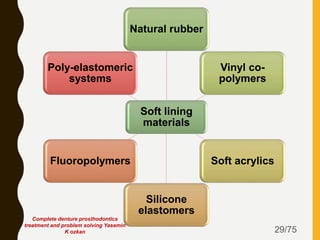
of alteration in the contour of soft tissues and resorption of
underlying bone.
• Resorption occurs most rapidly in first 6 months
following extraction of teeth and levels at about 12
months, and increases again as the patient reaches age of
about 65. 3/75Essentials of complete denture
prosthodontics Sheldon Winkler 2nd ed
INTRODUCTION
• Every edentulous patient among with other things should
be examined on an annual basis to determine the rate of
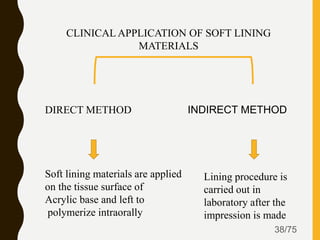
resorption of the residual ridges.
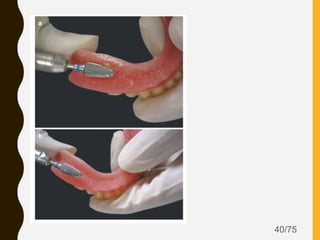
• More rapidly in females than in males.
• More rapidly in Caucasians than in Negroes.
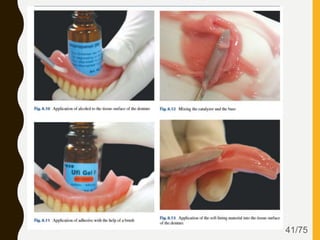
4/75Essentials of complete denture
prosthodontics Sheldon Winkler 2nd ed
• In such a case a replacement of the denture can be done, or
we can reline or rebase the denture
• Further the Denture soreness, pain, presence of abused,
hypertrophic, irritated, hyperaemic and displaced oral
mucosa, once very difficult to treat can now with the
advent of soft liners can be conditioned to a healthy state
5/75
Essentials of complete denture
prosthodontics Sheldon Winkler 2nd ed
DEFINITIONS
• RELINE
The procedure used to resurface the intaglio of a removable
dental prosthesis with new base material thus producing an
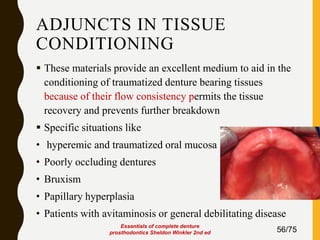
accurate adaptation to the denture foundation
GPT 9
The process of replacing the tissue contacting surface of an
existing denture
PHILIPS
6/75
7
• REBASE
The laboratory process of replacing the entire denture base
material on an existing prosthesis
GPT 9
The process of replacing the entire denture base of an
existing complete or partial denture
PHILIPS
• TISSUE CONDITIONER:
A resilient denture liner resin placed into a removable
prosthesis for a short duration to allow time for tissue healing
-GPT 9
A soft liner used to treat traumatized mucosa
-0’BRIEN
INDICATION FOR RELINING
OR REBASING
1. Immediate dentures at 3 to 6 months after their original
construction
2. When the residual alveolar ridge have resorbed and the
adaption of the denture base to the ridge is poor
3. When the patient cannot afford the cost of having new
dentures constructed
4. When the construction of new dentures with the
accompanying series of appointments can cause physical
or mental stress such as for chronically ill patients
8/75
Essentials of complete denture
prosthodontics Sheldon Winkler 2nd ed
CONTRAINDICATIONS
1. Excessive amount of resorption
2. Presence of abused soft tissues
3. When patients complain about TMJ problems
4. If the denture have poor esthetics
5. If the denture create major speech problem
6. When severe osseous undercuts exist
9/75
Essentials of complete denture
prosthodontics Sheldon Winkler 2nd ed
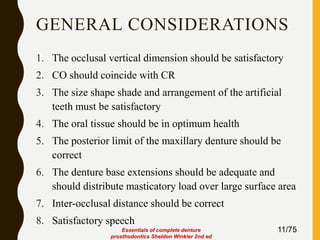
RELINING OR REBASING
10/75
Boucher's prosthodontic treatment for
edentulous patients 131h ed
GENERAL CONSIDERATIONS
1. The occlusal vertical dimension should be satisfactory
2. CO should coincide with CR
3. The size shape shade and arrangement of the artificial
teeth must be satisfactory
4. The oral tissue should be in optimum health
5. The posterior limit of the maxillary denture should be
correct
6. The denture base extensions should be adequate and
should distribute masticatory load over large surface area
7. Inter-occlusal distance should be correct
8. Satisfactory speech
11/75Essentials of complete denture
prosthodontics Sheldon Winkler 2nd ed
RELINING
TISSUE
PREPARATION
• Excessive hypertrophic
tissue should be surgically
removed.
• The oral mucosa should be
free of areas of irritation.
• Dentures should not be
worn at least 2-3 days
before the final
impression.
• Daily message is helpful
to stimulate their blood
supply.
DENTURE
PREPARATION
• Pressure areas on the tissue
surface of the dentures
should be removed.
• Minor occlusal
disharmony is corrected by
selective grinding.
• Small border inadequacies
are corrected.
• A correct posterior palatal
seal area should be
established.
12/75
Essentials of complete denture
prosthodontics Sheldon Winkler 2nd ed
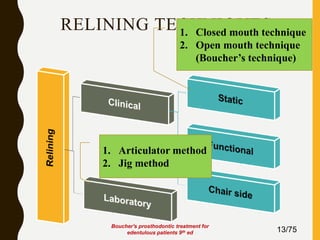
RELINING TECHNIQUES
13/75
1. Closed mouth technique
2. Open mouth technique
(Boucher’s technique)
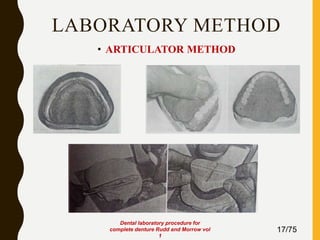
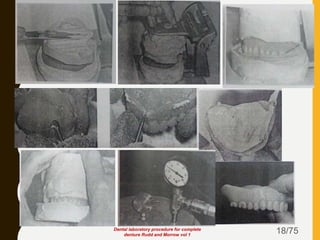
1. Articulator method
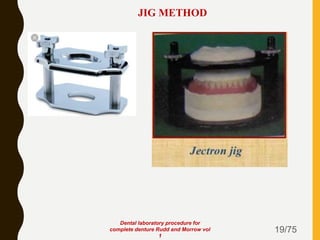
2. Jig method
Boucher's prosthodontic treatment for
edentulous patients 9th ed
14/75
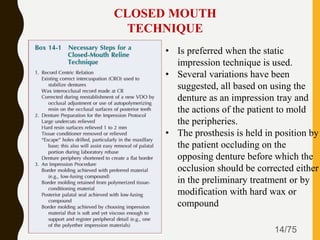
CLOSED MOUTH
TECHNIQUE
• Is preferred when the static
impression technique is used.
• Several variations have been
suggested, all based on using the
denture as an impression tray and
the actions of the patient to mold
the peripheries.
• The prosthesis is held in position by
the patient occluding on the
opposing denture before which the
occlusion should be corrected either
in the preliminary treatment or by
modification with hard wax or
compound
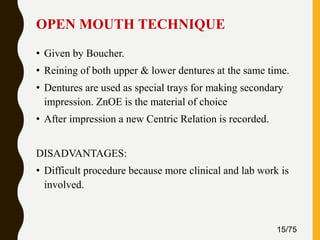
OPEN MOUTH TECHNIQUE
• Given by Boucher.
• Reining of both upper & lower dentures at the same time.
• Dentures are used as special trays for making secondary
impression. ZnOE is the material of choice
• After impression a new Centric Relation is recorded.
DISADVANTAGES:
• Difficult procedure because more clinical and lab work is
involved.
15/75
CHAIR SIDE RELINE
TECHNIQUE
Several attempts had been made to produce an acrylic or
other plastic material that could be added to the denture and
allowed to set in the mouth to produce an instant chairside
reline/rebase.
These are not recommended because of following
drawbacks:
• Chemical burns (from the monomer)
• Porosity and poor odor
• Poor color stability
• Material cannot be removed easily if there is any mistake
16/75
Recent introduction of VLC resin systems
These materials can be partly polymerized at the chairside
using handheld curing lights, but require a more powerful
light chamber device for complete curing.
USE
• temporary modification of dentures
• corrections to the posterior border seal on the upper
denture & the extension of flanges, and
• may be employed for relining dentures.
The technique is not, however, suited to situations where
there are undercut areas
REASON: can be distorted during removal and becomes
rigid once cured
LABORATORY METHOD
• ARTICULATOR METHOD
17/75
Dental laboratory procedure for
complete denture Rudd and Morrow vol
1
18/75Dental laboratory procedure for complete
denture Rudd and Morrow vol 1
19/75
JIG METHOD
Dental laboratory procedure for
complete denture Rudd and Morrow vol
1
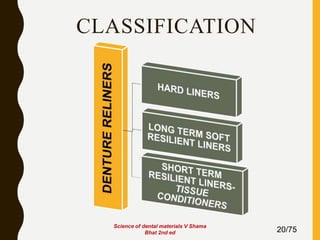
CLASSIFICATION
20/75
Science of dental materials V Shama
Bhat 2nd ed
CLASSIFICATION
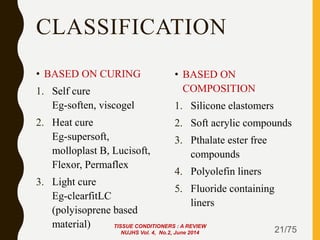
• BASED ON CURING
1. Self cure
Eg-soften, viscogel
2. Heat cure
Eg-supersoft,
molloplast B, Lucisoft,
Flexor, Permaflex
3. Light cure
Eg-clearfitLC
(polyisoprene based
material)
• BASED ON
COMPOSITION
1. Silicone elastomers
2. Soft acrylic compounds
3. Pthalate ester free
compounds
4. Polyolefin liners
5. Fluoride containing
liners
21/75
TISSUE CONDITIONERS : A REVIEW
NUJHS Vol. 4, No.2, June 2014
CLASSIFICATION Cntd
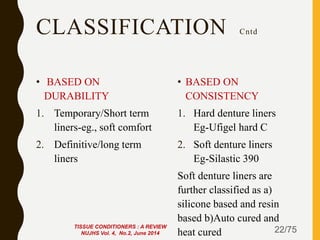
• BASED ON
DURABILITY
1. Temporary/Short term
liners-eg., soft comfort
2. Definitive/long term
liners
• BASED ON
CONSISTENCY
1. Hard denture liners
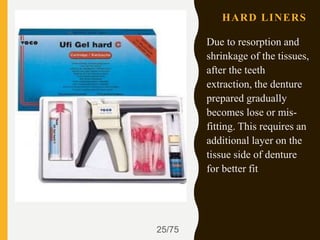
Eg-Ufigel hard C
2. Soft denture liners
Eg-Silastic 390
Soft denture liners are
further classified as a)
silicone based and resin
based b)Auto cured and
heat cured 22/75TISSUE CONDITIONERS : A REVIEW
NUJHS Vol. 4, No.2, June 2014
CLASSIFICATION cntd
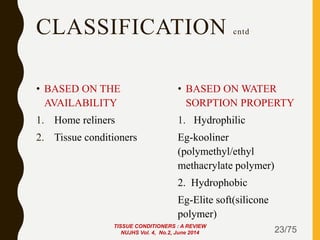
• BASED ON THE
AVAILABILITY
1. Home reliners
2. Tissue conditioners
• BASED ON WATER
SORPTION PROPERTY
1. Hydrophilic
Eg-kooliner
(polymethyl/ethyl
methacrylate polymer)
2. Hydrophobic
Eg-Elite soft(silicone
polymer)
23/75
TISSUE CONDITIONERS : A REVIEW
NUJHS Vol. 4, No.2, June 2014
REQUIREMENTS OF RESILIENT
DENTURE BASE LINERS
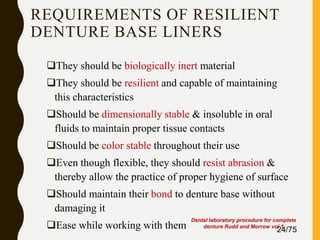
They should be biologically inert material
They should be resilient and capable of maintaining
this characteristics
Should be dimensionally stable & insoluble in oral
fluids to maintain proper tissue contacts
Should be color stable throughout their use
Even though flexible, they should resist abrasion &
thereby allow the practice of proper hygiene of surface
Should maintain their bond to denture base without
damaging it
Ease while working with them 24/75
Dental laboratory procedure for complete
denture Rudd and Morrow vol 1
HARD LINERS
Due to resorption and
shrinkage of the tissues,
after the teeth
extraction, the denture
prepared gradually
becomes lose or mis-
fitting. This requires an
additional layer on the
tissue side of denture
for better fit
25/75
HARD LINERS
TYPE 1
• Powder
PMMA----Polymer beads
Benzoyl
Peroxide-----initiator
• Liquid
MMA-------monomer
Di-n-butyl
phthalate-----plasticizer
Tertiary amine----Chemical
activator
TYPE 2
• Powder
PMMA----Polymer beads
Benzoyl
Peroxide-----initiator
• Liquid
Butyl/ iso-butyl/ higher
methacrylates-----monomer
Di-methacrylate ----CLA
Tertiary amine----Chemical
activator
26
Applied Dental Materials John F.
McCabe 9th ed
 Disadvantage is
that it is irritant to
the soft tissues
 May cause allergic
reaction
Less irritant
comparitively
COLD CURE IS
PREFERRED
Simpler curing procedure
Less distortion or warpage of denture
Strength of cold cure is adequate for liner
27/75
Science of dental materials V Shama
Bhat 2nd ed
SOFT LINING
MATERIALS
• Permanent soft lining materials are most commonly used
for patients who cannot tolerate a hard base.
• This problem generally arises if the patient has an irregular
mandibular alveolar ridge covered by a thin and relatively
non-resilient mucosa.
• It may be very painful when a masticatory load is applied
through a hard base on to this type of supporting tissue.
• In such cases, a soft lining on the denture will help to
relieve the pain and increase patient acceptance of the
denture. 28/75
Applied Dental Materials John F.
McCabe 9th ed
29/75
Soft lining
materials
Natural rubber
Vinyl co-
polymers
Soft acrylics
Silicone
elastomers
Fluoropolymers
Poly-elastomeric
systems
Complete denture prosthodontics
treatment and problem solving Yasemin
K ozkan
NATURAL RUBBERS
• Have been used as soft lining materials since 1860s
• Not a material of choice because of
 Quick absorbance of intraoral liquids
 Difficulty in preparation
 Low quality of connection to base materials
30/75
Complete denture prosthodontics
treatment and problem solving Yasemin
K ozkan
SOFT ACRYLICS
Plasticized acrylic resins
chemically cured heat cured
• Available in powder and liquid forms
• Polymer is either methyl or ethyl-methacrylate
• Primary difference between conventional PMMA and
these is that liquid contains large amount of plasticizers
• Plasticizers limits the tangling of the polymer chains
31/75
SILICONES
• One of the more successful soft lining materials
• There is no need for addition of plasticizing agents
• The material retains its rubbery consistency for long period
of time
• Available as
Chemical cure
Supplied as two components
Setting is by condensation reaction
Heat cure
Supplied as one-component pastes
Applied using compression moulding technique
32/75
Complete denture prosthodontics
treatment and problem solving Yasemin
K ozkan
DISADVANTAGES
1. They generally do not bond to the denture base and
require some form of adhesive
2. The material is also unsuitable for polishing and has to
be left in the finished state. Thus they are prone to
bacterial contamination and growth of C. albicans ( GC
reline modifier which removes surface roughness and
manufacturing defects when added )
3. They occupy space and as their thickness increases, the
thickness of the denture itself is reduced. Affects the
strength of denture base
33/75
A Clinical guide to applied dental
materials Stephen J Bonsor
FLUORINATED SOFT LINING
MATERIALS
• Polyphosphazene is a fluorinated nitrogen- phosphate
elastomers distinctly different from plastiols and silicones
• It quickly deforms under load converting the deformation
energy into a small amount of heat before returning to its
original shape
34/75
Complete denture prosthodontics
treatment and problem solving Yasemin
K ozkan
OLEFINIC SOFT
LINING MATERIAL
• Have good elastic properties
• But these require a special apparatus for lining and the
lining procedures are complicated
• Eg MOLTENO
35/75
Complete denture prosthodontics
treatment and problem solving Yasemin
K ozkan
36/75
•INDICATIONS OF SOFT LINING
•Aging & pathological changes
•Atropy and resorption
•Decreasing the pressure locally
•Reducing the pressure locally
•Reducing occlusal irritation
•Providing retention in presence of undercuts
•Rehabilitation of congenital/acquired defects
•Following radiation therapy
•Some systemic disease or excessive usage of alcohol or
cigarate
Complete denture prosthodontics
treatment and problem solving Yasemin
K ozkan
DISADVANTAGES
1. Hardening of materials by loosing its softness
2. Bonding problems to the denture base
3. Fracture of denture base
4. Cost application problems
5. Color stability
6. Candidal growth
37/75
Complete denture prosthodontics
treatment and problem solving Yasemin
K ozkan
38/75
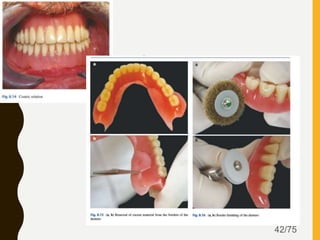
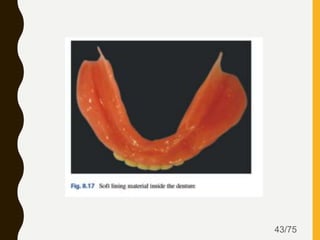
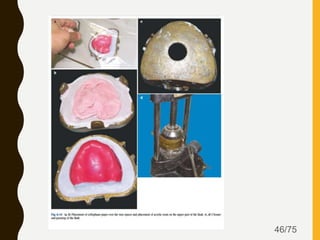
CLINICAL APPLICATION OF SOFT LINING
MATERIALS
DIRECT METHOD INDIRECT METHOD
Soft lining materials are applied
on the tissue surface of
Acrylic base and left to
polymerize intraorally
Lining procedure is
carried out in
laboratory after the
impression is made
APPLICATION
OF
SOFT LINING
MATERIAL BY
DIRECT
METHOD
39/75
40/75
41/75
42/75
43/75
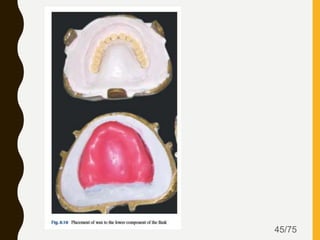
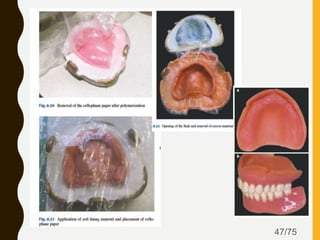
APPLICATION
OF
SOFT LINING
MATERIAL
BY INDIRECT
METHOD
44/75
45/75
46/75
47/75
48/75
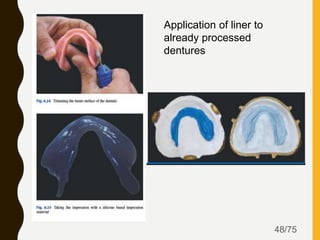
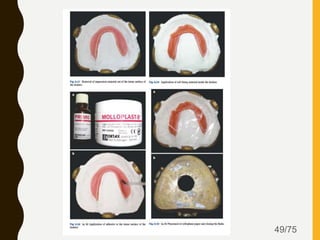
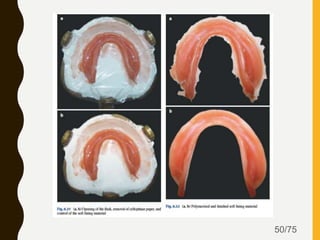
Application of liner to
already processed
dentures
49/75
50/75
51/75
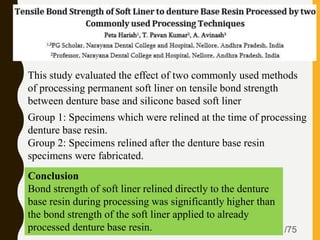
This study evaluated the effect of two commonly used methods
of processing permanent soft liner on tensile bond strength
between denture base and silicone based soft liner
Group 1: Specimens which were relined at the time of processing
denture base resin.
Group 2: Specimens relined after the denture base resin
specimens were fabricated.
Conclusion
Bond strength of soft liner relined directly to the denture
base resin during processing was significantly higher than
the bond strength of the soft liner applied to already
processed denture base resin.
TISSUE
CONDITIONERS
• Tissue conditioners are also known as temporary soft
lining materials
• Intraorally these materials can be used 1 week to 10 days
at most
52/75
Complete denture prosthodontics
treatment and problem solving Yasemin
K ozkan
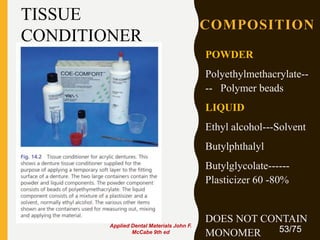
COMPOSITION
POWDER
Polyethylmethacrylate--
-- Polymer beads
LIQUID
Ethyl alcohol---Solvent
Butylphthalyl
Butylglycolate------
Plasticizer 60 -80%
DOES NOT CONTAIN
MONOMER 53/75
TISSUE
CONDITIONER
Applied Dental Materials John F.
McCabe 9th ed
• Setting reaction is by gelation ----------15-20 min
• In tissue conditioners, polymerization starts with mixing
the powder with plasticizer and penetrant involving liquid
mixture and letting the liquid penetrating into powder
monomers. This procedure is accelerated by the presence
of ethyl alcohol.
54/75
Complete denture prosthodontics
treatment and problem solving Yasemin
K ozkan
USE OF TISSUE
CONDITIONERS
Adjuncts in tissue conditioning
Temporary obturators
Stabilizers of baseplates and surgical splints or
stents
Adjunct in the impression making procedure or as a
final impression material
55/75
Essentials of complete denture
prosthodontics Sheldon Winkler 2nd ed
ADJUNCTS IN TISSUE
CONDITIONING
 These materials provide an excellent medium to aid in the
conditioning of traumatized denture bearing tissues
because of their flow consistency permits the tissue
recovery and prevents further breakdown
 Specific situations like
• hyperemic and traumatized oral mucosa
• Poorly occluding dentures
• Bruxism
• Papillary hyperplasia
• Patients with avitaminosis or general debilitating disease
56/75
Essentials of complete denture
prosthodontics Sheldon Winkler 2nd ed
ADJUNCT IN TEMPORARY
OBTURATORS
• Temporary obturation is usually accomplished 7 to 10 days
after surgery, and so it is important that minimal pressure
and no irritation be produced by obturators
• The use of these materials protects the tissue and thereby
enhances the healing process
57/75
Essentials of complete denture
prosthodontics Sheldon Winkler 2nd ed
STABILIZERS OF
BASEPLATES AND SURGICAL
SPLINTS
• When undercuts are present on an edentulous cast,
tissue conditioners of a stiffer consistency may be
used to stabilize recording base and prevent
breakage of the cast
enhances the stability, retention and comfort of the
recording base
58/75
Essentials of complete denture
prosthodontics Sheldon Winkler 2nd ed
• They are used to line surgical stents or splints when
performing maxillary or mandibular vestibuloplasties
• Their use provide closer adaption to the healing tissues and
so protects them from trauma
59/75
Essentials of complete denture
prosthodontics Sheldon Winkler 2nd ed
IN IMPRESSION MAKING
PROCEDURE
• Can be used when it is difficult to determine the extent of
the denture base by means of the movable oral structures.
• The materials will record the extension in a dynamic form
that will later help in preparing an impression tray for the
final impression.
60/75
Essentials of complete denture
prosthodontics Sheldon Winkler 2nd ed
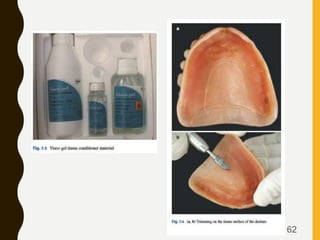
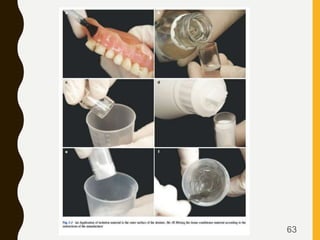
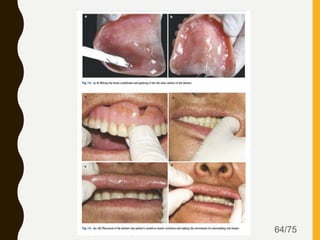
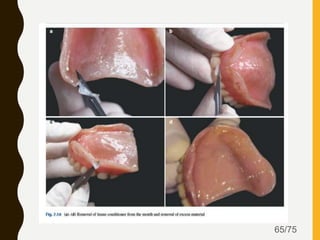
PROCEDURE
FOR APPLICATION
OF TISSUE
CONDITIONER
61
62
63
64/75
65/75
66/75
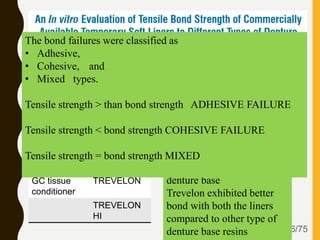
This in vitro study evaluated and compared the tensile bond
strength of two commercial brands of temporary soft liners to
different types of denture base resins.
Soft liners Denture
resin base
Viscogel DPI
GC tissue
conditioner
TREVELON
TREVELON
HI
Conclusion
Viscogel showed better
bond compared to GC tissue
conditioner with all type of
denture base
Trevelon exhibited better
bond with both the liners
compared to other type of
denture base resins
The bond failures were classified as
• Adhesive,
• Cohesive, and
• Mixed types.
Tensile strength > than bond strength ADHESIVE FAILURE
Tensile strength < bond strength COHESIVE FAILURE
Tensile strength = bond strength MIXED
67/75
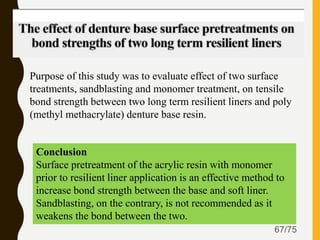
Purpose of this study was to evaluate effect of two surface
treatments, sandblasting and monomer treatment, on tensile
bond strength between two long term resilient liners and poly
(methyl methacrylate) denture base resin.
Conclusion
Surface pretreatment of the acrylic resin with monomer
prior to resilient liner application is an effective method to
increase bond strength between the base and soft liner.
Sandblasting, on the contrary, is not recommended as it
weakens the bond between the two.
CARE & MAINTENANCE
• Soft brush is recommended to clean the material
under cold running water.
• Soaking in denture cleansers - not recommended –
adversely affects physical properties & causes
premature deterioration.
68/75
Essentials of complete denture
prosthodontics Sheldon Winkler 2nd ed
69/75
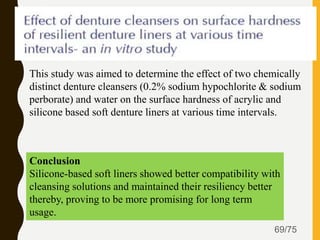
Conclusion
Silicone-based soft liners showed better compatibility with
cleansing solutions and maintained their resiliency better
thereby, proving to be more promising for long term
usage.
This study was aimed to determine the effect of two chemically
distinct denture cleansers (0.2% sodium hypochlorite & sodium
perborate) and water on the surface hardness of acrylic and
silicone based soft denture liners at various time intervals.
70/75
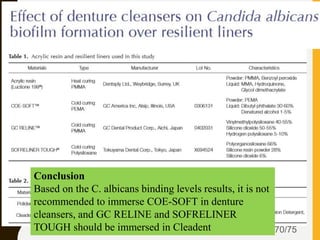
This study evaluated the effect of denture cleansers on C.
albicans biofilm formation over resilient liners and to evaluate
compatibility between resilient liners and denture cleansers.
Conclusion
Based on the C. albicans binding levels results, it is not
recommended to immerse COE-SOFT in denture
cleansers, and GC RELINE and SOFRELINER
TOUGH should be immersed in Cleadent
71/75
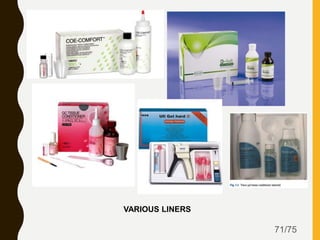
VARIOUS LINERS
CONCLUSION
• Soft liners have an important place in denture prosthetics
but require improved strength, improved adhesion to the
denture base and the ability to inhibit the growth of
microorganisms.
• The greatest virtue of tissue conditioners is their
versatility and ease of use.
• However they’re temporary materials and are not
adequate substitute for new dentures.
72/75
REFERENCES
1. Science of dental materials V Shama Bhat 2nd ed
2. Phillips science of dental materials 12th ed
3. Applied dental materials John f McCabe 9th ed
4. Dental materials and their selection William O’brien
3rd ed
5. Clinical guide to applied dental materials Stephen J
Bonsor
6. Essentials of complete denture prosthodontics
Sheldon Winkler 2nd ed
7. Complete denture prosthodontics treatment and
problem solving Yasemin k Ozkan
73/75
CROSS REFERENCES
• An In vitro Evaluation of Tensile Bond Strength of Commercially
Available Temporary Soft Liners to Different Types of Denture Base
Resins 2018 Journal of Natural Science, Biology and Medicine
• Tensile Bond Strength of Soft Liner to denture Base Resin Processed
by two Commonly used Processing Techniques Int J Sci Res Sci
Technol . March-April-2019
• Effect of denture cleansers on surface hardness of resilient denture
liners at various time intervals- an in vitro study J Adv Prosthodont
2013
• Effect of denture cleansers on Candida albicans biofilm formation
over resilient liners J Adv Prosthodont 2014
• The effect of denture base surface pretreatments on bond strengths of
two long term resilient liners J Adv Prosthodont 2011
74/75
Thank You!
75

Tissue conditioners

  • 1.
    TISSUE CONDITIONERS AND LINERS Presentedby, Dr. Chaithra Prabhu B 1st year post graduate Department of Prosthodontics 175
  • 2.
    2 CONTENTS • Introduction • Definitions •Reliningandrebasing • Classifications • Requirementsof dentureliners • Hardliners • Softliners types,indications,procedurefor applicationofsoftliners • Tissueconditioners composition, uses,procedure forapplicationoftissue conditioners&careandmaintenance • Conclusion • Reference 75
  • 3.
    INTRODUCTION • Maintenance ofthe adaptation of denture bases to the mucosa that covers the ridges is a critical part of complete denture service. • Residual ridges have been described as plastic in nature, always changing in topography and morphology because of alteration in the contour of soft tissues and resorption of underlying bone. • Resorption occurs most rapidly in first 6 months following extraction of teeth and levels at about 12 months, and increases again as the patient reaches age of about 65. 3/75Essentials of complete denture prosthodontics Sheldon Winkler 2nd ed
  • 4.
    INTRODUCTION • Every edentulouspatient among with other things should be examined on an annual basis to determine the rate of resorption of the residual ridges. • More rapidly in females than in males. • More rapidly in Caucasians than in Negroes. 4/75Essentials of complete denture prosthodontics Sheldon Winkler 2nd ed
  • 5.
    • In sucha case a replacement of the denture can be done, or we can reline or rebase the denture • Further the Denture soreness, pain, presence of abused, hypertrophic, irritated, hyperaemic and displaced oral mucosa, once very difficult to treat can now with the advent of soft liners can be conditioned to a healthy state 5/75 Essentials of complete denture prosthodontics Sheldon Winkler 2nd ed
  • 6.
    DEFINITIONS • RELINE The procedureused to resurface the intaglio of a removable dental prosthesis with new base material thus producing an accurate adaptation to the denture foundation GPT 9 The process of replacing the tissue contacting surface of an existing denture PHILIPS 6/75
  • 7.
    7 • REBASE The laboratoryprocess of replacing the entire denture base material on an existing prosthesis GPT 9 The process of replacing the entire denture base of an existing complete or partial denture PHILIPS • TISSUE CONDITIONER: A resilient denture liner resin placed into a removable prosthesis for a short duration to allow time for tissue healing -GPT 9 A soft liner used to treat traumatized mucosa -0’BRIEN
  • 8.
    INDICATION FOR RELINING ORREBASING 1. Immediate dentures at 3 to 6 months after their original construction 2. When the residual alveolar ridge have resorbed and the adaption of the denture base to the ridge is poor 3. When the patient cannot afford the cost of having new dentures constructed 4. When the construction of new dentures with the accompanying series of appointments can cause physical or mental stress such as for chronically ill patients 8/75 Essentials of complete denture prosthodontics Sheldon Winkler 2nd ed
  • 9.
    CONTRAINDICATIONS 1. Excessive amountof resorption 2. Presence of abused soft tissues 3. When patients complain about TMJ problems 4. If the denture have poor esthetics 5. If the denture create major speech problem 6. When severe osseous undercuts exist 9/75 Essentials of complete denture prosthodontics Sheldon Winkler 2nd ed
  • 10.
    RELINING OR REBASING 10/75 Boucher'sprosthodontic treatment for edentulous patients 131h ed
  • 11.
    GENERAL CONSIDERATIONS 1. Theocclusal vertical dimension should be satisfactory 2. CO should coincide with CR 3. The size shape shade and arrangement of the artificial teeth must be satisfactory 4. The oral tissue should be in optimum health 5. The posterior limit of the maxillary denture should be correct 6. The denture base extensions should be adequate and should distribute masticatory load over large surface area 7. Inter-occlusal distance should be correct 8. Satisfactory speech 11/75Essentials of complete denture prosthodontics Sheldon Winkler 2nd ed
  • 12.
    RELINING TISSUE PREPARATION • Excessive hypertrophic tissueshould be surgically removed. • The oral mucosa should be free of areas of irritation. • Dentures should not be worn at least 2-3 days before the final impression. • Daily message is helpful to stimulate their blood supply. DENTURE PREPARATION • Pressure areas on the tissue surface of the dentures should be removed. • Minor occlusal disharmony is corrected by selective grinding. • Small border inadequacies are corrected. • A correct posterior palatal seal area should be established. 12/75 Essentials of complete denture prosthodontics Sheldon Winkler 2nd ed
  • 13.
    RELINING TECHNIQUES 13/75 1. Closedmouth technique 2. Open mouth technique (Boucher’s technique) 1. Articulator method 2. Jig method Boucher's prosthodontic treatment for edentulous patients 9th ed
  • 14.
    14/75 CLOSED MOUTH TECHNIQUE • Ispreferred when the static impression technique is used. • Several variations have been suggested, all based on using the denture as an impression tray and the actions of the patient to mold the peripheries. • The prosthesis is held in position by the patient occluding on the opposing denture before which the occlusion should be corrected either in the preliminary treatment or by modification with hard wax or compound
  • 15.
    OPEN MOUTH TECHNIQUE •Given by Boucher. • Reining of both upper & lower dentures at the same time. • Dentures are used as special trays for making secondary impression. ZnOE is the material of choice • After impression a new Centric Relation is recorded. DISADVANTAGES: • Difficult procedure because more clinical and lab work is involved. 15/75
  • 16.
    CHAIR SIDE RELINE TECHNIQUE Severalattempts had been made to produce an acrylic or other plastic material that could be added to the denture and allowed to set in the mouth to produce an instant chairside reline/rebase. These are not recommended because of following drawbacks: • Chemical burns (from the monomer) • Porosity and poor odor • Poor color stability • Material cannot be removed easily if there is any mistake 16/75 Recent introduction of VLC resin systems These materials can be partly polymerized at the chairside using handheld curing lights, but require a more powerful light chamber device for complete curing. USE • temporary modification of dentures • corrections to the posterior border seal on the upper denture & the extension of flanges, and • may be employed for relining dentures. The technique is not, however, suited to situations where there are undercut areas REASON: can be distorted during removal and becomes rigid once cured
  • 17.
    LABORATORY METHOD • ARTICULATORMETHOD 17/75 Dental laboratory procedure for complete denture Rudd and Morrow vol 1
  • 18.
    18/75Dental laboratory procedurefor complete denture Rudd and Morrow vol 1
  • 19.
    19/75 JIG METHOD Dental laboratoryprocedure for complete denture Rudd and Morrow vol 1
  • 20.
    CLASSIFICATION 20/75 Science of dentalmaterials V Shama Bhat 2nd ed
  • 21.
    CLASSIFICATION • BASED ONCURING 1. Self cure Eg-soften, viscogel 2. Heat cure Eg-supersoft, molloplast B, Lucisoft, Flexor, Permaflex 3. Light cure Eg-clearfitLC (polyisoprene based material) • BASED ON COMPOSITION 1. Silicone elastomers 2. Soft acrylic compounds 3. Pthalate ester free compounds 4. Polyolefin liners 5. Fluoride containing liners 21/75 TISSUE CONDITIONERS : A REVIEW NUJHS Vol. 4, No.2, June 2014
  • 22.
    CLASSIFICATION Cntd • BASEDON DURABILITY 1. Temporary/Short term liners-eg., soft comfort 2. Definitive/long term liners • BASED ON CONSISTENCY 1. Hard denture liners Eg-Ufigel hard C 2. Soft denture liners Eg-Silastic 390 Soft denture liners are further classified as a) silicone based and resin based b)Auto cured and heat cured 22/75TISSUE CONDITIONERS : A REVIEW NUJHS Vol. 4, No.2, June 2014
  • 23.
    CLASSIFICATION cntd • BASEDON THE AVAILABILITY 1. Home reliners 2. Tissue conditioners • BASED ON WATER SORPTION PROPERTY 1. Hydrophilic Eg-kooliner (polymethyl/ethyl methacrylate polymer) 2. Hydrophobic Eg-Elite soft(silicone polymer) 23/75 TISSUE CONDITIONERS : A REVIEW NUJHS Vol. 4, No.2, June 2014
  • 24.
    REQUIREMENTS OF RESILIENT DENTUREBASE LINERS They should be biologically inert material They should be resilient and capable of maintaining this characteristics Should be dimensionally stable & insoluble in oral fluids to maintain proper tissue contacts Should be color stable throughout their use Even though flexible, they should resist abrasion & thereby allow the practice of proper hygiene of surface Should maintain their bond to denture base without damaging it Ease while working with them 24/75 Dental laboratory procedure for complete denture Rudd and Morrow vol 1
  • 25.
    HARD LINERS Due toresorption and shrinkage of the tissues, after the teeth extraction, the denture prepared gradually becomes lose or mis- fitting. This requires an additional layer on the tissue side of denture for better fit 25/75
  • 26.
    HARD LINERS TYPE 1 •Powder PMMA----Polymer beads Benzoyl Peroxide-----initiator • Liquid MMA-------monomer Di-n-butyl phthalate-----plasticizer Tertiary amine----Chemical activator TYPE 2 • Powder PMMA----Polymer beads Benzoyl Peroxide-----initiator • Liquid Butyl/ iso-butyl/ higher methacrylates-----monomer Di-methacrylate ----CLA Tertiary amine----Chemical activator 26 Applied Dental Materials John F. McCabe 9th ed  Disadvantage is that it is irritant to the soft tissues  May cause allergic reaction Less irritant comparitively
  • 27.
    COLD CURE IS PREFERRED Simplercuring procedure Less distortion or warpage of denture Strength of cold cure is adequate for liner 27/75 Science of dental materials V Shama Bhat 2nd ed
  • 28.
    SOFT LINING MATERIALS • Permanentsoft lining materials are most commonly used for patients who cannot tolerate a hard base. • This problem generally arises if the patient has an irregular mandibular alveolar ridge covered by a thin and relatively non-resilient mucosa. • It may be very painful when a masticatory load is applied through a hard base on to this type of supporting tissue. • In such cases, a soft lining on the denture will help to relieve the pain and increase patient acceptance of the denture. 28/75 Applied Dental Materials John F. McCabe 9th ed
  • 29.
    29/75 Soft lining materials Natural rubber Vinylco- polymers Soft acrylics Silicone elastomers Fluoropolymers Poly-elastomeric systems Complete denture prosthodontics treatment and problem solving Yasemin K ozkan
  • 30.
    NATURAL RUBBERS • Havebeen used as soft lining materials since 1860s • Not a material of choice because of  Quick absorbance of intraoral liquids  Difficulty in preparation  Low quality of connection to base materials 30/75 Complete denture prosthodontics treatment and problem solving Yasemin K ozkan
  • 31.
    SOFT ACRYLICS Plasticized acrylicresins chemically cured heat cured • Available in powder and liquid forms • Polymer is either methyl or ethyl-methacrylate • Primary difference between conventional PMMA and these is that liquid contains large amount of plasticizers • Plasticizers limits the tangling of the polymer chains 31/75
  • 32.
    SILICONES • One ofthe more successful soft lining materials • There is no need for addition of plasticizing agents • The material retains its rubbery consistency for long period of time • Available as Chemical cure Supplied as two components Setting is by condensation reaction Heat cure Supplied as one-component pastes Applied using compression moulding technique 32/75 Complete denture prosthodontics treatment and problem solving Yasemin K ozkan
  • 33.
    DISADVANTAGES 1. They generallydo not bond to the denture base and require some form of adhesive 2. The material is also unsuitable for polishing and has to be left in the finished state. Thus they are prone to bacterial contamination and growth of C. albicans ( GC reline modifier which removes surface roughness and manufacturing defects when added ) 3. They occupy space and as their thickness increases, the thickness of the denture itself is reduced. Affects the strength of denture base 33/75 A Clinical guide to applied dental materials Stephen J Bonsor
  • 34.
    FLUORINATED SOFT LINING MATERIALS •Polyphosphazene is a fluorinated nitrogen- phosphate elastomers distinctly different from plastiols and silicones • It quickly deforms under load converting the deformation energy into a small amount of heat before returning to its original shape 34/75 Complete denture prosthodontics treatment and problem solving Yasemin K ozkan
  • 35.
    OLEFINIC SOFT LINING MATERIAL •Have good elastic properties • But these require a special apparatus for lining and the lining procedures are complicated • Eg MOLTENO 35/75 Complete denture prosthodontics treatment and problem solving Yasemin K ozkan
  • 36.
    36/75 •INDICATIONS OF SOFTLINING •Aging & pathological changes •Atropy and resorption •Decreasing the pressure locally •Reducing the pressure locally •Reducing occlusal irritation •Providing retention in presence of undercuts •Rehabilitation of congenital/acquired defects •Following radiation therapy •Some systemic disease or excessive usage of alcohol or cigarate Complete denture prosthodontics treatment and problem solving Yasemin K ozkan
  • 37.
    DISADVANTAGES 1. Hardening ofmaterials by loosing its softness 2. Bonding problems to the denture base 3. Fracture of denture base 4. Cost application problems 5. Color stability 6. Candidal growth 37/75 Complete denture prosthodontics treatment and problem solving Yasemin K ozkan
  • 38.
    38/75 CLINICAL APPLICATION OFSOFT LINING MATERIALS DIRECT METHOD INDIRECT METHOD Soft lining materials are applied on the tissue surface of Acrylic base and left to polymerize intraorally Lining procedure is carried out in laboratory after the impression is made
  • 39.
  • 40.
  • 41.
  • 42.
  • 43.
  • 44.
  • 45.
  • 46.
  • 47.
  • 48.
    48/75 Application of linerto already processed dentures
  • 49.
  • 50.
  • 51.
    51/75 This study evaluatedthe effect of two commonly used methods of processing permanent soft liner on tensile bond strength between denture base and silicone based soft liner Group 1: Specimens which were relined at the time of processing denture base resin. Group 2: Specimens relined after the denture base resin specimens were fabricated. Conclusion Bond strength of soft liner relined directly to the denture base resin during processing was significantly higher than the bond strength of the soft liner applied to already processed denture base resin.
  • 52.
    TISSUE CONDITIONERS • Tissue conditionersare also known as temporary soft lining materials • Intraorally these materials can be used 1 week to 10 days at most 52/75 Complete denture prosthodontics treatment and problem solving Yasemin K ozkan
  • 53.
    COMPOSITION POWDER Polyethylmethacrylate-- -- Polymer beads LIQUID Ethylalcohol---Solvent Butylphthalyl Butylglycolate------ Plasticizer 60 -80% DOES NOT CONTAIN MONOMER 53/75 TISSUE CONDITIONER Applied Dental Materials John F. McCabe 9th ed
  • 54.
    • Setting reactionis by gelation ----------15-20 min • In tissue conditioners, polymerization starts with mixing the powder with plasticizer and penetrant involving liquid mixture and letting the liquid penetrating into powder monomers. This procedure is accelerated by the presence of ethyl alcohol. 54/75 Complete denture prosthodontics treatment and problem solving Yasemin K ozkan
  • 55.
    USE OF TISSUE CONDITIONERS Adjunctsin tissue conditioning Temporary obturators Stabilizers of baseplates and surgical splints or stents Adjunct in the impression making procedure or as a final impression material 55/75 Essentials of complete denture prosthodontics Sheldon Winkler 2nd ed
  • 56.
    ADJUNCTS IN TISSUE CONDITIONING These materials provide an excellent medium to aid in the conditioning of traumatized denture bearing tissues because of their flow consistency permits the tissue recovery and prevents further breakdown  Specific situations like • hyperemic and traumatized oral mucosa • Poorly occluding dentures • Bruxism • Papillary hyperplasia • Patients with avitaminosis or general debilitating disease 56/75 Essentials of complete denture prosthodontics Sheldon Winkler 2nd ed
  • 57.
    ADJUNCT IN TEMPORARY OBTURATORS •Temporary obturation is usually accomplished 7 to 10 days after surgery, and so it is important that minimal pressure and no irritation be produced by obturators • The use of these materials protects the tissue and thereby enhances the healing process 57/75 Essentials of complete denture prosthodontics Sheldon Winkler 2nd ed
  • 58.
    STABILIZERS OF BASEPLATES ANDSURGICAL SPLINTS • When undercuts are present on an edentulous cast, tissue conditioners of a stiffer consistency may be used to stabilize recording base and prevent breakage of the cast enhances the stability, retention and comfort of the recording base 58/75 Essentials of complete denture prosthodontics Sheldon Winkler 2nd ed
  • 59.
    • They areused to line surgical stents or splints when performing maxillary or mandibular vestibuloplasties • Their use provide closer adaption to the healing tissues and so protects them from trauma 59/75 Essentials of complete denture prosthodontics Sheldon Winkler 2nd ed
  • 60.
    IN IMPRESSION MAKING PROCEDURE •Can be used when it is difficult to determine the extent of the denture base by means of the movable oral structures. • The materials will record the extension in a dynamic form that will later help in preparing an impression tray for the final impression. 60/75 Essentials of complete denture prosthodontics Sheldon Winkler 2nd ed
  • 61.
  • 62.
  • 63.
  • 64.
  • 65.
  • 66.
    66/75 This in vitrostudy evaluated and compared the tensile bond strength of two commercial brands of temporary soft liners to different types of denture base resins. Soft liners Denture resin base Viscogel DPI GC tissue conditioner TREVELON TREVELON HI Conclusion Viscogel showed better bond compared to GC tissue conditioner with all type of denture base Trevelon exhibited better bond with both the liners compared to other type of denture base resins The bond failures were classified as • Adhesive, • Cohesive, and • Mixed types. Tensile strength > than bond strength ADHESIVE FAILURE Tensile strength < bond strength COHESIVE FAILURE Tensile strength = bond strength MIXED
  • 67.
    67/75 Purpose of thisstudy was to evaluate effect of two surface treatments, sandblasting and monomer treatment, on tensile bond strength between two long term resilient liners and poly (methyl methacrylate) denture base resin. Conclusion Surface pretreatment of the acrylic resin with monomer prior to resilient liner application is an effective method to increase bond strength between the base and soft liner. Sandblasting, on the contrary, is not recommended as it weakens the bond between the two.
  • 68.
    CARE & MAINTENANCE •Soft brush is recommended to clean the material under cold running water. • Soaking in denture cleansers - not recommended – adversely affects physical properties & causes premature deterioration. 68/75 Essentials of complete denture prosthodontics Sheldon Winkler 2nd ed
  • 69.
    69/75 Conclusion Silicone-based soft linersshowed better compatibility with cleansing solutions and maintained their resiliency better thereby, proving to be more promising for long term usage. This study was aimed to determine the effect of two chemically distinct denture cleansers (0.2% sodium hypochlorite & sodium perborate) and water on the surface hardness of acrylic and silicone based soft denture liners at various time intervals.
  • 70.
    70/75 This study evaluatedthe effect of denture cleansers on C. albicans biofilm formation over resilient liners and to evaluate compatibility between resilient liners and denture cleansers. Conclusion Based on the C. albicans binding levels results, it is not recommended to immerse COE-SOFT in denture cleansers, and GC RELINE and SOFRELINER TOUGH should be immersed in Cleadent
  • 71.
  • 72.
    CONCLUSION • Soft linershave an important place in denture prosthetics but require improved strength, improved adhesion to the denture base and the ability to inhibit the growth of microorganisms. • The greatest virtue of tissue conditioners is their versatility and ease of use. • However they’re temporary materials and are not adequate substitute for new dentures. 72/75
  • 73.
    REFERENCES 1. Science ofdental materials V Shama Bhat 2nd ed 2. Phillips science of dental materials 12th ed 3. Applied dental materials John f McCabe 9th ed 4. Dental materials and their selection William O’brien 3rd ed 5. Clinical guide to applied dental materials Stephen J Bonsor 6. Essentials of complete denture prosthodontics Sheldon Winkler 2nd ed 7. Complete denture prosthodontics treatment and problem solving Yasemin k Ozkan 73/75
  • 74.
    CROSS REFERENCES • AnIn vitro Evaluation of Tensile Bond Strength of Commercially Available Temporary Soft Liners to Different Types of Denture Base Resins 2018 Journal of Natural Science, Biology and Medicine • Tensile Bond Strength of Soft Liner to denture Base Resin Processed by two Commonly used Processing Techniques Int J Sci Res Sci Technol . March-April-2019 • Effect of denture cleansers on surface hardness of resilient denture liners at various time intervals- an in vitro study J Adv Prosthodont 2013 • Effect of denture cleansers on Candida albicans biofilm formation over resilient liners J Adv Prosthodont 2014 • The effect of denture base surface pretreatments on bond strengths of two long term resilient liners J Adv Prosthodont 2011 74/75
  • 75.